Greenhouse Lighting Calculator: 2026 DLI & Cost Guide
Use our Greenhouse Lighting Calculator (2026) to convert DLI to PPFD, fixtures, and cost. Get formulas, examples, and a planning checklist—try it now.
TLDR
A greenhouse lighting calculator estimates how much supplemental light a crop needs after sunlight and greenhouse transmission losses are accounted for. It converts the crop's DLI deficit into a target PPFD, fixture load, runtime, and operating cost using the formula DLI = PPFD × hours × 0.0036. The result is a planning estimate, not a final fixture layout. Commercial projects should follow calculator math with a professional PPFD design and electrical review.
Quick Answer: How Do You Calculate Greenhouse Lighting?
A greenhouse lighting calculator estimates supplemental lighting by comparing a crop's target DLI with the natural DLI that reaches the canopy. The basic calculation is:
Inside DLI = Outdoor DLI × Greenhouse Light Transmission
Supplemental DLI = Target DLI − Inside DLI
Required PPFD = Supplemental DLI ÷ (Lighting Hours × 0.0036)
You can then estimate electrical demand with:
Power Density (W/m²) = Design PPFD ÷ Fixture PPE
And operating cost with:
Daily Lighting Cost = Installed kW × Hours per Day × Electricity Rate
For example, if lettuce needs 14 mol/m²/day, the greenhouse receives 6 mol/m²/day of natural light, and supplemental LEDs operate for 16 hours, the 8 mol/m²/day deficit requires approximately 139 µmol/m²/s of supplemental PPFD. This calculation is a planning estimate; a commercial project should follow it with a professional PPFD layout, uniformity analysis, and electrical review.
What Is a Greenhouse Lighting Calculator?
A greenhouse lighting calculator is a tool or worksheet that estimates how much supplemental electric light a greenhouse crop needs. It starts with the crop's target daily light integral (DLI), subtracts the natural light that actually reaches the canopy inside the greenhouse, then converts the remaining deficit into a required PPFD, fixture quantity, lighting runtime, electrical load, and operating cost.
In practice, it answers four questions:
- How much light does the crop need each day?
- How much sunlight actually reaches the canopy after greenhouse losses?
- How much supplemental PPFD is required to close the gap?
- What will that supplemental light cost in fixtures, power, and electricity?
The term "calculator" is broad. It can refer to a simple DLI conversion formula on paper, a university spreadsheet, or a full online tool that factors in location, season, greenhouse cover type, fixture efficacy, and electricity rate. A Greenhouse Grower article on a university built calculator describes inputs that include zip code, electricity rate, greenhouse size, light transmission, target DLI, lighting efficacy, and lit area by month. These details go far beyond simple PPFD math.
A key framing point: a greenhouse lighting calculator is ultimately an economic tool. It estimates how many supplemental photons the crop needs, how much those photons cost to deliver, and whether the crop value justifies the energy and equipment. For a broader look at the strategy behind supplemental light, see this greenhouse supplemental lighting guide.
Schedule a free lighting consultation to discuss your greenhouse project with a lighting specialist.
Why Greenhouse Lighting Calculations Matter
Greenhouses are not indoor farms. They start with sunlight. Supplemental lighting covers the gap between what the sun delivers and what the crop needs, and that gap changes by month, location, weather, and greenhouse structure. Getting the calculation wrong in either direction costs real money.
Under lighting leaves yield and quality on the table. Over lighting wastes electricity and capital. According to the University of Georgia, electricity for supplemental greenhouse lighting can account for up to 30% of total production cost. A 2024 lettuce production study found that supplemental lighting typically represents 10 to 30% of operating expenses.
Those numbers explain why a greenhouse lighting calculation is not optional for commercial growers. Every watt installed without a clear DLI target is a watt that may or may not pay for itself.
As one practitioner noted on LinkedIn, winter canopy DLI can differ dramatically by location, so copying a PPFD target from a grower in another region can lead to a system that is oversized, undersized, or both at different times of year. A greenhouse lighting calculator forces location specific, season specific thinking.
The Calculation Sequence
A greenhouse lighting calculation is not a single formula. It is a sequence of steps, each building on the one before it. Think of it as a ladder:
- Choose the crop's target DLI.
- Estimate outdoor monthly DLI for your location.
- Multiply outdoor DLI by greenhouse transmission to get inside natural DLI.
- Subtract inside natural DLI from the crop target to find the DLI deficit.
- Convert the DLI deficit into a required average PPFD over your planned lighting hours.
- Calculate photoperiod hours based on crop needs and operational constraints.
- Determine total PPF required from the target PPFD and growing area.
- Estimate fixture count from total PPF, individual fixture PPF, and coefficient of utilization.
- Adjust PPFD for design and utilization losses.
- Estimate power density (W/m²) from adjusted PPFD and fixture efficacy.
- Calculate total installed kW from power density and growing area.
- Estimate daily, monthly, and annual energy cost.
- Compare cost per mole of supplemental light with added crop value.
Each step introduces assumptions. The more assumptions the calculator makes transparent, the more useful the output becomes.
Greenhouse Lighting Calculator Formulas
These formulas provide the basic calculations used to estimate supplemental greenhouse lighting requirements.
| Calculation | Formula | What It Tells You |
|---|---|---|
| Natural DLI inside greenhouse | Outdoor DLI × Transmission | How much sunlight reaches the crop |
| Supplemental DLI | Target DLI − Inside DLI | How much additional light the crop needs |
| Required PPFD | Supplemental DLI ÷ (Hours × 0.0036) | Average supplemental light intensity required |
| Photoperiod Hours | Supplemental DLI ÷ (Target PPFD × 0.0036) | How long fixtures must run each day |
| Design PPFD | Required PPFD ÷ Design Factor | PPFD target after accounting for planning losses |
| Total PPF Required | Design PPFD × Growing Area (m²) | Total photon output the fixture array must deliver |
| Fixture Count | Total PPF Required ÷ (Fixture PPF × CU) | Number of fixtures needed after utilization losses |
| Power Density | Design PPFD ÷ Fixture PPE | Approximate electrical watts required per m² |
| Installed Load | Power Density × Growing Area | Approximate total lighting load in kW |
| Daily Energy | Installed kW × Lighting Hours | Daily electricity consumption |
| Daily Cost | Daily kWh × Electricity Rate | Estimated daily lighting cost |
| Monthly Cost | Daily Cost × Operating Days | Estimated monthly electricity cost |
The formulas provide planning estimates. Final fixture selection and layout should account for fixture distribution, mounting height, greenhouse structure, edge effects, shadows, uniformity, controls, and electrical requirements.
Greenhouse Lighting Calculator Assumptions
A greenhouse lighting calculator is only as accurate as the assumptions used as inputs. The most important variables are outdoor DLI, greenhouse transmission, target crop DLI, lighting hours, fixture PPE, growing area, and electricity rate.
The calculation also assumes that the supplemental lighting is distributed effectively across the crop area. In an actual greenhouse, structural members, glazing, hanging equipment, shade screens, fixture spacing, mounting height, and greenhouse geometry can create areas with significantly different PPFD.
For this reason, calculated PPFD should be treated as an average planning target rather than a guarantee that every point on the canopy will receive the same amount of light. For more on this topic, see this greenhouse lighting uniformity guide.
For commercial projects, use the calculator to establish the required light level and operating load, then validate the design with fixture photometrics, a PPFD distribution map, electrical calculations, and an assessment of HVAC and control requirements.
Core Formulas
If you are unfamiliar with units like micromoles and moles, review those first. The formulas below use µmol/m²/s (PPFD) and mol/m²/day (DLI) as the standard plant light metrics.
DLI from PPFD and Photoperiod
DLI = PPFD × hours × 0.0036
Where DLI is in mol/m²/day, PPFD is in µmol/m²/s, hours is the daily lighting window, and 0.0036 is the conversion constant (3,600 seconds per hour divided by 1,000,000 µmol per mol). Virginia Tech uses this same formula in its greenhouse lighting publication, showing that 200 µmol/m²/s for 16 hours equals about 11.5 mol/m²/day.
Supplemental DLI Deficit
Inside natural DLI = Outdoor DLI × Greenhouse Transmission

Supplemental DLI = Crop Target DLI − Inside Natural DLI
The University of New Hampshire's supplemental lighting worksheet uses this same approach: measure sunlight outside, measure it inside at the crop, calculate the percent transmitted, then find the gap.
Required PPFD from a Target Supplemental DLI
Required PPFD = Supplemental DLI ÷ (hours × 0.0036)
This is just the DLI formula rearranged. Here is what different deficits look like at various lighting windows:
| Supplemental DLI needed | Lighting window | Required average PPFD |
|---|---|---|
| 4 mol/m²/day | 16 hours | ~69 µmol/m²/s |
| 8 mol/m²/day | 16 hours | ~139 µmol/m²/s |
| 12 mol/m²/day | 16 hours | ~208 µmol/m²/s |
| 8 mol/m²/day | 12 hours | ~185 µmol/m²/s |
| 8 mol/m²/day | 20 hours | ~111 µmol/m²/s |
The same DLI deficit can be met with lower PPFD over more hours, or higher PPFD over fewer hours. The calculator should show this tradeoff clearly.
For a deeper treatment of DLI targets and seasonal planning, see this DLI greenhouse calculations guide.
Photoperiod Hour Calculation
One of the most practical questions a greenhouse lighting calculator answers is: how many hours should the supplemental lights run each day? The formula is the DLI equation solved for hours:
Lighting Hours = Supplemental DLI ÷ (PPFD × 0.0036)
If you know the fixtures deliver 150 µmol/m²/s and the crop needs 8 mol/m²/day of supplemental light:
Hours = 8 ÷ (150 × 0.0036) = 8 ÷ 0.54 = ~14.8 hours
This tells you the fixtures need to run roughly 15 hours to close the DLI gap.
But raw math is only part of the picture. Photoperiod decisions also depend on crop biology. Long day plants like lettuce and spinach tolerate or benefit from 16 to 20 hour photoperiods. Short day crops like chrysanthemum or cannabis flower need uninterrupted dark periods, which constrains how many hours you can run supplemental light regardless of the DLI math. For details on how photoperiod interacts with supplemental lighting strategy, see this greenhouse photoperiod lighting guide.
Practitioners on Reddit frequently point out that running lights during off peak electricity hours (early morning, evening, overnight) can cut energy costs even if the total runtime stays the same. A calculator that only outputs "hours needed" without flagging the rate schedule misses a real savings opportunity.
The practical takeaway: calculate hours from the DLI deficit and available PPFD, then check the result against crop photoperiod requirements and your electricity rate structure before locking in a schedule.
Total PPF Calculation
Before you can estimate fixture count, you need to know the total photosynthetic photon flux (PPF) the lighting system must deliver across the entire growing area. The formula is:
Total PPF Required (µmol/s) = Design PPFD (µmol/m²/s) × Growing Area (m²)
Using the lettuce example from later in this article, with a design PPFD of 163 µmol/m²/s over 929 m²:
Total PPF = 163 × 929 = ~151,427 µmol/s
This is the system level photon output target. It represents the total "photon budget" the fixture array needs to deliver to the canopy, not the raw output of the fixtures themselves. The distinction matters because not every photon leaving a fixture reaches the crop. Losses from fixture optics, mounting geometry, edge spill, and structural obstructions reduce the fraction of emitted photons that actually land on the growing area.
That fraction is addressed by the coefficient of utilization, covered in the next section.
Fixture Count Calculation
The next logical question after total PPF is: how many fixtures do I need? The formula is:
Fixture Count = Total PPF Required ÷ (Single Fixture PPF × CU)
Where CU is the coefficient of utilization (explained in detail below). If each fixture produces 1,200 µmol/s of PPF and the CU is 0.80:
Fixture Count = 151,427 ÷ (1,200 × 0.80) = 151,427 ÷ 960 = ~158 fixtures
Without the CU adjustment, you would calculate only 126 fixtures, and the system would underperform by roughly 20%.
This number is a planning estimate. Project LAMP warns that lamp placement should be determined by a lighting professional for uniformity, and that more fixtures may be needed at edges or where light spills outside the growing area. Fixture count from a formula gets you in the right range. A photometric layout gets you the right answer.
Coefficient of Utilization (CU)
The coefficient of utilization is the fraction of a fixture's total photon output that actually reaches the target crop area. It accounts for real world losses that raw PPF and PPFD numbers ignore.
CU = Photons reaching the crop area ÷ Total photons emitted by fixtures
A CU of 1.0 would mean every photon from every fixture lands on the crop. That never happens. In practice, greenhouse CU values typically range from 0.50 to 0.85 depending on several factors:
- Mounting height. Higher mounting spreads light more evenly but sends more photons past the edges of the growing area.
- Fixture optics. Narrow beam fixtures concentrate light but create hot spots. Wide beam fixtures distribute more evenly but lose more at the edges.
- Greenhouse geometry. A long narrow greenhouse with gutter mounted fixtures will have different edge losses than a wide open span.
- Structural obstructions. Purlins, trusses, hanging baskets, HVAC ducts, and retractable shade screens all block or redirect photons.
- Reflective surfaces. White floors, white poly, or reflective benching can recover some spilled photons back onto the crop. Dark floors and soil absorb them.
Many simple calculators skip CU entirely, which means they assume every photon reaches the crop. That assumption inflates the effective PPFD and understates the actual number of fixtures needed. Practitioners on Reddit report that ignoring CU is one of the most common reasons a new greenhouse lighting system underperforms expectations. One commenter noted that their measured canopy PPFD was 25% lower than the calculator predicted because the tool used raw fixture PPF without any utilization adjustment.
For commercial projects, the CU should come from the fixture manufacturer's photometric data modeled against your specific greenhouse layout. If a manufacturer cannot provide this, that itself is useful information about the quality of their design support.
Power Density from PPFD and Fixture Efficacy
W/m² ≈ Design PPFD ÷ Fixture PPE
PPFD is in µmol/m²/s and PPE (photosynthetic photon efficacy) is in µmol/J. Dividing gives W/m². This tells you how much electrical power is needed per square meter of growing area to hit the design PPFD.
Energy Cost
Energy cost = Installed kW × Operating hours × Electricity rate ($/kWh)
The U.S. Energy Information Administration reported a 2025 average commercial electricity price of 13.41¢/kWh, but rates vary widely by state. Use your actual rate, not the national average.
How Many Watts Per Square Foot Does a Greenhouse Need?
There is no single watts per square foot number that works for every greenhouse. Required electrical power depends on the target PPFD, fixture PPE, lighting hours, greenhouse transmission, crop DLI target, and growing area.
A better starting point is:
Power Density (W/m²) = Design PPFD ÷ Fixture PPE
For example, a design PPFD of 163 µmol/m²/s with a fixture system rated at 2.6 µmol/J requires approximately 63 W/m².
To convert W/m² to W/ft²:
W/ft² = W/m² ÷ 10.764
In this example:
63 W/m² ÷ 10.764 ≈ 5.9 W/ft²
Watts per square foot can therefore be useful for estimating electrical load, but it should not replace PPFD, DLI, PPF, and PPE when designing greenhouse lighting. For guidance on electrical planning and infrastructure, see this greenhouse electrical infrastructure glossary.
Inputs Checklist
Before running any greenhouse lighting calculator, gather these numbers. Missing even one can produce a misleading result.
Required Inputs
Crop and growth stage. DLI targets vary significantly by species and stage. A lettuce crop needs 12 to 17 mol/m²/day, while tomatoes may need 20 to 30. Seedlings and cuttings may only need 5 to 10.
Target DLI. This is the total daily light dose the crop should receive from all sources (sunlight plus electric light), not just the LED contribution.
Location and monthly outdoor DLI. Supplemental lighting need is seasonal. Project LAMP at the University of Georgia provides DLI maps and calculator tools that show monthly average outdoor DLI by U.S. location.
Greenhouse transmission factor. Project LAMP reports that greenhouse light transmission ranges from 35% to 80%, depending on glazing material, age, and cleanliness. A clean double poly house transmits differently than an old glass range with dirty panes and heavy trusses.
Lighting photoperiod. How many hours per day will the supplemental lights run? This depends on crop biology, electricity rate structure, and the DLI deficit (see the photoperiod hour calculation section above).
Growing area. Use the crop area that receives light, not the total building footprint. Practitioners on Reddit report frequent confusion between "plant area" and "fixture area" when doing power budget calculations, which leads to incorrect energy estimates.
Fixture PPF and system PPE. PPF is total photon output in µmol/s. PPE is photon output per joule of electricity. These are not interchangeable. A fixture with high PPF but low PPE wastes energy.
Electricity rate. Use your actual tariff, not a national average.
Inputs Many Calculators Miss
Coefficient of utilization. As described above, CU accounts for how much of each fixture's output actually reaches the crop. Calculators that skip CU undercount fixtures and overstate expected PPFD. If your calculator does not include a CU input, apply a manual adjustment of 0.60 to 0.80 depending on your mounting height and greenhouse geometry.
Demand charges. Many commercial electricity tariffs include demand charges based on peak load (kW), not just energy consumption (kWh). Project LAMP's calculator distinguishes between energy and demand charge estimates because the difference can be significant for large lighting systems.
For projects where installed kW is high, electrical infrastructure design matters just as much as fixture selection. Thrive's OptiDrive remote power system moves LED drivers out of the grow area, which can simplify wiring, reduce in room heat, and lower installation cost for large deployments.
Monthly lit area percentage. Not every zone runs supplemental light year round. Some calculators let you specify which months are lit and what fraction of the greenhouse gets supplemental light.
Dimming and DLI control. Virginia Tech notes that supplemental lighting can run in the morning and evening, avoiding midday hours when the sun is sufficient. Controllers that dim or switch fixtures based on real time DLI can reduce energy use without cutting crop performance.
Uniformity and design factor. A single average PPFD number does not guarantee uniform crop performance. Structural shadows, fixture spacing, mounting height, edge losses, and crop height all affect the real light map.
Crop DLI Targets
Use this table as a starting reference. Targets vary by cultivar, growth stage, CO₂ level, temperature, and production goals.
| Crop / Stage | Suggested DLI Range (mol/m²/day) |
|---|---|
| Seedlings / cuttings | 5 to 10 |
| Microgreens | 9 to 12 |
| Lettuce | 12 to 17 |
| Spinach | 14 to 20 |
| Parsley | 10 to 15 |
| Cilantro | 15 to 20 |
| Basil | 15 to 25 |
| Tomato | 20 to 30 |
| Cucumber | 20 to 30 |
| Zucchini | 20 to 30 |
Virginia Tech provides these example DLI ranges and notes they are references that may need adjustment for specific conditions. For crop specific lighting guides, see articles on greenhouse lettuce lighting and greenhouse tomato lighting.
Worked Example: 10,000 ft² Lettuce Greenhouse
This example walks through the greenhouse lighting calculation step by step, now including the photoperiod, total PPF, fixture count, CU, and monthly cost breakdown calculations. The goal is education, not precision. A real project would refine these numbers with measured data and professional photometrics.
Assumptions:
- Crop: greenhouse lettuce
- Target DLI: 14 mol/m²/day
- Outdoor winter DLI: 10 mol/m²/day
- Greenhouse transmission: 60%
- Lighting window: 16 hours/day
- Design/utilization factor: 0.85
- Fixture system PPE: 2.6 µmol/J
- Single fixture PPF: 1,200 µmol/s
- Coefficient of utilization: 0.80
- Lit crop area: 10,000 ft² (~929 m²)
- Electricity rate: $0.1341/kWh (EIA 2025 U.S. average commercial rate)
- Supplemental lighting months: November through February (4 months)
Step 1: Inside natural DLI
Inside natural DLI = 10 × 0.60 = 6 mol/m²/day
Step 2: Supplemental DLI deficit
Supplemental DLI = 14 − 6 = 8 mol/m²/day
Virginia Tech uses the same example structure for greenhouse lettuce: a 14 mol/m²/day target minus 6 mol/m²/day of transmitted sunlight yields an 8 mol/m²/day supplemental deficit.
Step 3: Photoperiod hour check
The 16 hour lighting window is an assumption. Verify it makes sense by checking what PPFD it implies, and whether the crop tolerates that photoperiod. Lettuce is a long day tolerant crop, so 16 hours is acceptable. If you had a shorter window (say 12 hours), the required PPFD would jump:
At 16 hours: PPFD = 8 ÷ (16 × 0.0036) = ~139 µmol/m²/s
At 12 hours: PPFD = 8 ÷ (12 × 0.0036) = ~185 µmol/m²/s
The 16 hour window keeps PPFD moderate, which means fewer or lower output fixtures, less peak electrical demand, and potentially lower demand charges.
Step 4: Required average PPFD over 16 hours
Required PPFD = 8 ÷ (16 × 0.0036) = ~139 µmol/m²/s
Step 5: Adjust for design/utilization losses
Design PPFD = 139 ÷ 0.85 = ~163 µmol/m²/s
This adjustment accounts for the fact that not every photon from every fixture reaches the crop uniformly. It is a planning buffer, not a substitute for proper photometric modeling.
Step 6: Total PPF required
Total PPF = 163 × 929 = ~151,427 µmol/s
This is the total photon output the fixture array must deliver to the crop canopy.
Step 7: Fixture count estimate
Applying the coefficient of utilization:
Fixture Count = 151,427 ÷ (1,200 × 0.80) = 151,427 ÷ 960 = ~158 fixtures
Without CU, you would calculate only 126 fixtures. That 32 fixture gap is the difference between a system that hits target and one that falls short by 20%.
Step 8: Power density
W/m² = 163 ÷ 2.6 = ~63 W/m²
Step 9: Total installed load
63 W/m² × 929 m² = ~58.4 kW
Step 10: Monthly lighting cost breakdown
Rather than a single annual number, breaking costs out by month reveals where the money actually goes:
| Month | Outdoor DLI (est.) | Inside DLI | Supplemental DLI | Daily kWh | Monthly Cost |
|---|---|---|---|---|---|
| November | 12 | 7.2 | 6.8 | ~793 | ~$3,191 |
| December | 10 | 6.0 | 8.0 | ~934 | ~$3,758 |
| January | 10 | 6.0 | 8.0 | ~934 | ~$3,758 |
| February | 14 | 8.4 | 5.6 | ~654 | ~$2,455 |
| Winter Total | ~$13,162 |
This monthly breakdown changes the planning conversation. December and January account for 57% of winter lighting cost, while February (with longer days and more sun) costs 35% less than the peak months. Some growers use this analysis to decide which months justify supplemental lighting and which months are better served by adjusting crop scheduling.
Practitioners on Reddit note that a single "annual cost" number hides these seasonal swings. A grower who sees $13,000 for four months makes a different decision than one who sees $40,000 for a full year that was never realistic.
What this means: The calculator says this greenhouse zone may need roughly 139 µmol/m²/s of average supplemental PPFD, approximately 158 fixtures, and about 58 kW of installed LED capacity, costing around $13,200 over the four winter months. That is a planning estimate. The next step is fixture selection, a PPFD layout, and an electrical review.
For help evaluating whether those numbers make economic sense, see this greenhouse lighting payback guide.
What the Calculator Result Means
A greenhouse lighting calculator produces several outputs. Each one has a specific practical meaning.
DLI deficit tells you how much daily light the greenhouse is missing. A deficit of 2 mol/m²/day is a small nudge. A deficit of 12 is a heavy supplement.
Required PPFD is the average light intensity your fixtures need to deliver at the canopy during the lighting window. It is the intensity, not the dose.
Total PPF is the system level photon budget. It bridges the gap between canopy level PPFD targets and fixture selection by establishing how many total photons per second the entire array must produce.
Fixture count from a calculator is a preliminary planning number. Project LAMP warns that lamp placement should be determined by a lighting professional for uniformity, and that more fixtures may be needed at edges or where light spills outside the growing area.
Installed kW is the electrical load. It determines breaker sizing, wiring, transformer capacity, and demand charges.
kWh is energy consumption. Combined with your electricity rate, it produces the operating cost.
Monthly cost breakdown reveals where the real spending happens. Designing and budgeting around the peak deficit month (usually December or January in the Northern Hemisphere) keeps expectations realistic while highlighting months where dimming or reduced schedules can save meaningfully.
ROI requires crop value assumptions. Purdue's lettuce economics research recommends calculating both the cost of adding a mole of supplemental light and the added crop value that mole produces. In one lettuce example, each supplemental mole generated roughly 6.8 grams of additional fresh mass. Without connecting light cost to crop value, the ROI calculation is incomplete.
Check whether your project qualifies for utility lighting rebates that can improve payback.
What a Greenhouse Lighting Calculator Cannot Tell You
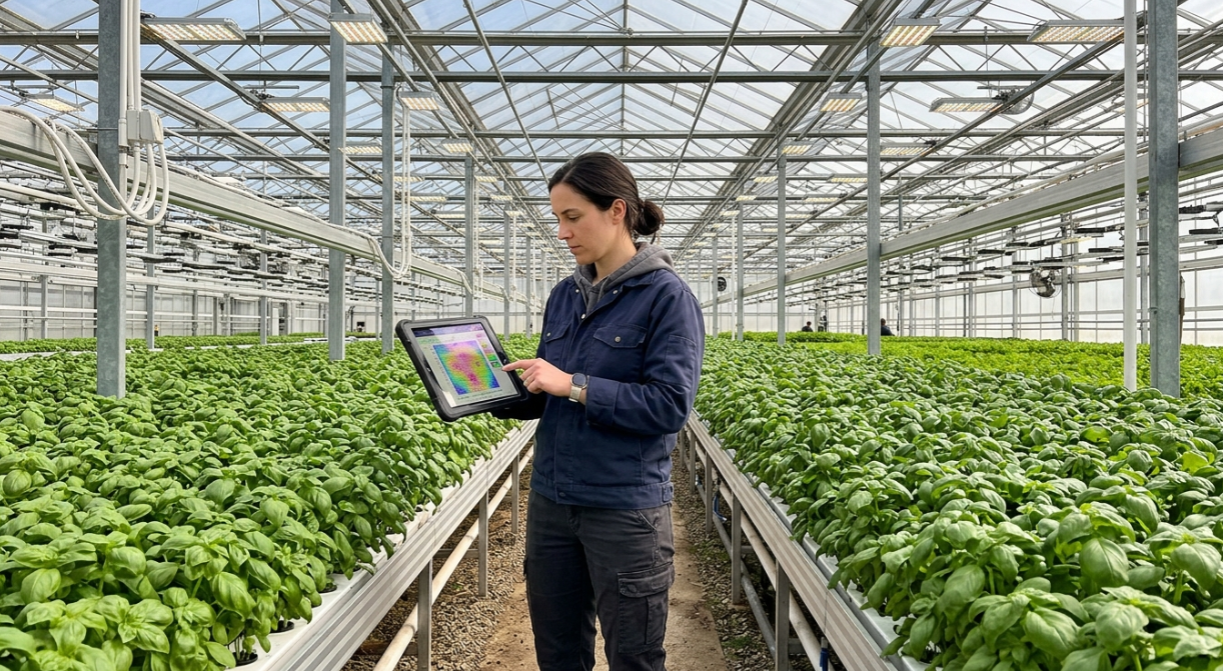
A calculator gives you a target. It does not give you a finished design. Here is what it cannot reliably determine:
- Fixture spacing and mounting height. Photometric data and grow area geometry dictate these, not a formula. For mounting height guidance, see this greenhouse grow light height guide.
- PPFD uniformity. Average PPFD can look fine while edges, corners, and zones under structural members are severely underlit.
- Structural shadows. Purlins, trusses, hanging baskets, HVAC ducts, and shade screens all block or diffuse light.
- HVAC impact. Every watt of lighting eventually becomes heat. The calculator estimates electrical load, but the HVAC consequences need separate analysis.
- Controls integration. Dimming zones, DLI based shutoff, sunrise/sunset ramping, and photoperiod management are design decisions that change energy use.
- Electrical infrastructure cost. Conduit, wire runs, panel upgrades, and transformer sizing can be a meaningful share of project cost.
- Rebate eligibility. Utility incentive programs have specific requirements around fixture certification, efficacy thresholds, and documentation.
- Maintenance and reliability risk. Fixture failure rates, driver access, and serviceability affect long term operating cost in ways no calculator models.
The bottom line: calculator math is the starting point. A professional PPFD layout is the next step.
Common Calculation Mistakes That Cost Money
These errors show up constantly in practice, especially from growers doing their first supplemental lighting project.
1. Using outdoor DLI as if it were canopy DLI. Outdoor DLI from a map tells you what hits the roof of the greenhouse, not what reaches the crop. After transmission losses, the crop may receive only 40 to 70% of that number. An experienced commenter in a Reddit greenhouse LED discussion put it simply: "What's your DLI inside the greenhouse on cloudy days?" Before calculating fixtures, calculate the deficit. A light you do not need is the most expensive light in the greenhouse.
2. Using lumens or lux for plant lighting decisions. Lumens, lux, and foot candles measure human perception of brightness. UNH states directly that these metrics are not useful for measuring plant useful light in a greenhouse and recommends using a PAR/PPFD meter instead.
3. Confusing PPF with PPE. PPF is total photon output (µmol/s). PPE is photon output per joule (µmol/J). A fixture can have high PPF and mediocre PPE, meaning it produces a lot of light but wastes electricity doing so.
4. Using fixture wattage as the primary metric. Watts measure electrical consumption, not light delivered to the crop. Two fixtures at the same wattage can deliver very different PPFD at the canopy depending on efficacy, optics, and mounting height.
5. Ignoring the coefficient of utilization. This is the most common source of undersized systems. Calculators that divide total required PPF by fixture PPF without a CU factor assume every emitted photon reaches the crop, which never happens. Even a well designed layout rarely exceeds 0.85 CU, and many greenhouse installations with high mounting heights or narrow beds fall closer to 0.60.
6. Using total greenhouse square footage instead of cropped area. If only 70% of the floor is actively cropped, the lighting calculation should use that 70%.
7. Ignoring dirty or aged greenhouse covers. A cover that transmitted 75% of light when new may transmit 50% after years of condensation, mineral deposits, and UV degradation. This alone can swing the supplemental DLI deficit by several mol/m²/day.
8. Designing for the darkest day of the year without checking economics. Project LAMP explicitly notes that designing to reach target DLI every single day would require enough light for the darkest day of the year, and this approach is usually not cost effective.
9. Treating fixture count as a finished layout. A calculation might say you need 158 fixtures. That does not tell you where to mount them, how to space them, or what the minimum PPFD will be at the edges. In a Reddit thread about large greenhouse planning, one response recommended getting an actual lighting company layout based on target PPFD and uniformity rather than trying to scale up from a fixture count alone.
10. Skipping the monthly cost breakdown. A single annual cost estimate hides the month to month reality. Some months may not justify supplemental lighting at all, and knowing that before the system is installed changes the ROI math.
Good Calculator vs. Weak Calculator
Not all greenhouse lighting calculators are equally useful. Here is how to tell the difference.
| Weak Calculator | Useful Commercial Calculator |
|---|---|
| Uses watts per square foot only | Uses DLI, PPFD, PPF, and PPE |
| Ignores sunlight | Starts with outdoor DLI and greenhouse transmission |
| Ignores season | Calculates by month with seasonal cost breakdown |
| Ignores greenhouse losses | Includes cover type, age, dirt, shade, and structure |
| Skips coefficient of utilization | Includes CU to adjust fixture count and expected PPFD |
| Gives one fixture count | Explains layout and uniformity limits |
| Ignores cost | Estimates kW, kWh, demand charges, and operating cost |
| Ignores crop economics | Compares cost per mole with crop value per mole |
A LinkedIn post about a recently updated DLI calculator highlighted newer inputs: greenhouse cover type, interference factors for aging and structural shading, cloud cover data from NASA, and monthly energy cost estimates. The trend is clear: the most useful calculators are getting more specific, not simpler.
When to Use a Calculator vs. Get a Professional Lighting Design
Use a greenhouse lighting calculator for early planning: estimating supplemental DLI, comparing seasons, roughing out operating cost, and deciding whether the project economics justify moving forward.
Get a professional design when the project involves:
- A commercial greenhouse with high value crops
- A retrofit from HPS to LED
- Utility rebate submission (which often requires documented PPFD maps)
- Multiple growing zones with different crop targets
- Electrical load planning and infrastructure upgrades
- Required PPFD uniformity across benches, gutters, or beds
- A facility where lighting decisions affect HVAC, CO₂, and irrigation strategy
The gap between calculator math and installed reality is where commercial projects either succeed or waste capital.
An Advanced Note on Daily Targets
Most greenhouse lighting calculators assume a fixed DLI target every day. But a 2024 lettuce study found that using a "carry over DLI" concept, where surplus light from sunny days reduces the supplemental need on following days, could save roughly 75 to 190 MWh per hectare annually in modeled U.S. greenhouse lettuce production. Designing with this kind of flexibility, rather than brute forcing the same target every day, can meaningfully reduce operating cost without sacrificing crop performance.
This is the kind of nuance that separates a back of the envelope calculation from a real lighting strategy.
Contact a lighting specialist to turn your calculator estimates into a validated PPFD layout and project plan.
FAQ
What is a greenhouse lighting calculator?
A greenhouse lighting calculator is a tool that estimates how much supplemental electric light a crop needs after accounting for sunlight, greenhouse transmission losses, crop DLI targets, and seasonal variation. It typically outputs required PPFD, total PPF, fixture count, runtime, and energy cost.
How do you calculate greenhouse supplemental lighting?
Start with the crop's target DLI. Multiply your location's outdoor DLI by the greenhouse transmission factor to find inside natural DLI. Subtract inside natural DLI from the target to get the supplemental DLI deficit. Convert the deficit to required PPFD using the formula: PPFD = Supplemental DLI ÷ (hours × 0.0036). Then calculate total PPF from PPFD and area, estimate fixture count using fixture PPF and coefficient of utilization, and estimate energy cost from installed kW, runtime, and electricity rate.
What is the formula for DLI?
DLI = PPFD × hours × 0.0036. DLI is in mol/m²/day, PPFD is in µmol/m²/s, hours is the daily photoperiod, and 0.0036 is the conversion constant (3,600 seconds per hour divided by 1,000,000 µmol per mol).
How do you calculate photoperiod hours for supplemental lighting?
Rearrange the DLI formula: Hours = Supplemental DLI ÷ (PPFD × 0.0036). Then check the result against the crop's biological photoperiod requirements. Long day crops like lettuce can tolerate 16 to 20 hours. Short day crops require uninterrupted dark periods that constrain maximum runtime.
What is the coefficient of utilization in greenhouse lighting?
The coefficient of utilization (CU) is the fraction of a fixture's total photon output that actually reaches the target crop area. It accounts for losses from edge spill, structural obstructions, mounting height, and fixture optics. Greenhouse CU values typically range from 0.50 to 0.85. Ignoring CU is one of the most common reasons a lighting system underperforms its calculator estimate.
How do you calculate fixture count for a greenhouse?
Fixture Count = Total PPF Required ÷ (Single Fixture PPF × CU). Total PPF Required equals Design PPFD × Growing Area in m². Without applying CU, you will undercount fixtures and the system will not hit target PPFD at the canopy.
How much DLI do greenhouse crops need?
It depends on the crop. Lettuce typically needs 12 to 17 mol/m²/day, basil 15 to 25, and tomato 20 to 30. Seedlings and cuttings may only need 5 to 10. These are reference ranges that should be adjusted for cultivar, growth stage, CO₂ level, and production goals.
Can I use lumens or lux for greenhouse lighting calculations?
Lumens, lux, and foot candles measure human perception of brightness, not plant usable light. For greenhouse lighting decisions, use PAR, PPFD, and DLI. These units measure the photons that actually drive photosynthesis.
Is outdoor DLI the same as greenhouse DLI?
No. Outdoor DLI is the light hitting the roof of the greenhouse. The crop receives less because of transmission losses from glazing material, structure, dirt, condensation, shade screens, and equipment. Greenhouse transmission typically ranges from 35% to 80%.
How do I calculate the cost to run greenhouse grow lights?
Multiply the total installed kW of the lighting system by the daily operating hours to get kWh per day. Multiply kWh by your electricity rate per kWh to get daily cost. Break costs out by month to see where spending peaks. For commercial tariffs, also check for demand charges, which are based on peak load (kW) rather than total energy consumed.
When is a calculator not enough?
A calculator gives planning estimates but cannot determine fixture spacing, PPFD uniformity, structural shadow impacts, HVAC consequences, or electrical infrastructure requirements. For commercial greenhouses, high value crops, rebate submissions, or any project where light uniformity and ROI matter, follow calculator math with a professional PPFD design.