Greenhouse Electrical Infrastructure: 2026 Complete Glossary
Learn greenhouse electrical infrastructure essentials: service sizing, GFCI/NEC 410.184, wiring, and centralized drivers. Avoid mistakes—read now.
TL;DR
Greenhouse electrical infrastructure covers every component that delivers, distributes, protects, and controls power across a commercial growing operation. This includes service entrance sizing, panel layout, conduit selection, GFCI compliance under NEC 410.184, and emerging centralized driver architectures that can cut installation costs by up to 40%. Understanding these terms is essential for code compliance, operational uptime, and controlling total cost of ownership. This glossary defines each component, explains why it matters in a greenhouse context, and flags the common mistakes that trip up even experienced operators.
Greenhouse electrical infrastructure is the complete electrical system that powers commercial growing operations. It includes the utility service entrance, electrical panels, feeders, branch circuits, conduit, wiring, grounding, GFCI protection, LED lighting distribution, backup power, surge protection, and code compliance. Proper electrical infrastructure ensures reliable operation of lighting, HVAC, irrigation, and environmental controls while reducing energy costs, improving safety, and allowing future expansion.
Greenhouse Electrical Infrastructure at a Glance
Component | Primary Purpose | Why It Matters |
|---|---|---|
Service Entrance | Receives utility power | Determines maximum electrical capacity |
Main Panel | Distributes power | Protects circuits and equipment |
Feeder Circuits | Carry power to subpanels | Reduce wire length |
Branch Circuits | Power individual equipment | Improve reliability |
EMT Conduit | Protects wiring | Resists moisture and UV |
GFCI Protection | Prevents electric shock | Required for many lighting installations |
Grounding & Bonding | Safety | Protects people and equipment |
LED Drivers | Convert AC to DC | Largest failure point in LED fixtures |
Backup Generator | Maintains power outages | Protects crops |
Surge Protection | Stops voltage spikes | Extends equipment life |
Why Greenhouse Electrical Infrastructure Matters
A commercial greenhouse is one of the most electrically demanding agricultural structures you can build. Lighting alone can dwarf every other load combined. Fans, heaters, irrigation pumps, environmental controllers, and cooling systems all compete for capacity on circuits that may run hundreds of feet through a hot, humid, corrosive environment.
Get the electrical infrastructure wrong and the consequences show up fast: fans that can’t move air because voltage has dropped below useful levels, lights that dim when the furnace kicks on, or entire crop cycles lost to a power outage with no backup in place. Greenhouse management expert John Bartok Jr. has documented real facilities where fans had to be shut off so the water pump could run, and lights dimmed whenever a furnace started. These are symptoms of undersized greenhouse electrical infrastructure, and they are surprisingly common in operations that grew organically without a master electrical plan.
Whether you are planning a new build, expanding an existing operation, or retrofitting legacy HPS lighting with LEDs, the terms below form the vocabulary of every electrical decision you will make. For a broader view of startup costs including electrical work, that guide breaks down the capital picture.
How Greenhouse Electrical Infrastructure Works
Many readers understand the individual components but not how they connect together.
The electrical path typically follows this sequence:
Utility Power
↓
Service Entrance
↓
Main Service Panel
↓
Feeder Circuits
↓
Subpanels
↓
Branch Circuits
↓
LED Lights
Fans
HVAC
Pumps
Controllers
This simple flow helps growers understand where each glossary term fits within the overall electrical system.
Power Supply and Distribution
Service Entrance / Main Service Panel
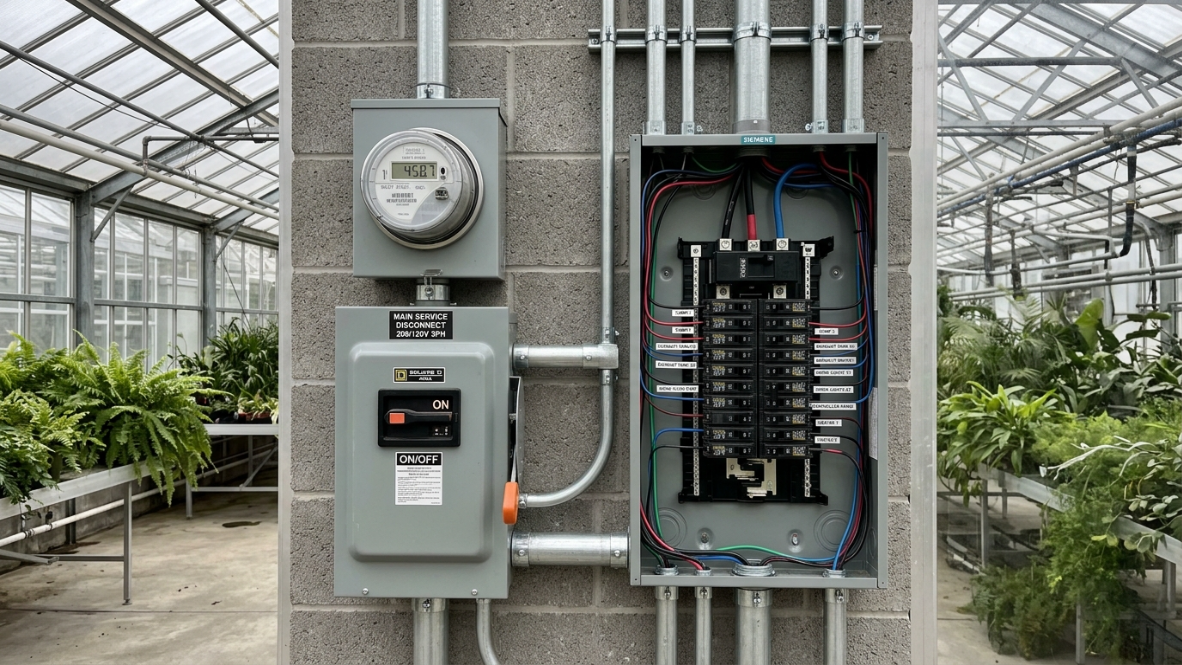
Definition: The service entrance is the point where utility power enters your greenhouse facility. It includes the main disconnect, metering equipment, and the primary panel where power is first distributed.
Why it matters: The service entrance determines the ceiling for everything your operation can do electrically. A single hoophouse might get by with a 60-amp service, while a gutter-connected range with a headhouse full of equipment can require 800 amps or more. Undersizing the service entrance is one of the most expensive mistakes in greenhouse construction because upgrading later means reworking the entire electrical backbone.
Common mistake: Installing a service panel that is “just big enough” for current loads with no room for supplemental lighting, automation upgrades, or additional greenhouse bays. As one Greenhouse Management article notes, it is not uncommon for growers to install panels that are not large enough.
Single-Phase vs. Three-Phase Power
Definition: Single-phase power delivers electricity through two conductors (one hot, one neutral) and is standard for residential and small commercial applications. Three-phase power uses three hot conductors with alternating current offset by 120 degrees, delivering more power more efficiently.
Why it matters: For operations under an acre, single-phase may suffice. But three-phase power offers real advantages at scale: it allows higher voltages (which minimize voltage drop over long runs), supports more efficient motors, and gives more flexibility for expansion. According to Penn State Extension, three-phase motors cost 20 to 50 percent less than comparable single-phase motors. Where three-phase service is available, it almost always makes economic sense for commercial greenhouse electrical infrastructure.
Practical note: If three-phase is not available at your site, the cost to bring it in from the nearest utility line can be significant. Factor this into site selection decisions early.
Single-Phase vs Three-Phase Comparison
Feature | Single Phase | Three Phase |
|---|---|---|
Typical Voltage | 120/240V | 208V, 240V, 480V |
Best For | Small greenhouses | Commercial operations |
Motor Efficiency | Lower | Higher |
Voltage Drop | Higher | Lower |
Expansion | Limited | Excellent |
Initial Cost | Lower | Higher |
Load Schedule / Demand Load
Definition: A load schedule is a complete inventory of every piece of electrical equipment in your greenhouse, listing its wattage, voltage, amperage, and operating hours. The total demand load is the sum of all equipment that might run simultaneously.
Why it matters: The load schedule is the foundation document for sizing everything else: service entrance, panels, feeders, wire gauges, and backup generators. Without it, you are guessing. A design engineer uses the load schedule to prepare power diagrams, wiring layouts, and control diagrams.
Common mistake: Forgetting to include seasonal or occasional loads. Supplemental lighting that only runs in winter months still needs to be accounted for in panel capacity and service sizing.
Branch Circuits and Feeder Circuits
Definition: A feeder circuit carries power from the main service panel to a subpanel (distribution panel) located closer to the equipment it serves. Branch circuits run from the subpanel to individual pieces of equipment like motors, lights, or controllers.
Why it matters: In large, gutter-connected greenhouses, feeder circuits dramatically reduce the total amount of wiring needed. A typical setup might have a 200-amp main service panel feeding several 60-amp feeder circuits, one per greenhouse bay. Each feeder terminates at a distribution panel with branch circuits serving the motors and lights in that zone.
Subpanels / Distribution Panels
Definition: A subpanel (or distribution panel) is a secondary breaker panel fed by a feeder circuit from the main service. It distributes power locally to branch circuits within a section of the greenhouse.
Why it matters: Proper subpanel placement reduces wire runs, lowers voltage drop, and makes troubleshooting easier. Rutgers engineer Tom Manning recommends one subpanel for every two acres, with no more than four to five greenhouse zones on a single panel. This rule of thumb keeps circuits manageable and limits the blast radius of any single panel failure.
For a full breakdown of how lighting costs shape these decisions, the greenhouse lighting installation cost guide covers the numbers in detail.
Demand Charges and Utility Rate Structures
Definition: A demand charge is a fee based on your peak power draw during a billing period, separate from the per-kilowatt-hour energy charge. Most commercial greenhouse operations are on utility schedules that include demand charges.
Why it matters: Demand charges can represent 30% or more of a greenhouse electricity bill. Strategies to reduce them include installing efficient motors, staggering non-essential loads, and using microprocessor controllers that shed equipment when demand approaches a set threshold. All greenhouses and accessory buildings should be served by one electrical service to avoid multiple base charges. It is usually less expensive to obtain a farm rate rather than a commercial rate with its associated demand charge.
Many utilities also offer rebates and incentives for greenhouse LED lighting that can offset the capital cost of upgrading to more efficient fixtures.
Wiring, Conduit, and Protection
Conduit Types (EMT, PVC, Liquidtight)
Definition: Conduit is the protective tubing that encloses electrical wiring. The three types most discussed in greenhouse contexts are Electrical Metallic Tubing (EMT), PVC conduit, and liquidtight flexible conduit.
Why it matters: A greenhouse environment combines moisture, heat, UV exposure, dust, and sometimes chemical spray. The NEC requires wiring in high-moisture, high-dust environments to be placed in conduit. EMT (galvanized steel with an organic interior coating) is generally the best choice for greenhouses because it is durable, easy to install, and unaffected by UV light.
Critical warning: PVC conduit should not be used in greenhouses. Rutgers engineer Tom Manning is blunt on this: PVC sags under warm temperatures and degrades under ultraviolet light, breaking down over time. The same applies to PVC outlet boxes and other PVC electrical components. Romex (NM-B flexible wire) also has no place in a greenhouse.
Wire Types (THHN/THWN, SJOOW, UF-B)
Definition: Wire type designations indicate the insulation material and the conditions the wire is rated to handle. THHN/THWN is rated for wet and dry locations and commonly used inside conduit. SJOOW is a flexible cord rated for hard service, oil resistance, and wet locations, often used for temporary or pluggable connections. UF-B (underground feeder) is rated for direct burial and wet locations.
Why it matters: The NEC requires wire insulation to match the application: wet, dry, high temperature, or a combination. Using the wrong wire type in a greenhouse is a code violation and a fire risk. All exposed wiring should be waterproof and UV-resistant if not protected by conduit.
Voltage Drop
Definition: Voltage drop is the reduction in voltage that occurs as electricity travels through wire. It increases with wire length, wire resistance, and current draw.
Why it matters: In a greenhouse, equipment can easily sit hundreds of feet from the panel feeding it. If the wire gauge is too small relative to the distance, voltage drop exceeds the 5% threshold and real problems start: fans lose output, motors overheat, lights dim or flicker, and heaters produce less heat. The lost voltage doesn’t disappear, it converts to heat in the wire, wasting energy you still pay for. A common scenario is a load panel at one end of a 200-foot greenhouse with exhaust fans at the opposite endwall. Undersized wire on that run means reduced airflow and shortened motor life.
For more on how heat from lighting interacts with your HVAC system, see how much HVAC you need to cool LED lights.
Recommended Maximum Voltage Drop
Circuit Type | NEC Recommendation |
|---|---|
Branch Circuit | 3% |
Feeder Circuit | 3% |
Entire System | 5% |
Grounding and Bonding
Definition: Grounding connects the electrical system and all metal equipment to the earth, providing a safe fault-current path. Bonding connects all metal parts of the electrical system together to ensure they stay at the same potential.
Why it matters: Greenhouses are wet environments where growers regularly contact metal structures, benches, and irrigation systems. Proper grounding protects people from electrical shock by providing a reliable path from each piece of equipment back to the system ground conductor in the main service. In a greenhouse, this is not optional, it is survival-critical.
GFCI (Ground-Fault Circuit Interrupter)
This is the single most contested and confusing topic in greenhouse electrical infrastructure today, and it deserves the most space.
Definition: A GFCI monitors the current flowing on the hot and neutral conductors of a circuit. If it detects an imbalance (indicating current is leaking to ground, possibly through a person), it trips the circuit in milliseconds.
The NEC requirement: The 2020 NEC introduced Section 410.184, mandating GFCI protection for horticultural lighting equipment. The 2023 NEC clarified the rule: flexible cord-connected horticultural lighting that uses a separable connector or attachment plug must have GFCI protection. Hard-wired horticultural lighting without a separable connector does not require GFCI.
The Article 547 myth: Many growers and even some electricians believe NEC Article 547 (which covers agricultural buildings) exempts greenhouses from GFCI requirements. It does not. Section 410.184 applies to horticultural lighting regardless of building classification.
The voltage problem: When circuits exceed 150 volts to ground, Special Purpose GFCI (SPGFCI) is required instead of standard Class A GFCI. SPGFCI devices trip at 15 to 20 milliamps rather than the 4 to 6 milliamps of Class A devices. The practical headache is that sourcing GFCIs rated for 277VAC is difficult and expensive. This forces many growers to add step-down transformers to bring voltage to 208VAC or 240VAC, increasing costs and reducing distribution efficiency.
Nuisance tripping: This is the operational pain point that keeps growers up at night. LED drivers and electronic ballasts contain EMI filters required by FCC regulations. These filters shunt high-frequency noise to ground, creating small amounts of leakage current. Individually, the leakage from one luminaire is insignificant. But modern cultivation facilities often run many luminaires on a single circuit, and the leakage currents are additive. When cumulative leakage on a circuit approaches the GFCI trip threshold, the device trips even though no actual ground fault exists. The result is lights going dark during a critical photoperiod with no warning and no actual hazard.
Practical workaround: Limiting the number of fixtures per GFCI-protected circuit reduces cumulative leakage below the trip threshold. Some operators are also exploring centralized driver architectures and low-voltage distribution systems that sidestep the GFCI issue entirely by changing the fundamental electrical topology. For a deeper look at how these approaches intersect with code, the guide on centralized LED drivers covers the full picture.
GFCI Decision Chart
Installation Type | GFCI Required? |
|---|---|
Hardwired Fixture | Usually No |
Plug-connected Fixture | Yes |
Flexible Cord with Connector | Yes |
Circuit Above 150V to Ground | SPGFCI Required |
Weatherproof Enclosures (NEMA Ratings)
Definition: NEMA ratings classify electrical enclosures by their level of protection against environmental hazards. NEMA 3R protects against rain, sleet, and ice. NEMA 4 adds protection against windblown dust and splashing water.
Why it matters: Greenhouses should be treated as outdoor environments for electrical purposes. All boxes, covers, and enclosures must be outdoor-rated and weatherproof (NEMA 3R minimum, NEMA 4 where spraying or misting occurs). Practitioners on the THCFarmer forum have flagged that even with NEMA 5 rated boxes, bugs infiltrate junction boxes, which is a practical annoyance absent from most guides but very real in day-to-day greenhouse operation. One grower running mister systems noted that higher NEMA ratings are worth the cost just to keep moisture and insects out.
For more on how IP and NEMA ratings apply specifically to grow light fixtures, see the guide on environmental protection ratings for LED grow lights.
Lighting Electrical Infrastructure
Horticultural lighting is typically the single largest electrical load in a commercial greenhouse. If a grower is lighting even one acre with high-intensity fixtures, the electrical service must be sized to accommodate those loads. As a rule of thumb, every 100 watts of actual fixture draw adds roughly 341 BTU per hour of heat to the cooling load, which means lighting decisions ripple through every other system.
LED Driver (Ballast Equivalent)
Definition: An LED driver is the power supply that converts AC mains voltage to the regulated DC current an LED array requires. It is the functional equivalent of a ballast in HID lighting.
Why it matters: The driver is typically the first component to fail in any LED fixture, and it generates the majority of waste heat at the fixture level. Driver quality directly affects fixture lifespan, efficiency, and reliability. In-fixture drivers also add weight to overhead structures and create servicing complexity when hundreds or thousands of fixtures are deployed. Learn more about LED reliability and failure rates and what to look for.
Power Drops (Per-Fixture vs. Daisy-Chain)
Definition: A power drop is the electrical connection from the branch circuit to an individual fixture. Per-fixture drops give each light its own home run to the panel. Daisy-chaining connects fixtures in series from a single circuit, with power passing through or tapping off at each fixture location.
Why it matters: Per-fixture drops offer the most control and simplest troubleshooting but require more wire and labor. Daisy-chaining reduces wiring but increases the consequences of a single connection failure. The choice affects conduit routing, junction box count, and total installation cost. In facilities with centralized driver systems, chainable low-voltage fixtures can eliminate individual power drops entirely.
Centralized / Remote LED Driver Architecture
Definition: A centralized (or remote) driver architecture moves the AC-to-DC power conversion from individual fixtures to a shared rack or cabinet located outside the grow space. Power is distributed to lightweight, driverless fixtures over DC or low-voltage cabling.
Why it matters: This is the most significant shift in greenhouse electrical infrastructure design in recent years, and no competing glossary covers it. The conventional model puts a driver on every fixture. The centralized model consolidates those drivers into fewer, larger, more efficient units.
The benefits compound across multiple systems:
Reduced wiring complexity. One centralized unit replaces dozens or hundreds of individual drivers, simplifying installation. Industry sources report that centralized power with chainable fixtures can reduce install time and labor by up to 80%.
Lower total system cost. Centralized architectures can reduce electrical, control, and LED system costs by up to 40% compared to traditional distributed-driver setups.
Better heat management. Removing drivers from the grow space means less heat above the canopy, which reduces HVAC load and improves environmental stability for temperature, humidity, and CO2 management. The guide on latent vs. sensible heat explains why this matters for controlled environments.
Improved serviceability and biosecurity. Centralizing a few large drivers simplifies maintenance compared to managing thousands dispersed throughout the facility. Since drivers are not washable, removing them from grow spaces also reduces contamination risk. For greenhouses specifically, removing driver weight and bulk from overhead reduces shading and structural steel requirements.
GFCI simplification. Some centralized systems distribute low-voltage DC power to fixtures, which can eliminate the GFCI compliance headaches described above.
Thrive Agritech’s OptiDrive platform is one example of this architecture built specifically for horticultural applications.
Distributed vs Centralized Driver Architecture
Feature | Distributed Drivers | Centralized Drivers |
|---|---|---|
Driver Location | Inside Fixture | Remote Cabinet |
Fixture Weight | Higher | Lower |
Heat Above Crop | Higher | Lower |
Maintenance | Fixture-by-fixture | Centralized |
Installation Labor | Higher | Lower |
Future Expansion | Moderate | Easier |
Low-Voltage Distribution
Definition: Low-voltage distribution systems deliver power to fixtures at voltages below the thresholds that trigger traditional high-voltage electrical code requirements. Instead of running 120V, 208V, or 277V AC to each fixture, power is converted centrally and distributed at lower voltages.
Why it matters: Low-voltage wiring can often be installed by low-voltage technicians rather than licensed electricians, potentially reducing labor costs. It can also eliminate the need for conduit in some applications, simplify GFCI compliance, and reduce the total amount of electrical infrastructure (transformers, subpanels, breakers) needed. Some systems claim to eliminate up to 75% of typical distribution equipment.
Dimming Protocols (0-10V, MODBUS)
Definition: Dimming protocols are the communication standards used to control light output. 0-10V is an analog protocol where a low-voltage signal (0 to 10 volts DC) tells the driver what percentage of full output to deliver. MODBUS is a digital communication protocol that allows more granular control, scheduling, and integration with building management systems.
Why it matters: Dimming is not just about energy savings. It enables photoperiod management, DLI targeting, and sunrise/sunset simulation. The protocol you choose affects wiring (0-10V needs a separate pair of low-voltage wires; MODBUS can run over RS-485 or TCP/IP) and integration complexity. For guidance on light-level targets that drive dimming decisions, the PPFD greenhouse guide is a useful reference.
Backup and Resilience
Standby Generator
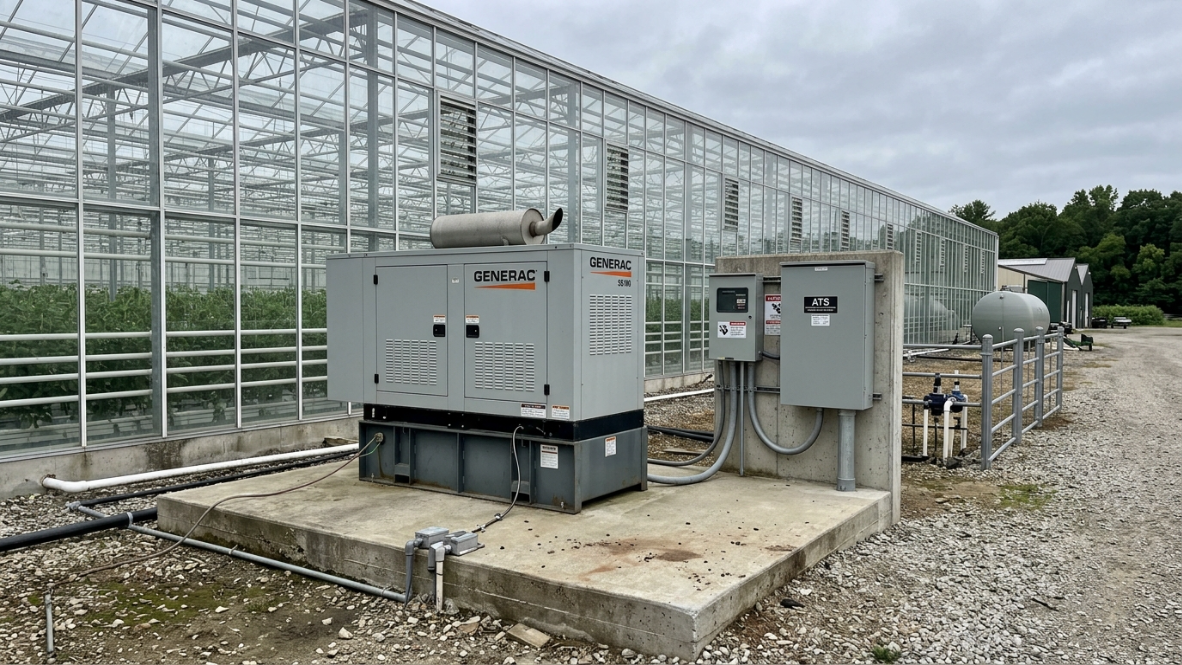
Definition: A standby generator is a permanently installed power source that activates during a utility outage to keep critical greenhouse systems running.
Why it matters: A greenhouse can gain or lose heat so rapidly that a power outage of more than a few minutes can mean the loss of an entire crop. Heating, cooling, ventilation, and irrigation all depend on continuous power. Generator sizing should be based on the load schedule, covering at minimum the critical loads (ventilation, heating, environmental controls) and ideally the full lighting load as well.
Automatic Transfer Switch (ATS)
Definition: An ATS monitors utility power and, upon detecting an outage, automatically starts the generator, allows the engine to warm up, and transfers the load from utility to generator power. When utility power returns, it reverses the process.
Why it matters: Manual transfer is too slow for greenhouse applications. By the time someone notices the power is out, drives to the facility, and flips the switch, temperatures may have already moved outside the safe range. An ATS eliminates the human delay.
Surge Protection
Definition: Surge protection devices (SPDs) divert voltage spikes away from sensitive equipment. They are installed at the service entrance, subpanels, or individual equipment connections.
Why it matters: Greenhouses in rural areas are especially vulnerable to utility switching surges and lightning-induced transients. LED drivers, environmental controllers, and irrigation timers are all sensitive electronics that can be damaged or degraded by voltage spikes. A whole-facility SPD at the main panel plus point-of-use protection on critical equipment is standard good practice.
Lightning Protection
Definition: A lightning protection system provides a controlled path for lightning current to reach ground without passing through the building structure or electrical system.
Why it matters: Greenhouses are often the tallest structures on open agricultural land, making them lightning targets. A direct strike without a protection system can destroy electrical panels, fry controllers, and start fires. Even nearby strikes can induce damaging surges on power and control wiring.
Critical Loads During a Power Outage
Priority | Equipment |
|---|---|
Critical | Ventilation Fans |
Critical | Heating System |
Critical | Environmental Controls |
Critical | Irrigation Pumps |
Medium | Supplemental Lighting |
Low | Convenience Outlets |
Planning and Compliance
National Electrical Code (NEC)
Definition: The NEC is a set of standards published by the National Fire Protection Association (NFPA) that governs safe electrical installation in the United States. It is updated on a three-year cycle, with the 2023 edition being current.
Why it matters: NEC compliance is not optional. It is the baseline for passing electrical inspections, obtaining certificates of occupancy, and qualifying for insurance coverage. For greenhouse electrical infrastructure specifically, NEC Article 547 (agricultural buildings), Section 410.184 (horticultural lighting), and various articles on wiring methods, grounding, and GFCI protection all apply.
Authority Having Jurisdiction (AHJ)
Definition: The AHJ is the local official or office responsible for approving equipment, installations, and procedures. In electrical work, this is typically the local building department or electrical inspector.
Why it matters: The NEC sets minimum standards, but the AHJ can impose stricter requirements. A greenhouse built to NEC minimums might still fail inspection if the local AHJ interprets certain provisions differently. Always consult your AHJ early in the design process, especially on contested topics like GFCI requirements for horticultural lighting.
UL Listing / Certification
Definition: UL (Underwriters Laboratories) listing means a product has been tested and certified to meet specific safety standards. A UL-listed fixture or panel has been independently verified for electrical safety.
Why it matters: Most AHJs require UL-listed equipment. Insurance carriers may deny claims involving non-listed equipment. In horticultural lighting, UL listing also affects eligibility for utility rebates and incentive programs.
Spare Capacity / Future Expansion Planning
Definition: Spare capacity is the deliberate oversizing of electrical service, panels, and conduit to accommodate future growth without requiring a complete infrastructure overhaul.
Why it matters: This is arguably the most important planning concept in the entire glossary. The biggest mistake growers make is sizing their greenhouse electrical infrastructure for today’s loads with no margin for tomorrow. Adding supplemental lighting, automating irrigation, installing CO2 injection systems, or expanding greenhouse bays all require electrical capacity. Building in 20 to 30% spare capacity at the service entrance and subpanel level is far cheaper than retrofitting later.
Common Greenhouse Electrical Infrastructure Mistakes
These errors appear repeatedly across practitioner forums, extension service publications, and industry case studies:
Undersized service panels. The most common mistake. Operations that grow incrementally often hit their electrical ceiling before they realize it, forcing expensive upgrades.
PVC conduit in UV-exposed areas. PVC degrades under ultraviolet light and sags in warm greenhouse temperatures. Use EMT instead.
Ignoring voltage drop on long runs. A 200-foot run to a fan with undersized wire means that fan operates below rated capacity and the motor overheats. Always calculate voltage drop for runs over 50 feet.
Assuming Article 547 exempts greenhouses from GFCI. It does not. NEC 410.184 applies to horticultural lighting with flexible cord connections regardless of building classification.
No expansion capacity. Saving a few thousand dollars on a smaller service entrance today can cost tens of thousands in retrofit costs when you add supplemental lighting or a second greenhouse bay.
Running too many LED fixtures on one GFCI circuit. Cumulative leakage current from EMI filters causes nuisance tripping. Limit fixture count per GFCI-protected circuit based on manufacturer leakage specifications.
Greenhouse Electrical Infrastructure Planning Checklist
Before construction, verify that you have:
Completed a full electrical load schedule
Sized the utility service for future expansion
Selected single-phase or three-phase service
Planned feeder and branch circuit layouts
Calculated voltage drop
Selected conduit and wiring materials
Designed grounding and bonding
Reviewed NEC requirements
Consulted the AHJ
Planned backup power
Added surge protection
Reserved 20–30% spare capacity
Common Electrical Components by Greenhouse Size
Greenhouse Size | Typical Electrical Needs |
|---|---|
Small Hobby | 60–100A Service |
Small Commercial | 200–400A |
Medium Commercial | 400–600A |
Large Multi-Bay | 800A+ |
Key Takeaways
Greenhouse electrical infrastructure includes every component from the utility service entrance to the final lighting fixture.
Proper service sizing prevents expensive future upgrades.
Three-phase power is generally the best option for commercial greenhouses.
EMT conduit is preferred over PVC in greenhouse environments.
Voltage drop should be limited to preserve equipment performance.
NEC Section 410.184 governs GFCI protection for many horticultural lighting installations.
Backup generators, surge protection, and spare electrical capacity improve long-term reliability.
Centralized LED driver systems can reduce installation costs, simplify maintenance, and improve scalability.
FAQ
What size electrical service does a commercial greenhouse need?
It depends entirely on the operation. A single hoophouse with basic ventilation and heating might need only 60 amps. A multi-bay gutter-connected greenhouse with supplemental lighting, automated irrigation, and environmental controls can require 800 amps or more. The answer comes from a proper load schedule prepared by a design engineer.
Should I choose single-phase or three-phase power?
For operations under an acre with minimal supplemental lighting, single-phase may be adequate. For anything larger, three-phase is almost always the better investment. It supports higher voltages (reducing voltage drop on long runs), uses less expensive motors, and provides more flexibility for future expansion. Penn State Extension reports that three-phase motors cost 20 to 50% less than single-phase equivalents.
Do greenhouse lights require GFCI protection?
It depends on how they are connected. Under NEC Section 410.184, horticultural lighting connected with flexible cords and separable connectors or attachment plugs requires GFCI protection. Hard-wired fixtures without separable connectors do not. For circuits over 150 volts to ground, SPGFCI (which trips at 15 to 20 milliamps) is required rather than standard Class A GFCI.
What causes GFCI nuisance tripping with LED grow lights?
LED drivers contain EMI filters that shunt small amounts of current to ground. When many fixtures share a single GFCI-protected circuit, these individual leakage currents add up. If the cumulative leakage approaches the GFCI trip threshold, the device trips even though no real fault exists. The solution is to limit fixtures per circuit or use electrical architectures that avoid the issue.
Can I use PVC conduit in a greenhouse?
No. PVC conduit sags under the elevated temperatures found in greenhouses and degrades under UV exposure, becoming brittle over time. EMT (Electrical Metallic Tubing) is the preferred choice. This also applies to PVC outlet boxes and fittings.
What is a centralized LED driver system and why does it matter?
A centralized driver system moves the AC-to-DC power conversion out of individual fixtures and into a shared cabinet outside the grow space. This reduces fixture weight and shading, cuts heat above the canopy, simplifies wiring, improves serviceability, and can reduce total system costs by up to 40%. It is particularly attractive for new-build greenhouses where the electrical infrastructure can be designed around it from the start.
How much spare electrical capacity should I plan for?
A minimum of 20 to 30% spare capacity at the service entrance and subpanel level is good practice. Supplemental lighting is the most common load that growers add after initial construction, and it is also the largest. Planning for it upfront, even if you do not install it immediately, avoids costly service upgrades later.
How do I get started planning greenhouse electrical infrastructure?
Begin with a complete load schedule of every piece of electrical equipment your operation will use, including seasonal loads. Work with a design engineer experienced in agricultural facilities to size service, panels, feeders, and branch circuits. Consult your local AHJ early about GFCI and code requirements. For operations that include supplemental lighting, the lighting system often drives the entire electrical design.
Schedule a free consultation with a lighting infrastructure specialist to discuss your project’s electrical requirements and find the right approach for your facility.