DLI Greenhouse 2026 Guide: Calculations, Targets & PPFD
Learn how to calculate greenhouse DLI, understand PPFD targets, and plan supplemental LED lighting for commercial crop production.
TL;DR
Daily Light Integral (DLI) measures the total number of photosynthetically active photons a plant receives over one full day, expressed in mol/m²/d. Inside a greenhouse, glazing and structural elements cut outdoor DLI by 35 to 50%, creating a light deficit that limits crop yield and quality. Calculating that deficit and closing it with supplemental LED lighting is one of the most direct ways to improve year-round greenhouse production.
Ready to close your greenhouse light deficit? Request a Greenhouse Lighting Design and our team will size supplemental LEDs to your exact DLI targets.
Quick Answer: What Is Daily Light Integral (DLI)?
Daily Light Integral (DLI) is the total amount of photosynthetically active light that reaches plants during a 24-hour period. It is measured in mol/m²/day and combines both light intensity (PPFD) and photoperiod into one number.
For greenhouse growers, DLI is one of the most important measurements because it determines whether crops receive enough light for optimal photosynthesis.
General greenhouse DLI targets include:
Crop | Recommended DLI |
|---|---|
Lettuce | 12–17 mol/m²/day |
Herbs | 12–18 |
Tomatoes | 20–35 |
Cucumbers | 20–30 |
Cannabis (Flower) | 35–50 |
If your greenhouse cannot naturally reach these values, supplemental LED lighting is typically required.
What Is DLI?
Daily Light Integral, or DLI, is the total amount of photosynthetically active radiation (PAR) that lands on a square meter of growing area over the course of a full day. The unit is moles of photons per square meter per day (mol/m²/d).
Think of it like a rain gauge. A rain gauge doesn’t tell you how hard it’s raining at any given second. It tells you how much water accumulated over the whole day. DLI works the same way for light. A single PPFD reading tells you the intensity right now, but DLI tells you how much total light energy your plants actually received from sunrise to sunset (or from lights-on to lights-off).
This distinction matters because natural light changes constantly. Clouds roll in, the sun’s angle shifts through the season, and the photoperiod shrinks in winter. A single PPFD measurement at noon on a clear day can be wildly misleading about what your crop is actually getting over 24 hours. DLI captures the full picture.
The photons DLI counts fall within the 400 to 700 nanometer wavelength range, which is the band plants use to drive photosynthesis. If you’re unfamiliar with the units, what is a micromole provides a quick primer on the measurement system behind PPFD and DLI.
For growers evaluating how supplemental lighting fits into their operation, understanding DLI is the starting point.
Explore greenhouse supplemental LED fixtures
Why DLI Matters More Than Light Intensity Alone
Many growers focus only on PPFD because fixture manufacturers advertise high output numbers.
However, plants respond to the total number of photons received over the entire day, not simply the highest instantaneous intensity.
For example:
200 µmol/m²/s for 20 hours
500 µmol/m²/s for 8 hours
These produce dramatically different DLI values.
When planning greenhouse lighting, DLI should be the primary target, while PPFD becomes the tool used to achieve it.
DLI vs. PPFD vs. PAR: Clearing Up the Confusion
These three terms get mixed up constantly. Here’s the quick breakdown:
Term | What It Measures | Unit | Analogy |
|---|---|---|---|
PAR | The wavelength range plants use (400–700 nm) | Not a unit itself, it’s a category | The type of rain (useful rain vs. sleet) |
PPFD | Instantaneous light intensity at one point | µmol/m²/s | How hard it’s raining right now |
DLI | Total light accumulated over a full day | mol/m²/d | How much water collected in the rain gauge |
PAR defines which photons count. PPFD tells you how many of those photons are hitting a surface at this exact moment. DLI adds them all up across the day.
Growers need both PPFD and DLI, but planning should be built around DLI targets. A fixture delivering 400 µmol/m²/s for 12 hours creates a very different outcome than one delivering 267 µmol/m²/s for 18 hours, even though both situations could be described as “adequate PPFD.” The DLI values, however, would be quite different (17.3 vs. 17.3, actually the same in this case, which is exactly the point: DLI integrates both variables into one number). Understanding how light spectra affect plant growth adds another layer, because spectrum quality influences how efficiently plants use the photons that DLI counts.
One important note: do not use lux, foot-candles, or lumens for plant lighting decisions. These units are weighted for human vision, not photosynthesis. They will mislead you.
DLI vs Lux vs Foot-Candles
Many new greenhouse operators accidentally measure greenhouse lighting using lux meters.
This creates major errors because lux measures light according to human vision rather than plant photosynthesis.
Measurement | Used For | Good for Plants? |
|---|---|---|
Lux | Human brightness | ❌ No |
Foot-candles | Human lighting | ❌ No |
Lumens | Total visible light output | ❌ No |
PPFD | Instant plant light intensity | ✅ Yes |
DLI | Total daily plant light | ✅ Best |
The DLI Formula
The core calculation is straightforward:
DLI (mol/m²/d) = PPFD (µmol/m²/s) × Photoperiod (hours) × 3,600 ÷ 1,000,000
The 3,600 converts hours to seconds. The 1,000,000 converts micromoles to moles.
When you already know your DLI target and photoperiod but need to figure out the required PPFD, flip the formula:
PPFD (µmol/m²/s) = DLI (mol/m²/d) × 1,000,000 ÷ (Photoperiod in hours × 3,600)
Want to skip the math? Download the free Greenhouse DLI Worksheet to calculate your light deficit and required supplemental PPFD in minutes.
Worked Example
A lettuce grower in Ohio needs a DLI of 17 mol/m²/d. In January, their greenhouse receives only 8 mol/m²/d after transmission losses. The deficit is 9 mol/m²/d. If they run supplemental lights for 16 hours:
PPFD needed = 9 × 1,000,000 ÷ (16 × 3,600) = 9,000,000 ÷ 57,600 = 156 µmol/m²/s
That’s the average supplemental PPFD the fixtures need to deliver at canopy level to close the gap.
DLI Conversion Cheat Sheet
Instead of performing the formula manually every time, growers often use quick conversion values.
PPFD | 12 Hours | 16 Hours | 18 Hours |
|---|---|---|---|
100 | 4.3 | 5.8 | 6.5 |
200 | 8.6 | 11.5 | 13.0 |
300 | 13.0 | 17.3 | 19.4 |
400 | 17.3 | 23.0 | 25.9 |
500 | 21.6 | 28.8 | 32.4 |
600 | 25.9 | 34.6 | 38.9 |
Outdoor DLI Across the United States
Outdoor DLI ranges from roughly 5 mol/m²/d on a dark, cloudy winter day in the northern U.S. to about 60 mol/m²/d on a cloudless summer day. The variation is enormous, driven by latitude, season, altitude, and cloud cover.
In the northern half of the country, outdoor DLI during winter months commonly drops below 10 mol/m²/d. That’s already below the minimum target for most crops, and it’s measured outside, before any greenhouse losses.
The best free tool for checking your location is the interactive DLI map maintained by the American Floral Endowment, built on NOAA data. Zoom in, click your facility’s location, and it returns monthly and annual average DLI values. These maps now cover all 50 states with high-resolution data.
What Factors Affect Greenhouse DLI?
Outdoor sunlight is only one part of the equation.
Greenhouse DLI also changes because of:
Latitude
Season
Weather
Cloud cover
Greenhouse orientation
Roof angle
Glazing material
Shade curtains
Dirt accumulation
Structural shadows
Crop density
Hanging baskets
Internal equipment
Supplemental lighting schedule
These variables explain why two greenhouses in the same city can have significantly different DLI values.
Why Greenhouse DLI Is Always Lower Than Outdoor DLI
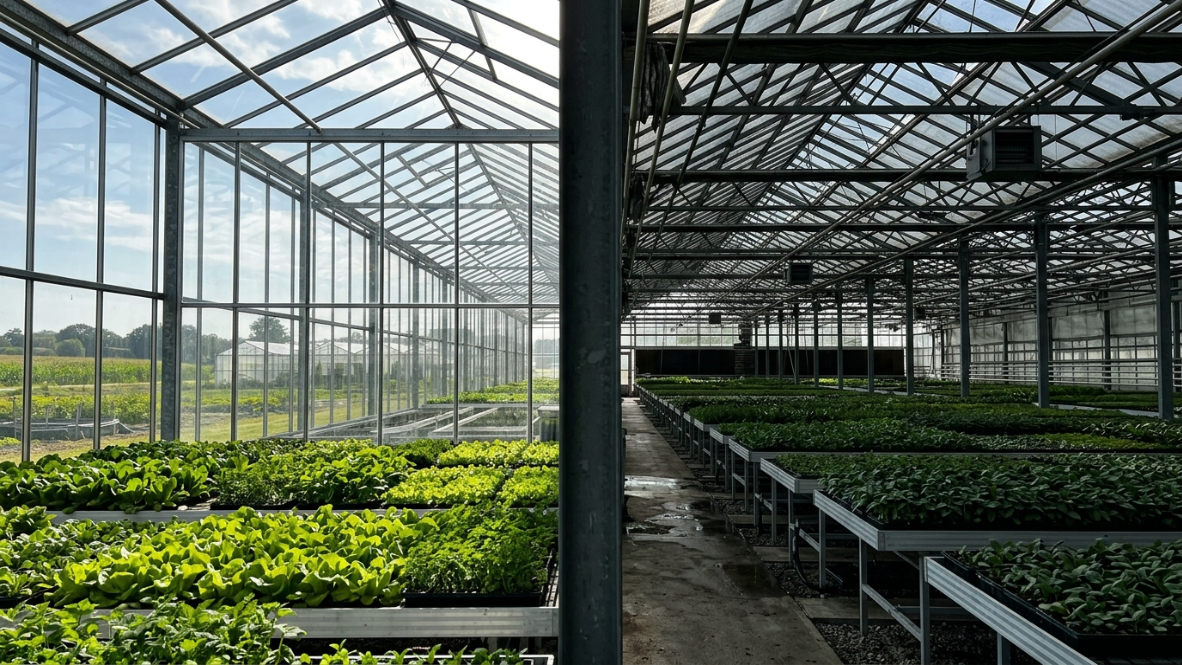
This is the central challenge for greenhouse growers. The structure itself eats light.
Glazing materials typically transmit 60 to 80% of incoming PAR when new and clean. Single-pane clear glass runs around 88 to 91% transmission. Double-wall polycarbonate drops to about 80%. But measured at canopy level, actual PAR delivery is often only 40 to 60% of what’s available outside. The difference comes from structural elements (purlins, trusses, gutters), hanging baskets, heat pipes, shade cloths, and dirt accumulation on the glazing.
The result: average DLI inside a greenhouse in the United States typically ranges from 5 to 30 mol/m²/d.
A practical way to find your transmission factor: On a clear day around solar noon, take a PAR reading just outside the greenhouse, then immediately take one inside at plant height. Divide the indoor reading by the outdoor reading. That’s your transmission percentage. Do this several times across the greenhouse footprint because uniformity varies.
Glazing Age and DLI Drift
Here’s something most references skip: glazing transmission degrades over time. Film-based coverings yellow. Polycarbonate hazes. Condensation channels clog and scatter light. A greenhouse that transmitted 70% of PAR when new might transmit 55% three years later. Growers who sized their supplemental lighting to new-glazing performance find themselves under-delivering light without realizing it. Rechecking transmission at least annually, especially before winter, is worth the effort.
Typical PAR Transmission by Greenhouse Covering
Material | Typical PAR Transmission |
|---|---|
Single-pane glass | 88–91% |
Double glass | 70–80% |
Acrylic | 85–90% |
ETFE | 90–95% |
Polyethylene film | 80–90% |
Double-wall polycarbonate | 75–82% |
DLI Targets by Crop
Different crops have different appetites for light. These ranges represent general targets based on research literature and extension recommendations:
Crop | DLI Target (mol/m²/d) |
|---|---|
Microgreens | 8–14 |
Leafy greens (lettuce, spinach) | 12–17 |
Herbs (basil, mint) | 12–18 |
Strawberries | 15–20 |
Ornamentals (minimum) | 10–12 |
Tomatoes | 20–35 |
Cucumbers, peppers | 20–30 |
Cannabis (vegetative) | 25–35 |
Cannabis (flowering) | 35–50 |
A few things to note. Lettuce and tomatoes are often mentioned together as a DLI comparison point: lettuce needs around 17 mol/m²/d while tomatoes need roughly double that. Cannabis in flower is among the most light-hungry crops commercially grown in greenhouses, and since greenhouse DLI rarely exceeds 30 mol/m²/d due to structural losses, supplemental lighting is essentially mandatory for flowering cannabis in any greenhouse north of the Sun Belt.
These are targets, not absolute requirements. Cultivar, temperature, CO₂ levels, and other environmental factors all influence where within the range a crop performs best. For cannabis specifically, photoperiod management adds another layer of complexity because flowering depends on strict dark periods.
How to Calculate the DLI Gap in Your Greenhouse
This five-step process turns the concept into something you can act on.
Step 1: Find your outdoor DLI. Use the interactive DLI maps or a quantum sensor logging data over a full day.
Step 2: Determine your greenhouse transmission percentage. Measure inside vs. outside on a clear day at solar noon, as described above.
Step 3: Calculate your indoor DLI. Multiply outdoor DLI by your transmission factor. If outdoor DLI is 12 mol/m²/d in December and your transmission is 60%, indoor DLI is 7.2 mol/m²/d.
Step 4: Find the deficit. Subtract indoor DLI from your crop’s target. For tomatoes needing 25 mol/m²/d, the deficit is 25 minus 7.2 = 17.8 mol/m²/d.
Step 5: Convert the deficit to supplemental PPFD. Using the reverse formula with a 16-hour light period: 17.8 × 1,000,000 ÷ (16 × 3,600) = 309 µmol/m²/s.
That’s the average PPFD your supplemental fixtures need to deliver at canopy height. From here, you can spec fixtures, mounting heights, and spacing. For a deeper walkthrough of how this calculation connects to fixture selection and ROI, the greenhouse LED lighting sizing and ROI guide breaks the process into actionable steps.
If you have your DLI deficit numbers and want help translating them into a lighting plan, request a greenhouse lighting design who can model your specific greenhouse geometry and crop targets.
Once you have your deficit, our greenhouse LED lighting systems can be sized to deliver the exact supplemental PPFD your crop needs.
How to Close the DLI Gap: Supplemental Lighting Strategies
Knowing the deficit is only useful if you can fix it. There are several strategies, and the best operations combine more than one.
Size Supplemental Lighting to the Actual Deficit
The most direct approach is installing LED top lights rated to deliver the supplemental PPFD your crop needs at your mounting height. Greenhouse top lights like the Altus 1K are designed to deliver specific PPFD levels at defined mounting heights, allowing growers to map supplemental DLI precisely rather than guessing.
Sensor-based dimming adds another layer of efficiency. On sunny days, the fixtures dial down or shut off entirely. On overcast days, they ramp up. This dynamic response means you’re not paying for light you don’t need.
Extend the Photoperiod (Where the Crop Allows It)
Research from the University of Georgia produced one of the more counter-intuitive findings in greenhouse lighting: not all DLIs are the same. Plants grown under the same DLI but with lower PPFD over longer photoperiods were approximately 30% larger than those receiving higher PPFD over shorter photoperiods.
The study found that extending the photoperiod resulted in higher light use efficiency and energy use efficiency. This is directly actionable. Running more fixtures at lower intensity for more hours can outperform fewer fixtures at full blast for a shorter period, all while delivering the same DLI.
The caveat is critical: photoperiod-sensitive crops like flowering cannabis and some fruiting crops require at least 4 to 6 hours of uninterrupted darkness per day. You cannot chase DLI through photoperiod extension with these crops without triggering physiological problems.
Use the DLI Carryover Effect
A 2024 study from the University of Georgia found that the DLI requirement can be reduced by approximately 5.25 mol/m²/d on the day following a sunny day. Plants effectively carry excess photosynthate into the next day.
For growers running supplemental lighting on timers or manual schedules, this means real energy savings. The day after a high-sun day, you can reduce supplemental output without yield loss. Smart lighting controllers that integrate weather data and PAR sensor feedback can automate this.
Address the Under-Canopy DLI Deficit
Most discussions about DLI in a greenhouse focus on what arrives at the top of the canopy. But within the canopy itself, DLI drops sharply. Lower bud sites, lower fruit trusses, and lower leaves can receive a fraction of the light measured at the top. This is its own DLI problem.
Under-canopy LED lighting addresses this specific gap by adding light from below, driving photosynthesis in plant tissue that would otherwise be shaded out. For crops like cannabis where lower flower quality directly affects revenue, the under-canopy lighting approach has been validated with yield gains that justify the additional fixture investment. Thrive’s Boost XE is purpose-built for this application.
Signs Your Greenhouse Has a DLI Problem
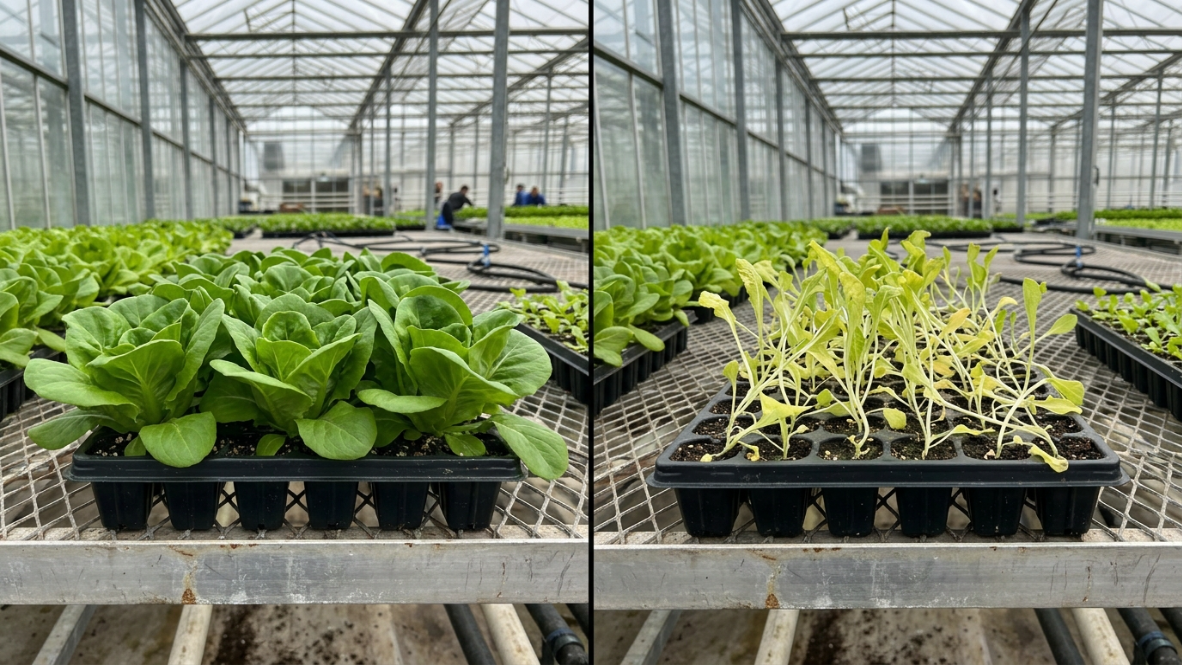
Plants often show symptoms long before growers realize insufficient light is the cause.
Common warning signs include:
Leggy growth
Pale leaves
Slow vegetative growth
Reduced flowering
Small fruit
Delayed harvests
Poor color development
Reduced essential oil production in herbs
Lower cannabinoid production in cannabis
Common DLI Mistakes
Confusing PPFD with DLI. A fixture spec sheet might say “1,000 µmol/m²/s” but that tells you nothing about daily light delivery without knowing the run time. Practitioners on Reddit frequently point out that new growers fixate on peak PPFD numbers without calculating whether their actual DLI hits the crop target.
Using lux or foot-candles. These units measure light as the human eye perceives it. Plants don’t have human eyes. Always measure in µmol/m²/s (PPFD) and calculate DLI from there.
Ignoring transmission loss. The DLI maps show outdoor values. If you look up your location and see 25 mol/m²/d in June, you might think you’re fine for tomatoes. But after 40% transmission loss, you’re actually at 15 mol/m²/d. That’s a 10 mol/m²/d deficit.
Over-lighting without environmental controls. Pushing DLI higher by adding more light only works if the rest of the environment keeps up. At ambient CO₂ levels of 400 to 600 ppm, photosynthesis saturates well below 1,000 µmol/m²/s. Running high-intensity supplemental lighting without CO₂ supplementation wastes electricity because plants simply can’t use the extra photons. Temperature and humidity need to track with light levels too.
Measuring once and assuming. Transmission changes with glazing age, dirt buildup, and seasonal sun angle. A measurement from May won’t represent December conditions. Check when it matters most, which is during the low-light months when your DLI deficit is largest.
Treating all DLIs as equivalent. As the UGA research showed, the same DLI number can produce meaningfully different growth depending on how it’s delivered (high PPFD for short hours vs. lower PPFD for longer hours). Planning supplemental lighting strategy without considering this trade-off leaves performance on the table.
DLI, Supplemental Lighting, and ROI
Supplemental lighting typically accounts for 10 to 30% of greenhouse operating expenses. Across the entire U.S. controlled environment agriculture industry, lighting electricity costs total around $600 million per year. DLI-based control is how that number comes down.
Right-sizing fixtures to your actual deficit rather than over-speccing saves capital on day one and energy every day after. LEDs deliver the same DLI as HPS fixtures with substantially less heat and lower energy draw, which matters for both the electric bill and the HVAC budget. Remote power systems like OptiDrive move driver heat out of the grow space entirely, further reducing the cooling load that supplemental lighting creates.
The connection between DLI management and profitability is direct: every mol/m²/d of deficit you close translates to measurable improvements in yield, quality, and consistency. For a detailed breakdown of the financial math, the greenhouse lighting ROI guide walks through payback calculation step by step.
Key Takeaways
DLI measures total daily photosynthetic light.
Greenhouses commonly lose 35–50% of outdoor light.
PPFD alone does not determine crop performance.
Every crop has a recommended DLI target.
Supplemental LEDs should be sized according to DLI deficit, not fixture wattage.
Measuring greenhouse transmission annually improves lighting accuracy.
Longer photoperiods can improve light-use efficiency for many crops.
Frequently Asked Questions
What is a good DLI for a greenhouse?
It depends entirely on the crop. Leafy greens perform well at 12 to 17 mol/m²/d. Tomatoes need 20 to 35. Cannabis in flower requires 35 to 50. A common baseline minimum for general greenhouse production is 10 to 12 mol/m²/d, below which most crops struggle.
How do I measure DLI in my greenhouse?
The most accurate method is a quantum sensor (PAR meter) that logs readings over a full day and integrates them into a daily total. A quicker approach: find your outdoor DLI from the interactive DLI maps at endowment.org/dlimaps, then multiply by your greenhouse’s measured transmission percentage.
Why is my greenhouse DLI so much lower than outdoor DLI?
Glazing and structural elements absorb and reflect light. New, clean glazing transmits 60 to 80% of PAR, but by the time you factor in structural shadows, equipment, and glazing degradation, canopy-level PAR can be only 40 to 60% of outdoor levels.
Can I increase DLI by extending photoperiod instead of adding more light intensity?
Yes, for many crops. Research shows that lower PPFD over longer photoperiods can actually produce more growth than higher PPFD over shorter periods at the same DLI. However, photoperiod-sensitive crops like flowering cannabis need strict dark periods and cannot use this strategy freely.
What happens if DLI is too high?
Over-lighting stresses plants, especially without adequate CO₂, temperature control, and humidity management. Symptoms include bleaching, leaf curling, and reduced yields. More light is not always better if the rest of the growing environment can’t keep pace.
How does CO₂ relate to DLI in a greenhouse?
At ambient CO₂ levels (400 to 600 ppm), photosynthesis saturates at moderate light intensities. Pushing DLI higher with supplemental lighting only pays off if CO₂ is also supplemented, typically to 800 to 1,200 ppm for high-light crops. Without it, the extra photons go unused and the extra electricity is wasted.
Do I need supplemental lighting for cannabis in a greenhouse?
Almost always, yes. Greenhouse structures reduce outdoor DLI by 30 to 70%, meaning indoor levels rarely exceed 30 mol/m²/d. Since flowering cannabis targets 35 to 50 mol/m²/d, supplemental lighting is necessary for consistent, high-quality production in virtually any greenhouse cannabis operation.
What is the DLI carryover effect?
Recent research found that plants can carry excess photosynthate from a sunny day into the next day, allowing growers to reduce the DLI target by roughly 5.25 mol/m²/d on the day following a high-light day. This creates a real opportunity to cut supplemental lighting energy costs without sacrificing yield.