Cannabis DLI Guide 2026: Formula, Targets & Stages
Learn Cannabis DLI: what it is, the PPFD × hours × 0.0036 formula, and 2026 targets by stage (seedling, veg, flower, auto). Get pro tips to boost yields.
TL;DR
Daily Light Integral (DLI) measures the total photosynthetically active photons your cannabis plants receive over a full day, expressed in mol/m²/day. It is the single most important lighting metric for cannabis yield optimization. Seedlings need 6 to 16 DLI, vegetative plants 20 to 40, and flowering plants 35 to 50. You calculate it with a simple formula: PPFD × hours × 0.0036.
Quick Answer: What DLI Should Cannabis Receive?
Cannabis responds to total daily light, not just PPFD. The correct DLI depends on both light intensity and photoperiod. Flower rooms generally perform best around 40–45 mol/m²/day, while seedlings require much lower light to avoid stress.
If you're looking for the ideal Daily Light Integral (DLI) for cannabis, use these targets:
Growth Stage | Recommended DLI |
|---|---|
Seedlings | 6–16 mol/m²/day |
Vegetative | 20–40 mol/m²/day |
Flowering | 40–45 mol/m²/day (ideal) |
High-CO₂ Flower Rooms | Up to 50–60 mol/m²/day |
Autoflowers | 40–55 mol/m²/day |
What Is DLI?
DLI stands for Daily Light Integral. It tells you the total amount of usable light your plants receive across a 24-hour period. The unit is moles of photons per square meter per day (mol/m²/day).
Think of it this way. PPFD (photosynthetic photon flux density, measured in micromoles per second) is a speedometer reading, a snapshot of light intensity at one moment. DLI is the odometer. It tells you how far you actually traveled. Two grow rooms running identical fixtures at the same height can produce wildly different results if one runs lights for 18 hours and the other for 12. PPFD alone can’t explain that gap. DLI can.
This matters because cannabis yield increases in near-linear proportion to DLI, up to surprisingly high levels. Rodriguez-Morrison et al. (2021) demonstrated yield increases all the way up to 1,800 µmol/m²/s, corresponding to a DLI of roughly 78 mol/m²/day, with minimal effects on cannabinoid and terpene concentrations. The old assumption that pushing more light sacrifices potency doesn’t hold up in well-managed environments.
Horticulturists have a rule of thumb: 1% more light equals 1% more yield. Cannabis follows that same pattern, at least until environmental factors become the bottleneck.
If you’re planning a flower room, get a lighting consultation before choosing fixtures. DLI targets should drive that decision, not wattage.
Why DLI Matters More Than Wattage
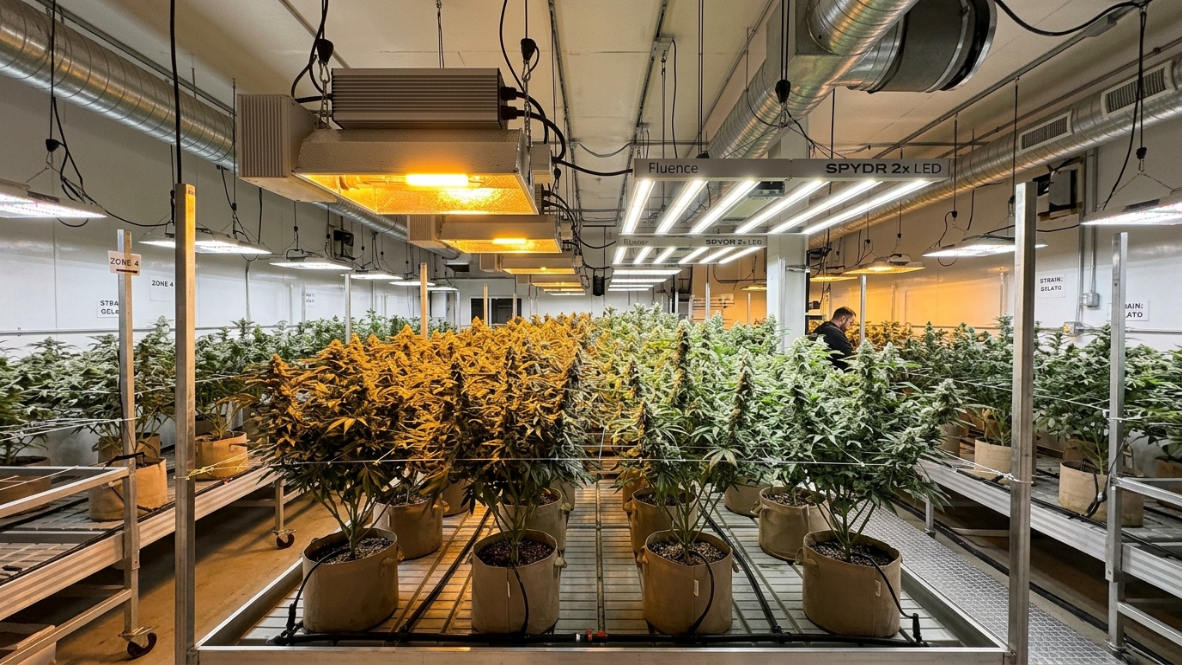
Many growers still compare lights by wattage, but watts only measure electricity consumption—not how much usable light reaches the plant.
A 650W LED with high photon efficacy may deliver significantly more usable light than a 1000W HPS fixture. DLI accounts for the actual photons reaching the canopy over an entire day, making it a much better metric for comparing grow room performance.
When planning a cannabis lighting system, think in this order:
Target DLI
Required PPFD
Photoperiod
Fixture selection
Electrical consumption
Never work backwards from wattage alone.
The DLI Formula
The calculation is straightforward:
DLI = PPFD × photoperiod (hours) × 0.0036
The 0.0036 conversion factor accounts for converting seconds to hours and micromoles to moles (3,600 seconds per hour ÷ 1,000,000 micromoles per mole).
Worked Examples
Here’s where it gets interesting. Two completely different setups can deliver the same DLI:
Veg room: 600 PPFD × 18 hours × 0.0036 = 38.9 DLI
Flower room: 900 PPFD × 12 hours × 0.0036 = 38.9 DLI
Same daily light dose. Totally different intensity and schedule. This is why comparing grow rooms by PPFD alone, or worse, by fixture wattage, leads to bad conclusions.
The practical takeaway: when you flip from 18/6 veg to 12/12 flower, you lose a third of your photoperiod. To maintain the same DLI, you need roughly 50% more PPFD intensity. Most growers don’t grasp this until they’ve lost a cycle to underwhelming flower production.
DLI Conversion Table
This table makes it easy for growers to estimate DLI without using a calculator.
PPFD | 12 Hours | 18 Hours | 20 Hours | 24 Hours |
|---|---|---|---|---|
200 | 8.6 | 13.0 | 14.4 | 17.3 |
300 | 13.0 | 19.4 | 21.6 | 25.9 |
400 | 17.3 | 25.9 | 28.8 | 34.6 |
500 | 21.6 | 32.4 | 36.0 | 43.2 |
600 | 25.9 | 38.9 | 43.2 | 51.8 |
700 | 30.2 | 45.4 | 50.4 | 60.5 |
800 | 34.6 | 51.8 | 57.6 | 69.1 |
900 | 38.9 | 58.3 | 64.8 | 77.8 |
1000 | 43.2 | 64.8 | 72.0 | 86.4 |
Cannabis DLI Targets by Growth Stage
This table is the reference point. Bookmark it.
Growth Stage | DLI Target (mol/m²/day) | Typical PPFD (µmol/m²/s) | Photoperiod |
|---|---|---|---|
Seedlings / Clones | 6–16 | 80–200 | 18–24h |
Vegetative | 20–40 | 300–600 | 18/6 |
Flowering | 35–50 | 600–1,000 | 12/12 |
Autoflower (flowering) | 40–55 | 500–800 | 18/6 or 20/4 |
Seedlings and Clones
Young plants with limited leaf area and no established root system cannot process intense light. A PPFD range of 80 to 200 keeps leaves healthy without overwhelming transpiration.
The trap here is subtle. Because propagation often runs 18 to 24 hours of light, DLI can quietly climb even when the PPFD reading looks safe. At 200 PPFD on a 24-hour cycle, you’re already at 17.3 DLI, which pushes the upper boundary for unrooted clones. Excess light triggers photosynthesis that demands water and nutrients the rootless cutting simply cannot supply, resulting in yellow, cupped leaves that growers often misdiagnose as a nutrient problem.
Vegetative Stage
Veg plants on an 18/6 schedule accumulate significant DLI even at moderate intensities. A target range of 20 to 40 mol/m²/day supports strong branching and leaf development. PPFD between 300 and 600 µmol/m²/s will get you there comfortably.
One often-overlooked guideline from California Lightworks: veg DLI should be at least 75% of your flower DLI. If your flower room targets 40 DLI and your veg room delivers only 20, you’re setting up transition shock. Plants that jump from a low-light veg environment into an intense flower room can stall for days while they acclimate.
Flowering Stage
This is where DLI matters most. The commercial sweet spot sits between 40 and 45 mol/m²/day, with some high-performance cultivars benefiting from DLI up to 50. Below 40, flower structure, resin production, and overall yield begin to decline proportionally.
For a deeper breakdown of flower room design around these targets, the cannabis flower room lighting guide covers fixture selection, layout, and PPFD mapping in detail.
The diminishing returns curve is real. Beyond roughly 50 DLI, additional light produces less incremental yield while adding heat load and energy cost. Pushing past that threshold only makes sense with exceptional environmental control.
How to Choose the Right DLI
Not every cannabis cultivar performs identically under the same lighting.
Consider adjusting your target based on:
Lower DLI (30–40)
Suitable for:
Heat-limited grow rooms
No CO₂ supplementation
Young flowering plants
Low-power LED fixtures
Medium DLI (40–45)
Ideal for:
Most commercial indoor grows
Quality-focused production
Standard environmental control
Higher DLI (45–55)
Appropriate when:
CO₂ exceeds 900 ppm
Irrigation is optimised
Leaf temperature is controlled
High-efficacy LEDs are used
Cultivars tolerate high light intensity
Autoflower DLI: Why the Math Is Different
Autoflowers don’t need a 12/12 flip to initiate flowering. They flower based on age, which means you can keep them on 18/6 or even 20/4 through their entire life cycle. This fundamentally changes the DLI calculation.
An autoflower on 20/4 at just 555 PPFD already hits 40 DLI. A photoperiod strain on 12/12 would need 926 PPFD to reach the same daily dose. The autoflower gets there with 40% less intensity, which means less heat, less electrical draw, and less stress on the plant.
Because of this, autoflowers can maintain 40+ DLI through their flowering phase without the extreme PPFD levels that photoperiod strains demand. That said, practitioners on cannabis forums report that light stress is still very real toward the end of the autoflower cycle. One grower on the ILGM forum described running 50 DLI at 800 PPFD on an auto and noticing droopy leaves before lights-off, requiring them to dial back intensity. The plant tells you when it’s had enough.
DLI for Photoperiod vs Autoflower Cannabis
Factor | Photoperiod | Autoflower |
|---|---|---|
Flower Trigger | 12/12 | Plant age |
Typical Flower PPFD | 700–1000 | 500–800 |
Flower Photoperiod | 12 hours | 18–20 hours |
Typical Flower DLI | 40–45 | 40–55 |
Heat Production | Higher | Lower |
Electrical Demand | Higher | Lower |
DLI and CO₂: They Work as a System
Increasing DLI without addressing CO₂ is like widening a highway but keeping the on-ramp one lane. Cannabis photosynthesis hits a ceiling at ambient CO₂ levels (around 400 to 600 ppm), and that ceiling kicks in sooner than most growers expect.
Practitioners on the Coco for Cannabis forum report that cannabis starts becoming CO₂-limited at around 500 µmol/m²/s PPFD. Beyond that intensity, the plant literally cannot process more photons without more carbon dioxide. Supplementing CO₂ to 800+ ppm roughly doubles the available photosynthetic capacity, and pushing to 1,000 to 1,400 ppm during flowering allows plants to productively use PPFD up to 1,500 µmol/m²/s.
The rule of thumb: increase CO₂ before increasing light intensity, not the other way around. For a full breakdown, see this guide on the role of CO₂ in CEA.
Recommended CO₂ levels by stage:
Stage | CO₂ Target (ppm) |
|---|---|
Seedlings | ~400 |
Vegetative | 400–800 |
Flowering | 800–1,400 |
And CO₂ isn’t the only variable. VPD (vapor pressure deficit), temperature, irrigation, and nutrition all need to scale with DLI. Increasing one input without the others produces diminishing returns at best and plant stress at worst.
Environmental Factors That Limit DLI
Increasing light only improves growth when other resources keep pace.
Common limiting factors include:
Environmental Factor | Effect |
|---|---|
CO₂ | Limits photosynthesis |
Temperature | Controls enzyme activity |
VPD | Influences transpiration |
Root-zone oxygen | Affects nutrient uptake |
Irrigation | Prevents drought stress |
Fertility | Supports increased growth |
Air movement | Reduces leaf temperature |
Think of DLI as one side of a system rather than an isolated target.
DLI in a Cannabis Greenhouse
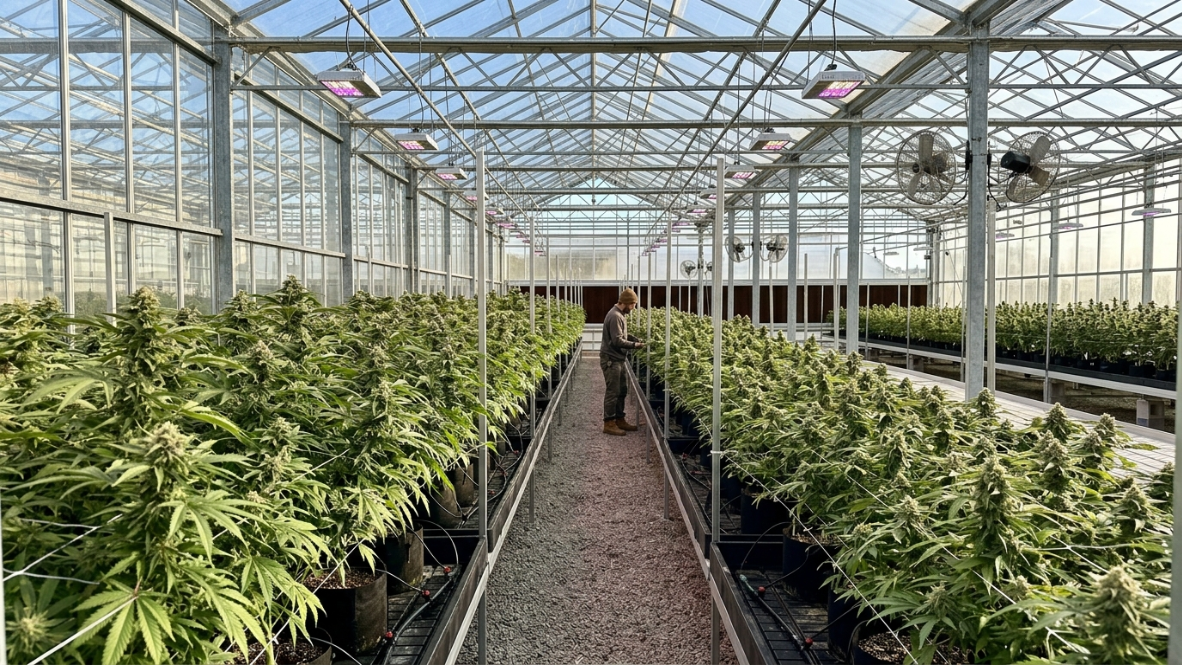
Greenhouse DLI rarely exceeds 25 to 30 mol/m²/day. Glazing, framing, and structural elements absorb 30 to 70% of incoming sunlight before it reaches the canopy. For flowering cannabis that needs 40+ DLI, supplemental lighting is essentially mandatory in any greenhouse outside the Sun Belt.
Cannabis can tolerate very high DLI (often cited up to ~65 mol/m²/day). The challenge in a greenhouse is that you’re almost never close to that ceiling without supplemental lighting.
The calculation for sizing supplemental lighting starts with your local outdoor DLI data (which varies by season and latitude), subtracts the greenhouse transmission losses, and then determines how much PPFD your fixtures need to supply and for how many hours. The DLI greenhouse guide walks through this calculation step by step.
Indoor vs Greenhouse Cannabis DLI
Grow Type | Typical DLI |
|---|---|
Indoor LED | 35–50 |
Greenhouse Winter | 10–20 |
Greenhouse Summer | 20–30 |
Outdoor Summer | 40–70+ |
Common DLI Mistakes Cannabis Growers Make
Over-lighting without environmental support. Pushing DLI above 45 or 50 without matching CO₂, HVAC, and irrigation leads to leaf bleaching, stunted growth, and pest susceptibility. More light is only more yield if the rest of the environment can keep up.
Ignoring the veg-to-flower transition. This is the math trap described earlier. When you drop from 18 to 12 hours, you need 50% more PPFD to maintain the same DLI. Growers who don’t increase intensity at flip see flower quality drop and blame genetics or nutrients.
Measuring PPFD at one point. A single center-canopy reading tells you almost nothing useful. Map PPFD across at least a 9-point grid at canopy height and keep readings within ±10 to 15% across the entire flowering footprint. Over-lit centers and under-lit edges are the most common layout mistake in commercial rooms.
Forgetting about under-canopy DLI. DLI is usually discussed as a top-of-canopy metric, but the lower canopy may receive less than half of that. Dense cannabis canopies block a significant portion of light from reaching lower flower sites, which is why under-canopy lighting exists. Adding light below the canopy raises the effective whole-plant DLI without increasing top-canopy intensity or heat load.
An experienced grower on the Autoflower Network forum offered a counterintuitive tip related to light distribution: you’re better off reducing intensity by raising the light at full power rather than dimming it. Running a fixture at full power from a greater height delivers more light to the lower canopy than running a dimmed fixture closer to the top. The physics of beam spread make this true, even though it feels wrong.
How to Improve DLI in Your Grow
Choose higher-efficacy fixtures. Fixtures with better µmol/J ratings deliver more photons per watt. If you’re still running HPS, transitioning to LED is the single biggest efficiency gain available.
Improve uniformity. A room averaging 40 DLI with ±10% uniformity outperforms a room averaging 45 DLI with ±30% uniformity. Raising fixtures slightly or adding more points of light reduces hot spots and dead zones.
Add under-canopy lighting. Rather than cranking top-light intensity (and adding heat), fixtures like the Boost XE deliver light directly to lower flower sites, raising effective whole-plant DLI without stressing the upper canopy.
Supplement CO₂. As discussed above, CO₂ unlocks the plant’s ability to use higher PPFD. This is often the cheapest way to get more value from the DLI you’re already delivering.
Use reflective surfaces. White walls, white poly, or reflective mylar on floors and walls recapture stray photons. It’s the lowest-cost DLI improvement available.
Dr. Bruce Bugbee’s advice on ramping. A frequently cited exchange from 420 Magazine references Dr. Bugbee being asked how quickly to increase PPFD. His answer: cannabis is ready to go to work as soon as it gets up in the morning, and you can increase from 500 to 900 µmol/m²/s in a day or two. Don’t overthink the ramp.
Need a lighting plan that actually hits your DLI targets? Talk to a Thrive lighting expert about your facility.
Cannabis DLI Troubleshooting Guide
Symptom | Possible Cause |
|---|---|
Bleached tops | Excess DLI |
Slow flowering | DLI too low |
Stretching | Low PPFD/DLI |
Small buds | Low flower DLI |
Leaf tacoing | Excess heat/light |
Drooping before lights off | Excess DLI |
Weak lower buds | Poor canopy penetration |
Frequently Asked Questions
What is a good DLI for cannabis?
For flowering cannabis, 40 to 45 mol/m²/day is the widely accepted sweet spot. Vegetative plants do well at 20 to 40, and seedlings or clones should stay between 6 and 16. Some cultivars can benefit from DLI up to 50 during flower, but only with proper CO₂ supplementation and environmental control.
How do I calculate DLI from PPFD?
Multiply your PPFD reading by your photoperiod in hours, then multiply by 0.0036. For example, 800 PPFD for 12 hours: 800 × 12 × 0.0036 = 34.6 mol/m²/day.
Is DLI more important than PPFD?
Yes. PPFD is an instantaneous measurement, while DLI accounts for both intensity and duration. Two rooms with the same PPFD but different light schedules will produce different results. DLI captures that difference. Always design around DLI targets, then back into the PPFD you need based on your photoperiod.
What DLI do autoflowers need?
Autoflowers can maintain 40 to 55 DLI through their flowering phase because they stay on 18/6 or 20/4 schedules. The longer photoperiod means they reach high DLI at lower PPFD intensities than photoperiod strains on 12/12, which reduces heat stress and energy costs.
Does higher DLI reduce cannabinoid potency?
Research says no. Rodriguez-Morrison et al. (2021) found that increasing DLI raised both yield and cannabinoid content simultaneously. A separate 2024 study by Sae-Tang found that terpene concentrations actually increased at higher light levels. The yield-potency tradeoff is largely a myth in well-controlled environments.
Can you give cannabis too much DLI?
Absolutely. Over-lighting without matching environmental conditions causes leaf bleaching, heat stress, and reduced yields. Practical diminishing returns set in above 45 to 50 DLI for most operations. Nielson (2024) tested intensities up to 2,300 µmol/m²/s (DLI of 100), but those extremes are research settings, not realistic commercial targets.
Why is my greenhouse DLI too low for cannabis?
Greenhouse structures typically transmit only 30 to 70% of outdoor sunlight, capping interior DLI at 25 to 30 mol/m²/day even in summer. Since flowering cannabis needs 40+ DLI, supplemental lighting is required in nearly all greenhouse cannabis operations outside the sunniest climates.
How can I estimate yield from DLI?
A rough method cited on 420 Magazine (based on Dr. Bugbee’s work): add up your total daily moles and multiply by 0.25. This assumes approximately 0.25 grams per mole of photons, which serves as a ballpark for well-managed indoor grows. Real-world results depend on genetics, CO₂, nutrition, and every other variable in the room.