Tomato Lighting Requirements Greenhouse: DLI & PPFD 2026
Tomato Lighting Requirements Greenhouse guide: DLI 20–30, PPFD 400–600, 14–18h photoperiod, and spectrum tips. Calculate needs and boost yields.
TL;DR
Greenhouse tomatoes need 20 to 30 mol/m²/d of daily light integral (DLI) during fruiting, with instantaneous PPFD levels of 400 to 600+ µmol/m²/s. Photoperiod should stay between 14 and 18 hours because anything beyond 18 hours causes leaf injury. Spectrum matters more than most growers realize: a mix of red, blue, green, and far-red light outperforms red/blue-only fixtures. Every 1% shortfall in DLI costs roughly 1% in yield.
Tomato lighting requirements in a greenhouse context come down to four variables: how much total light the plant receives each day (DLI), how intense that light is at any given moment (PPFD), how many hours the lights stay on (photoperiod), and what colors of light are in the mix (spectrum). Get any one of these wrong and you leave yield on the table. Get all four right and the math works in your favor, especially during winter months when natural light alone falls far short.
This guide covers every number and threshold a greenhouse tomato grower needs, broken down by growth stage and backed by peer-reviewed research. Whether you’re sizing a supplemental lighting system for the first time or optimizing an existing setup, the targets below give you a concrete starting point.
Talk to a greenhouse lighting specialist →
Quick Answer: What Lighting Do Greenhouse Tomatoes Need?
Greenhouse tomatoes perform best with a daily light integral (DLI) of 20–30 mol/m²/day, a canopy PPFD of 400–600 µmol/m²/s during fruiting, and a photoperiod of 14–18 hours per day. Supplemental LED lighting is typically added when natural greenhouse DLI drops below 20 mol/m²/day. A broad spectrum containing red, blue, green, and far-red wavelengths produces better results than red/blue-only lighting.
Lighting Factor | Tomato Target |
|---|---|
Fruiting DLI | 20–30 mol/m²/day |
Vegetative DLI | 15–22 mol/m²/day |
Seedling DLI | 8–15 mol/m²/day |
Fruiting PPFD | 400–600 µmol/m²/s |
Supplemental LED PPFD | 200–250 µmol/m²/s |
Photoperiod | 14–18 hours |
Blue Light | 6–12% |
Far-Red | Around 5% |
The Quick Reference Table
Before the deep dive, here is the summary table worth bookmarking.
Growth Stage | DLI Target (mol/m²/d) | PPFD Range (µmol/m²/s) | Photoperiod | Spectrum Notes |
|---|---|---|---|---|
Germination / Seedling | 8–15 | 100–300 | 14–16 h | Moderate blue (10–15%) to promote compact growth |
Vegetative | 15–22 | 300–500 | 14–18 h | Broad spectrum with red dominant, 6–12% blue |
Flowering / Fruiting | 20–30 | 400–600+ (supplemental: 200–250) | 14–18 h | High red, 6–12% blue, green for canopy penetration, 5% far-red for yield |
These numbers assume a greenhouse with supplemental lighting, not sole-source indoor production. In sole-source environments, PPFD targets during fruiting can push to 800–1200+ µmol/m²/s.
How Light Requirements Change Throughout Tomato Growth
Tomatoes do not need the same amount of light from seedling to harvest. Increasing light intensity too early can create stress, while insufficient light during flowering reduces fruit set and final yield.
Growth Stage | Plant Goal | DLI Target | PPFD Target | Lighting Priority |
|---|---|---|---|---|
Seedling | Compact plants, strong roots | 8–15 mol/m²/day | 100–300 | Blue light, shorter plants |
Vegetative | Leaf development | 15–22 | 300–500 | Balanced spectrum |
Flowering | Pollination and fruit set | 20–25 | 400–600 | High red + blue |
Fruiting | Maximum yield | 25–30 | 500–600+ | Canopy penetration |
Daily Light Integral (DLI): The Number That Matters Most
DLI measures the total amount of photosynthetically active light a plant receives over an entire day. Think of PPFD as the flow rate of a faucet and DLI as the total water collected in a bucket by day’s end. For greenhouse tomatoes, the size of that bucket determines yield.
The research converges on a clear range. Optimal DLI for greenhouse tomato production sits between 20 and 30 mol/m²/d. Iowa State University Extension classifies tomatoes as “Very High Light” crops requiring 18 to 30 mol/m²/d for productive growth. Seedlings need less, around 15 mol/m²/d for the first two to three weeks, with a PPFD of about 200 to 300 µmol/m²/s.
The 1% Rule
Here is the single most useful benchmark in greenhouse lighting economics: a 1% reduction in DLI produces roughly a 1% reduction in yield. This relationship, sometimes called the “1% rule of thumb,” has been validated in greenhouse cucumber, sweet pepper, and tomato production during winter and spring. It means that if your greenhouse is delivering 15 mol/m²/d when your tomatoes need 25, that 40% DLI shortfall translates to approximately 40% lost yield. The financial case for supplemental lighting starts right here.
The Winter DLI Problem
Northern-latitude greenhouses face a brutal light deficit in winter. In Harrow, Ontario, the outdoor DLI during winter months ranges from 5 to 15 mol/m²/d. Factor in greenhouse transmission losses (structural shading and glazing typically absorb 30 to 50% of incoming light) and the indoor DLI can drop to 2.5 to 7.5 mol/m²/d. A tomato grower in the southwestern United States might measure 13 mol/m²/d inside the greenhouse on a January day, enough for seedlings but well below the 20+ mol/m²/d needed for quality fruit production.
For a deeper look at DLI calculation methods and how to map your specific facility’s light levels, Thrive’s DLI greenhouse guide walks through the math step by step.
Supplemental Lighting Requirements by Climate Zone
The amount of artificial light required depends heavily on latitude, season, greenhouse glazing, and local weather conditions.
Location Type | Winter Indoor DLI | Supplemental Need |
|---|---|---|
Northern Europe / Canada | 2–8 mol/m²/day | Heavy LED supplementation |
Northern United States | 5–12 | Moderate to heavy supplementation |
Southern United States | 10–18 | Seasonal supplementation |
Tropical Regions | 15–25 | Usually limited supplementation |
Tomato Lighting Requirements by Variety Type
Different tomato varieties respond differently to supplemental lighting. Large beefsteak tomatoes, cluster tomatoes, and cherry tomatoes have different canopy structures and yield responses.
Tomato Type | Recommended DLI | Lighting Consideration |
|---|---|---|
Cherry Tomatoes | 20–30 mol/m²/day | High light improves sweetness (Brix) |
Cluster Tomatoes | 20–30 | Benefits strongly from interlighting |
Beefsteak Tomatoes | 18–25 | Avoid excessive vegetative growth |
Vine Tomatoes | 22–30 | High-wire systems benefit from canopy lighting |
DLI vs PPFD for Greenhouse Tomatoes
DLI and PPFD measure different aspects of plant lighting.
PPFD measures light intensity at one moment
DLI measures total accumulated light over the entire day
A greenhouse can have excellent PPFD but still produce poor yields if the photoperiod is too short.
Example:
PPFD | Photoperiod | Resulting DLI |
|---|---|---|
250 µmol/m²/s | 12 hours | 10.8 mol/m²/day |
250 µmol/m²/s | 16 hours | 14.4 mol/m²/day |
400 µmol/m²/s | 16 hours | 23 mol/m²/day |
PPFD: Instantaneous Light Intensity for Tomatoes
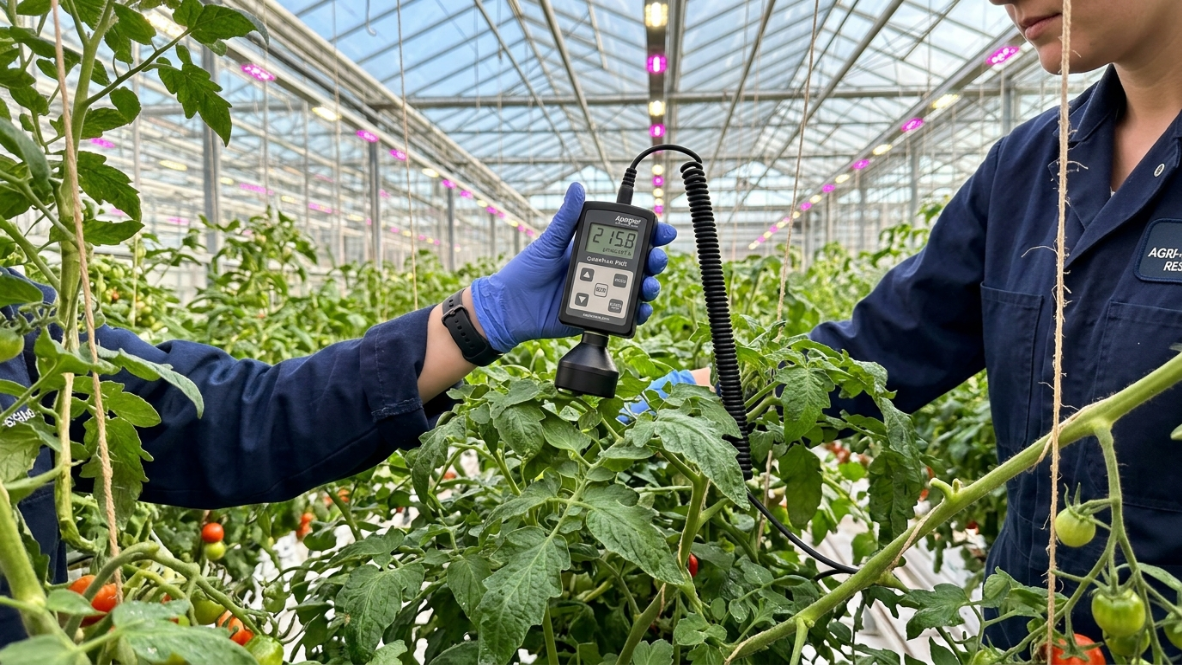
PPFD (photosynthetic photon flux density) measures how many photons of usable light hit a square meter of canopy every second, expressed in micromoles per square meter per second (µmol/m²/s). While DLI is the daily total, PPFD is the moment-to-moment intensity.
For greenhouse tomato supplemental lighting, overhead fixtures are typically implemented at 200 to 250 µmol/m²/s. This is additive to whatever natural sunlight provides. In sole-source environments, tomatoes during peak fruiting require 800 to 1200+ µmol/m²/s, but few greenhouse growers need to hit those numbers because the sun does most of the heavy lifting during the growing season.
Seedlings are a different story. Young tomato plants need 100 to 300 µmol/m²/s. Pushing intensity higher at this stage risks light stress and leggy, poorly rooted transplants.
Worked Calculation: How Much Supplemental PPFD Do You Need?
Suppose your greenhouse in the northern United States receives a winter average of 5 mol/m²/d indoors, and your fruiting-stage target is 30 mol/m²/d. You need to supplement 25 mol/m²/d.
The formula:
Supplemental PPFD = (Target DLI − Natural DLI) ÷ Photoperiod (seconds)
Converting to seconds with a 16-hour photoperiod: 16 × 3,600 = 57,600 seconds.
25,000,000 µmol/m² ÷ 57,600 seconds = 434 µmol/m²/s
That means your supplemental fixtures need to deliver about 434 µmol/m²/s over 16 hours to close the gap. This is a substantial lighting load, and it illustrates why fixture selection, layout, and power infrastructure all matter. For an overview of how PPFD targets translate to fixture planning, see our PPFD greenhouse guide.
Photoperiod: Why More Hours Isn’t Always Better
This is where many growers make a costly mistake. The intuition is that running lights longer should increase DLI without requiring higher intensity. With most crops, that logic holds. With tomatoes, it breaks down at a specific threshold.
Greenhouse tomatoes generally require a photoperiod of 14 to 18 hours. Research consistently shows that extending the photoperiod beyond 14 hours increases shoot fresh weight by 40 to 57% and yields by 15 to 20% compared to natural light alone. But pushing past 17 to 18 hours triggers a well-documented injury response.
Lighting longer than 18 hours causes leaf injury in tomato characterized by interveinal chlorosis, and yield no longer increases with further photoperiod extension. Continuous 24-hour lighting is even worse: tomato plants exposed to a 24-hour photoperiod started developing leaf chloroses after just 7 weeks.
The practical takeaway is straightforward. Hit your DLI target by adjusting intensity, not by pushing past 18 hours. If your calculation says you need more light than 18 hours at your available intensity can deliver, the answer is more powerful fixtures or better fixture placement, not a longer day.
One emerging exception worth noting: researchers have found that tomato plants grown under supplemental continuous lighting using alternating red and blue spectra remained injury-free. This is still experimental and not yet standard practice, but it points to future possibilities for dynamic LED control.
Practitioners on Reddit’s greenhouse growing communities frequently report discovering the photoperiod injury threshold the hard way, often after pushing to 20+ hours and watching interveinal chlorosis develop within weeks. It’s one of the most common and avoidable mistakes in greenhouse tomato lighting management.
Light Spectrum for Greenhouse Tomatoes
Spectrum is where the science has moved fastest, and where the biggest information gaps exist among competing guides. The short version: tomatoes need a broad spectrum, and red/blue-only “pink” fixtures leave measurable yield on the table.
Red and Blue: The Foundation
Red light (600 to 700 nm) drives photosynthesis most efficiently. But growing tomatoes under monochromatic red light alone causes “red light syndrome,” including elongated stems, reduced leaf expansion, and impaired photosynthetic function. Adding blue light (400 to 500 nm) suppresses these symptoms.
Research from Wageningen University found that adding 6 to 12% blue light to supplemental red light is optimal for growth and yield, while pushing to 24% blue is suboptimal. The ideal red-to-blue ratio for maximizing fruit yield in cherry tomatoes lands around 3:1, with a small inclusion of far-red light at about 5%.
Green Light: The Canopy Penetrator
Green light (500 to 600 nm) is often dismissed as wasted energy because individual leaves absorb it less efficiently than red or blue. But in a tomato canopy with multiple leaf layers, green light penetrates deeper. Research from Wageningen University & Research showed that grow lights containing 40% green in the output spectrum increased greenhouse tomato yield by 6% compared to supplemental LED light containing only blue and red at the same total intensity.
The mechanism is straightforward. Middle-canopy leaves showed significant increases in chlorophyll ratios and carotenoid concentrations as green light intensity increased, indicating that more light was reaching the interior of the canopy. For a dense, tall crop like high-wire tomatoes, this canopy penetration matters. For a broader discussion of how light spectra affect plant growth, Thrive’s spectral impact summary covers the research across crop types.
Far-Red Light: The Yield Lever
Far-red light (700 to 750 nm) has been the biggest spectral story in greenhouse lighting research over the past few years. Signify, Wageningen University & Research, and Nunhems conducted research showing that far-red light can produce an additional yield of almost one-fifth in tomatoes, depending on variety.
A dose-response study found that adding far-red to supplementary lighting can increase tomato fruit yield linearly up to a far-red fraction of 0.40, though higher fractions showed limited or negative effects. Most current supplemental LED fixtures emit far-red fractions of just 0 to 0.1, compared to roughly 0.46 under direct solar radiation. In other words, the typical supplemental spectrum is actually far-red deficient compared to what tomatoes evolved under.
Why Full-Spectrum White Matters
The combined evidence, including the green-light canopy penetration data, the far-red yield research, and the blue-light optimization work, all point in the same direction: tomatoes perform best under a broad, continuous spectrum that includes meaningful amounts of green and far-red alongside the red and blue foundation. Full-spectrum white fixtures deliver this naturally. They also create better working conditions for greenhouse staff, a practical benefit that growers mention consistently.
Ideal LED Spectrum for Greenhouse Tomatoes
Commercial tomato lighting generally favors a broad spectrum rather than narrow red/blue fixtures.
Spectrum | Recommended Range | Purpose |
|---|---|---|
Red (600–700nm) | 60–75% | Photosynthesis and biomass |
Blue (400–500nm) | 6–12% | Compact growth and leaf development |
Green (500–600nm) | 10–30% | Canopy penetration |
Far-red (700–750nm) | 5–15% | Flowering and fruit expansion |
Supplemental Lighting Strategy: Top Lighting vs. Interlighting
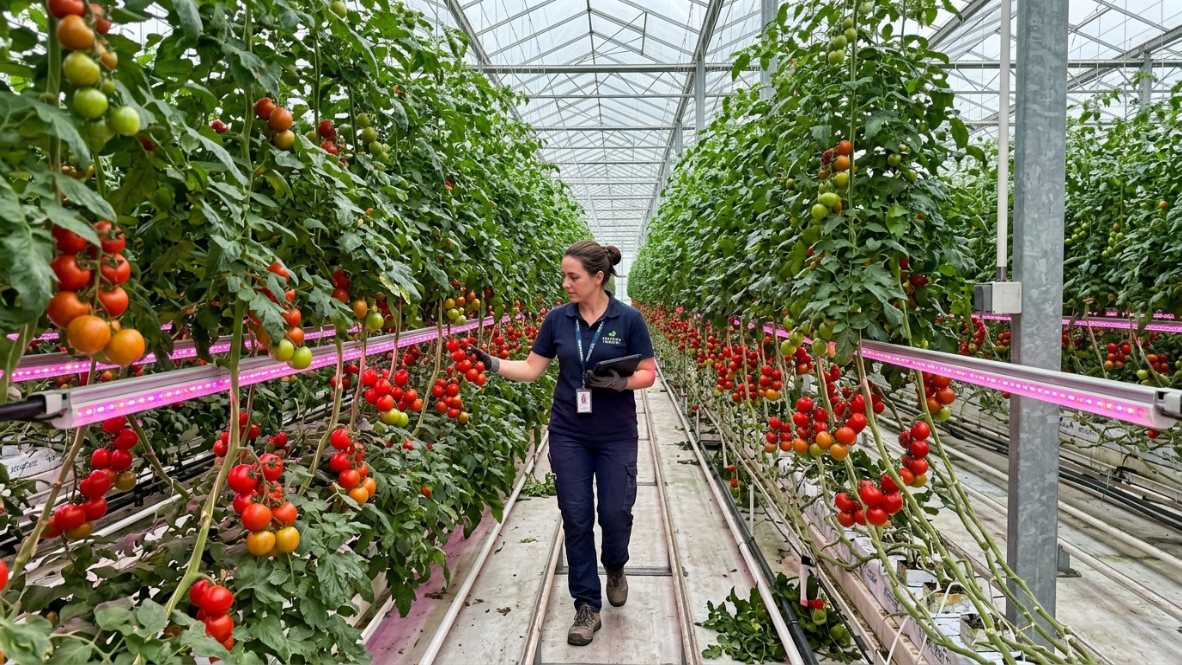
High-wire tomato production creates a specific problem. Plants grow tall, often exceeding 3 meters, and the upper canopy shades the lower and middle leaves. Overhead fixtures alone cannot solve this because light from above attenuates rapidly through dense leaf layers.
The Case for Interlighting
Commercial greenhouse trials found that adding intercanopy lighting improved crop yields by up to 24% under high light intensities. When partially replacing toplighting with intercanopy lighting at 375 µmol levels, yields increased 20 to 24%, compared to 10 to 12% gains at lower intensities of 250 µmol.
The seasonal data is particularly compelling. Daytime LED interlighting increased the photosynthetic capacity of middle and lower canopy leaves, yielding a 27% increase in winter production. A Mediterranean greenhouse trial found that supplemental LED interlighting accelerated ripening by one week in spring and two weeks in summer, resulting in 16% higher cumulative productivity.
Nighttime interlighting showed additional benefits: yield increases of 24% in winter and 12% in summer, plus 20% higher total soluble solids and 25% higher ascorbic acid content in the fruit. Better-tasting, more nutritious tomatoes grown on fewer kilowatt-hours.
For growers interested in under-canopy supplementation, the Boost XE is purpose-built for this application, delivering light directly to the mid and lower canopy layers where shading is most severe.
One project manager shared in a YouTube walkthrough of a high-wire tomato facility that adding interlighting rows at the 1-meter and 2-meter heights transformed fruit set in the lower trusses, which had previously been their weakest-performing zone. The research supporting under-canopy lighting is now extensive enough that the question has shifted from “does it work?” to “what’s the optimal placement?”
Greenhouse Tomato LED Lighting Calculation Example
To size LED fixtures:
Required Supplemental PPFD = (Target DLI - Natural DLI) ÷ Lighting Hours × 3,600
Example:
Target:
Desired DLI: 25 mol/m²/day
Natural greenhouse DLI: 10 mol/m²/day
Lighting duration: 16 hours
Calculation:
15 ÷ (16 × 3,600)
= approximately 260 µmol/m²/s supplemental PPFD
This means the greenhouse requires fixtures capable of delivering approximately:
250–275 µmol/m²/s supplemental PPFD at canopy height.
LED vs. HPS for Greenhouse Tomatoes
The transition from high-pressure sodium (HPS) to LED supplemental lighting in greenhouse tomato production is well past the experimental phase. The numbers are clear on three fronts: energy, yield, and plant physiology.
Energy Savings
A Dutch modeling study calculated energy savings of up to 60% for tomato production when transitioning to LED. A Purdue University study found even larger savings, 55 to 75%, when comparing intracanopy LED supplemental lighting to standard overhead HPS treatments, while achieving equivalent increases in fruit number and yield.
Yield and Quality
A meta-analysis of 31 published papers and 100 total observations found that supplemental LED lighting improved yield by 40%, photosynthetic capacity by 50%, and leaf chlorophyll content by 31% compared to control conditions. Soluble solids increased 6% and ascorbic acid increased 11%. These are not marginal gains.
Separate research found that LED fixtures with a full PAR spectrum improved light use efficiency by 19% and reduced transpiration rate by 40% compared to HPS.
The HVAC Factor
LEDs produce less radiant heat at the canopy. This is almost always a benefit, as it reduces cooling load and gives the grower more climate control. But in cold climates during winter, growers transitioning from HPS may need to adjust their heating strategy since they are removing a significant heat source from the growing space. For growers evaluating the full economics of transitioning to LED, the energy, yield, and HVAC factors all need to be modeled together.
For larger greenhouse installations, centralized power architecture like the OptiDrive system moves LED drivers out of the growing area entirely, further reducing heat at the canopy and simplifying electrical infrastructure.
Tools for Measuring Tomato Greenhouse Lighting
Growers should measure actual canopy light rather than relying only on fixture specifications.
Important measurements:
Measurement | Tool |
|---|---|
PPFD | Quantum sensor |
DLI | Light meter or PAR sensor |
Spectrum | Spectrometer |
Uniformity | PPFD mapping |
Measure:
Top canopy
Middle canopy
Lower fruiting zone
A greenhouse with high average PPFD but poor uniformity can still underperform.
Common Mistakes in Greenhouse Tomato Lighting
Running the photoperiod past 18 hours. The assumption that more hours means more light means more yield breaks down with tomatoes. At 17 to 18 hours, you hit a physiological ceiling. Past that, you get chlorosis and declining vigor.
Ignoring the lower canopy. Overhead lighting only reaches so far into a high-wire tomato plant. The middle and lower trusses, often the weakest-performing zone, are the most responsive to interlighting. Skipping under-canopy supplementation means leaving 12 to 27% of potential winter yield unharvested.
Comparing fixtures on wattage instead of delivered PPFD. A 1000W fixture that delivers uneven light across the canopy is worse than a 600W fixture with tight uniformity. What matters is the PPFD at canopy level and how consistently it’s distributed.
Not accounting for greenhouse transmission losses. Your outdoor weather station says 20 mol/m²/d. Your plants are receiving 10 to 14 mol/m²/d after structural shading, glazing absorption, and overhead equipment block their share. Always measure or model indoor DLI, not outdoor.
Treating spectrum as an afterthought. Red/blue “pink” fixtures miss the green-light canopy penetration benefit and the far-red yield response. Spectrum is not just about photosynthesis efficiency per photon. It’s about how light distributes through a real, multi-layered canopy and how the plant’s developmental pathways respond.
Frequently Asked Questions
What DLI do greenhouse tomatoes need?
Fruiting-stage greenhouse tomatoes need 20 to 30 mol/m²/d for optimal production. Seedlings require 8 to 15 mol/m²/d. The midpoint target most commercial growers aim for is around 25 mol/m²/d. Every 1% shortfall in DLI roughly equals 1% lost yield.
How many hours of light do greenhouse tomatoes need per day?
Between 14 and 18 hours. Research shows that extending beyond natural daylight hours increases yield by 15 to 57% depending on the metric, but exceeding 17 to 18 hours causes interveinal chlorosis (leaf yellowing between veins) and no further yield improvement. Never run 24-hour continuous lighting on tomatoes.
What PPFD should I target for supplemental greenhouse tomato lighting?
For overhead supplemental lighting in a greenhouse, 200 to 250 µmol/m²/s is the standard range. The exact number depends on your natural DLI shortfall and photoperiod length. Use the formula: Supplemental PPFD = (Target DLI minus Natural DLI) ÷ (Photoperiod in seconds). In sole-source environments, fruiting tomatoes need 800 to 1200+ µmol/m²/s.
Is red/blue LED light enough for greenhouse tomatoes?
No. While red and blue light power photosynthesis, tomatoes benefit measurably from green light (which penetrates deeper into the canopy, adding 6% yield in WUR trials) and far-red light (which can increase yield by up to 20% depending on variety). Full-spectrum white fixtures provide all of these wavelengths naturally.
How much energy do LEDs save compared to HPS for greenhouse tomatoes?
Studies report 40 to 75% energy savings depending on the comparison. A Dutch analysis found 60% savings from transitioning to LED. A Purdue study found 55 to 75% savings when comparing intracanopy LED lighting to overhead HPS at equivalent yield levels.
Does interlighting really improve greenhouse tomato yields?
Yes. Peer-reviewed trials consistently show 12 to 27% yield improvements from adding under-canopy or intercanopy lighting, with the largest gains in winter when natural light is lowest. Nighttime interlighting also improves fruit quality, increasing soluble solids by 20% and vitamin C by 25%.
How do I calculate how much supplemental light my greenhouse tomatoes need?
Subtract your average indoor DLI (account for 30 to 50% greenhouse transmission loss from outdoor measurements) from your target DLI (20 to 30 mol/m²/d for fruiting). Divide the shortfall by the number of seconds in your planned photoperiod. The result is the supplemental PPFD your fixtures need to deliver.
When should I start supplemental lighting for greenhouse tomatoes?
Start when your indoor DLI drops below 20 mol/m²/d. In northern North America, this typically means October through March, though the exact window varies by latitude and greenhouse design. Seedling-stage supplementation should begin when indoor DLI falls below 12 to 15 mol/m²/d.
Getting greenhouse tomato lighting requirements right is not just a technical exercise. It’s the single biggest lever for winter yield and year-round consistency. If you’re planning a new supplemental lighting installation or upgrading from HPS, the numbers in this guide give you a foundation for a solid lighting design.
Schedule a free consultation with a Thrive lighting specialist →