PPFD Greenhouse Guide 2026: Targets, DLI & Mapping
Master PPFD Greenhouse lighting: crop targets, PPFD to DLI formulas, uniformity mapping, and cost tips. Plan smarter supplemental light.
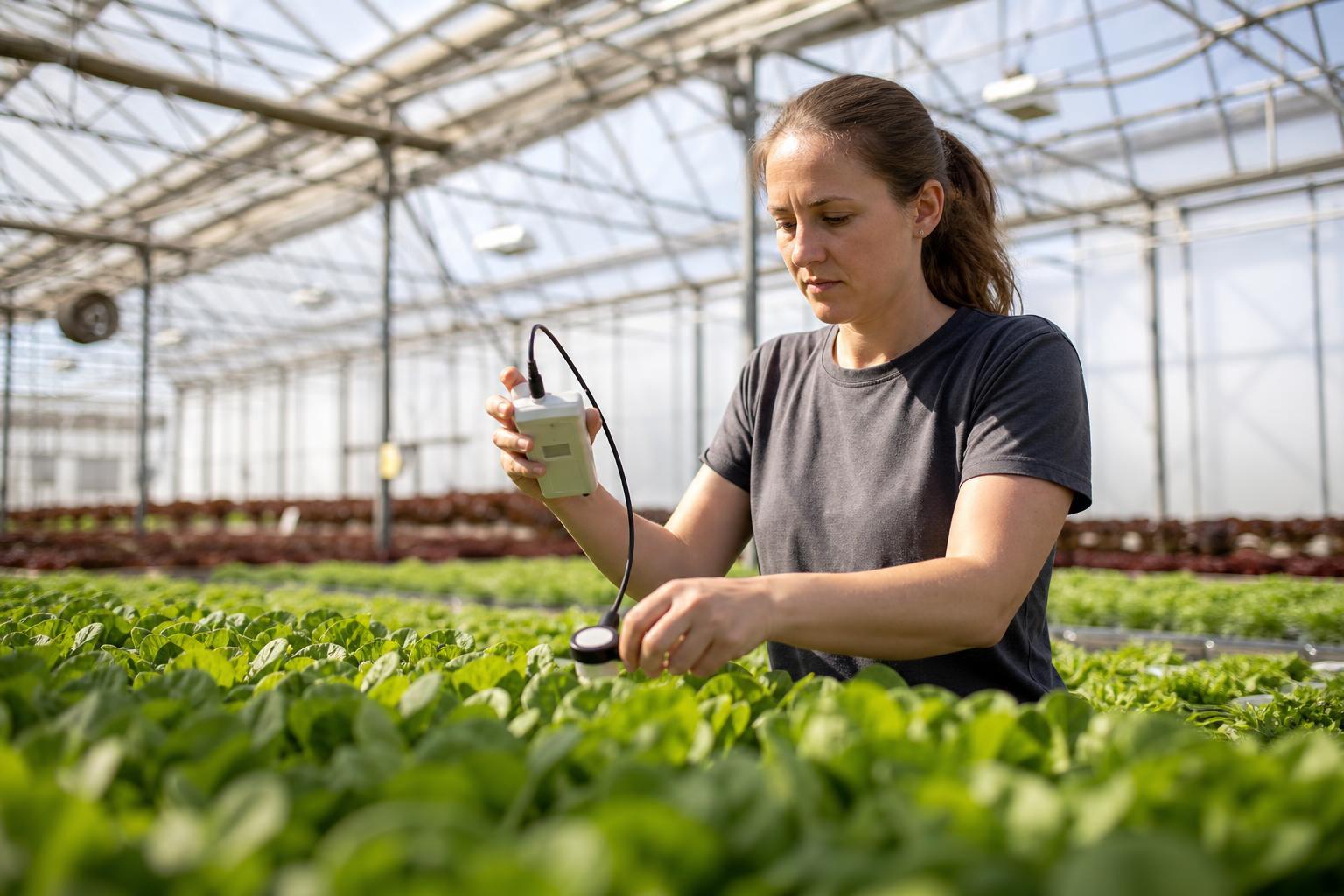
TL;DR
PPFD (Photosynthetic Photon Flux Density) measures how much usable light actually reaches your plant canopy, expressed in µmol/m²/s. In a greenhouse, PPFD is the single most important metric for sizing supplemental lighting because glazing, season, and weather constantly change how much sunlight gets through. Knowing your PPFD targets by crop, converting between PPFD and DLI, and measuring properly with multi-point mapping are the foundation of any profitable greenhouse lighting strategy.
Greenhouse growers hear the term PPFD constantly, on fixture spec sheets, in conversations with lighting reps, and in university extension bulletins. But the concept is often explained poorly or buried in jargon. This guide breaks down what PPFD means in a greenhouse context, why it matters more here than in any other growing environment, and how to use the number to make real decisions about supplemental lighting.
If you’re evaluating supplemental lighting for your greenhouse, talk to a lighting expert before committing to a fixture layout.
Quick Answer: What PPFD Should a Greenhouse Have?
Most greenhouse crops require 150–700 µmol/m²/s depending on the species, growth stage, photoperiod, and CO₂ concentration. Rather than targeting one universal PPFD number, growers should determine their crop's Daily Light Integral (DLI) goal first, calculate how much sunlight the greenhouse naturally provides, and then use supplemental lighting to close the remaining gap.
For most commercial greenhouses:
Crop Type | Typical PPFD |
|---|---|
Leafy greens | 150–300 µmol/m²/s |
Herbs | 200–400 |
Strawberries | 300–350 |
Tomatoes | 400–700 |
Cannabis (flower) | 700–1,500 |
The correct PPFD depends on:
crop species
greenhouse glazing
season
latitude
supplemental lighting hours
CO₂ concentration
target DLI
What Does PPFD Stand For?
PPFD stands for Photosynthetic Photon Flux Density. In plain terms, it measures how many photons of usable light land on a square meter of surface every second. The unit is µmol/m²/s (micromoles per square meter per second). If you want to understand what a micromole actually represents, it is roughly 602 quadrillion photons, but the number itself matters less than what it tells you: how intense the light is at the canopy.
Only photons in the 400 to 700 nanometer wavelength range count. This band is called PAR (Photosynthetically Active Radiation), and it covers the light plants actually use for photosynthesis.
A few quick distinctions that trip people up:
PAR is a range of wavelengths, not a measurement. It defines which light counts.
PPF (Photosynthetic Photon Flux) measures how many PAR photons a fixture emits in total. It tells you about the light source, not what your plants receive.
PPFD measures how many of those photons actually arrive at the plant canopy. The difference is enormous because fixture height, optics, reflections, and greenhouse glazing all eat into the light between the source and the leaf.
DLI (Daily Light Integral) is PPFD accumulated over an entire day. Think of PPFD as the flow rate and DLI as the total volume.
Why Not Lux?
Lux measures brightness as the human eye perceives it, which means it is heavily biased toward green light. Plants, on the other hand, favor red and blue wavelengths for photosynthesis. One industry analysis found that 500 lux from pink LEDs delivers 72% more usable PAR than the same lux reading from white LEDs. That discrepancy makes lux essentially useless for evaluating grow lights. PPFD treats all photons in the PAR range equally regardless of wavelength, which is why it became the standard metric in professional greenhouse management.
PPFD at a Glance
Metric | Measures | Unit | Why It Matters |
|---|---|---|---|
PAR | Light plants can use | 400–700 nm | Defines usable wavelengths |
PPF | Total light emitted | µmol/s | Fixture output |
PPFD | Light reaching canopy | µmol/m²/s | Crop light intensity |
DLI | Total daily light | mol/m²/day | Daily plant light dose |
Lux | Human brightness | lux | Not suitable for grow lighting |
Why PPFD Matters in a Greenhouse
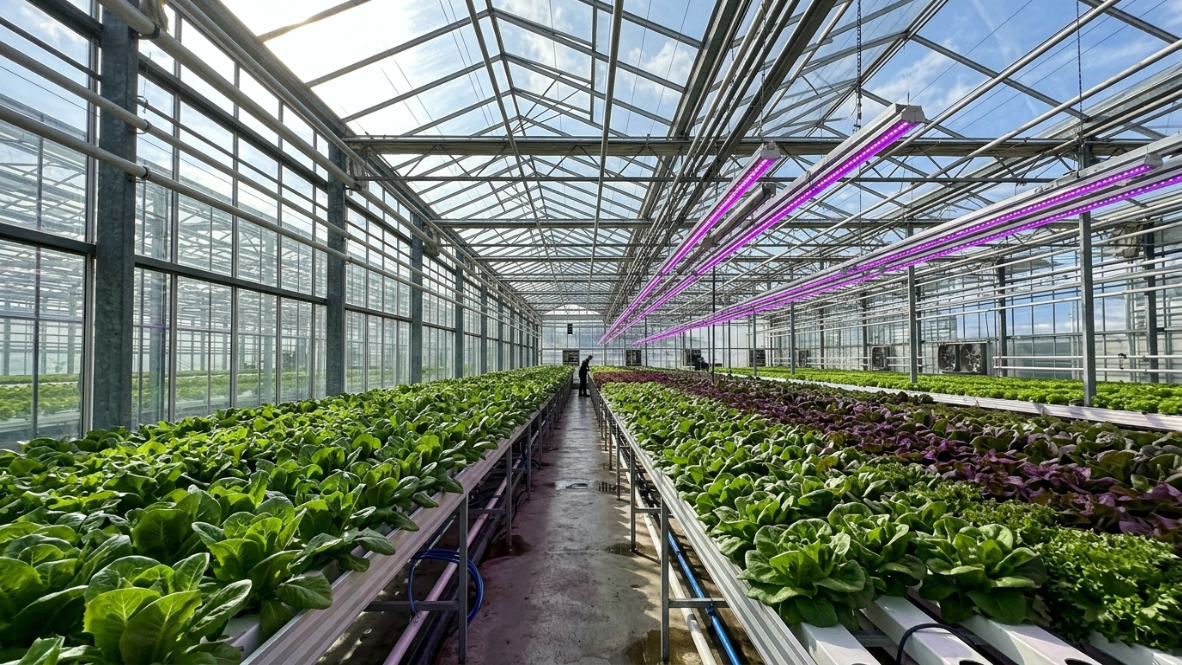
Every growing environment needs light. What makes greenhouse PPFD uniquely complicated is that you are always dealing with two light sources at once: the sun and your supplemental fixtures. Both are variable, and the greenhouse structure itself sits between the sun and your crops.
Glazing Eats Your Sunlight
Greenhouse coverings, whether glass, polycarbonate, or polyethylene film, reduce light transmission significantly. A common planning assumption is 70% transmission, but real-world numbers vary from as low as 45% with aging or dirty glazing to 80% or more with new glass. If your transmission drops from 0.55 to 0.45 due to grime or frequent shade screen deployment, your indoor natural DLI falls by roughly 18%. That deficit shows up almost one-for-one in your supplemental lighting bill.
Seasonal Swings Drive Supplemental Lighting Needs
At northern latitudes, the difference in natural DLI between June and December can be dramatic. Research on greenhouse lettuce production confirms that consistent year-round production may require supplemental lighting from fall through spring, especially above 40°N latitude. PPFD greenhouse measurements during winter often reveal that crops are receiving less than half of their target light levels from the sun alone.
For a detailed walkthrough of how to plan supplemental lighting for greenhouses, including fixture selection and scheduling, that guide covers the full process.
Canopy Light Gradients
In dense plantings, PPFD at the top of the canopy can be three or four times higher than at the lower leaves. Published research shows that low PPFD at the lower canopy limits plant growth, particularly in winter when the sun angle is low and day length is short. This is the reason under-canopy supplemental lighting exists as a strategy. Fixtures like the Boost XE are designed specifically to address this gradient by pushing light into the lower canopy rather than adding more intensity at the top.
The Cost Equation
Lighting accounts for up to 30% of total operating costs in greenhouses that run supplemental fixtures. Getting your PPFD targets right, not too high, not too low, directly affects energy spend and greenhouse lighting ROI. Overshooting your PPFD target wastes electricity. Undershooting it costs you yield.
PPFD Targets by Greenhouse Crop
PPFD requirements vary significantly by crop and growth stage. The table below reflects commonly cited ranges, though keep in mind that these numbers assume appropriate temperature, humidity, and CO₂ levels.
Crop | PPFD Range (µmol/m²/s) |
|---|---|
Leafy greens (lettuce, spinach) | 150–300 |
Herbs (basil, mint, coriander) | 200–400 |
Strawberries | 300–350 |
Tomatoes | 400–700 |
Cannabis (vegetative) | 300–600 |
Cannabis (flower, no CO₂ supplementation) | 700–900 |
Cannabis (flower, with CO₂ at 1,000–1,200 ppm) | 1,200–1,500 |
Sources: Nexsel Tech crop PPFD/DLI database, Weed Seeds Express PPFD cannabis research
Two important caveats.
First, more light is not always better. Every crop has a light saturation point where additional photons stop producing additional photosynthesis and start causing stress or wasted energy. For lettuce, that point is surprisingly low. Research has shown that at a constant DLI target, lettuce photosynthesizes better at a lower PPFD delivered over a longer photoperiod than at a higher PPFD for fewer hours.
Second, the CO₂ connection cannot be ignored. Increasing CO₂ concentration from 400 to 1,000 µmol/mol within the PPFD range of 303 to 653 µmol/m²/s increased net photosynthesis by 51%. For cannabis growers especially, PPFD targets are meaningless without specifying the CO₂ environment. Learn more about CO₂ in controlled environment agriculture and how it interacts with lighting decisions.
Recommended DLI Targets by Crop
Many growers plan around DLI rather than PPFD because sunlight changes throughout the year.
Crop | Recommended DLI |
|---|---|
Lettuce | 12–17 mol/m²/day |
Herbs | 12–20 |
Tomatoes | 20–30 |
Cucumbers | 20–30 |
Peppers | 20–30 |
Strawberries | 17–25 |
Cannabis | 30–45 |
How PPFD Relates to DLI
PPFD is an instantaneous reading, a snapshot of light intensity at one moment. DLI is the daily total, the sum of all photons received over 24 hours. In a greenhouse where cloud cover, sun angle, and shade screens constantly change the light hitting your canopy, DLI is the better planning metric. But you need PPFD to size your fixtures.
The Conversion Formulas
From PPFD to DLI:
DLI (mol/m²/d) = PPFD (µmol/m²/s) × Hours of Light × 3600 ÷ 1,000,000
From DLI deficit to required supplemental PPFD:
Supplemental PPFD = (DLI Deficit × 1,000,000) ÷ (Hours On × 3600)
Worked Example: Lettuce in Michigan, December
Say you are growing butterhead lettuce at 42°N latitude. Your crop needs a target DLI of 17 mol/m²/d. In December, the outdoor DLI averages roughly 12 mol/m²/d. Your greenhouse has 60% light transmission, so the indoor natural DLI is:
12 × 0.60 = 7.2 mol/m²/d
Your DLI deficit is 17 - 7.2 = 9.8 mol/m²/d. If you plan to run supplemental lights for 16 hours:
Supplemental PPFD = (9.8 × 1,000,000) ÷ (16 × 3600) = 170 µmol/m²/s
That is the average PPFD your greenhouse supplemental lighting fixture needs to deliver across the canopy to close the gap.
This calculation explains why greenhouse growers plan around DLI targets but use PPFD to evaluate and compare fixture performance.
PPFD vs DLI: Which Metric Matters More?
PPFD and DLI work together rather than competing.
Use PPFD when you want to:
compare fixtures
design lighting layouts
verify canopy intensity
create PPFD maps
Use DLI when you want to:
plan seasonal lighting
estimate crop productivity
calculate lighting schedules
determine supplemental lighting needs
The best greenhouse lighting plans start with a target DLI and then calculate the PPFD required to reach it.
How to Measure PPFD in Your Greenhouse
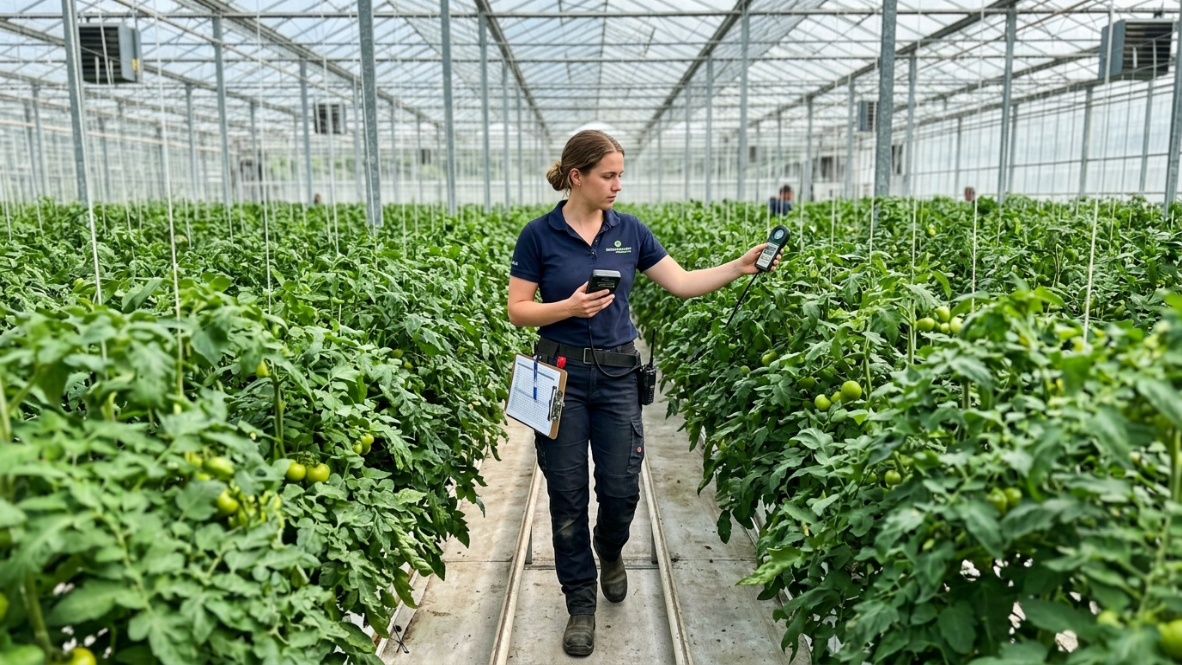
The Right Equipment
A calibrated quantum PAR sensor (also called a PPFD meter) is the standard tool. Apogee and LI-COR sensors are the industry benchmarks for professional operations. They are cosine-corrected and calibrated for LED spectra.
Smartphone apps exist as a lower-cost entry point. Among phone-based options, grower testing indicates the Photone app is the most accurate. But phone sensors have real limitations. Commercial growers who need precision for fixture layout validation and crop management should invest in a dedicated quantum sensor or request verified PPFD maps from their lighting manufacturer.
Multi-Point Mapping, Not Single Readings
A single PPFD reading at one spot tells you almost nothing useful about your greenhouse lighting. PPFD varies with distance from the fixture, position relative to the greenhouse structure, and time of day. The correct approach is to take measurements at multiple points across the growing area and map the results.
The goal is homogeneity across the entire growing surface to avoid growth disparities based on plant placement. If one zone gets 400 µmol/m²/s and another gets 200, your crop quality will reflect that unevenness regardless of what the average number looks like.
How Many PPFD Measurements Should You Take?
Accurate PPFD mapping requires measurements across the entire growing area rather than a single reading.
A common approach is:
Growing Area | Suggested Measurement Grid |
|---|---|
Small bench | 9 points |
Small greenhouse bay | 25 points |
Commercial zone | 49–81 points |
Whole greenhouse | Multiple overlapping grids |
Avoid averaging only the center of the fixture footprint since this often overestimates usable light.
Factors That Affect Greenhouse PPFD
Even with the same lighting system, PPFD changes throughout the year because of multiple variables.
Major influences include:
glazing material
glazing cleanliness
greenhouse orientation
roof angle
latitude
cloud cover
season
shade curtains
hanging baskets
crop height
fixture mounting height
fixture spacing
beam angle
canopy density
reflective surfaces
Understanding these variables helps explain why one greenhouse can require substantially more supplemental lighting than another growing the same crop.
Common Mistakes When Using PPFD in Greenhouses
Trusting Inflated Vendor PPFD Maps
Many lighting brands publish PPFD maps that look impressive but do not reflect real-world conditions. Common tactics include using incorrect testing point grids, reducing measurement density to hide poor uniformity, and testing with reflective walls and floors that artificially boost readings. When evaluating a fixture, ask for the test conditions: grid density, room size, wall material, and mounting height.
Chasing Peak PPFD Instead of Uniformity
A spec sheet might list a center-point PPFD of 1,200 µmol/m²/s. But if the edges of the coverage area drop to 400, you have a uniformity problem that will show up as inconsistent crop growth. Light intensity must be evenly distributed. Uniformity is just as important as the peak number.
Confusing PPF with PPFD on Spec Sheets
PPF tells you what a fixture emits. PPFD tells you what reaches the canopy. Growers who compare fixtures by PPF alone miss the impact of optics, mounting height, and spacing. Always ask for PPFD at a specified mounting height over a defined area. For more on comparing LEDs to HPS without falling into this trap, that guide covers the details.
Ignoring Environmental Context
Practitioners on Reddit and cannabis growing forums regularly report frustration with published PPFD targets. One grower on Reddit shared that recommended PPFD ranges caused plant stress every time they tried to hit them. Experienced growers in the thread explained that PPFD targets must be paired with correct VPD and temperature, and that ramping light intensity gradually is critical. The numbers alone mean nothing without environmental context. This is a common issue: a grower reads “400 µmol/m²/s for veg” and cranks the lights up on day one, stressing seedlings that were acclimated to half that level.
Using Lux Meters for LED Environments
As covered earlier, lux is weighted toward human visual sensitivity. In a greenhouse running supplemental LEDs with a red-heavy or mixed spectrum, lux readings will mislead you. Always measure in PPFD.
PPFD Troubleshooting Guide
Problem | Likely Cause | Solution |
|---|---|---|
Slow growth | PPFD too low | Increase supplemental lighting |
Leaf bleaching | PPFD too high | Raise fixtures or dim output |
Uneven crop size | Poor uniformity | Improve fixture spacing |
Lower leaf yellowing | Canopy shading | Add inter-canopy lighting |
High electricity bills | Excess PPFD | Optimize DLI instead of increasing intensity |
Putting PPFD Greenhouse Knowledge Into Practice
Understanding PPFD is the prerequisite to every lighting decision in a greenhouse, from fixture selection to scheduling to HVAC sizing. The metric connects directly to crop quality, energy costs, and the return on your lighting investment. Getting it right requires accurate measurement, realistic targets matched to your crop and CO₂ environment, and honest uniformity data from your lighting vendor.
For operators planning or upgrading greenhouse supplemental lighting, translating your PPFD targets into the right fixture layout is where professional lighting design makes the biggest difference.
Schedule a free consultation to discuss your greenhouse PPFD targets and lighting plan.
Greenhouse Lighting Glossary
Term | Definition |
|---|---|
PAR | Photosynthetically Active Radiation |
PPF | Total photons emitted by a fixture |
PPFD | Photons reaching one square meter each second |
DLI | Total daily light received |
Quantum Sensor | Device used to measure PPFD |
Supplemental Lighting | Artificial lighting added to sunlight |
Light Uniformity | Evenness of PPFD distribution |
Frequently Asked Questions
What is a good PPFD for a greenhouse?
It depends entirely on the crop. Leafy greens perform well at 150 to 300 µmol/m²/s, while fruiting crops like tomatoes need 400 to 700 µmol/m²/s. Cannabis in flower can use 700 to 1,500 µmol/m²/s depending on CO₂ supplementation. The right PPFD target also depends on your photoperiod, since the same DLI can be achieved with lower PPFD over more hours.
How do you convert PPFD to DLI?
Multiply your average PPFD by the number of light hours per day, then multiply by 3,600 and divide by 1,000,000. For example, 200 µmol/m²/s for 16 hours equals a DLI of 11.52 mol/m²/d.
Can I measure PPFD with my phone?
Smartphone apps like Photone can give you a rough directional reading, and grower testing suggests Photone is the most accurate among phone-based options. However, commercial greenhouse operations need calibrated quantum sensors from manufacturers like Apogee or LI-COR for reliable data.
Why is my greenhouse PPFD lower than outdoor levels?
Greenhouse glazing reduces light transmission. Depending on the covering material, age, and cleanliness, anywhere from 20% to 55% of sunlight is blocked before it reaches your canopy. Structural elements, shade screens, and hanging equipment reduce it further.
Is PPFD the same as PAR?
No. PAR refers to the wavelength range (400 to 700 nm) of light that plants use for photosynthesis. PPFD measures the quantity of photons within that range hitting a surface per second. PAR is a category. PPFD is a measurement.
How does CO₂ affect the PPFD my plants can use?
Higher CO₂ levels allow plants to photosynthesize at higher light intensities without reaching saturation. Research shows that raising CO₂ from ambient (400 ppm) to 1,000 ppm can increase net photosynthesis by 51% within moderate PPFD ranges. Without supplemental CO₂, pushing PPFD above a crop’s natural saturation point wastes energy.
What is the difference between PPF and PPFD on a spec sheet?
PPF measures the total photons a fixture emits. PPFD measures how many of those photons reach a specific area at a specific distance. Two fixtures with identical PPF can deliver very different PPFD at the canopy depending on their optics, beam angle, and mounting height. Always compare fixtures using PPFD at the same mounting height and coverage area.
How often should I measure PPFD in my greenhouse?
At minimum, measure at the start of each season and after any changes to glazing, shade systems, or fixture layout. Many commercial operations use permanently mounted PAR sensors that log data continuously, giving a real-time picture of how natural and supplemental light combine throughout the day.