Best Supplemental Lighting for Greenhouses: 2026 Guide
Learn the best supplemental lighting for greenhouses: DLI targets, LED vs HPS, toplight + under-canopy gains, and 2026 rebate tips. Get the guide.
TL;DR
The best supplemental lighting for greenhouses depends on your crop’s Daily Light Integral (DLI) needs, your facility’s size, and your economic situation. LEDs now hold roughly 60% of the greenhouse lighting market, saving 40% to 60% in energy versus HPS while lasting more than twice as long. Combining toplighting with interlighting or under-canopy fixtures can boost yields 20% to 30%. Utility rebates can offset 30% to 70% of fixture costs, but you need DLC-listed products and pre-approval before purchasing.
Choosing the best supplemental lighting for greenhouses is fundamentally an investment decision, not a shopping trip. The right system pays for itself through higher yields, better crop quality, and lower energy bills. The wrong one wastes capital and electricity while underdelivering on production.
This guide covers every concept, technology, and economic factor greenhouse operators need to evaluate supplemental lighting. It’s organized by decision domain rather than alphabetically, because growers don’t think in ABCs. They think in crops, costs, and results.
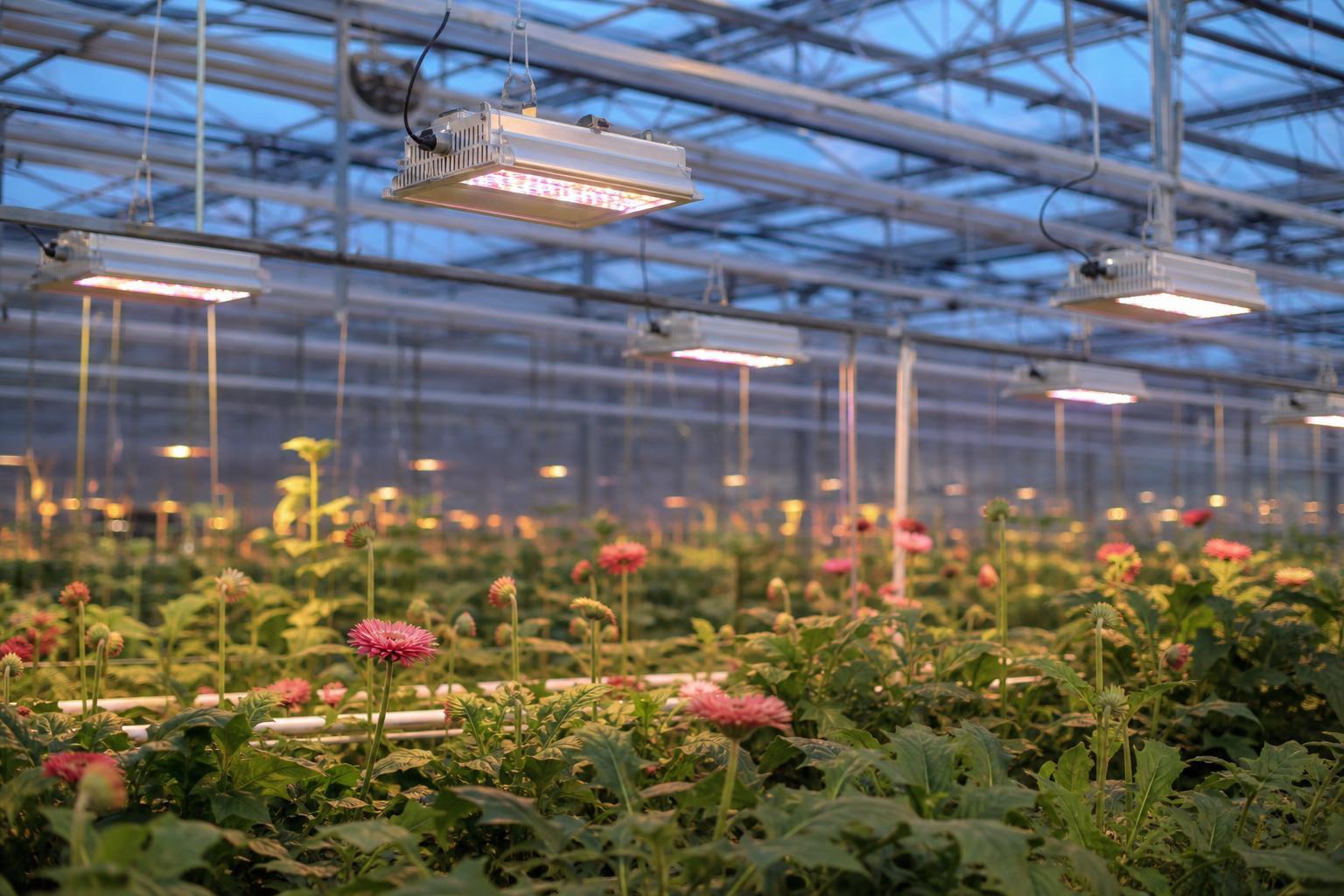
Explore Thrive’s Altus 1K for commercial greenhouse toplighting.
Quick Answer: What Is the Best Supplemental Lighting for Greenhouses?
If you only need the short answer:
• Choose high-efficiency LED fixtures rated at 2.5 µmol/J or higher.
• Size the system around your crop's Daily Light Integral (DLI) rather than fixture wattage.
• Use toplighting for leafy crops and toplighting plus interlighting or under-canopy lighting for tall fruiting crops.
• Select DLC-listed fixtures if utility rebates are available.
• Measure natural greenhouse light before purchasing equipment so you only install the supplemental PPFD you actually need.
For most commercial greenhouses in 2026, full-spectrum white LED fixtures provide the best balance of energy efficiency, crop quality, worker visibility, rebate eligibility, and long-term operating costs.
What Is Greenhouse Supplemental Lighting?
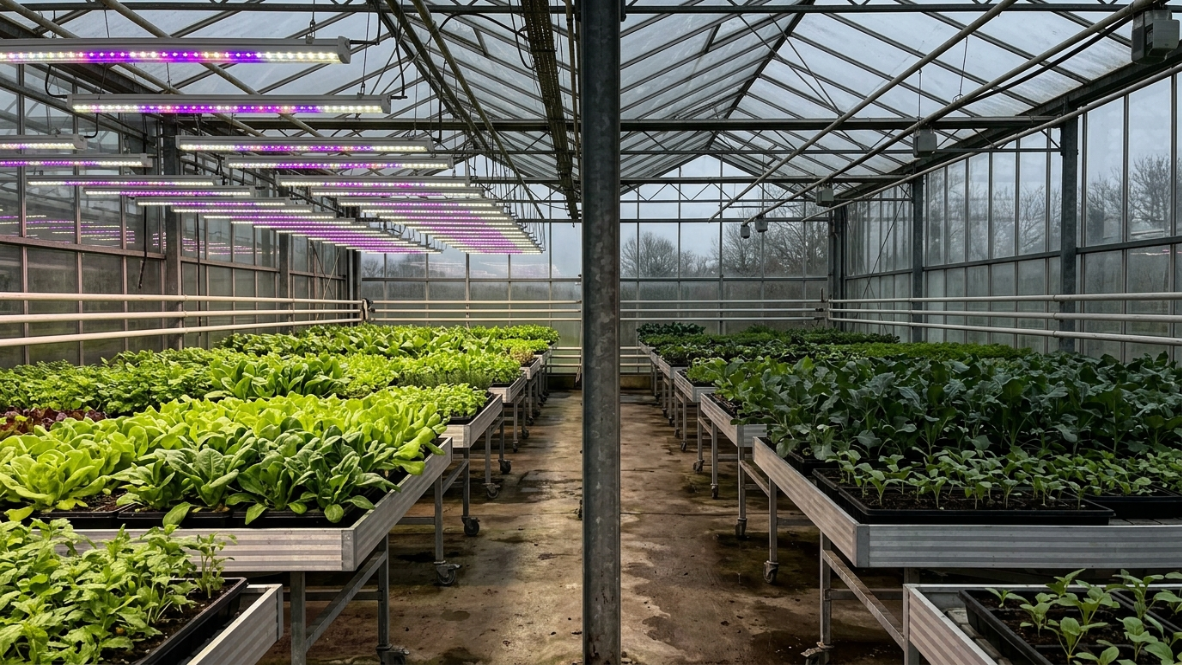
Greenhouse supplemental lighting adds artificial light to fill the gap between what your crops need and what the sun provides through your glazing. It is not sole-source lighting (where artificial light is the only source, as in vertical farms) and it is not photoperiod lighting (low-intensity light used simply to extend day length for flowering control).
Why do greenhouses, structures literally built to capture sunlight, need supplemental light? Two reasons.
First, glazing transmission losses are significant. Depending on the material, structure, and cleanliness, only 30% to 70% of outdoor sunlight actually reaches the plant canopy. Second, seasonal variation hammers northern growers. In winter months across the northern United States and Canada, outdoor DLI can plummet to just 3 to 5 mol/m²/day, which is far below what most crops require for productive growth.
Supplemental lighting bridges that gap. For a deeper look at practical strategies, see this guide on how to use supplemental lighting in greenhouse environments.
When Do Greenhouses Need Supplemental Lighting?
Many growers assume supplemental lighting is only necessary during winter, but the actual requirement depends on daily light availability rather than the season.
Supplemental lighting is commonly used when:
Winter DLI falls below crop requirements
Extended cloudy weather reduces natural light
High-value crops require maximum production
Young plants need consistent growth
Northern latitudes experience short days
Typical situations include:
Situation | Supplemental Lighting Usually Needed? |
|---|---|
Winter | Yes |
Extended cloudy periods | Often |
Seedling production | Usually |
High-wire tomatoes | Yes |
Summer in southern climates | Rarely |
Light Measurement Terms Every Grower Must Know
Before comparing fixtures or technologies, you need a shared vocabulary. These four metrics form the foundation of every lighting decision.
PAR (Photosynthetically Active Radiation)
PAR is the band of light between 400 and 700 nanometers that plants use for photosynthesis. It is not a measurement itself but rather the defined range of wavelengths that matter. When someone says a fixture produces “more PAR,” they mean it emits more photons in that 400 to 700 nm window.
Think of PAR as the playing field. The measurements below tell you how much action is happening on it.
PPFD (Photosynthetic Photon Flux Density)
PPFD measures instantaneous light intensity at the plant level, expressed in µmol/m²/s (micromoles of photons per square meter per second). This is the metric that tells you how much usable light is actually hitting your canopy right now.
PPFD matters far more than wattage when evaluating grow lights. A 600-watt fixture with poor optics and low efficiency might deliver less PPFD at canopy level than a well-designed 400-watt unit. For a more detailed explanation of the underlying unit, read about what a micromole is and why it matters.
Crop benchmarks vary considerably. Leafy greens generally perform well at 200 to 400 PPFD, while fruiting crops like tomatoes and peppers need 600+ PPFD. It’s worth noting that most commercial supplemental lighting systems provide around 200 µmol/m²/s of additional light, designed to supplement rather than replace sunlight.
DLI (Daily Light Integral)
If PPFD is a snapshot, DLI is the full movie. DLI measures the total accumulated PAR a plant receives over 24 hours, expressed in mol/m²/day. Maintaining the correct DLI ensures optimal photosynthesis, plant health, and yield.
This is arguably the single most important number for greenhouse supplemental lighting decisions. Two growers can provide identical PPFD but get dramatically different results if one runs lights for 8 hours and the other for 16.
Crop-Specific DLI Targets:
Crop | Target DLI (mol/m²/day) |
|---|---|
Microgreens | 8–14 |
Lettuce / Leafy Greens | 14–17 |
Herbs (basil, cilantro) | 12–18 |
Cucumber | 15–25 |
Tomato | 22–35 |
Pepper | 20–30 |
Cannabis (flower) | 35–45 |
For a full breakdown of DLI calculations and targets, including worked examples for different latitudes and seasons, check out our dedicated guide.
The DLI-PPFD-Photoperiod Formula
This is the equation growers use to determine how many hours of supplemental light to run:
DLI (mol/m²/day) = PPFD (µmol/m²/s) × Photoperiod (hours) × 3,600 / 1,000,000
A worked example: Your lettuce needs 17 mol/m²/day. The sun provides 8 mol/m²/day through your glazing in January. You need to supplement 9 mol/m²/day. If your fixtures deliver 200 µmol/m²/s at canopy level, you’d need to run them for approximately 12.5 hours to hit that target.
Greenhouse Lighting Calculator Example
The following example shows how growers determine required lighting hours.
Crop | Target DLI | Natural Winter DLI | Supplemental DLI Needed | Fixture PPFD | Runtime |
|---|---|---|---|---|---|
Lettuce | 17 | 8 | 9 | 200 PPFD | 12.5 hrs |
Tomato | 30 | 10 | 20 | 250 PPFD | 22.2 hrs |
Cannabis | 40 | 12 | 28 | 350 PPFD | 22.2 hrs |
PPE (Photosynthetic Photon Efficacy)
PPE measures how efficiently a fixture converts electricity into PAR photons, expressed in µmol/J (micromoles per joule). This is your efficiency metric for comparing fixtures across brands and technologies.
High efficiency starts at 2.5 µmol/J. Top-tier products now exceed 3.0 µmol/J. This matters because lighting can represent 10% to 30% of a greenhouse’s operating expenses, and every fraction of a micromole per joule translates into real dollars on your electricity bill.
Lighting Technologies Compared: LED vs. HPS vs. CMH
The technology question is where most growers start when searching for the best supplemental lighting for greenhouses. Here’s what the data shows.
LED (Light-Emitting Diode)
LEDs now command roughly 59.5% of the greenhouse lighting market. The reasons are straightforward: they save 40% to 60% in energy compared to HPS, and quality fixtures last over 50,000 hours, which translates to 5 to 7 years of continuous operation. LEDs also allow spectrum customization, something no other technology can match.
The upfront cost is higher, but practitioners consistently report that the biggest ROI driver is not energy savings alone. As Fluence noted in their ROI analysis, many cultivators focus on the 20% efficiency gains from LEDs but are surprised to learn that improved production is actually the larger profit driver. Reduced costs help, but higher crop quality and yield boost the bottom line more.
One critical adjustment: LEDs produce less radiant heat at the canopy than HPS, which changes your climate management. Leaf temperatures drop, humidity dynamics shift, and VPD calculations need updating. As one practitioner-focused resource from Fohse put it, “the technology has changed, but cultivation strategies haven’t always kept pace.” This is one of the most common pitfalls growers encounter during a transition. For a practical transition guide, see Thrive’s walkthrough of what to expect.
HPS (High-Pressure Sodium)
HPS remains in some greenhouses for understandable reasons. The upfront cost is considerably lower than LED, and the radiant heat HPS produces can be beneficial in cold climates where that warmth helps maintain canopy temperature during winter months.
The downsides are well documented. HPS bulbs have an average lifetime of around 20,000 hours at LC90 (the point where output drops to 90% of original intensity), meaning they need replacement roughly every 2 to 3 years. They also operate at a fixed spectrum weighted heavily toward yellow-orange, which cannot be adjusted.
When might HPS still make sense? Short-term leases where the lower capital outlay matters, or cold-climate operations where the waste heat genuinely offsets heating costs. But these situations are becoming rarer. For a deeper look at the nuances, see this comparison of LED vs. HPS greenhouse lighting.
CMH (Ceramic Metal Halide)
CMH occupies a middle ground that comes up in grower forums. Practitioners on the Permies forum noted that CMH produces a spectrum closer to full sunlight than HPS, and bulbs last somewhat longer. Heat dissipation profiles are similar to LED. However, CMH has not seen the rapid efficiency improvements or market adoption that LEDs have, and fewer utility rebate programs cover CMH fixtures.
Technology Comparison at a Glance
Factor | LED | HPS | CMH |
|---|---|---|---|
Energy Efficiency | 2.5–3.0+ µmol/J | 1.0–1.7 µmol/J | 1.4–1.9 µmol/J |
Lifespan | 50,000+ hours | 20,000 hours | 24,000–30,000 hours |
Spectrum Control | Full customization | Fixed (yellow-orange) | Broad but fixed |
Upfront Cost | Higher | Lower | Moderate |
Heat at Canopy | Lower | Higher | Moderate |
Rebate Eligibility | Widely supported | Rarely | Rarely |
How to Choose the Right LED Fixture
Rather than comparing brands, compare specifications.
Look for:
PPE
Minimum:
2.5 µmol/J
Excellent:
3.0+ µmol/J
DLC Listing
Necessary for most rebate programs.
Dimming
Allows seasonal adjustment while reducing energy costs.
IP Rating
Greenhouse fixtures should tolerate moisture and humidity.
Recommended:
IP65 or higher.
Warranty
Commercial fixtures should include at least a five-year warranty.
Spectrum Terms: Full-Spectrum White vs. Red/Blue
Beyond the technology itself, spectrum choice is a real decision point that most guides skip entirely.
Full-Spectrum White LED
Full-spectrum lights cover a broad range of wavelengths, including blue (400 to 500 nm), green (500 to 600 nm), red (600 to 700 nm), and sometimes UV and far-red. They produce a balanced output similar to natural sunlight.
Beyond plant performance, full-spectrum white light makes for a dramatically better work environment. Staff can accurately assess plant health, spot pests, and identify nutrient deficiencies without removing plants to inspect them under different lighting. This is a practical benefit that rarely appears in spec sheets but matters enormously in daily operations.
For a technical overview of how light spectra affect growth and morphology, Thrive’s research summary covers the peer-reviewed evidence.
Red/Blue (“Pink”) LED
Red and blue LEDs are the most efficient wavelengths for converting electricity into PAR. For greenhouse operators already receiving the full solar spectrum through their glazing, adding targeted red/blue supplemental light can make sense from a pure efficiency standpoint.
The tradeoff is that the purple-pink light these fixtures produce creates an unpleasant working environment, makes visual crop inspection difficult, and misses the benefits of green light.
Why Green Light Matters
Green light (500 to 600 nm) is often dismissed because chlorophyll absorbs it less efficiently than red or blue. But in greenhouse canopies, green light penetrates deeper into the leaf layers and reaches foliage that red and blue cannot. It also plays a role in regulating stomatal opening, which affects gas exchange and transpiration.
For tall, dense crops, this canopy penetration from green light can meaningfully improve lower-leaf photosynthesis without requiring separate under-canopy fixtures.
Placement Strategies: Toplighting, Interlighting, and Under-Canopy
Where you position your fixtures is just as important as which fixtures you choose. The best greenhouse supplemental lighting systems often combine multiple placement strategies.
Toplighting
The standard approach. Fixtures are mounted overhead, suspended from or attached to the greenhouse structure. Toplighting provides the necessary DLI for upper leaves and is the workhorse of greenhouse supplemental light.
Every greenhouse supplemental lighting installation starts with toplighting. The question is whether it should stop there. For high-wire crops with dense canopies (tomatoes, cucumbers, peppers, cannabis), the answer is almost always no. Commercial LED toplighting fixtures designed for greenhouse use typically range from 600W to 1,050W and need careful spacing to ensure uniform PPFD coverage.
Interlighting (Intercanopy Lighting)
Interlighting positions LED fixtures directly within the plant canopy to deliver photons to shaded middle and lower leaves that overhead lighting simply cannot reach. This is critical for high-wire greenhouse crops where the upper canopy blocks a significant portion of overhead light.
The yield data is compelling. In trials using 375 µmol lighting levels, partially replacing a portion of toplighting with intercanopy lighting increased yields 20% to 24%. The key insight: the total energy input stayed roughly the same, but redirecting some of it into the canopy rather than only over it produced meaningfully more crop.
Under-Canopy Lighting
Under-canopy lighting places fixtures beneath the canopy to boost lower-leaf photosynthesis directly. This approach has gained significant traction in cannabis cultivation and high-wire produce. Operations report yield gains of 20% to 30% from under-canopy configurations.
See Thrive’s Boost XE, an under-canopy LED bar built for lower-canopy yield gains.
For documented results from commercial grows, the evidence on under-canopy lighting outcomes is now substantial enough that the question isn’t whether it works, but whether the math justifies it for your specific operation.
The Hybrid Approach (Top + Under-Canopy)
Peer-reviewed research strongly supports combining placement strategies. A study published in the journal Agronomy found that an LED-LED combination of toplighting and interlighting produced the most favorable economic outcome, with production value higher by as much as 32.55% compared to HPS toplighting alone.
This layered approach works because it addresses the fundamental physics of light in a canopy. No matter how powerful your overhead fixture, light attenuates as it passes through leaf layers. Adding light sources within or below the canopy bypasses this entirely.
Fixture Spacing and Uniformity
Fixture spacing affects crop uniformity as much as fixture efficiency.
Most greenhouse designers aim for:
PPFD uniformity above 80%
Even overlap between adjacent fixtures
Minimal shadows from greenhouse trusses
Proper hanging height based on beam angle
Poor spacing often causes larger yield losses than choosing a slightly less efficient fixture.
Power Architecture: Integrated vs. Centralized Remote Drivers
This is a decision factor that no other top-ranking page on greenhouse supplemental lighting addresses, yet it matters significantly for large-scale projects.
Integrated Drivers (Standard Approach)
Most LED fixtures include their power driver (the component that converts AC power to the DC current the LEDs need) inside or attached to the fixture itself. This is simple and works fine for smaller installations. The downside is that every driver generates heat right where you don’t want it: above your canopy.
Centralized / Remote Power Architecture
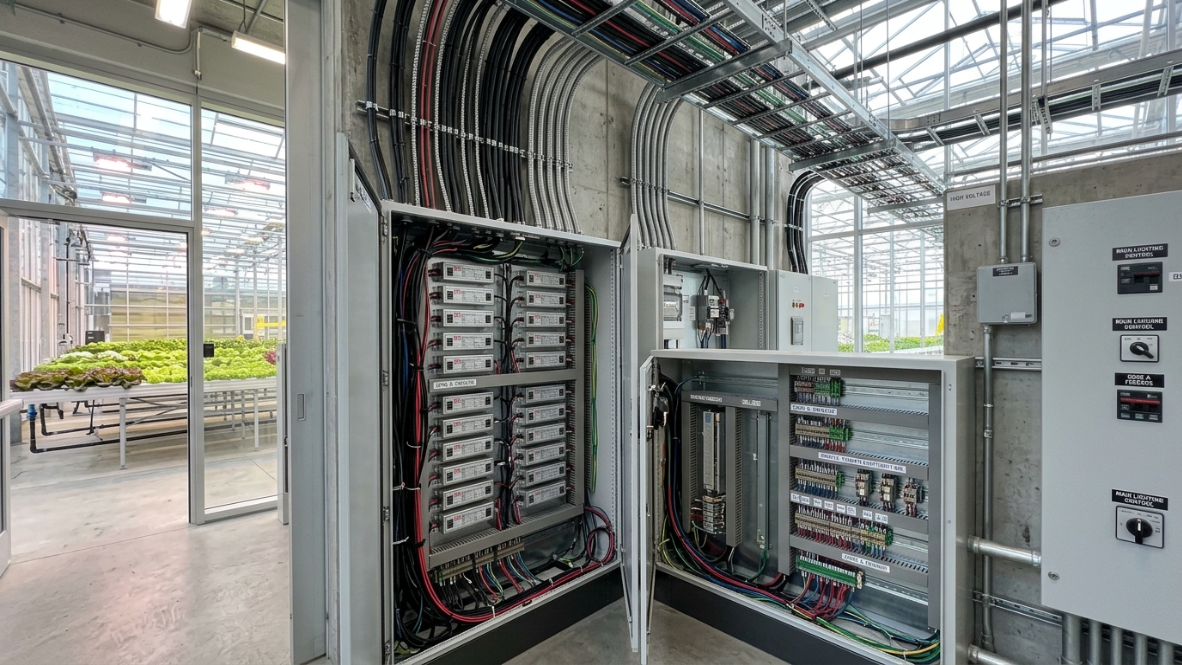
An emerging approach removes the drivers from the grow space entirely, housing them in a centralized location. While the electrical efficiency of individual and centralized drivers is roughly equivalent, removing generated heat from the grow space makes the centralized approach more cost-effective overall.
When drivers sit outside the growing environment, that heat exhausts outdoors rather than adding to your HVAC load. For a greenhouse running thousands of watts of supplemental light, this reduction in cooling demand adds up fast. Learn more about how centralized LED drivers work, their costs, and their code implications.
Centralized power also simplifies installation (fewer high-voltage connections at each fixture point), eliminates hundreds or thousands of in-room failure points, and allows fixtures to be lighter and more compact. This matters most in large-scale deployments and retrofits where electrical infrastructure is a significant cost line. For a closer look at how removing drivers affects thermal management, see this breakdown of HVAC sizing for LED lights.
Explore the OptiDrive platform, a centralized remote power system designed for commercial greenhouse and indoor farm installations.
Smart Lighting Controls and Automation
Modern greenhouse lighting systems rarely operate on simple timers.
Commercial systems increasingly use:
DLI-based control
Light sensors
Weather forecasting
Cloud prediction
Sunrise/sunset automation
Energy pricing optimization
Smart controls reduce unnecessary lighting hours while maintaining crop targets.
Economic Terms: ROI, Payback, Rebates, and Life-Cycle Cost
The economics of the best supplemental lighting for greenhouses ultimately determine whether an investment makes sense. This section defines the financial terms and flags the traps.
ROI and Payback Period
Many successful growers target a payback period of three to five years for lighting infrastructure, though larger projects may take longer. In commercial greenhouse LED upgrades specifically, payback typically ranges from 18 to 36 months, heavily influenced by electricity rates, daily hours of operation, and available rebates.
A critical insight from MSU Extension researcher Erik Runkle: the economics of supplemental lighting are most favorable when light is provided to young plants (plugs and liners), because the cost per plant is relatively small at that stage. For many crops, the value of supplemental lighting diminishes once natural DLI reaches 12 to 15 mol/m²/day.
Simple Payback vs. Life-Cycle Cost Analysis (LCCA)
Here’s a trap that catches growers regularly. A 2025 paper in HortTechnology warned that simple payback calculations can significantly underestimate the time required for an investment to become profitable. LCCA accounts for factors that simple payback ignores: the time value of money, energy price escalation, maintenance costs over the fixture’s lifetime, and bulb replacement schedules for HPS.
If a vendor shows you a simple payback calculation that looks great, ask for the LCCA version. It tells a more honest story. For a thorough walkthrough of the financial side, read this greenhouse lighting ROI guide.
Utility Rebates and Incentives
This is the single largest lever most greenhouse operators overlook. For facilities running 12 to 18 hours of daily supplemental lighting, transitioning from HPS to LED with modern rebates can offset 30% to 70% of the total fixture cost. In 2026, average rebate amounts rose 17% across all product types.
The DesignLights Consortium (DLC) Horticultural Qualified Products List is the gatekeeper for rebate eligibility. Approximately 70% of North American energy efficiency programs use the DLC list to qualify LED products. If a fixture isn’t DLC-listed, you almost certainly can’t get a rebate for it.
Important timing note: the DLC released SSL V6.0 in November 2025, raising minimum efficacy thresholds by an average of 14%. Products listed under the previous version (V5.1) that don’t meet V6.0 requirements will be delisted by December 15, 2026. If you’re buying fixtures now, confirm they qualify under V6.0.
One more critical detail that trips up even experienced operators: you must apply for rebate pre-approval before purchasing equipment. Buying first and applying later usually disqualifies you. For step-by-step guidance, see the greenhouse lighting rebates guide.
LED vs HPS Total Cost of Ownership
Many growers focus only on purchase price.
A better comparison is lifetime ownership cost.
Cost Category | LED | HPS |
|---|---|---|
Initial Cost | Higher | Lower |
Electricity | Much Lower | Higher |
Lamp Replacement | Rare | Frequent |
Maintenance | Low | Moderate |
Cooling Costs | Lower | Higher |
Rebate Eligibility | High | Limited |
Seasonal Supplemental Lighting Strategy
Lighting needs change throughout the year.
Winter
Highest supplemental lighting demand.
Spring
Use weather-based controls.
Summer
Lighting often unnecessary except propagation.
Fall
Increase lighting gradually as natural DLI declines.
Common Mistakes and Misconceptions
The most expensive errors in greenhouse supplemental lighting aren’t technical. They’re strategic.
Undersizing Based on Budget
The most common mistake is installing inadequate lighting to save money upfront. Budget fixtures that deliver insufficient PPFD for your crop’s DLI target don’t just underperform; they waste every dollar spent on electricity to run them. A fixture delivering 100 µmol/m²/s when your tomatoes need 200 µmol/m²/s supplemental light is essentially burning money while producing mediocre fruit.
Chasing PPFD While Ignoring DLI
A fixture that delivers impressive PPFD numbers is useless if you don’t account for how many hours it needs to run to hit your DLI target. High PPFD for a short photoperiod can produce a lower DLI than moderate PPFD for a longer period. Always calculate the total daily delivery.
Treating LEDs as Drop-In HPS Replacements
Switching from HPS to LED without adjusting your growing environment is a recipe for disappointment. LEDs produce less radiant heat at the canopy, which means leaf temperatures drop, VPD changes, and irrigation schedules may need updating. The technology shift requires a cultivation strategy shift.
Undervaluing Cloudy-Day Sunlight
A grower on the Permies forum made a point that’s frequently missed: photosynthesis rate on cloudy days isn’t 10% of a sunny day, it’s closer to 50%. Depending on what you grow, light saturation reportedly occurs around 2,000 foot-candles, typical of a bright cloudy or partly-cloudy day. Supplemental lighting isn’t always needed just because it’s overcast.
Supporting this, University of Georgia research from 2024 showed that plants can carry excess light from a sunny day into an overcast day. The DLI requirement on a cloudy day following a sunny one can be reduced by approximately 5.25 mol/m²/day. This “DLI carryover” approach yielded annual energy savings of 75 to 190 MWh per hectare in greenhouse lettuce production. Smart supplemental lighting strategies account for this rather than running fixtures on a fixed timer.
Skipping Rebate Pre-Approval
This mistake costs growers tens of thousands of dollars every year. Purchasing fixtures before securing utility rebate pre-approval typically disqualifies the entire incentive. The process takes a few weeks but can offset a third to two-thirds of your fixture cost.
Decision Framework: Matching Lighting to Your Operation
Pulling it all together, here’s a quick-reference framework for finding the best supplemental lighting for your greenhouse.
Crop Category | Target DLI | Recommended Placement | Primary Technology | Key Economic Note |
|---|---|---|---|---|
Microgreens | 8–14 mol/m²/day | Toplighting only | LED (multi-tier bars) | Low per-plant cost; fast payback |
Leafy Greens | 14–17 mol/m²/day | Toplighting only | LED | Rebates make LED math compelling |
Herbs | 12–18 mol/m²/day | Toplighting, optional interlighting | LED | Supplement young plants first |
Cucumber | 15–25 mol/m²/day | Toplighting + interlighting | LED | Interlighting adds 20%+ yield |
Tomato | 22–35 mol/m²/day | Toplighting + interlighting | LED | Highest DLI gap in winter |
Cannabis (flower) | 35–45 mol/m²/day | Toplighting + under-canopy | LED | Under-canopy gains of 20–30% |
The path from this table to an actual lighting design involves measuring your existing natural DLI (by season), calculating the supplemental gap, selecting fixtures with sufficient PPE, and running the economics including rebates and LCCA.
Schedule a free consultation with a lighting specialist to walk through your specific project.
Frequently Asked Questions
How much supplemental light does a greenhouse need?
It depends entirely on your crop and location. Calculate your natural DLI (accounting for glazing transmission losses of 30% to 70%), compare it to your crop’s target DLI from the table above, and the difference is what your supplemental system needs to provide. In northern climates during winter, that gap can be 15 to 30 mol/m²/day for fruiting crops.
Are LEDs really worth the higher upfront cost compared to HPS?
For most commercial operations, yes. LEDs save 40% to 60% in energy, last more than twice as long, qualify for utility rebates that can cover 30% to 70% of the purchase price, and produce higher-quality crops. The typical payback period is 18 to 36 months.
What is the minimum PPE I should look for in a greenhouse fixture?
For rebate eligibility under most current programs, fixtures need at least 2.3 µmol/J. For competitive performance, aim for 2.5 µmol/J or higher. The best fixtures on the market now exceed 3.0 µmol/J.
Should I choose full-spectrum white or red/blue LEDs for greenhouse supplemental lighting?
In a greenhouse where plants already receive sunlight’s full spectrum, red/blue can be efficient for supplementing PAR. However, full-spectrum white provides green light for canopy penetration, a comfortable working environment, and the ability to visually inspect plants for pests and deficiencies. Most commercial greenhouse operations choose white for these practical reasons.
Do I always need to run supplemental lights on cloudy days?
Not necessarily. Research shows that cloudy-day photosynthesis rates are about 50% of sunny-day rates, not the 10% many people assume. Plants can also carry over excess DLI from a sunny day, reducing the need for supplemental light by up to 5.25 mol/m²/day the following day. Smart lighting controllers that integrate with weather data can capture these savings.
What’s the difference between toplighting and interlighting?
Toplighting is standard overhead lighting that delivers PPFD to the upper canopy. Interlighting positions fixtures within the canopy itself to reach shaded middle and lower leaves. For tall, dense crops, trials show interlighting can increase yields 20% to 24% without increasing total energy input by simply redistributing where light is delivered.
How do I qualify for utility rebates on greenhouse LED lighting?
Start by confirming your fixtures are on the DLC Horticultural Qualified Products List. Then contact your utility provider about their commercial lighting incentive program. Apply for pre-approval before purchasing any equipment. The process varies by utility, but rebate amounts averaged a 17% increase in 2026, making this step well worth the paperwork.
What does centralized power architecture mean for greenhouse lighting?
It means moving the LED drivers (the power conversion components) out of the grow space into a central location. This reduces heat above the canopy, lowers HVAC costs, eliminates in-room failure points, and can simplify electrical installation. It matters most for large-scale greenhouse projects where hundreds of fixtures are deployed.