Cannabis Flower Room Lighting Guide: PPFD, DLI, LED Layout, and Fixture Strategy | Thrive Agritech
Plan cannabis flower room lighting with practical PPFD, DLI, fixture layout, heat, and commercial LED grow light considerations.
TL;DR
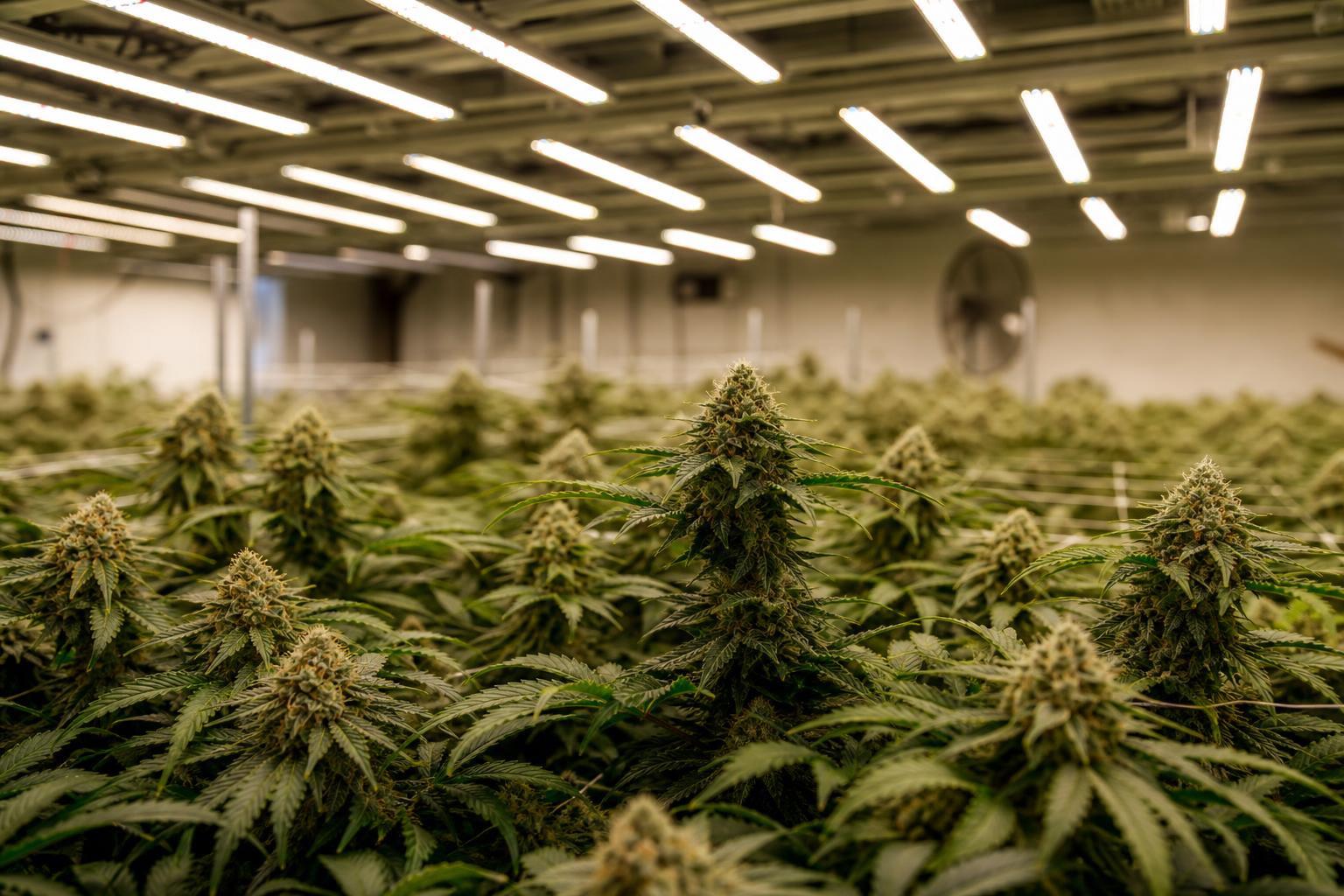
Cannabis flower room lighting refers to the intensity, spectrum, schedule, and layout of lights used during the flowering stage, typically under a 12/12 photoperiod. Flower rooms demand higher PPFD (700–1,500 µmol/m²/s depending on CO₂ levels) than vegetative rooms to hit daily light integral targets of 35–50 mol/m²/day in fewer lit hours. Uniformity across the canopy matters more than peak intensity under any single fixture, and modern LEDs have largely replaced HPS for new builds due to 40%+ energy savings and 12–18 month payback periods.
The flower room is where cannabis cultivation either pays off or falls short. Everything a grower does in propagation and veg, from dialing in genetics to building canopy structure, converges here. The lighting system in this room is the single largest controllable input for bud development, cannabinoid production, and harvest economics.
Cannabis flower room lighting encompasses the full set of decisions that shape how photons reach the canopy during the generative cycle: fixture type, mounting height, light intensity, spectral composition, photoperiod schedule, uniformity mapping, heat management, and increasingly, under-canopy supplementation. Getting these right determines yield per square foot, potency, and operating cost. Getting them wrong wastes electricity and leaves money on the table.
If you’re designing or upgrading a flower room, commercial LED grow lights built for this stage are the starting point.
Commercial cannabis flower rooms typically target 700–900 µmol/m²/s PPFD under ambient CO₂ and 900–1,500 µmol/m²/s with CO₂ enrichment. Because flowering occurs under a 12-hour photoperiod, growers generally aim for a Daily Light Integral (DLI) of 35–50 mol/m²/day. Modern full-spectrum LED fixtures delivering 2.8–3.6 µmol/J provide the best combination of yield, energy efficiency, and operating cost. Uniform canopy lighting is usually more important than achieving the highest peak PPFD.
Flower Room Lighting Targets at a Glance
Metric | Recommended Target |
|---|---|
Photoperiod | 12 hours on / 12 hours off |
PPFD (Ambient CO₂) | 700–900 µmol/m²/s |
PPFD (CO₂ Enriched) | 900–1,500 µmol/m²/s |
Daily Light Integral | 35–50 mol/m²/day |
Uniformity | ±10–15% |
LED Efficiency | 2.8–3.6 µmol/J |
Mounting Height | Manufacturer PPFD map |
Recommended Fixture | Full-spectrum commercial LED |
Why the Flower Room Has Different Lighting Requirements
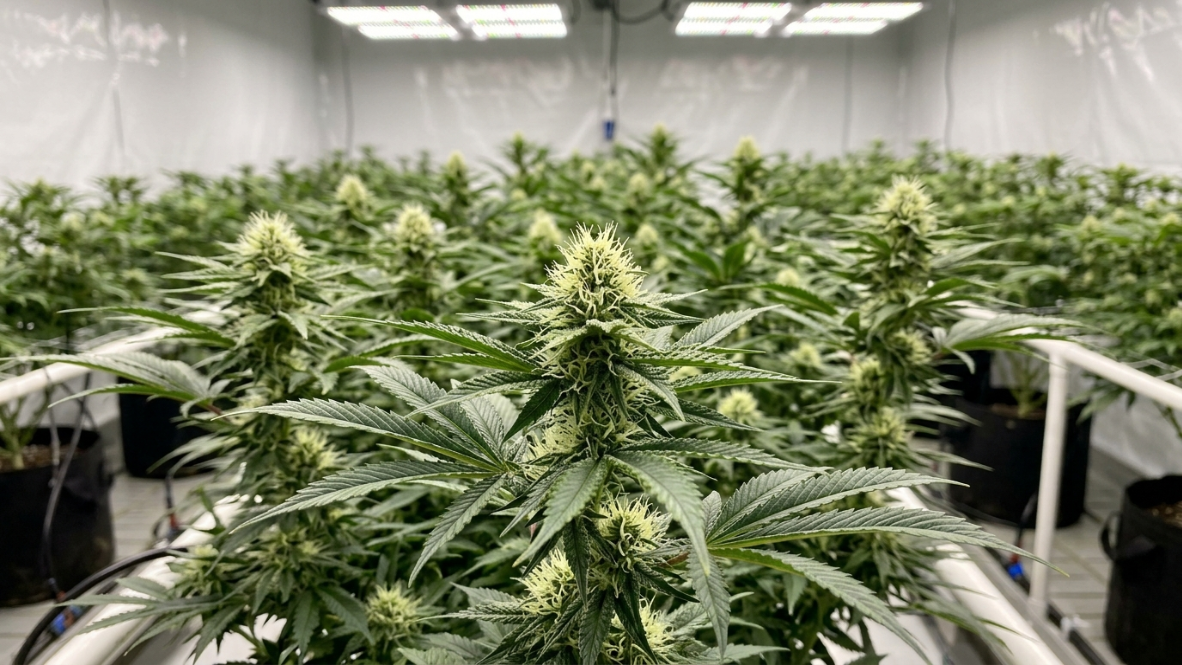
A vegetative cannabis plant sits under 18 hours of light per day. A flowering plant gets 12. That six-hour difference changes the math completely.
The biological trigger is straightforward. Indoor cultivation simulates seasonal changes. Switching from 18/6 to 12/12 mimics the shorter days of autumn that naturally push photoperiod cannabis into its reproductive cycle. The plant shifts energy from building leaves and stems to developing flowers, and it needs dense, high-quality light to fuel that transition.
Here’s the practical consequence: a flowering plant has 33% fewer lit hours to accumulate its daily photon budget. To reach the same daily light integral (DLI) as a veg plant on a longer schedule, the flower room must run at significantly higher intensity. This is why flower rooms use more powerful fixtures, generate more heat, and consume more electricity per square foot than any other stage of cultivation.
The DLI formula makes this concrete:
DLI = PPFD × (3,600 × photoperiod hours) / 1,000,000
Running 1,000 µmol/m²/s for 12 hours produces a DLI of 43.2 mol/m²/day. To hit that same 43.2 in veg with 18 hours of light, you’d only need about 667 PPFD. The flower room demands roughly 50% more intensity to compensate for the compressed light window.
Understanding VPD in your flower room becomes critical here too, because higher light intensity drives faster transpiration and shifts the environmental balance.
Key Metrics for Flower Room Lighting
Four numbers define whether a flower room’s lighting is adequate, efficient, or optimized.
PPFD (Photosynthetic Photon Flux Density)
PPFD measures how many photons land on the canopy per second per square meter, expressed in µmol/m²/s. It’s the intensity number growers check first.
Target ranges depend on CO₂ strategy:
Without CO₂ enrichment: 700–900 µmol/m²/s. Cannabis plants begin experiencing photoinhibition around 1,000 µmol/m²/s at ambient CO₂, so pushing past 900 without supplementation wastes energy and stresses plants.
With CO₂ enrichment (1,000–1,200 ppm): 900–1,500 µmol/m²/s. Elevated carbon dioxide raises the photosynthetic ceiling, letting plants convert more light into biomass. High-performance sealed rooms routinely run 1,100–1,200 PPFD with CO₂ programs.
For a deeper understanding of these units, the explainer on what a micromole is is worth reading.
DLI (Daily Light Integral)
DLI is the total photon delivery over a full day, measured in mol/m²/day. Where PPFD is a snapshot, DLI is the full picture. It’s the metric that actually correlates with yield.
Flower rooms should target 35–50 mol/m²/day. The sweet spot for most commercial cultivars is 40–45, which a 1,000W HPS over a 4×4 tray historically delivered quite well. Some high-performance operations push toward 50 mol/m²/day, though diminishing returns set in without excellent environmental control.
PPE (Photosynthetic Photon Efficacy)
PPE measures fixture efficiency in µmol/J, meaning how many photons a fixture produces per watt of electricity consumed. This is the number that drives operating cost and ROI.
Double-ended HPS: 1.7–1.9 µmol/J
Commercial LED (2020 era): 2.6 µmol/J
Commercial LED (2025): 3.2–3.6 µmol/J in top-tier fixtures
That progression means the best current LEDs produce roughly 60–90% more usable light per watt than HPS. The gap keeps widening.
Uniformity
This is the metric most growers undervalue. A plant sitting in a 600 µmol/s zone will produce accordingly, regardless of whether the fixture overhead is rated for 1,500. That’s the uniformity problem, and it matters more than peak readings.
Practitioners on Reddit’s r/macrogrowery consistently flag this issue. One grower shared that raising fixtures 8 inches, which dropped peak output by 5%, improved yield uniformity from 72% to 89%. The trade-off was worth it.
Best practice: map PPFD across at least a 9-point grid at canopy height. Keep readings within ±10–15% across the entire flowering footprint. Over-lit centers and under-lit edges are the most common layout mistake in commercial rooms.
How PPFD, DLI, and CO₂ Work Together
Many growers optimize one lighting metric while ignoring the others. In reality, PPFD, DLI, and CO₂ should be treated as one system.
Situation | PPFD | Photoperiod | DLI |
|---|---|---|---|
Small Grow | 700 | 12 hr | 30.2 |
Standard Commercial | 900 | 12 hr | 38.9 |
High Performance | 1000 | 12 hr | 43.2 |
CO₂ Optimized | 1200 | 12 hr | 51.8 |
Increasing PPFD without adequate CO₂, irrigation, nutrition, temperature, and VPD usually produces diminishing returns.
Spectrum Considerations in Flower
Spectrum gets more attention than it probably deserves, but it still matters.
Red Light: The Flowering Engine
Red photons (600–700 nm) are the primary driver of flower development. They fuel the photosynthetic reactions most efficiently and promote bud density and overall yield. Every flower room fixture, whether LED or HPS, delivers a heavy dose of red.
Blue Light: Compactness and Cannabinoids
Blue photons (400–500 nm) play a supporting role. They promote shorter internodes and bushier architecture, which helps plants support heavy flower formations. Research has also shown that blue light can increase cannabinoid concentrations, particularly THC. However, there’s a trade-off: one peer-reviewed study found a consistent, linear 12% decrease in yield as the fraction of blue photons increased from 4% to 20%.
Far-Red: Handle With Care
Far-red wavelengths (700–750 nm) signal shade to the plant, triggering stem elongation. End-of-day far-red pulses can accelerate flowering response in short-day crops like cannabis, and strategic use can improve canopy penetration. But overdoing far-red in late flower leads to unwanted stretching and loose bud structure.
Full-Spectrum White vs. “Pink” LEDs
Red/blue “pink” fixtures were the first generation of horticultural LEDs. They work, but they create a disorienting purple environment where growers cannot properly identify nutrient deficiencies, pests, or disease. Full-spectrum white LEDs deliver a natural color rendering that makes plant scouting easier and the work environment far more pleasant.
The Critical Insight: Efficiency Beats Spectrum for ROI
A landmark study published in PLOS ONE found that yield under a white+red LED fixture was 4.6% lower than HPS per unit area, but 27% higher per dollar of electricity. The researchers concluded that fixture efficacy and initial cost matter more for return on investment than spectral distribution at high photon flux.
This reframes the entire conversation. For flower room economics, µmol/J is the number to optimize. Spectrum refinement is secondary.
Recommended Flower Room Spectrum
Although every manufacturer promotes a unique spectrum, commercial research has reached broad agreement.
Ideal flowering fixtures typically contain:
White full-spectrum LEDs
Deep red (660 nm)
Small amount of blue (450 nm)
Optional far-red (730 nm)
The goal is maximizing photosynthesis while maintaining good visual inspection conditions for growers.
The 12/12 Photoperiod and Dark Period Integrity
The 12/12 light/dark cycle is the foundation of photoperiod flower room lighting. Cannabis uses the length of uninterrupted darkness to regulate its flowering hormones. Disrupting that darkness, even briefly, can cause real problems.
Why Light Leaks Are Dangerous
Light leaks during the dark period can delay flowering, trigger reversion to vegetative growth, or cause hermaphroditism, where female plants develop male pollen sacs and self-pollinate. This can devastate a crop’s seedless flower quality.
For a thorough treatment of this topic, the guide on photoperiod management in cannabis covers the biology and practical controls.
The Nuance Experienced Growers Add
The severity of light leaks is debated in grower communities. On forums like Rollitup and GrowWeedEasy, experienced cultivators report that minor pinhole leaks sustained consistently over years have caused no observable issues. One long-time grower put it this way: “I’m convinced it’s the variations in light exposure that may cause herms. A light leak occurring at the same time every day wouldn’t have an effect.” The nuance is that inconsistent or sudden light interruptions are likely far more damaging than low-level ambient consistency.
Still, for commercial operations where crop uniformity and quality directly affect revenue, eliminating light leaks entirely is standard practice. The risk-reward calculation doesn’t favor gambling.
Beyond 12/12: The Critical Inductive Photoperiod
Here’s something most flower room lighting guides miss entirely. Although some tropical landrace varieties require 12 hours or more of complete darkness to flower, most commercial cultivars will flower with only 10–10.5 hours of darkness. This means growers could potentially run 13–14 hour photoperiods, dramatically increasing DLI without raising PPFD.
Running 1,000 PPFD for 14 hours instead of 12 bumps DLI from 43.2 to 50.4 mol/m²/day, a 17% increase in total light delivery with no additional fixture investment. This approach requires cultivar-specific testing, because not all genetics respond the same way, but it represents a genuine frontier in flower room optimization.
Light Uniformity and Layout Design
Peak PPFD under the center of a fixture is a marketing number. Canopy-wide uniformity is the operational number.
Commercial flower rooms are large, and the edges, corners, and spaces between fixtures all receive less light than the centers. Plants in those zones produce smaller, less dense flowers. In a room with 100 lights, even a 20% variance means a significant portion of the canopy is underperforming.
How to Map and Fix Uniformity
Measure properly. Use a quantum sensor at canopy height across at minimum a 9-point grid per fixture footprint. Record readings at center, edges, and corners.
Raise fixtures to smooth the spread. Mounting lights higher increases the overlap between adjacent fixtures, reducing hot spots and filling in gaps. The trade-off is a slight reduction in peak intensity, but as the earlier grower example showed, that trade-off frequently increases total yield.
Dim rather than distance for fine-tuning. Most commercial LED fixtures accept 0–10V dimming signals. After optimizing height for spread, use the dimmer to dial intensity to target PPFD without changing the uniformity pattern.
Target ±10–15% variance across the entire flowering canopy. Anything beyond that and you’re effectively running multiple light zones in one room, with corresponding variation in flower quality.
For growers evaluating flower room LED fixtures, published PPFD maps at multiple mounting heights are essential comparison data.
Common Flower Room Lighting Mistakes
Even expensive fixtures cannot compensate for poor lighting design.
Common mistakes include:
Hanging Fixtures Too Low
Creates hot spots directly beneath fixtures while starving edge plants.
Chasing Maximum PPFD
Running 1,400 PPFD without CO₂ wastes electricity and may reduce quality.
Ignoring Fixture Spacing
Large gaps between fixtures create inconsistent flower development.
Never Measuring PPFD
Many growers estimate intensity instead of measuring with a quantum sensor.
Ignoring Side Lighting
Dense canopies often receive less than 20% of top-canopy light in lower bud sites.
Heat, HVAC, and Driver Placement
Every watt a light fixture consumes eventually becomes heat. In a flower room, that heat directly shapes the environmental control challenge and the facility’s energy bill.
The Thermal Budget
Indoor cannabis facilities can use up to 10 times more energy per square foot than typical office spaces, and lighting is the primary driver. Environmental control in flower rooms is precise, often held within 1–2°F and a narrow humidity band, because even small deviations risk crop quality.
The Lights-Off Humidity Spike
This is the single biggest hidden cost of flower room lighting that most lighting content ignores. When lights turn off, the sensible heat load drops immediately, but the latent heat (moisture from transpiring plants) remains high. The result is an instant humidity spike that can push conditions into botrytis territory within minutes.
Understanding HVAC sizing for LED grow lights is critical for avoiding this problem. Dehumidification capacity, not just cooling capacity, needs to account for the lights-off transition.
How Many Grow Lights Does a Flower Room Need?
Fixture quantity depends on:
canopy size
fixture efficacy
mounting height
target PPFD
room reflectivity
Example:
Canopy Size | Typical Commercial LED Power |
|---|---|
4×4 ft | 600–700W |
4×8 ft | 1,200–1,400W |
10×10 ft | 3,500–4,500W |
Actual fixture count should always be confirmed using manufacturer PPFD simulations.
LED vs. HPS Heat Profiles
HPS fixtures emit substantial radiant heat (infrared) directly onto the canopy, which raises leaf surface temperature independently of air temperature. LEDs produce primarily convective heat from the fixture body and driver, which is easier for HVAC systems to manage. This difference means rooms transitioning from HPS to LED often need to adjust air temperature upward by 3–5°F to maintain the same leaf temperature.
Flower Room Lighting Cost Example
Example commercial room
20 fixtures
650W each
12 hours/day
Total lighting load:
13 kW
Daily energy use:
156 kWh
Annual electricity consumption:
56,940 kWh
At $0.12/kWh:
Annual lighting cost:
$6,833
Switching from older HPS systems commonly reduces total lighting energy by approximately 40%.
Driver Placement as a Design Variable
In a standard LED fixture, the driver sits inside the housing above the canopy, adding heat directly to the grow space. Relocating drivers outside the room, using centralized power systems, removes that heat source from the growing environment. This reduces the HVAC load, simplifies the thermal profile, and removes hundreds of potential failure points from the room itself. For large commercial builds, driver architecture is as much an HVAC decision as it is a lighting one.
Under-Canopy Lighting in the Flower Room
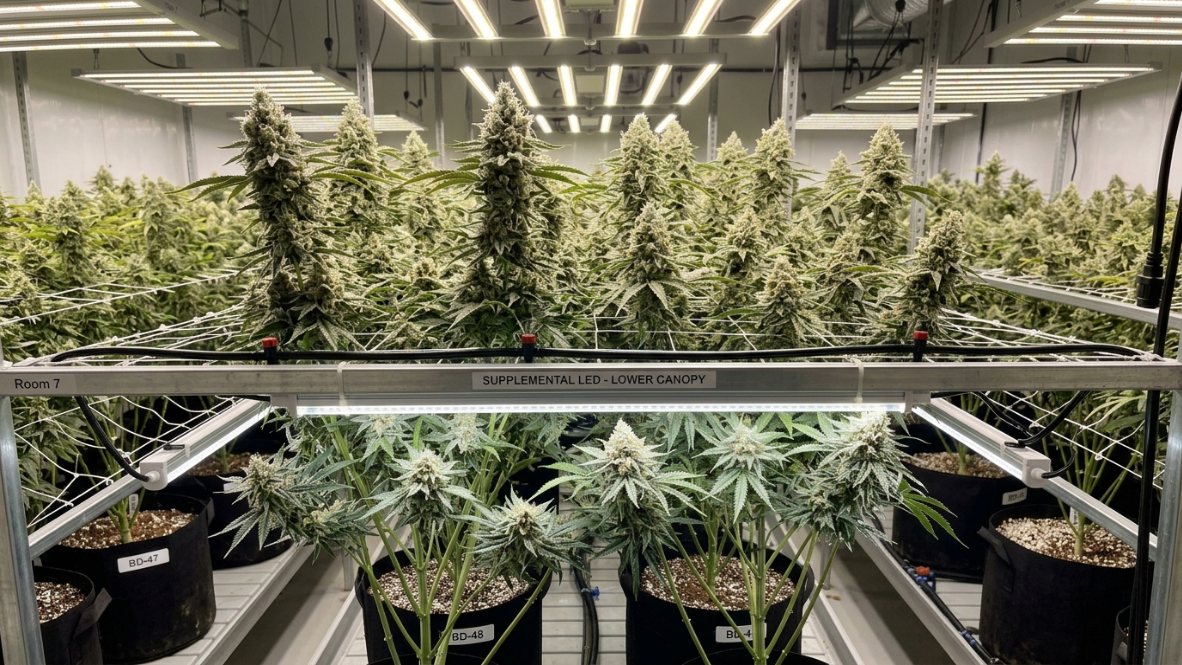
Top lighting alone leaves the lower canopy chronically underserved. In flower, where dense bud sites form throughout the plant, this matters.
Cannabis canopies are thick. By the time light from overhead fixtures penetrates through the top cola and upper fan leaves, the lower third of the plant may receive only 10–20% of the PPFD hitting the top. Those lower buds develop as small, airy “larf” that gets sorted into lower-grade product or trim.
The Research Is Convincing
A 2025 study published in PMC found that interlighting (light bars placed within the canopy) achieved a 29.95% increase in dry flower yield, 24.4% higher THC accumulation, and 12.5% more total terpenes compared to top lighting alone. Practitioners across cannabis forums and industry media broadly report 20–25% increases in flower mass from under-canopy supplementation.
The key is that under-canopy lighting doesn’t just add weight. It shifts the grade distribution. More of the harvest ends up as A-grade flower rather than trim, which changes the revenue picture significantly. For the full evidence base, the article on under-canopy lighting results compiles the data.
Under-canopy makes the most sense with dense canopies, large plants, and high-value flower crops. It’s specifically a flower-room strategy because the vegetative canopy rarely gets dense enough to justify the added fixtures.
Under-canopy LED bars designed for flower rooms are purpose-built for this application, running at lower wattages (typically 60–120W per bar) with spectra tuned for the lower canopy environment.
LED vs. HPS in Today’s Flower Room
In 2021, growers still debated whether LEDs could truly replace HPS. That conversation is over for new builds. Practitioners on Reddit’s r/macrogrowery now discuss which LED spectrum, what form factor, and whether to run hybrid or full-LED, not whether to switch.
The numbers explain why. Modern commercial LEDs produce 2.6–3.6 µmol/J compared to 1.7–1.9 for double-ended HPS. That’s 40–90% more usable light per watt. Factor in reduced HVAC cooling load (less waste heat to remove) and the total energy savings typically hit 40%+ versus an equivalent HPS installation.
For most commercial indoor cannabis facilities, the ROI when replacing HPS with high-efficacy LEDs lands within 12–18 months, driven by electricity savings, HVAC reductions, and higher gram-per-watt yields.
The remaining HPS holdouts are typically facilities with paid-off fixtures, cheap electricity, and no immediate expansion plans. For anyone building new or undergoing a major retrofit, LED is the default.
Flower Room Lighting Checklist
Before you finalize a flower room lighting design, confirm each of these:
- Target PPFD set to your CO2 level, roughly 700 to 900 without CO2 and 1,000 to 1,500 with CO2 enrichment
- DLI lands in the 35 to 50 mol/m²/day range across the 12 hour photoperiod
- Canopy uniformity within about 10 to 15 percent, measured at multiple grid points
- Fixture hanging height and spacing set to the manufacturer PPFD map, not guesswork
- Full dark period protected with zero light leaks during lights off
- Thermal and HVAC load sized for both lights on heat and the lights off humidity spike
- Driver placement planned to keep heat off the canopy and simplify service
- Under-canopy or side lighting considered for lower bud sites
- A PPFD meter on hand to measure, not estimate, at install and over time
Bringing It All Together
Cannabis flower room lighting is not a single product decision. It’s a system design problem that touches intensity, spectrum, photoperiod, uniformity, heat management, and increasingly, multi-layer light delivery. The cultivators who treat it as a system, rather than a fixture purchase, consistently outperform those who don’t.
The numbers to remember:
Metric | Target |
|---|---|
PPFD (no CO₂) | 700–900 µmol/m²/s |
PPFD (with CO₂) | 900–1,500 µmol/m²/s |
DLI | 35–50 mol/m²/day |
Photoperiod | 12/12 standard (10.5–12 hrs dark minimum for most cultivars) |
Uniformity | ±10–15% across canopy |
LED PPE | 2.6–3.6 µmol/J (current generation) |
For project-specific guidance on flower room design, fixture selection, and layout optimization, request a cannabis facility lighting review and our team will model your room dimensions, environmental constraints, and production goals. For flower room builds, Altus 1K and Pinnacle top lights, Strata HP for multi-tier, Boost XE for under-canopy, and the OptiDrive remote power platform cover most fixture and layout decisions.
Frequently Asked Questions
What PPFD should I run in my cannabis flower room?
Without CO₂ enrichment, target 700–900 µmol/m²/s at canopy height. With CO₂ supplementation at 1,000–1,200 ppm in a sealed, well-controlled room, plants can productively use 900–1,500 µmol/m²/s. Going above 1,000 PPFD at ambient CO₂ levels risks photoinhibition and wasted electricity.
How do I calculate DLI for my flower room?
Use the formula: DLI = PPFD × (3,600 × photoperiod hours) / 1,000,000. For example, 900 PPFD running for 12 hours equals a DLI of 38.9 mol/m²/day. Most flowering cannabis performs best at 40–50 mol/m²/day.
Can light leaks during the dark period really ruin a crop?
Yes, though the severity depends on the nature of the leak. Sudden or inconsistent light interruptions are most likely to trigger hermaphroditism or delayed flowering. Forum-experienced growers report that consistent, minor ambient light (like a tiny pinhole) is less damaging than erratic disruptions. For commercial operations, eliminating all leaks is standard practice because the financial risk isn’t worth the gamble.
Is spectrum or efficiency more important when choosing flower room lights?
Efficiency. Peer-reviewed research shows that fixture efficacy (µmol/J) has a greater impact on ROI than spectral fine-tuning. A white+red LED fixture produced 27% more yield per dollar of electricity than HPS despite slightly lower per-area yield. Spectrum matters, but it’s the second-order variable after energy efficiency.
Does under-canopy lighting actually increase yield in flower?
Published research and practitioner reports consistently show 20–30% increases in flower mass, with measurable gains in cannabinoid and terpene content. A 2025 peer-reviewed study documented nearly 30% more dry flower yield and 24% higher THC from interlighting. The strategy works best with dense canopies in the flower stage.
Why do flower rooms need more intense light than veg rooms?
Because flowering plants receive only 12 hours of light instead of 18. To accumulate a comparable daily photon budget (DLI), the flower room must deliver roughly 50% higher PPFD during those fewer lit hours.
How much can I save switching from HPS to LED in a flower room?
Most commercial operations see a 40%+ reduction in lighting electricity, plus significant HVAC savings from reduced heat load. The total ROI for an HPS-to-LED conversion typically arrives within 12–18 months. The payback accelerates further when utility rebates are available.