Cannabis PPFD Guide 2026: Seedling, Veg, Flower Targets
Cannabis PPFD guide with stage targets (100-300, 300-600, 600-1,000+), DLI math, CO2 tips, and measurement steps. Boost yields with our 2026 guide.
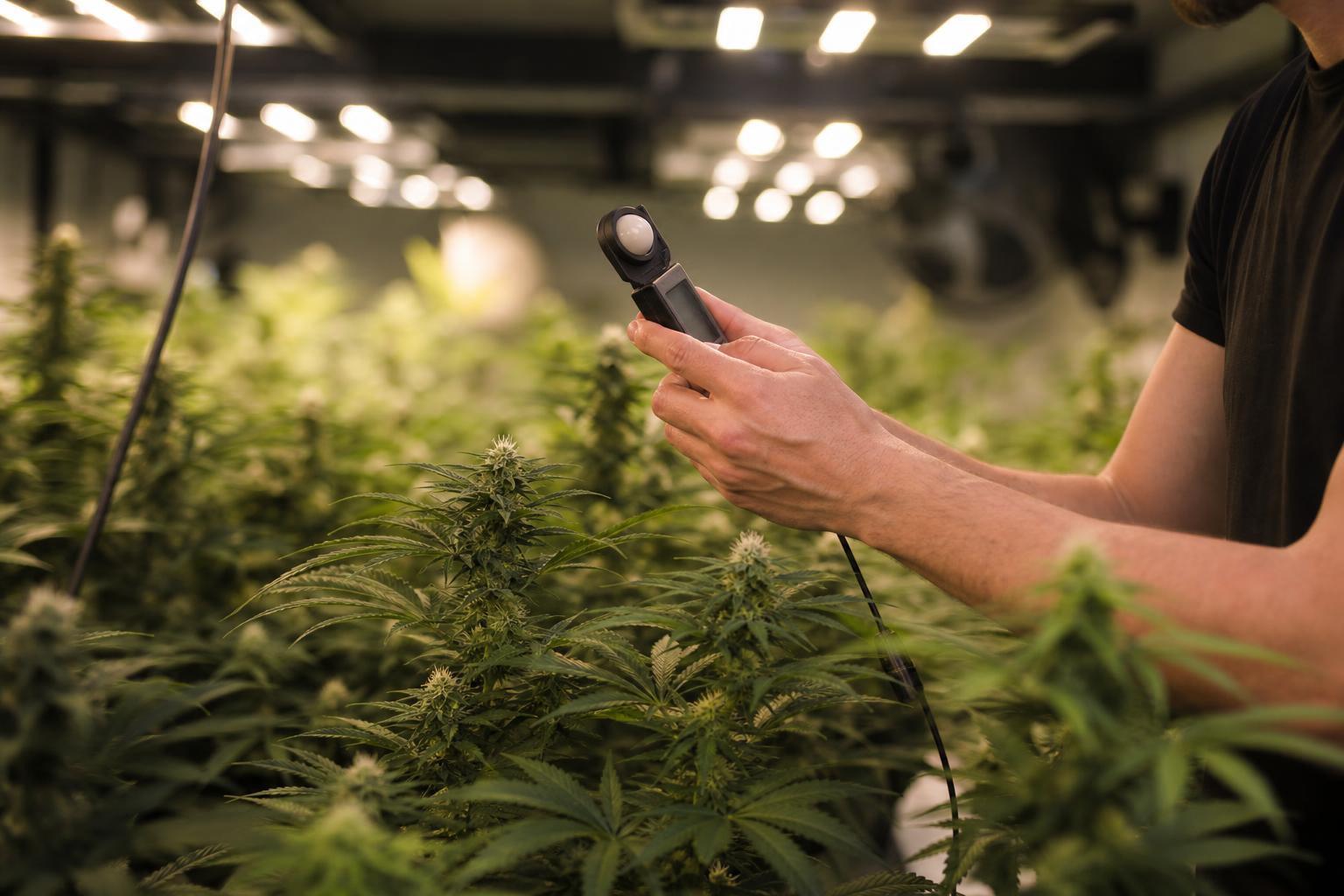
TLDR: Cannabis PPFD measures the intensity of photosynthetically active light reaching the canopy, reported in µmol·m⁻²·s⁻¹. Common starting ranges are 100–300 for seedlings, 300–600 for vegetative growth, and 600–1,000+ for flowering, though the right number depends on Daily Light Integral (DLI), CO₂ levels, environment, cultivar, and economics. PPFD is a snapshot measurement, not a daily total. For commercial cultivation, average canopy PPFD and uniformity matter far more than any single center reading.
Cannabis PPFD Quick Answer
These ranges are starting points rather than universal rules. The ideal PPFD depends on photoperiod, Daily Light Integral (DLI), CO₂ concentration, temperature, VPD, irrigation, cultivar, fixture distribution, and production goals. Commercial growers should optimise average canopy PPFD and uniformity rather than aiming for the highest centre-canopy reading.
If you only need starting PPFD targets:
Growth Stage | Recommended PPFD |
|---|---|
Seedlings & Clones | 100–300 µmol·m⁻²·s⁻¹ |
Vegetative Growth | 300–600 µmol·m⁻²·s⁻¹ |
Late Veg | 400–700 µmol·m⁻²·s⁻¹ |
Flowering | 600–1,000 µmol·m⁻²·s⁻¹ |
High-Light Commercial Flower | 1,000–1,500+ µmol·m⁻²·s⁻¹ |
What Is PPFD?
PPFD stands for Photosynthetic Photon Flux Density. It counts how many photons in the 400–700 nm wavelength range land on one square meter of surface every second. The Illuminating Engineering Society defines PPFD as photons per unit time and area in the 400–700 nm band, measured in µmol·s⁻¹·m⁻².
Growers usually shorten the unit to “micromoles.” If you want that unit explained from scratch, what is a micromole breaks it down in plain terms.
Think of cannabis PPFD as the speed of usable light hitting the canopy right now. It does not tell you total fixture output (that is PPF), the full daily light dose (that is DLI), or anything about electrical consumption (that is watts). It answers one question: how intense is the plant-usable light at this exact spot, at this moment?
A common source of confusion is treating PAR as a measurement. PAR (photosynthetically active radiation) describes a wavelength range, not an intensity value. PPFD is the actual intensity measurement within that range. Apogee Instruments clarifies that PAR defines the 400–700 nm waveband and PPFD is the photon flux density summed across it. Saying “my PAR is 800” is shorthand. What you mean is “my PPFD is 800 µmol·m⁻²·s⁻¹.”
Talk to a lighting expert about your facility’s PPFD targets.
PPFD at a Glance
Term | Measures | Unit |
|---|---|---|
PAR | Usable light wavelengths | none |
PPF | Total light output | µmol/s |
PPFD | Light reaching plants | µmol/m²/s |
DLI | Daily light received | mol/m²/day |
PPE | Fixture efficiency | µmol/J |
Cannabis PPFD Chart by Growth Stage
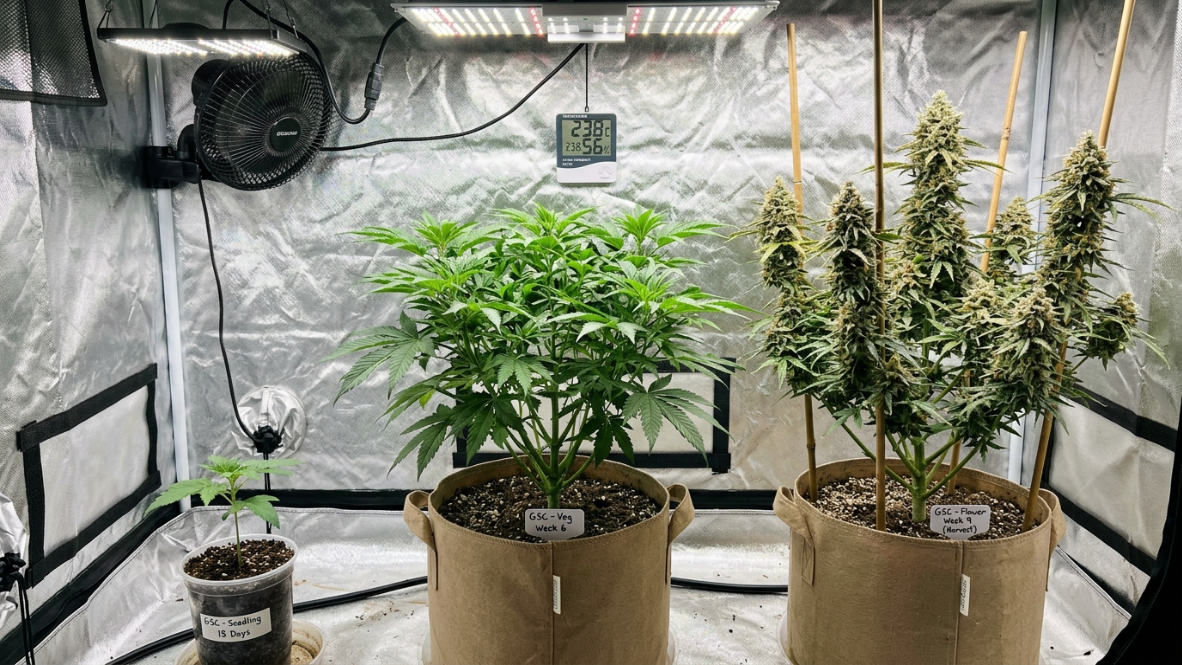
Use these cannabis PPFD ranges as starting points, not laws. The correct number depends on DLI, photoperiod, cultivar, CO₂, temperature, VPD, irrigation, nutrient availability, and canopy architecture.
Growth Stage | PPFD Starting Range (µmol·m⁻²·s⁻¹) | DLI Target (mol·m⁻²·day⁻¹) | Notes |
|---|---|---|---|
Seedling / clone | 100–300 | 15–20 | Young plants stress easily. Prioritize root and leaf establishment over maximum photosynthesis. |
Early / mid veg | 300–600 | 20–40 | Longer photoperiod (18h) means high DLI is achievable at moderate PPFD. |
Late veg / mother plants | 400–700+ | 20–40 | Depends on plant size, desired morphology, and whether lighting is sole-source or supplemental. |
Flower | 600–1,000 | 25–50 | Common commercial and hobby range. Higher levels require stronger environment control. |
High-light flower | 1,000–1,500+ | 40–65+ | Advanced zone. Requires tight environmental control, CO₂ strategy, cultivar selection, and economic justification. |
The DLI targets come from the Resource Innovation Institute’s cannabis controls guide, which lists flower/bloom at 25–50, vegetative at 20–40, and clone/seedling at 15–20 mol·m⁻²·day⁻¹.
The PPFD ranges align with what growers commonly report in practice. Practitioners on Overgrow cite 200–400 for seedlings, 400–600 for veg, and 600–900 for flowering, then debate whether higher levels waste power without supplemental CO₂. These are practical grower benchmarks, not scientific maximums.
For a deeper look at lighting design in flower rooms, see the full cannabis flower room lighting guide.
PPFD Recommendations by Grow Type
Grow Type | Typical PPFD |
|---|---|
Autoflower Tent | 500–900 |
Photoperiod Tent | 600–900 |
Commercial Indoor | 700–1,100 |
Greenhouse Supplemental | 300–700 |
Vertical Farm | 700–1,200 |
PPFD Calculator Examples
Google loves calculation examples.
Example:
Example 1
600 PPFD
18 hours
=
38.9 DLI
Example 2
900 PPFD
12 hours
=
38.9 DLI
Example 3
1000 PPFD
12 hours
=
43.2 DLI
PPFD vs DLI: The Distinction That Fixes Most Confusion
PPFD is intensity per second. DLI (Daily Light Integral) is the total daily dose, the sum of all those seconds across the entire light period.
The formula is straightforward:
DLI = PPFD × hours of light × 0.0036
This conversion comes from the same relationship Virginia Tech’s supplemental lighting guide uses in its operating-hours framework for greenhouse DLI management.
Here is why this matters for cannabis:
PPFD (µmol·m⁻²·s⁻¹) | 12-hour flower DLI | 18-hour veg DLI |
|---|---|---|
300 | 13.0 | 19.4 |
500 | 21.6 | 32.4 |
600 | 25.9 | 38.9 |
700 | 30.2 | 45.4 |
900 | 38.9 | 58.3 |
1,000 | 43.2 | 64.8 |
1,200 | 51.8 | 77.8 |
Notice something important: a cannabis plant under 600 PPFD for 18 hours receives the same daily light dose (38.9 DLI) as a plant under 900 PPFD for 12 hours. If PPFD is miles per hour, DLI is miles driven that day. A car going 60 mph for 3 hours covers the same distance as one going 90 mph for 2 hours.
This is why cannabis PPFD alone can mislead growers. Vegetative plants on long photoperiods can accumulate a high DLI at moderate instantaneous intensity. Flowering plants on 12/12 need higher PPFD to hit the same daily dose.
For a full walkthrough of DLI math and targets, see DLI calculations and targets.
How Much PPFD for Cannabis Flower?
Most growers and lighting guides cite 600–1,000 µmol·m⁻²·s⁻¹ as the standard cannabis flowering PPFD range. That is a reasonable starting zone, but it is not a biological ceiling.
A University of Guelph study tested flowering cannabis at canopy PPFD levels from approximately 120 to 1,800 µmol·m⁻²·s⁻¹. Dry inflorescence yield increased linearly from 116 to 519 g·m⁻², a 4.5x increase, as average canopy PPFD rose across the full range. Cannabinoid potency showed no significant treatment effect. Yield went up because flower mass went up, not because THC percentage rose.
A separate 2022 study grew high-THC cannabis under 600, 800, and 1,000 PPFD. Dry inflorescence weight increased from 27.6 g per plant at 600 PPFD to 44.7 g at 1,000 PPFD. Cannabinoid and total terpene concentrations were not significantly different across treatments.
The takeaway: more PPFD often means more grams and more total cannabinoids per area, because flower mass increases. It does not necessarily mean higher THC percentage.
Why 1,000 PPFD Is Not a Hard Maximum
Many cannabis PPFD charts imply a plateau around 900–1,000 µmol·m⁻²·s⁻¹. This likely comes from leaf-level photosynthesis curves, which do saturate below that range. But the Guelph researchers explicitly warned that leaf photosynthesis is not a reliable predictor of whole-plant yield. The canopy is layered. Lower leaves may still be light-limited even when top leaves are near saturation.
Practitioners have highlighted this same point, noting that lighting vendors sometimes overuse leaf photosynthesis graphs to justify selling more fixtures, when whole-canopy yield data tells a different story. Some have specifically referenced the Guelph paper’s warning about this disconnect.
Running above 1,000 PPFD is an advanced operating zone. It requires tight environmental control, CO₂ management, proper fertigation, cultivar tolerance, and economic justification. For most growers, 600–1,000 PPFD during flower is where practical results and manageable complexity intersect.
Explore commercial top-lighting fixtures designed for cannabis flower rooms.
How CO₂, VPD, and Temperature Change Cannabis PPFD Targets
PPFD does not exist in isolation. Plants process photons within an environmental system, and that system determines whether high light becomes yield or stress.
Chandra et al. tested Cannabis sativa leaf gas exchange under PPFDs from 0 to 2,000 µmol·m⁻²·s⁻¹, temperatures from 20–40°C, and CO₂ levels from 250–750 µmol·mol⁻¹. They found peak photosynthesis around 30°C and approximately 1,500 PPFD. Elevated CO₂ at 750 µmol·mol⁻¹ stimulated photosynthesis by roughly 50% and water-use efficiency by about 111% compared with ambient levels.
CO₂ does not turn high PPFD on or off like a switch. It changes how efficiently plants convert extra photons into biomass. At high PPFD, added CO₂ improves the odds that extra light becomes yield rather than waste. For more on this dynamic, see the role of CO₂ in CEA.
Beyond CO₂, growers raising cannabis PPFD targets above moderate levels should evaluate several factors:
Leaf temperature. Higher light intensity adds radiant heat. Leaf temperature can climb above air temperature, shifting VPD and stress thresholds.
VPD. Vapor pressure deficit controls transpiration rate. Higher PPFD increases water demand, and if VPD is out of range, stomata close and photosynthesis stalls.
Fertigation. More photosynthesis means more nutrient uptake. Irrigation frequency and nutrient concentration may need adjustment.
HVAC and dehumidification. Higher light intensity increases both sensible heat and transpiration, adding load to cooling and dehumidification systems.
Cultivar tolerance. A 2024 Utah State University thesis found cultivar-specific responses to high DLI, including reduced height in one cultivar and decreased CBD concentration in another.
High PPFD without environmental support often produces bleaching, foxtailing, nutrient deficiencies, or simply wasted electricity. The light intensity decision is an environmental system decision.
How Fixture Height Changes PPFD
Fixture Height | PPFD | Uniformity |
|---|---|---|
Too Low | Very High Centre | Poor |
Recommended | Balanced | Good |
Too High | Lower | Better Spread |
How to Measure PPFD in a Cannabis Room
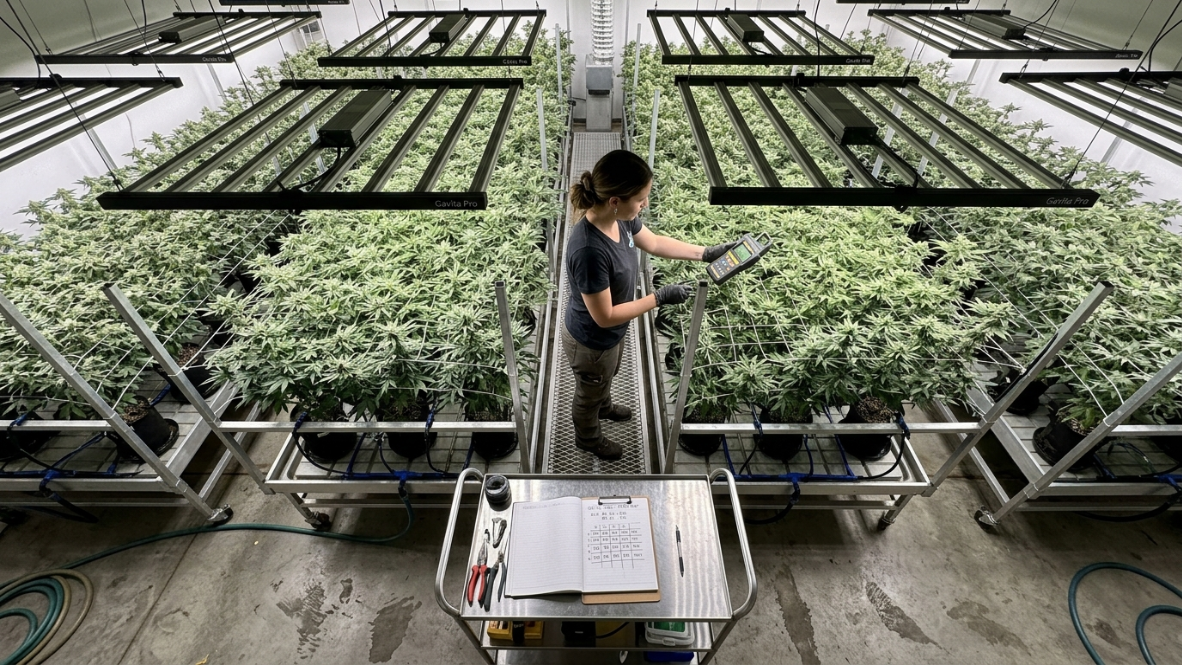
A cannabis PPFD number is only as useful as the measurement behind it. Too many growers take a single reading directly under the fixture and call it their room’s PPFD. That number represents the hotspot, not the canopy average.
Here is a practical measurement workflow:
Use a calibrated quantum sensor or reliable PPFD meter. Phone apps can work for rough estimates but should be used with any required diffuser and understood as approximations, not precision instruments.
Measure at the actual canopy height, not at the fixture or at floor level.
Take readings on a grid. A 4x4 or 5x5 grid across the growing area captures both center intensity and edge falloff. Record every reading.
Calculate minimum, maximum, and average PPFD. Then calculate uniformity, often expressed as min/average or min/max.
Measure with the room configured as grown. Reflective walls, adjacent fixtures, trellising, and plant canopy all affect actual readings.
Re-check after changes. Dimmer adjustments, fixture cleaning, hanging height changes, or room layout modifications all shift the PPFD map.
Practitioners on 420 Magazine’s top-ranking PPFD thread measured lights on a detailed grid and demonstrated how sharply intensity drops outside a fixture’s direct footprint. The author showed that manufacturer recommended coverage areas can significantly overstate useful flowering coverage.
A THCFarmer discussion illustrates a common beginner question: “Should I use height or the dimmer to hit my target PPFD?” The practical answer is that dimming changes intensity while preserving light distribution, while changing height changes both intensity and distribution (often affecting uniformity). For most growers, adjusting the dimmer first and fine-tuning height second is the more predictable approach.
A PPFD Number Without a Map Is Not a Lighting Plan
Manufacturer PPFD maps show modeled output under specific conditions. They are useful starting points. But installed PPFD in a real room depends on mounting height, fixture spacing, reflective surfaces, canopy shape, and adjacent fixture overlap. Commercial growers should verify installed PPFD against the design spec after commissioning.
Why PPFD Uniformity Matters in Commercial Rooms
A center-canopy reading of 1,000 PPFD is not the same as a room average of 1,000 PPFD. In many rooms, the center gets more light than it needs while edges and corners are significantly underlit. This creates uneven plant growth, inconsistent flower quality, variable transpiration rates, and environmental control headaches.
Commercial cannabis PPFD design should focus on:
Average canopy PPFD across the entire growing area, not just the peak under the fixture.
Minimum PPFD at the weakest point. This is often where yield is lost.
Uniformity ratio (minimum ÷ average). Ratios below 0.7 indicate meaningful edge losses.
Fixture spacing and overlap. Proper overlap fills gaps and smooths the PPFD map.
Canopy height changes. As plants stretch during flower, fixture-to-canopy distance shrinks, changing both intensity and distribution.
A commercial lighting practitioner on LinkedIn emphasized that simply lowering lights does not necessarily increase useful light. The post explained how lighting plans should show PPFD and uniformity at different distances from fixture to canopy, because the relationship is not linear. Moving fixtures closer raises center intensity but can worsen edge falloff.
This is why serious commercial facilities design around average PPFD and uniformity targets, not a single impressive center value. They request light plans before installation and verify with physical measurements afterward.
PPFD Below the Canopy: Why Under-Canopy Light Matters
Most cannabis PPFD discussions focus entirely on light hitting the top of the canopy. That makes sense as a starting point, but it misses something important. Dense cannabis canopies create heavily shaded lower zones. A plant receiving 1,000 PPFD at the crown might see only 100–200 PPFD at middle-canopy nodes and near zero at the base.
Lower-canopy flower sites contribute meaningfully to total yield and quality. When they are light-starved, they produce smaller, less dense flowers with lower cannabinoid content per gram.
A 2025 study on supplemental lighting in medicinal cannabis found that inter-canopy lighting increased dry inflorescence yield by 29.95%, THC accumulation by 24.4%, and total terpene concentration by 12.5%. The authors concluded that supplemental inner-canopy lighting improves yields, energy efficiency, and product standardization.
Advanced growers have explored this topic in detail. A common observation is that adding photons to underlit lower-canopy tissue can produce yield responses roughly proportional to the added PPFD, because those tissues are far from saturation even when the top canopy is fully lit.
Once the top canopy is receiving adequate light, the next yield opportunity may not be more top light. It may be better photon distribution into the shaded parts of the crop. PPFD is three-dimensional in a cannabis canopy.
See the Boost XE under-canopy bar for commercial lower-canopy lighting.
For the research behind this strategy, read under-canopy lighting: the experiment is over.
Top Lighting vs Under Canopy Lighting
Top Lighting | Under Canopy |
|---|---|
Upper flowers | Lower flowers |
Higher hotspot | Better penetration |
Easier install | Higher capital cost |
Standard | Supplemental |
PPFD vs PAR, PPF, Watts, Lux, and PPE
Cannabis growers encounter several light-related terms. Confusing them leads to bad purchasing decisions and poor environmental management.
Term | What It Measures | Unit | Why It Matters |
|---|---|---|---|
PAR | Wavelength range plants use (400–700 nm) | Not a measurement | Describes what kind of light is relevant, not how much. |
PPF | Total PAR photons a fixture emits per second | µmol·s⁻¹ | Compares total fixture output. Does not tell you what reaches the canopy. |
PPFD | PAR photons reaching one square meter each second | µmol·m⁻²·s⁻¹ | The key canopy-level intensity measurement. |
DLI | Total PAR photons per square meter per day | mol·m⁻²·day⁻¹ | Connects PPFD with photoperiod. Often predicts crop response better than instantaneous PPFD. |
PPE | Photosynthetic photon efficacy | µmol·J⁻¹ | Photon output per joule of electricity. Higher PPE means lower cost per unit of light. |
Watts | Electrical power draw | W | Tells you the electricity cost, not the light delivered. |
Lux / Lumens | Light weighted for human vision | lx / lm | Irrelevant for plant growth decisions. |
Watts are what the utility bills you for. PPFD is what the canopy receives. PPE connects the two.
A cannabis lighting study found that fixture efficacy was more important than spectrum for cost-effective cannabinoid production, and estimated lower photon costs for LEDs than HPS at typical electricity rates. This is why comparing lights by wattage alone is misleading. Two fixtures drawing the same watts can deliver very different amounts of usable light depending on their efficacy and optical design.
One additional nuance: PPFD counts all photons in 400–700 nm equally, but spectrum can still influence morphology, photosynthetic efficiency, and secondary metabolites. A plant scientist on LinkedIn summarized research showing that specific red wavelength peaks affected photosynthetic efficiency at low PPFD and terpenoid concentrations at high PPFD, while cannabinoid concentrations were unaffected by spectrum. PPFD is the quantity measure. Spectrum is the quality layer.
Common Cannabis PPFD Mistakes
Treating PAR as a number
PAR is the wavelength range. PPFD is the measured intensity within that range. “My PAR is 800” is imprecise shorthand.
Using a single center reading as the room target
A center hotspot can hide weak edges and corners. Map the canopy on a grid, calculate the average, and track uniformity.
Ignoring DLI
The same PPFD has very different meaning under 12 hours versus 18 hours of light. A veg room at 600 PPFD for 18 hours delivers more total daily light than a flower room at 900 PPFD for 12 hours.
Increasing PPFD without adjusting environment
Higher PPFD increases water demand, nutrient uptake, heat load, and dehumidification requirements. Raising intensity without raising everything else often causes stress or wasted electricity.
Assuming 1,000 PPFD is a hard maximum
Research shows cannabis yield can keep increasing above 1,000 PPFD under the right conditions. The number is a common practical target, not a proven biological wall.
Comparing lights by watts alone
Fixture efficacy, distribution pattern, spectrum, mounting height, and installed PPFD matter more than raw wattage.
Forgetting lower-canopy PPFD
Dense flower rooms may benefit more from better light distribution through the canopy than from additional top intensity.
Trusting manufacturer maps without verification
Manufacturer PPFD maps are modeled under specific conditions. Real rooms have different wall reflectivity, spacing, canopy shapes, and heights. Verify after installation.
Key Takeaways
PPFD measures instantaneous light intensity.
DLI measures total daily light.
Seedlings generally perform well around 100–300 PPFD.
Vegetative cannabis typically uses 300–600 PPFD.
Flowering commonly uses 600–1,000 PPFD.
Above 1,000 PPFD generally requires stronger environmental control.
Uniformity matters more than peak readings.
Average canopy PPFD is the most useful commercial metric.
PPFD should always be considered alongside DLI, CO₂, temperature, and VPD.
FAQs
What does PPFD stand for?
PPFD stands for Photosynthetic Photon Flux Density. It measures the number of photosynthetically active photons (400–700 nm) landing on one square meter each second, reported in µmol·m⁻²·s⁻¹.
What PPFD should cannabis seedlings get?
Cannabis seedlings and clones typically start around 100–300 µmol·m⁻²·s⁻¹. Young plants are sensitive to high light, and root establishment matters more than pushing photosynthesis at this stage.
What PPFD should cannabis get in flower?
Most growers target 600–1,000 µmol·m⁻²·s⁻¹ during flowering. Advanced commercial operations may push to 1,000–1,500+ when CO₂, environment, cultivar tolerance, and economics support it. Peer-reviewed research has shown yield increases up to 1,800 PPFD under controlled conditions, though most facilities find their economic optimum well below that.
Is 1,000 PPFD too much for cannabis?
Not necessarily. Research shows cannabis can continue producing more flower mass above 1,000 PPFD. Whether it is “too much” depends on CO₂ levels, temperature, VPD, fertigation capacity, cultivar tolerance, and whether the added yield justifies the added electricity, HVAC, and CO₂ costs.
Do I need CO₂ above 1,000 PPFD?
CO₂ supplementation is not required at any specific PPFD threshold, but it increases the plant’s ability to convert high-intensity light into biomass. Research shows elevated CO₂ can boost photosynthesis by approximately 50% under optimum conditions. Above 800–1,000 PPFD, CO₂ enrichment increasingly separates the growers who see returns from high light and those who waste electricity.
Is DLI more important than PPFD?
They measure different things and work together. PPFD is instantaneous intensity. DLI is the total daily dose, calculated from PPFD and photoperiod length. For crop management decisions, DLI often predicts plant response better because it accounts for how long the light is on, not just how bright it is.
What is the difference between PPFD and PAR?
PAR (photosynthetically active radiation) describes the wavelength band from 400–700 nm. PPFD is the measured intensity of light within that band at the canopy surface. PAR is the category; PPFD is the measurement.
Why is my edge canopy PPFD lower than the center?
Light intensity from any fixture drops with distance from the optical center. Without adequate fixture overlap, edges and corners receive significantly less light. This is why commercial lighting design emphasizes fixture spacing, overlap patterns, and uniformity ratios rather than peak center values.
Need a cannabis PPFD design for your facility? Schedule a free consultation with a lighting expert.