How to Use Supplemental Lighting in a Greenhouse for Better DLI and Yield Consistency
A practical guide to using greenhouse supplemental lighting for winter production, crop uniformity, DLI targets, and commercial lighting ROI.
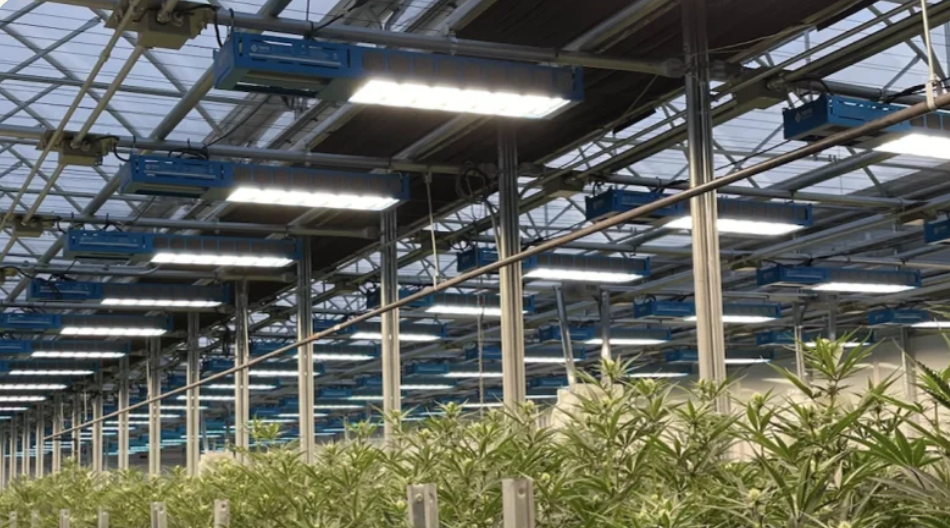
TLDR
Greenhouse supplemental lighting is used to fill the gap between the sunlight a crop actually receives and the daily light integral (DLI) it needs. The core operating logic is simple: target DLI minus actual crop-level DLI equals the supplemental light requirement. Growers manage it using PPFD and DLI rather than watts or lumens, and fixture choice, controls, spectrum, and economics all follow from that gap calculation.
Greenhouse supplemental lighting adds artificial light to natural sunlight so crops receive enough daily photosynthetic light for consistent growth, yield, quality, and scheduling. The concept sounds straightforward, but getting it right means understanding why sunlight alone falls short, how to measure the deficit, and what to do about it.
For commercial growers, that gap shows up directly in winter yield, crop uniformity, and the ability to hit delivery schedules, which makes supplemental lighting one of the highest leverage upgrades in a greenhouse.
DLI (daily light integral)—the total photosynthetically useful photons per m² per day—is the key metric. Fixture choice, runtime, and controls should all be set to close the DLI gap between greenhouse light and the crop’s target.
If you are evaluating supplemental lighting for a commercial greenhouse, Thrive Agritech’s greenhouse lighting applications page is a good starting point for understanding fixture options.
Greenhouse Supplemental Lighting: Quick Answer
Greenhouse supplemental lighting is the use of electric grow lights to increase a crop's daily light integral (DLI) when sunlight alone cannot meet plant requirements. Growers calculate supplemental lighting needs by measuring the difference between target crop DLI and actual greenhouse DLI.
The basic formula is:
Target Crop DLI − Actual Greenhouse DLI = Supplemental DLI Required
Supplemental lighting is most commonly used during winter, cloudy weather, high-latitude production, and year-round greenhouse operations where maintaining consistent yield and crop quality is critical.
Key takeaways:
- DLI is the most important greenhouse lighting metric.
- PPFD determines how quickly supplemental DLI is delivered.
- LEDs are now the dominant fixture type for new installations.
- Lighting controls and sensors improve efficiency by preventing unnecessary runtime.
- The best lighting system is the one that delivers the required DLI at the lowest total operating cost.
Greenhouse Supplemental Lighting, Defined
Greenhouse supplemental lighting is the practice of using light fixtures inside a greenhouse to deliver photosynthetic photons when sunlight is insufficient for a grower’s production target. It is “supplemental” because the sun remains part of the lighting system. The fixtures fill what the sun cannot provide on a given day, not replace it entirely.
This distinguishes it from two related concepts. Indoor sole-source lighting (used in vertical farms or sealed grow rooms) provides all the light a crop receives. Photoperiodic lighting uses very low intensity to manipulate how plants perceive day length and trigger flowering responses. Michigan State University notes that photoperiodic lighting can work at intensities as low as 1 to 2 µmol·m⁻²·s⁻¹, while supplemental lighting is high-intensity lighting intended to increase DLI.
Think of supplemental lighting as crop light insurance. When the greenhouse falls short of the crop’s daily light requirement, supplemental fixtures fill the gap.
Why Greenhouses Need Supplemental Light
Sunlight is free but unreliable. It changes by latitude, season, weather, time of day, and greenhouse orientation. Natural DLI can exceed 60 mol·m⁻²·d⁻¹ during long summer days and fall below 5 mol·m⁻²·d⁻¹ under overcast winter conditions, according to Ohio State University.
The crop does not receive what is measured outdoors, either. Greenhouse structures, glazing, shade curtains, hanging baskets, heat pipes, and accumulated dust all reduce light transmission. OSU reports that greenhouse glazing and structure alone can cut DLI by 30 to 50%. Vegetable Growers News puts the figure at 35 to 50%, with additional losses from obstructions.
In year-round commercial production, low and variable light shows up fast: plugs root slowly, lettuce stretches, yields fall in vine crops, and flowering can stall. Supplemental lighting addresses this by keeping crop-level DLI closer to the target despite seasonal and weather swings.
Typical Greenhouse DLI by Season
Condition | Typical Outdoor DLI (mol·m⁻²·d⁻¹) | Typical Crop-Level Greenhouse DLI (After Transmission Losses) |
|---|---|---|
Sunny Summer Day | 40–60+ | 25–45 |
Spring/Fall | 20–35 | 12–25 |
Cloudy Spring Day | 10–20 | 6–14 |
Winter Northern Climate | 5–15 | 3–10 |
Heavy Overcast Winter Day | 2–8 | 1–5 |
Actual values vary by latitude, greenhouse design, glazing material, and weather conditions.
How to Calculate Whether You Need Supplemental Lighting
Most greenhouse lighting decisions can be reduced to a simple four-step process:
Step 1: Identify Crop DLI Requirements
Determine the target DLI for the crop and growth stage.
Step 2: Measure Greenhouse DLI
Use a quantum sensor at crop height to measure actual DLI reaching the canopy.
Step 3: Calculate the Deficit
Subtract measured DLI from target DLI.
Example:
Crop target DLI = 18 mol·m⁻²·d⁻¹
Actual greenhouse DLI = 9 mol·m⁻²·d⁻¹
Deficit:
18 − 9 = 9 mol·m⁻²·d⁻¹
Step 4: Determine Fixture Runtime
Use fixture PPFD and operating hours to deliver the missing photons.
This process prevents one of the most common mistakes in greenhouse lighting: purchasing fixtures before determining the actual DLI deficit.
The Key Metric: Daily Light Integral
DLI is the total number of photosynthetically active photons (400–700 nm) that land on one square meter of crop canopy over a day, measured in mol·m⁻²·d⁻¹. PPFD is the instantaneous photon rate (µmol·m⁻²·s⁻¹). In simple terms: PPFD is how hard the light is hitting the canopy at a given moment; DLI is the accumulated “photon dose” the crop receives by day’s end.
Virginia Tech provides the calculation framework that most commercial growers follow: determine the crop’s target DLI, estimate inside-greenhouse DLI after transmission losses, and calculate the deficit.
The formula
Supplemental DLI needed = Target crop DLI − actual crop-level greenhouse DLI
Then convert to runtime:
Lighting hours = supplemental DLI × 1,000,000 ÷ (PPFD × 3,600)
A worked example
Say a greenhouse lettuce crop needs 14 mol·m⁻²·d⁻¹. On a cloudy winter day, the greenhouse delivers only 6 mol·m⁻²·d⁻¹ at crop height. The supplemental deficit is 8 mol·m⁻²·d⁻¹. If fixtures deliver 200 µmol·m⁻²·s⁻¹ at the canopy:
8 × 1,000,000 ÷ (200 × 3,600) = 11.1 hours of supplemental lighting
Understanding units like micromoles, PPFD, and PPF is essential for this math. For a plain-English breakdown, see Thrive’s guide on what is a micromole.
Supplemental Lighting vs. Photoperiodic Lighting
This distinction trips up a lot of growers, and MSU considers it one of the most common sources of confusion in greenhouse lighting.
Supplemental lighting uses meaningful photosynthetic intensity (typically 50 to 200+ µmol·m⁻²·s⁻¹) to increase total daily light. Its purpose is growth, yield, and quality.
Photoperiodic lighting uses very low intensity to change how plants perceive day length. It triggers or prevents flowering in photoperiod-sensitive crops. It does not meaningfully increase DLI.
A high-intensity fixture running for a long photoperiod can accomplish both goals simultaneously. But a low-intensity night-interruption lamp will not substitute for photosynthetic supplemental lighting, no matter how many hours it runs.
Key Terms in Greenhouse Supplemental Lighting
These are the terms that matter when specifying, purchasing, or operating greenhouse supplemental lighting systems. Virginia Tech and Oklahoma State University both emphasize using plant-relevant photon metrics rather than human-lighting units.
PAR (photosynthetically active radiation): The 400 to 700 nm light band that drives photosynthesis.
PPF (photosynthetic photon flux): Total photons a fixture emits per second. Useful for comparing fixtures.
PPFD (photosynthetic photon flux density): Photons reaching a square meter of canopy per second. The “right now” intensity at crop height.
DLI (daily light integral): Total photosynthetic photons per square meter per day. The daily crop light budget.
PPE (photosynthetic photon efficacy): Fixture photon output per joule of electricity, measured in µmol/J. The efficiency metric.
Photoperiod: Duration of light and dark in a 24-hour cycle.
Greenhouse transmission: The percentage of outdoor sunlight that reaches the crop after glazing and structure losses.
Quantum sensor: A sensor measuring plant-relevant light at crop height. MSU recommends placing at least one at canopy level near the middle of the growing area.
Top lighting: Fixtures mounted above the canopy, the most common supplemental lighting configuration.
Interlighting: Fixtures placed within the crop canopy, common in tall vine crops like tomato.
Under-canopy lighting: Fixtures positioned below the main canopy to light lower leaves and secondary growth. Thrive’s Boost XE is designed for this application.
When evaluating fixture specifications, understanding horticultural lighting labels helps separate meaningful data from marketing claims.
A critical point: lumens, lux, foot-candles, and watts are not plant-relevant metrics. Virginia Tech explicitly says these human-lighting units are not recommended for measuring plant light levels.
What Crops Benefit Most?
The economic case for greenhouse supplemental lighting depends on the crop, its DLI target, and the value of the response. Here are starting ranges from university research (not universal prescriptions):
Young plants and propagation: Target DLI of 10 to 12 mol·m⁻²·d⁻¹. Low winter DLI can cause delays, leggy growth, and poor post-transplant performance. Purdue and MSU research found that plugs grown with supplemental lighting were marketable sooner with thicker stems and greater mass.
Lettuce and leafy greens: Minimum 12 to 14 mol·m⁻²·d⁻¹ per MSU vegetable guidance. Winter greenhouse sunlight in northern regions may deliver only 5 mol·m⁻²·d⁻¹, creating a large deficit.
Vine crops (tomato, pepper, cucumber): At least 15, preferably above 20 mol·m⁻²·d⁻¹. MSU notes that 200 µmol·m⁻²·s⁻¹ is commonly provided in northern European greenhouse tomato production. One greenhouse tomato study found LED interlighting increased fruit yield by about 21%.
Strawberry: Minimum 10 to 12 mol·m⁻²·d⁻¹, optimum 20 to 25. DLI above 30 may cause stress, according to OSU.
Cannabis: Commercial cannabis growers often target high DLI during flower. Field observations from greenhouse cannabis operations indicate that extended cloudy periods can reduce light enough to slow growth, which is why many facilities prioritize automated supplemental lighting for consistent production.
The common rule of thumb in greenhouse production: a 1% increase in DLI increases production by roughly 1%. MSU’s vegetable lighting guidance cites this heuristic, though it should be treated as a general principle rather than an absolute law.
Recommended DLI Targets by Crop
Crop | Minimum DLI (mol·m⁻²·d⁻¹) | Preferred Range |
|---|---|---|
Lettuce | 12 | 14–17 |
Basil | 12 | 15–20 |
Strawberry | 10 | 20–25 |
Tomato | 15 | 20–30 |
Pepper | 15 | 20–30 |
Cucumber | 15 | 20–25 |
Cannabis Vegetative | 20 | 25–35 |
Cannabis Flowering | 30 | 40+ |
Bedding Plant Propagation | 10 | 12–15 |
Actual targets vary by cultivar, CO₂ concentration, nutrition, and production goals.
LED vs. HPS for Greenhouse Supplemental Lighting
High-pressure sodium (HPS) has been the greenhouse supplemental lighting standard for decades. LEDs are now the default direction for most new installations. The comparison is more nuanced than “LED wins.”
Where LED leads
Modern horticultural LEDs offer higher photon efficacy, longer useful life, spectral control, dimming capability, and lower radiant heat. The DesignLights Consortium’s 2025 requirements set a new PPE threshold, and Greenhouse Grower reports that listed fixtures are now at least 45% more efficient than the most efficacious 1,000-watt double-ended HPS luminaire. The qualified product list includes over 1,200 fixtures from more than 130 manufacturers.
Where HPS still has a role
HPS fixtures emit significant radiant heat, which can be beneficial in cold-climate greenhouses during winter—but only when there is a meaningful heating load to offset. MSU’s vegetable guidance notes that HPS heat can offset a portion of greenhouse heating requirements. In milder seasons or warmer climates, that same heat becomes a liability, increasing venting/cooling needs and potentially reducing the net efficiency advantage.
The heat tradeoff most articles understate
A Wageningen University study found that LED conversions reduced lighting energy demand but increased heating demand. In most modeled cases, total greenhouse energy savings were 10 to 25% after accounting for the heating offset.
Anecdotal evidence from the field points to the same conclusion: the LED vs. HPS decision is often a heat, economics, and risk-tolerance decision. Some operators value HID radiant heat in cool climates; others prioritize reducing electrical load. Which is “best” depends on the greenhouse energy balance and the production goals.
For a deeper look at thermal management, Thrive’s article on HVAC needs for LED lights covers heat load calculations.
Maintenance differences
HPS systems require periodic re-lamping: many growers plan to replace bulbs roughly every 6 to 12 months to maintain output and uniformity. LEDs do not require bulb changes and typically deliver useful life measured in years (often tens of thousands of hours), though light output gradually degrades over time.
Bottom line: maintenance and downtime are usually higher with HPS, while LEDs shift the focus to long-term degradation and warranty/reliability.
How Many Supplemental Lighting Fixtures Do You Need?
The number of fixtures required depends on:
Greenhouse dimensions
Crop spacing
Target PPFD
Mounting height
Fixture output (PPF)
Desired uniformity
A common mistake is sizing fixtures based on square footage alone. Professional lighting designs calculate canopy-level PPFD distribution rather than fixture count per square foot.
For most commercial greenhouses, fixture quantity should be determined through lighting simulation software and crop-specific DLI targets.
How Growers Control Supplemental Lighting
Bad supplemental lighting is static. Good supplemental lighting is measured, zoned, and controlled.
MSU’s 2025 guidance identifies lack of lighting controls as a common pitfall. The recommendations are clear: use an environmental control system integrated with lighting, place at least one quantum sensor at crop height, and avoid running lights when they are not needed.
Best practices for controls
Prioritize morning and evening operation. Virginia Tech notes that supplemental lighting is often most efficient during early morning and late afternoon when ambient PPFD is low, rather than midday when the sun may already meet the crop’s needs.
Use DLI-based targets, not just timers. A simple timer runs the same hours regardless of whether the day was sunny or overcast. Sensor-driven controls adjust to actual conditions. Many growers—large and small—adopt this approach in variable climates by using a PAR/PPFD sensor to turn fixtures on only when natural light drops below a setpoint.
Account for electricity rates. MSU says lighting has the greatest value when it is dark or cloudy, DLI is low, electricity is not at peak price, and plants are actually under the fixtures.
Zone your lights. Do not light empty benches or unoccupied crop zones. LED lifespan is not affected by on/off cycling, so LEDs can be controlled with a single setpoint. HPS fixtures need a deadband to reduce frequent cycling and extend bulb life. This operational detail matters for automated control strategies.
Remote drivers. For larger deployments where electrical architecture affects controls and maintenance, Thrive’s OptiDrive platform moves LED drivers out of the grow area through remote or centralized power distribution.
How to Know If Your Greenhouse Needs Supplemental Lighting
Before buying fixtures, answer these questions. A common field takeaway is to measure your crop-level DLI on the worst (darkest) days you plan to produce—then size lighting to cover that deficit.
What is the target DLI?
What is your actual crop-level DLI during the darkest production period?
How much light do you lose through glazing, shade systems, structure, and obstructions?
How many hours can lights run without causing crop stress or photoperiod problems?
What canopy-level PPFD do you need, and what fixture layout achieves uniform coverage?
What are your utility rates, demand charges, and available rebates?
What environmental adjustments (heating, cooling, humidity, CO₂, irrigation) will the lighting system require?
What controls will prevent lighting during sunny conditions or over empty crop zones?
Does the expected crop response justify the investment?
Supplemental lighting can account for 10 to 30% of greenhouse operating expenses, according to a 2024 lettuce production study. The goal is not maximum photons at all times. It is the most profitable crop response per added photon.
When Supplemental Lighting Is Worth the Investment
Supplemental lighting pays off when the added yield, quality, or scheduling value is worth more than the electricity and fixtures it takes to close your DLI gap. It makes the most sense in three cases: winter and shoulder seasons when greenhouse DLI drops below your crop target, high-value crops where a small quality or timing gain moves revenue, and year-round schedules where consistent light protects your delivery commitments. If your greenhouse already hits target DLI for most of the year, a smaller system sized to the worst months usually beats over-lighting. Right-size the install to your actual deficit, let controls dim fixtures when sunlight is enough, and the payback comes from every mole you add that the crop can actually use.
Common Mistakes
Buying fixtures before measuring crop-level DLI. The DLI deficit drives every other decision. Without it, fixture selection is a guess.
Using lumens or watts as the main specification. These are human-lighting and electrical metrics. Plants respond to photosynthetic photons. Use PPFD, DLI, PPF, and PPE.
Confusing photoperiodic lighting with supplemental lighting. A low-intensity flowering lamp will not meaningfully increase DLI. These are different tools for different purposes.
Ignoring heat and humidity after switching to LED. LEDs change the greenhouse energy balance. Lower radiant heat affects canopy temperature, transpiration, humidity, and disease pressure.
Assuming equal DLI always means equal crop response. DLI is the core budget, but photoperiod and instantaneous PPFD still matter. Field experience suggests that equal DLI does not always produce equal growth when the PPFD/photoperiod combinations are very different, and that pushing to very high DLI can increase demands on utilities, irrigation, nutrition, and HVAC.
Mixing fixture types without a lighting plan. MSU warns that combining different LED types or mixing LEDs with HPS can create variable light intensity and spectrum across the crop, leading to nonuniform growth.
Frequently Asked Questions
Is greenhouse supplemental lighting the same as grow lighting?
Grow lighting is a broad category. Greenhouse supplemental lighting is a specific application where electric lights add to (not replace) natural sunlight. Sole-source grow lighting in an indoor facility provides all the light. The design approach, fixture selection, and controls differ between the two.
How much PPFD do I need for greenhouse supplemental lighting?
It depends on the crop and the DLI deficit. Common supplemental PPFD ranges are 50 to 200+ µmol·m⁻²·s⁻¹ at canopy height. MSU notes that 125 to 175 µmol·m⁻²·s⁻¹ is typical for high-light vegetable crops, with 200 µmol·m⁻²·s⁻¹ common in northern European tomato greenhouses.
Do I need supplemental lighting in summer?
Usually not, unless your greenhouse has very low transmission, your crop has extremely high DLI requirements, or you are trying to maintain production during extended overcast periods. Supplemental lighting delivers the most value in winter and early spring when natural DLI is lowest.
Can supplemental lighting increase yield?
Yes, when light is the limiting factor. MSU cites the general rule that a 1% increase in DLI can produce roughly a 1% increase in production for many greenhouse crops. One tomato interlighting study reported 16% higher cumulative productivity with supplemental LED lighting.
What is the difference between PPFD and DLI?
PPFD is the instantaneous light intensity at the crop canopy, measured in µmol·m⁻²·s⁻¹. DLI is the total light received over the entire day, measured in mol·m⁻²·d⁻¹. You can reach the same DLI with different PPFD and hour combinations, but crop response may differ at extreme ends.
Should supplemental lights run at night?
They can, particularly for extending the photoperiod on short winter days. Virginia Tech notes that supplemental lighting is commonly used in morning and evening hours. Running lights at night may also take advantage of lower electricity rates. Just confirm the crop tolerates the extended photoperiod.
How does greenhouse supplemental lighting affect heating costs?
It depends on the fixture type. HPS fixtures add radiant heat that offsets some heating demand. LEDs add less radiant heat, which may increase the heating load. Wageningen research found that total greenhouse energy savings from LED conversions were typically 10 to 25% after accounting for higher heating needs.
What DLI is too high for greenhouse crops?
Excessive DLI can cause stress, leaf burn, nutrient imbalances, excessive transpiration, and reduced crop quality. The optimal upper limit varies by crop species and environmental conditions.
Can greenhouse supplemental lighting replace sunlight completely?
Technically yes, but greenhouse supplemental lighting is normally designed to complement sunlight. If artificial lighting provides all crop light requirements, the system becomes sole-source lighting rather than supplemental lighting.
How much electricity does greenhouse supplemental lighting use?
Electricity consumption depends on fixture wattage, operating hours, fixture count, and control strategy. Energy use is commonly measured in kilowatt-hours (kWh) and evaluated against crop yield improvements.
Should greenhouse lighting be controlled by DLI or timers?
Most modern greenhouse operations use DLI-based controls because they automatically adjust to weather conditions and reduce unnecessary runtime compared with fixed schedules.
If you know your crop, location, greenhouse dimensions, and target DLI, a lighting design can translate that into fixture layout, PPFD, controls, and electrical requirements.For most greenhouse projects, Altus 1K and Pinnacle top lights cover the supplemental PPFD range, and you can see the full greenhouse supplemental lighting options in one place.
Request a supplemental lighting plan and our team will turn your crop, location, and target DLI into a fixture layout, PPFD map, controls, and electrical plan.