Greenhouse Lighting for Lettuce: 2026 DLI & PPFD Guide
Greenhouse lighting for lettuce explained: target 12–17 DLI, 250–350 PPFD with 100–200 supplemental. Get formulas, spectrum tips, and airflow fixes.
TLDR
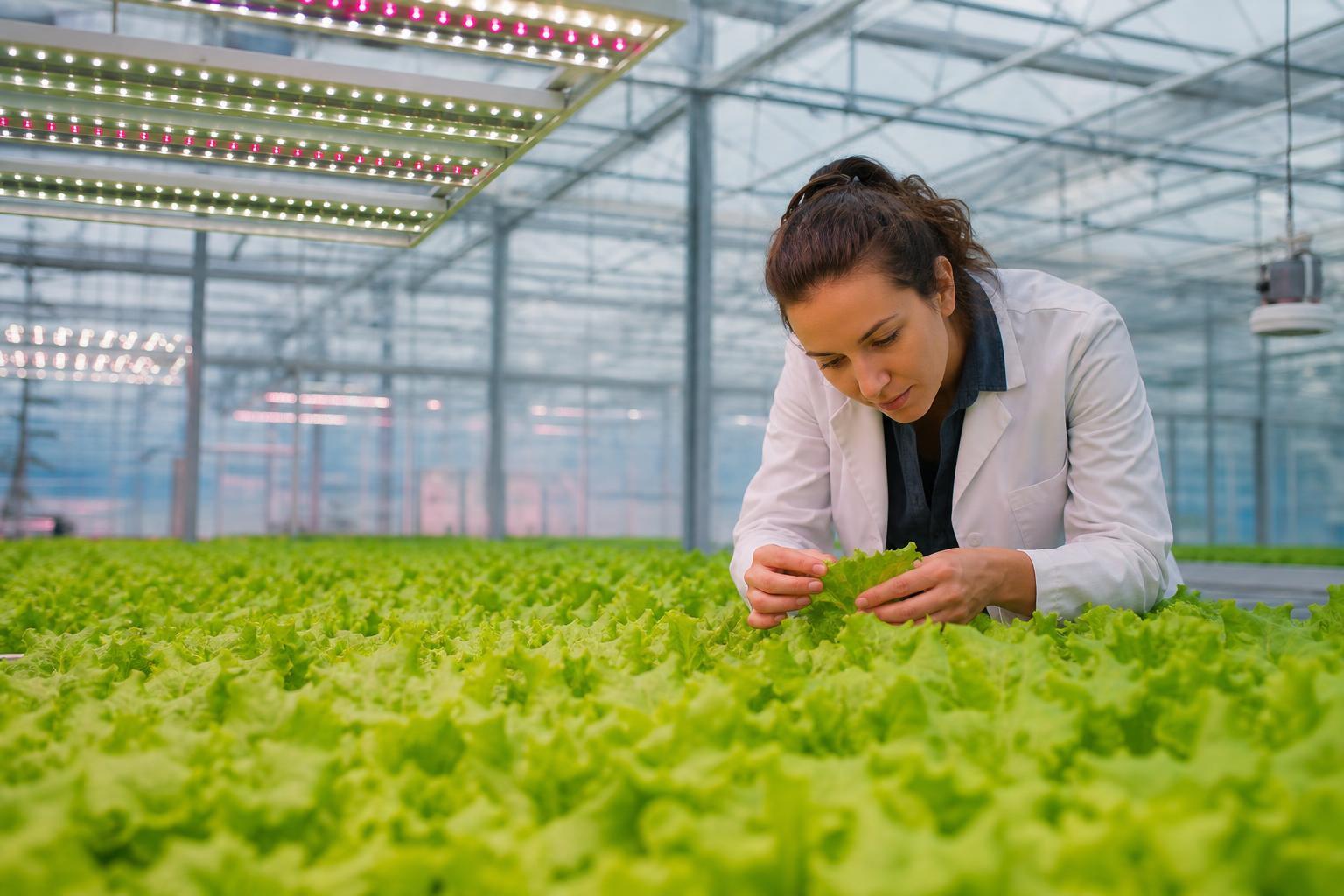
Greenhouse lighting for lettuce is about delivering the right daily total of photosynthetic light to the canopy, not simply picking the brightest fixture. Most programs target roughly 12 to 17 mol/m²/day DLI, with supplemental fixtures adding 100 to 200 µmol/m²/s to fill the gap left by sunlight. Spectrum, photoperiod, uniformity, and airflow all shape the final crop quality, and ignoring any one of them leads to problems like tipburn, stretch, or wasted electricity. This glossary covers every term a grower needs to plan, measure, and evaluate a lettuce lighting system.
Why Lettuce Lighting Terms Matter
If you are planning greenhouse lighting for lettuce based on fixture wattage alone, you are using the wrong yardstick. Lettuce responds to the amount of photosynthetic light reaching its leaves over the course of a day. That is why experienced growers talk in terms of PPFD, DLI, photoperiod, spectrum, and greenhouse transmission rather than watts or lumens.
Lettuce is a relatively low-light crop compared with tomatoes or peppers, but it still suffers when the daily light total drops too low. Purdue Extension notes that leafy greens can require 15 to 20 mol/m²/day, and that winter greenhouse sunlight in states like Indiana can fall to roughly 5 mol/m²/day inside the greenhouse. At those levels, growth slows, plants stretch, and quality drops. Supplemental lighting becomes necessary for consistent winter production.
The mindset shift matters: design around daily photons delivered to the crop, not around how bright the greenhouse looks to people. Extension sources across multiple universities emphasize PPFD and DLI because human-light units like lumens, lux, and foot-candles do not measure what plants actually use for photosynthesis.
This glossary translates the lighting vocabulary into plain English so greenhouse managers, head growers, consultants, and project engineers can make better decisions. Whether you are reviewing a lighting plan, comparing fixture specs, or calculating runtime, each term below connects directly to a crop outcome.
Talk to a greenhouse lighting expert before committing capital to a lettuce lighting project.
Quick Answer: Greenhouse Lettuce Lighting Targets
Most greenhouse lettuce programs target roughly 12 to 17 mol/m²/day DLI, with many commercial references using about 17 mol/m²/day for head lettuce or Boston-type lettuce when airflow and cultivar selection can support it. Canopy-level PPFD targets often fall around 250 to 350 µmol/m²/s for lettuce, while greenhouse supplemental lighting may add 100 to 200 µmol/m²/s depending on sunlight, season, and target DLI. These are starting points. Cultivar, growth stage, temperature, humidity, CO₂, airflow, spacing, and market goals all change the final recipe.
The Most Important Lettuce Lighting Terms
Each term below follows the same pattern: what it means, why it matters for lettuce, how growers use it, and the common mistake to avoid.
DLI (Daily Light Integral)
What it means: DLI is the total amount of photosynthetic light a plant receives over one full day, expressed as mol/m²/day. Think of PPFD as the speed of light delivery and DLI as the total distance covered by the end of the day.
Why it matters for lettuce: DLI connects intensity and time into one number that predicts growth. Virginia Tech lists lettuce at 12 to 17 mol/m²/day as the general recommended range. Purdue uses 15 to 20 mol/m²/day for leafy greens in a commercial greenhouse context. Cornell’s greenhouse lettuce handbook used 17 mol/m²/day for a specific Boston Bibb cultivar.
How growers use it: DLI is the daily target. A grower compares the desired lettuce DLI against the DLI already supplied by sunlight inside the greenhouse. The gap between the two is what fixtures must fill.
Common mistake: Asking “what PPFD does lettuce need?” without asking “for how many hours?” PPFD without a photoperiod is half a question. Practitioners on Reddit consistently point out that lettuce is better evaluated by daily light total than by a single brightness number.
For a step-by-step breakdown of the math, see the DLI formula and conversion guide.
PPFD (Photosynthetic Photon Flux Density)
What it means: PPFD is the instantaneous intensity of plant-usable light at the crop canopy, measured in µmol/m²/s. It tells you how many photosynthetic photons are hitting the lettuce right now.
Why it matters for lettuce: A university extension guide gives lettuce as an example crop needing 250 to 350 µmol/m²/s of total PPFD. In a greenhouse where sunlight contributes part of that total, supplemental fixtures typically add 100 to 200 µmol/m²/s to reach the DLI target.
How growers use it: Measure PPFD at canopy height in multiple locations, not just directly under the brightest point of a fixture.
Common mistake: Using fixture output claims as if they equal canopy PPFD. The number on a spec sheet describes what the fixture emits. The number that matters is what actually reaches the lettuce, after accounting for mounting height, spacing, obstructions, and light spread.
PAR (Photosynthetically Active Radiation)
What it means: PAR is the range of light wavelengths that plants use for photosynthesis, commonly defined as 400 to 700 nm. It is not a unit of measurement but a category of light.
Why it matters for lettuce: PAR is the portion of the spectrum measured when growers track PPFD and DLI. Cornell’s lettuce handbook notes that foot-candle and lux meters are inappropriate for greenhouse crop lighting because they measure human-eye sensitivity, not plant-usable light.
Common mistake: Buying lights based on lumens or lux. Those metrics describe brightness as humans perceive it, which correlates poorly with what drives lettuce photosynthesis. Use a quantum sensor that reads in µmol/m²/s instead. More detail on choosing and using the right meter is covered in this PAR meter for greenhouse guide.
Photoperiod
What it means: Photoperiod is the number of hours per day that lettuce receives light, whether from the sun, fixtures, or both.
Why it matters for lettuce: DLI equals intensity multiplied by time. The same DLI can come from high PPFD over fewer hours or lower PPFD over more hours, but those strategies do not always produce the same plant response. Recent lettuce research found that under a constant DLI of 14.4 mol/m²/day, different PPFD/photoperiod combinations produced comparable growth, while continuous low-intensity lighting improved energy and light-use efficiency.
Common mistake: Assuming a high-intensity short day is always interchangeable with a moderate-intensity long day. Growers on Reddit frequently ask whether they can blast lettuce with intense light for five hours instead of running moderate light longer. The math can deliver the same DLI, but lettuce often rewards moderate, efficient light delivery over extreme intensity, and heat and tipburn risk still apply.
Greenhouse Light Transmission
What it means: The percentage of outdoor sunlight that actually reaches the crop inside the greenhouse. Glazing, structural members, coatings, dust, condensation, hanging equipment, and irrigation lines all reduce light before it hits the lettuce.
Why it matters: Virginia Tech gives a general greenhouse loss range of 30 to 50%. A greenhouse that transmits only 50% of sunlight cuts the available DLI in half before supplemental lights even turn on.
How growers use it: UNH Extension recommends measuring outside sunlight and inside sunlight with a PAR meter to calculate the actual percentage reaching the crop.
Practical formula:
Inside sunlight DLI = outdoor DLI × greenhouse transmission percentage
Common mistake: Using outdoor DLI maps or weather data without adjusting for greenhouse losses. That overestimates the sunlight your lettuce actually receives and underestimates how much your fixtures need to supply.
For guidance on managing the relationship between shading and supplemental light, see the greenhouse shading and supplemental lighting guide.
Supplemental Lighting
What it means: Electric lighting used to add photosynthetic light when natural sunlight does not supply enough DLI for the crop.
Why it matters: Greenhouses rely partly on sunlight, so supplemental lights fill the gap between the DLI the sun provides inside the greenhouse and the DLI the crop needs. Virginia Tech explains that supplemental lighting should account for average monthly DLI, fixture PPFD at crop height, greenhouse light loss, and the desired crop DLI.
Common mistake: Treating supplemental lighting as a fixed daily schedule instead of a seasonal, sensor-driven strategy. Sunlight changes by month, weather, and glazing condition. A schedule that works in January will waste electricity in April.
Runtime
What it means: The number of hours per day the lights must operate to supply the DLI deficit.
Formula:
Hours = additional DLI needed ÷ (PPFD × 0.0036)
UNH Extension uses this exact conversion approach, where the constant 0.0036 converts PPFD in micromoles per second into daily moles.
Example: If the crop needs 6 mol/m²/day from lamps and the fixtures deliver 200 µmol/m²/s at canopy level:
6 ÷ (200 × 0.0036) = 8.3 hours
Common mistake: Running the same schedule all season. Bright days need less supplemental light. Dark days need more. The supplemental lighting hours formula guide walks through this calculation in more detail.
Light Uniformity
What it means: How evenly PPFD is distributed across the production area.
Why it matters: Greenhouse lettuce is sold as a uniform crop. Uneven light creates uneven head size, inconsistent harvest timing, and variable quality. Cornell emphasizes that lamps should be configured for uniform light distribution over the entire growing area and that specialized lighting-layout software can determine the proper number and placement of fixtures.
Common mistake: Optimizing for peak PPFD instead of average PPFD and minimum-to-maximum uniformity. A single bright reading directly under a fixture tells you almost nothing about what the edges of the growing area receive.
LED Spectrum
What it means: The color or wavelength mix emitted by an LED fixture.
Why it matters for lettuce: Spectrum influences photosynthesis, plant shape, pigmentation, leaf expansion, and the ability to inspect the crop visually. Research summaries on greenhouse lettuce note that red (roughly 600 to 700 nm) and blue (roughly 400 to 500 nm) wavelengths are especially effective for photosynthesis and growth. Far-red (roughly 700 to 750 nm) can increase canopy size and light capture under controlled conditions, but must be managed to avoid unwanted elongation.
Full-spectrum white light has practical value beyond photosynthesis. It helps growers inspect crops accurately and creates a more comfortable work environment. For a deeper look at how different wavelengths affect plant development, see this summary of light spectra and plant growth.
Common mistake: Treating spectrum as universal. There is no single “best spectrum” for all lettuce types, stages, and production goals. Spectrum is a steering tool. DLI drives much of the biomass response, while spectrum fine-tunes morphology, color, and crop inspection.
Red lettuce note: Growers on Reddit often notice red-leaf lettuce staying green or not developing attractive color under certain light conditions. Research on end-of-production lighting indicates that blue light can improve anthocyanin accumulation and red coloration in red-leaf lettuce. Community advice aligns: more blue or UV-range light near harvest can deepen red pigmentation.
Tipburn
What it means: A physiological disorder where young lettuce leaves develop necrotic margins or brown tips, tied to rapid growth and poor calcium delivery to expanding tissues.
Why it matters for lighting: More light accelerates growth. If airflow, transpiration, humidity, cultivar choice, and calcium transport do not keep up with that faster growth, tipburn risk rises. Cornell’s greenhouse lettuce handbook states that a 17 mol/m²/day DLI target required sufficient downward airflow to prevent tipburn. Without adequate airflow, their system could not exceed 12 mol/m²/day.
Common mistake: Assuming tipburn means the nutrient solution lacks calcium. Practitioners on Reddit consistently point to airflow, humidity management, DLI reduction, harvest timing, and cultivar sensitivity as the practical fixes, not simply adding more calcium to the tank.
Vertical Airflow
What it means: Air movement directed down through the lettuce canopy. Cornell used overhead fans pushing air vertically onto the lettuce at a rate of 140 cubic feet per minute per square foot of pond area.
Why it matters: Increased transpiration improves calcium transport to young, fast-growing leaves, the exact tissue where tipburn starts. Without airflow, increasing light intensity is risky.
Common mistake: Installing more lighting before solving airflow. The first upgrade for many lettuce greenhouses is not another fixture but a fan.
Light-Use Efficiency
What it means: A measure of marketable biomass produced per unit of light or electricity.
Why it matters: The real question in commercial greenhouse lettuce lighting is not “did yield increase?” but “did added photons produce enough marketable biomass to justify their cost?” Purdue estimated lettuce produced about 6.8 grams of additional fresh mass per mole of incident light, and cited similar research showing 3.7 to 6.9 grams per mole.
Common mistake: Comparing fixture price without comparing cost per delivered mole and grams of crop produced per mole.
Dynamic Lighting Control
What it means: Adjusting light output or runtime based on real-time sunlight, crop demand, energy price, CO₂ levels, or physiological feedback.
Why it matters: Fixed schedules waste photons on bright days and under-light crops on dark days. GLASE research reported that integrating CO₂ control with DLI targeting reduced supplemental-lighting hours by 27% in a central New York lettuce scenario, with the biggest benefit from November through February. A 2026 greenhouse lettuce study found that sensor-based biofeedback control improved LED energy-use efficiency without reducing biomass compared with constant PPFD control.
Common mistake: Treating lighting controls as a future luxury. For any commercial lettuce operation, responsive controls pay for themselves quickly by cutting unnecessary runtime.
What DLI and PPFD Does Greenhouse Lettuce Need?
There is no single magic number. Research and extension sources vary because cultivar, growth stage, temperature, and airflow all shift the target. The table below gives practical starting points.
| Use Case | Starting Range | Key Caveat |
|---|---|---|
| General lettuce DLI | 12 to 17 mol/m²/day | Good broad range; adjust for cultivar and stage |
| Commercial leafy greens | 15 to 20 mol/m²/day | Purdue uses this for leafy greens and hydroponic lettuce |
| Head lettuce / Boston-type | Around 17 mol/m²/day | Cornell paired this with vertical airflow to prevent tipburn |
| Total canopy PPFD | 250 to 350 µmol/m²/s | Useful intensity reference, but DLI depends on hours |
| Supplemental PPFD in greenhouse | 100 to 200 µmol/m²/s | Fills the gap between sunlight and DLI target |
| Germination (first 24 hours) | 50 µmol/m²/s | Cornell’s system; prevents stretching and drying |
| Seedling phase after day one | 250 µmol/m²/s for 24 hours | Specific to Cornell’s protocol, not universal |
Many greenhouse lettuce references use 12 to 17 mol/m²/day as the practical range, with 17 mol/m²/day common for head lettuce systems when airflow and cultivar choice support it. Some cultivars may tipburn at 17. Others may benefit from the upper end of the range. Start within the range, observe the crop, and adjust.
Practitioner posts on LinkedIn emphasize that growers should design around DLI first, then engineer backward to PPFD, photoperiod, and layout. That design sequence looks like this:
- Crop goal (lettuce type, head size, harvest timing, color target)
- Target DLI
- Sunlight audit (local month, greenhouse transmission, shade, structure)
- DLI deficit (target minus usable sunlight)
- Fixture PPFD at canopy level
- Photoperiod and runtime
- Uniformity across the crop zone
- Environmental support (airflow, humidity, temperature, CO₂, nutrition)
- Economics (cost per mole, grams per mole, utility rate, rebates)
- Controls (dimming, sensors, scheduling, DLI tracking)
For a complete overview of lettuce light needs across all production systems, see the lettuce lighting requirements guide.
How to Calculate Greenhouse Lettuce Lighting Runtime
This is one of the most practical skills for any greenhouse operator managing supplemental lighting for lettuce.
The Formula
DLI = PPFD × hours × 0.0036
Rearranged to solve for hours:
Hours = DLI needed from lamps ÷ (lamp PPFD × 0.0036)
Virginia Tech gives a practical example: 200 µmol/m²/s for 16 hours = 11.5 mol/m²/day.
Quick PPFD-to-DLI Conversion Table
| Canopy PPFD | 12 hours | 14 hours | 16 hours | 18 hours | 20 hours |
|---|---|---|---|---|---|
| 100 µmol/m²/s | 4.3 DLI | 5.0 DLI | 5.8 DLI | 6.5 DLI | 7.2 DLI |
| 150 µmol/m²/s | 6.5 DLI | 7.6 DLI | 8.6 DLI | 9.7 DLI | 10.8 DLI |
| 200 µmol/m²/s | 8.6 DLI | 10.1 DLI | 11.5 DLI | 13.0 DLI | 14.4 DLI |
| 250 µmol/m²/s | 10.8 DLI | 12.6 DLI | 14.4 DLI | 16.2 DLI | 18.0 DLI |
| 300 µmol/m²/s | 13.0 DLI | 15.1 DLI | 17.3 DLI | 19.4 DLI | 21.6 DLI |
| 350 µmol/m²/s | 15.1 DLI | 17.6 DLI | 20.2 DLI | 22.7 DLI | 25.2 DLI |
These values assume steady PPFD. In a real greenhouse, sunlight fluctuates throughout the day, so growers should measure or model DLI over time rather than assuming a constant value.
Worked Example: Winter Lettuce Supplemental Lighting
Assumptions:
- Target lettuce DLI: 15 mol/m²/day
- Outdoor winter DLI: 10 mol/m²/day
- Greenhouse transmission: 60%
- Inside sunlight DLI: 10 × 0.60 = 6 mol/m²/day
- DLI deficit: 15 minus 6 = 9 mol/m²/day
- Fixture PPFD at canopy: 200 µmol/m²/s
Runtime: 9 ÷ (200 × 0.0036) = 12.5 hours/day
Virginia Tech gives a similar simplified winter greenhouse example using 10 outdoor DLI, 60% transmission, a 14 DLI target, and 200 µmol/m²/s LEDs, resulting in about 11 hours/day of supplemental lighting.
For operators looking at LED bars for leafy greens, the fixture’s delivered PPFD at the planned mounting height should be the number used in this calculation, not the catalog output.
How Too Much Light Causes Problems
More light is not always better for lettuce. The grower’s job is to maximize marketable biomass per dollar of light, not simply crank DLI to the highest possible value.
The tipburn ceiling is real. Cornell’s greenhouse lettuce system used 17 mol/m²/day, but the handbook makes clear that this target required sufficient downward airflow to prevent tipburn. Without airflow, their system could not go above 12 mol/m²/day. Research summaries confirm that DLI targets can be cultivar-specific, with some varieties tipping below 17.
Energy waste compounds quickly. Virginia Tech notes that too much light can waste energy or harm sensitive plants. Every mole of supplemental light above the crop’s productive response is electricity spent for no return.
The practical rule: The right lettuce lighting target is the highest DLI that improves marketable yield without creating tipburn, stretch, poor color, excess heat, or wasted electricity.
Think of it as a traffic light system:
- Under-lit (red zone): slow growth, stretching, small heads, longer crop cycles. Purdue links insufficient DLI directly with slow growth, poor quality, and elongation.
- Productive range (green zone): 12 to 17 mol/m²/day for most lettuce programs, often around 17 for head types when the environment supports it.
- Over-lit or unsupported (yellow zone): tipburn, wasted energy, need for stronger airflow, potential cultivar-specific damage.
Lighting changes also affect nutrient uptake and transpiration. Adjusting nutrient strategies with LED lighting is worth reviewing when increasing supplemental light levels.
LED Lighting and Greenhouse Operating Cost
For greenhouse lettuce, the value of LED lighting is less about raw yield claims and more about controllability, energy use, heat distribution, and water savings.
A greenhouse lettuce study comparing LEDs to older high-intensity discharge lighting found LED fixtures reduced water consumption by about 15% without yield loss and produced 76% direct fixture energy savings. Both supplemental light treatments increased lettuce head diameter compared with natural light alone, and the two technologies did not differ in leaf number, fresh weight, or dry matter in that experiment.
The same study cautions that LEDs emit less radiant heat than older fixtures. In cold climates, the greenhouse heating system may need to compensate for that missing heat, which can reduce whole-greenhouse energy savings to as low as 10 to 25% once heating effects are accounted for. LED economics should be modeled at the greenhouse-system level, not only at the fixture wattage level.
For operations planning larger retrofits, centralized power architecture that relocates LED drivers out of the grow area can change the heat, serviceability, and reliability equation significantly.
Cost Per Mole: The Right Way to Think About Lettuce Lighting ROI
Purdue Extension frames the economics simply: a grower needs two numbers. First, the cost of adding a mole of supplemental light. Second, the added crop value produced from that mole.
In Purdue’s 15-variety lettuce trial, DLI regimes of 5.6, 10.8, and 19.8 mol/m²/day for 28 days produced average fresh weights of 0.90, 2.1, and 6.7 lb/m² respectively. Lettuce produced about 6.8 grams of additional fresh mass per mole of incident light.
In their economic example, the lighting setup had a combined fixed and operational cost of 3.1 cents per mole. At a lettuce price of $2.50 per pound, the added crop value was 3.78 cents per mole, making supplemental lighting economically beneficial in that scenario.
A lighting plan should be judged by cost per delivered mole and grams of marketable lettuce per mole, not by fixture wattage or purchase price alone. For help modeling project economics and available utility incentives, see greenhouse lighting rebates.
Checklist Before Choosing Commercial Lettuce Lighting
A greenhouse operator should ask any lighting supplier these questions:
- What target DLI is the design based on?
- What outdoor DLI and greenhouse transmission assumptions are being used?
- What canopy-level PPFD will the fixture layout deliver?
- What is the average PPFD and uniformity across the entire crop zone?
- Is the PPFD map based on installed height, crop height, obstructions, and greenhouse geometry?
- How will lights be controlled: fixed schedule, dimming, DLI target, weather response, or integrated environmental control?
- What spectrum is recommended for this lettuce type and market goal?
- How does the design account for tipburn risk, airflow, humidity, and cultivar sensitivity?
- What is the expected cost per delivered mole of light?
- What utility rebates or incentives may apply?
- What warranty, certifications, service process, and failure-rate history support the installation?
- How does driver placement affect heat load, serviceability, and electrical installation?
If a lighting plan does not include a DLI model and a canopy-level PPFD layout, it is incomplete. The right starting point is not buying fixtures off a spec sheet. It is getting a plan built around the crop, greenhouse structure, electrical capacity, and operating economics.
Common Mistakes in Greenhouse Lettuce Lighting
Using watts, lumens, or lux as the design metric. UNH Extension states that lumens, lux, and footcandles measure human perception and are not useful for measuring plant light.
Forgetting greenhouse transmission. Outdoor DLI is not crop DLI. A greenhouse that blocks 40% of sunlight turns a 15 mol/m²/day outdoor reading into just 9 mol/m²/day at the canopy.
Assuming 17 DLI is safe for every cultivar. Cornell’s 17 DLI target was tied to a specific system, a specific cultivar, and aggressive airflow. Some cultivars tipburn at lower levels.
Chasing peak PPFD instead of uniformity. A crop is only as uniform as the light field allows. One bright reading under a fixture means nothing if the edges get half as much light.
Running fixed schedules all season. Virginia Tech recommends accounting for average monthly DLI, fixture PPFD, greenhouse light loss, and desired crop DLI. A fixed timer ignores all of those variables.
Ignoring airflow when adding light. More DLI accelerates growth and exposes weaknesses in calcium transport. Adding fixtures without airflow fans is asking for tipburn.
Treating LED savings as purely electrical. LEDs reduce fixture energy and radiant heat, but greenhouse heating demand can offset some savings. Model the whole system, not just the fixture. Understanding how LED lighting affects HVAC load is essential for accurate project economics.
Frequently Asked Questions
What DLI does greenhouse lettuce need?
Most references place lettuce around 12 to 17 mol/m²/day, while some commercial leafy-greens guidance uses 15 to 20 mol/m²/day. Head lettuce systems often target around 17 mol/m²/day, but cultivar and airflow determine whether that level is safe. Start within the range and observe the crop.
How many hours should lettuce grow lights run in a greenhouse?
Calculate the DLI deficit first (target DLI minus sunlight DLI inside the greenhouse), then use: hours = additional DLI needed ÷ (PPFD × 0.0036). Runtime changes by season as sunlight contribution shifts.
Can lettuce get too much light?
Yes. Excess light can waste electricity and increase tipburn risk, especially if airflow and humidity management do not support the faster growth rate. Cornell’s system required vertical airflow to safely reach 17 mol/m²/day. Without it, 12 mol/m²/day was the practical ceiling.
What color light is best for lettuce?
There is no universal best color. Red and blue wavelengths both support photosynthesis and growth. Blue light can improve compactness and red-leaf pigmentation. Far-red can influence leaf expansion but must be managed to avoid elongation. A commercial greenhouse should choose spectrum based on cultivar, growth stage, color target, and worker visibility.
Should I use lux or lumens to measure greenhouse lettuce lighting?
No. Lux and lumens are based on human vision and correlate poorly with photosynthetic light. Use a quantum sensor that measures PPFD in µmol/m²/s at canopy level.
Why is my greenhouse lettuce leggy?
Common causes include low DLI, poor light distribution, fixtures mounted too far from the crop, or an unsuitable spectrum during seedling production. Cornell notes that blue-rich lighting produced compact, sturdy seedlings, while red-heavy lighting caused stretching.
Does CO₂ affect lettuce lighting requirements?
CO₂ and lighting interact because photosynthesis depends on both. GLASE research found that integrating CO₂ with lighting control could reduce supplemental-lighting hours by 27% in a lettuce greenhouse scenario, with the largest benefit during the darkest months.
Is supplemental lighting for lettuce worth the investment?
It depends on the cost per delivered mole versus the crop value produced per mole. Purdue’s economic analysis showed supplemental lighting was beneficial when the added crop value (3.78 cents per mole at $2.50/lb lettuce) exceeded the lighting cost (3.1 cents per mole). Model the numbers for your own facility, climate, and market before committing.
Next Steps
The best lettuce lighting plan starts with DLI, proves canopy-level PPFD, protects crop quality with airflow and environmental control, and then evaluates whether the added photons pay for themselves. If you are planning a commercial greenhouse lettuce project or evaluating a retrofit, the next step is getting a lighting layout and DLI model built around your specific greenhouse.
Request a free consultation to start with a crop-specific lighting design instead of generic specs.