Lettuce Lighting Requirements Greenhouse: 2026 DLI & PPFD
Lettuce Lighting Requirements Greenhouse: DLI 12–17, PPFD 200–400, 16h photoperiod, tipburn prevention and energy‑saving tips. Get the 2026 guide.
TL;DR
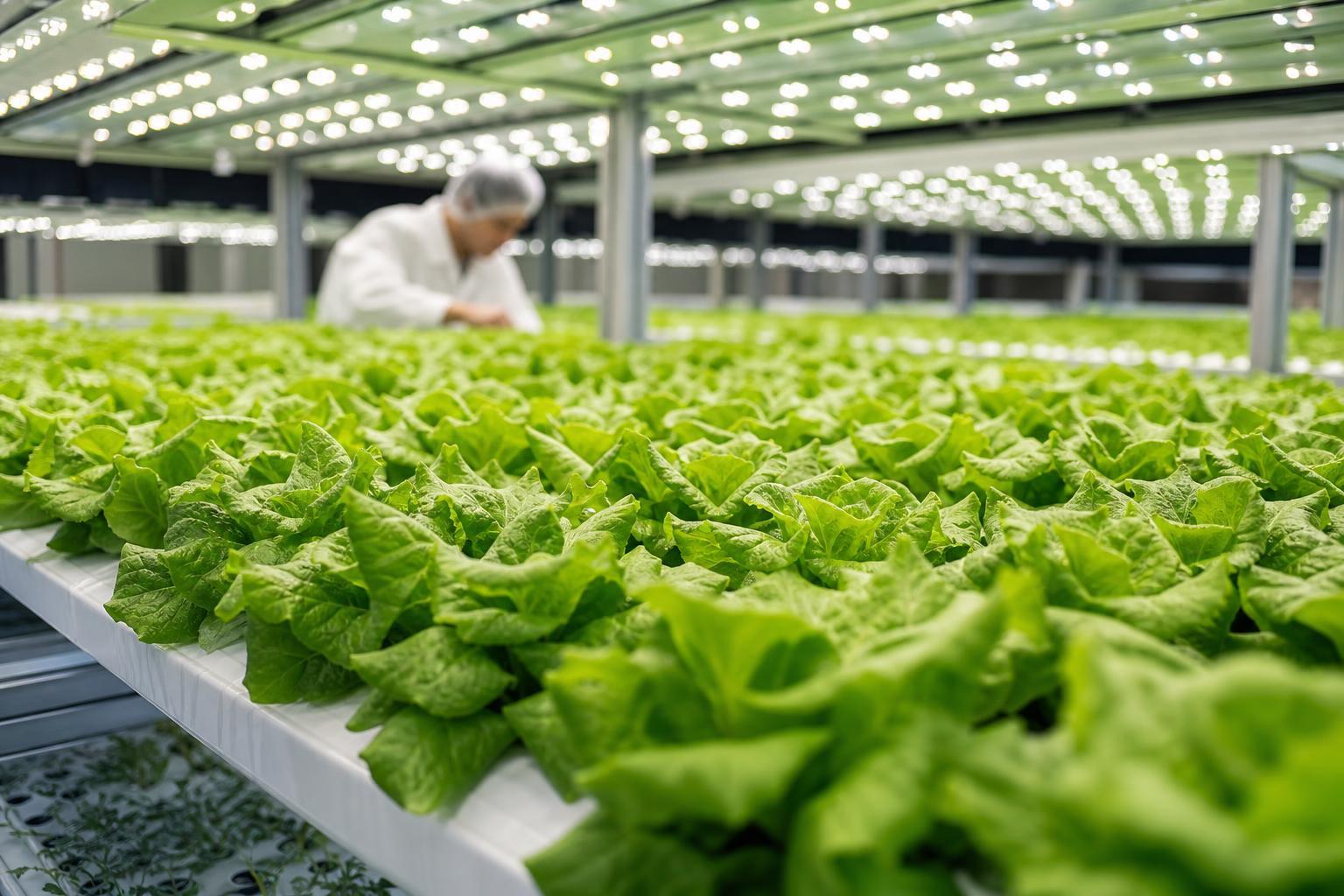
Greenhouse lettuce needs a daily light integral (DLI) of 12 to 17 mol/m²/d depending on cultivar type, with a PPFD range of 200 to 400 µmol/m²/s at the canopy. A 16-hour photoperiod is standard for commercial production. The most effective strategy is to calculate your natural light shortfall, then fill the gap with supplemental LEDs, using lower intensity over longer hours for better efficiency and fewer fixtures.
Greenhouse lettuce production is a year-round business, but sunlight is not a year-round constant. In northern latitudes, natural light inside a greenhouse can drop to 4 or 5 mol/m²/d during winter months, which is roughly a third of what lettuce actually needs. Understanding lettuce lighting requirements for greenhouse operations means knowing the exact numbers for your crop, calculating the gap between what the sun provides and what your plants demand, and filling that gap without wasting energy or creating new problems like tipburn.
This is fundamentally different from sole-source lighting in a vertical farm. In a greenhouse, supplemental lighting works alongside sunlight. The calculations, fixture choices, and economics all change because of that partnership.
Explore fixtures designed for leafy greens production.
If you're growing greenhouse lettuce, target a total DLI of 12–17 mol/m²/day, maintain 200–400 µmol/m²/s PPFD at canopy level, and use a 16-hour photoperiod for most commercial crops. Calculate the natural sunlight entering your greenhouse, subtract it from your target DLI, and use supplemental LED lighting only to fill the difference. Butterhead and red-leaf cultivars generally require the highest light levels, while proper airflow is essential to prevent tipburn under high-light conditions.
Greenhouse Lettuce Lighting Requirements at a Glance
Goal | Recommendation |
|---|---|
Commercial target DLI | 14–17 mol/m²/day |
Minimum DLI | 12 mol/m²/day |
PPFD | 200–400 µmol/m²/s |
Photoperiod | 16 hours |
Spectrum | Full-spectrum white or 60% Red / 30% Blue / 5% Far-Red |
Tipburn prevention | Airflow + humidity control |
Winter strategy | Supplemental LEDs |
Summer strategy | Shade curtains if DLI exceeds target |
Why Light Matters More in Greenhouses Than Outdoors
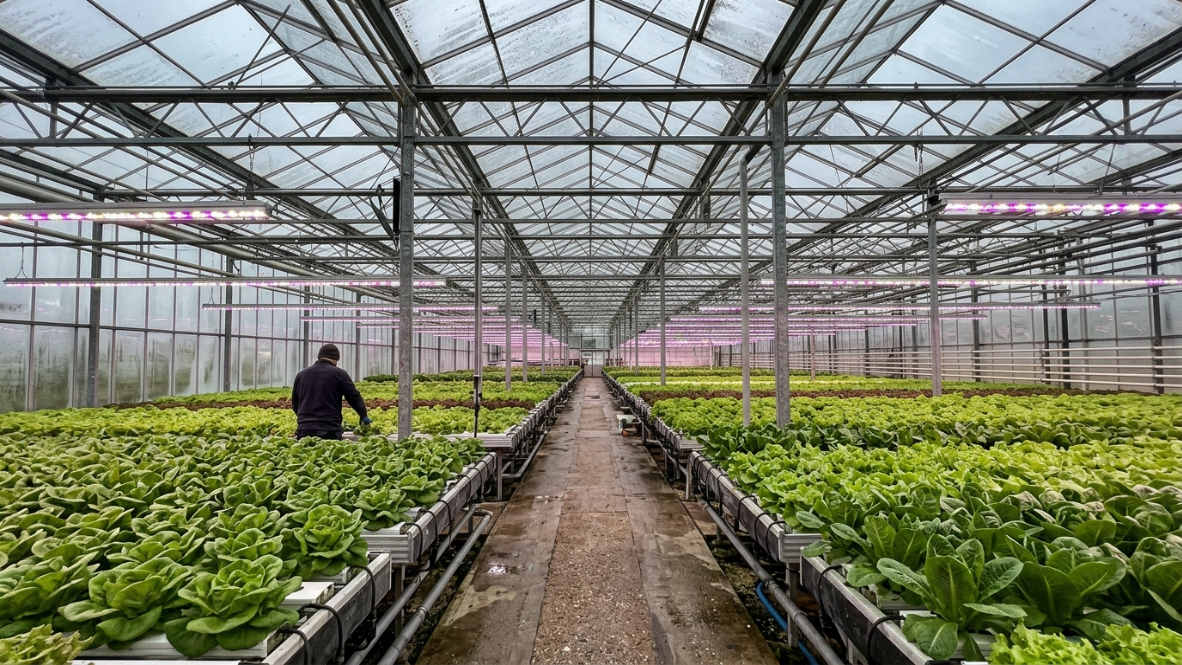
Many new greenhouse growers assume lettuce receives enough sunlight simply because it is grown under glass or polycarbonate. In reality, greenhouse coverings reduce incoming sunlight, and winter days often provide only one-third of the light lettuce requires.
Several factors reduce usable light inside a greenhouse:
Greenhouse glazing transmission losses
Structural shading from trusses
Cloud cover
Short winter days
Dirt or condensation on glazing
Because of these factors, greenhouse growers manage total DLI instead of relying on outdoor sunlight measurements. Supplemental LEDs are used to close the gap between available sunlight and crop requirements while maintaining consistent production schedules throughout the year.
DLI Targets by Lettuce Type
DLI, or daily light integral, is the total amount of photosynthetically active light a plant receives over 24 hours, measured in mol/m²/d. Think of it like a rain gauge for light: PPFD tells you how hard it’s raining at any given moment, but DLI tells you how much total rain fell that day.
The most widely cited baseline comes from Erik Runkle at Michigan State University, who established a minimum DLI of 12 to 14 mol/m²/d for greenhouse lettuce. But that is a floor, not a target. Different cultivar types have different optimal ranges.
Lettuce Type | Minimum DLI (mol/m²/d) | Optimal DLI (mol/m²/d) |
|---|---|---|
Butterhead / Bibb | 12 | 17 |
Looseleaf | 12 | 14–16 |
Romaine | 12 | 15–17 |
Red-leaf | 12 | 15–17+ |
Butterhead varieties are the most demanding. Research published in Produce Grower puts the optimal DLI for butterhead at 17.1 mol/m²/d, a level that’s genuinely difficult to hit in northern greenhouses from late fall through early spring without supplemental lighting.
Red-leaf cultivars deserve a special note. The reddish pigment anthocyanin requires adequate light to develop properly. When light levels drop, red varieties lose their color and look washed out, which directly affects marketability. Higher DLI (toward the upper end of the range or beyond) produces deeper, more consistent red coloration. Blue light from LEDs is particularly effective at driving anthocyanin production.
For growers running mixed lettuce varieties, a DLI of 14 to 17 mol/m²/d covers most production scenarios well.
PPFD Range: Seedling Through Harvest
PPFD (photosynthetic photon flux density) measures instantaneous light intensity at the canopy in micromoles per square meter per second (µmol/m²/s). While DLI is the daily total, PPFD is the moment-to-moment reading that determines how hard your fixtures are running.
The optimal PPFD range for greenhouse lettuce is 200 to 400 µmol/m²/s at the canopy level. Within that range, different growth stages call for different intensities:
Seedlings and transplants: 100 to 200 µmol/m²/s. Young lettuce plants are sensitive to high intensity and benefit from gentler light during establishment.
Vegetative growth: 250 to 400 µmol/m²/s. This is where most of the biomass accumulates and faster growth translates to shorter crop cycles.
Heading stage (butterhead, romaine, iceberg): Moderate intensity with careful monitoring. Pushing PPFD too high during head formation accelerates calcium-related disorders.
There is a practical ceiling. According to the University of Missouri Extension, lettuce may still look healthy above 350 µmol/m²/s, but the marginal return on each additional photon drops sharply. Beyond that threshold, you’re spending energy without gaining proportional growth.
Airflow Changes the Equation
Here’s a point most guides miss entirely: the DLI target your lettuce can actually handle depends on your environment management, not just your lights.
With proper airflow across the canopy, growers can push to a DLI target of 17 mol/m²/d. Without adequate air movement, a lower target of 13 to 14 mol/m²/d is safer, though it comes with a correspondingly longer crop cycle. The reason ties back to tipburn and calcium transport, which we’ll cover below.
This means lettuce lighting requirements for greenhouse crops aren’t purely about photons. They’re about the interaction between light, air movement, temperature, and plant physiology.
DLI vs PPFD: What's the Difference?
Although DLI and PPFD are closely related, they measure different aspects of plant lighting.
Measurement | What it Measures | Units | Best Used For |
|---|---|---|---|
PPFD | Instant light intensity | µmol/m²/s | Setting fixture output |
DLI | Total light received each day | mol/m²/day | Crop growth planning |
Photoperiod | Hours lights remain on | Hours | Determining total DLI |
A useful way to think about it is:
PPFD is the speed.
Photoperiod is the travel time.
DLI is the total distance traveled.
Growers adjust PPFD and photoperiod together to reach the desired DLI while minimizing electricity costs.
Photoperiod: How Many Hours of Light
Lettuce typically performs well under 14 to 18 hours of light per day in greenhouse environments. The industry standard for commercial greenhouse lettuce production is a 16-hour photoperiod.
But photoperiod isn’t just about growth rate. It interacts with genetics in ways that matter.
Bolting Risk
Lettuce is a facultative long-day plant. Certain early-flowering varieties will bolt (shoot up a flower stalk) when exposed to photoperiods exceeding 14 to 16 hours, especially when temperatures are high. Once bolting begins, the crop is essentially lost for market. The effect of photoperiod on flowering is accelerated by heat, so summer production with extended lighting is particularly risky with bolt-prone cultivars.
Modern bolt-resistant cultivars expand what’s possible. Some can be grown successfully under 20-hour photoperiods, or even continuous 24-hour light, with healthy morphology and no injury symptoms. Research on ‘Jagger’ and ‘Danstar’ lettuce under continuous light showed fresh mass increases of 6 to 23% with no signs of tipburn or bolting, and light-use efficiency improved by 7 to 11% compared to an 18-hour photoperiod.
However, 24-hour lighting may raise nitrate levels in leaf tissue, causing bitterness, a quality issue that matters at market. The bottom line: the optimal photoperiod for greenhouse lettuce should be individually adjusted based on cultivar genetics and growing conditions. Default to 16 hours for commercial production. If you’re running bolt-resistant varieties, you can experiment with longer periods to improve efficiency.
For a deeper look at how photoperiod management works across crops, the principles of light-period manipulation apply broadly.
Light Spectrum for Greenhouse Lettuce
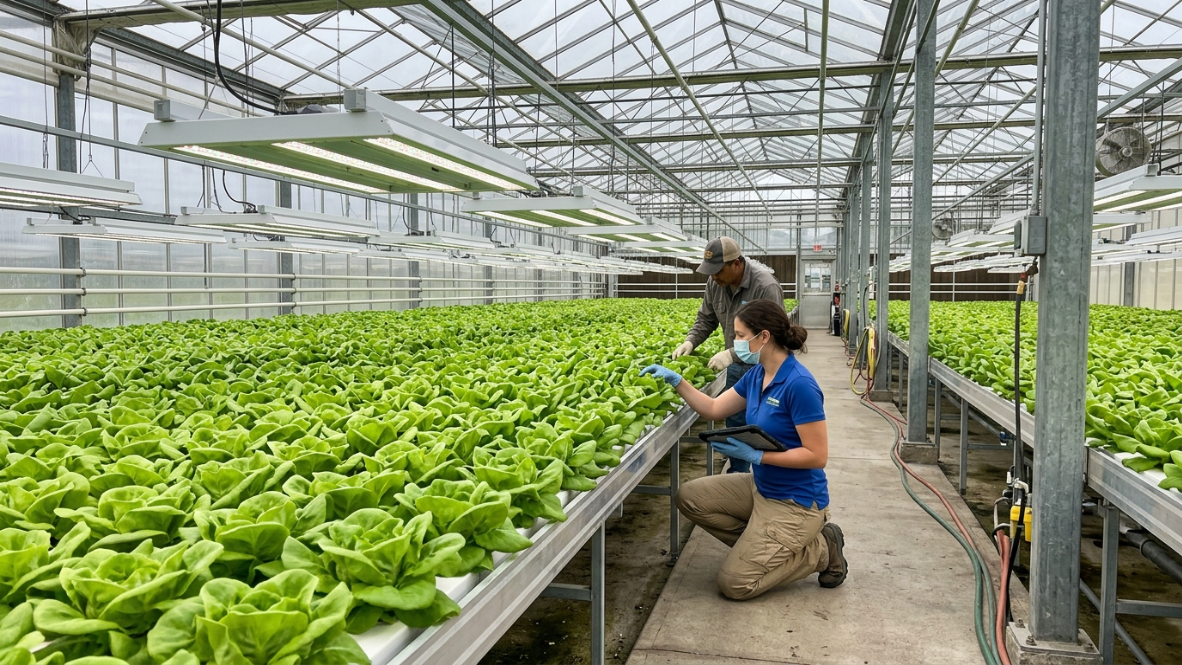
Not all photons are equal. Different wavelengths drive different plant responses, and the recommended spectral balance for lettuce breaks down roughly as:
60% red (around 660 nm): The primary driver of photosynthesis and biomass accumulation.
30% blue (around 450 nm): Controls morphology (compact growth, shorter internodes) and enhances nutritional quality. Critical for red-leaf varieties.
5% far-red (around 730 nm): Promotes leaf expansion and improves light penetration in dense canopies.
Blue light deserves particular attention. Supplemental blue light from LEDs significantly increases coloration in red-leaf lettuce, a direct quality and marketability lever. It also promotes more compact, stocky plants that ship better and look more appealing at retail.
Full-spectrum white LEDs work well for lettuce and offer a practical advantage that isn’t always discussed in technical literature: they create a much more pleasant working environment than the pink or purple light emitted by red-blue-only fixtures. In a commercial greenhouse where workers spend hours daily, that matters for labor retention and quality control (it’s easier to spot pests and nutrient deficiencies under white light).
Does CO₂ Supplementation Change Lighting Requirements?
Higher light levels only translate into faster lettuce growth if other growth factors keep pace.
When growers supplement carbon dioxide to approximately 800–1,000 ppm, lettuce can utilize additional light more efficiently, particularly under higher DLI conditions. Without sufficient CO₂, nutrients, irrigation, and airflow, increasing PPFD alone often produces diminishing returns.
Lighting, CO₂, irrigation, and climate management should be optimized together rather than independently.
How to Calculate the Supplemental Lighting Gap
This is where lettuce lighting requirements in a greenhouse become actionable. The core formula:
PPFD (µmol/m²/s) × photoperiod (hours) × 3.6 ÷ 1,000 = DLI (mol/m²/d)
Worked Example
Say you’re growing butterhead lettuce in Ohio during January. Your target DLI is 17 mol/m²/d. After accounting for glazing transmission losses, the natural DLI inside your greenhouse during a typical winter day is around 4 mol/m²/d.
The supplemental gap: 17 − 4 = 13 mol/m²/d that must come from fixtures.
To figure out the PPFD needed, rearrange the formula. If you’re running a 16-hour photoperiod:
13 × 1,000 ÷ (16 × 3.6) = approximately 226 µmol/m²/s from fixtures
That’s well within the efficient operating range for LED supplemental lighting and below the diminishing-returns threshold.
For a comprehensive walkthrough of this calculation with additional crops and seasonal adjustments, the DLI greenhouse guide covers the process in detail.
Example DLI Targets by Season
Natural sunlight changes dramatically throughout the year.
Season | Typical Greenhouse DLI | Supplemental Lighting Needed |
|---|---|---|
Winter | 3–6 mol/m²/day | High |
Spring | 8–12 mol/m²/day | Moderate |
Summer | 18–30+ mol/m²/day | Usually none or shading required |
Fall | 7–12 mol/m²/day | Moderate |
Actual values depend on latitude, greenhouse glazing, weather, and transmission losses.
The Efficiency Strategy: Lower PPFD Over Longer Photoperiods
This is one of the most powerful and under-discussed strategies for greenhouse lettuce lighting. Research published in GPN Magazine demonstrated that not all DLIs are created equal, even when the total daily photon count is identical.
Plants that receive lower PPFD spread over a longer photoperiod are more light-use efficient than plants that receive higher PPFD over a shorter period. The photosynthetic machinery operates more efficiently when it isn’t being pushed to its maximum capacity at any given moment.
In a concrete greenhouse study, ‘Little Gem’ lettuce grew significantly faster under longer photoperiods with lower PPFD compared to shorter photoperiods with high PPFD, even though the DLI was the same in both treatments.
What This Means for Fixture Count
Consider two supplemental lighting layouts, both targeting 13 mol/m²/d of supplemental light:
Layout A: 60 fixtures at 300 µmol/m²/s running for 12 hours
Layout B: 48 fixtures at 250 µmol/m²/s running for 15 hours
Layout B achieves the same DLI with 12 fewer fixtures. For a three-hour difference in photoperiod, a grower saves on the upfront capital cost of those additional fixtures plus the associated wiring, mounting hardware, and electrical capacity.
Practitioners in greenhouse forums often confirm this math. The initial reaction is that longer run hours means more energy, but the reduced fixture count and lower per-fixture wattage typically offset the extended schedule. The net result is lower capital cost and comparable or lower operating cost.
Get a free lighting consultation to calculate your specific supplemental needs.
Tipburn: The Real Upper Limit on Greenhouse Lettuce Light
Every guide tells you the minimum DLI for lettuce. Almost none explain the practical maximum. That maximum is dictated by tipburn, the single most common quality defect in greenhouse and indoor lettuce production.
Tipburn appears as necrotic (brown, dead) margins on new leaves, typically in the center of the head for butterhead and romaine types. It looks like a nutrient deficiency, and it is frequently misdiagnosed as one. But tipburn is almost never caused by a lack of calcium in the nutrient solution. The real problem is poor calcium transport within the plant.
Why Light Drives Tipburn
Calcium moves through the xylem, which is driven by transpiration. In rapidly growing lettuce under high light, new inner leaves expand faster than calcium can be delivered to them. The outer leaves transpire heavily and hog the calcium supply. Inner leaves, sheltered from airflow, don’t transpire enough to pull calcium in.
When PPFD exceeds 300 µmol/m²/s, or when DLI pushes well above 17 mol/m²/d, growth rates can outstrip calcium delivery, especially in heading varieties. The risk is highest when:
Airflow across the canopy is inadequate
Humidity is very high (reducing transpiration)
Temperature is elevated (accelerating growth)
The cultivar is tipburn-susceptible
Managing the Risk
Don’t overdrive DLI. For heading varieties, stay at or slightly below 17 mol/m²/d unless you’ve confirmed your environment can support faster growth.
Increase airflow. Horizontal air movement across the canopy surface is the single most effective tipburn mitigation strategy.
Use shade curtains in summer. When natural light alone pushes DLI above optimal levels, a retractable shade curtain prevents excess light from creating problems.
Choose tipburn-resistant cultivars. Breeding progress has produced varieties with much better calcium transport under high-light conditions.
Manage humidity and temperature. For more on how climate control intersects with plant health, environmental management is as important as the lighting plan itself.
Understanding nutrient behavior under LED lighting is also relevant here. Calcium transport dynamics shift when you change from HPS to LED because the heat profile at the canopy changes.
DLI Carryover: A Cutting-Edge Energy Strategy
Recent research has revealed something that could meaningfully reduce supplemental lighting costs for greenhouse lettuce. Scientists studying DLI requirements found that after a sunny day, lettuce doesn’t need its full DLI target the following day.
A 2024 study published in Frontiers in Plant Science showed that the DLI requirement can be reduced by approximately 5.25 mol/m²/d on the day following a sunny day, without yield loss. The researchers called this the “DLI carryover effect,” and it resulted in annual energy savings of approximately 75 to 190 MWh per hectare in greenhouse lettuce production.
The practical application: if your greenhouse received 20+ mol/m²/d of natural light yesterday, you can dim your supplemental fixtures significantly today, even if today is overcast. This requires dimmable LED systems and ideally some form of light-sum tracking, whether through a climate computer or manual monitoring.
This is frontier-level strategy that zero currently ranking pages cover in detail. For growers operating at scale, those energy savings compound quickly.
Energy Costs and ROI for Greenhouse Lettuce Lighting
Lighting is not a small line item. The cost of supplemental lighting in a vegetable greenhouse can reach $200,000 per hectare, representing roughly 30% of the annual farm gate value. For lettuce specifically, more than 30% of the per-kilogram production cost (approximately $4.66/kg) is attributable to lighting energy.
Those numbers make fixture selection and lighting strategy genuine financial decisions, not just horticultural ones.
LED vs. HPS for Greenhouse Lettuce
LEDs reduce energy consumption by 30 to 40% compared to HPS fixtures delivering the same DLI. They last up to 50,000 hours versus roughly 10,000 for HPS bulbs. The ROI timeline for an LED conversion typically falls in the 12 to 18 month range, depending on electricity rates and operating hours.
Beyond energy, LEDs produce less radiant heat at the canopy, which reduces cooling loads and gives growers more precise control over the growing environment. This matters for lettuce because temperature and light interact to determine both growth rate and bolting risk. A full breakdown of the LED vs. HPS comparison covers the economics in more detail.
Many utility programs across North America offer rebates for greenhouse LED upgrades, which can significantly reduce upfront capital costs and shorten payback periods.
Common Lighting Mistakes Greenhouse Lettuce Growers Make
Even experienced growers can lose efficiency through incorrect lighting strategies.
Common mistakes include:
Using outdoor sunlight data instead of greenhouse DLI
Measuring PPFD above the canopy instead of at canopy level
Running lights during peak sunlight instead of low-light periods
Ignoring fixture uniformity
Overdriving PPFD beyond economic returns
Forgetting to clean greenhouse glazing
Assuming every lettuce cultivar has identical light requirements
Avoiding these mistakes often improves yields more than simply installing additional fixtures.
Quick-Reference Summary Table
Parameter | Seedling Stage | Vegetative / Heading Stage | Notes |
|---|---|---|---|
DLI | 8–12 mol/m²/d | 12–17 mol/m²/d | Butterhead needs 17; looseleaf can thrive at 14–16 |
PPFD | 100–200 µmol/m²/s | 200–400 µmol/m²/s | Diminishing returns above 350 |
Photoperiod | 16 hours | 16 hours (up to 20 with bolt-resistant cultivars) | Check cultivar tolerance before exceeding 16h |
Spectrum | Full-spectrum white or 60R/30B/5FR | Full-spectrum white or 60R/30B/5FR | More blue for red-leaf color |
Tipburn risk threshold | Low | Increases above 300 µmol/m²/s and 17 DLI | Airflow is the primary mitigation |
Frequently Asked Questions
What is the minimum DLI for greenhouse lettuce?
The widely accepted minimum is 12 mol/m²/d, established by research at Michigan State University. This is a survival floor, not an optimum. Most commercial operations should target 14 to 17 mol/m²/d depending on cultivar type.
How many hours of light does greenhouse lettuce need?
A 16-hour photoperiod is standard for commercial greenhouse lettuce. Some bolt-resistant cultivars tolerate 18 to 20 hours or even continuous light, but this should be confirmed per variety. Early-flowering types can bolt above 14 to 16 hours, especially in warm conditions.
What PPFD is too high for lettuce?
Above 350 µmol/m²/s, lettuce shows diminishing returns. The energy spent producing additional photons beyond this point is largely wasted. More critically, sustained high PPFD increases tipburn risk, particularly in heading varieties with inadequate airflow.
Does light spectrum affect lettuce color?
Yes. Red-leaf lettuce cultivars require adequate light intensity, and specifically blue wavelengths (around 450 nm), to produce anthocyanin pigments. Low light or red-dominant spectrums result in washed-out, greenish leaves that hurt marketability.
How do I calculate how much supplemental light my greenhouse lettuce needs?
Subtract your average natural indoor DLI from your target DLI. The difference is your supplemental gap. Then use the formula: supplemental DLI × 1,000 ÷ (photoperiod hours × 3.6) = required PPFD from fixtures. Our DLI calculation guide walks through this step by step.
Is 24-hour lighting good for lettuce?
It can increase yield by 6 to 23% in bolt-resistant cultivars with no visible quality defects. However, continuous light may raise nitrate levels (causing bitterness), and not all cultivars tolerate it. This is still more of a research finding than a standard commercial practice for greenhouse production.
What causes tipburn in greenhouse lettuce?
Tipburn is caused by insufficient calcium transport to rapidly growing inner leaves, not by a lack of calcium in the nutrient solution. High light intensity, high temperatures, high humidity, and poor airflow all increase the risk. The primary fix is improving air movement across the canopy, not adding more calcium.
Are LEDs worth the investment for greenhouse lettuce?
For most operations, yes. LEDs reduce energy use by 30 to 40% compared to HPS, last five times longer, and typically pay for themselves within 12 to 18 months. When combined with utility rebates and strategies like extending photoperiod to reduce fixture count, the financial case is strong.
Meeting your lettuce lighting requirements in the greenhouse starts with knowing the numbers, but it ends with a lighting plan built around your specific latitude, greenhouse transmission, crop mix, and budget. If you’re ready to move from research to implementation, book a free consultation with a lighting specialist to map out your supplemental lighting strategy.