LED vs HPS Greenhouse Lighting: 2026 Comparison & ROI
LED vs HPS Greenhouse Lighting in 2026: energy, heat, yields, and ROI compared. See when hybrid wins and how to model payback for your crop.
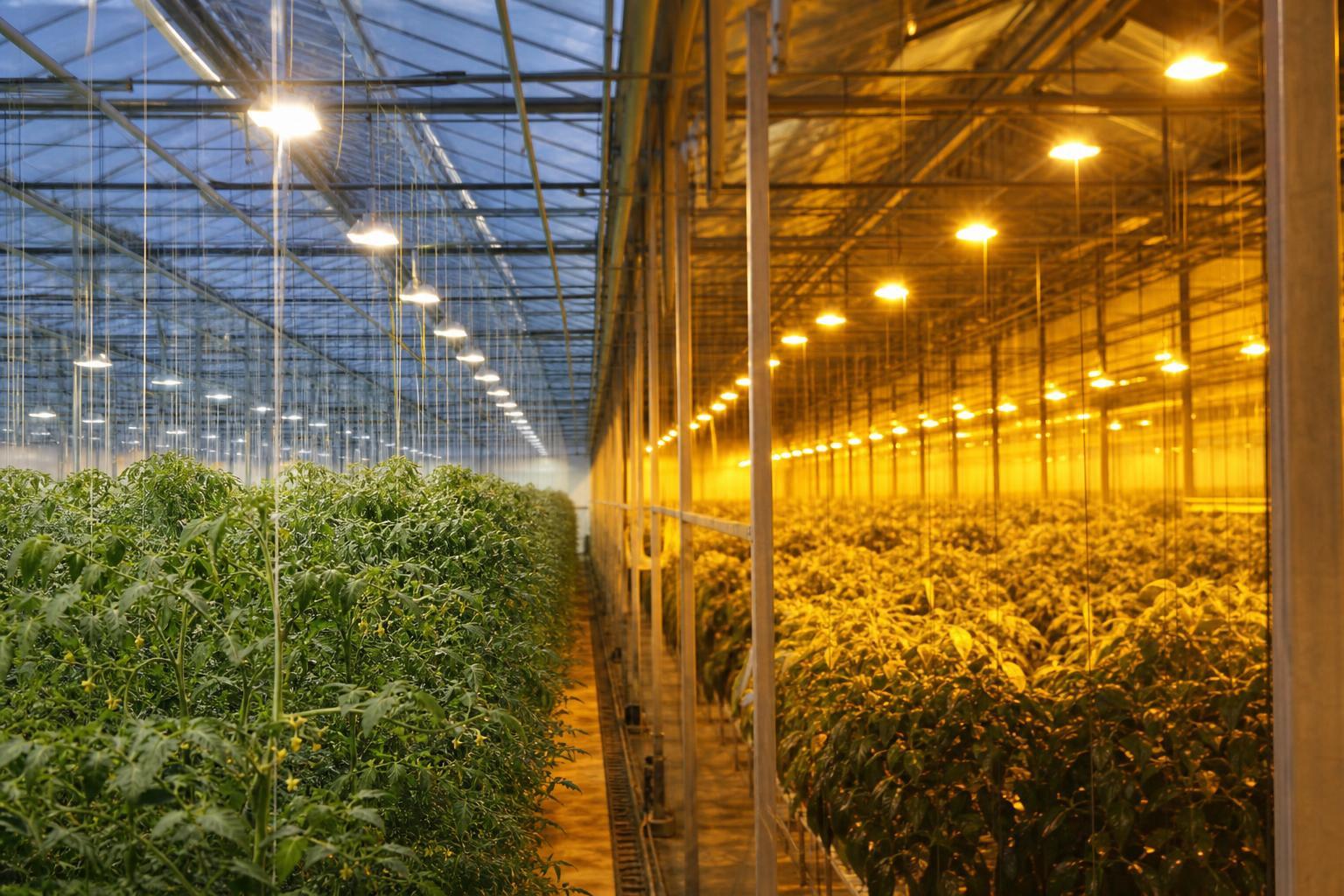
TLDR
LED vs HPS greenhouse lighting is the core comparison commercial growers face when selecting supplemental lighting. LEDs produce more photons per watt and offer spectral control, making them the stronger long term choice for most new projects. HPS costs less upfront and contributes radiant heat that can benefit cold climate production. The real decision extends beyond the fixture to include crop response, greenhouse heat balance and circulation, dehumidification, light uniformity, canopy penetration, dynamic lighting strategies, extended growing seasons, and total return on investment.
LED vs HPS Greenhouse Lighting: Direct Answer
For most commercial greenhouse projects in 2026, LED lighting is the better long term investment because it delivers more plant usable photons per watt, offers spectrum control, reduces maintenance, and typically lowers operating costs.
However, HPS remains viable when:
- Upfront budget is limited
- Winter heating costs are significant
- Existing HPS infrastructure is already installed
- Growers want a phased lighting upgrade
The best choice depends on:
- Electricity cost
- Climate zone
- Crop type
- Target DLI
- Heating and cooling load calculations
- Payback expectations
In most new greenhouse builds, LED is now the default recommendation, while HPS is increasingly used only in retrofit or hybrid scenarios.
Key takeaway: LED usually wins on efficiency and long term ROI, while HPS can still win on initial cost and beneficial radiant heat.
What LED vs HPS Greenhouse Lighting Means
LED vs HPS greenhouse lighting compares two supplemental lighting technologies used to boost daily light integral (DLI) in commercial greenhouses.
LED (light emitting diode) grow lights use semiconductor diodes to produce plant usable photons. They can be built with specific spectral recipes, combining white, red, blue, and far red diodes, and are generally the more electrically efficient option. HPS (high pressure sodium) is a high intensity discharge lamp that has been the standard greenhouse supplemental light for decades. It produces a broad yellow orange and red heavy output along with significant radiant heat.
The practical difference between these technologies goes well beyond wattage. For greenhouse operators, LED vs HPS is really a question about how many photons reach the crop, how much electricity that requires, how the lighting system changes the greenhouse climate, and how long the investment takes to pay back. A comprehensive review in Horticulture Research notes that horticultural lighting efficacy should be measured in µmol/J (photons per joule), not lumens, because lumens weight light according to human vision, not plants.
If you are starting to scope a greenhouse lighting project, a free consultation with a lighting specialist is the fastest way to match fixture selection to your specific crop and facility.
Quick Answer: Which Is Better?
For most new commercial greenhouse lighting projects, LED is the better long term platform. Modern LED fixtures deliver more photons per joule of electricity, last longer, and give growers meaningful control over spectrum and intensity.
But that does not mean HPS is dead. HPS still makes sense where upfront budget is the main constraint, where winter radiant heat offsets separate heating costs, or where a hybrid lighting approach allows growers to phase their capital spending. The comparison between LED and HPS greenhouse lighting is not a simple “one is always better” answer. It is a facility level decision.
Greenhouse energy modeling from Wageningen University illustrates why. When researchers compared HPS at 1.8 µmol/J to LED at 3.0 µmol/J, LED cut lighting energy demand by about 40%. But total greenhouse energy savings dropped to just 10 to 25% because the LED greenhouses needed more heating to compensate for lost HPS radiant heat, according to the Wageningen greenhouse energy study. That gap between “lighting savings” and “total energy savings” is the single most important nuance in this comparison.
If you are evaluating a greenhouse LED project, start with a clear understanding of your crop DLI targets and facility constraints.
LED vs HPS at a Glance
| Factor | LED | HPS |
|---|---|---|
| Photon efficacy | Higher. Commercial fixtures commonly around 2.5 to 3.0 µmol/J, with potential above 3.4 µmol/J for optimized designs. | Lower. Typically modeled at 1.7 to 1.85 µmol/J in research comparisons. |
| Spectrum | Tunable. Can include white, red, blue, far red, and other wavelengths. | Fixed. Red/orange heavy with limited spectral flexibility. |
| Radiant heat to crop | Less. Shifts heat management to air handling, HVAC, and dehumidification. | More. Warms leaf surfaces directly, affecting transpiration and VPD. |
| Fixture lifespan | Longer, though driver quality and thermal design matter. | Shorter. Lamps degrade and need periodic replacement. |
| Upfront cost | Higher, sometimes offset by utility rebates and incentives. | Lower, with familiar infrastructure. |
| Maintenance | Lower ongoing costs. No lamp or reflector replacement. | Higher. Lamp replacement, reflector cleaning, and output degradation tracking required. |
| Controllability | Dimmable, programmable, compatible with crop steering strategies. | Limited dimming. On/off operation is most common. |
| Best fit | New builds, high energy costs, long photoperiods, operations needing spectral or intensity control. | Low budget retrofits, cold climates where radiant heat is useful, hybrid systems. |
LED vs HPS Greenhouse Lighting Comparison Table
| Category | LED | HPS | Winner |
|---|---|---|---|
| Energy Efficiency | Excellent | Moderate | LED |
| Photon Efficacy (µmol/J) | 2.5 to 3.5+ | 1.7 to 1.9 | LED |
| Fixture Lifespan | 50,000 to 100,000 hrs | 10,000 to 24,000 hrs | LED |
| Spectrum Control | Full | Limited | LED |
| Maintenance | Low | High | LED |
| Initial Cost | Higher | Lower | HPS |
| Cooling Requirements | Lower | Higher | LED |
| Greenhouse Heating Contribution | Lower | Higher | HPS |
| Utility Rebates | Common | Rare | LED |
| ROI Potential | Higher | Lower | LED |
Summary
LED wins in most categories related to efficiency, controllability, and long term operating cost. HPS primarily retains advantages in lower upfront cost and supplemental greenhouse heating.
How to Compare Grow Lights: PPF, PPFD, DLI, and PPE
Comparing LED and HPS greenhouse lighting by watts or lumens is a common mistake. Watts measure electricity consumption. Lumens measure brightness to the human eye. Neither tells you how many plant usable photons reach the crop canopy.
Here are the metrics that actually matter.
PPF (photosynthetic photon flux) is the total number of photosynthetically active photons a fixture emits per second, measured in µmol/s. It describes the fixture’s raw output before accounting for layout, mounting height, or reflection losses.
PPFD (photosynthetic photon flux density) is the number of photons landing on a surface per second per square meter, measured in µmol/m²/s. This is what the crop actually receives. A typical supplemental lighting installation might deliver 60 to 80 µmol/m²/s, with some vegetable crops receiving up to 200 µmol/m²/s. For more detail on how PPFD targets vary by crop and growth stage, see this greenhouse PPFD guide.
DLI (daily light integral) is the total photosynthetic light received per square meter per day, expressed in mol/m²/day. In northern U.S. winters, greenhouse DLI can fall below 10 mol/m²/day, making supplemental lighting essential for quality and scheduling. A quick formula: DLI = PPFD × hours × 0.0036. For example, 100 µmol/m²/s for 16 hours adds about 5.76 mol/m²/day.
PPE (photosynthetic photon efficacy) is the number of plant usable photons produced per joule of electrical input, measured in µmol/J. This is the core efficiency metric. A fixture rated at 3.0 µmol/J produces roughly 67% more photons per watt than one rated at 1.8 µmol/J.
Biomass efficacy goes a step further: how much edible crop weight is produced per kWh of electricity. Cornell researchers argue that fixture efficacy alone does not account for plant performance and that biomass efficacy is a better measure of real growing efficiency.
When evaluating any lighting proposal, ask for average PPFD across the full growing area, not just a peak reading directly under one fixture.
LED vs HPS by Greenhouse Type
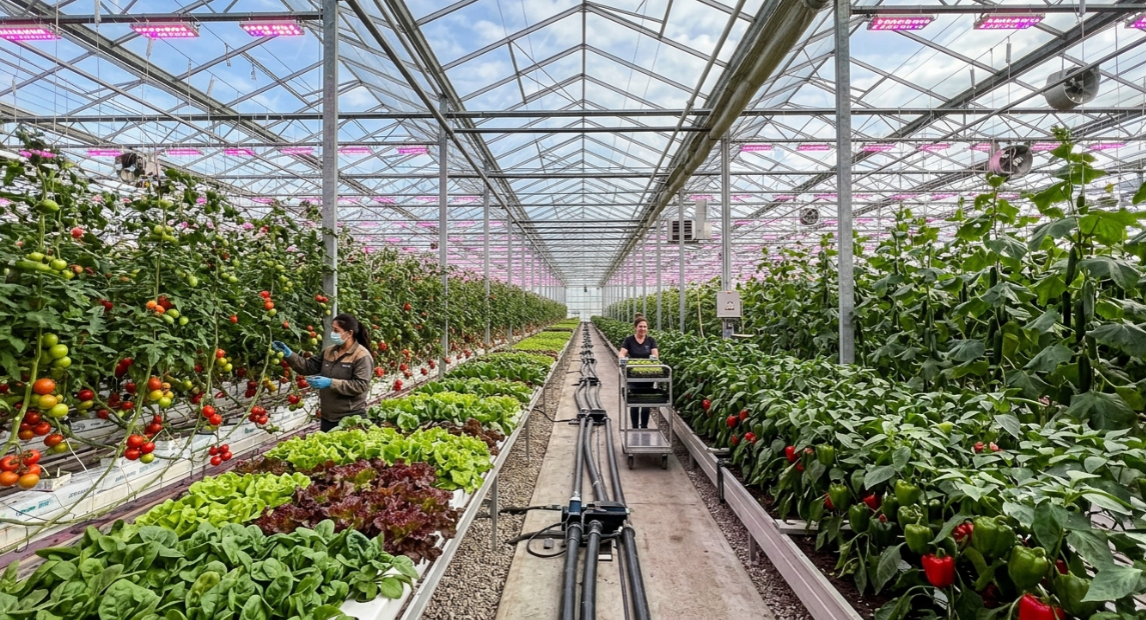
Different greenhouse operations benefit differently from each lighting technology.
Vegetable Greenhouses
LED is typically preferred for tomatoes, cucumbers, peppers, and lettuce. Benefits include higher efficiency, better crop steering, and lower electricity consumption. For crop specific DLI and PPFD targets, guides on tomato lighting and lettuce lighting requirements break down the numbers by growth stage.
Cannabis Greenhouses
LED provides spectrum control, dimming capability, and better integration with environmental controls. However, growers must carefully manage humidity and VPD after transitioning from HPS.
Ornamental and Bedding Plants
Research shows both technologies can perform well, making ROI and energy cost major decision factors. For ornamental growers weighing the switch, crop trials under each lighting type remain the most reliable way to confirm quality standards are met.
High Latitude Winter Production
Hybrid systems often perform best because HPS contributes useful radiant heat while LED reduces electrical consumption.
Greenhouse Heat Circulation Under HPS vs LED
The way heat moves through a greenhouse changes fundamentally depending on which lighting technology is installed. This is not a minor detail. Heat circulation patterns affect plant transpiration, humidity distribution, disease pressure, and the performance of every other climate system in the facility.
How HPS Creates a Convective Loop
An HPS fixture is essentially a heater that happens to produce light. About 60 to 65% of input power exits as infrared radiation and convective heat. That radiant energy warms the canopy directly, while the hot fixture surface (bulb temperatures exceed 400°C) heats the air immediately around it. Hot air rises, cooler air moves in from below, and a natural convective circulation pattern develops throughout the greenhouse bay.
This circulation does useful work. It moves air across leaf surfaces, helping dry moisture and reduce the boundary layer that slows gas exchange. It also distributes heat more evenly from gutter to gutter than the fixture spacing alone would suggest. In cold climates, growers have relied on this passive air movement for decades, often without fully recognizing it as a designed part of their climate system.
What Changes With LED
LED fixtures run dramatically cooler at the fixture surface. They produce very little infrared radiation toward the canopy, and the heat they do generate exits through the heat sink and driver, primarily as convective warmth near the ceiling or (if drivers are remote) outside the growing space entirely. The result is that the natural convective loop created by HPS mostly disappears.
Practitioners on Reddit report noticing this immediately after a conversion. One grower described “dead air” pockets forming between rows after removing HPS, leading to localized humidity spikes and early signs of botrytis within two weeks. The fix required adding horizontal air flow (HAF) fans that the previous HPS installation had made unnecessary.
Practical Adjustments for LED Greenhouses
When switching to LED, plan for supplemental air circulation. Horizontal air flow fans, spaced every 40 to 50 feet in a standard pattern, replace the passive convection that HPS provided. In taller gutter greenhouses, vertical destratification fans may also be needed to push warm air from the ridge back down to the canopy.
Growers running LED with energy screens face an additional complication. Closing screens at night traps moisture above the crop, and without the HPS convective loop to circulate air behind the screen, condensation on the screen surface becomes more likely. Grodan’s full LED tomato trial confirmed that stable production under LEDs with closed screens depended on active air dehumidification and increased air movement to support transpiration.
The bottom line: heat circulation is not just about temperature. It is about air movement, moisture management, and disease prevention. LED greenhouses need active airflow strategies that HPS greenhouses got for free.
Energy Efficiency: Lighting Electricity vs Total Greenhouse Energy
This is the single biggest misconception in the LED vs HPS greenhouse lighting debate: the difference between lighting energy savings and total facility energy savings.
LED fixtures use significantly less electricity to produce the same number of photons. That part is straightforward. In the Wageningen modeling study, LED at 3.0 µmol/J required about 40% less lighting electricity than HPS at 1.8 µmol/J to deliver equivalent photon levels. Earlier experimental results cited in the same paper showed fixture level electricity reductions of 37% to 60%.
But here is where most comparison articles stop, and where growers get burned.
HPS lamps dump a large amount of heat into the greenhouse. In cold months, that heat partially offsets the boiler or heating system. When LEDs replace HPS, the lighting electricity drops, but the heating bill rises. The Wageningen study found total greenhouse energy savings were only 10 to 25% across the modeled scenarios, not the 40 to 60% that fixture only comparisons suggest.
This distinction matters enormously. A grower in the Netherlands or northern Canada will see different total savings than one in southern California. Anyone evaluating LED vs HPS for a greenhouse project should model the whole energy balance, not just the lighting circuit. For a broader look at where energy savings come from in a greenhouse, this energy savings guide covers LED, HVAC, and rebate strategies together.
Heating and Cooling Load Calculation for LED vs HPS
One of the most overlooked steps in an LED vs HPS decision is running a proper heating and cooling load calculation that accounts for the lighting system. Growers who skip this step tend to underestimate the climate impact of switching technologies.
Why Lighting Changes the Load Calculation
Every watt of electricity consumed by a grow light eventually becomes heat. The difference is where that heat ends up. An HPS fixture converts roughly 60 to 65% of its input power to heat, most of it as infrared radiation directed at the canopy. An LED fixture at 3.0 µmol/J converts a higher share of input power into photons, but the remaining heat exits primarily through convection at the fixture and driver, not as radiant heat on the leaf surface.
This means switching from HPS to LED changes three things simultaneously:
- Sensible heat load in the growing zone drops. Less radiant energy warms the air and canopy.
- Heating demand in cold months increases. The greenhouse loses a “free” heat source and must compensate with boiler or heat pump output.
- Cooling demand in warm months decreases. Less waste heat means less mechanical cooling or vent time.
A Simplified Approach
A practical heating and cooling load estimate for a lighting retrofit starts with the current system’s total wattage, then calculates the BTU contribution. One watt equals approximately 3.41 BTU/hr. A greenhouse running 500 kW of HPS contributes about 1.7 million BTU/hr of heat to the facility. Replace that with 300 kW of LED (delivering equivalent photons), and the heat contribution drops to roughly 1.02 million BTU/hr, a gap of about 680,000 BTU/hr that the heating system must cover during cold periods.
Practitioners on Reddit consistently flag this as the surprise cost of LED conversion. One grower in an r/macrogrowery discussion described discovering a $15,000/year increase in heating costs after switching an entire facility to LED, partially offsetting the electricity savings. The lesson: model the net energy balance, not just the lighting circuit.
For facilities where the HVAC math gets complex, understanding latent vs sensible heat is essential. Radiant heat from HPS disproportionately affects sensible heat, while LED conversions tend to shift the balance toward latent heat (moisture) as a bigger proportion of the remaining load.
When to Bring in Engineering Support
Any facility over 10,000 sq ft should consider a formal HVAC audit before a full LED retrofit. Smaller projects can often get by with the simplified BTU approach, but larger operations need to model boiler capacity, dehumidification requirements, and air exchange rates against the new lighting load.
Heat, Humidity, and VPD: Why LED Is Not a Drop In HPS Replacement
When an HPS lamp runs, a substantial portion of its energy output reaches the crop as radiant heat. That infrared radiation warms leaf surfaces directly, increases leaf temperature, drives transpiration, and helps manage vapor pressure deficit (VPD). LED fixtures convert more energy into photons and less into radiant heat. That sounds like a pure advantage. In practice, it creates a different greenhouse.
Practitioners on Reddit report this consistently. In one r/macrogrowery thread, growers warned that switching from HPS to LED often leaves facilities with too much AC capacity and not enough dehumidification. Another thread focused on how LEDs do not warm the leaf surface the way HID fixtures do, meaning ambient temperature targets often need to increase by several degrees to maintain the same VPD range.
Svensson, a major climate screen manufacturer, made the same point on LinkedIn: LED efficiency changes greenhouse climate and requires new humidity strategies, especially when energy screens are deployed.
What Changes When You Switch to LED
- Leaf temperature drops. Growers may need to raise air temperature setpoints to compensate.
- Transpiration decreases. Lower leaf temperature means less water vapor leaving the plant, which can slow nutrient uptake and calcium transport.
- Humidity rises. Less radiant heat plus reduced AC runtime means less passive dehumidification. Active systems or adjusted ventilation become necessary.
- VPD targets change. The crop’s microclimate is different even when the same number of photons arrive. Irrigation, fertigation, and climate recipes all need revisiting.
For sealed indoor cannabis facilities, the dynamics are similar but more intense. The enclosed environment amplifies any change in heat load. Understanding HVAC sizing for LED lights prevents the most common engineering mistakes.
One clear message from practitioner forums: do not switch lighting technology mid crop cycle. Multiple r/macrogrowery threads advise waiting until the next cycle rather than hard switching during flower. Test in one zone first.
Extended Growing Season: How Lighting Technology Shapes Year Round Production
One of the most financially significant outcomes of the LED vs HPS decision is how each technology supports (or limits) the ability to extend the growing season. Supplemental lighting exists precisely because natural light runs short for months at a time, and the lighting system you choose determines how many additional weeks or months of productive growing you can sustain economically.
The Winter DLI Problem
In northern U.S. and Canadian greenhouses, natural DLI inside the structure can drop below 5 mol/m²/day during December and January after accounting for glazing transmission losses. Most greenhouse vegetable crops need 15 to 25 mol/m²/day for quality production. That gap has to come from supplemental lighting or growers shut down.
Both HPS and LED can bridge that gap. But the economics of running supplemental lights 14 to 18 hours per day for four to five months straight are where the technologies diverge sharply. A greenhouse running 500 kW of HPS for 16 hours daily at $0.12/kWh spends roughly $960 per day on lighting electricity alone. The same photon output from LED (around 300 kW at higher efficacy) costs approximately $576 per day. Over a 150 day winter lighting season, that is a difference of roughly $57,600 in electricity, before accounting for heating offsets.
Why LED Makes Extended Seasons More Profitable
The longer your lighting hours, the more LED’s per photon efficiency advantage compounds. A greenhouse that only needs 4 to 6 hours of supplemental light per day (mild climates, spring shoulder seasons) sees modest electricity savings from LED. A greenhouse running lights 14 to 18 hours per day through a northern winter sees savings that can justify the higher fixture cost within two or three seasons.
This math is why northern European growers, who operate some of the longest supplemental lighting seasons in the world, have adopted LED faster than growers in lower latitudes. Dutch tomato producers running 5,000+ annual lighting hours report that LED payback periods shortened to under four years even when accounting for increased heating costs.
LED’s dimmability adds another layer. On clear winter days when natural DLI might reach 8 to 10 mol/m²/day inside the greenhouse, LED fixtures can dim proportionally rather than running at full power. HPS fixtures running at partial output lose efficiency and shorten lamp life. Over a five month season, that automated dimming response reduces total lighting electricity by an additional 10 to 20% compared to running any fixture type at constant output. For growers structuring their supplemental lighting hours, LED’s flexibility directly translates into more crop cycles per year at lower cost per cycle.
Revenue Impact of Additional Crop Cycles
The extended season question is not just about cost. It is about revenue. A greenhouse that can maintain quality production through January and February, rather than shutting down or accepting low grade output, captures winter premium pricing. Greenhouse tomatoes in the northeastern U.S. wholesale at 30 to 50% higher prices during December through March compared to summer months. Leafy greens show similar seasonal premiums.
Strawberry Fields, a Colorado cannabis greenhouse operation, doubled winter yields in previously unlit areas after adding supplemental LED lighting. That kind of production gain, converting dead months into productive ones, is where the ROI case for LED becomes most compelling.
Dynamic LED Lighting in Greenhouse Production
One of LED’s most significant advantages over HPS has nothing to do with raw efficiency. It is programmability.
Dynamic LED lighting refers to the ability to adjust light intensity, spectrum, and photoperiod in real time based on crop stage, ambient sunlight levels, or energy pricing. HPS fixtures are essentially binary: on or off. Some ballasts allow limited dimming, but the spectrum cannot change and dimming below about 50% causes lamp instability and accelerated degradation.
LED fixtures, by contrast, can dim smoothly from 100% down to 10% or lower without affecting spectrum or fixture lifespan. More advanced systems allow spectral shifts, adding far red during end of day treatments to promote flowering or increasing blue wavelengths during vegetative stages to control stretch.
How Growers Use Dynamic Lighting
Sunlight compensation. On bright days, LED fixtures dim or turn off entirely when ambient DLI is sufficient. On overcast days, they ramp up. This strategy delivers a consistent DLI target with minimal electricity waste. One YouTube walkthrough by a Dutch tomato grower showed a 15 to 20% reduction in lighting hours per year simply by integrating PAR sensors with automated dimming.
Spectral recipes by crop stage. Propagation might use a higher blue ratio for compact growth, while flowering stages shift toward red and far red. This kind of crop steering is impossible with HPS.
Time of use energy management. In regions with variable electricity pricing, growers can dim or shift lighting hours to avoid peak rate periods while still hitting daily DLI targets. This is especially valuable for operations running 16 to 18 hour photoperiods in winter.
End of day far red treatments. A pulse of far red light at the end of the photoperiod accelerates phytochrome conversion and can shorten time to flower in long day sensitive crops. Some LED greenhouse fixtures include dedicated far red channels for exactly this purpose.
Dynamic lighting is not just a feature. It changes the economics. A greenhouse that can dim its LED array by 30% on sunny winter afternoons uses 30% less electricity during those hours. Over a season, the cumulative savings can meaningfully accelerate payback. For growers interested in optimizing supplemental lighting strategy, dynamic dimming is the first capability to implement.
Canopy Penetration and Fixture Spacing
When comparing LED vs HPS greenhouse lighting, most discussions focus on efficiency, spectrum, and heat. Canopy penetration and fixture spacing get far less attention, but they directly affect yield uniformity and crop quality.
The Physics of Light Distribution
HPS fixtures produce light from a single, intensely bright point source (the arc tube). That concentrated output, combined with a large parabolic reflector, creates a deep cone of light that penetrates relatively well into tall, dense canopies. The downside is that PPFD is highest directly below the fixture and drops off sharply toward the edges.
LED fixtures spread their output across many diodes on a bar, panel, or multi bar array. This creates a wider, more even footprint at canopy level but with lower peak intensity at any single point. The result is better uniformity across the horizontal plane but potentially less penetration into the lower canopy layers of tall crops like tomatoes, peppers, or cannabis.
Why Fixture Spacing Matters More Than You Think
Uniformity is measured as the ratio of minimum to maximum PPFD across a defined area. A ratio above 0.7 is generally considered acceptable for most greenhouse crops. Below that, you get hot spots under fixtures and dim spots between them, leading to uneven growth, variable fruit size, or inconsistent flower quality.
LED fixtures often require tighter spacing or different mounting heights than HPS to achieve equivalent uniformity, especially in greenhouses with low gutter heights. Practitioners on Reddit regularly note that a 1:1 fixture swap (replacing each HPS with one LED at the same location) frequently produces dark spots between fixtures. A proper lighting layout simulation, run before purchase, prevents this problem.
Addressing Lower Canopy Light
For crops with dense upper canopies (cannabis is the obvious example, but tall vine crops also qualify), upper fixture light alone often cannot reach lower leaves and developing fruit. This is true regardless of whether the top light is HPS or LED.
Under canopy or interlighting fixtures solve this by positioning supplemental light bars within or below the canopy. Research and grower trials consistently show yield improvements of 20 to 30% in lower bud sites when under canopy lighting is added to cannabis production. The same principle applies to greenhouse tomato interlighting, where supplemental light at fruit cluster height improves color development and sugar content.
For greenhouse top lighting projects that need high output and wide, uniform coverage, commercial fixtures in the 800W to 1050W range are purpose built for this application.
Crop Response: What the Research Actually Shows
“LED yields more” is not a universal truth. Crop response depends on species, cultivar, spectrum, light intensity, climate management, and grower SOPs. The research paints a nuanced picture.
Lettuce. Cornell researchers studying hydroponic greenhouse lettuce found that LED arrays used less than half as much electricity as HPS while producing similar sized lettuce. Electrical biomass efficacy was two to three times higher under LEDs. However, in one trial phase, HPS actually produced larger height or diameter for certain cultivars.
Water use. A separate greenhouse lettuce study found 15% lower water consumption under LED compared to HPS with no yield loss, likely tied to lower transpiration from reduced radiant heat.
Bedding plants. A Purdue/USDA/MSU study on commercial greenhouse bedding plants found seedlings grown under HPS or LED supplemental lighting were comparable in quality. When both systems produced similar results, the researchers concluded growers could prioritize energy savings, fixture price, and lifespan.
Cannabis. The picture is more complicated. Some cannabis growers on Reddit still prefer HPS for specific legacy genetics, flower structure, or perceived terpene outcomes. Others report that LEDs produce equal or better quality once the climate recipe is dialed in. One commercial operator quoted on LinkedIn described transitioning from 64 1000W DE HPS fixtures and said plant quality justified the change. The evidence suggests cannabis can perform well under either technology, but the transition demands cultivar validation and adjusted SOPs.
The bottom line: LED can match or exceed HPS yield with much less electricity, but only when fixture, spectrum, layout, and climate are designed for the specific crop.
Direct and Secondary Cost Savings: Beyond the Electricity Bill
Most LED vs HPS comparisons stop at electricity cost per photon. That is the most obvious savings category, but it accounts for only part of the total financial picture. Growers who model the full cost structure find that secondary savings often rival or exceed the direct electricity reduction.
Direct Cost Savings
Electricity. This is the headline number. LED fixtures producing equivalent photons at 2.8 to 3.0 µmol/J versus HPS at 1.7 to 1.8 µmol/J use 35 to 45% less electricity for the same PPFD output. For a greenhouse running 500 kW of supplemental lighting 16 hours per day at $0.12/kWh, that translates to roughly $100,000 to $170,000 per year in reduced lighting electricity.
Lamp replacement. HPS lamps degrade measurably within 8,000 to 12,000 operating hours and need periodic replacement to maintain output. A 5 acre greenhouse might run 2,000+ HPS fixtures, each requiring a $30 to $60 lamp swap every 12 to 18 months, plus labor. That adds $60,000 to $120,000 per replacement cycle. LED fixtures rated at 50,000+ hours eliminate this line item almost entirely.
Reflector maintenance. HPS reflectors lose 5 to 10% of their effectiveness per year from oxidation, dust, and condensation. Cleaning or replacing reflectors is a recurring labor cost that LED’s integrated optics avoid.
Secondary Cost Savings
These are the savings that rarely appear on a lighting spec sheet but show up in the operating budget.
Reduced cooling costs in warm months. LED’s lower heat output means less energy spent on ventilation, evaporative cooling, or mechanical AC during spring and summer. For greenhouses in USDA zones 7 and above, cooling costs can represent 15 to 25% of total energy spend, and reducing the internal heat load cuts into that directly.
Lower peak demand charges. Many commercial utility rates include demand charges based on the highest 15 minute power draw in a billing period. Replacing 500 kW of HPS with 300 kW of LED (delivering the same photons) permanently reduces peak demand by 200 kW. At typical demand charges of $10 to $20/kW/month, that saves $24,000 to $48,000 annually, a number many growers overlook entirely.
Extended fixture life and reduced labor. LED fixtures last 2 to 4 times longer than HPS assemblies. Beyond lamp costs, this means fewer maintenance hours at height, less production disruption from fixture failure, and lower insurance and safety costs associated with hot lamp handling.
Utility rebates and incentives. DLC listed LED fixtures qualify for utility rebates in many North American territories. These rebates can reduce the effective capital cost of an LED installation by 20 to 40%. The DLC released its Horticultural Lighting Technical Requirements V4.0 in March 2025, with applications accepted starting April 2025. For growers exploring whether their project qualifies, rebate eligibility details are worth reviewing early in the planning process.
Crop quality premiums. This is harder to quantify upfront but real in practice. LED spectrum control can improve color, compactness, flavor compounds, and shelf life in certain crops. Growers who sell into retail channels with quality premiums (specialty lettuce, herbs, premium cannabis) report that better light recipes translate into price premiums of 5 to 15% on finished product.
Building a Complete Cost Model
A proper LED vs HPS financial comparison should include a line item for each category above, not just the electricity calculation. When secondary savings are included, the payback period for LED typically shortens by 6 to 18 months compared to models that only account for direct electricity reduction.
How Much Can LED Save Compared to HPS?
The actual savings depend on climate, operating hours, and utility rates.
| Metric | LED Advantage |
|---|---|
| Lighting Electricity Use | 30 to 60% lower |
| Maintenance Costs | 50 to 80% lower |
| Lamp Replacement Costs | Near zero |
| Fixture Life | 2 to 4x longer |
| Total Greenhouse Energy Use | 10 to 25% lower in many studies |
| Peak Demand Charges | 30 to 40% lower |
Hybrid LED and HPS Lighting ROI
The LED vs HPS conversation often gets framed as either/or. In practice, many commercial greenhouses run hybrid systems, and the ROI math for this approach deserves its own analysis.
Why Hybrid Makes Financial Sense
A full LED conversion for a 5 acre greenhouse can require $1 million or more in capital, depending on fixture density and electrical upgrades. A hybrid approach lets growers capture meaningful efficiency gains while spreading capital expenditure across multiple budget cycles.
The typical hybrid strategy works like this: retain functional HPS fixtures in zones where radiant heat is beneficial (propagation houses in cold climates, for example), and install LED in zones where cooling load is a problem or where spectrum control adds crop value (flowering zones, research bays, or areas with long photoperiods).
Modeling Hybrid ROI
A hybrid ROI model needs to account for the fact that LED and HPS zones will have different operating costs, different climate loads, and potentially different yields. The key variables:
- Electricity cost per zone. LED zones consume less power per photon. Calculate annual kWh savings for each LED zone relative to the HPS baseline.
- Heating offset value. In HPS zones that benefit from radiant heat, calculate the avoided heating cost and credit it against the HPS operating expense.
- Maintenance differential. LED zones have near zero relamping cost. HPS zones require lamp replacement every 8,000 to 12,000 hours, plus reflector cleaning.
- Rebate eligibility. DLC listed LED fixtures may qualify for utility rebates that do not apply to HPS. This can reduce the effective LED capital cost by 20 to 40% in some utility territories.
- Phased capex timeline. Spreading LED investment over 2 to 3 years reduces the annual cash impact and aligns spending with crop revenue cycles.
Practitioners report that hybrid systems typically achieve 3 to 5 year payback on the LED portion, while the retained HPS fixtures continue operating at their known cost structure until they reach end of life. For a deeper breakdown of lighting payback math, this greenhouse lighting ROI guide walks through the calculation step by step.
When Hybrid Becomes Full LED
Most hybrid systems are transitional. As HPS lamps reach replacement age (typically every 2 to 3 years of heavy use), growers can convert those zones to LED incrementally. This natural replacement cycle means the facility reaches full LED without ever taking a single large capital hit.
Cost and ROI: The Variables That Matter
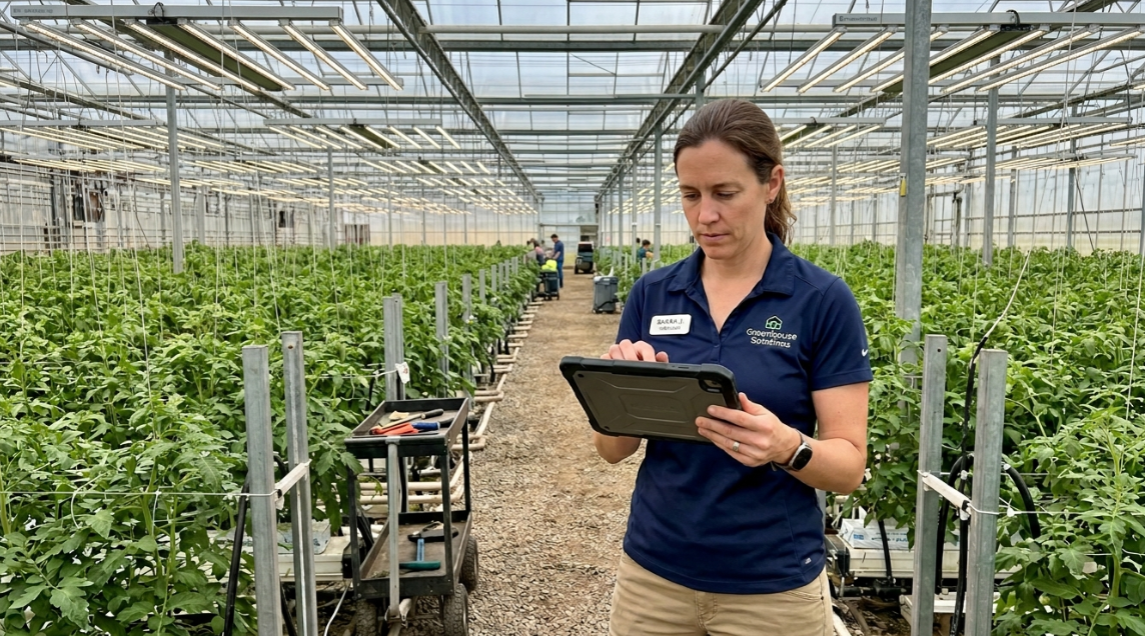
LED fixtures carry higher upfront cost per unit. That is still true, though the gap has narrowed. The question is whether lower operating cost, longer fixture life, and available incentives close the payback gap within a reasonable timeframe.
A fair LED vs HPS greenhouse lighting ROI comparison should account for:
- Fixture and installation cost, including electrical service, mounting, and controls.
- Electricity price and operating hours. A greenhouse running 16 hour supplemental lighting at $0.15/kWh will see very different payback than one running 8 hours at $0.06/kWh.
- Maintenance. HPS lamps degrade over time and need periodic replacement. Reflectors lose efficiency. LED fixtures avoid relamping but are not maintenance free.
- HVAC, heating, and dehumidification changes. If LEDs reduce cooling load but add heating or dehumidification cost, those numbers belong in the model.
- Crop value. Higher value crops justify faster payback timelines.
- Utility rebates. DLC listed LED fixtures can qualify for utility rebates that meaningfully reduce net capex.
There is no true one for one replacement of HPS by LED. LEDs are directional and create different light distributions, so comparisons should evaluate the entire growing area, not just fixture output directly under the luminaire.
For large scale projects, power architecture also affects total cost. Moving LED drivers out of the grow space through a centralized power system can simplify electrical distribution, reduce heat in the canopy zone, and lower installation complexity.
When to Choose LED, HPS, or Hybrid
The LED vs HPS greenhouse lighting decision maps to specific facility and business situations. Here is a practical starting framework.
| Situation | Starting point | Why |
|---|---|---|
| New commercial greenhouse build | LED | Higher efficacy, modern code compliance, rebate eligibility, and long fixture life. |
| High electricity cost or long photoperiod | LED | More operating hours multiply the energy savings advantage. |
| Cold winter greenhouse, limited heating | Hybrid or careful LED design | Some HPS heat may reduce heating costs. Full LED may need HVAC upgrades. |
| Existing HPS greenhouse, tight budget | HPS or phased hybrid | Lower upfront cost. Use existing infrastructure while budgeting for a future LED phase. |
| Facility struggling with excess heat | LED | Lower radiant heat reduces cooling stress and allows better climate separation. |
| Cannabis with high quality targets | LED with updated SOPs | Needs warmer air, VPD adjustment, dehumidification, and cultivar validation. |
| Research or crop steering program | LED | Spectrum and dimming control support stage specific light recipes. |
| Extending growing season into winter | LED | Long daily run hours compound LED’s per photon efficiency advantage. |
Hybrid lighting (combining LED and HPS in the same facility) is a real world compromise that many growers adopt. It captures some LED efficiency and control while retaining HPS radiant heat where it benefits the crop or the energy balance. Practitioners on Reddit mention hybrid systems as a practical bridge strategy, and it lets facilities spread capex over time.
LED Retrofit Checklist
Before replacing HPS with LED in a greenhouse, work through these steps.
- Measure current HPS PPFD across the canopy at multiple points, not just directly under fixtures.
- Calculate seasonal natural DLI inside the greenhouse after accounting for glazing, shade structures, and latitude.
- Define crop target DLI by growth stage.
- Model the LED layout for average PPFD and uniformity across the full growing area, paying close attention to fixture spacing and mounting height.
- Estimate fixture shading and mounting constraints. LED fixtures have different profiles than HPS and may block or pass sunlight differently.
- Run a heating and cooling load calculation. This is the step most growers skip, and it is the most expensive mistake. Use the BTU approach described above or bring in HVAC engineering for larger facilities.
- Adjust temperature and VPD targets for the new heat balance.
- Review irrigation and nutrient strategy. Lower transpiration rates under LED may require changes to fertigation timing and EC management. This nutrient strategy guide covers the adjustments.
- Plan for supplemental air circulation. Budget for HAF fans or vertical destratification fans to replace the passive convective mixing that HPS provided.
- Check DLC listing, rebates, and local regulations if applicable, especially for cannabis projects in regulated states.
- Trial one bay or one cultivar group before committing to a full facility conversion.
For deeper technical planning, LED lighting white papers can help bridge the gap between this overview and a formal project design.
Frequently Asked Questions
Is LED better than HPS for greenhouse lighting?
For most new projects, yes. LED delivers more photons per joule, lasts longer, and offers more control. But “better” depends on the specific facility, climate, crop, and budget. HPS remains rational in some cold climate or budget constrained scenarios. Hybrid systems split the difference.
Do LED grow lights produce less heat than HPS?
LEDs produce less radiant heat toward the crop and convert more electricity into photons. But all electrical equipment eventually becomes heat somewhere in the building. The difference is where that heat goes. LED greenhouses often need more active heating, air circulation, and dehumidification than HPS greenhouses do.
Can LED replace 1000W HPS one for one?
Not reliably. LED and HPS distribute photons differently. A fixture that matches HPS output directly underneath it may deliver less uniform light across a full bay. Any replacement should be designed around target DLI, average PPFD, and canopy uniformity rather than fixture wattage.
Do LEDs improve yield?
They can, but yield depends on delivered DLI, cultivar, spectrum, climate management, and grower SOPs. Research shows LED can match HPS yield with significantly less electricity in lettuce, bedding plants, and other crops. In some trials, HPS produced larger plants for specific cultivars. Results are crop specific.
Why do LED greenhouses need more dehumidification?
Lower radiant heat from LEDs means cooler leaf surfaces, reduced transpiration, and less moisture removal by cooling systems. The net effect is higher relative humidity in the growing environment. Without active dehumidification or adjusted ventilation, this creates disease risk and poor VPD conditions.
What is hybrid greenhouse lighting?
A lighting strategy that combines LED and HPS fixtures in the same facility. Hybrid systems let growers capture LED efficiency and spectrum control while retaining some HPS radiant heat. It is also a practical way to phase a full LED conversion over multiple budget cycles.
Should I compare grow lights by watts or lumens?
Neither. Watts measure electricity consumption, and lumens measure brightness as perceived by humans. For plant lighting, compare PPF (total photon output), PPFD (photons reaching the canopy), PPE (photons per joule), and DLI (total daily photons). These metrics describe what the crop actually receives.
What is the biggest mistake when switching from HPS to LED?
Treating the switch as a fixture replacement instead of a system change. Successful LED transitions require new lighting layouts, updated climate recipes, adjusted VPD and temperature targets, supplemental air circulation, potentially different irrigation strategies, and a trial period before full facility conversion.
How does dynamic LED lighting save energy?
By dimming fixtures when ambient sunlight is sufficient and ramping up only when DLI falls short of crop targets. Automated dimming based on PAR sensor feedback can reduce annual lighting hours by 15 to 20% in many greenhouse locations, compounding the per watt efficiency advantage LED already holds over HPS.
How do I calculate the heating load change when switching to LED?
Multiply the total wattage difference between your current HPS system and the proposed LED system by 3.41 BTU/hr per watt. That gives you the approximate additional heating load your boiler or heat pump must cover during cold months. Factor this into your ROI model alongside electricity savings.
Does LED or HPS do more to extend the growing season?
Both technologies can bridge winter DLI deficits. LED does it at substantially lower electricity cost per photon, which makes running lights 14 to 18 hours per day through winter months more financially sustainable. The longer the supplemental lighting season, the stronger the economic case for LED.
Ready to evaluate LED greenhouse lighting for your facility? Talk to a lighting specialist about fixture selection, layout design, and project planning.