Greenhouse Shading and Supplemental Lighting: 2026 Guide
Master Greenhouse Shading and Supplemental Lighting to hit DLI targets year-round. Learn crop benchmarks, energy-smart tips, and shadow fixes.
TL;DR
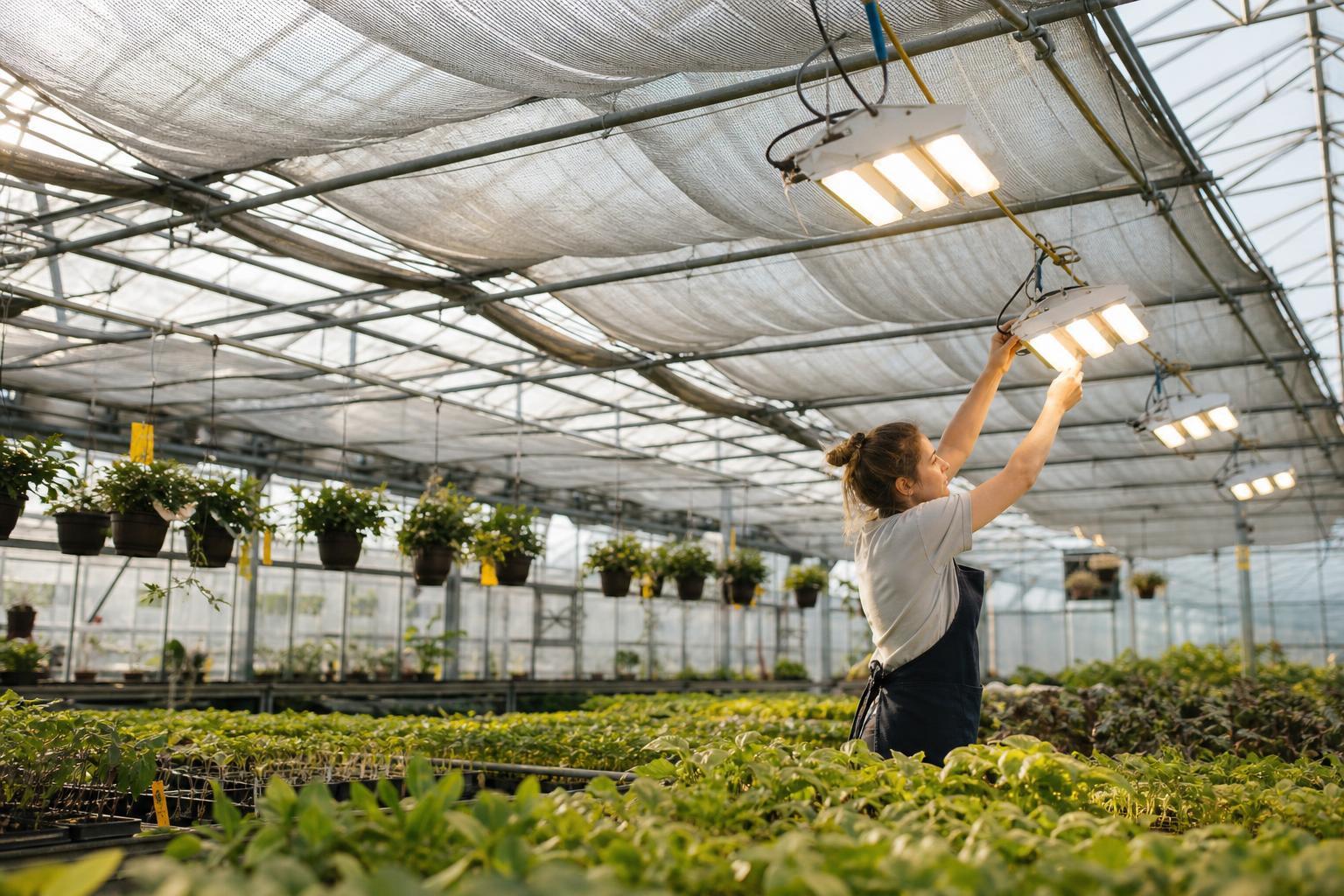
Greenhouse shading and supplemental lighting are two sides of the same coin: managing Daily Light Integral (DLI). Shading reduces excess sunlight during peak summer months, while supplemental lighting fills the gap during winter and overcast periods. Both strategies exist to keep crops within their optimal DLI range, and getting either one wrong costs yield. This guide covers the science, practical benchmarks, common mistakes, and the often-overlooked problem of fixture shadow.
Why Greenhouse Shading and Supplemental Lighting Matter
A greenhouse structure reduces the amount of light reaching the plant canopy by 40% to 50% compared to outdoor levels. In winter and at northern latitudes, that reduction pushes crops well below the light they need to grow productively. In summer, the opposite problem emerges: too much radiation raises canopy temperatures, causes photobleaching, and stresses plants.
Greenhouse shading and supplemental lighting solve these two problems. Shading caps light when there is too much. Supplemental lighting adds light when there is not enough. The metric that connects them is DLI, the total amount of photosynthetically active photons a plant receives over 24 hours, measured in mol/m²/d.
A widely cited rule of thumb puts the stakes in simple terms: a one percent increase in light reaching the crop translates to roughly a one percent increase in plant growth. That relationship works in both directions, which means over-shading and under-lighting carry real economic penalties.
Explore greenhouse LED lighting options purpose-built for supplemental use.
What Is Greenhouse Shading?
Greenhouse shading refers to any method used to reduce the amount of sunlight reaching the crop canopy. The purpose is twofold: lower light intensity and reduce heat buildup. In summer or at southern latitudes, unmanaged solar radiation can push canopy temperatures high enough to trigger wilting, tip burn, and fruit disorders.
Shading Methods
Shade cloth is the most common approach. It comes in two main types. Knitted cloth is lightweight, resists fraying when cut, and allows better airflow. Woven cloth offers tighter light control and holds up better in wind and rain. The color of the cloth matters beyond aesthetics: black absorbs heat and re-radiates it into the greenhouse, while white or aluminum-faced cloth reflects incoming radiation away from the structure. For that reason, reflective materials like aluminum strips are generally preferred for internal shade curtains.
Retractable curtain systems can be deployed and retracted based on real-time light and temperature readings. Their primary advantage over permanent shade cloth is flexibility: they provide higher light levels on overcast days while still protecting the crop during intense midday sun.
Whitewash and shading compounds are painted or sprayed onto the glazing. They are cheap but static, meaning they reduce light even on cloudy days when plants actually need every photon they can get.
Automated screen systems combine motorized curtains with sensors. These are the gold standard in commercial greenhouse shading because they respond to actual conditions rather than calendar-based guesses.
Shade Percentages by Crop
For most greenhouse crops, 30% to 50% shade is appropriate. Commercial operations should generally keep shading at or below 40% to 45%. The exact percentage depends on the greenhouse’s location, glazing material, and the crop being grown.
Going beyond those thresholds creates what greenhouse practitioners describe as the worst possible growing environment: high temperature combined with low light. This happens because heavy shade blocks photosynthetically active radiation but does little to stop infrared heat from building up inside the structure. Understanding how heat loads interact with lighting and shading decisions is essential for climate management.
Common Shading Mistake
Leaving heavy shade deployed too long is one of the most frequent errors in greenhouse management. A grower who installs 50% shade cloth in June and forgets to remove it in September is starving the crop of light during the shoulder season, exactly when supplemental lighting would start to make economic sense. Retractable systems largely solve this, but they require calibration and maintenance to function properly.
What Is Supplemental Lighting?
Supplemental lighting is the use of artificial light sources to increase the total photosynthetically active radiation plants receive during a day. The goal is straightforward: close the gap between the DLI available from sunlight and the DLI the crop actually needs. This is distinct from photoperiodic lighting, a common point of confusion that trips up even experienced growers.
Supplemental vs. Photoperiodic Lighting
Photoperiodic lighting controls the duration of the light period to trigger or suppress flowering responses. It requires very low intensity, just 1 to 2 µmol/m²/s, because it is signaling to the plant rather than feeding photosynthesis. A single incandescent bulb can do the job.
Supplemental lighting drives actual photosynthesis and growth. Typical greenhouse supplemental lighting systems deliver between 60 and 200 µmol/m²/s at the top of the plant canopy, per the NRCS Conservation Practice Standard. That is 30 to 200 times the intensity of photoperiodic lighting. Confusing the two leads to growers who think they are supplementing light when they are only extending day length.
For a deeper breakdown of this distinction, see the photoperiod lighting guide.
LED vs. HPS for Supplemental Use
LEDs now hold roughly 60% of the greenhouse lighting market. They save 40% to 60% in energy compared to high-pressure sodium (HPS) fixtures and last more than twice as long. Beyond efficiency, LEDs offer spectrum tunability and produce less radiant heat at the canopy level, which reduces cooling costs. For a fair comparison of the two technologies, there are important nuances to consider beyond wattage alone.
The Extended Photoperiod Strategy
One cost-saving approach is to run supplemental lighting at lower intensity but for a longer duration. Instead of blasting 200 µmol/m²/s for 10 hours, a grower might deliver 120 µmol/m²/s for 16 hours and achieve a similar DLI. This reduces the number of fixtures required (lower capital cost) and shifts electricity consumption into nighttime hours when rates are often cheaper. Not every crop tolerates extended photoperiods, though. Tomatoes, for instance, can develop chlorosis if lit for more than about 17 hours per day.
Energy Cost Reality
Supplemental lighting commonly accounts for 10% to 30% of a greenhouse’s operating expenses. That is a significant line item, which makes fixture efficiency and lighting strategy critical to profitability. Utility rebates can offset a substantial portion of the upfront cost. Check available rebate programs before finalizing a lighting investment.
How Shading and Supplemental Lighting Work Together
DLI: The Unifying Metric
DLI measures the total number of photosynthetically active photons delivered to a square meter of canopy over a full day. It is the single number that tells a grower whether to shade, supplement, or do nothing. Inside a greenhouse, DLI is influenced by outdoor sunlight, glazing transmittance, structural obstructions, shading curtains, and supplemental lighting when deployed.
To learn how to calculate DLI from PPFD readings, see the formula walkthrough.
Crop DLI Benchmarks
| Crop / Stage | Target DLI (mol/m²/d) |
|---|---|
| Seedlings and young cuttings | 6 to 8 |
| Older transplants, flowering annuals, small herbs | 10 to 12 |
| Lettuce | ~17 |
| Tomatoes (optimal production) | 20 to 30 |
| Cannabis vegetative stage | 18 to 52 |
Cannabis research demonstrates particularly dramatic DLI responses. LED lighting at intensities of approximately 150, 300, 500, and 700 µmol/m²/s on an 18-hour photoperiod, combined with solar radiation, produced average DLIs of 17.9, 29.8, 39.5, and 51.8 mol/m²/d, with linear yield increases across that entire range.
For crop-specific targets, see the detailed guides for tomato lighting requirements and lettuce lighting requirements.
Seasonal Rhythm in Practice
Consider a lettuce grower in Ohio targeting 17 mol/m²/d. In July, outdoor DLI might reach 45 mol/m²/d. After 40% glazing loss, the canopy receives about 27 mol/m²/d, well above the target. A 30% to 40% shade curtain, deployed during peak hours, brings the crop into range while preventing heat stress.
In December, outdoor DLI in Ohio drops to around 10 to 15 mol/m²/d. After glazing loss, the canopy might receive just 6 to 9 mol/m²/d, far below the 17 mol/m²/d target. Supplemental lighting at 100 to 150 µmol/m²/s for 12 to 16 hours closes the gap.
During spring and fall shoulder seasons, both systems may operate on the same day: shade curtains deploy at midday to prevent overheating, while supplemental lights run in the early morning and late afternoon to top off the DLI.
What the Research Shows
A meta-analysis on LED supplemental lighting in tomato greenhouses found statistically significant effects: +40% yield, +50% photosynthetic capacity, +31% leaf chlorophyll content, and +6% soluble solid content compared to controls. Combining toplighting with under-canopy or interlighting fixtures can boost yields an additional 20% to 30%. The evidence behind under-canopy lighting is now extensive enough that growers in forums describe it as table stakes rather than experimental.
DLI Carry-Over: A Cutting-Edge Insight
Recent University of Georgia research has uncovered something practical and underexploited: DLI carry-over. After a particularly sunny day, the DLI requirement can be reduced by approximately 5.25 mol/m²/d on the following day. In other words, plants bank some of the excess light from bright days, reducing the need for supplemental lighting on the next overcast day. Incorporating this concept into lighting controls resulted in annual energy savings of approximately 75 to 190 MWh per hectare in greenhouse lettuce production. That is a meaningful cost reduction for operations already spending 10% to 30% of their budget on supplemental lighting.
The Fixture Shadow Problem
Here is an irony that most greenhouse lighting discussions overlook entirely: supplemental lighting fixtures themselves create shading.
Every square inch of aluminum housing, reflector hood, and driver box mounted below the greenhouse roof acts as a permanent barrier to sunlight. These physical obstructions cast persistent shadow footprints across the upper canopy. In effect, growers pay to build a high-transmittance greenhouse envelope and then block some of those free photons with the very equipment meant to add light.
Quantifying the Problem
A typical tomato or cucumber greenhouse with four LED fixtures per 8-meter bay results in approximately 1,000 fixtures per hectare. With standard fixture dimensions of 100 x 21 x 12 cm, the total structural shadow footprint adds up to roughly 210 m² per hectare. Given that one percent of lost sunlight equals roughly one percent of lost production, fixture shadow is not a trivial issue.
Solutions: Low-Profile Design and Remote Drivers
Two design approaches address this problem directly. First, low-profile fixture designs minimize the physical cross-section that blocks sunlight. Second (and more impactful), remote driver architecture moves the bulkiest component, the LED driver, out of the grow space entirely. Eliminating the driver from the fixture body reduces the shadow footprint by around 25%.
OptiDrive, a centralized power platform, relocates drivers to the wall or a remote rack. This not only reduces fixture shadow but also removes heat sources from above the canopy and consolidates potential failure points outside the growing environment.
Practitioners on Reddit and in greenhouse forums have noted that the fixture shadow issue becomes especially pronounced in winter months, precisely when every photon of natural light matters most and supplemental lighting is running at full capacity. Addressing it is one of the few ways to gain yield without increasing energy consumption.
Glazing Transmittance: The Context for Everything
Glazing material determines how much outdoor light reaches the crop before shading or supplemental lighting even enters the equation.
| Glazing Material | Light Transmittance |
|---|---|
| Single-layer ETFE | 87% to 94% |
| Single-layer glass | 88% to 94% |
| Double-layer glass | ~77% |
| Double polyethylene | ~45% |
A grower operating under double polyethylene is starting with barely half the outdoor light. That grower needs supplemental lighting far earlier in the season and more intensely during winter than a single-glass operator in the same climate. Conversely, a single-layer ETFE house in the southern United States may require aggressive shading for five or six months of the year.
Understanding how to measure PPFD at canopy level, rather than relying on manufacturer specs for the glazing, gives growers the ground truth they need to calibrate both systems.
Light Pollution: An Emerging Constraint
Supplemental lighting from greenhouses is becoming a growing source of light pollution. In the Netherlands, regulations already require that 95% to 98% of artificial light be retained inside the greenhouse, forcing operators to deploy specialized overhead screens with reflective upper and lower surfaces. These screens can be cracked open slightly to allow heat and moisture to escape, but the primary function is containment.
North American growers in suburban or residential-adjacent areas are beginning to face similar pressure. This is one of those areas where shading and supplemental lighting intersect in an unexpected way: blackout or high-retention shade screens, originally designed for light-sensitive crops like cannabis, also solve the light pollution problem during nighttime supplemental lighting hours.
Quick-Reference Tables
DLI Targets by Crop
| Crop / Stage | DLI Target (mol/m²/d) |
|---|---|
| Seedlings, young cuttings | 6 to 8 |
| Older transplants, herbs, flowering annuals | 10 to 12 |
| Lettuce | ~17 |
| Peppers | 15 to 25 |
| Cucumbers | 18 to 25 |
| Tomatoes (optimal production) | 20 to 30 |
| Cannabis (vegetative) | 18 to 52 |
Shade Cloth Ranges
| Application | Shade Percentage |
|---|---|
| Most greenhouse crops | 30% to 50% |
| Commercial maximum (recommended) | 40% to 45% |
| High-light crops (tomatoes, peppers) | 30% to 40% |
| Shade-loving ornamentals | 50% to 70% |
Supplemental vs. Photoperiodic Lighting
| Parameter | Photoperiodic | Supplemental |
|---|---|---|
| Purpose | Control flowering response | Drive photosynthesis |
| Intensity at canopy | 1 to 2 µmol/m²/s | 60 to 200+ µmol/m²/s |
| Duration | 4 to 7 hours (night interruption or day extension) | 8 to 18 hours |
| Fixture cost | Very low | Significant capital investment |
| Energy draw | Negligible | 10% to 30% of operating budget |
Common Mistakes in Greenhouse Shading and Supplemental Lighting
1. Over-shading in summer. Heavy shade cloth that is never removed creates the worst possible greenhouse environment: high heat with low light. Retractable systems or automated screens prevent this.
2. Confusing photoperiodic and supplemental lighting. A few low-intensity bulbs running through the night will change flowering behavior but will not meaningfully increase DLI. If the goal is more growth, the fixtures need to deliver 60+ µmol/m²/s at canopy level.
3. Not measuring DLI at canopy level. Manufacturer specs for glazing transmittance and fixture output are starting points, not ground truth. Canopy-level PAR measurements reveal what plants actually receive.
4. Ignoring fixture shadow when calculating supplemental needs. A lighting plan that assumes zero obstruction between the glazing and the canopy will overestimate natural light delivery. Factor in fixture shadow, structural members, and hanging baskets.
5. Running supplemental lights without considering light pollution. Nighttime operation without containment screens can create neighbor complaints and, increasingly, regulatory problems.
6. Treating shading and supplemental lighting as separate decisions. They are two halves of the same DLI management strategy. Planning them together, ideally with integrated sensors and controls, produces better outcomes than optimizing each in isolation.
Next Steps
The right combination of greenhouse shading and supplemental lighting depends on your location, glazing, crop mix, and energy costs. A lighting audit that maps actual DLI at canopy level across seasons is the starting point for any meaningful improvement.
Schedule a free consultation with a lighting expert to calculate your DLI gap and evaluate your options.
Frequently Asked Questions
What is the difference between greenhouse shading and supplemental lighting?
Greenhouse shading reduces excess sunlight reaching the crop canopy, while supplemental lighting adds artificial light to compensate for insufficient sunlight. Both are tools for managing Daily Light Integral, the total photosynthetically active light a plant receives in 24 hours. Most commercial greenhouses need both strategies at different times of the year.
How do I know when to shade versus when to supplement?
Measure DLI at canopy level and compare it to your crop’s target. If canopy DLI exceeds the target, shade. If it falls short, supplement. During shoulder seasons (spring and fall), you may need to shade during midday peaks and supplement in the early morning or late afternoon on the same day.
What shade percentage should I use for my greenhouse?
Most crops perform well with 30% to 50% shade, and commercial operations should generally not exceed 40% to 45%. The exact percentage depends on your location, glazing type, and crop. Retractable systems are preferred over static shade cloth because they allow full light on cloudy days.
How much supplemental light does a typical greenhouse need?
Standard supplemental lighting systems deliver 60 to 200 µmol/m²/s at the canopy. The amount you need depends on the gap between your available DLI and your crop’s target. A lettuce grower in the northern United States might need 100 to 150 µmol/m²/s for 14 to 16 hours during winter to reach 17 mol/m²/d.
Is photoperiodic lighting the same as supplemental lighting?
No. Photoperiodic lighting uses very low intensity (1 to 2 µmol/m²/s) to control flowering responses by manipulating day length. Supplemental lighting uses much higher intensity (60 to 200+ µmol/m²/s) to drive actual photosynthesis and increase yield. Confusing the two is one of the most common mistakes in greenhouse operations.
Do supplemental lighting fixtures create shade in the greenhouse?
Yes. This is an underappreciated problem. A typical LED fixture layout casts roughly 210 m² of shadow per hectare. Remote driver architecture can reduce fixture shadow by approximately 25% by relocating the bulkiest component outside the growing space. Every percent of blocked sunlight translates to roughly one percent of lost production.
Can I reduce supplemental lighting costs after a sunny day?
Recent University of Georgia research shows that plants can carry over excess light from a sunny day, allowing you to reduce supplemental lighting by about 5.25 mol/m²/d the following day. Incorporating this concept into automated controls has shown annual energy savings of 75 to 190 MWh per hectare in lettuce production.
How much does supplemental lighting cost to operate?
Supplemental lighting typically accounts for 10% to 30% of greenhouse operating expenses. LED fixtures save 40% to 60% in energy compared to HPS, and utility rebates can offset a significant portion of the initial investment. Strategies like extended photoperiods and DLI carry-over further reduce ongoing costs.