How to Calculate DLI from PPFD: Formula & Examples (2026)
Learn how to calculate DLI from PPFD using the 0.0036 formula. Get step-by-step examples, inverse equations, and greenhouse tips. Start optimizing today.
TL;DR
To calculate DLI from PPFD, multiply average canopy PPFD by light hours per day and by 0.0036. For example, 400 PPFD for 16 hours gives 23.04 mol·m⁻²·d⁻¹. The formula works accurately under constant electric lighting, but not under variable sunlight or from a single point measurement. Always use average PPFD across the canopy rather than a single hot-spot reading, because that number determines whether the result reflects what the crop actually receives.
The formula for calculating DLI from PPFD is straightforward:
DLI = PPFD × light hours per day × 0.0036
Where:
- DLI = daily light integral, in mol·m⁻²·d⁻¹
- PPFD = photosynthetic photon flux density, in µmol·m⁻²·s⁻¹
- Light hours = hours per day the crop receives that PPFD
- 0.0036 = conversion factor (3,600 seconds per hour ÷ 1,000,000 µmol per mol)
Quick example: A fixture delivers an average PPFD of 200 µmol·m⁻²·s⁻¹ at the canopy for 16 hours. That gives 200 × 16 × 0.0036 = 11.52 mol·m⁻²·d⁻¹. This same example appears in Extension crop lighting guidance, which notes that 11.5 DLI supports many lower-light crops but falls short for most fruiting vegetables.
That covers the core math. The rest of this guide explains what PPFD value to plug in, how to use inverse formulas for lighting design, and how DLI calculations apply to greenhouse and indoor growing operations.
What DLI and PPFD Mean
PPFD stands for photosynthetic photon flux density. It measures how many photosynthetically active photons (in the 400 to 700 nm range) hit one square meter every second. The unit is µmol·m⁻²·s⁻¹. Think of PPFD as a speedometer: how fast light is arriving right now.
DLI stands for daily light integral. It measures the total quantity of those photons delivered to one square meter over an entire day. The unit is mol·m⁻²·d⁻¹. DLI is the odometer: how much light accumulated during the full photoperiod.
Two setups with different PPFD can produce the same DLI if photoperiods differ. That is why DLI is more useful than PPFD alone for comparing light schedules, setting crop targets, and planning fixture runtimes. For a deeper look at how these metrics interact, see this guide on PPFD vs. DLI.
Both PPFD and DLI describe plant-usable light. Human-centered units like lumens, lux, and foot-candles measure brightness as the human eye perceives it, not photon delivery for photosynthesis. For plant lighting decisions, PPFD and DLI are the right currency.
The DLI from PPFD Formula and Its Variations
The main formula
DLI = PPFD × hours × 0.0036
The 0.0036 factor exists because PPFD uses micromoles per second but DLI uses moles per day. There are 3,600 seconds in an hour and 1,000,000 micromoles in a mole, so 3,600 ÷ 1,000,000 = 0.0036. This is the same conversion structure published by light-measurement instrument manufacturers.
If you prefer to see the full units written out:
DLI = PPFD × 3,600 × hours ÷ 1,000,000
24-hour shortcut
For continuous lighting at a constant PPFD (24 hours on):
DLI = PPFD × 0.0864
The 0.0864 comes from 86,400 seconds per day ÷ 1,000,000.
Inverse formula: finding PPFD from a DLI target
PPFD needed = target DLI ÷ (hours × 0.0036)
Example: A grower wants 20 mol·m⁻²·d⁻¹ over 16 hours. 20 ÷ (16 × 0.0036) = 347 PPFD. That is the average canopy PPFD the lighting plan must deliver.
Inverse formula: finding light hours from a DLI target
Hours needed = target DLI ÷ (PPFD × 0.0036)
Example: A grower needs 12 mol·m⁻²·d⁻¹ from supplemental lighting and the fixtures average 250 PPFD at canopy height. 12 ÷ (250 × 0.0036) = 13.3 hours. This inverse formula is the backbone of supplemental lighting runtime calculations.
DLI Calculation Examples
These worked examples show how to calculate DLI from PPFD across different scenarios, including schedule comparisons and design planning.
Example 1: Basic indoor calculation
A light delivers 300 PPFD for 16 hours. What is the DLI?
300 × 16 × 0.0036 = 17.28 mol·m⁻²·d⁻¹
This falls in the general range for lettuce and many leafy greens. Extension crop references list lettuce at 12 to 17 DLI and basil at 15 to 25 DLI.
Example 2: Same PPFD, different photoperiod
What happens when 600 PPFD runs for 12 hours versus 18 hours?
- 12 hours: 600 × 12 × 0.0036 = 25.92 DLI
- 18 hours: 600 × 18 × 0.0036 = 38.88 DLI
The 18-hour schedule delivers 50% more daily light at the same intensity. Forum discussions among cannabis and commercial growers consistently confirm this point: a 12/12 flowering schedule produces a significantly lower DLI than an 18/6 vegetative schedule at the same PPFD. This is exactly why DLI matters more than PPFD alone when comparing schedules.
Example 3: Finding required PPFD for a target DLI
A grower wants 25 DLI over 16 hours. What average PPFD is needed?
25 ÷ (16 × 0.0036) = 434 PPFD
The facility needs about 434 µmol·m⁻²·s⁻¹ average across the canopy for 16 hours to hit that target.
Example 4: Greenhouse supplemental lighting gap
A lettuce crop target is 17 DLI. The greenhouse receives 8 DLI from sunlight at crop level during winter. That leaves a 9 DLI gap. Fixtures deliver 250 average PPFD at canopy height.
9 ÷ (250 × 0.0036) = 10 hours of supplemental lighting needed that day.
Example 5: Why average canopy PPFD matters
A grower’s light map shows nine readings at canopy height: 700, 760, 800, 620, 700, 780, 500, 560, 650. Lights run 12 hours.
Average PPFD: (700 + 760 + 800 + 620 + 700 + 780 + 500 + 560 + 650) ÷ 9 = 674 PPFD
DLI: 674 × 12 × 0.0036 = 29.1 mol·m⁻²·d⁻¹
Using the 800 PPFD hot spot would overstate the crop’s actual DLI. And the 500 PPFD zone is receiving only 21.6 DLI, which means part of the canopy is getting 26% less light than average. Uniformity matters.
PPFD to DLI Conversion Table
This table provides a quick PPFD to DLI reference for common photoperiods. All values assume constant average PPFD at canopy height.
| Average PPFD (µmol·m⁻²·s⁻¹) | 12 hours | 16 hours | 18 hours | 24 hours |
|---|---|---|---|---|
| 100 | 4.32 | 5.76 | 6.48 | 8.64 |
| 200 | 8.64 | 11.52 | 12.96 | 17.28 |
| 300 | 12.96 | 17.28 | 19.44 | 25.92 |
| 400 | 17.28 | 23.04 | 25.92 | 34.56 |
| 500 | 21.60 | 28.80 | 32.40 | 43.20 |
| 600 | 25.92 | 34.56 | 38.88 | 51.84 |
| 800 | 34.56 | 46.08 | 51.84 | 69.12 |
| 1,000 | 43.20 | 57.60 | 64.80 | 86.40 |
All values are in mol·m⁻²·d⁻¹. These numbers only hold if the PPFD entered represents average canopy PPFD, not a peak center reading.
Which PPFD Value to Use in the Formula
Calculating DLI from PPFD is only useful if the PPFD number is real. The most common mistake is plugging in a single reading from the brightest point under the fixture. That reading describes the best-case spot, not what the crop as a whole receives.
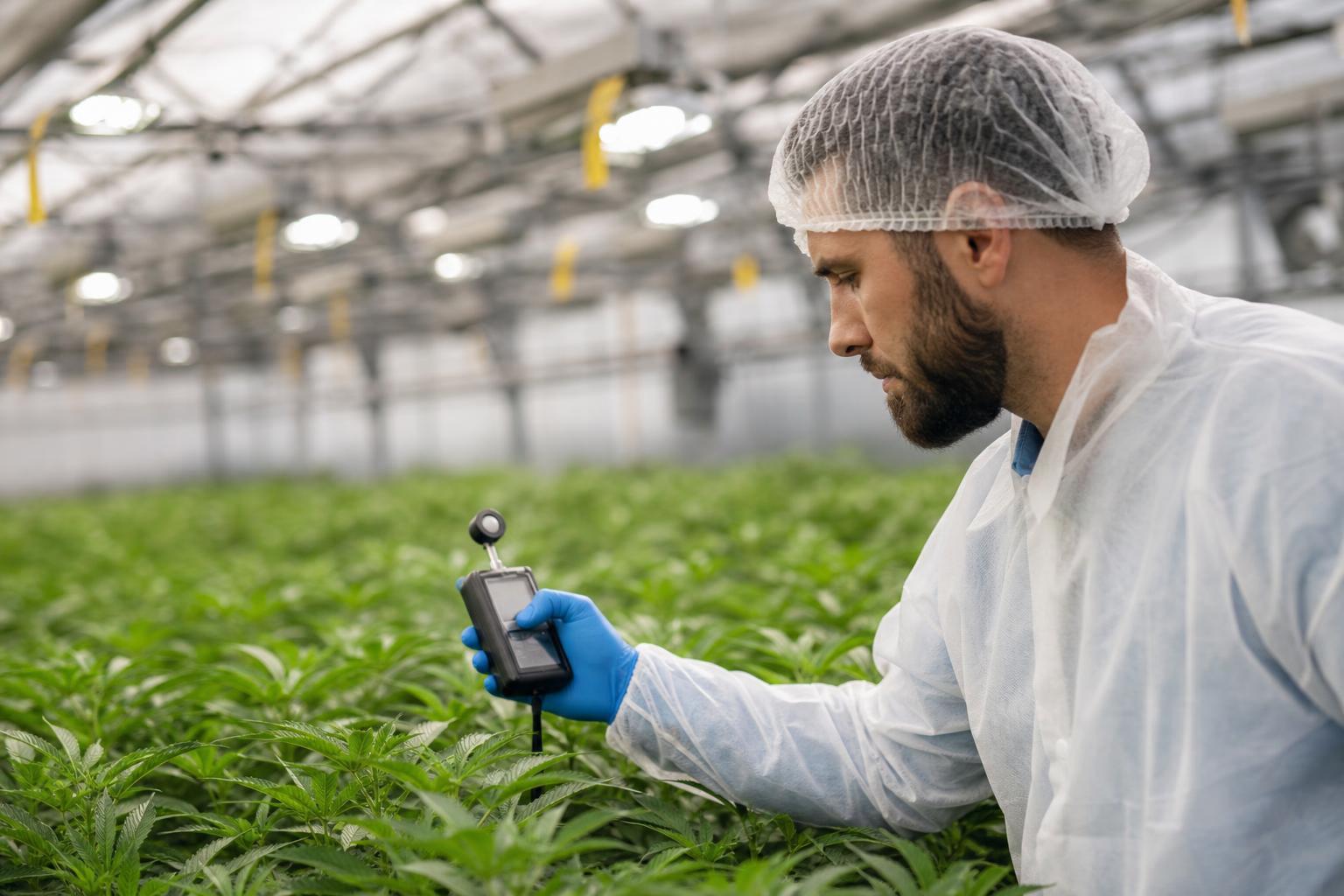
Practitioners on Reddit’s macrogrowery community emphasize measuring PPFD at canopy height in a grid pattern, then averaging all readings to calculate DLI source. They also recommend recording the minimum and maximum values (or standard deviation) to understand how much variation exists across the growing area.
A practical measurement approach:
- Set the lights to their operating intensity.
- Place the sensor at canopy height.
- Measure PPFD at a grid of points (9-point or 16-point depending on area size).
- Average all readings. That is the PPFD to use in the formula.
- Record min and max to evaluate uniformity.
- Re-map whenever fixture height, dimming level, plant height, or layout changes.
A center reading tells you the brightest point. Average canopy PPFD tells you what the crop is actually getting. For commercial operations, tight design-to-install PPFD variance means the calculated DLI closely matches real crop conditions across the entire growing area.
When the Simple Formula Works and When It Does Not
The simple DLI = PPFD × hours × 0.0036 formula works when PPFD is stable throughout the light period. Under constant electric lighting, a single average canopy PPFD measurement is a valid input. But when intensity changes during the day, the formula needs adjustment.
| Situation | One PPFD value works? | Reason |
|---|---|---|
| Constant electric light | Yes (if average canopy PPFD) | PPFD is stable during the photoperiod |
| Dimmable schedule | No | PPFD changes by time block; calculate each segment separately |
| Greenhouse (sun + LEDs) | No | Sunlight varies hour to hour and season to season |
| Outdoor / sunlight only | No | PPFD changes continuously through the day |
| Uneven canopy | Only with grid average | Center readings overstate actual DLI |
Light-measurement references explicitly warn that a single sunlight PPFD reading cannot estimate daily DLI because sunlight intensity changes throughout the day. One grower in a Reddit thread about natural-light plant measurements made the same practical point: “aim for X PPFD” does not apply cleanly to natural light because the sun rises and falls, and cloud cover can sharply reduce daily totals source.
For variable conditions, the accurate approach is:
DLI = Σ(PPFD × time interval in seconds) ÷ 1,000,000
That means measuring at regular intervals (every 30 to 60 minutes), multiplying each reading by the interval duration in seconds, summing the results, and dividing by 1,000,000 to convert to moles. A data logger or integrated sensor handles this automatically.
How to Calculate Supplemental DLI in a Greenhouse
In a greenhouse, calculating DLI from PPFD requires more than the basic formula because two light sources contribute: sunlight and fixtures. University Extension supplemental-lighting worksheets lay out a clear workflow for this:
- Set the crop DLI target. For lettuce, that might be 14 to 17 mol·m⁻²·d⁻¹. For tomatoes, 20 to 30.
- Estimate outside DLI using weather data, local DLI maps, or an outdoor sensor.
- Measure greenhouse transmission. Compare outdoor PPFD to indoor PPFD on a clear day. Greenhouses typically lose 30% to 50% of incoming light through glazing and structural shadows.
- Calculate inside sunlight DLI. Inside DLI = outside DLI × greenhouse transmission percentage.
- Find the DLI gap. Supplemental DLI needed = crop target DLI minus inside sunlight DLI.
- Calculate fixture runtime. Hours = supplemental DLI ÷ (average fixture PPFD × 0.0036).
Greenhouse worked example
A lettuce grower in the mid-Atlantic region targets 17 DLI. In January, the greenhouse receives about 8 DLI from sunlight at crop level after transmission losses. That leaves a 9 DLI deficit. The supplemental fixtures deliver 250 average PPFD at canopy height.
Hours needed: 9 ÷ (250 × 0.0036) = 10 hours of supplemental lighting.
This runtime changes month to month as natural light shifts. A grower recalculating monthly (or using a DLI controller) can avoid both under-lighting and wasted electricity. A horticulture lighting practitioner on LinkedIn warned against copying a blanket PPFD target from another region. The right process is to start with the crop DLI target, measure what reaches the canopy in the specific facility, and fill the gap.
For commercial greenhouse top lighting designed to fill seasonal DLI gaps, see the Altus 1K specifications.
DLI Targets by Crop
Crop DLI targets give you the number to aim for when calculating required PPFD or supplemental lighting hours. These ranges, drawn from university Extension crop references, should be treated as starting points rather than rigid prescriptions.
| Crop / Stage | General DLI Range (mol·m⁻²·d⁻¹) |
|---|---|
| Seedlings | 5 to 10 |
| Cuttings | 5 to 10 |
| Microgreens | 9 to 12 |
| Lettuce | 12 to 17 |
| Spinach | 14 to 20 |
| Parsley | 10 to 15 |
| Cilantro | 15 to 20 |
| Basil | 15 to 25 |
| Tomato | 20 to 30 |
| Cucumber | 20 to 30 |
The right DLI depends on crop type, growth stage, cultivar, temperature, CO2 levels, and production goals. Extension guidance explicitly notes that economic considerations are part of DLI management. A grower pushing 30 DLI on lettuce is probably buying photons that do not pay back.
For cannabis, DLI targets are highly cultivar- and environment-specific. Published research shows significant variation in yield response across different lighting treatments and genetics. A detailed breakdown of cannabis DLI by growth stage covers the nuances.
Higher DLI targets interact with CO2 supplementation, temperature management, and nutrition. If you push DLI significantly above baseline, the rest of the growing environment needs to keep up. For more on that relationship, read about the role of CO2 in CEA.
What DLI Means for Commercial Lighting Decisions
DLI is not just a plant biology number. It is a planning and economics metric. In indoor farms and growth chambers, nearly all crop light comes from fixtures, which means the DLI target ties directly to electricity consumption. Recent vertical-farm research estimates that artificial lighting accounts for roughly 20% to 40% of total operating costs, depending on electricity price and system efficiency.
Three levers control DLI in any facility:
- Intensity. Raise or lower PPFD by adjusting fixtures or dimming.
- Duration. Extend or shorten photoperiod (where crop biology allows).
- Distribution. Improve fixture layout and uniformity so the average PPFD is meaningful and low spots are not dragging crop performance down.
The same DLI can often be reached with higher PPFD for fewer hours or lower PPFD for more hours. Research into photoperiod strategies for leafy greens has shown that increasing DLI by extending photoperiod can sometimes produce more growth than increasing DLI by raising intensity, with better light-use and energy-use efficiency. That is not universally true though. Photoperiod-sensitive crops, flowering responses, blackout requirements, and electricity tariffs all shape the best approach for a given operation.
An Extension specialist on LinkedIn noted that tracking average DLI is a reliable way to keep greenhouse crops on schedule, and that the real challenge is balancing quality, growth rate, and cost. The right DLI is not always the highest DLI. It is the one that meets the production target at an acceptable cost.
For large facilities where fixture count, driver heat, and installation complexity add up fast, centralized power systems simplify the electrical design and reduce the heat load above the canopy.
Common DLI Calculation Mistakes
1. Using center PPFD instead of average canopy PPFD. The center of the fixture footprint is always the brightest. Using that number overstates DLI for most of the growing area. Measure a grid and average the results.
2. Using one sunlight reading for the whole day. Sunlight PPFD changes hour by hour. A noon reading may be three to five times higher than morning or late afternoon. Use multiple measurements or a data logger.
3. Mixing lux, lumens, or watts with PPFD. These units measure different things. Watts describe electrical input. Lumens describe human brightness perception. PPFD and DLI describe photon delivery for photosynthesis. Understanding this distinction is critical when comparing grow light technologies.
4. Forgetting photoperiod. Two identical PPFD readings produce very different DLIs depending on how long the lights run. Always include hours in the calculation.
5. Treating DLI targets as universal rules. Extension guidance says DLI depends on crop, stage, cultivar, environment, and economics. A target range is a starting point, not a recipe.
6. Mixing PAR and ePAR measurements. Standard DLI calculations use conventional PAR (400 to 700 nm). Some newer research discusses extended PAR, or ePAR (400 to 750 nm), which includes far-red. If a meter or fixture spec uses ePAR, the numbers are not directly comparable with standard PAR-based crop targets. Keep the measurement basis consistent throughout the calculation.
Frequently Asked Questions
What is the formula for DLI from PPFD?
DLI = PPFD × light hours per day × 0.0036. The constant 0.0036 converts micromoles per second into moles per day. Use average canopy PPFD for the most accurate result.
What is 400 PPFD for 18 hours in DLI?
400 × 18 × 0.0036 = 25.92 mol·m⁻²·d⁻¹.
What PPFD do I need for 20 DLI over 16 hours?
20 ÷ (16 × 0.0036) = 347 PPFD average at canopy height.
Can I calculate DLI from sunlight with one PPFD reading?
Not reliably. Sunlight intensity changes throughout the day, so a single reading cannot represent the daily total. Use multiple readings at regular intervals, a data logger, or regional DLI maps to estimate sunlight contribution.
Should I use the highest PPFD reading from my light map?
No. Use the average of all readings taken across the canopy at crop height. The highest reading describes the best-case spot, not what the crop as a whole receives.
Is DLI more important than PPFD?
DLI is better for understanding the total daily light dose a crop receives. But PPFD still matters because excessively high instantaneous intensity can cause photoinhibition or heat stress, and because PPFD uniformity across the canopy determines whether the average DLI is meaningful.
Does increasing DLI always increase yield?
Not always. There is a point of diminishing returns for every crop, beyond which additional light does not translate into proportional yield or quality gains. The economically optimal DLI balances plant performance, energy cost, and production targets.
How do I measure PPFD without an expensive sensor?
Phone-based light meter apps provide rough PPFD estimates for hobby growers. For commercial decisions where lighting design and runtime calculations affect crop outcomes and energy budgets, a calibrated quantum sensor (ranging from under $100 to over $1,000) provides the accuracy the math requires.
Once you know the target DLI and the required average canopy PPFD, the next step is a fixture layout that delivers those numbers uniformly. For commercial greenhouse, cannabis, and vertical-farm applications, the Pinnacle series covers a range of power classes designed for consistent PPFD across the canopy at scale.