Greenhouse Photoperiod Lighting: 2026 Grower's Guide
Master greenhouse photoperiod lighting to control flowering, DLI, and schedules. Learn NI, day-extension, blackout, and LED tips. Get the 2026 guide.
TL;DR
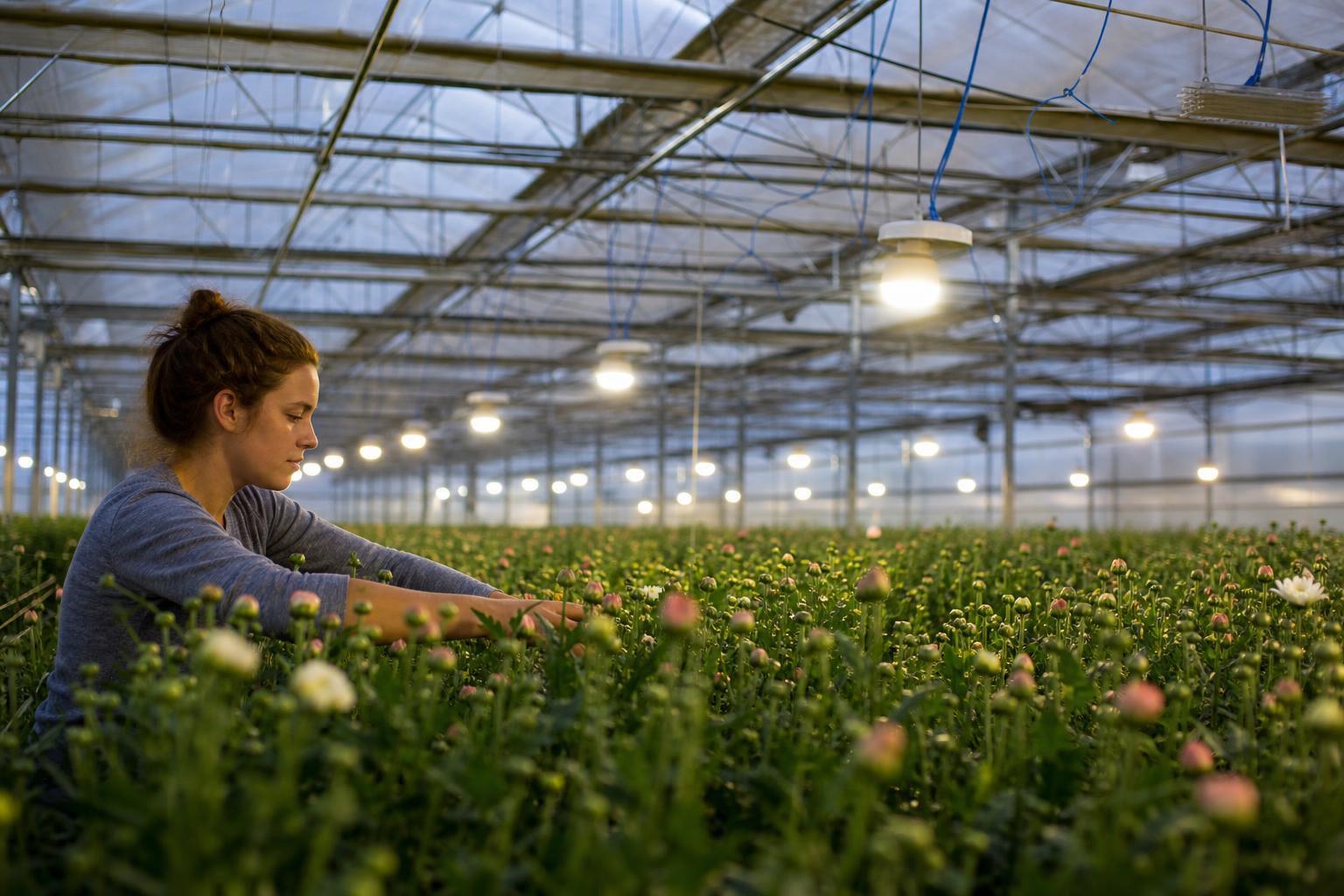
Greenhouse photoperiod lighting uses low-intensity electric light to artificially lengthen or interrupt the natural day, controlling when plants flower. Plants actually measure uninterrupted darkness, not light hours, which is why even a brief night interruption can prevent or trigger flowering. Photoperiod lighting operates at just 1 to 2 µmol·m⁻²·s⁻¹ and should not be confused with high-intensity supplemental lighting designed to drive photosynthesis. This guide covers the science, strategies, and practical application across ornamental, produce, and cannabis crops.
What Is Greenhouse Photoperiod Lighting?
Greenhouse photoperiod lighting is the use of low-intensity electric light to artificially extend, shorten, or interrupt the natural daylength inside a greenhouse, with the goal of controlling plant developmental responses, primarily flowering. A photoperiod is simply the duration of light within a 24-hour cycle. A 16-hour photoperiod means 16 hours of light and 8 hours of darkness. An 8-hour photoperiod means 8 hours of light and 16 hours of darkness.
Here is the single most important concept to understand: plants do not measure how many hours of light they receive. They measure the length of uninterrupted darkness. University of Massachusetts extension research confirms that it is actually the uninterrupted dark period that governs flowering responses. This is why a four-hour light break in the middle of the night can completely override the effect of a long dark period, even though the total light hours barely change.
Understanding this distinction matters for every grower who needs to hit precise bloom windows, prevent premature bolting, or trigger flower initiation on schedule.
Talk to a lighting specialist about your greenhouse photoperiod strategy.
Photoperiod Lighting vs. Supplemental Lighting: The Critical Distinction
This is the most common source of confusion in greenhouse lighting, and researchers at Purdue and Michigan State University have flagged it repeatedly. Photoperiod lighting and supplemental lighting serve completely different purposes, operate at different intensities, and produce different outcomes.
Photoperiod Lighting | Supplemental Lighting | |
|---|---|---|
Purpose | Control flowering timing | Increase photosynthesis and growth |
Intensity | 1 to 2 µmol·m⁻²·s⁻¹ (~10 foot-candles) | 50 to 75+ µmol·m⁻²·s⁻¹ |
Effect on growth | None, the light is too dim for photosynthesis | Directly increases dry weight and yield |
Effect on flowering | Accelerates or inhibits flowering depending on crop type | No direct effect on flowering timing |
Typical use case | Extending day or interrupting night for long-day crops; combined with blackout for short-day crops | Boosting daily light integral during cloudy weather or short winter days |
The GPN distinction between photoperiodic and photosynthetic lighting puts it plainly: photoperiodic lighting delivers light “bright enough for plants to perceive but not enough for photosynthesis.” It controls the calendar. It does not feed the plant.
Many growers, especially those new to greenhouse production, assume that turning on any light in the greenhouse counts as “photoperiod lighting.” It does not. A high-intensity supplemental lighting system running during the day adds photosynthetic energy but has nothing to do with photoperiod control unless it also extends the hours of light beyond the natural day.
The confusion becomes costly when a grower installs supplemental lights for growth but neglects photoperiod management, then wonders why their short-day crop won’t flower or their long-day crop bolts prematurely.
How Plants Respond to Daylength
Plant Classification by Photoperiod Response
Plants fall into three categories based on how they respond to daylength:
Long-day plants (LDP) flower when the dark period is shorter than a critical length. In practical terms, they flower when days are long (or when photoperiod lighting extends the perceived day). Common examples include spinach, lettuce, arugula, dill, cilantro, oregano, and peppermint. For lettuce growers, controlling photoperiod matters because long days trigger bolting, which makes the crop unmarketable.
Short-day plants (SDP) flower when the dark period exceeds a critical length. They need long, uninterrupted nights. Chrysanthemums, poinsettias, marigolds, and cannabis are all short-day plants. So are some basil cultivars and peppers.
Day-neutral plants (DNP) flower regardless of daylength. Tomatoes and most cucumber varieties fall into this group, though even day-neutral crops can show photoperiod effects on vegetative growth.
Obligate vs. Facultative Responses
Within the long-day and short-day categories, there is a further split. Obligate (qualitative) plants absolutely require the correct photoperiod to flower. Without it, they simply will not bloom. Facultative (quantitative) plants will eventually flower under any photoperiod, but the correct daylength accelerates flowering significantly. The distinction matters for scheduling. An obligate short-day crop like poinsettia will not flower at all without sufficiently long nights, while a facultative long-day crop may flower slowly under short days but much faster with photoperiod lighting extending the day.
The Phytochrome Mechanism
The biological machinery behind all of this is a photoreceptor protein called phytochrome. It exists in two interconvertible forms: Pr (which absorbs red light around 630 to 660 nm) and Pfr (which absorbs far-red light around 730 to 760 nm). When red light hits Pr, it converts to Pfr. When far-red light hits Pfr, it converts back to Pr. Pfr also slowly reverts to Pr on its own during darkness, a process called dark reversion.
This dark reversion is the plant’s clock. During a long night, Pfr levels gradually drop as the protein reverts to Pr. When Pfr drops below a threshold, the plant “knows” the night has been long enough and triggers a signaling cascade. A mobile protein called florigen travels to the shoot apex and initiates flowering.
The practical takeaway: a burst of red light in the middle of the night instantly converts Pr back to Pfr, resetting the clock. That is why night-interruption lighting works, and why even a brief light leak in a greenhouse can prevent short-day crops from flowering.
Photoperiod also controls more than flowering. Research documents its effects on internode elongation, tuber and bulb formation, anthocyanin pigment production, sex expression, leaf fall, and dormancy. Understanding the full scope of how light spectra affect plant growth helps growers manage these secondary effects alongside bloom timing.
The Four Main Photoperiod Lighting Strategies
Day-Extension Lighting
Day-extension lighting is the simplest approach. Lights come on before sunrise or stay on after sunset, extending the perceived photoperiod to a target length. Since critical photoperiods vary by crop, most growers aim for 16 hours of total light as a safe long-day target for the majority of greenhouse crops.
This method works well when the natural day is only slightly too short. In northern latitudes during early spring or late fall, an hour or two of day-extension lighting in the evening is often enough to keep long-day crops flowering on schedule.
Night-Interruption Lighting
Night-interruption (NI) lighting is the most effective method for creating a long-day response. Instead of extending the day at either end, lights turn on in the middle of the night, typically from 10:00 PM to 2:00 AM, splitting the dark period into two shorter segments.
Why is this more effective than day extension? Because the plant’s phytochrome clock measures the longest uninterrupted dark period. Splitting a 14-hour night into two 5-hour segments (with a 4-hour light break) is more reliably perceived as a “short night” than adding the same 4 hours to the end of the day. Purdue and MSU extension research consistently recommends night interruption as the gold standard for long-day photoperiod control.
Cyclic (Intermittent) Lighting
Cyclic lighting saves energy by pulsing lights during the night-interruption window rather than running them continuously. The standard protocol is 10 minutes on, 20 minutes off, repeated throughout a 4-hour window. This cuts energy use for photoperiod lighting by roughly two-thirds compared to continuous night interruption.
There is a catch. For crops that are especially sensitive to far-red light, continuous night interruption with a red-plus-far-red source can be more effective than cyclic lighting. Some research shows flowering is fastest when the night break includes far-red wavelengths delivered continuously for the full four hours. Growers who switch to cyclic lighting should trial it on their specific cultivars before scaling up.
For operations focused on reducing operating expenses, cyclic lighting represents a meaningful savings on an already low-cost input.
Blackout Cloth (Shortening the Photoperiod)
When natural days are too long and the goal is to induce flowering in short-day plants, the only option is to physically block light. Opaque blackout cloth (also called black cloth or blackout curtains) is pulled over the crop to create an artificially long dark period.
This is standard practice for poinsettia and chrysanthemum growers who need to time holiday blooms. It is equally critical for greenhouse cannabis production, where flower initiation depends on receiving more than 12 hours of uninterrupted darkness.
Blackout systems are not just about blocking sunlight. They must also block stray electric light from neighboring bays, security lighting, street lights, and even moonlight in some sensitive crops. A pinhole leak can reset the phytochrome clock and delay flowering by weeks.
Greenhouse Photoperiod Lighting for Cannabis
Cannabis (with the exception of autoflowering varieties derived from Cannabis ruderalis) is an obligate short-day plant. It requires long, uninterrupted dark periods to initiate flowering. This makes photoperiod management the central control mechanism for cannabis greenhouse production.
The Standard Protocol
The conventional approach uses two photoperiod regimes:
Vegetative growth: 18 hours of light, 6 hours of darkness (18/6). This long day prevents flowering and encourages vegetative development.
Flower initiation: 12 hours of light, 12 hours of darkness (12/12). This signals the plant that “winter is coming” and triggers the reproductive phase.
Growers consistently report that even small deviations from the dark period can cause problems. If photoperiod plants don’t receive the required hours of undisturbed darkness, they can revert to vegetative growth, display hermaphroditic traits, produce inferior yields, or fail to flower altogether. Light leaks are the number one enemy of greenhouse cannabis flowering.
Beyond 12/12: Emerging Flexibility
Recent research from Greenhouse Grower suggests that most modern cultivars will flower reliably under 13.5 hours of light after the initial trigger. The recommended approach is to use a strict 12/12 photoperiod for the first six to eight days to ensure a complete flowering response, then shift to 13.5 hours of light for the remainder of the flower cycle.
This matters economically. Cannabis is a light-hungry crop with a proposed DLI target of 40 to 50 mol·m⁻²·d⁻¹. Every additional 1.5 hours of light per day at high intensity adds meaningful photosynthetic energy, translating to more dry weight without compromising flower quality. For greenhouse operators already investing in supplemental lighting infrastructure, this extra DLI comes at minimal incremental cost.
The Integrated System
Cannabis greenhouse photoperiod management requires both lighting and blackout systems working together. During vegetative hold, high-intensity supplemental lights extend the natural photoperiod to 18 hours. When it is time to flip to flower, blackout curtains enforce the dark period while supplemental lights maintain high PPFD during the shortened light window. Understanding how cannabis flower room lighting interacts with photoperiod decisions is essential for optimizing both yield and timing.
The Altus 1K greenhouse top light is designed for this kind of dual-purpose greenhouse deployment, where high supplemental output during the day can be paired with photoperiod management strategies.
Spectrum and Intensity Requirements for Photoperiod Control
Not all light is equal when it comes to photoperiod responses. The type of light matters as much as the amount.
Intensity Thresholds
Photoperiod lighting needs to deliver only 1 to 2 µmol·m⁻²·s⁻¹ at plant level, roughly 10 foot-candles. This is barely perceptible to the human eye but sufficient for the phytochrome system to detect.
Blue light is the exception. Research from Michigan State University (Meng and Runkle) found that blue wavelengths require approximately 30 µmol·m⁻²·s⁻¹ to produce a comparable photoperiodic response, about 15 to 30 times more than red or far-red light. This is why blue-heavy light sources are poor choices for dedicated photoperiod fixtures.
Red and Far-Red: The Key Wavelengths
The phytochrome system responds most strongly to red light (peak around 630 to 660 nm) and far-red light (peak around 730 to 760 nm). Their effects differ by crop type:
For long-day plants: A combination of red and far-red light at low intensity is the most effective at promoting flowering. The far-red component rapidly converts Pfr back to Pr, and the interplay between the two forms drives the long-day response.
For short-day plants: Red light alone is primarily responsible for inhibiting flowering. A burst of red light during the dark period converts Pr to Pfr, effectively resetting the dark-period timer.
Green Light Is Not a Safe Light
An older assumption held that green light was invisible to the phytochrome system and could be used as a “safe” work light during dark periods without affecting photoperiod. MSU research has shown this is not reliably true. Green light can affect flowering in some crops, especially at higher intensities. Growers who need to enter blackout zones during dark periods should minimize all light exposure, green included.
LED Technology for Modern Photoperiod Management
Greenhouse growers have historically used incandescent bulbs, compact fluorescents, and high-pressure sodium lamps for photoperiod lighting. LEDs have changed the calculus.
Why LEDs Are Now the Standard
LEDs offer several advantages for photoperiod duty. Their energy efficiency is substantially higher than incandescent bulbs (which waste most of their input as heat). They last far longer, with commercial horticultural LEDs rated for 40,000 hours or more. They can target specific wavelengths, meaning a fixture can deliver the ideal red-to-far-red ratio for photoperiod control without wasting energy on wavelengths that don’t contribute. And they can be dimmed, which allows a single fixture to serve both high-intensity supplemental and low-intensity photoperiod roles at different times of day.
Full-spectrum white LEDs are particularly well suited because they naturally include both the red and far-red wavelengths the phytochrome system requires. This contrasts with older “pink” or narrow-band fixtures that may lack far-red entirely.
For growers considering an upgrade from legacy fixtures, a guide on transitioning to LED grow lighting covers the practical steps and common pitfalls.
A Common and Costly Mistake
One practical warning that Michigan State University researchers have documented but few ranking pages mention: commodity LED screw-in bulbs designed for home or office use are not built for greenhouse conditions. High humidity, condensation, and temperature swings cause moisture to penetrate the lamp housing, leading to electrical failure and potential safety hazards. MSU extension documentation includes photos of household LED lamps with visible water accumulation inside the bulb after greenhouse use.
Commercial horticultural LED fixtures carry appropriate environmental protection ratings (IP65 or higher) and are UL listed for wet or damp locations. Cutting corners on fixture selection for what seems like a “low-stakes” photoperiod application can create real problems in a matter of months.
When Supplemental Fixtures Pull Double Duty
In modern greenhouse operations, the line between photoperiod and supplemental fixtures is blurring. A high-output LED top light running at full power during the day provides supplemental photosynthetic light. The same fixture, dimmed to minimal output and running for an additional two hours after sunset, provides day-extension photoperiod lighting. This dual-use approach reduces the total fixture count and simplifies the lighting infrastructure.
The key is selecting fixtures that dim smoothly to very low output levels and deliver the right spectrum even at reduced power. Understanding the comparison between LEDs and HPS helps growers evaluate whether their existing infrastructure can handle both roles.
DLI, Photoperiod Length, and Economic Efficiency
Photoperiod decisions do not exist in isolation. The length of the photoperiod directly affects the daily light integral a crop receives, which in turn affects yield and quality.
The Extended Photoperiod Advantage
Research published in HortScience found that for lettuce, extending the supplemental lighting photoperiod from 12 to 21 hours (at proportionally lower PPFD to maintain the same DLI) increased both plant dry weight and energy conversion efficiency. In other words, delivering the same total daily light over more hours at lower intensity produced better growth than delivering it in a shorter, higher-intensity burst.
This makes economic sense too. A longer photoperiod at lower intensity requires fewer fixtures to achieve the same DLI, reducing capital costs. Energy consumption can be similar or lower because the fixtures run at more efficient operating points.
The Upper Limit
There is a ceiling. Research on greenhouse tomatoes has shown that extending the photoperiod beyond 17 hours can cause leaf chlorosis, reduced leaf growth, and diminished plant vigor. Practitioners on horticultural forums report similar findings with other fruiting crops. The sweet spot for most greenhouse operations appears to be 16 to 18 hours, depending on the crop’s tolerance.
For day-neutral crops like tomatoes, the extended photoperiod strategy is purely about DLI optimization since there is no flowering response to manage. For photoperiod-sensitive crops, the grower must balance DLI gains against the risk of triggering unwanted flowering or bolting.
Common Grower Mistakes with Greenhouse Photoperiod Lighting
Confusing photoperiod and supplemental lighting. This has been covered in detail above, but it bears repeating. They are different tools that solve different problems.
Inadequate blackout coverage. Even small light leaks, from gaps in curtain seams, pinholes, or adjacent greenhouse bays, can prevent short-day crops from flowering. Cannabis growers in particular report on forums that light leak troubleshooting is one of the most frustrating and time-consuming aspects of greenhouse flower production.
Using household LED bulbs. They fail in greenhouse environments. Moisture ingress, corrosion, and electrical shorts are predictable outcomes.
Ignoring far-red in the light source. Switching from incandescent (which naturally emits significant far-red) to an LED source that lacks far-red can slow flowering in long-day crops. The phytochrome system needs both red and far-red wavelengths for optimal long-day promotion.
Assuming all crops respond the same way. An 18/6 photoperiod that keeps cannabis in vegetative growth will cause spinach to bolt. Photoperiod strategies must be crop-specific.
Neglecting the interaction between photoperiod and HVAC. Extending the photoperiod with supplemental lights adds heat to the greenhouse during hours when the heating system may already be running or the cooling system is off. The thermal and humidity implications of nighttime or late-evening lighting should be factored into climate control planning.
Related Terms
Daily Light Integral (DLI): The total amount of photosynthetically active light a plant receives in a 24-hour period, measured in mol·m⁻²·d⁻¹. Photoperiod length directly affects DLI.
PPFD (Photosynthetic Photon Flux Density): The instantaneous intensity of photosynthetically active light, measured in µmol·m⁻²·s⁻¹. Photoperiod lighting operates at extremely low PPFD compared to supplemental lighting.
Supplemental Lighting: High-intensity electric lighting used to increase DLI and drive photosynthesis. Not the same as photoperiod lighting.
Blackout Cloth: Opaque material used to block light and create artificially short days for short-day plant flowering.
Phytochrome: The photoreceptor protein that senses red and far-red light and serves as the plant’s molecular timer for dark-period measurement.
Critical Photoperiod: The specific daylength threshold above or below which a plant’s flowering response is triggered. Varies by species and cultivar.
For deeper technical resources, explore the available technical whitepapers on greenhouse lighting.
Frequently Asked Questions
What intensity does greenhouse photoperiod lighting need to be?
Very low. Research from multiple university extension programs confirms that 1 to 2 µmol·m⁻²·s⁻¹ (approximately 10 foot-candles) at plant level is sufficient for the phytochrome system to detect light and register a long-day signal. This is far below the 50 to 75+ µmol·m⁻²·s⁻¹ required for supplemental photosynthetic lighting.
Does photoperiod lighting increase plant growth?
No. At 1 to 2 µmol·m⁻²·s⁻¹, the light is too dim to contribute to photosynthesis. Photoperiod lighting controls developmental timing (flowering, dormancy, elongation) but does not add measurable biomass. Growth increases require supplemental lighting at much higher intensities.
What is the best photoperiod lighting strategy for most greenhouse crops?
Night-interruption lighting from 10:00 PM to 2:00 AM is consistently identified as the most effective method for creating a long-day response. It splits the dark period into two short segments, which the plant perceives as short nights, triggering the long-day flowering pathway.
Can I use the same LED fixtures for both supplemental and photoperiod lighting?
Yes, if the fixtures are dimmable and deliver appropriate red and far-red wavelengths. A high-output LED top light can run at full intensity during the day for supplemental photosynthesis, then dim to minimal output for day-extension or night-interruption duty. This dual-use approach is becoming standard in modern commercial greenhouses.
Why does my short-day crop refuse to flower in the greenhouse?
The most common cause is light leaks during the dark period. Even brief, low-level light exposure from adjacent bays, security lights, street lights, or gaps in blackout curtains can reset the phytochrome clock and prevent the plant from accumulating enough dark hours to trigger flowering. Inspect the blackout system thoroughly, preferably from inside the covered area at night.
Is 12/12 always necessary for cannabis flowering?
For the initial trigger, yes, most growers use 12 hours of light and 12 hours of uninterrupted darkness. However, emerging research suggests that after six to eight days of strict 12/12, many modern cultivars will continue flowering under 13.5 hours of light. This allows growers to capture additional DLI during the flower cycle without compromising the flowering response.
Does green light affect the photoperiod response?
It can. The old assumption that green light is invisible to the phytochrome system has been challenged by MSU research showing that green wavelengths can affect flowering in some crops, especially at moderate to high intensities. Green “safe” work lights should be used cautiously in blackout environments, and exposure should be minimized.
How long can I extend the photoperiod before causing crop damage?
Research on greenhouse tomatoes suggests that photoperiods exceeding 17 hours can lead to leaf chlorosis and reduced vigor. Most crops perform well under 16 to 18 hours of total light. The optimal length depends on the specific crop, and growers should consult crop-specific guidelines before pushing beyond 16 hours.
Ready to design a photoperiod and supplemental lighting plan for your greenhouse? Schedule a free consultation with a lighting specialist.