Greenhouse Grow Light Height: 2026 Mounting Guide
Get greenhouse grow light height right with a 2026 guide to PPFD, uniformity, and mounting ranges (2–4 m). Avoid burn or stretch with crop tips.
TL;DR
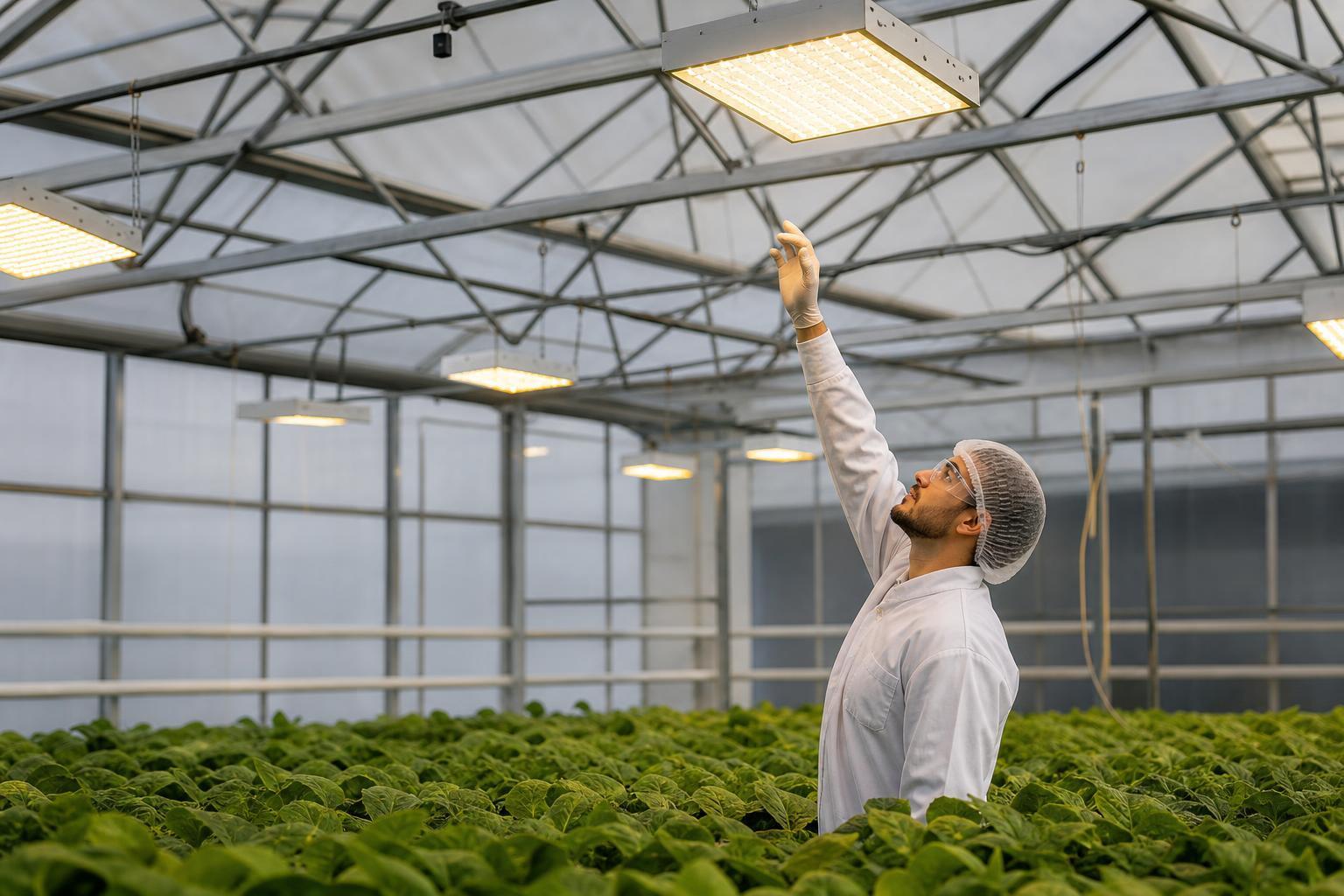
Greenhouse grow light height is the distance between a fixture’s light-emitting surface and the top of the plant canopy. In commercial greenhouses, supplemental top lights typically mount 2 to 4 meters (6.5 to 13 feet) above the crop. This single variable controls how much photosynthetically active radiation (PPFD) reaches your plants and how evenly that light spreads across the growing area. Getting it wrong causes either light burn or stretched, underperforming crops.
What Greenhouse Grow Light Height Means and Why It Matters
Greenhouse grow light height refers to the vertical distance between the light-emitting surface of a fixture and the top of the plant canopy below it. It is not the distance from fixture to floor, and it is not measured from the ceiling. The measurement that matters is fixture to canopy, and that distance changes as plants grow.
This measurement controls three things simultaneously. First, it determines PPFD (photosynthetic photon flux density) at the canopy, which is the amount of usable light your plants actually receive. Second, it determines how uniformly that light distributes across the growing area. Third, it determines whether plants experience stress from too much light or stretch from too little.
For growers planning a new installation or retrofit, getting light height right from the design phase prevents expensive corrections later.
The Physics: How Height Changes Light Intensity
Light intensity follows the inverse square law. Double the distance between fixture and canopy, and PPFD drops by roughly 75%, not 50%. This is the single most important concept behind greenhouse grow light height decisions.
That math explains why “just move the light up a few inches” can turn a light-burn problem into a stretching problem overnight. Small height changes compound fast.
There is a caveat. The pure inverse square law applies to point sources. Commercial greenhouse fixtures, especially large LED panels and bar arrays, are not point sources. Their beam angle, optic design, and physical size all modify how intensity changes with distance. Still, the directional trend holds: closer means more intense, farther means less intense.
The Height and Uniformity Trade-Off
This is where greenhouse grow light height gets genuinely tricky, and where many growers make mistakes.
Mounting a fixture lower delivers higher peak PPFD directly beneath it, but the coverage footprint shrinks. Plants in the center get far more light than plants at the edges. Raising the fixture spreads light more evenly across a wider area, but total intensity at the canopy drops.
For commercial operations, uniformity is measured using the coefficient of variation (CV): standard deviation of PPFD readings divided by mean PPFD, multiplied by 100. A CV below 15% is the accepted commercial threshold. Our detailed guide to greenhouse lighting uniformity covers how to measure and optimize this metric.
The practical takeaway: there is always a trade-off between intensity and evenness. The right greenhouse grow light height balances both for your specific crop and facility.
Typical Mounting Heights by Application
Mounting height varies dramatically depending on the growing environment. Confusing indoor grow-room numbers with commercial greenhouse numbers is a common and costly mistake.
Commercial Greenhouse Supplemental Lighting
Commercial greenhouse fixtures typically mount 2.0 to 4.0 meters (roughly 6.5 to 13 feet) above the crop canopy. This range accommodates fixtures from 200W to 1,050W and accounts for structural constraints like truss and gutter height. High-wattage fixtures like the Altus 1K are designed specifically for this mounting range, delivering target PPFD across wide canopy areas from greenhouse truss height.
HPS fixtures have traditionally been mounted higher than LEDs because they produce a wider beam spread. LEDs generate a more focused beam. Growers who switch from HPS to LED without recalculating their mounting height often find their crop receiving less PPFD than expected. The differences between the two technologies are significant, and there is a common mistake when comparing LEDs to HPS that directly affects height decisions.
Indoor and Controlled-Environment LED
In sealed grow rooms and smaller greenhouses using LED panels, the typical range is 30 to 60 cm (12 to 24 inches) above the canopy. Growers adjust within that range based on growth stage: higher for seedlings, closer for flowering. These distances assume the fixture is the sole light source, not supplemental.
Vertical Farm and Multi-Tier
Multi-tier setups run fixtures as close as 15 to 30 cm (6 to 12 inches) above the canopy. The key is using multiple bar-style fixtures evenly spaced so that each bar contributes a moderate, uniform amount of light rather than one intense hotspot. At 12 inches, each bar provides lower individual output that creates even PPFD across the entire growth cycle without the need for height adjustments. For growers interested in multi-tier configurations, our multi-tier grow lights guide covers fixture selection and spacing in detail.
Factors That Change the Right Height
No single number works for every greenhouse. Several variables interact to determine the correct grow light height for a specific operation.
Crop Type and DLI Targets
Different crops need different amounts of daily light. Lettuce targets roughly 17 mol/m²/day, tomatoes need about 35, and cannabis in flower can exceed 40. A crop with higher DLI requirements needs either closer fixtures, higher wattage, or longer photoperiods to hit its target. Understanding how to calculate DLI from PPFD is essential for dialing in the right mounting height.
Cannabis in flower is among the most light-hungry crops commercially grown in greenhouses. Because greenhouse structures absorb and reflect a portion of incoming sunlight, supplemental lighting is essentially mandatory for flowering cannabis in most regions.
Growth Stage
Seedlings and propagation material need lower PPFD, typically 100 to 300 µmol/m²/s. Vegetative growth calls for 300 to 600 µmol/m²/s. Flowering and fruiting crops often need 600 to 900+ µmol/m²/s. Adjusting greenhouse grow light height by stage (or adjusting dimmer settings, which we will get to) keeps plants in their optimal range throughout the production cycle.
Fixture Wattage, Optics, and Beam Angle
A 300W fixture and a 1,050W fixture at the same height will deliver very different PPFD at the canopy. Beam angle matters just as much: a narrow beam concentrates light into a smaller footprint, while a wide beam spreads it. There is no universal height recommendation that works across all fixtures. If a manufacturer will not publish a PPFD map at a defined hanging height, that is a red flag.
LED vs. HPS Heat Profile
LEDs produce substantially less radiant heat than HPS fixtures. Research has shown that young tomato plants grown under LED supplemental light had lower leaf temperature, higher stomatal density, and greater transpiration rates compared to plants under HPS. This lower heat output is the practical reason LEDs can be mounted closer to the canopy without thermal damage. In one comparative study, the reduced heat from LEDs allowed growers to fit four tiers of grow space where HPS could only support three.
The heat question also affects HVAC requirements, because less radiant heat at the canopy means less cooling demand regardless of mounting height.
Greenhouse Structural Constraints
Unlike indoor grow rooms, greenhouse mounting height is constrained by truss and gutter height. You cannot always mount fixtures at the theoretically optimal distance. This is why fixture selection, wattage, and optics must be matched to the structural realities of the greenhouse, not the other way around.
Signs of Incorrect Grow Light Height
Getting greenhouse grow light height wrong produces visible symptoms. Knowing what to look for prevents prolonged crop damage.
Too Close: Light Stress Symptoms
When fixtures are too close, the upper leaves closest to the light source show damage first. Symptoms include bleached or white patches on leaves, leaf curling (sometimes called “tacoing”), and photoinhibition where the plant’s photosynthetic machinery shuts down under excess light. Research has found that when LED fixtures were positioned closer than 8 inches from leaves, leaf temperatures exceeded 30°C and caused tissue damage. The ideal leaf temperature range for most crops is 20 to 28°C.
One important distinction: light burn and nutrient burn look different. Light burn creates bleached spots concentrated on the upper canopy leaves nearest the fixture. Nutrient burn starts at the tips and edges of older, lower leaves and causes browning or darkening, not bleaching.
Too Far: Light Deficiency Symptoms
When fixtures mount too far from the canopy, plants stretch toward the light source. Stems elongate and become thin and weak. Leaves turn pale or dull green. Flowering is poor or delayed. The plant is spending energy reaching for photons instead of building biomass.
A Practitioner Note on Canopy Penetration
Practitioners on growing forums point out something that PPFD readings at canopy height alone do not capture: even at the same top-of-canopy PPFD, light penetration into the lower canopy decreases as fixture height increases. For dense crops like cannabis or tomato, this means the lower leaves receive progressively less light as fixtures move higher. This is why adjusting top-light height alone sometimes cannot solve lower-canopy production problems.
How to Verify Your Grow Light Height
Trust but verify. Even well-designed lighting plans need field confirmation.
PPFD Mapping with a Quantum Sensor
Use a calibrated quantum sensor (PAR meter) to take PPFD readings at multiple points across the canopy. Measure at the center, edges, and corners of the growing area. Our guide to measuring PPFD in greenhouses walks through the process step by step.
What Good PPFD Maps Should Include
When evaluating fixture manufacturers, demand PPFD maps that disclose the test height, grid density and spacing, mapped area size, and the resulting average, minimum, and maximum values. Without that metadata, you cannot compare maps from different setups or verify whether a fixture will perform at your mounting height.
Recheck as Plants Grow
Here is what many growers forget: as plants grow taller, the distance between the canopy and the fixture shrinks. A greenhouse grow light height that was correct at transplant may be too close six weeks later. Build rechecking into your crop management routine, or use dimming controls to compensate.
When Height Is Not the Only Answer
Sometimes adjusting mounting height is not the best or only solution. Modern commercial lighting offers several alternatives.
Dimming Instead of Raising
Fixtures with 0-10V dimming capability let growers reduce intensity without changing physical height. This is often preferable because raising a fixture improves uniformity (wider spread) while dimming reduces intensity but preserves the existing uniformity pattern. As plants grow toward the fixture, dimming the output can maintain target PPFD without the labor and infrastructure hassle of physically repositioning lights.
Under-Canopy Lighting
For dense canopies where top light cannot penetrate to lower leaves, the answer is not always lowering the top fixture. Adding light within or below the canopy, using fixtures like the Boost XE, delivers photons directly where they are needed. This approach has shown yield gains that top-light adjustments alone cannot match, and the research supporting under-canopy lighting is now well established.
Remote Power Architecture
When LED drivers are relocated outside the grow space, the fixture itself produces less heat at the canopy plane. This can allow closer mounting without thermal stress to the crop. The reduction in canopy-level heat also reduces HVAC demand, which compounds the economic benefit. Thrive’s OptiDrive platform is built on this principle, moving the entire driver layer out of the growing environment.
Greenhouse Glazing Maintenance
A greenhouse that transmitted 70% of PAR when new might transmit only 55% three years later due to dirt, algae, and material degradation. Growers who sized their supplemental lighting based on new-glazing performance may be unknowingly under-delivering light. Annual cleaning and transmission checks affect how much supplemental light you actually need, which in turn affects whether your current greenhouse grow light height is still appropriate.
Quick Reference: Crop PPFD Targets and Mounting Context
| Crop | Target DLI (mol/m²/day) | Typical PPFD Range (µmol/m²/s) | Greenhouse Context |
|---|---|---|---|
| Lettuce | 15 to 20 | 150 to 300 | Lower supplemental need; fixtures can mount higher or dim more |
| Tomato | 35 to 40 | 400 to 600+ | High supplemental need; fixtures closer or at higher wattage |
| Cucumber | 25 to 30 | 300 to 500 | Moderate supplemental need |
| Cannabis (flower) | 35 to 45+ | 600 to 900+ | Highest supplemental demand; often requires both top and under-canopy light |
For crop-specific guidance, see our detailed lighting guides for tomatoes and lettuce.
Need help determining the right mounting height for your specific greenhouse and crop? Talk to a lighting specialist for a free consultation and facility-specific recommendations.
Frequently Asked Questions
How high should LED grow lights be in a greenhouse?
For commercial greenhouse supplemental lighting, LED fixtures typically mount 2 to 4 meters (6.5 to 13 feet) above the crop canopy, depending on fixture wattage and target PPFD. For small or hobby greenhouse LEDs, 30 to 90 cm (12 to 36 inches) is more common. The right height depends on your fixture’s output, beam angle, and the crop’s light requirements.
Does grow light height affect yield?
Yes. Grow light height directly controls the PPFD reaching your crop and how uniformly that light distributes across the canopy. Incorrect height leads to either light stress (reducing quality and causing damage) or light deficiency (reducing growth rate and yield). Getting the height right, or using dimming to compensate, is one of the most impactful adjustments a grower can make.
What happens if grow lights are too close to plants?
Fixtures mounted too close cause photoinhibition, leaf bleaching, curling, and scorching. These symptoms concentrate on the upper leaves nearest the light source. When leaf temperatures exceed 30°C due to proximity, tissue damage occurs. The risk is higher with HPS fixtures because of their greater radiant heat output compared to LEDs.
How do I know if my grow light is too far away?
Plants that do not receive enough light stretch toward the source, producing elongated stems and thin, weak growth. Leaves turn pale or dull green, and flowering is delayed or poor. If you see these symptoms primarily in the upper canopy (not just shaded lower leaves), your fixture is likely mounted too high or running at insufficient output.
Should I raise my grow light or dim it as plants grow?
Dimming is often the better choice. Raising a fixture changes both intensity and uniformity across the canopy. Dimming reduces intensity while preserving the existing light distribution pattern. Modern commercial fixtures with 0-10V dimming make this straightforward, and it eliminates the labor and structural challenges of physically repositioning fixtures.
How does the inverse square law apply to greenhouse grow lights?
The inverse square law states that doubling the distance between a light source and a surface reduces light intensity by roughly 75%. While real-world greenhouse fixtures do not behave exactly like point sources (their size, optics, and beam angle modify the relationship), the principle still holds directionally. Small changes in greenhouse grow light height produce outsized changes in PPFD at the canopy.
Do LED and HPS fixtures need different mounting heights?
Generally, yes. HPS fixtures produce more radiant heat and a wider beam spread, so they traditionally mount higher to avoid thermal damage and to distribute light broadly. LEDs produce less radiant heat and a more focused beam, allowing closer mounting. When switching from HPS to LED, recalculating the appropriate mounting height is critical to avoid under-delivering light to the crop.