Multi-Tier Grow Lights: 2026 Buying Guide & Setup Tips
Multi-Tier Grow Lights explained: uses, PPFD/DLI targets, PPE, uniformity, and setup for vertical racks and farms. Get expert tips to choose right.
TLDR
Multi-tier grow lights are LED horticultural fixtures designed for stacked crop layers in vertical farms, propagation racks, cannabis rooms, and research chambers. They deliver controlled light intensity (PPFD) to each shelf or rack level at close mounting distances, so growers can manage daily light dose (DLI), uniformity, heat, and crop consistency across every tier. Choosing the right multi-tier grow light depends on rack geometry, crop requirements, fixture efficacy, and power architecture, not wattage alone.
What Are Multi-Tier Grow Lights?
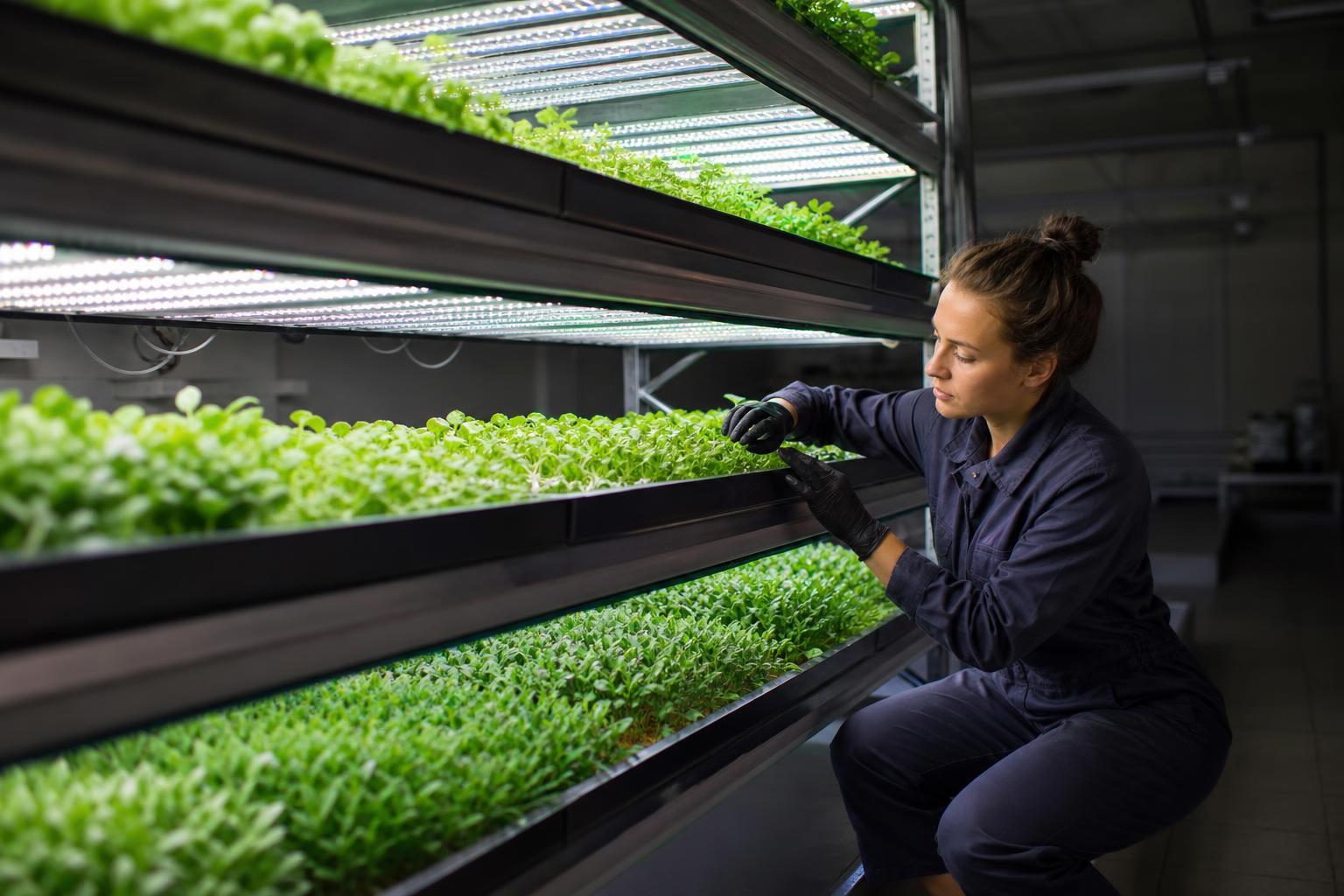
Multi-tier grow lights are LED grow lights built for stacked growing systems. Instead of lighting one canopy from high overhead, they deliver controlled photosynthetically active radiation to each shelf or rack level at close range.
Think of it this way: they are grow lights built for growing “up” in layers, not just “out” across one floor-level canopy.
You will also see these fixtures called vertical farm grow lights, multi-tier rack lights, rack-integrated LED grow lights, stacked grow lights, propagation rack lights, or multi-layer cultivation lights. The terms overlap, but they all describe the same core idea: per-tier light delivery in a stacked system.
For commercial operations evaluating fixtures for vertical racks or multi-tier flower rooms, the Strata HP is one example of a purpose-built multi-tier fixture designed for both flower and veg applications.
Why Multi-Tier Grow Lights Exist
Multi-tier cultivation increases canopy area without requiring the same increase in floor area. That is the whole point. But the lighting problem changes immediately when you stack crops.
One overhead fixture cannot evenly light multiple stacked shelves. Upper tiers block lower tiers. Light intensity changes with distance and geometry. Indoor vertical farms commonly place fixtures above each stacked shelf or integrate them into tower and wall systems, making lighting one of the highest operating costs and a primary driver of crop uniformity and facility power demand. Source: Virginia Tech
Practitioners on Reddit confirm this in practical terms. In one hydroponic tiered-system discussion, commenters observed that upper tiers received adequate light while lower tiers were weak, and they recommended bar-style lighting above each tier because tier spacing was too low for a single overhead source. That is one of the simplest real-world explanations for why multi-tier grow lights exist.
For commercial operators, this means multi-tier lighting is both a space-utilization tool and an energy-management tool. A fixture that works fine in a single-level room may fail in a rack system if it is too tall, too hot, uneven at close distance, hard to clean, or difficult to wire. Anyone looking to maximize grow room footage needs to plan the lighting tier by tier.
How Multi-Tier Grow Lights Work
Each tier in a stacked system gets its own light zone. The fixtures sit close to the canopy, typically inches to a few feet above the plants, and are designed to spread light evenly across the shelf width rather than projecting it from a great height.
Linear bars or low-profile modules are the most common form factor because they fit rack geometry. Tall fixtures steal plant height and reduce the number of usable tiers.
A few working principles define how these lights operate:
- Close-mounting optics. The beam must spread evenly at short distances. Poor beam spread at close range creates hotspots in the center and weak corners.
- Dimming and zoning. Different crops, growth stages, shelf heights, and cultivars need different light levels. Dimming lets growers dial intensity without swapping fixtures.
- Validation with measurement. The lighting plan should be verified with PPFD measurements at crop height, not assumed from spec sheets alone.
One CEA education resource explains that indoor vertical farm systems grow plants in a multi-layer arrangement where the shorter distance between lamps and plants allows the use of more fixtures with lower photon flux than the high-output fixtures mounted far above greenhouse canopies. Source: Hort Americas
Practitioners on Reddit reinforce this. In a thread about choosing lights, one user advised buyers to look at the PPFD chart for each fixture and verify the measurement distance before comparing claims. PPFD numbers without distance, area, and measurement grid are incomplete.
Why LEDs Dominate Multi-Tier Systems
The U.S. Department of Energy has noted that HID fixtures are generally too hot and too bright for close-proximity plant lighting in vertical farms, making LED the viable technology. LED lighting in vertical farms was estimated at about 15 W/ft², a 34% reduction in lighting power density versus older linear fluorescent systems. Source: DOE
Beyond power reduction, LEDs offer longer lifetime, tailored spectral output, tailored optical distribution, and dynamic controls. Those advantages matter more per fixture when you have hundreds or thousands of them across a multi-tier facility. For operations considering the switch from older technologies, a guide on transitioning to LED lighting covers the practical steps.
One important point: LEDs produce less radiant heat than HID at the canopy, but they still add heat to the room. Multi-tier cannabis operators report that vertical growing exacerbates microclimates and requires more environmental sensing at different heights and canopy zones. Source: Cannabis Business Times
Multi-Tier Grow Lights vs. Related Terms
The terminology around stacked lighting gets confusing. Here is how the main categories differ.
Multi-Tier vs. Vertical Grow Lights
These terms overlap but are not identical. Multi-tier grow lights usually refers to fixtures used on stacked racks or shelves. Vertical grow lights can also mean side-mounted lights for towers, living walls, or vertical plant structures. Practitioners on Reddit have noted this distinction: in a thread about a 5-foot indoor tower, commenters explained that one overhead light would adequately cover only the top plants and that many growers use vertical bar lights around towers instead.
Multi-Tier vs. Top Lights
Top lights are usually mounted above a single canopy or greenhouse bay. Multi-tier lights repeat fixture placement at each crop layer. The fixtures themselves can be similar, but the design challenge is different: managing uniformity, heat, and serviceability at every level rather than across one plane.
Multi-Tier vs. Under-Canopy Lights
Under-canopy lights supplement light below or within a dense canopy, usually in taller crops like cannabis. Multi-tier lights are the primary or stage-specific lights for each rack level. In a multi-tier cannabis room, both can exist simultaneously. For more on under-canopy approaches, there is a detailed guide on under-canopy lighting ROI.
Multi-Tier vs. “Rack Lights”
Rack lights is practical shorthand for multi-tier fixtures. It usually implies linear bars or modules mounted directly to a shelf, rolling rack, pallet rack, or aluminum extrusion.
Important Specs for Multi-Tier Grow Lights
Vendor spec sheets can be overwhelming. Here are the metrics that actually matter, explained in plain English.
PPFD (Photosynthetic Photon Flux Density)
PPFD measures the amount of plant-usable light reaching a specific area of canopy each second, in µmol/m²/s. For multi-tier systems, PPFD at the crop surface matters more than fixture wattage because each tier has its own canopy height, mounting distance, and edge conditions.
To understand the units behind PPFD, a primer on what a micromole means in grow lighting is helpful.
DLI (Daily Light Integral)
DLI is the total amount of photosynthetically active light a crop receives per square meter per day, measured in mol/m²/day. It is calculated from PPFD and photoperiod:
DLI = PPFD × photoperiod (hours) × 3,600 ÷ 1,000,000
DLI is the metric that actually predicts crop performance. Watts help estimate operating cost, but DLI helps estimate crop light dose. Source: Hort Americas
Useful DLI benchmarks from CEA education data:
| Crop | Minimum DLI (mol/m²/day) | Optimum DLI (mol/m²/day) |
|---|---|---|
| Lettuce | 12 | 17 |
| Strawberry | 17 | 20 |
| Cucumber | 15 | 30 |
| Tomato | 20 | 30 |
| Sweet pepper | 20 | 30 |
One warning: more light is not always better. Continuous DLI above 17 mol/m²/day for more than three days has been associated with lettuce tipburn in Cornell-related research summaries.
PPE (Photosynthetic Photon Efficacy)
PPE measures how efficiently a fixture turns electrical energy into plant-usable photons, in µmol/J. Higher PPE means more light per watt of electricity, which directly affects operating cost. The current DLC Horticultural Lighting V4.0 requirements set a minimum PPE threshold of 2.5 µmol/J for listed LED products. Source: DLC
Uniformity
Uniformity describes how evenly PPFD is distributed across the crop area. In multi-tier systems, this is a first-order design variable. Shelves have edges. Corners receive less light. Trays have gaps. Plant height changes during the crop cycle.
The Illuminating Engineering Society notes that a 1% increase in sustained PPFD can produce roughly a 1% increase in growth or yield (though the relationship varies by crop). A 10 to 20% light-intensity variation is often considered acceptable, while some plant factories target ±5% PPFD. IES modeling showed that a vertical farm tray at seedling height had 40% of canopy area within the desired ±5% range, and at a taller canopy height, that figure fell to just 21%. Source: IES
That means uniformity is not cosmetic. Uneven PPFD creates uneven crop size, color, morphology, harvest timing, and yield.
Spectrum
Spectrum affects morphology, coloration, quality, and crop steering. There is no single universal spectrum that works best for all crops. Spectrum is a crop-stage decision. For a deeper look, there is a summary of light spectra’s impact on plants.
IP Rating
IP ratings describe protection against dust and water ingress. Multi-tier systems commonly involve irrigation, humidity, nutrient solution handling, and sanitation sprays. Make sure the fixture’s IP rating matches the environment.
Lifetime and Warranty
DLC V4.0 requires Q90 of at least 36,000 hours (Q90 is the projected time before a light’s photon output falls to 90% of initial output), driver lifetime of at least 50,000 hours, and a fixture warranty of at least five years. It also requires horticultural safety certification to ANSI/UL 8800. These are minimum standards, so look for fixtures that meet or exceed them. More on this topic is covered in a guide on LED grow light reliability.
Where Multi-Tier Grow Lights Are Used
Multi-tier grow lights show up across a wide range of controlled-environment applications:
- Vertical farms growing leafy greens, herbs, microgreens, and strawberries
- Propagation and seedling production on multi-shelf racks
- Cannabis vegetative rooms with stacked canopy layers
- Multi-tier cannabis flower rooms designed to increase canopy per square foot
- Research growth chambers at universities and commercial R&D labs
- Hydroponic and aeroponic rack systems
- Tissue culture facilities
For leafy greens, microgreens, herbs, and vegetable production on racks, the Strata is a 30W bar designed specifically for these applications.
Trade interviews with commercial cannabis operators show that multi-tier LED rooms help use cubic footage, but they introduce operational complexity: wider aisles for access equipment, upper-tier labor, different plant spacing, microclimates, airflow variation, humidity and VPD control, sensor placement at multiple heights, and irrigation balancing across tiers.
How to Choose Multi-Tier Grow Lights: The G.L.A.S.S. Framework
Choosing multi-tier grow lights is a design problem, not just a shopping decision. The G.L.A.S.S. framework covers the five factors that determine whether a lighting system will actually perform across every rack tier.
G: Geometry
Define the physical system before selecting fixtures. Shelf width. Tier spacing. Maximum crop height. Fixture clearance. Tray layout. Aisle access. Irrigation and drainage paths.
The same fixture can perform differently at 6 inches, 12 inches, or 24 inches above the canopy. IES modeling confirms that canopy height changes during a crop cycle materially affect the uniformity of light reaching the plants. Choosing fixtures before defining rack spacing is a common and expensive mistake.
L: Light Dose
Work backward from crop DLI, then calculate the PPFD needed for your planned photoperiod. For example, a lettuce target of 12 to 17 mol/m²/day can be achieved with different PPFD and photoperiod combinations:
| DLI Target | PPFD at 16-hour photoperiod | PPFD at 18-hour photoperiod |
|---|---|---|
| 12 mol/m²/day | ~208 µmol/m²/s | ~185 µmol/m²/s |
| 17 mol/m²/day | ~295 µmol/m²/s | ~262 µmol/m²/s |
| 20 mol/m²/day | ~347 µmol/m²/s | ~309 µmol/m²/s |
| 30 mol/m²/day | ~521 µmol/m²/s | ~463 µmol/m²/s |
The right fixture is the one that delivers that target at canopy height with acceptable uniformity, not the one with the highest wattage. Practitioners in a Reddit hydroponics thread recommended choosing a strong enough dimmable light and measuring PPFD to dial in the correct intensity, rather than buying by wattage alone.
For cannabis specifically, trade-published grower interviews report commercial operators targeting 700 to 900 PPFD at the top of the canopy in vertical LED systems, adjusting fixture output and distance with PAR meters.
A: Airflow and Heat
Stacked racks multiply local heat and humidity zones. Upper racks tend to run warmer. Air movement can be restricted between tiers. Multi-tier cannabis grower interviews consistently point to the need for additional sensors at different heights and within trays.
Planning HVAC around stacked heat loads is not optional. A detailed look at climate control in vertical farming covers this topic further.
S: Spectrum and Steering
Spectrum affects plant morphology, coloration, flowering, and quality. But no single spectrum is universally best. Spectrum is a crop-stage decision, and the lighting system should support the light recipes your operation needs.
S: Serviceability and Safety
In a commercial rack system, hundreds or thousands of lights mean connectors, drivers, warranties, water protection, safety certification, and replacement labor all matter. DLC V4.0 requirements around PPE, Q90, driver life, warranty, power factor, THDi, and UL 8800 certification provide a useful baseline spec checklist.
Energy and Operating Cost Reality
Lighting is the dominant operating cost in vertical farming. A 2025 review of vertical farming found that energy costs are mainly tied to lighting, estimated at 42 to 80% of total energy costs, with climate control next at 16 to 43%. Total vertical farm energy use has been estimated at 400 to 1,260 kWh/m²/year. Source: Agronomy for Sustainable Development
The DOE estimated that vertical farms typically run lighting for about 18 hours per day, 365 days per year, or roughly 6,570 hours annually.
In a multi-tier facility, a small difference in fixture efficacy, uniformity, heat load, or controls compounds across every tier, every rack, and every crop cycle. A practitioner discussion on LinkedIn made this same point: grow-light selection affects yield, quality, energy cost, heat load, financial feasibility, and asset performance, and small efficiency differences become material across a multi-tier operation.
Common Mistakes
These are the errors that show up repeatedly in practitioner forums, trade interviews, and facility commissioning:
- Buying by wattage instead of PPFD and DLI. Wattage is electrical input. PPFD is what reaches the crop. PPE tells how efficiently watts become photons.
- Comparing PPFD charts without checking measurement distance. A chart measured at 6 inches tells you nothing about performance at 18 inches.
- Ignoring edge and corner uniformity. Center PPFD looks great on paper. Corners and edges are where crops suffer.
- Assuming one overhead light can serve multiple tiers. It almost never works. Each tier needs its own light zone.
- Forgetting that canopy height changes. A seedling tray and a mature lettuce head sit at different heights. The effective light field changes through the crop cycle.
- Underestimating heat differences between upper and lower tiers. Upper racks run warmer. Airflow is restricted. You need a plan for how to size HVAC for LEDs.
- Choosing fixtures before defining rack spacing. The rack dictates the fixture, not the other way around.
- Skipping commissioning with a PAR meter. A grid-style PPFD map at each tier, measured at actual canopy height, is the only way to verify that your lighting plan matches reality.
- Treating crop spectrum as universal. Different crops and growth stages have different spectral needs.
- Installing too many in-room drivers. In large facilities, hundreds of drivers above the canopy add heat, failure points, and maintenance complexity.
One Reddit user reported leggy seedlings under shelf lights in a tiered garden. The community’s replies focused on stronger lights, keeping them close, using appropriate photoperiods, and adding airflow. The takeaway: “a light on a shelf” is not automatically a multi-tier grow light system.
Commercial Design Note
In commercial multi-tier facilities, the lighting system includes more than fixtures. Drivers, cabling, control zones, heat sources, service access, and electrical infrastructure all affect reliability and operating cost.
Remote power architectures can move drivers out of the grow space, reducing in-room components, lowering heat above the canopy, and simplifying maintenance in large deployments. The OptiDrive platform is one example of this approach, centralizing power distribution outside the grow area while supporting fixtures across the full multi-tier product line.
For more on how centralized power changes the install and operating math, see the guide on horticulture power distribution.
Frequently Asked Questions
Are multi-tier grow lights the same as vertical grow lights?
Not exactly. The terms overlap, but multi-tier grow lights usually refers to fixtures for stacked racks or shelves where each level gets its own light zone. Vertical grow lights can also mean side-mounted lighting for towers or living walls.
What type of grow light is best for multi-tier racks?
Low-profile LED bars or modules with proven PPFD uniformity at close mounting heights. The fixture needs to fit the rack geometry and deliver even light across the full shelf width, not just the center.
How close should multi-tier grow lights be to plants?
It depends on fixture output, optics, crop stage, target PPFD, and heat. Use the manufacturer’s PPFD map at your specific mounting distance and verify with a PAR meter after installation.
What PPFD do multi-tier grow lights need to deliver?
Start with the crop’s DLI target and work backward using your photoperiod. For lettuce at a 16-hour photoperiod, a 12 to 17 mol/m²/day DLI target translates to roughly 208 to 295 µmol/m²/s average PPFD.
Can one light cover multiple tiers?
Usually no. Each tier normally needs its own light zone because shelves and crops block light from reaching lower layers.
Do LEDs eliminate heat problems in multi-tier systems?
No. LEDs reduce close-range radiant heat compared with HID, but they still add heat to the room. Stacked racks can create tier-by-tier microclimates that require environmental sensing and airflow planning at each level.
What matters more, spectrum or uniformity?
Both matter, but for multi-tier production, poor uniformity can create uneven crops even if the spectrum is suitable. Uniformity is the more common failure point in rack systems.
Are multi-tier grow lights only for vertical farms?
No. They are also used for propagation, cannabis veg and flower, microgreens, research growth chambers, and stacked hydroponic systems.
Planning a multi-tier lighting project or need help sizing fixtures to your rack layout? Talk with a lighting expert to get a consultation and lighting design tailored to your facility.