Horticulture Lighting Power Distribution: 2026 Guide
Horticulture lighting power distribution explained—costs, HVAC load, reliability, and NEC/GFCI. Compare distributed, centralized DC, and low-voltage.
TL;DR
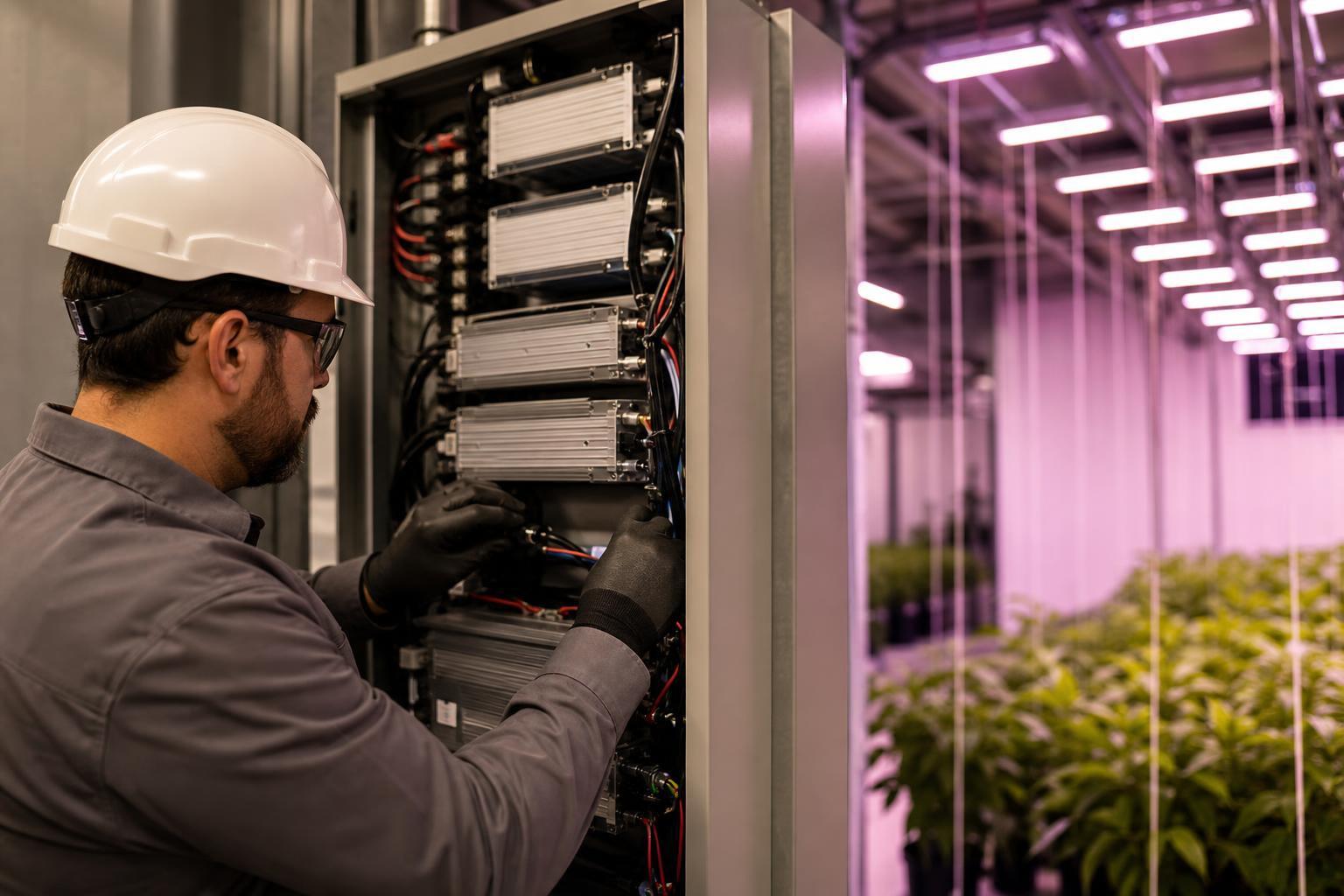
Horticulture lighting power distribution is the electrical architecture that delivers power from a facility’s utility service to LED grow-light fixtures. Three main approaches exist: distributed (one driver per fixture), centralized DC (remote rack-mounted drivers), and fault-managed low-voltage distribution. Choosing the right architecture affects installation cost, HVAC load, fixture reliability, and NEC code compliance, making it one of the most consequential infrastructure decisions in any commercial grow facility.
Power distribution is not a fixture decision. It is an infrastructure decision, and it is one of the most expensive ones a commercial grower will make. The cost of running power to lights can account for up to 50% of the capital required to build an indoor farm. Yet most facility designers evaluate grow lights based on PPFD output and efficacy alone, barely glancing at how electricity actually reaches the diodes.
This guide breaks down what horticulture lighting power distribution means, why it matters, and how the three major architectures compare on cost, reliability, heat management, and code compliance.
Explore OptiDrive centralized power to see how remote driver architecture works in practice.
Horticulture lighting power distribution is the electrical system that delivers power from a building's electrical service to LED grow lights. Commercial facilities typically use one of three architectures:
- Distributed power (one driver per fixture)
- Centralized DC power (remote drivers)
- Fault-managed low-voltage distribution
For facilities with fewer than about 50 fixtures, distributed systems are often the simplest option. Larger commercial grows usually benefit from centralized power because it reduces wiring, lowers HVAC loads, simplifies maintenance, and can reduce installation costs.
Horticulture Lighting Power Distribution at a Glance
Facility Size | Recommended Architecture | Why |
|---|---|---|
Under 50 fixtures | Distributed | Lowest upfront cost and simplest installation |
50–200 fixtures | Centralized DC | Lower wiring cost and easier maintenance |
Large indoor farms | Centralized DC | Better scalability and lower HVAC load |
Retrofits | Fault-Managed Low Voltage | Easier installation using existing pathways |
High-compliance environments | Depends on NEC requirements | GFCI and hardwiring requirements influence design |
What Is Horticulture Lighting Power Distribution?
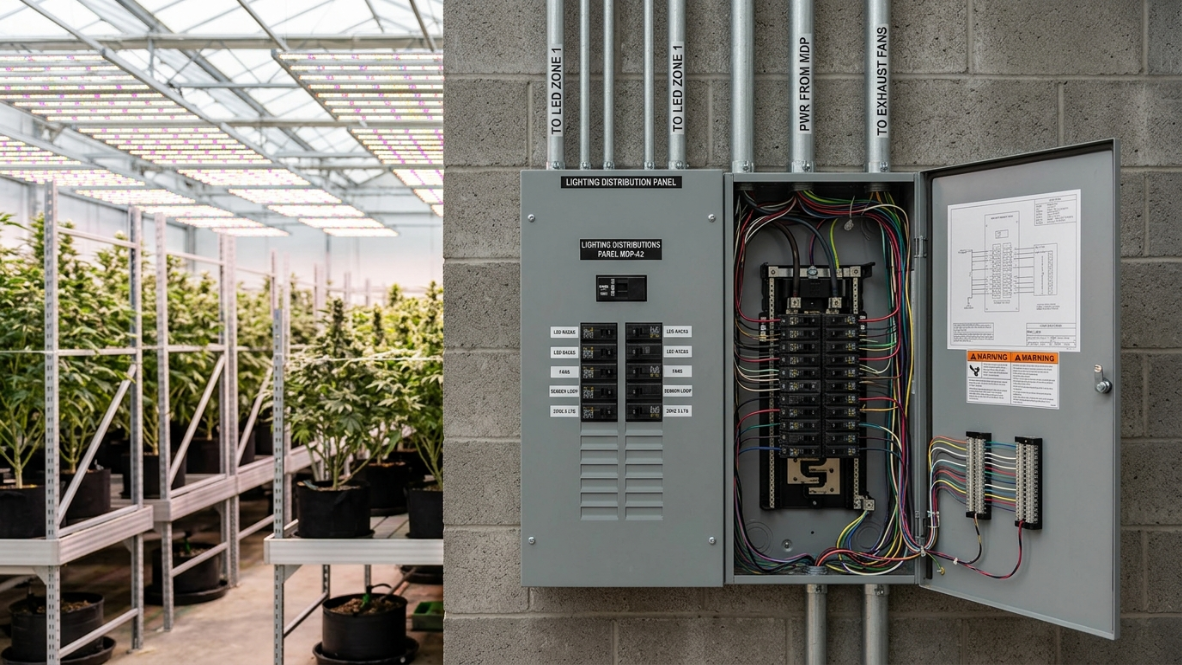
Horticulture lighting power distribution encompasses everything between a facility’s electrical panel and the LED diodes on the fixture: drivers, conductors, control wiring, safety devices, and the physical routing of all these components. In commercial Controlled Environment Agriculture (CEA), whether greenhouse, indoor grow, or vertical farm, this infrastructure determines how efficiently and reliably hundreds or thousands of fixtures receive power.
The term covers more than just wire gauge and breaker sizing. It describes the architectural choice of where AC-to-DC conversion happens, how much heat stays in the grow space, how fixtures are controlled and dimmed, and how the installation interacts with building codes. Getting this right has a direct, measurable impact on capital expenditure, operating cost, and crop consistency.
Power Flow in a Commercial Grow Facility
Most commercial facilities distribute electricity using the following sequence:
Utility Service
↓
Main Electrical Panel
↓
Lighting Distribution Panel
↓
Driver or Central Power Supply
↓
LED Fixtures
↓
Plant Canopy
Although every architecture follows this basic path, the location of the driver changes the amount of heat generated inside the grow room, installation complexity, and maintenance requirements.
How Power Gets from the Panel to the Plant
To understand why power distribution architecture matters, start with the conventional model and its problems.
The Traditional Distributed-Driver Approach
In a standard LED grow-light installation, every fixture contains its own onboard AC/DC driver. The driver converts incoming alternating current (typically 120V, 208V, 240V, or 277V) to the direct current the LEDs need. This is the simplest design from a fixture engineering standpoint, and it is how the vast majority of commercial grow lights ship today.
Simple does not mean cheap or efficient once you scale up.
The Heat Problem
Every LED driver loses some energy as heat, typically 5% to 15% of the fixture’s total wattage. A 1,000W fixture with an onboard driver produces roughly 50 to 100W of continuous waste heat from the driver alone, and that heat dumps directly into the grow space. Lights are already the dominant heat source in a controlled environment, accounting for 70% to 80% of total room heat load. Adding driver heat on top of that forces the HVAC system to work harder.
At scale, this compounds fast. A 100-fixture room with 1,000W lights and onboard drivers adds 5,000 to 10,000 watts of pure waste heat that the cooling system must remove. That is not a rounding error. It is a meaningful, ongoing operating expense. For a deeper look at this dynamic, see how much HVAC you need to cool LED lights, and how driver placement changes the equation.
The Reliability Problem
The cause behind most LED light failures is not the diodes. Commercial LED fixtures typically use L90-rated diodes that maintain at least 90% output after 50,000 hours. The weak link is the driver, which is the most thermally sensitive component in the fixture. Heat is the leading killer of LED drivers, and grow rooms are among the harshest environments an electronic component can inhabit: high humidity, temperature swings, and constant operation for 12 to 18 hours per day.
Power surges and harmonic distortion compound the problem in large facilities running hundreds of independent electrical loads. When a single driver fails, the grower loses that fixture’s output until it can be replaced, often during an active crop cycle. Understanding LED reliability factors is critical when evaluating long-term infrastructure choices.
The Installation Cost Problem
Traditional onboard-driver setups require step-down controls to decrease voltage from 480V three-phase to 240V or 277V. This effectively doubles the number of lighting panels and electrical receptacles required and demands commercial relay contactors, one of the most expensive components in any electrical buildout. Every fixture also needs its own home run of conduit, dimming wire, and a dedicated circuit connection.
For a 500-fixture cannabis facility, that means 500 sets of wiring, 500 connections, and hundreds of contactors and relays. The labor and material cost is enormous. A detailed breakdown of these expenses appears in our greenhouse lighting installation cost guide.
Estimated Installation Cost Comparison
Cost Factor | Distributed | Centralized DC | Fault-Managed |
|---|---|---|---|
Driver count | High | Low | Low |
Wiring | High | Moderate | Low |
Labor | High | Moderate | Low |
HVAC demand | High | Low | Low |
Maintenance | High | Low | Low |
Scalability | Moderate | Excellent | Excellent |
Three Horticulture Lighting Power Distribution Architectures
The industry has responded to these problems by developing alternatives to the one-driver-per-fixture model. Today, horticulture lighting power distribution systems fall into three categories.
Architecture 1: Distributed (Traditional)
Every fixture ships with an integrated AC/DC driver. Power arrives at the fixture as AC, gets converted onboard, and feeds the LEDs.
Best for: Small installations (under roughly 50 fixtures) where the wiring complexity and heat penalties are manageable, or facilities where budget constraints preclude centralized infrastructure.
Trade-offs: Highest per-fixture wiring cost at scale. All driver heat stays in the grow environment. Each driver is an independent failure point. Dimming requires dedicated control wiring to every fixture.
Architecture 2: Centralized DC (High-Voltage DC Bus)
Drivers are consolidated into rack-mounted power supply units located outside the grow room, typically in a mechanical or electrical closet. These centralized power supplies deliver high-voltage DC (commonly 150VDC to 260VDC) over a bus to each string of LED fixtures. The fixtures themselves become simpler and lighter because they no longer contain a driver.
Centralized DC systems can deliver energy savings of up to 12% compared to distributed-driver setups, according to Advanced Energy’s technical documentation. Installation costs can drop 10% to 15% by eliminating contactors, relays, and two-wire dimming circuits to each fixture.
One of the strongest practical advantages is fault isolation. In a well-designed centralized system, a single power supply failure affects only the fixtures on that string. In a documented 720-fixture room, one rack module going down affected only 10 lights, just 1.4% of total room capacity. Maintenance happens rack-by-rack without shutting down the entire grow, which means no disruption to photoperiod schedules.
Best for: New-build facilities at scale (roughly 50+ fixtures), where the upfront investment in centralized racks pays back through reduced wiring, lower HVAC load, and simplified maintenance.
Architecture 3: Fault-Managed / Low-Voltage Distribution
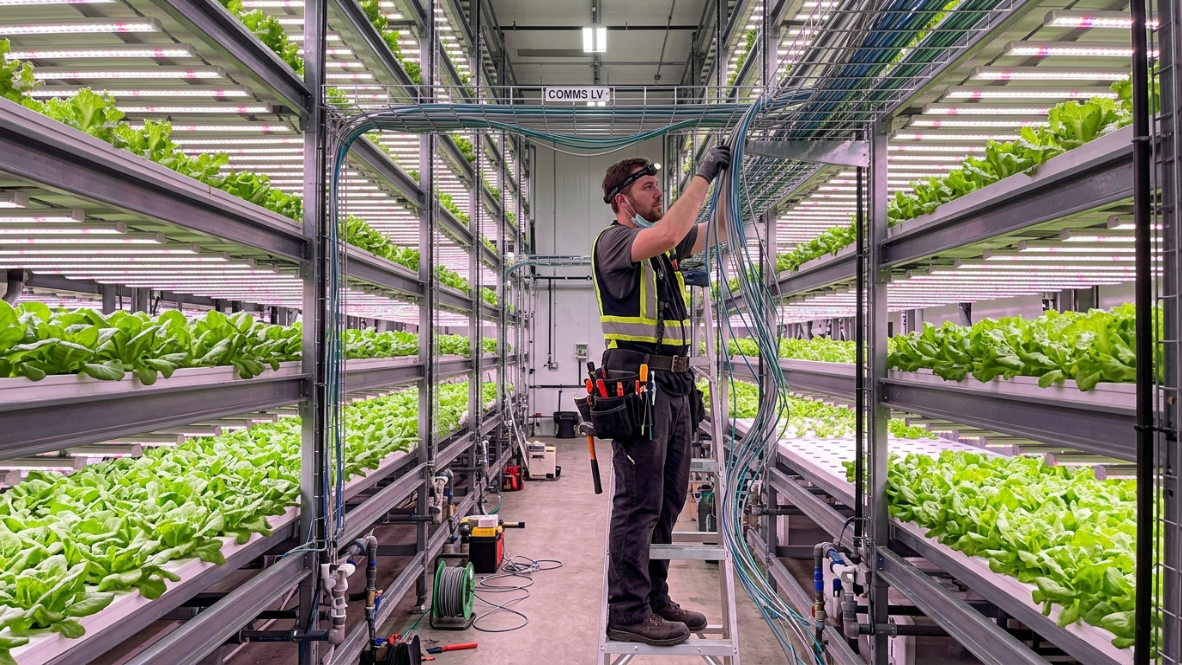
A newer approach uses packetized energy transfer or low-voltage DC distribution to achieve high power delivery with low-voltage safety classification. VoltServer’s Digital Electricity protocol, for example, distributes power via discrete energy packets with 500 safety checks per second. This technology claims to reduce distribution cost by 20% to 40% while requiring 75% fewer components and enabling installation speeds roughly five times faster than traditional AC infrastructure.
Low-voltage distribution methods can also simplify code compliance (more on that below) because circuits classified as low-voltage face fewer conduit and wiring requirements under the National Electrical Code.
Best for: Retrofits where running new high-voltage DC conduit is impractical, and projects where electrical safety classification and fast install timelines are top priorities.
Talk to a lighting engineer about which architecture fits your facility and scale.
Quick Comparison
Factor | Distributed (Traditional) | Centralized DC | Fault-Managed / Low-Voltage |
|---|---|---|---|
Driver location | On each fixture | Remote rack | Remote transmitter/rack |
Grow-room heat from drivers | 5-15% of fixture wattage | Near zero | Near zero |
Installation complexity | High (per-fixture wiring) | Moderate (bus wiring + rack) | Low (standard cabling) |
Fixture weight | Heavier (driver onboard) | Lighter | Lighter |
Fault impact | 1 fixture per failure | Small group per failure | Small group per failure |
NEC/GFCI interaction | Standard AC compliance | Hardwire required (no DC GFCI) | May qualify as low-voltage |
Best scale threshold | Under ~50 fixtures | 50+ fixtures, new builds | Retrofits, any scale |
Typical install cost reduction | Baseline | 10-15% | 20-40% (claimed) |
NEC Code and GFCI Requirements: A Hidden Decision Driver
This is the part most vendor marketing glosses over, but it increasingly shapes horticulture lighting power distribution decisions in North America.
NEC Section 410.184
The 2023 National Electrical Code, Section 410.184, mandates GFCI protection for outlets supplying lighting equipment identified for horticultural use that employs a flexible cord. This sounds straightforward, but the implications ripple through every architecture choice.
For standard circuits (150 volts to ground or less), Class A GFCI protection applies. For circuits exceeding 150 volts to ground, a Special Purpose Ground-Fault Circuit-Interrupter (SPGFCI) is required, since standard Class A GFCI devices cannot operate above 150V.
The 2026 NEC expands Section 410.184 further, reorganizing it into a two-part format that distinguishes requirements based on voltage to ground, with more detailed provisions for both Class A GFCI and SPGFCI protection.
How Architecture Affects Compliance
Here is where it gets practical. No GFCI device is currently rated for DC power. That means centralized high-voltage DC bus systems cannot use cord-and-plug connections with GFCI protection. The fixtures must be hardwired, and local disconnects must be added, which can increase installation cost and partially offset the wiring savings of centralization.
Practitioners on electrician forums confirm this plainly: if you don’t want to use GFCIs or SPGFCIs, the only option is to hardwire. This is not necessarily a deal-breaker for centralized DC, but it is a real cost and design consideration that belongs in any honest evaluation.
Low-voltage distribution methods may sidestep some of these requirements entirely if the system qualifies as Class 2 or limited-energy under NEC definitions. This is one reason fault-managed approaches have gained traction, particularly in retrofit scenarios where adding hardwired disconnects to every fixture location would be prohibitively expensive.
For facilities navigating these code requirements alongside centralized LED driver decisions, understanding the GFCI interaction is not optional. It directly affects your electrical bid.
Commercial Lighting Power Distribution by the Numbers
Metric | Typical Value |
|---|---|
Driver efficiency | 85–95% |
Driver heat loss | 5–15% |
Commercial fixture power | 500–1000W |
Driver lifespan | 50,000+ hours (varies by temperature) |
Centralized installation savings | 10–15% |
Fault-managed installation savings | Up to 40% (vendor claims) |
HVAC reduction | Up to 20% reported |
Practical Impacts for Growers and Facility Operators
HVAC Load and Operating Cost
Moving drivers out of the grow space is functionally equivalent to removing a space heater from every fixture. At commercial scale, centralized power distribution can reduce grow-room temperatures by roughly 20%, according to TSRgrow’s published case data. That translates directly to lower cooling costs and better environmental control. When your HVAC system is not fighting an extra 5,000 to 10,000 watts of driver heat, you gain tighter temperature and humidity management, which affects everything from VPD to pest pressure.
The relationship between latent and sensible heat in CEA facilities becomes easier to manage when a major sensible heat source is physically relocated outside the growing environment.
Fixture Weight and Install Labor
Removing the driver from each fixture makes the luminaire lighter, thinner, and easier to hang. In a vertical farm with hundreds of shelf-level fixtures, or a greenhouse with overhead mounts, the cumulative weight savings can change structural requirements. Lighter fixtures also mean faster physical installation, especially when combined with simplified wiring.
Maintenance and Photoperiod Disruption
When a centralized power module fails, a technician swaps it in an equipment room without entering the grow space, without disturbing the plants, and without interrupting the photoperiod of the remaining fixtures. Compare this to the traditional scenario: a fixture driver fails, a technician enters the grow room during a dark cycle (or waits until lights-on, losing production time), disconnects the fixture, replaces the driver or the entire luminaire, and reconnects. In flowering cannabis rooms where light interruption can trigger hermaphroditism, this difference is not theoretical. It is operational.
Zone Control and Dimming
Centralized architectures typically integrate dimming control at the rack level via MODBUS or 0-10V protocols, rather than requiring dedicated dimming wires to each fixture. This makes zone-based light recipes easier to implement and adjust. If your facility uses different DLI targets for different crop zones or growth stages, centralized control simplifies the programming and reduces the wiring. Our DLI greenhouse guide covers how to set those targets.
When Centralized Power Distribution Makes the Most Sense
Centralized horticulture lighting power distribution is not always the right answer. For a small propagation room with 20 fixtures, the upfront cost of a power rack and DC bus wiring likely does not pencil out. But above roughly 50 fixtures, the math starts to shift. Installation labor savings, HVAC reduction, and maintenance simplification compound, and the payback period shortens.
New builds benefit the most because the electrical infrastructure is designed from scratch around the chosen architecture. Retrofits are more nuanced: if the existing facility already has AC wiring to every fixture location, switching to centralized DC means either abandoning that wiring or running new conductors alongside it. Low-voltage fault-managed distribution can be more practical for retrofits because it may reuse existing cable pathways. If you are weighing a retrofit, our guide to transitioning to LED grow lighting covers the broader decision framework.
Also worth noting: power distribution upgrades often qualify for utility energy-efficiency rebates. Centralized systems that demonstrably reduce facility energy consumption can strengthen a rebate application because the savings are measurable and well-documented.
Common Mistakes When Designing Lighting Power Distribution
Sizing Electrical Panels Only for Today's Load
Future expansion often requires additional circuits. Oversizing electrical infrastructure during construction is usually less expensive than retrofitting later.
Ignoring Driver Heat
Driver heat contributes to HVAC load. Designers should account for driver placement during cooling calculations.
Overlooking NEC Compliance
Cord-connected fixtures, GFCI requirements, disconnects, and wiring methods should be considered during design rather than after installation.
Choosing Fixtures Before Electrical Design
Many projects select luminaires first and only later consider electrical architecture. Power distribution should be designed before fixture procurement.
How to Choose the Right Power Distribution System
Choose Distributed Power If:
You have fewer than 50 fixtures.
Budget is the primary concern.
HVAC costs are relatively low.
Future expansion is limited.
Simple maintenance is preferred.
Choose Centralized DC If:
Building a new commercial greenhouse.
Installing more than 50 fixtures.
HVAC efficiency is important.
You want easier driver replacement.
Reducing electrical infrastructure is a priority.
Choose Fault-Managed Power If:
Retrofitting an existing facility.
Installation speed matters.
Existing cable pathways need to be reused.
Electrical safety classification is important.
You want lower-voltage infrastructure.
“Driverless” Does Not Mean No Driver
A point of confusion that shows up frequently in grower forums: the term “driverless” means different things in different contexts, and conflating them leads to bad purchasing decisions.
In the hobby and budget market, “driverless” LEDs typically refer to cheap AC-direct COB modules that run directly off line voltage without a separate driver. These are not the same technology. Practitioners on growing forums report that these AC-direct COBs operate at very low efficiency, with one user on a popular cultivation forum noting they were “only like 15% efficient when driven from the wall.” They flicker at line frequency, produce poor-quality light, and have short lifespans. They are not suitable for any commercial application.
In the commercial horticulture context, “driverless” fixtures still require AC-to-DC conversion. The driver is not absent; it is remote. The fixture arrives without an onboard driver because the power conversion happens in a centralized rack or transmitter elsewhere in the facility. This is a fundamentally different and vastly superior approach.
When evaluating vendor claims about driverless horticulture lighting power distribution, always ask: where is the driver, and what is the DC bus voltage? If the answer is “there is no driver anywhere in the system,” walk away.
Key Terms and Related Concepts
LED driver: The power supply that converts AC input to regulated DC output for LED operation. The component most responsible for fixture failures in grow environments.
DC bus: A common conductor carrying direct current from a centralized power supply to multiple fixtures. Voltages in horticulture systems typically range from 150VDC to 336VDC.
Remote driver: An LED driver physically separated from the fixture it powers, usually rack-mounted in a mechanical room.
GFCI (Ground-Fault Circuit-Interrupter): A safety device that interrupts current when it detects a ground fault. Required by NEC 410.184 for cord-connected horticultural lighting at or below 150V to ground.
SPGFCI (Special Purpose Ground-Fault Circuit-Interrupter): A GFCI device rated for circuits exceeding 150V to ground. Required under NEC 410.184 for higher-voltage cord-connected horticultural lighting.
MODBUS: An industrial communication protocol used in centralized power systems for fixture-level or zone-level dimming and monitoring.
0-10V dimming: An analog control signal where 0V = off (or minimum) and 10V = full output. Common in both distributed and centralized lighting control.
Power factor: A measure of how efficiently a device uses the current it draws. Low power factor means wasted capacity on the electrical service. Large facilities with hundreds of drivers can have significant power-factor and harmonic-distortion issues.
PPFD (Photosynthetic Photon Flux Density): The number of photosynthetically active photons hitting a surface per second per square meter. The primary metric for grow-light output at the canopy. Our PPFD greenhouse guide explains measurement and target setting in detail.
DLI (Daily Light Integral): The total photosynthetic light a plant receives in a 24-hour period. Power distribution reliability directly affects whether fixtures deliver the intended DLI consistently.
For additional technical resources, visit the Thrive Agritech whitepapers library.
Pros and Cons of Each Architecture
Architecture | Advantages | Disadvantages |
|---|---|---|
Distributed | Lowest upfront cost, familiar installation | More heat, more drivers, more wiring |
Centralized DC | Reduced HVAC load, easier maintenance, fewer drivers | Higher initial cost, hardwiring required |
Fault-Managed | Fast installation, lower-voltage safety, retrofit friendly | Newer technology, fewer vendors |
Frequently Asked Questions
What is horticulture lighting power distribution?
It is the electrical architecture that delivers power from a facility’s utility service entrance to the LED grow-light fixtures. This includes drivers, conductors, control wiring, safety devices, and the physical routing of all components between the electrical panel and the diodes.
What are the main types of power distribution for grow lights?
Three architectures dominate: distributed (one driver per fixture, traditional), centralized DC (remote rack-mounted drivers delivering high-voltage DC), and fault-managed or low-voltage distribution (packetized energy or low-voltage DC approaches). Each has different cost, reliability, and code compliance profiles.
Why do LED grow light drivers fail?
Heat is the primary killer. Drivers are the most thermally sensitive component in a fixture, and grow rooms subject them to high humidity, temperature swings, and continuous operation. Power surges and harmonic distortion in large multi-fixture facilities accelerate degradation.
How much heat do LED drivers add to a grow room?
Onboard drivers typically produce waste heat equal to 5% to 15% of fixture wattage. For a 1,000W fixture, that is 50 to 100 watts of heat per fixture that the HVAC system must remove. In a room with 100 fixtures, this adds up to 5,000 to 10,000 watts of extra cooling load.
Does centralized power distribution save money?
At scale, yes. Published data from system providers shows installation cost reductions of 10% to 40% depending on the architecture, plus energy savings of up to 12% from improved conversion efficiency and reduced HVAC load. The savings increase as facility size grows, with centralized systems typically becoming cost-effective above roughly 50 fixtures.
How does NEC 410.184 affect horticulture lighting power distribution?
NEC 410.184 requires GFCI protection for cord-connected horticultural lighting. Since no GFCI device is rated for DC, centralized high-voltage DC systems must use hardwired connections with local disconnects. Low-voltage distribution systems may qualify for exemptions. This code requirement directly influences architecture selection and installation cost.
What does “driverless” mean for commercial grow lights?
In the commercial context, “driverless” means the fixture does not contain an onboard driver. The driver is remote, located in a centralized rack or transmitter outside the grow space. This is fundamentally different from cheap “driverless” AC-direct COB LEDs sold at the hobby level, which run directly off line voltage with very poor efficiency and are unsuitable for commercial use.
When should I choose centralized over distributed power distribution?
Centralized horticulture lighting power distribution makes the most sense for new-build facilities with 50 or more fixtures, where the upfront rack and bus investment pays back through reduced wiring, lower HVAC costs, and simplified maintenance. For small installations or tight-budget retrofits, distributed drivers may still be the practical choice. Low-voltage fault-managed systems split the difference for retrofit scenarios.
Ready to evaluate power distribution for your next project? Schedule a free consultation with a Thrive Agritech lighting engineer to discuss your facility’s specific requirements.