Under-Canopy Lighting ROI: 2026 Guide to Faster Payback
Learn how Under-Canopy Lighting ROI pencils out in 2026: model 20-35% yield gains, grade-shift revenue, and 1-2 harvest payback. Get the guide.
TL;DR
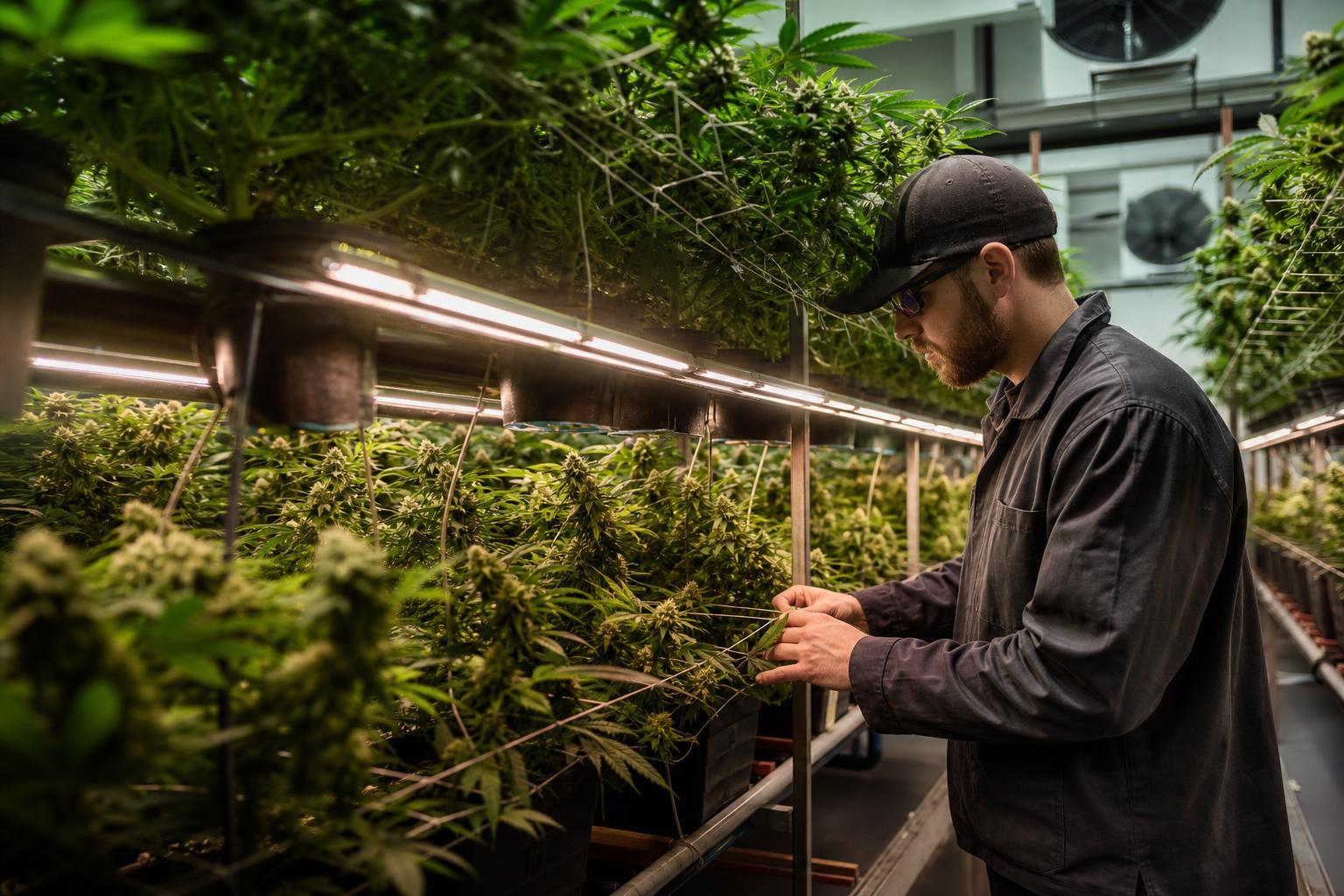
Under-canopy lighting ROI measures the financial return from installing supplemental LED bars below the plant canopy, factoring in yield gains, grade-shift revenue, electricity, HVAC load, and labor savings. Commercial growers consistently report 20 to 35% yield increases under optimized conditions, with payback periods of one to two harvests. The biggest and most overlooked ROI driver is not total weight but the conversion of low-value popcorn buds into premium flower that commands two to three times the price per pound.
If you're evaluating under-canopy lighting strictly on return on investment, most commercial cannabis facilities report payback within 1–2 harvests when environmental conditions are optimized. Published research commonly shows 20–35% yield increases, while the largest financial benefit often comes from upgrading lower-canopy buds into premium-grade flower rather than simply increasing harvest weight. Facilities with low electricity costs, available utility rebates, and strong HVAC capacity typically achieve the fastest ROI.
What Under-Canopy Lighting ROI Means
Under-canopy lighting ROI is the net financial return a grower earns from installing supplemental LED fixtures below or within the plant canopy, expressed as a percentage or payback period. It’s calculated by weighing incremental revenue (more flower weight, higher grade distribution, labor savings) against total system cost (fixtures, installation, electricity, and HVAC adjustments).
This is not the same as general “lighting ROI,” which typically refers to replacing overhead HPS with LED toplights. Under-canopy ROI isolates the value created by targeting photons at the lower and middle canopy zones, where flower sites would otherwise produce small, low-value buds or get stripped entirely during lollipopping. The practice is no longer experimental for commercial operations. It’s a capital expenditure decision that requires real numbers.
Explore the Boost XE, a purpose-built 120W under-canopy LED bar designed for commercial flower rooms and greenhouses.
What Determines Whether Under-Canopy Lighting Pays Off?
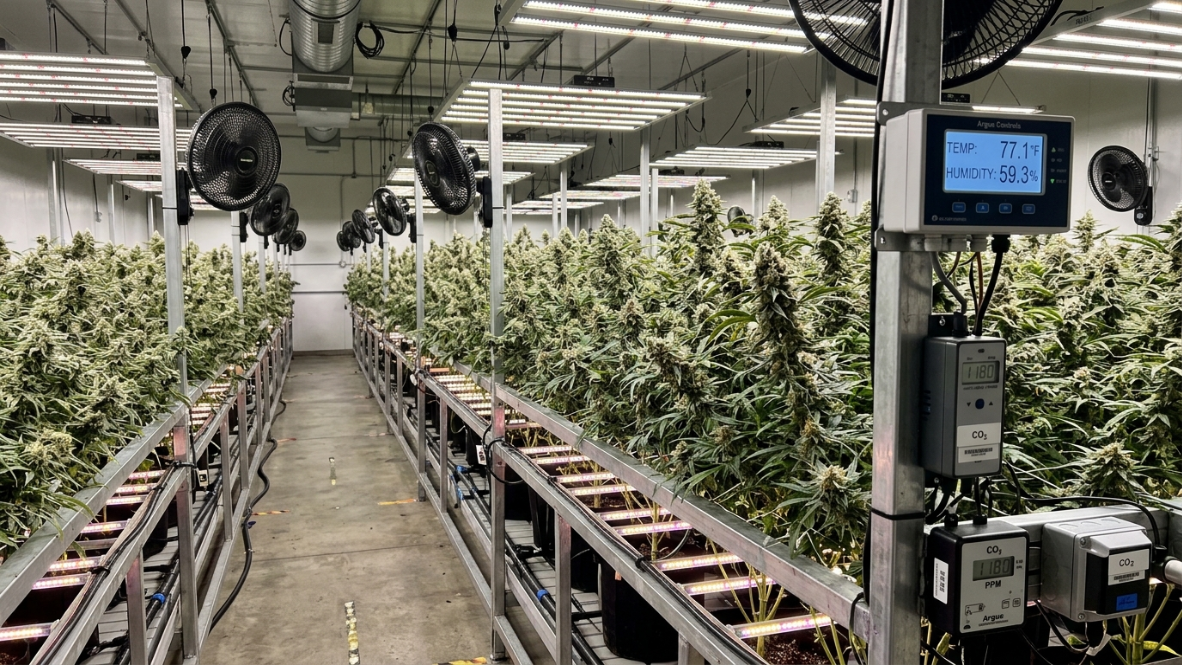
Not every cultivation facility will achieve the same ROI. The largest variables influencing profitability include:
Wholesale flower pricing
Existing yield per square foot
Percentage of popcorn buds
Utility electricity rates
HVAC capacity
Available LED rebates
Environmental control (CO₂, VPD, airflow)
Fixture efficiency (µmol/J)
Harvest frequency
Facilities already producing high-quality premium flower generally see smaller percentage improvements than growers with significant lower-canopy waste.
Factor | Small Effect | Large Effect on ROI |
|---|---|---|
Yield Increase | ✓ | |
Grade Shift | ✓✓✓ | |
Utility Rebates | ✓✓✓ | |
Electricity Cost | ✓✓ | |
HVAC Upgrades | ✓✓ | |
Labor Savings | ✓ | |
Flower Price | ✓✓✓ | |
Fixture Efficiency | ✓ | ✓ |
How to Calculate Under-Canopy Lighting ROI
The simplest break-even formula is:
Payback (harvests) = System Cost ÷ (Incremental Revenue per Harvest − Incremental Operating Cost per Harvest)
But the simple version hides where the real money is. A complete ROI model accounts for these inputs:
Cost side:
Fixture purchase price (net of any utility rebates)
Installation and wiring labor
Incremental electricity (fixture wattage × daily run hours × local kWh rate × days per cycle)
Incremental HVAC load (roughly 341 BTU/hr per 100W of fixture draw)
Revenue side:
Extra flower weight per harvest (lbs or grams per square foot gained)
Grade shift value (moving buds from C-grade smalls to A-grade premium, which can double the price per pound)
Labor savings from reduced lollipopping, defoliation, and trimming
Potential cycle-time reduction (some growers report 7 to 10 day shorter growth cycles)
A Worked Example
Take a 1,000 square foot flower room. You install under-canopy bars that produce a 25% yield increase on a baseline of 1.5 lbs per light (a conservative commercial figure). If you run 100 lights, that’s an additional 37.5 lbs per harvest. At $600/lb wholesale for premium flower, that’s $22,500 in new revenue per cycle.
Subtract incremental electricity (say $800/cycle at $0.12/kWh) and you net roughly $21,700 per harvest. If the fixture and installation cost was $25,000 after rebates, you break even in roughly 1.2 harvests.
California Lightworks ran a similar calculation on their Harborside greenhouse test: a 29.84% yield increase translated to an additional 0.45 lbs per unit at $800/lb, generating $360 extra per harvest, roughly $100 more than the fixture cost. One-run payback.
Under-Canopy Lighting ROI Calculator Inputs
When building an ROI model, collect these numbers before purchasing equipment.
Variable | Example |
|---|---|
Flower room size | 1,000 sq ft |
Number of fixtures | 100 |
Fixture wattage | 120W |
Electricity rate | $0.12/kWh |
Flower cycles per year | 5 |
Wholesale flower price | $600/lb |
Baseline yield | 150 lbs |
Expected yield gain | 20–30% |
Utility rebate | 40% |
Installation cost | $5,000 |
This table makes it much easier for readers to estimate their own ROI using their facility's production numbers.
What Kind of Returns Are Growers Actually Seeing?
The evidence base is now substantial enough to set expectations with confidence. Here’s what published studies show:
StateHouse Holdings / TSRgrow (2023): A multi-facility study testing intracanopy light distribution found a 20% increase in flower yield and a 27% improvement in the premium-to-small bud ratio. The critical finding: these gains came from repositioning existing light energy below the canopy, not from adding more total wattage.
California Lightworks / Harborside (Greenhouse): The controlled test showed a 29.84% increase in total dried, trimmed flower versus the control, with an 11% increase in A-grade classification.
Green Vibe (Commercial Greenhouse): Aldo Jarez, VP of Farming Operations, reported “somewhere between 25 to 30% increase in yield” after adding under-canopy bars.
Thrive Agritech research (cited by CannaCribs): Under-canopy integration led to a substantial increase in A-grade flowers, improved cannabinoid and terpene profiles, and a notable 5% increase in THC levels across the crop.
Fluence data: Under-canopy lighting increased A-grade buds from 37% to 50% while reducing trim waste from 35% to 26%.
The Range, Honestly
Scenario | Expected Yield Gain | Context |
|---|---|---|
Conservative (partial coverage, limited env. control) | 5–15% | Grower reports from partial deployments |
Mid-range (optimized indoor) | 20–25% | AROYA, TSRgrow, Thrive Agritech studies |
Aggressive (greenhouse, full coverage, dialed environment) | 25–35% | CLW/Harborside, Green Vibe, AROYA data |
Under optimized conditions (adequate CO₂, VPD in the 0.8 to 1.6 kPa range depending on flower stage, calibrated nutrients), the 20 to 35% range is well-supported. If your environment isn’t dialed, expect the low end. For more on managing VPD, see this guide on vapor pressure deficit in cannabis cultivation.
Typical Payback Timeline by Facility Type
Facility Type | Typical ROI |
|---|---|
Small Indoor Grow | 2–4 harvests |
Commercial Indoor | 1–2 harvests |
Greenhouse | 1 harvest |
Hybrid Greenhouse | 1–2 harvests |
Vertical Farm | Depends on crop density |
Explain that environmental control, rebates, and wholesale pricing largely determine where a facility falls within these ranges.
Grade Shift: The ROI Multiplier Most People Miss
This is the most underdiscussed factor in the under-canopy lighting ROI conversation. Weight gains get the headlines, but grade distribution is where the economics get compelling.
In California’s wholesale bulk market, premium flower (A and B grade) sells for $550 to $710 per pound, while smalls (C-grade and below) go for $250 to $300. That’s a 2x to 2.5x price gap. When under-canopy lighting shifts 27% more of your harvest from smalls into premiums (as the StateHouse study demonstrated), the revenue impact is far larger than the raw yield percentage suggests.
Put differently: growing an extra pound of smalls at $275 is worth $275. Growing an extra pound of A-grade at $650 is worth $650. Under-canopy lighting does both, converting larf into marketable flower and pushing existing mid-tier buds into premium territory.
When Under-Canopy Lighting Is Worth the Investment
Under-canopy lighting generally produces the strongest financial return when a facility:
Produces premium flower
Has adequate HVAC capacity
Uses CO₂ supplementation
Experiences significant lower-canopy larf
Operates multiple harvests annually
Qualifies for utility rebates
Already has optimized irrigation and fertigation
Operations still struggling with environmental consistency should typically improve climate control before investing in additional lighting.
Variables That Make or Break Your ROI
Electricity Rate and Run-Time Strategy
Under-canopy bars typically draw 60 to 160W per fixture, a fraction of your toplight wattage. But at scale (50 bars at 120W = 6kW), the operating cost is real, especially in high-rate markets. Growers paying $0.08/kWh will see very different payback timelines than those at $0.18/kWh. Some operators cycle under-canopy lights during off-peak hours to reduce demand charges. For a broader look at operational cost reduction strategies, read about reducing operating expenses in cannabis and food production facilities.
HVAC Capacity
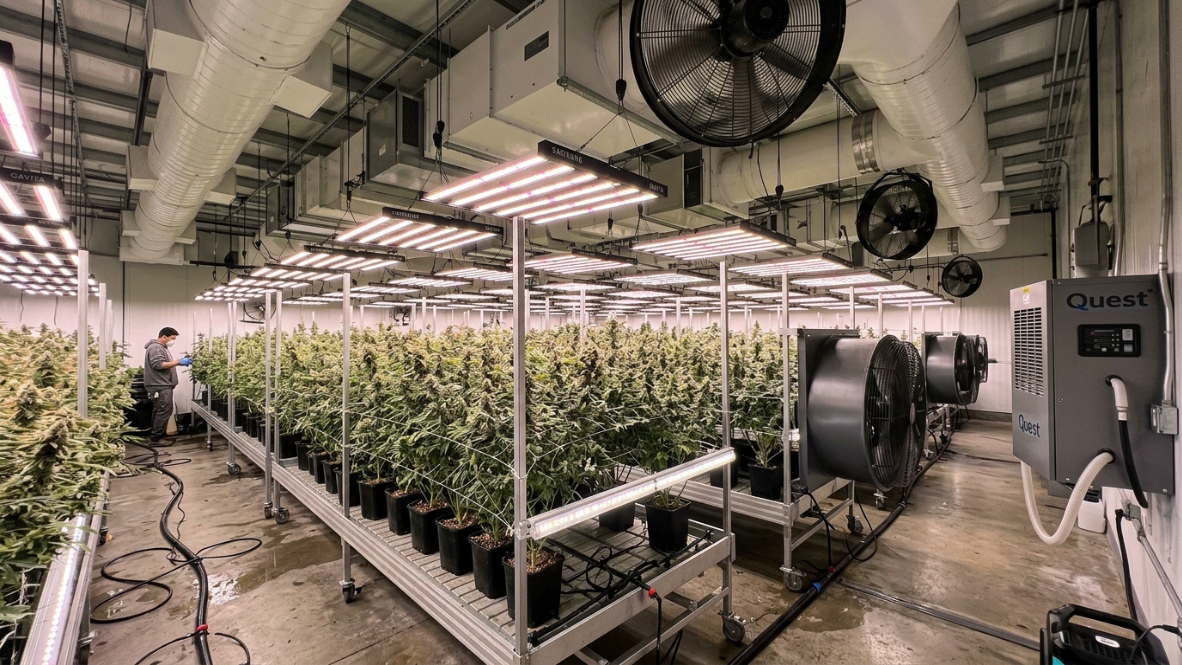
Every watt of lighting becomes heat. Practitioners on cultivation forums are blunt about this: “It’s not a huge heat load, but it’s enough to matter. You need to pull that extra heat out of the room.” A room with 50 under-canopy bars at 120W each adds roughly 20,000 BTU/hr to your cooling requirement. If your HVAC system is already at capacity, this added load is a real cost, not just an inconvenience.
Before buying fixtures, verify your HVAC sizing for LED grows. Undersized cooling will create humidity spikes, VPD problems, and potentially mold pressure that wipes out any yield gains.
Utility Rebates
This is the single easiest way to compress your payback period, and most growers are leaving money on the table. According to Cannabis Business Times research, 56% of cannabis cultivators have not explored LED rebates, with nearly a third unaware they exist. DLC (DesignLights Consortium) certification is the qualifying standard most utilities require.
Rebates can offset 30% to 70% of total fixture cost. In some cases, they bring the net out-of-pocket to near zero, making the ROI calculation almost purely upside. Any under-canopy lighting ROI model that ignores rebates is incomplete. Check your rebate eligibility before specifying fixtures.
Spectrum Choice
This is a live debate with direct ROI implications. Red-heavy diodes are cheaper to run per photon. As Fluence scientist Dr. David Hawley notes, “Red diodes inherently are cheaper to run. They have really good electrical efficacy.” But the lower canopy may respond better to full-spectrum, green-rich light that penetrates deeper into leaf tissue. A 2024 study in Frontiers in Plant Science found that a larger white-light fraction increased dry matter allocation to inflorescences.
The tradeoff: red-heavy bars squeeze more photons per watt but may produce suboptimal plant signaling and make the work environment unpleasant. Full-spectrum white costs slightly more per photon but tends to produce better plant morphology, more uniform bud structure, and a workspace where employees can actually see what they’re doing. For a deeper understanding of how spectrum affects growth, see this summary of light spectra impact on plants.
Power Architecture
Where the LED drivers live matters more than most growers realize. When drivers are built into each fixture, every under-canopy bar adds a driver, a wiring run, and a heat source to the canopy zone. Centralized or remote power systems move drivers out of the grow space entirely, reducing in-room heat, simplifying wiring, and cutting installation cost.
This is especially relevant for under-canopy lighting ROI because the bars sit close to the plants, in the densest, most humid part of the room. Fewer in-room electronics means fewer failure points and less heat where you least want it. Learn more about the OptiDrive centralized power platform, which is compatible across Thrive’s fixture line and designed to change the install economics for large deployments.
Cultivation Readiness
Under-canopy lighting amplifies what’s already happening in your room. If your environment is well-controlled (CO₂ at 1,200+ ppm, VPD dialed, nutrient EC calibrated), you’ll capture the full 20 to 35% upside. If your environment is inconsistent, adding light below the canopy can actually create problems: more humidity from increased transpiration, heat stress in microclimates, and disease pressure from poor airflow.
Flower Market Pricing
ROI is directly tied to the local wholesale price per pound. At $700/lb for premium flower, under-canopy lighting pays back in one harvest. At $300/lb in an oversaturated market, payback extends to three or four cycles. Any honest ROI framework must account for this variability.
Light Redistribution vs. Light Addition
One of the most important findings in the under-canopy lighting research is often overlooked. The StateHouse study showed that yield gains came from repositioning existing light energy, not from adding more total wattage. Researchers kept total photon delivery constant but split it between top and bottom fixtures. The result was still a 20% yield increase and 27% bud-size improvement.
This reframes the ROI calculation. If you dim toplights to redistribute photons below the canopy, the incremental electricity cost can be near zero. Your under-canopy lighting ROI then becomes almost entirely a question of fixture cost against revenue gain, with minimal operating cost to subtract.
That said, most commercial growers add under-canopy as supplemental (on top of full toplight intensity), which means real operating cost. The point is that even growers at their electrical ceiling can benefit by redistributing rather than adding.
Situations Where Under-Canopy Lighting May Not Produce Positive ROI
Not every facility benefits equally.
ROI may be limited when:
Flower prices are unusually low
HVAC systems already operate at full capacity
Plants receive poor airflow
Canopy density is already low
Environmental controls are inconsistent
Electricity prices are exceptionally high
Premium flower commands little price advantage
Including this section increases trust because it openly discusses situations where the investment may not pay off.
Common ROI Misconceptions
“More light always equals more yield.” It doesn’t. Light distribution matters as much as total PPFD. Blasting the canopy top with 1,200 µmol/m²/s while the lower third sits in darkness wastes potential. Under-canopy lighting addresses this inefficiency directly.
“ROI is just about yield gain.” It’s about yield, grade shift, labor reduction, and (in some configurations) HVAC savings. Focusing only on weight increase understates the true return, sometimes by 30% or more. The common mistake of comparing LEDs on wattage alone applies here too.
“Any under-canopy bar will do.” Spectrum, efficiency (µmol/J), DLC status, and build quality all affect returns. A cheap bar that isn’t DLC-listed forfeits rebate eligibility, which alone can swing the payback period by months.
“Under-canopy lighting works in any facility.” Without adequate HVAC headroom, CO₂ supplementation, and environmental control, adding under-canopy light can create more problems than it solves. The technology is proven, but only when the surrounding environment supports it.
Under-Canopy Lighting vs Increasing Top Lighting
Many growers assume increasing overhead PPFD produces the same results.
Research suggests otherwise.
Approach | Main Benefit | Limitation |
|---|---|---|
Increase Top Lighting | Higher canopy PPFD | Lower canopy remains shaded |
Under-Canopy Lighting | Improves light distribution | Additional installation cost |
Light Redistribution | Better efficiency | Requires careful fixture planning |
How to Start
The smartest approach is a single-room pilot with a controlled comparison.
Document your baseline. Weigh and grade your current harvest by position in the room. Record environmental data (temperature, humidity, VPD) at canopy level and below.
Run a split test. Light half the room with under-canopy bars and leave the other half as a control. Measure yield, grade distribution, and labor time for at least two full cycles.
Check DLC status before purchasing. Rebate eligibility can offset 30 to 70% of fixture cost, and it requires DLC-listed products.
Verify HVAC headroom. Calculate the additional BTU load and confirm your system can handle it before buying fixtures.
Model your numbers conservatively. Use 15% yield gain and current wholesale pricing as your base case. If the math works at 15%, it works even better at 25%.
Schedule a free lighting consultation to get a facility-specific ROI model and layout recommendation.
FAQ
How long does it take for under-canopy lighting to pay for itself?
Most commercial operations see positive under-canopy lighting ROI within one to two harvests. California Lightworks documented payback in a single cycle on their Harborside test, and one vendor reports 85%+ of customers achieve one-run ROI. The timeline depends on your facility’s electricity rate, rebate eligibility, and local flower pricing.
What yield increase should I realistically expect?
Published studies consistently show 20 to 35% yield increases under optimized conditions (adequate CO₂, controlled VPD, calibrated nutrients). Conservative estimates for facilities without full environmental control are 5 to 15%. The StateHouse study found 20% yield gains even when total light energy was held constant, by redistributing photons rather than adding them.
Is the ROI just about growing more flower?
No. Grade shift is often the bigger financial driver. Converting lower-canopy buds from C-grade smalls ($250 to $300/lb) to A-grade premium ($550 to $710/lb) can double the value per pound. The StateHouse study showed a 27% improvement in premium-to-small bud ratio, and Fluence data showed A-grade buds increasing from 37% to 50% of total harvest.
Do under-canopy lights add significant heat to the grow room?
Under-canopy bars are low wattage individually (typically 60 to 160W), but at scale they add meaningful BTUs. Fifty bars at 120W each produce roughly 20,000 BTU/hr of additional heat. This matters most in rooms where HVAC is already near capacity. Always calculate your thermal load before committing to a full deployment.
Can I get utility rebates for under-canopy LED fixtures?
Yes, if the fixtures are DLC-listed. Rebates typically offset 30 to 70% of fixture cost and can compress payback to near-zero upfront cost. Over half of cannabis cultivators haven’t explored available rebates, which represents a major missed opportunity for ROI improvement.
Does spectrum choice affect under-canopy lighting ROI?
It does. Red-heavy bars produce more photons per watt but may underperform in plant morphology and bud quality below the canopy. A 2024 peer-reviewed study found that a larger white-light fraction increased dry matter allocation to inflorescences. Full-spectrum white light also creates a safer, more productive work environment. The spectrum decision has both biological and practical ROI implications.
Is under-canopy lighting worth it in an oversaturated market with low flower prices?
The ROI case is weaker at low wholesale prices, but the grade-shift effect provides a buffer. Even in a $400/lb market, converting smalls into premiums generates meaningful incremental revenue. The key is modeling your ROI against current local pricing rather than industry averages, and factoring in labor savings from reduced lollipopping and trimming.