Greenhouse Lighting for Tomatoes: 2026 DLI & PPFD Guide
Master greenhouse lighting for tomatoes with DLI 20–30, stage PPFD targets, spectra, and photoperiod limits. Boost yields 14–28%. Get the guide.
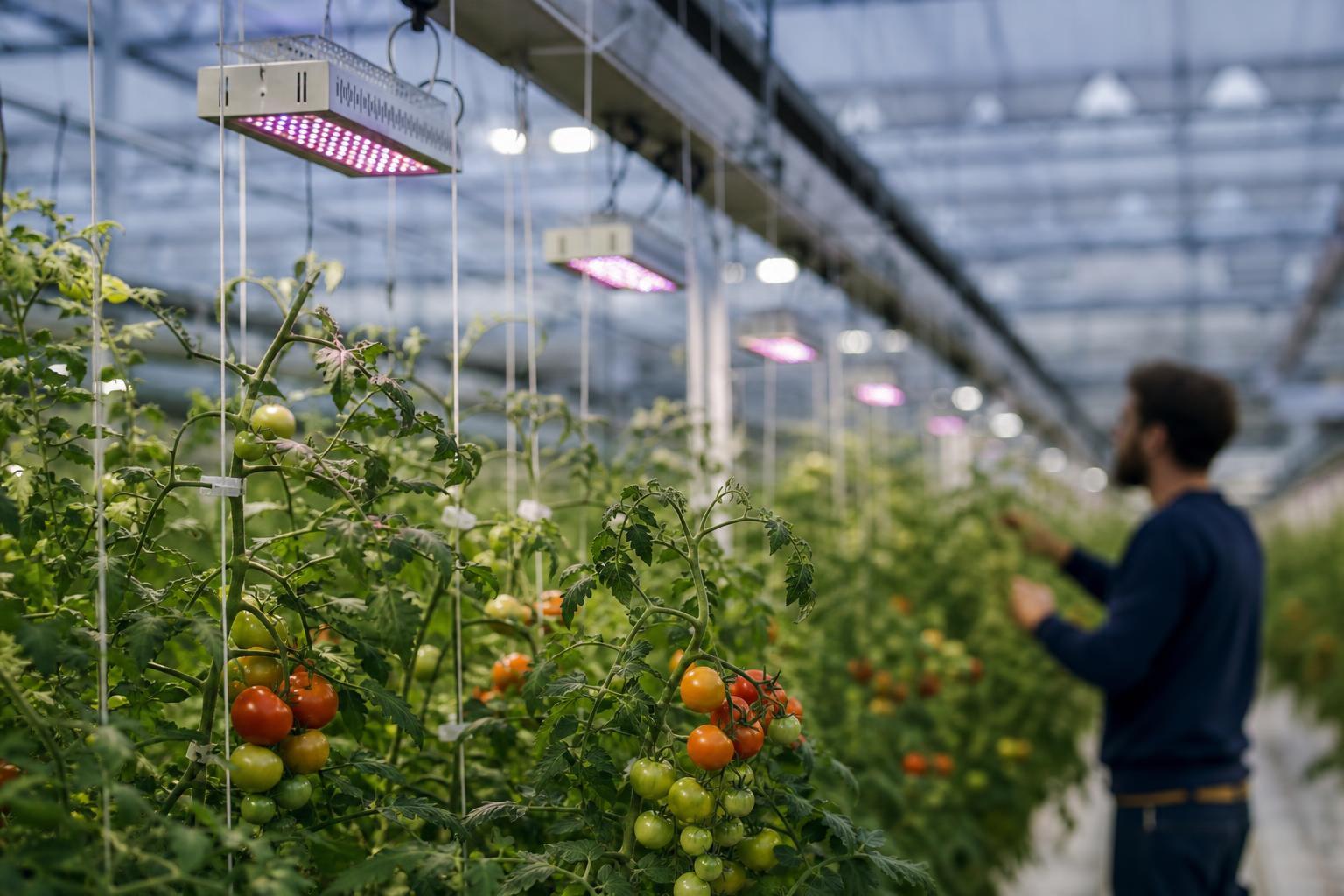
TL;DR
Greenhouse lighting for tomatoes requires understanding a handful of critical metrics. Tomatoes need a Daily Light Integral (DLI) of 20 to 30 mol/m²/day, with PPFD targets that shift from 200 µmol/m²/s at the seedling stage to 600 to 900 µmol/m²/s during fruiting. Photoperiod should not exceed 17 hours to avoid leaf chlorosis. Supplemental LED lighting, especially when combined with interlighting below the canopy, has been shown to boost yields by 14% to 28% in peer-reviewed research.
Tomatoes are among the most light-hungry crops grown under glass. They demand roughly double the daily light of leafy greens, and they punish growers who get the photoperiod wrong. That combination of high demand and narrow tolerance makes greenhouse lighting for tomatoes one of the most technically precise challenges in controlled environment agriculture.
This glossary defines every key term a grower needs to understand when designing, evaluating, or optimizing a tomato lighting system. Each entry includes the definition, why it matters for tomatoes specifically, and the numbers to target.
If you’re planning a lighting project for a greenhouse tomato operation, schedule a free consultation to discuss your specific facility and crop goals.
Core Light Measurement Terms
PAR (Photosynthetically Active Radiation)
The range of light wavelengths (400 to 700 nm) that plants use for photosynthesis. PAR is not a measurement itself but rather defines what counts as useful light. It includes blue, green, and red wavelengths. When someone talks about “grow light output,” they should be talking about photons within this PAR range, not total visible light or lumens. Lumens measure brightness to the human eye, which is a poor proxy for plant-useful radiation. For a deeper explanation of how PAR relates to other metrics, see this PAR vs. PPFD guide.
PPFD (Photosynthetic Photon Flux Density)
The number of PAR photons hitting a square meter of canopy per second, measured in µmol/m²/s. Think of PPFD as the speedometer of your lighting system: it tells you how fast light is being delivered right now, at a specific point.
Tomato PPFD targets vary by growth stage:
| Growth Stage | PPFD Target (µmol/m²/s) | Recommended Photoperiod |
|---|---|---|
| Seedling | 200 – 300 | 16 – 18 hours |
| Vegetative | 400 – 600 | 16 hours |
| Flowering / Fruiting | 600 – 900 | 14 – 16 hours |
These benchmarks align with Virginia Tech Extension data and are widely used in commercial greenhouse production. Most pages give a single DLI range for tomatoes. The stage-specific breakdown matters because pushing 600+ µmol/m²/s onto seedlings will cause stress, while limiting fruiting plants to 300 µmol/m²/s leaves yield on the table.
To understand how to measure PPFD accurately in your greenhouse, our guide on how to measure PPFD walks through the practical steps.
DLI (Daily Light Integral)
The total number of PAR photons delivered to a square meter over a full 24-hour period, measured in mol/m²/day. If PPFD is the speedometer, DLI is the odometer. It captures the cumulative light dose a plant receives, which is what actually drives growth and yield.
The target DLI for greenhouse tomatoes is 20 to 30 mol/m²/day. Michigan State University recommends at least 25 to 30 mol/m²/day for high-wire fruiting vegetables like tomatoes and cucumbers. Some researchers push the ceiling to 35 mol/m²/day for maximum fruit production, noting that tomatoes require roughly double the light of lettuce.
The DLI calculation formula:
PPFD (µmol/m²/s) × photoperiod (hours) × 3,600 ÷ 1,000,000 = DLI (mol/m²/day)
Worked example: A supplemental lighting system delivering 200 µmol/m²/s for 16 hours contributes:
200 × 16 × 3,600 ÷ 1,000,000 = 11.52 mol/m²/day
If natural sunlight inside the greenhouse provides 5 mol/m²/day during winter, the combined DLI is 16.52, still short of the 25 mol target. This is why so many northern greenhouse operators need high-output supplemental systems. For more calculation examples and the math behind DLI conversions, see our DLI formula and PPFD conversion guide.
Photosynthetic Efficacy (µmol/J)
How efficiently a fixture converts electrical energy into PAR photons, expressed in micromoles per joule. This is the efficiency rating that actually matters for horticultural lighting, not lumens per watt. Modern high-performance LED fixtures range from 2.5 to 3.6 µmol/J. Higher efficacy means less electricity spent per photon delivered to the crop, which directly reduces operating cost.
Spectrum Terms
Full-Spectrum White Light
LED fixtures using phosphor-converted technology to produce a broad, sunlight-like blend of blue, green, and red wavelengths. Full-spectrum white avoids the “pink” appearance of red-blue-only fixtures and creates a more comfortable working environment for greenhouse staff. More importantly, plants grown under a broad spectrum that mimics sunlight tend to develop more naturally than those under narrow-band light. For greenhouse tomatoes receiving significant sunlight throughout the day, full-spectrum white supplements integrate seamlessly with the existing solar spectrum rather than creating an imbalanced light environment.
Red Light (620–700 nm)
The most photosynthetically efficient wavelength range, where each photon drives the most photosynthesis per unit of energy. However, plants grown solely under monochromatic red light develop abnormally, a phenomenon researchers call “red light syndrome,” which includes elongated stems and underdeveloped leaves. In greenhouse tomato production, red light is always delivered alongside other wavelengths, either from sunlight or from a balanced fixture spectrum.
Blue Light (400–500 nm)
Shorter wavelengths that regulate plant morphology, promoting compact growth, shorter internodes, and proper stomatal function. For greenhouse tomatoes, the amount of blue in the supplemental spectrum matters more than many growers realize. Research from Wageningen University found that both very low (0%) and high (24%) blue light fractions were suboptimal for tomato growth and yield. A moderate blue fraction of 6% to 12% in the supplemental LED spectrum appears to hit the sweet spot when sunlight already contributes background blue.
Far-Red Light (700–750 nm)
Wavelengths just beyond the traditional PAR range that influence stem elongation, flowering, and dry matter partitioning. Research published in the Journal of Horticultural Science & Biotechnology found that supplementary LED lighting with additional far-red can increase fruit yield and the fraction of dry matter partitioned to the fruits in tomato plants grown under low solar radiation. Far-red is not a standalone solution but an additive spectral component that can shift more of the plant’s energy toward fruit production.
Light Recipe
A custom spectral output, often including photoperiod timing and intensity schedules, designed for a specific crop and growth stage. For greenhouse tomatoes, the light recipe changes across the production cycle. Seedlings benefit from moderate intensity with slightly higher blue fractions for compact growth. Fruiting plants need high-intensity light weighted toward red for photosynthetic efficiency, with moderate blue and potentially supplemental far-red to promote fruit loading. Research consistently shows that tradeoffs between yield and efficacy can vary by cultivar, so light recipes should be validated on the specific variety being grown.
Lighting Strategies
Supplemental Lighting
Electric light added to natural solar radiation to maintain a crop’s target DLI, especially during low-light months. For greenhouse tomatoes, supplemental lighting is typically delivered at 200 to 250 µmol/m²/s PPFD with photoperiods around 16 hours. The primary goal is filling the winter DLI gap: in northern latitudes like Ontario, Canada, indoor winter DLI can drop to 2.5 to 7.5 mol/m²/day, a fraction of the 25+ mol target tomatoes need.
Sizing a supplemental system correctly requires knowing your baseline solar DLI, your greenhouse’s light transmission factor, and your target DLI. For a full breakdown of how to approach this, our supplemental lighting guide covers the step-by-step process.
Top Lighting (Overhead Lighting)
Fixtures mounted above the crop canopy, directing light downward. This is the traditional approach to greenhouse supplemental lighting and remains the primary system for most operations. However, top lighting has a significant limitation for tall crops like high-wire tomatoes: it creates a steep light gradient from the top of the canopy to the bottom. The uppermost leaves receive far more light than they can use efficiently, while the lower leaves, which are still actively feeding developing fruit, sit in relative shade.
The Altus 1K is an example of a commercial LED top light designed for greenhouse supplemental use, delivering the high output and uniform coverage that overhead systems require.
Interlighting / Under-Canopy Lighting / Intracanopy Lighting
Fixtures placed within or below the crop canopy to illuminate lower and middle leaves that overhead lighting cannot reach. This is one of the highest-impact strategies in modern greenhouse tomato production, and the research backing it is strong.
A meta-analysis published in Scientific Reports found that intra-canopy LED lighting alone increased tomato fruit yield by 28.46% compared to no supplemental lighting, outperforming top LED lighting alone (12.12%). The same study found a 31.3% increase in lycopene content with interlighting. In separate trials, a U.S. greenhouse grower achieved a 17% yield increase by combining intracanopy LED lighting with overhead lighting.
Recent 2026 trial data shows that at higher light intensities (375 µmol/m²/s), replacing part of the top lighting with intracanopy lighting produced a 20 to 24% additional yield increase.
Practitioners on Reddit and greenhouse forums frequently report that interlighting changed their approach to lower-leaf management. Where growers once removed basal leaves aggressively, interlighting promotes those leaves’ role as active source organs feeding developing fruit clusters.
The Boost XE is a 120W under-canopy LED bar designed specifically for this application. For more evidence on why under-canopy lighting has moved well beyond the experimental stage, read our article: Under-Canopy Lighting: The Experiment Is Over.
Photoperiod
The number of hours a plant receives light per day. For greenhouse tomatoes, the safe photoperiod range is 14 to 18 hours, with most commercial operations running supplemental lights for 16 hours. This is one of the most commonly misunderstood aspects of greenhouse lighting for tomatoes, because unlike many other crops, tomatoes have a hard ceiling. Extending the photoperiod beyond 17 hours may be detrimental to production and lead to leaf chlorosis, reduced leaf growth, and diminished plant vigor.
The temptation to run lights longer, perhaps to hit a DLI target with fewer fixtures at lower PPFD, is a trap. More hours at lower intensity is not equivalent to fewer hours at higher intensity when you cross the photoperiod threshold.
For more on designing photoperiod schedules for greenhouse crops, see our greenhouse photoperiod lighting guide.
Photoperiod Injury / Continuous Light Injury
Interveinal leaf chlorosis and photosystem damage caused by lighting tomatoes for more than approximately 17 hours per day. This condition is specific to certain species, and tomatoes are among the most sensitive. Research confirms that lighting longer than 18 hours causes leaf injury characterized by interveinal chlorosis, and yield is no longer increased with further photoperiod extension.
There is emerging work on a workaround: dynamic lighting strategies that switch from white light during the day to blue light at night at reduced PPFD. Studies show these 24-hour dynamic treatments maintained photosystem health similar to 16-hour controls, while static 24-hour lighting caused drastic reductions. This is still experimental and not ready for commercial adoption.
Technology and Infrastructure Terms
LED Grow Light
A solid-state lighting fixture designed for horticultural use, converting electricity into PAR photons at high efficiency. Modern LEDs offer several advantages over legacy technology for greenhouse tomato lighting: higher photosynthetic efficacy (2.5 to 3.6 µmol/J), spectrum customization, longer lifespans (40,000+ hours is standard for quality fixtures), and lower radiant heat output.
The heat difference matters more than many growers expect. LED fixtures dissipate thermal energy primarily through convection, while HPS lamps emit significant longwave radiation directly onto the canopy. This means switching to LEDs changes the greenhouse climate equation. Less radiant heat on the canopy reduces heat stress risk and can lower summer cooling costs, but in winter, growers may need to compensate for the loss of “free” heating that HPS provided. For more on the HVAC implications, see how much HVAC is needed to cool LED lights.
Commercial growers report yield increases ranging from 8.7% to 33% after transitioning to LED supplemental lighting, depending on the crop, baseline conditions, and lighting strategy used.
HPS (High-Pressure Sodium)
The legacy greenhouse lighting technology that dominated commercial horticulture for decades. HPS fixtures produce a broad spectrum weighted toward yellow and red. A 1000W HPS fixture can often be replaced with approximately 700W of LED lighting while delivering similar PPFD at the canopy, reducing lighting energy consumption by roughly 25%. In daily operating cost terms, a 1000W double-ended HPS costs roughly $1.85 per day to run, while a comparable LED fixture costs under $1.00.
Given that supplemental lighting can account for up to 30% of a grower’s operating costs, the economics of the HPS-to-LED transition are compelling. Most new commercial greenhouse builds specify LED, and retrofit projects are accelerating.
Centralized / Remote Power Architecture
A system design that relocates LED drivers (the power conversion units) out of the grow space and into a central rack or location. Traditional LED fixtures house their drivers inside the fixture body, which adds weight, generates heat above the canopy, and creates thousands of potential failure points distributed throughout the grow area.
Centralized power changes this equation. Moving drivers outside reduces in-canopy heat load (cutting HVAC costs), simplifies fixture maintenance, and can reduce wiring complexity and installation costs in large-scale deployments. For greenhouse operators installing hundreds of fixtures, the reliability and serviceability improvements are substantial.
The OptiDrive platform is an example of this approach, offering both DC and low-voltage distribution models that work across multiple fixture types.
DLC (DesignLights Consortium) Listed
A certification indicating that a lighting fixture meets the efficiency and performance standards set by the DesignLights Consortium. DLC listing is required for eligibility in most utility rebate programs across North America. For greenhouse operators, these rebates can offset 20% to 50% of fixture costs, dramatically improving project payback timelines. Always verify that any fixture you specify carries current DLC listing before counting on rebate eligibility. To check available programs in your area, visit our rebate eligibility page.
Economics and Decision-Making Terms
Light Transmission Factor
The percentage of outdoor solar radiation that actually reaches the crop inside the greenhouse. Depending on glazing material, structural shadows, and greenhouse orientation, transmission factors typically range from 50% to 70%. This number is critical for calculating supplemental lighting needs. If outdoor winter DLI is 10 mol/m²/day and your greenhouse transmits 50%, your plants receive only 5 mol/m²/day from sunlight, leaving a 20 mol/m²/day gap to reach the 25 mol target.
Greenhouse Lighting ROI
The return on investment from a supplemental lighting system, accounting for fixture cost, energy consumption, utility rebates, yield gains, and extended production season. ROI calculations for greenhouse lighting for tomatoes must include both sides of the equation. On the cost side: fixture purchase, installation, electrical infrastructure, and ongoing energy. On the return side: increased winter yield (often 15% to 30%), improved fruit quality (including Brix and lycopene), longer production seasons, and premium pricing for off-season fruit.
Practitioners on YouTube walkthroughs and greenhouse forums frequently note that the payback period varies dramatically by latitude. A greenhouse in Michigan with a severe winter DLI gap will see faster payback than one in Southern California where sunlight already provides most of the needed DLI.
For a detailed financial framework, our greenhouse lighting payback and ROI guide walks through the math.
Winter DLI Gap
The difference between a greenhouse’s natural winter DLI and the crop’s target DLI, representing the supplemental lighting workload. In Harrow, Ontario (a major North American greenhouse hub), outdoor winter DLI is typically 5 to 15 mol/m²/day. After accounting for greenhouse transmission losses, indoor winter DLI can be as low as 2.5 to 7.5 mol/m²/day. Reaching the tomato target of 25 mol/m²/day means supplemental lighting must contribute 17 to 22.5 mol/m²/day, a significant engineering challenge.
CO₂ Interaction
The relationship between supplemental light intensity and carbon dioxide availability in the greenhouse. This is not a lighting term per se, but ignoring it undermines any lighting investment. Cranking PPFD to the top of the tomato range without matching CO₂ and temperature control can trigger photoinhibition, where leaves actually lose photosynthetic capacity instead of gaining it.
Korean research published in 2025 confirmed that the combined application of supplemental lighting and CO₂ enrichment significantly improved tomato yields beyond what either intervention achieved alone. Target DLI alone does not dictate final harvest numbers. For more on how CO₂ strategy interacts with lighting, read our article on the role of CO₂ in controlled environment agriculture.
Yield Impact: What the Research Shows
Greenhouse lighting for tomatoes is ultimately about yield and quality. Here is what peer-reviewed research documents:
| Study | Finding |
|---|---|
| Appolloni et al. 2021 (meta-analysis, 80+ citations) | Supplemental LED lighting improves both quantitative and qualitative aspects of greenhouse tomato production |
| Ziaei et al. 2024, Scientific Reports | Intra-canopy LED lighting increased tomato fruit yield by 28.46% and lycopene content by 31.3% |
| Tewolde et al. 2016, Frontiers in Plant Science | Interlighting increased yield by 20% in winter and 14% in autumn for single-truss tomatoes |
| 2026 high-radiation trial | At 375 µmol/m²/s, replacing part of top lighting with interlighting yielded a 20 to 24% additional increase |
| Dynamic LED study | Dynamic spectral lighting produced a 19.5% yield boost |
The pattern is clear: supplemental lighting works, and the combination of top lighting with interlighting consistently outperforms either alone.
Putting It All Together
Consider a greenhouse in the northern United States with a winter indoor DLI of 5 mol/m²/day. To reach a tomato target of 25 mol/m²/day, the supplemental system needs to deliver 20 mol/m²/day. Running fixtures at 350 µmol/m²/s for 16 hours yields approximately 20.16 mol, closing the gap. But that calculation assumes the photoperiod stays at or below 16 to 17 hours, CO₂ is enriched to 800 to 1,000 ppm, and temperature and humidity are managed in concert.
Greenhouse lighting for tomatoes is never just about the lights. It is an integrated system decision where lighting, climate control, fertigation, and CO₂ must work together.
Ready to design a supplemental lighting system for your tomato operation? Contact our team for a free consultation and facility-specific lighting plan.
Frequently Asked Questions
What DLI do tomatoes need in a greenhouse?
Tomatoes require a DLI of 20 to 30 mol/m²/day for optimal production. Michigan State University recommends targeting at least 25 to 30 mol/m²/day for high-wire fruiting vegetables. In winter at northern latitudes, supplemental lighting is nearly always required to reach these levels.
How many hours of light do greenhouse tomatoes need?
Most commercial operations run supplemental lights for 14 to 16 hours per day. The critical limit is 17 hours. Exceeding that causes photoperiod injury, including interveinal leaf chlorosis and yield decline. Running lights longer to compensate for lower fixture intensity is a common and costly mistake.
What PPFD should I target for fruiting tomatoes?
During the flowering and fruiting stage, target 600 to 900 µmol/m²/s. Seedlings need only 200 to 300 µmol/m²/s, and vegetative plants do well at 400 to 600 µmol/m²/s. Always pair high PPFD with adequate CO₂ enrichment.
Is interlighting worth the investment for greenhouse tomatoes?
Research strongly supports it. Studies show yield gains of 14% to 28% from interlighting alone, with even greater gains when combined with top lighting. Interlighting also improves fruit quality metrics like lycopene content. For tall, high-wire tomato crops, it addresses the fundamental problem of light gradient through the canopy.
What spectrum is best for supplemental lighting on tomatoes?
Full-spectrum white light works well in greenhouses because it blends seamlessly with natural sunlight. If choosing a spectrum for the supplemental component, moderate blue (6 to 12%), a strong red fraction, and optional far-red supplementation represent the current research consensus for maximizing tomato yield.
How do I calculate the supplemental light my greenhouse needs?
Start with your winter outdoor DLI, multiply by your greenhouse’s light transmission factor (typically 50 to 70%), then subtract that from your target DLI (25 mol/m²/day for tomatoes). The gap is the DLI your lights need to deliver. Use the formula PPFD × hours × 3,600 ÷ 1,000,000 to convert between PPFD, hours, and DLI.
Do I still need HPS heating if I switch to LEDs?
Possibly. LEDs produce far less radiant heat than HPS, which can mean less “free” winter heating for the canopy. Many growers find the energy savings from LEDs more than offset the cost of additional greenhouse heating, but the climate impact should be modeled before making the switch.
Does CO₂ matter for greenhouse tomato lighting?
Absolutely. High PPFD without adequate CO₂ can trigger photoinhibition, reducing photosynthetic capacity. Research shows that combining supplemental lighting with CO₂ enrichment produces significantly better results than either alone. If you are investing in high-output lighting, you need a CO₂ strategy to match.