Winter Greenhouse Lighting: 2026 Glossary & Practical Guide
Master Winter Greenhouse Lighting with a 2026 glossary of DLI, PPFD, PPE, and more. Get benchmarks, cost‑saving tips, and strategy guidance—start now.
TL;DR
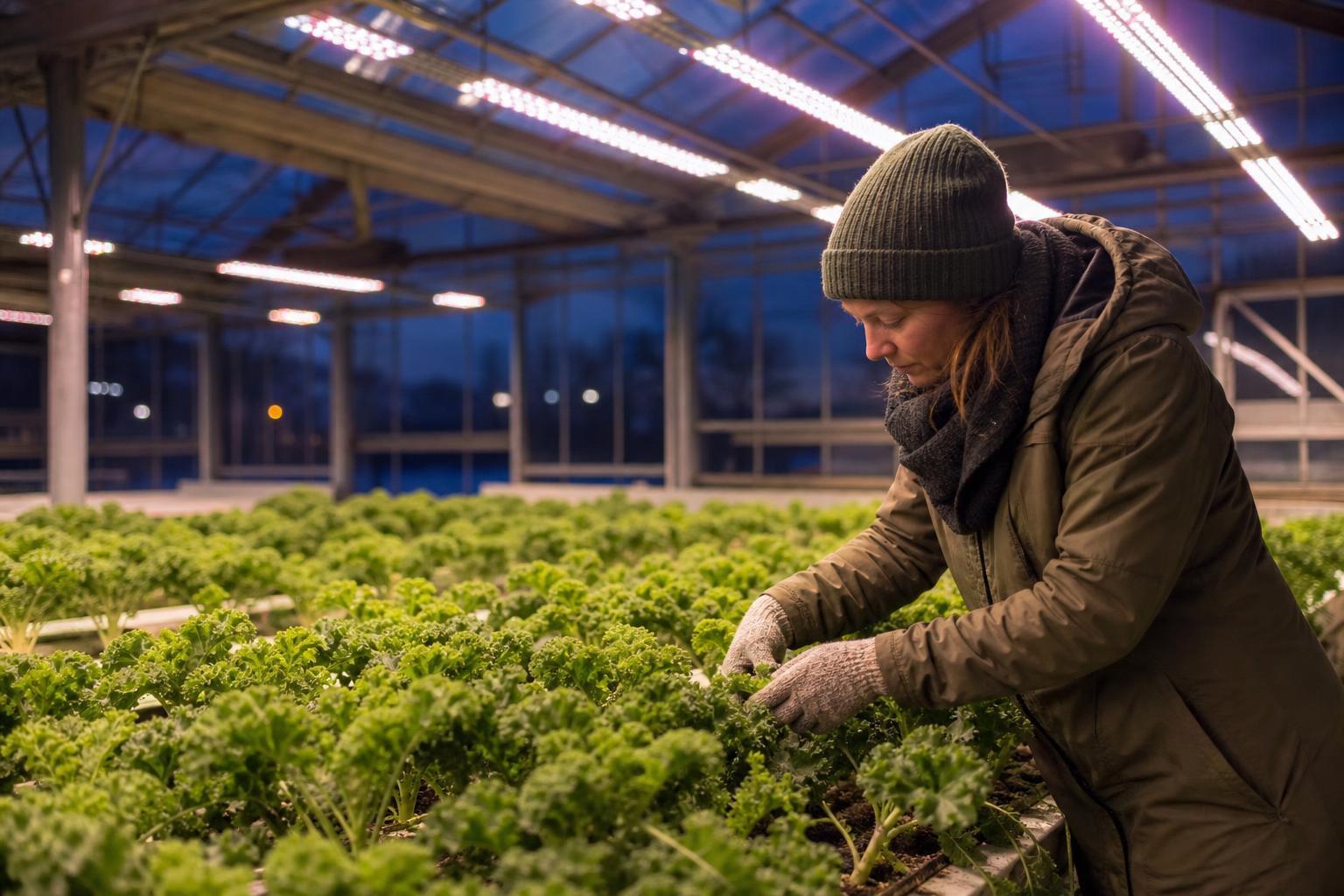
Winter greenhouse lighting refers to the supplemental light systems used to compensate for low natural sunlight during winter months. In northern U.S. states, interior greenhouse light levels can drop to just 2 to 4 mol/m²/d on cloudy winter days, far below what most crops need. This glossary defines every critical term, from DLI and PPFD to glazing transmission and DLI carryover, and ties each one to practical winter growing decisions. Understanding these terms is the difference between a lighting investment that pays back and one that doesn’t.
Why This Glossary Exists
In much of the United States, light is the limiting factor in greenhouses during winter. Not temperature, not humidity, not CO2. Light. And the terminology surrounding winter greenhouse lighting can be dense enough to slow down operators who are trying to make capital investment decisions.
Supplemental lighting accounts for 10 to 30 percent of a greenhouse’s operating expenses. That range is enormous, and where a facility lands within it depends largely on how well the operator understands what they’re buying and why. This glossary cuts through the jargon, connecting each term to its specific winter context, complete with quantitative benchmarks growers can actually use.
The terms are organized into five sections: light measurement, lighting strategy, facility infrastructure, technology and economics, and crop response. Each entry follows a simple structure: definition, why it matters in winter, and a key number to anchor the concept.
If your greenhouse is facing winter light deficits, schedule a free consultation to discuss the right approach for your facility.
Light Measurement Terms
Daily Light Integral (DLI)
Definition: The cumulative amount of PAR light received per square meter over an entire day, expressed as mol/m²/d. DLI is a function of both light intensity and duration.
Why it matters in winter: Think of DLI as the plant’s daily light dose. A single PPFD reading at noon tells you almost nothing about what plants actually received, just as checking the sky once doesn’t tell you how much rain fell. DLI is the rain gauge. In December, the average outdoor DLI in the 13 most northern U.S. states falls to just 5 to 10 mol/m²/d. Western Washington drops below 5. After glazing losses, interior greenhouse DLIs of 2 to 4 mol/m²/d on cloudy winter days are common.
Key benchmarks by crop (from Purdue Extension HO-283-W):
- Propagation materials: 8 to 10 mol/m²/d
- Potted plants: 10 to 15 mol/m²/d
- Leafy greens: 15 to 20 mol/m²/d
- Tomatoes and strawberries: 20+ mol/m²/d
For a deeper explanation of how to calculate DLI and convert it from PPFD readings, see this DLI formula and conversion guide.
Photosynthetic Photon Flux Density (PPFD)
Definition: The number of photosynthetically active photons landing on a square meter per second, measured in µmol/m²/s. PPFD is an instantaneous measurement, a snapshot of light intensity at a single moment and point in space.
Why it matters in winter: Winter supplemental lighting for high-value crops like greenhouse tomatoes is typically implemented at a PPFD of 200 to 250 µmol/m²/s with photoperiods around 16 hours. The common confusion is treating PPFD and DLI as interchangeable. They are not. PPFD measures how intense the light is right now. DLI measures how much total light accumulated over the full day. A fixture delivering 200 µmol/m²/s for 16 hours produces a very different DLI than the same fixture running for 8 hours.
Key number: For most greenhouse supplemental applications in winter, target PPFD ranges fall between 100 and 250 µmol/m²/s depending on the crop. To understand how these readings are gathered and interpreted, this guide to measuring PPFD in greenhouses walks through the process step by step.
Photosynthetically Active Radiation (PAR)
Definition: The wavelength band between 400 and 700 nanometers that drives photosynthesis. PAR describes the type of light. PPFD tells you how much of it arrives per second. DLI tells you how much accumulated over a day.
Why it matters in winter: Not all light reaching a greenhouse is PAR. Glazing materials filter different proportions, and the low winter sun angle compounds the problem. When evaluating greenhouse lighting for winter, every metric that matters (PPFD, DLI, PPE) is rooted in PAR. For a clear breakdown of how PAR relates to PPFD in practice, see this PAR vs. PPFD explainer.
Photosynthetic Photon Flux (PPF)
Definition: The total number of PAR photons a fixture emits per second in all directions, measured in µmol/s. While PPFD measures what lands on the canopy, PPF measures what leaves the light source.
Why it matters in winter: PPF is the honest starting point for comparing fixtures before installation factors (mounting height, reflectors, spacing) enter the picture. Two fixtures with identical PPF can deliver very different PPFD at the canopy depending on optics and layout.
Photosynthetic Photon Efficacy (PPE)
Definition: The number of micromoles of PAR photons produced per joule of electricity consumed (µmol/J). PPE is the single most honest metric for comparing grow lights, because it normalizes output against energy input.
Why it matters in winter: Supplemental lighting runs more hours during winter than any other season. Every fraction of efficacy difference multiplies across those hours. Top-tier 2026 LED fixtures achieve around 3.0 to 3.1 µmol/J, compared to roughly 1.7 µmol/J for a 1000W HPS lamp. When lighting can represent 10 to 30 percent of a greenhouse’s operating expenses, the gap between 1.7 and 3.0 µmol/J translates directly into thousands of dollars per hectare per winter.
Key number: High efficiency starts at 2.5 µmol/J. The best available fixtures now exceed 3.0 µmol/J. When evaluating options, learn how to avoid common comparison mistakes that distort the PPE picture.
Lighting Strategy Terms
Supplemental Lighting
Definition: Lighting used in greenhouses to increase crop production during periods of low natural light intensity. It adds to sunlight rather than replacing it.
Why it matters in winter: For year-round production, supplemental lighting during winter months is often necessary. The electricity to provide it is a major expense, up to 30 percent of total production cost according to University of Georgia research. But the returns can be dramatic: one study on greenhouse eggplant found that supplemental lighting treatments increased total yield by 124 to 144 percent relative to unlit controls. For a comprehensive overview of strategies and equipment, see this supplemental lighting guide.
Sole Source Lighting
Definition: Lighting systems that provide 100 percent of the light plants receive, with no contribution from the sun. This applies to vertical farms, warehouses, and other fully enclosed growing environments.
Why it matters in winter: The distinction matters because greenhouses in winter still use supplemental lighting. The sun contributes something, even on cloudy days. Sole source environments operate under different economics and equipment requirements. Understanding which category your facility falls into shapes every subsequent decision about fixture selection, intensity targets, and energy budgets.
Top Lighting (Toplighting)
Definition: Fixtures mounted overhead, above the plant canopy. The most common approach to supplemental greenhouse lighting.
Why it matters in winter: Top lighting stabilizes winter greenhouse lighting by delivering consistent light to the crop canopy when outdoor conditions fall short. Overhead fixtures paired with proper spacing and mounting height create the uniform light footprint that crops need. The Altus 1K greenhouse top-light fixture is an example of a purpose-built LED designed for this application.
Inter-lighting / Under-canopy Lighting
Definition: Fixtures positioned within or below the plant canopy to deliver light to lower leaves that overhead fixtures and winter sunlight cannot reach.
Why it matters in winter: In a greenhouse crop with high planting density, low PPFD at the lower leaves limits plant growth. This problem is worst in winter when the solar altitude is low, the day length is shorter, and the canopy blocks what little light arrives. Providing supplemental lighting to the lower canopy can increase year-round productivity. For the evidence behind this approach, including documented yield gains, see the case for under-canopy lighting.
The Boost XE under-canopy LED fixture was designed specifically for this purpose.
Photoperiod / Photoperiod Extension
Definition: Photoperiod is the total number of hours a plant receives light in a 24-hour cycle. Photoperiod extension means using artificial light to lengthen the effective day beyond what the sun provides.
Why it matters in winter: Standard practice is to start LED operation 2 to 3 hours before sunrise and continue 2 to 3 hours after sunset, achieving 14 to 16 hour photoperiods for most crops.
Here is where a critical confusion arises. Practitioners on growing forums frequently mix up photoperiod lighting with photosynthetic supplemental lighting. One grower in an online thread noted they were “just trying to stop them from flowering early,” a completely different goal than boosting DLI for yield. Photoperiod control for flowering manipulation requires as little as a 4-hour extension at just 2 to 3 µmol/m²/s around midnight. Supplemental lighting for photosynthesis requires 100 to 250+ µmol/m²/s. Two very different light levels, two very different purposes, two very different electricity bills. For a detailed guide covering this distinction, see this greenhouse photoperiod lighting guide.
Night Interruption (NI) Lighting
Definition: A brief period of light (typically 2 to 4 hours) delivered in the middle of the dark period at very low intensity (1 to 2 µmol/m²/s) to manipulate plant flowering responses.
Why it matters in winter: NI lighting is critical for short-day and long-day flowering crops during winter, when natural day length can trigger unwanted dormancy or premature flowering. There is an additional benefit that is rarely discussed: the efficacy of beneficial insects introduced for biological pest control often decreases in winter due to short photoperiods, as many insects enter diapause under light-limiting conditions. NI lighting can help keep biocontrol programs functional.
DLI Carryover
Definition: A lighting strategy where “excess” light from a sunny day is credited toward the next day’s DLI requirement, allowing supplemental lighting to be reduced the following day.
Why it matters in winter: This is a frontier concept in winter greenhouse lighting management. Research by Jayalath et al. (2024) found that the DLI requirement can be reduced by approximately 5.25 mol/m²/d on the day following a sunny day. Applied to greenhouse lettuce production, this approach resulted in annual energy savings of approximately 75 to 190 MWh per hectare. No other commonly published glossary includes this term, but it represents a meaningful opportunity for operators to reduce winter lighting costs without sacrificing crop quality.
Facility and Infrastructure Terms
Glazing Transmission
Definition: The percentage of outdoor light that passes through the greenhouse covering material to reach the plant canopy.
Why it matters in winter: This is where theory meets reality, and the numbers can be sobering. Manufacturers report that single-pane clear glass transmits 88 to 91 percent of light, and double-wall polycarbonate transmits around 80 percent. But if you measure PAR at the leaf canopy, it is often only 40 to 60 percent of what is measured outside. Structural framing, hanging baskets, equipment, dirty glazing, and the low winter sun angle all compound losses.
A powerful rule of thumb from university researchers: a one percent increase in light equates to roughly a one percent increase in plant growth during fall, winter, and spring, especially on cloudy days. This means cleaning glazing, improving reflective surfaces, and upgrading fixtures all have directly quantifiable returns. The 1% rule makes every small improvement tangible.
DLI Deficit / Light Gap
Definition: The difference between a crop’s target DLI and the DLI actually delivered by sunlight through the greenhouse glazing. The supplemental lighting system must close this gap.
Why it matters in winter: A lettuce grower targeting 17 mol/m²/d who receives only 5 mol/m²/d inside the greenhouse during a northern-latitude winter faces a deficit of 12 mol/m²/d. That is what the supplemental system must provide. Calculating the light gap is the foundational step in any winter greenhouse lighting design, and this greenhouse DLI calculator guide can help walk through the math.
Connected Load / Installed Wattage
Definition: The total electrical power draw (in watts or kilowatts) of all lighting fixtures when operating at full output. Used for electrical panel sizing and operating cost calculations.
Why it matters in winter: Winter is when connected load matters most. Supplemental lighting runs the longest hours and at the highest intensity during this season, stressing electrical infrastructure more than at any other time. Understanding connected load is essential for panel sizing, circuit planning, and avoiding costly mid-project electrical upgrades. For larger installations, centralized power architectures like OptiDrive can simplify electrical design and reduce wiring costs.
Light Uniformity
Definition: How evenly light is distributed across the growing area, typically expressed as a ratio or coefficient of variation. High uniformity means minimal difference between the brightest and dimmest spots.
Why it matters in winter: When supplemental lighting provides a large share of total DLI (as it does on cloudy winter days), any non-uniformity in the artificial light translates directly into uneven crop growth. Uniformity depends on fixture spacing, mounting height, and optics.
Technology and Economics Terms
LED (Light Emitting Diode) vs. HPS (High Pressure Sodium)
These are the two dominant technologies in greenhouse supplemental lighting. The comparison is critical for anyone planning winter greenhouse lighting investments.
LEDs now hold roughly 60 percent of the greenhouse lighting market. Modern LED bar arrays achieve 2.7 to 3.0+ µmol/J, saving 40 to 60 percent in energy versus HPS while lasting more than twice as long.
HPS fixtures produce significant heat, and in cold-climate winter greenhouses, that heat can offset heating costs. This is a genuine consideration, not marketing spin. However, it is a diminishing advantage as LED efficacy improves, and practitioners note that HPS heat comes from above the canopy, where it is least useful for root-zone warming. The heat is uncontrolled and often creates temperature gradients that cause more problems than they solve.
Key number: Modern LEDs deliver 30 to 40 percent more photons per watt than double-ended HPS with significantly less radiant heat at the canopy. For operators considering the switch, this guide to transitioning to LED grow lighting covers the practical steps.
Full Spectrum vs. Pink/Purple Light
Full spectrum LEDs include white diodes, producing a broad output closer to sunlight. They create better working conditions for humans, which matters when staff spend long winter hours in the greenhouse.
Pink/purple fixtures use primarily red and blue diodes. They can be slightly more photosynthetically efficient per watt, but as MSU Extension researcher Erik Runkle has noted, growers should consider people as well as plants when choosing a light spectrum. For a deeper look at how spectrum choices affect plant growth, see this summary of light spectra impact on plants.
DLC Listing
Definition: The DesignLights Consortium (DLC) is a nonprofit that maintains a qualified products list for energy-efficient lighting. DLC listing is often required to qualify for utility rebates.
Why it matters in winter: Rebates can offset significant capital costs for winter greenhouse lighting installations. The DLC released SSL V6.0 in November 2025, raising minimum efficacy thresholds by an average of 14 percent. Products listed under the previous version that don’t meet V6.0 requirements will be delisted by December 15, 2026. This means growers should verify that any fixture they’re considering meets the latest standard. For more detail, see what DLC-listed LED grow lights are and why it matters.
To check rebate eligibility for your specific location and utility, explore available rebates here.
Utility Rebates
Definition: Financial incentives offered by electric utilities to offset the cost of upgrading to energy-efficient lighting. Rebate amounts vary by utility, fixture type, and efficiency rating.
Why it matters in winter: Because winter is the highest-usage season for supplemental lighting, the energy savings from efficient fixtures are greatest during winter months, which strengthens the rebate payback case. University of Georgia horticulturists developed smart control hardware and software that can reduce the overall cost of providing supplemental light by up to 40 percent, making the combined impact of efficient fixtures, smart controls, and utility rebates substantial.
Life Cycle Cost Analysis (LCCA)
Definition: A financial evaluation that accounts for the total cost of a lighting system over its entire useful life, including purchase price, installation, energy consumption, maintenance, lamp replacements, and disposal.
Why it matters in winter: A fixture that costs less upfront but consumes more energy and requires replacement sooner can easily cost more over a five-year period, especially when winter operation means thousands of additional run hours per year. LCCA is the only honest way to compare lighting investments.
Crop Response Terms
Light Saturation Point
Definition: The PPFD level above which additional light no longer increases photosynthesis for a given crop. Varies significantly by species.
Why it matters in winter: Rarely an issue in winter. The problem is almost always light deficit, not surplus. However, understanding saturation points prevents over-specifying fixtures and wasting energy on light the plants cannot use.
Photomorphogenesis
Definition: The way light quality (spectrum) influences plant shape, structure, and development beyond simple photosynthesis. This includes stem elongation, leaf expansion, branching, and flowering timing.
Why it matters in winter: When supplemental light provides the majority of total DLI (as happens on cloudy winter days when solar DLI drops below 5 mol/m²/d), the spectrum of the supplemental lighting fixtures starts to matter more for plant morphology. On sunny days, the sun’s broad spectrum dominates and supplemental spectrum has minimal effect. On dark winter days, the fixtures effectively control how plants grow, not just whether they grow.
Short-day and Long-day Plants
Definition: Short-day plants (like chrysanthemums and poinsettias) flower when the dark period exceeds a critical length. Long-day plants (like petunias and spinach) flower when the light period exceeds a critical length.
Why it matters in winter: Winter’s naturally short days trigger flowering in short-day plants and can prevent flowering in long-day plants. Photoperiod extension and night interruption lighting (defined above) are the tools growers use to override these natural responses. This is distinct from supplemental lighting for yield, a difference that trips up many growers, as discussed in the photoperiod entry above.
Putting It Together: How to Use This Glossary
If you’re planning winter greenhouse lighting for the first time, start with these five terms: DLI, PPFD, DLI deficit, PPE, and glazing transmission. Together, they answer the core questions: How much light do my plants need? How much are they actually getting? How big is the gap? And how efficiently can I close it?
From there, the strategy terms (supplemental vs. sole source, photoperiod extension vs. night interruption) shape the approach, and the economics terms (LCCA, DLC listing, utility rebates) determine the financial case.
The 1% rule ties everything together. Every one percent increase in light during winter translates to roughly one percent more plant growth. That makes every decision in this glossary, from cleaning glazing to choosing a higher-PPE fixture, directly quantifiable.
Talk to a lighting specialist to map these terms to your specific facility, crops, and winter conditions.
Frequently Asked Questions
How much supplemental light does a greenhouse need in winter?
It depends on the crop and location. Calculate the DLI deficit by subtracting your interior greenhouse DLI (often 2 to 4 mol/m²/d on cloudy northern winter days) from your crop’s target DLI. Lettuce needs 15 to 20 mol/m²/d, tomatoes need 20+, and propagation materials need 8 to 10. The deficit is what your supplemental system must provide.
What PPFD should winter greenhouse lights deliver?
For most crops, supplemental PPFD targets fall between 100 and 250 µmol/m²/s. Winter greenhouse tomato production, for example, typically uses overhead lighting at 200 to 250 µmol/m²/s with a 16-hour photoperiod.
Are LEDs better than HPS for winter greenhouse lighting?
For most operations, yes. LEDs deliver 30 to 40 percent more photons per watt of electricity, last more than twice as long, and generate less radiant heat at the canopy. In cold-climate greenhouses, HPS waste heat can partially offset heating costs, but this advantage diminishes as LED efficacy continues to improve.
What is the 1% rule in greenhouse lighting?
University researchers have established a rule of thumb: a one percent increase in light during winter results in approximately a one percent increase in plant growth. This applies during fall, winter, and spring, especially on cloudy days, and it makes the ROI case for every glazing improvement, reflective surface, and lighting upgrade immediately tangible.
What is DLI carryover and how does it save energy?
DLI carryover credits excess light from a sunny day toward the next day’s requirement, allowing supplemental lighting to be reduced. Research has shown this can cut the following day’s DLI requirement by about 5.25 mol/m²/d, saving 75 to 190 MWh per hectare annually in greenhouse lettuce production.
Is photoperiod lighting the same as supplemental lighting?
No, and this is one of the most common points of confusion. Photoperiod lighting manipulates flowering timing and operates at very low intensity (2 to 3 µmol/m²/s). Supplemental lighting boosts DLI for growth and yield, operating at 100 to 250+ µmol/m²/s. They serve completely different purposes at vastly different energy costs.
What PPE rating should I look for in greenhouse grow lights?
High efficiency starts at 2.5 µmol/J. Top-tier LED fixtures in 2026 achieve 3.0 to 3.1 µmol/J. Given that supplemental lighting can account for 10 to 30 percent of operating costs, every tenth of a µmol/J matters over a full winter season.
How do utility rebates apply to winter greenhouse lighting?
Many utilities offer rebates for energy-efficient lighting upgrades, but fixtures typically must be DLC-listed to qualify. The DLC’s V6.0 standard raised efficacy thresholds by 14 percent on average, so verify that any fixture you’re considering meets the current requirements before factoring rebates into your ROI calculation.