Greenhouse DLI Calculator: 2026 Guide, Formula & Targets
Use our Greenhouse DLI Calculator to convert PPFD, factor transmission losses, and size supplemental lighting. See steps and crop targets.
TL;DR
A greenhouse DLI calculator converts instantaneous light intensity (PPFD) into a daily total of photosynthetically active light, measured in mol/m²/d. The core formula is DLI = PPFD × hours × 0.0036. For greenhouses specifically, the calculation must account for glazing transmission losses (typically 40% to 65% of outdoor light), seasonal variation, and the gap between natural light and your crop’s target DLI. This guide walks through the full formula, a five-step greenhouse deficit calculation, crop-specific targets, a quick reference table, and the most common mistakes growers make.
Need help sizing supplemental lighting for your greenhouse? Talk to a lighting specialist for a free consultation.
Greenhouse DLI Calculator: Quick Answer
To calculate greenhouse DLI, first determine how much natural light reaches the crop, then calculate the remaining DLI deficit and convert that deficit into supplemental PPFD.
Greenhouse natural DLI = Outdoor DLI × Greenhouse light transmission
DLI deficit = Target crop DLI − Natural greenhouse DLI
Required supplemental PPFD = DLI deficit ÷ (Supplemental lighting hours × 0.0036)
For example, if outdoor DLI is 20 mol/m²/d, greenhouse transmission is 50%, the crop target is 25 mol/m²/d, and supplemental lights operate for 16 hours:
- Natural greenhouse DLI = 20 × 0.50 = 10 mol/m²/d
- DLI deficit = 25 − 10 = 15 mol/m²/d
- Required supplemental PPFD = 15 ÷ (16 × 0.0036) = 260 µmol/m²/s
Answer: The greenhouse would need approximately 260 µmol/m²/s of supplemental PPFD at canopy height, assuming the natural DLI estimate and lighting schedule are accurate.
Greenhouse DLI Calculator Inputs
Input | What to enter |
|---|---|
Outdoor DLI | Your location's daily outdoor DLI in mol/m²/d |
Greenhouse transmission | Percentage of outdoor PAR reaching the crop |
Crop target DLI | Desired DLI for the crop and growth stage |
Supplemental hours | Number of hours per day supplemental lights operate |
Supplemental PPFD | Calculated light intensity needed at canopy height |
The Three Equations
1. Natural greenhouse DLI
Natural DLI = Outdoor DLI × Transmission
2. DLI deficit
DLI deficit = Target DLI − Natural DLI
If the result is zero or negative, supplemental lighting may not be needed to meet the selected DLI target.
3. Required supplemental PPFD
Required supplemental PPFD = DLI deficit ÷ (Lighting hours × 0.0036)
These calculations are most accurate when the outdoor DLI comes from a daily DLI measurement, a reliable location-specific DLI dataset, or a logged sensor rather than a single midday PPFD reading.
What Is a Greenhouse DLI Calculator?
A greenhouse DLI calculator estimates the total amount of photosynthetically active light available to plants each day and determines whether supplemental lighting is needed to reach a crop's target DLI.
DLI, or Daily Light Integral, is measured in mol/m²/d. PPFD measures instantaneous light intensity in µmol/m²/s.
A basic DLI calculation converts PPFD and lighting duration into a daily total:
DLI = PPFD × hours × 0.0036
A greenhouse calculation goes one step further by accounting for natural outdoor DLI and the percentage of light transmitted through the greenhouse covering and structure.
In practice, a greenhouse DLI calculation answers three questions:
How much natural light reaches the crop?
How much DLI does the crop need?
How much supplemental light is required to close the gap?
What Do You Need to Calculate Greenhouse DLI?
A greenhouse DLI calculation requires five main inputs:
Input | Unit | Why it matters |
|---|---|---|
Outdoor DLI | mol/m²/d | Establishes the amount of sunlight available before greenhouse losses |
Greenhouse transmission | % | Estimates how much outdoor PAR reaches the crop |
Crop target DLI | mol/m²/d | Determines how much daily light the crop should receive |
Supplemental lighting time | hours/day | Determines how long fixtures can contribute light |
Supplemental PPFD | µmol/m²/s | Determines the intensity needed to close the DLI deficit |
For a simple indoor lighting calculation, PPFD and lighting duration may be enough. A greenhouse calculation is different because sunlight varies throughout the day and the greenhouse structure reduces the amount of outdoor light that reaches the crop.
The Most Important Input Is Outdoor DLI
Do not substitute a single midday PPFD measurement for daily outdoor DLI. Sunlight changes continuously from sunrise to sunset, so one instantaneous reading cannot represent the total amount of light received during the entire day.
For greenhouse planning, use a location-specific outdoor DLI value, a DLI map, or a properly logged quantum-sensor measurement whenever possible.
How to Calculate Greenhouse DLI
For a greenhouse receiving natural sunlight, a useful planning formula is:
Natural greenhouse DLI = Outdoor DLI × Greenhouse transmission
For example, if the outdoor DLI is 24 mol/m²/d and your greenhouse transmits 60% of incoming PAR:
24 × 0.60 = 14.4 mol/m²/d
The estimated natural DLI at the crop is therefore 14.4 mol/m²/d.
If the crop target is 25 mol/m²/d:
DLI deficit = 25 − 14.4 = 10.6 mol/m²/d
That 10.6 mol/m²/d deficit is the amount supplemental lighting needs to provide.
Important Limitation
This is a planning estimate, not a substitute for measuring light at crop height. Greenhouse transmission can vary with glazing type, structure, cleanliness, condensation, equipment shadows, sun angle and greenhouse orientation.
For the most accurate calculation, measure PPFD at representative crop locations and use logged measurements to determine actual DLI.
The Formula Behind a Greenhouse DLI Calculator
The Core Equation
DLI = PPFD × Photoperiod (hours) × 0.0036
This gives you the Daily Light Integral in mol/m²/d from a constant PPFD value and a number of hours.
Where 0.0036 Comes From
There are 3,600 seconds in one hour. If a light source delivers a constant PPFD, you can multiply that value by 3,600 to get the total micromoles delivered per square meter in one hour. Then divide by 1,000,000 to convert micromoles to moles. The result: 3,600 ÷ 1,000,000 = 0.0036. So 1 µmol/m²/s running for one hour delivers 0.0036 mol/m².
The Expanded Form
For those who want to see every step:
DLI (mol/m²/d) = PPFD (µmol/m²/s) × Photoperiod (hours) × 3,600 ÷ 1,000,000
The Reverse Calculation
When you know your target DLI and need to figure out how much supplemental PPFD your fixtures must deliver, flip the formula:
Required PPFD = Target DLI ÷ (Supplemental Hours × 0.0036)
This reverse calculation is what makes a greenhouse DLI calculator genuinely useful. It converts a crop target into a concrete fixture specification.
A Critical Caveat for Greenhouses
These calculations assume constant light intensity. That is true for electric lights but not for sunlight. Outdoor PAR rises from dawn, peaks around solar noon, and falls again to sunset. A single PPFD measurement taken at noon cannot be plugged into this formula to estimate the full day’s solar DLI. This is precisely why greenhouse growers need outdoor DLI data from maps or logged sensor readings rather than a single snapshot measurement.
Why Greenhouses Are Different
An indoor grower controls 100% of the light. A greenhouse grower works with whatever the sun provides and supplements the rest. Three factors make greenhouse DLI calculations more complex than indoor ones.
Transmission Losses Are Larger Than You Think
Glazing spec sheets show impressive numbers. Single-layer glass transmits 88% to 94% of light. Double-layer polyethylene transmits 74% to 77%. Double-wall polycarbonate sits around 80%.
But those are lab numbers for clean, new materials measured perpendicular to the light source. Reality is different. Once you account for structural shadows from gutters and purlins, equipment hanging in the light path, and the angle at which sunlight actually hits the glazing, the PAR reaching the canopy is often only 40% to 60% of what’s measured outside. Research from Faust and Logan at Clemson found that the percentage of light transmission may range from 35% to 70% for a given location during the course of the year.
To make things worse, glazing degrades. Polyethylene film yellows. Polycarbonate hazes. Condensation channels scatter light. A greenhouse that transmitted 70% of PAR when newly built might transmit 55% three years later. If you sized your supplemental lighting based on the original transmission value, you’re now under-delivering light without realizing it.
The type of supplemental fixture also matters. Bulky HPS reflectors can drop overall greenhouse transmission to 52% to 58% by blocking incoming sunlight. Slimmer linear LED fixtures recover some of that, bringing total transmission back to 62% to 66%. This is worth considering when comparing LEDs to HPS in a greenhouse context.
Seasonal Variation Is Enormous
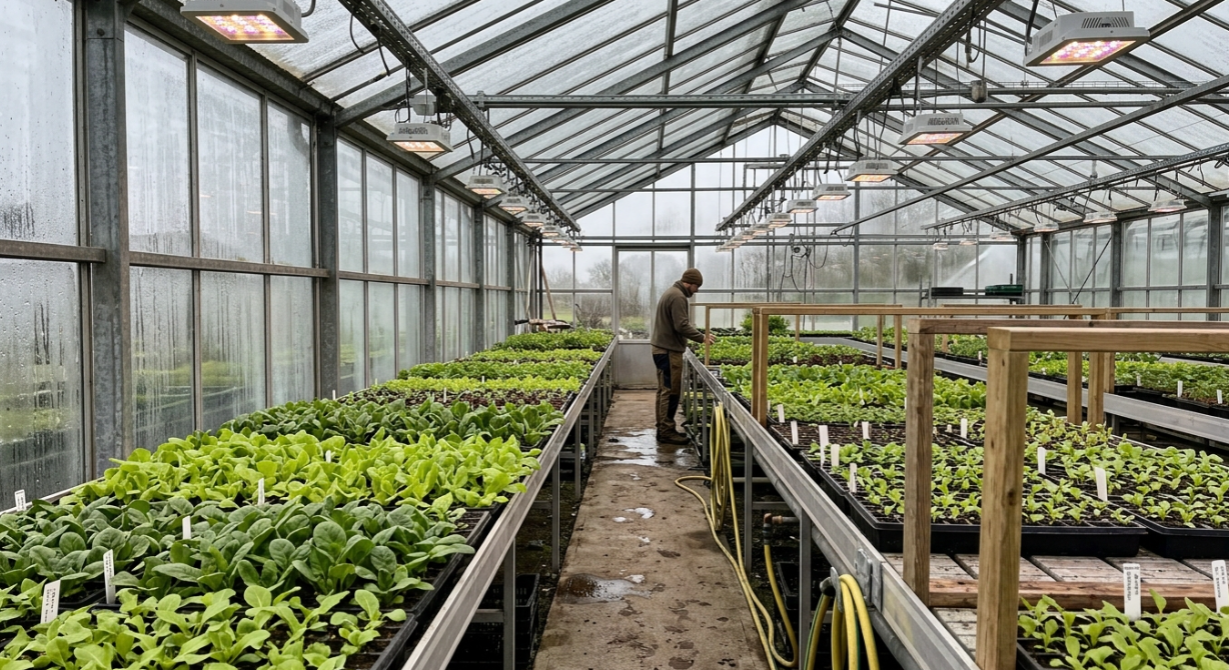
Outdoor DLI ranges from roughly 5 mol/m²/d on a cloudy winter day in the northern United States to about 60 mol/m²/d on a cloudless summer day. That’s a twelve-fold swing. In December, the average outdoor DLI is only 5 to 10 mol/m²/d in the 13 most northern states, and less than 5 mol/m²/d in western Washington.
After greenhouse transmission losses, a winter DLI of 5 mol/m²/d outdoors might deliver just 2.5 to 3 mol/m²/d at the canopy. For context, a minimum DLI of 13 mol/m²/d or greater is required to achieve desirable traits for high-wire vegetable transplants. That means northern greenhouses face a deficit of 10+ mol/m²/d for months at a time.
How to Measure Your Greenhouse’s Transmission
The practical method is straightforward. On a clear day around solar noon, take a PAR reading outside the greenhouse. Then take readings at several representative locations inside, at canopy height. Divide the average indoor reading by the outdoor reading.
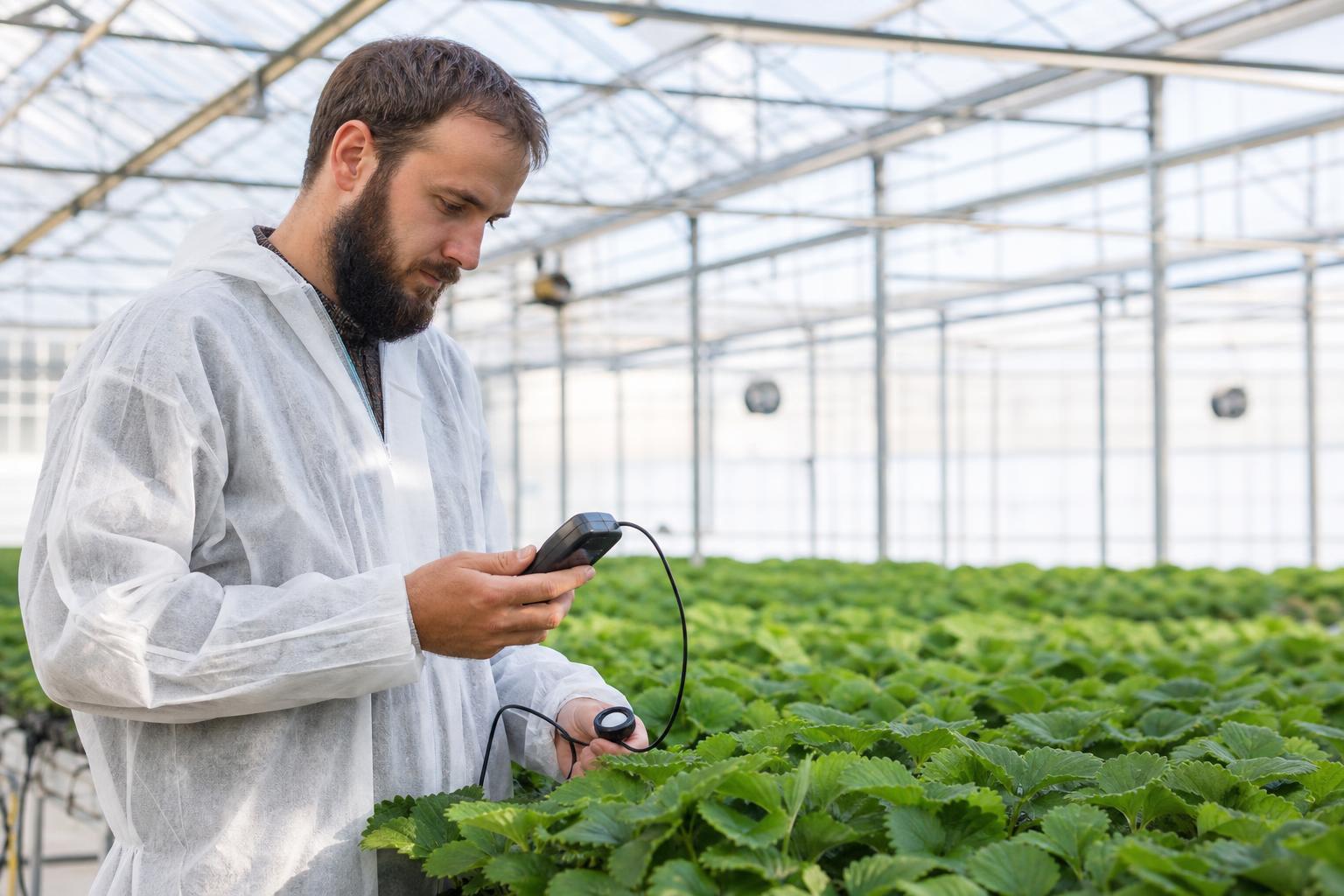
For example: outdoor PPFD of 1,510 µmol/m²/s, average indoor readings of 826 µmol/m²/s. That’s 826 ÷ 1,510 = approximately 55% transmission. Use a quantum sensor that reads in µmol/m²/s, not a lux meter. Quality PAR meters suitable for greenhouse applications start around $300 and can run up to $1,000. Less expensive meters are usually less accurate and often read in photometric units like foot-candles, which measure light as the human eye sees it, not as plants use it.
Greenhouse DLI Calculator: Worked Example
Suppose a greenhouse lettuce grower has these conditions:
Variable | Example value |
|---|---|
Outdoor January DLI | 12 mol/m²/d |
Greenhouse transmission | 50% |
Lettuce target DLI | 15 mol/m²/d |
Supplemental lighting duration | 16 hours/day |
Step 1: Calculate Natural Greenhouse DLI
12 × 0.50 = 6 mol/m²/d
The crop receives an estimated 6 mol/m²/d from sunlight.
Step 2: Calculate the DLI Deficit
15 − 6 = 9 mol/m²/d
The greenhouse therefore has a 9 mol/m²/d deficit.
Step 3: Convert the Deficit to Supplemental PPFD
9 ÷ (16 × 0.0036) = 156 µmol/m²/s
The supplemental lighting system therefore needs to provide approximately 156 µmol/m²/s at crop height if it operates for 16 hours per day.
Step 4: Verify the Result
156 × 16 × 0.0036 = 8.99 mol/m²/d
The supplemental system supplies approximately 9 mol/m²/d.
Step 5: Check the Total
6 natural DLI + 9 supplemental DLI = 15 mol/m²/d
The combined light level reaches the selected crop target.
This calculation estimates the required average PPFD at canopy height. Fixture spacing, mounting height, optics, dimming and uniformity still need to be considered when designing the actual lighting layout.
How Much Light Does a Greenhouse Lose?
A greenhouse does not receive all of the outdoor PAR measured above the structure. Light can be reduced by the greenhouse covering, framing, equipment, condensation, dirt, aging materials and the angle of incoming sunlight.
The correct transmission percentage therefore depends on the specific greenhouse rather than one universal number.
How to Calculate Your Greenhouse's Light Transmission
Take a PPFD measurement outside the greenhouse and then take several measurements at representative crop locations inside.
Use:
Greenhouse transmission (%) = Average indoor PPFD ÷ Outdoor PPFD × 100
For example:
Outdoor PPFD: 1,510 µmol/m²/s
Average indoor PPFD: 826 µmol/m²/s
826 ÷ 1,510 × 100 = 54.7%
The measured transmission in this example is approximately 55%.
Take multiple readings rather than relying on one location. Structural members, hanging equipment and greenhouse geometry can create significant differences across the growing area.
Why Measuring Is Better Than Guessing
A manufacturer's covering specification describes the material under specified test conditions. Your actual crop receives light after the effects of the entire greenhouse structure and operating environment.
For lighting-system design, measured canopy-level PPFD is therefore more useful than relying on a generic transmission assumption.
PPFD to DLI Calculator: Quick Reference
For constant-output supplemental lighting, use:
DLI = PPFD × hours × 0.0036
PPFD | 12 hours | 14 hours | 16 hours | 18 hours |
|---|---|---|---|---|
100 | 4.3 | 5.0 | 5.8 | 6.5 |
200 | 8.6 | 10.1 | 11.5 | 13.0 |
300 | 13.0 | 15.1 | 17.3 | 19.4 |
400 | 17.3 | 20.2 | 23.0 | 25.9 |
500 | 21.6 | 25.2 | 28.8 | 32.4 |
600 | 25.9 | 30.2 | 34.6 | 38.9 |
800 | 34.6 | 40.3 | 46.1 | 51.8 |
1,000 | 43.2 | 50.4 | 57.6 | 64.8 |
These values assume the stated PPFD remains constant for the entire lighting period.
For natural sunlight, use measured or modeled DLI rather than applying a single midday PPFD value to the formula.
How to Use a Greenhouse DLI Calculator: The Five-Step Process
This is where the greenhouse DLI calculator becomes a practical planning tool rather than a theoretical exercise.
Step 1: Find Your Outdoor DLI
Start with the outdoor DLI for your location. The interactive DLI maps developed by Jim Faust at Clemson University (originally created in 2002 and now updated with high-resolution data for all 50 states) let you click on your location to generate monthly DLI averages. These maps are the standard reference tool in commercial horticulture.
For this worked example, let’s say you’re a lettuce grower in central Ohio. In January, the outdoor average DLI is approximately 12 mol/m²/d.
Step 2: Measure or Estimate Your Greenhouse Transmission
You’ve measured your greenhouse and found 50% transmission (realistic for a double-poly structure with some equipment shadowing).
Step 3: Calculate Your Indoor DLI from Sunlight Alone
Indoor DLI = Outdoor DLI × Transmission Percentage
Indoor DLI = 12 × 0.50 = 6 mol/m²/d
Step 4: Find the Deficit
Your lettuce crop needs a DLI of 15 mol/m²/d for good growth and marketable quality.
Deficit = Target DLI − Indoor DLI
Deficit = 15 − 6 = 9 mol/m²/d
Step 5: Size Your Supplemental Lighting
You plan to run supplemental lights for 16 hours per day. How much PPFD do those fixtures need to deliver at canopy height?
Required PPFD = Deficit ÷ (Supplemental Hours × 0.0036)
Required PPFD = 9 ÷ (16 × 0.0036)
Required PPFD = 9 ÷ 0.0576 = 156 µmol/m²/s
That’s your fixture target at the canopy. When selecting and positioning fixtures, remember that light intensity falls off according to the inverse square law. Doubling the distance between a fixture and the canopy reduces PPFD to roughly one quarter of its original value. For a deeper walkthrough on choosing and positioning fixtures, see this guide on supplemental lighting for greenhouses.
Virginia Tech Extension summarizes it well: to deliver supplemental lighting correctly, you need the average monthly DLI, your lighting system’s PPFD at crop height, how much light is lost through the greenhouse covering and structure, and the desired DLI for your crop.
For greenhouse top lighting applications that need to close these kinds of deficits, the Altus 1K is built specifically for high-output supplemental and sole-source greenhouse lighting at 1050 watts.
Crop-Specific DLI Targets
A greenhouse DLI calculator is only useful if you know what number you’re aiming for. The table below compiles targets from university extension research and industry references. These are starting points, not absolute rules. As MSU’s Erik Runkle has pointed out, “there is no such thing as a DLI requirement” because most plants can grow under a range of conditions. The economically optimal DLI depends on your energy costs, CO₂ supplementation, temperature management, and cultivar.
Crop | Target DLI (mol/m²/d) | Notes |
|---|---|---|
Lettuce, leafy greens | 12–17 | Research shows iceberg lettuce fresh weight increased from 275 to 393 g as DLI rose from 8.6 to 11.5, but 14.4 mol/m²/d had a negative impact |
Herbs (basil, cilantro) | 12–18 | Basil benefits from higher DLI within this range |
Cucumbers | 20–30 | See the full cucumber lighting guide for stage-specific targets |
Peppers | 20–30 | See the full pepper lighting guide |
Tomatoes | 20–35 | Increasing DLI from 10 to 20 mol/m²/d significantly boosts fruit yield and sugar accumulation |
Ornamentals (general) | 10–20 | Wide variation by species |
Cannabis (vegetative) | 20–40 | See the cannabis DLI guide for stage breakdowns |
Cannabis (flower) | 35–50+ | Higher targets require matching CO₂ and environmental controls |
The “correct” DLI is somewhat subjective and not a fixed value. Managing DLI involves added costs, so the economic considerations of adjusting light levels are just as important as the target itself. For more on the financial side, see our greenhouse lighting payback guide.
Outdoor DLI vs. Greenhouse DLI: What's the Difference?
Outdoor DLI represents the amount of photosynthetic light available outside the greenhouse. Greenhouse DLI represents the amount that actually reaches the crop after light is reduced by the greenhouse covering and structure.
For example:
Outdoor DLI | Transmission | Estimated Greenhouse DLI |
|---|---|---|
10 | 50% | 5 |
15 | 50% | 7.5 |
20 | 50% | 10 |
25 | 50% | 12.5 |
30 | 50% | 15 |
40 | 50% | 20 |
The table assumes 50% transmission and is intended only as a planning example.
This distinction is important because a DLI map value should not automatically be treated as the DLI received by plants inside a greenhouse.
PPFD-to-DLI Quick Reference Table
For growers running constant-output electric lights, this table lets you skip the math. All values are in mol/m²/d, calculated using DLI = PPFD × hours × 0.0036.
PPFD (µmol/m²/s) | 12 hours | 14 hours | 16 hours | 18 hours |
|---|---|---|---|---|
100 | 4.3 | 5.0 | 5.8 | 6.5 |
200 | 8.6 | 10.1 | 11.5 | 13.0 |
300 | 13.0 | 15.1 | 17.3 | 19.4 |
400 | 17.3 | 20.2 | 23.0 | 25.9 |
500 | 21.6 | 25.2 | 28.8 | 32.4 |
600 | 25.9 | 30.2 | 34.6 | 38.9 |
A useful illustration: a cannabis plant under 600 PPFD for 18 hours receives the same daily light dose (38.9 mol/m²/d) as a plant under 900 PPFD for 12 hours. Same DLI, very different intensity and duration. Research from the University of Georgia suggests this distinction matters, too. Longer photoperiods at lower intensity can increase daily electron transport through photosystem II in lettuce, meaning the plant uses the light more efficiently. Delivering DLI over a longer, gentler window can be more energy-efficient than blasting plants with high PPFD for fewer hours.
Common Mistakes When Using a Greenhouse DLI Calculator
1. Confusing PPFD with DLI
A fixture spec sheet might say “1,000 µmol/m²/s,” but that tells you nothing about daily light delivery without knowing the run time. Practitioners on Reddit frequently point out that new growers fixate on peak PPFD numbers without ever calculating whether their actual DLI hits the crop target. A fixture delivering 400 PPFD for 16 hours (23.0 DLI) delivers more total light than one at 600 PPFD running only 10 hours (21.6 DLI).
2. Ignoring Greenhouse Transmission Losses
The DLI maps show outdoor values. If you look up your location and see 25 mol/m²/d in June, you might think you’re fine for tomatoes. But after 45% transmission loss, you’re actually at about 13.8 mol/m²/d at the canopy. That’s a deficit of 6 to 20 mol/m²/d depending on your target. Always apply your greenhouse’s measured transmission percentage before comparing to crop targets.
3. Using Lux or Foot-Candles Instead of PPFD
One grower on a popular cultivation forum captured the frustration perfectly: “I just bought a lux meter and went through the details… I am stuck at converting my LUX to PPFD and then to DLI. It seems like my math is way off.” Lux and foot-candles measure light as the human eye perceives it. Plants don’t have human eyes. The spectral weighting is completely different. Always measure in µmol/m²/s and calculate DLI from there.
4. Sizing for the Average Month Instead of the Worst Month
A greenhouse in a northern climate may receive adequate natural DLI in summer but drop to 3 to 5 mol/m²/d in winter. Growers who size supplemental lighting for average annual conditions rather than lowest-light months will underperform for a significant portion of the year. Use your worst month’s DLI data to size the system, and dim or turn off fixtures when summer sunlight is sufficient. For more detail on scheduling supplemental light throughout the year, see the greenhouse lighting schedule guide.
5. Over-Lighting Without Matching Environmental Controls
More light is not always better. Providing excessive DLI without proper environmental controls can stress plants and actually reduce yields. Symptoms include leaf bleaching, stunted growth, and increased susceptibility to pests and diseases. High-DLI strategies only work when temperature, humidity, and CO₂ are managed to match. The iceberg lettuce research cited above is a clear example: DLI of 14.4 mol/m²/d actually reduced fresh weight compared to 11.5 mol/m²/d.
6. Forgetting the Lower Canopy
Most DLI discussions focus on what arrives at the top of the canopy. But within the canopy itself, DLI drops sharply. Lower bud sites, lower fruit trusses, and lower leaves can receive a fraction of the light measured at the top. This is its own DLI problem. Under-canopy LED lighting addresses this specific gap, and growers using dedicated under-canopy fixtures like the Boost XE have documented meaningful yield gains in the lower canopy.
Related Terms
PAR (Photosynthetically Active Radiation): The range of light wavelengths (400 to 700 nm) that plants use for photosynthesis. DLI measures the daily accumulation of PAR. For a deeper look at how different wavelengths within this range affect growth, see this summary of light spectra impact.
PPFD (Photosynthetic Photon Flux Density): The instantaneous measurement of PAR intensity, in µmol/m²/s. PPFD is the input to the DLI formula.
Photoperiod: The number of hours per day that a plant receives light. In greenhouse DLI calculations, this includes both natural daylight hours and supplemental lighting hours.
Micromole (µmol): One millionth of a mole. PPFD is measured in micromoles of photons per square meter per second.
Supplemental Lighting: Electric lighting used in greenhouses to close the gap between available sunlight DLI and the crop’s target DLI.
Ready to close your greenhouse’s DLI gap? Contact a lighting specialist to discuss fixture sizing, layout, and available utility rebates for your project.
Frequently Asked Questions
What is a good DLI for a greenhouse?
It depends entirely on the crop. Leafy greens and herbs do well at 12 to 17 mol/m²/d. Tomatoes, cucumbers, and peppers typically need 20 to 35 mol/m²/d. Cannabis in flower often targets 35 to 50+ mol/m²/d. These are starting points that should be adjusted based on your cultivar, CO₂ levels, temperature, and economic constraints.
How do I calculate DLI from PPFD?
Multiply your PPFD reading (in µmol/m²/s) by the number of hours the light is on, then multiply by 0.0036. For example, 400 PPFD for 16 hours: 400 × 16 × 0.0036 = 23.0 mol/m²/d. This works for constant-output electric lights. For fluctuating sunlight, you need logged data or DLI map averages rather than a single PPFD reading.
Why does my greenhouse DLI calculator need a transmission percentage?
Because greenhouse glazing, structural members, and equipment block a significant amount of incoming sunlight. Real-world greenhouse transmission is typically only 40% to 65% of outdoor light. Without applying this factor, your greenhouse DLI calculator will overestimate how much natural light your plants actually receive, leading you to under-size your supplemental lighting.
Can I use a lux meter to calculate DLI?
Not directly. Lux measures light as the human eye perceives it, weighting green and yellow wavelengths heavily. Plants use a different spectrum. You need a quantum sensor that reads in µmol/m²/s (PPFD). Some growers attempt lux-to-PPFD conversions using published factors, but these factors vary by light source and introduce significant error. Invest in a proper PAR meter if you’re making lighting decisions based on the numbers.
Should I size supplemental lighting for winter or for the annual average?
Size for the worst month, not the average. A greenhouse in Michigan might receive adequate DLI from May through September but drop to 3 to 5 mol/m²/d inside during December and January. If you size your fixtures for average conditions, you’ll be under-lit for the months when supplemental lighting matters most. You can always dim or switch off fixtures during high-light months.
How often should I re-measure my greenhouse’s light transmission?
At least once a year, and ideally at the start of each growing season. Glazing degrades over time. Film coverings yellow, polycarbonate hazes, and dirt accumulates. A greenhouse that transmitted 70% of PAR when new might drop to 55% within a few years. Re-measuring ensures your greenhouse DLI calculator inputs stay accurate and your supplemental lighting is still adequately sized.
What is the difference between a greenhouse DLI calculator and an indoor DLI calculator?
A basic indoor DLI calculator only needs two inputs: PPFD and photoperiod. A greenhouse DLI calculator must also account for outdoor DLI (which varies by location, season, and weather), glazing transmission losses, and the gap between natural light and the crop’s target. The greenhouse version is fundamentally a deficit calculator that tells you how much supplemental light to add on top of what the sun provides.