Greenhouse Lighting Schedule: 9 Steps to Hit DLI (2026)
Greenhouse Lighting Schedule made simple: hit DLI using PPFD, transmission, and off-peak windows. Learn the 4-step formula and examples.
TL;DR
A greenhouse lighting schedule is the plan for when and how long supplemental grow lights run to hit a crop’s Daily Light Integral (DLI) target. There is no universal “hours on” answer. The right schedule starts with the crop’s DLI requirement, subtracts the sunlight that actually reaches the canopy inside the greenhouse, and fills the gap with supplemental light, usually in morning and evening hours. Photoperiod requirements, energy costs, and crop stage all shape the final plan.
Quick Answer: Greenhouse Lighting Schedule Cheat Sheet
Crop | Typical Daily Light Target | Common Supplemental Schedule |
|---|---|---|
Lettuce | 8-17 mol·m⁻²·d⁻¹ | 4-12 supplemental hours |
Tomatoes | 15-30+ mol·m⁻²·d⁻¹ | 6-14 supplemental hours |
Seedlings | 10-12 mol·m⁻²·d⁻¹ | 8-12 supplemental hours |
Cannabis (Vegetative) | 20-40 mol·m⁻²·d⁻¹ | 16-18-hour photoperiod |
Cannabis (Flowering) | 25-50 mol·m⁻²·d⁻¹ | 12-hour light, 12-hour dark |
Ornamentals | Crop-dependent | Day extension or night interruption |
Key takeaway: A greenhouse lighting schedule should be based on the crop's Daily Light Integral (DLI), not on a fixed number of hours. Most commercial greenhouses run supplemental lights during early morning and evening hours to reach a daily DLI target while minimizing electricity costs.
What Is a Greenhouse Lighting Schedule?
A greenhouse lighting schedule is the operating plan that controls when supplemental grow lights turn on, how long they run, and (in more advanced setups) how bright they operate to deliver the crop’s required daily light. It is not a fixed timer recipe. It changes by crop, crop stage, location, greenhouse design, and season.
The concept sounds straightforward, but it carries real complexity. A greenhouse lighting schedule that works in a Michigan winter will waste electricity in a Georgia summer. A schedule built for lettuce will under-light tomatoes and potentially ruin the flowering cycle of a photoperiod-sensitive cannabis cultivar.
What makes a greenhouse lighting schedule different from an indoor grow schedule is sunlight. Greenhouses have it, and it varies constantly. Cloud cover, season, glazing condition, shade cloth, hanging baskets, and even neighboring buildings all change how much usable light reaches the canopy on any given day. The best schedules respond to conditions rather than ignoring them.
If your operation needs help translating crop DLI targets into a workable lighting plan, talk to a lighting specialist before investing in equipment.
Why Greenhouse Lighting Schedules Are Based on DLI, Not Hours
The most common question growers ask is “how many hours should my greenhouse lights be on?” That question, asked alone, misses the point. Hours tell you how long lights ran. They do not tell you whether the crop received enough light.
The correct foundation for any greenhouse lighting schedule is DLI, or Daily Light Integral. DLI is the total accumulated photosynthetically active radiation (PAR) a crop receives over a full day, measured in mol·m⁻²·d⁻¹. Plant-production research defines it as the daily sum of PAR at the plant canopy.
If the units are unfamiliar, a micromole explainer covers the measurement basics.
Two greenhouses can run lights for 12 hours and deliver wildly different DLIs, because intensity matters as much as duration. A fixture producing 100 µmol·m⁻²·s⁻¹ for 12 hours delivers half the supplemental DLI of a fixture producing 200 µmol·m⁻²·s⁻¹ for the same period.
PPFD (Photosynthetic Photon Flux Density) is the instantaneous intensity measure. DLI is the accumulation of that intensity over time. The relationship between them is simple:
DLI = PPFD × hours × 0.0036
For a deeper look at how DLI targets are established and measured in greenhouses, see this DLI calculations guide.
Greenhouse Transmission: The Number Most Growers Miss
Building a schedule from outdoor sunlight data alone is a mistake. Glazing type, structural elements, shade cloth, condensation, and hanging equipment all reduce light before it reaches the crop. The real question is how much outdoor sun actually gets through.
Many commercial greenhouses transmit roughly 60 to 70% of outdoor light. Some older or heavily shaded structures transmit less. The practical method is to measure PAR just above the crop inside the greenhouse and compare it to outside readings on the same day.
If outdoor winter DLI is 10 mol·m⁻²·d⁻¹ and the greenhouse transmits 60%, the crop receives about 6 mol·m⁻²·d⁻¹ from sunlight. The remaining gap between that number and the crop’s target is what the greenhouse lighting schedule needs to fill.
The Greenhouse Lighting Schedule Formula
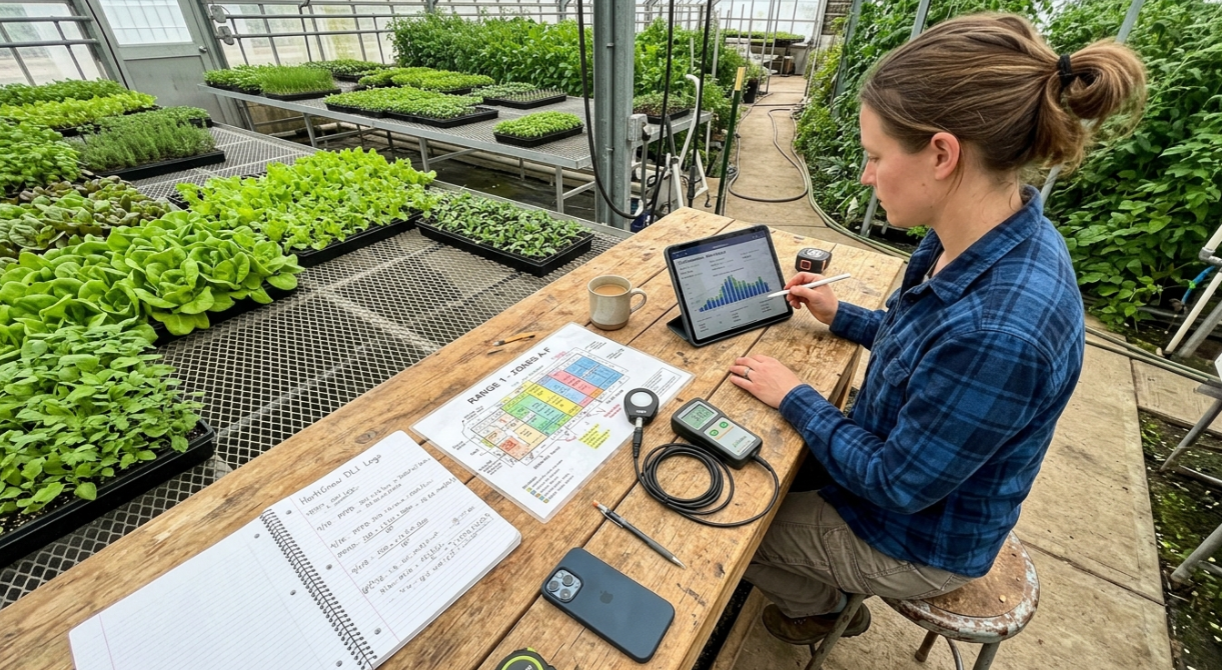
The core calculation is four steps.
Step 1: Pick the crop’s target DLI. Use crop research, Extension recommendations, or production data. Targets vary widely. Lettuce may need 8 to 17 mol·m⁻²·d⁻¹, while tomatoes can require 15 to 30 or more.
Step 2: Estimate inside solar DLI. Multiply average outdoor DLI for your location and month by your greenhouse transmission percentage.
Step 3: Calculate the DLI deficit. Supplemental DLI needed = target DLI minus inside solar DLI.
Step 4: Convert the deficit into lighting hours. Use the inverse formula:
Hours = supplemental DLI needed ÷ (fixture PPFD at canopy × 0.0036)
UNH Extension’s run-time worksheet uses this exact logic for greenhouse supplemental lighting calculations.
Worked Example: Winter Lettuce
Lettuce target DLI: 14 mol·m⁻²·d⁻¹
Outdoor winter DLI: 10 mol·m⁻²·d⁻¹
Greenhouse transmission: 60%
Inside solar DLI: 6 mol·m⁻²·d⁻¹
Supplemental DLI needed: 8 mol·m⁻²·d⁻¹
Fixture PPFD at canopy: 200 µmol·m⁻²·s⁻¹
Required lighting hours: 8 ÷ (200 × 0.0036) = 11.1 hours per day
Virginia Tech’s greenhouse lettuce example reaches approximately 11 hours per day using this same deficit logic and intensity level.
This formula also exposes a key design tradeoff. If your available lighting window is only 8 hours instead of 11, you need higher fixture intensity to deliver the same supplemental DLI. For a full walkthrough of sizing supplemental lighting across different crops, see this guide on greenhouse supplemental lighting.
Greenhouse Lighting Schedule by Season
Many growers use the same schedule year-round, but seasonal sunlight changes make that inefficient.
Season | Typical Schedule Adjustment |
|---|---|
Winter | Maximum supplemental lighting |
Spring | Reduce run time as natural DLI increases |
Summer | Supplemental lighting may be unnecessary |
Fall | Gradually increase supplemental hours |
Winter
Winter produces the largest DLI deficits. Northern greenhouses often require 8-12 hours of supplemental lighting.
Spring
As solar intensity increases, many growers shorten lighting windows and shift to sensor-based controls.
Summer
Natural sunlight frequently supplies enough DLI for most crops. Supplemental lighting is often unnecessary.
Fall
Many operations gradually increase supplemental lighting to compensate for declining sunlight.
Photoperiod Lighting vs Supplemental Lighting
A greenhouse lighting schedule serves two fundamentally different purposes, and confusing them is one of the most common errors in greenhouse production.
Photosynthetic supplemental lighting uses moderate to high intensity to increase the crop’s DLI. It drives actual growth. It runs during low-light windows, such as early morning, late evening, and overcast days, and delivers real photosynthetic energy.
Photoperiodic lighting uses low-intensity light to change how plants perceive day length. It controls flowering, dormancy, and vegetative state in sensitive crops but adds almost no meaningful DLI. Greenhouse Grower explains that photoperiodic lighting creates long-day responses while supplemental lighting increases the crop’s total daily light.
Practitioners on a Growers Network forum make the same point from a practical angle: DLI maintenance and photoperiod extension are the two distinct jobs a greenhouse lighting schedule performs. Getting clear on which job you are solving prevents expensive mistakes.
Photoperiodic Lighting | Supplemental Lighting | |
|---|---|---|
Purpose | Control flowering or day length | Increase DLI and growth |
Intensity | Low (often under 10 µmol·m⁻²·s⁻¹) | Moderate to high (100+ µmol·m⁻²·s⁻¹) |
Timing | Day extension or night interruption | Morning, evening, cloudy periods |
Adds meaningful DLI? | Usually no | Yes |
Common mistake | Expecting it to grow the crop | Running it like a photoperiod lamp |
For greenhouse cannabis and ornamental growers, this distinction is critical. A detailed photoperiod lighting guide covers the scheduling specifics for sensitive crops.
Common Greenhouse Lighting Schedule Types
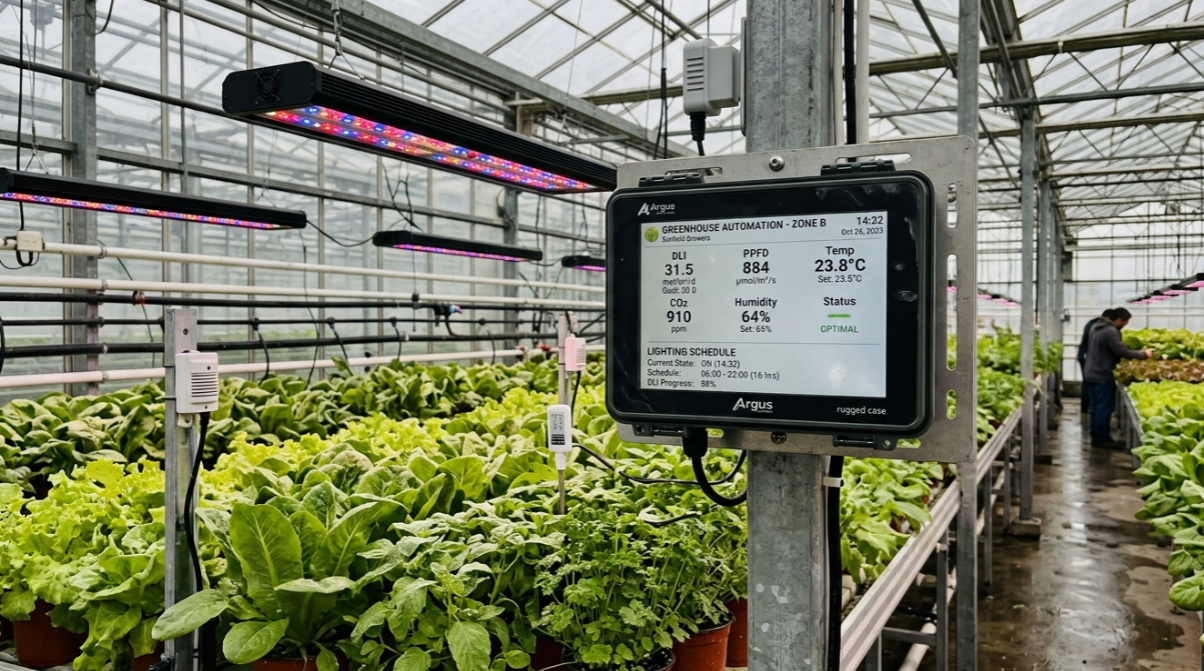
Not all greenhouses use the same scheduling approach. The right type depends on crop sensitivity, facility scale, available controls, and budget.
Schedule Type | How It Works | Best For | Watch Out For |
|---|---|---|---|
Fixed timer | Lights run set hours daily | Simple setups, hobby greenhouses | Wastes power on sunny days, under-lights on cloudy days |
Split-day | Lights before sunrise and after sunset, off midday | Commercial winter supplemental lighting | Must still hit DLI target by end of day |
Sensor-based threshold | Lights activate when PPFD falls below a setpoint | Greenhouses with environmental controllers | Bad sensor placement creates bad decisions |
DLI-to-target | Controller tracks accumulated DLI and dims or shuts off lights when target is met | Energy-conscious commercial operations | Needs reliable sensors and properly commissioned controls |
Photoperiod extension | Low-intensity light extends perceived day length | Long-day crops, vegetative-hold crops | Adds little DLI if intensity is low |
Night interruption | Lights run mid-night (often 10 p.m. to 2 a.m.) to break dark period | Creating long-day response with less total run time | Wrong timing can fail to control flowering |
Blackout / light deprivation | Curtains shorten perceived day or protect dark period | Short-day crops, cannabis flowering | Light leaks disrupt sensitive cultivars |
DLI carryover | Controller reduces next-day target after a high-sun day | Advanced leafy green scheduling | Crop-specific; do not generalize |
Virginia Tech confirms that supplemental systems typically operate in morning and evening rather than during sunny midday. The University of Arkansas describes night interruption, traditionally run from 10 p.m. to 2 a.m., as well as cyclic lighting of 5 to 10 minutes per hour during the dark period.
The DLI carryover concept is worth noting for commercial lettuce operations. Research found that excess DLI from a sunny day can reduce the following day’s supplemental requirement within limits, with estimated annual energy savings of 75 to 190 MWh/ha across five U.S. locations. This approach requires crop-specific validation and should not be applied broadly.
Practitioners on Reddit and hydroponics forums frequently recommend sensor-based and DLI-to-target schedules over fixed timers. As one grower put it, a PAR sensor tied to controls removes most of the guesswork from greenhouse lighting decisions. DLI-based controls can deliver 20 to 40% energy savings by modulating fixture output in response to available sunlight, according to the Resource Innovation Institute.
Example 24-Hour Greenhouse Lighting Schedule
Time | Lighting Activity |
|---|---|
5:00 a.m.-8:00 a.m. | Supplemental lights ON |
8:00 a.m.-4:00 p.m. | Sunlight only |
4:00 p.m.-8:00 p.m. | Supplemental lights ON |
10:00 p.m.-2:00 a.m. | Night interruption (photoperiod lighting only) |
Important: This is an example schedule, not a universal recommendation. Always calculate supplemental lighting based on your crop's DLI target.
Example Greenhouse Lighting Schedules by Crop
These are planning ranges, not prescriptions. Every greenhouse differs in transmission, climate zone, cultivar, and production goals.
Crop or Stage | Typical Scheduling Logic | DLI Range (mol·m⁻²·d⁻¹) |
|---|---|---|
Lettuce and leafy greens | Moderate PPFD over longer window, avoid excess-light stress | 8 to 17 |
Tomato and vine crops | Higher DLI target, winter supplemental light usually needed | Minimum ~15, optimum can exceed 30 |
Young plants and propagation | Consistent daily light for rooting, uniformity, and timing | 10 to 12 target commonly cited |
Cannabis vegetative / mothers | Long photoperiod and DLI management | 20 to 40 |
Cannabis flowering | Strict dark period plus DLI target | 25 to 50 |
Ornamentals | Often photoperiod control first, low-intensity day extension or night interruption | Crop-dependent |
Lettuce and Leafy Greens
Leafy greens have relatively low DLI demands, typically 8 to 14 mol·m⁻²·d⁻¹, with 17 identified as a practical ceiling for leaf lettuce before tipburn and other physiological issues become a risk. Greenhouse lighting schedules for lettuce often use moderate intensity over a longer window rather than pushing high PPFD for shorter periods.
The exact target depends on cultivar, growth stage, temperature, humidity, airflow, and calcium movement. For cultivar-specific guidance, see this lettuce lighting guide.
Tomatoes and Vine Crops
Fruiting crops need substantially more light. Tomatoes tolerate a minimum DLI of about 15 mol·m⁻²·d⁻¹, but optimum production targets can exceed 30. That means larger winter light deficits and either more supplemental hours, higher fixture intensity, or both.
A longer lighting window reduces the required installed PPFD, but the economics depend on crop value, power price, and photoperiod tolerance. A common rule of thumb for vegetable crops is that a 1% increase in DLI can produce roughly a 1% increase in growth, up to a saturation point.
Young Plants and Propagation
Young plants produced from December through March in northern greenhouses may experience solar DLI as low as 1 to 12 mol·m⁻²·d⁻¹. Research cited by Greenhouse Grower recommends a target of 10 to 12 mol·m⁻²·d⁻¹ for young plants, noting that hitting this target can reduce plug and liner production time by 25 to 50%.
The scheduling priority here is consistency and timing, not maximum light. The goal is enough daily light to build roots and drive uniform growth without stretching or delaying turns.
Cannabis
Cannabis greenhouse lighting schedules must manage both DLI and photoperiod simultaneously, and the balance shifts with crop stage. The Resource Innovation Institute lists stage-specific DLI targets: 15 to 20 for clones and seedlings, 20 to 40 for vegetative and mother plants, and 25 to 50 for flowering. Greenhouse supplemental lighting hours vary significantly by region, from 6 to 8 hours in northern locations to 1 to 3 hours in southern locations for vegetative plants.
Flowering photoperiod cultivars need a reliable, uninterrupted dark period. The lighting schedule is not just a DLI tool for cannabis; it is crop-stage control.
For commercial greenhouse and cannabis top-lighting applications, the Altus 1K is designed for high-output supplemental and sole-source lighting.
Ornamentals and Photoperiod-Sensitive Crops
For many ornamental crops, the “lighting schedule” is really a flowering-control schedule. Long-day responses can be created through day-extension lighting or night interruption. Short-day responses require blackout systems and protection from stray light.
Oregon State Extension points out that many plants respond to uninterrupted darkness rather than day length itself. This is why even brief light during the dark period can disrupt flowering in short-day crops. Low-intensity photoperiodic lighting can change plant development while adding very little DLI, which is useful when the goal is flowering control but not a substitute for supplemental growth light.
Tools You'll Need to Create a Greenhouse Lighting Schedule
PAR meter
Quantum sensor
DLI calculator
PPFD map
Greenhouse transmission measurements
Environmental controller
Light timer
Utility rate schedule
Without canopy-level measurements, it is almost impossible to create an accurate greenhouse lighting schedule.
How to Build a Greenhouse Lighting Schedule
Identify the crop and stage. DLI targets and photoperiod requirements vary by species and growth phase.
Set the target DLI. Use research, Extension publications, or production data for your specific crop.
Measure inside sunlight. Use a PAR meter at canopy height inside the greenhouse. Calculate your actual greenhouse transmission. Do not rely on outdoor weather data alone.
Measure fixture PPFD at canopy. Map the light your fixtures deliver where the plants actually grow.
Calculate the DLI deficit. Target DLI minus inside solar DLI equals the supplemental gap.
Determine the allowed photoperiod. Some crops cannot tolerate extended lighting windows. Others are flexible. University of Arkansas advises that supplemental light generally should not exceed 16 to 18 hours per day.
Schedule lights during low-sun or low-cost windows. Morning and evening hours are usually better than sunny midday for supplemental lighting. Off-peak electricity rates can reduce operating cost significantly.
Consider controls and sensors. Use at least two sensors per lighting zone, avoid shaded sensor locations, and add time delays so lights and shade systems do not cycle every time a cloud passes.
Recheck crop response and adjust. Monitor growth, quality, and uniformity. A schedule is a starting point, not a permanent setting.
Energy Costs Shape the Schedule Too
A greenhouse lighting schedule affects more than crop growth. It directly impacts energy bills. Demand charges, based on peak power draw during a billing period, can add thousands of dollars per month for large operations. Off-peak electricity supply savings can reach as much as 40% in some utility structures. Scheduling lights during lower-cost windows and using dimming controls helps manage these charges. For strategies on reducing greenhouse energy costs, including HVAC integration, see the linked guide.
Many utility territories also offer lighting rebates for qualified LED equipment that can offset upfront project costs.
Greenhouse Lighting ROI Example
Strategy | Annual Energy Cost | Crop Yield |
|---|---|---|
Fixed timer | Higher | Moderate |
Sensor-based control | Lower | Higher |
DLI-target control | Lowest | Highest |
Example:
A greenhouse that reduces lighting energy consumption by 20% while maintaining crop targets can significantly reduce annual operating costs.
Common Greenhouse Lighting Schedule Mistakes
Copying another grower’s schedule or PPFD target. A lighting practitioner on LinkedIn made this point directly: a winter greenhouse in one region may receive 1 to 3 mol per day at canopy while another receives 6 to 8, so a blanket PPFD target copied across regions will be wrong. Start with your own inside DLI data.
Measuring outdoor sunlight but not inside canopy light. Greenhouse transmission losses are real and variable. If you do not measure inside the structure, your schedule is based on assumptions.
Confusing photoperiod light with growth light. Photoperiod lighting controls flowering and vegetative responses at very low intensity, but it does not meaningfully increase DLI. Practitioners on Reddit reinforce this: in one greenhouse forum discussion, a user explained that lights often just extend perceived day length rather than provide real growth energy, and another warned that patio-style lights lack the output for actual plant growth.
Running supplemental lights at sunny midday. If natural sunlight already meets the crop’s needs, supplemental light adds cost without adding value. Schedule lights for early morning, late evening, or overcast periods.
Ignoring electricity demand charges. Even among the hours you do use, timing matters. Peak demand charges can represent a major portion of the monthly bill for large-scale greenhouse lighting.
Using one sensor in a bad location. A single sensor in a shaded corner misrepresents the light reaching most of the crop. Best practice is multiple sensors per zone, positioned to represent average canopy conditions.
Extending hours without checking photoperiod sensitivity. Not every crop tolerates a long lighting window. Some will flower early, flower late, or show quality defects under the wrong photoperiod.
Buying equipment before knowing your DLI deficit. In a Reddit thread about commercial cannabis greenhouse lighting, experienced growers pushed back against fixture recommendations that started with brand rather than data. The first question should always be: what is your DLI inside the greenhouse on cloudy days?
When to Work With a Lighting Designer
A simple timer-based schedule for a hobby greenhouse does not need professional design. But for commercial production, the schedule is one piece of a larger system that includes fixture selection, layout, electrical infrastructure, HVAC impact, controls, and energy economics.
Consider professional lighting design when:
You are lighting more than a small hobby greenhouse
You need reliable winter production or year-round consistency
You grow high-value crops where DLI directly affects yield and revenue
You need photoperiod control, uniformity mapping, or ROI modeling
You are retrofitting from legacy lighting to LEDs
You want to qualify for utility rebates and incentives
Your electrical infrastructure needs assessment or upgrade
A complete commercial lighting plan should show target DLI, expected PPFD distribution, photoperiod constraints, fixture layout, uniformity, electrical requirements, heat load, and projected operating cost. A good plan pays for itself by preventing the mistakes described above.
Schedule a free consultation to discuss greenhouse lighting schedules, DLI targets, and project economics with a specialist.
FAQ
How many hours should greenhouse grow lights be on?
There is no universal number. Calculate your crop’s supplemental DLI deficit, then divide by your fixture’s canopy-level PPFD times 0.0036. For example, an 8 mol·m⁻²·d⁻¹ deficit with fixtures delivering 200 µmol·m⁻²·s⁻¹ requires about 11 hours. The actual answer depends on crop target, greenhouse transmission, season, and fixture output.
Should greenhouse lights run during the day or at night?
For photosynthetic supplemental lighting, morning and evening are usually better than sunny midday because the crop already receives sufficient natural light during peak hours. For photoperiod control, lights may run after sunset, before sunrise, or during a 10 p.m. to 2 a.m. night-interruption window.
What is the difference between DLI and photoperiod?
DLI is the total daily amount of plant-usable light, measured in mol·m⁻²·d⁻¹. Photoperiod is the length of light and dark periods in a 24-hour cycle. DLI drives growth potential. Photoperiod controls developmental responses like flowering in sensitive crops. A plant can receive its full DLI in 12 hours or 16 hours, but those two photoperiods may trigger completely different flowering responses.
Is 18 hours of light good for greenhouse plants?
It depends entirely on the crop. Some species tolerate long lighting windows, while others have strict photoperiod responses or develop quality problems from excessive light hours. University of Arkansas advises that supplemental light generally should not exceed 16 to 18 hours per day, noting that 24-hour lighting can be harmful to many plants.
What is a good greenhouse lighting schedule for cannabis?
Cannabis lighting schedules depend on stage and cultivar. Typical DLI targets are 15 to 20 mol·m⁻²·d⁻¹ for clones and seedlings, 20 to 40 for vegetative and mother plants, and 25 to 50 for flowering. Flowering photoperiod cultivars require strict 12-hour dark periods. Greenhouse supplemental hours vary by latitude, available sunlight, and greenhouse transmission.
Do I need a PAR meter to set a greenhouse lighting schedule?
For commercial production, yes. Greenhouse lighting schedules depend on canopy-level PPFD and DLI measurements, and the human eye is not a reliable sensor for plant-usable light. Even an inexpensive quantum sensor is better than guessing.
Can excess DLI from a sunny day carry over to the next day?
In lettuce research, it can within limits. One study estimated 75 to 190 MWh per hectare in annual energy savings by applying a DLI carryover concept to greenhouse lettuce. This approach requires crop-specific validation and advanced controls. Do not apply it broadly without testing on your specific crop and cultivar.