Greenhouse Energy Savings: 2026 LED, HVAC & Rebate Guide
Discover Greenhouse Energy Savings in 2026: cut costs 10–25% with LED upgrades, smart controls, HVAC and thermal screens—plus rebate tips. Learn more.
TL;DR
Greenhouse energy savings refers to the measurable reduction in energy consumption and cost across all greenhouse systems, including lighting, heating, cooling, and ventilation. Lighting alone accounts for 30–50% of operating costs in supplementally-lit greenhouses, and switching from HPS to LED fixtures can cut lighting electricity by 24–30%. When you factor in HVAC reductions, thermal envelope improvements, smart controls, and utility rebates, total energy savings of 10–25% or more are achievable for most operations.
Quick Answer: How Can Greenhouses Reduce Energy Costs?
Most commercial greenhouses can reduce total energy consumption by 10% to 25%, with lighting electricity dropping 24% to 30% after switching from HPS to high-efficiency LED fixtures. Additional savings come from thermal screens, HVAC optimisation, DLI-based lighting controls, air sealing, and available utility rebates. For most operations, the fastest return comes from combining LED upgrades with smart lighting controls rather than relying on a single improvement.
Typical Savings by Upgrade
Upgrade | Typical Energy Savings | Difficulty | Typical ROI |
|---|---|---|---|
LED Lighting | 24–30% lighting electricity | Medium | High |
DLI-Based Dimming | Additional 20–30% lighting savings | Medium | High |
Thermal Screens | 30–50% heating savings | Medium | High |
Air Sealing | Up to 10% heating savings | Easy | High |
Centralised LED Drivers | Reduced HVAC load | Medium | Medium |
Smart HVAC Controls | 10–20% HVAC savings | Medium | Medium |
What Are Greenhouse Energy Savings?
Greenhouse energy savings is the measurable reduction in energy consumption and cost achieved through equipment upgrades, control strategies, structural improvements, and operational changes across every major greenhouse system. That includes lighting, heating, cooling, ventilation, and dehumidification.
The term gets used loosely, often as shorthand for “switching to LEDs.” But real greenhouse energy savings span the full energy budget. A lighting upgrade is the single biggest lever, yes, but it’s not the only one, and treating it as the whole story leads to incomplete planning and missed opportunities.
Why does lighting dominate the conversation? Because in many supplementally-lit operations, lighting uses more electricity than all other greenhouse processes combined. Over $1 billion was spent on horticultural lighting in the U.S. in 2019 alone. When a single line item commands that much budget, it naturally attracts the most attention.
But heating is the dominant cost in northern and high-latitude greenhouses. Cooling loads spike when legacy fixtures dump heat into the canopy zone. And structural losses through leaky glazing or absent thermal screens bleed energy around the clock. A serious approach to greenhouse energy savings addresses all of these, not just the fixtures hanging overhead.
Explore available rebates for greenhouse lighting projects before planning your upgrade timeline.
Where Greenhouse Energy Goes: The Cost Breakdown
Before you can reduce energy costs, you need to understand where the money actually goes. The breakdown shifts depending on climate, crop, and whether you run supplemental lighting, but the general pattern holds.
Lighting: 30–50% of operating costs. Research published in Energy Informatics and corroborated by industry sources consistently places electricity associated with greenhouse lighting at roughly 30% of total operating costs, with some cannabis and year-round produce operations pushing closer to 50%. Taylor Schaberg of ActiveGrow put it plainly in Greenhouse Grower: “Lighting, on average, is 50% of a commercial operation’s energy costs.”
Heating: 20–40%+ in cold climates. For operations in northern latitudes, heating can rival or exceed lighting as the top expense. In South Korean greenhouses, winter heating energy was estimated at 40% of total production cost. Canadian and northern U.S. operations face similar math.
Cooling and HVAC: variable but compounding. In facilities running HPS lighting, the cooling load from fixture heat alone can be enormous. This is where greenhouse energy savings compound: reduce fixture heat, and you reduce both the electricity bill and the HVAC bill simultaneously.
Dehumidification and ventilation are secondary but real costs, especially in sealed or semi-sealed environments where moisture management is critical.
For a deeper look at strategies for reducing operating expenses across production facilities, that guide walks through the broader cost picture.
Greenhouse Energy Savings by Climate
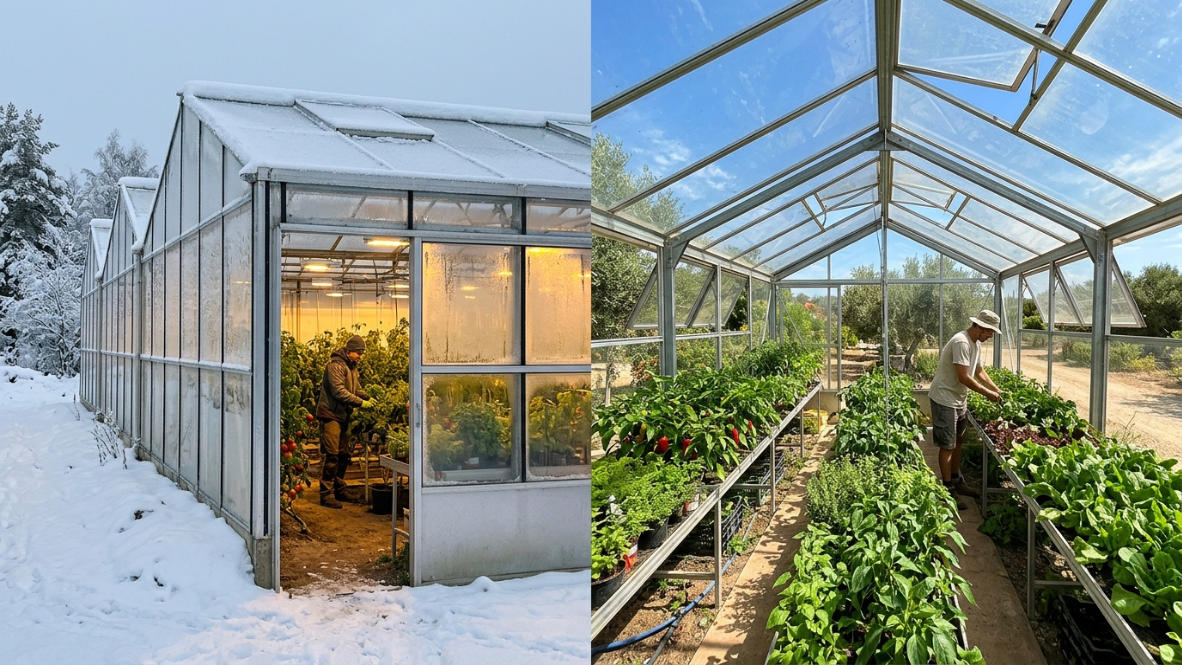
Different climates produce very different energy-saving opportunities.
Cold Climates
Examples:
Canada
Northern USA
Northern Europe
Primary savings come from:
LED lighting
Thermal screens
Better insulation
Heat recovery
Biggest concern:
Higher heating demand after switching from HPS.
Warm Climates
Examples:
Southern USA
Australia
Mediterranean
Primary savings come from:
LED lighting
Reduced HVAC cooling
Ventilation optimisation
Shade management
Biggest benefit:
Lower cooling loads.
Mixed Climates
Facilities with both hot summers and cold winters benefit from balancing lighting upgrades with automated environmental controls throughout the year.
Lighting: The Biggest Single Lever for Greenhouse Energy Savings
LED vs. HPS Efficacy
The core comparison is straightforward. Modern LED fixtures deliver 2.5–3.0 µmol/J of photon efficacy, compared to 1.7–1.9 µmol/J for HPS. That gap translates directly into electricity savings: the DOE’s Integrated Lighting Campaign documents a 24-to-30-percent reduction in electricity consumption when greenhouses switch from HPS to LED.
But efficacy numbers can be misleading if you don’t compare them correctly. Fixture-level efficacy, driver losses, and optical efficiency all matter. For a breakdown of the common mistakes when comparing LEDs to HPS, that post covers the pitfalls.
LED vs HPS Energy Savings Comparison
Feature | LED | HPS |
|---|---|---|
PPE | 2.5–3.0 µmol/J | 1.7–1.9 µmol/J |
Electricity Use | Lower | Higher |
Heat Output | Low | Very High |
Cooling Demand | Lower | Higher |
Heating Contribution | Lower | Higher |
Lamp Life | 50,000+ hours | 10,000–20,000 hours |
Maintenance | Minimal | Frequent bulb replacement |
Utility Rebates | Usually Eligible | Rare |
Maintenance Savings Are Substantial
LED lifespan runs 50,000+ hours. HPS bulbs last 10,000–20,000 hours before degradation forces replacement. In one documented case study, a greenhouse operation saved $161,211 over five years on bulb replacement alone, separate from any electricity savings. The same study showed per-fixture annual operating costs dropping from $1,135 to $605, and five-year cumulative savings exceeding $1.3 million.
For operations running hundreds or thousands of fixtures, this maintenance math alone can justify the transition. More detail on what to expect during the switch is covered in this guide to transitioning from HPS to LED.
Under-Canopy Lighting: A Different Way to Think About Efficiency
Most conversations about greenhouse energy savings focus on reducing total watts. But smart operators also think about yield-per-watt: how much marketable product you get for each kilowatt-hour consumed.
Under-canopy lighting addresses this directly. Instead of pushing more light from above (where the upper canopy intercepts most of it), adding light below the canopy improves lower-canopy development without a proportional increase in total energy. A ScienceDirect study found that LED interlights combined with HPS toplights increased yields by 15.3 to 27.5%.
This reframes energy savings as economic efficiency. You’re not necessarily using fewer kilowatt-hours in total, but you’re generating significantly more revenue per kilowatt-hour consumed. For growers who have already optimized top lighting, under-canopy additions often deliver the best marginal return. The research on under-canopy lighting ROI and payback breaks down the economics in detail.
High-efficacy LED top lights designed for greenhouse supplemental lighting pair with under-canopy systems to address both total-watt reduction and yield-per-watt improvement.
HVAC and Heat Management
The Cooling Load From Legacy Lighting
A 1,000W HPS fixture produces roughly 3,400 BTUs of heat per hour, with much of that directed straight down onto the plant canopy. In a greenhouse with hundreds of fixtures, the aggregate heat load is staggering. LED systems reduce peak cooling demands by an estimated 60–70%, allowing smaller HVAC systems and lower operating costs.
In one facility case study, the total annual BTU load dropped from over 7 billion BTUs to under 3 billion BTUs after switching from HPS to LED. That’s not a rounding error. It’s a fundamental change in the building’s thermal profile.
For operators sizing their cooling systems around a lighting upgrade, this guide on HVAC requirements for LED grow lights covers the calculations.
The Heating Penalty Nobody Talks About
Here’s the nuance that most marketing content skips. LEDs are extremely efficient at converting electricity to light, but they emit very little heat. In cold-climate greenhouses, that missing heat has to come from somewhere, typically the greenhouse heating system.
Researchers at Wageningen University studied this tradeoff directly. Their findings, published in Applied Energy, showed that in most cases the total energy saving from transitioning to LEDs was 10–25%, even after accounting for increased heating demand. The net savings correlated linearly with the fraction of energy used for lighting before the transition, which ranged from 40–80% depending on the operation.
The takeaway: LED upgrades are still strongly net positive in cold climates. But planners should model both the lighting savings and the heating offset. Going in with eyes open builds a more accurate business case and avoids surprise heating bills in the first winter.
Understanding latent vs. sensible heat is essential for anyone modeling this tradeoff correctly.
Centralized Power Architecture: A Hidden Efficiency Lever
No page currently ranking for greenhouse energy savings discusses how the physical location of LED drivers affects both energy use and HVAC load. This is a blind spot worth understanding.
In a standard LED fixture, the driver sits inside or adjacent to the unit, generating heat right at canopy level. When you multiply that by hundreds of fixtures, it becomes a meaningful heat source that HVAC must counteract. Centralized power systems move drivers out of the grow space entirely, removing that heat source from the canopy zone and simplifying climate control.
This approach also reduces failure points in the grow environment (fewer electronic components where humidity, heat, and dust cause problems) and can lower electrical infrastructure costs. For operations where HVAC is already tight or expensive to expand, remote driver LED systems represent a structural energy savings strategy that goes beyond fixture efficacy alone.
The Five Highest ROI Greenhouse Energy Improvements
Not every energy upgrade produces the same return. For most commercial operations, the following improvements provide the fastest payback.
1. LED Lighting
Largest electricity reduction.
2. Thermal Screens
Largest heating reduction.
3. Smart Lighting Controls
Reduces unnecessary lighting during sunny periods.
4. HVAC Optimisation
Improves both cooling and dehumidification efficiency.
5. Utility Rebates
Reduces project cost before installation even begins.
Controls, Automation, and Daylight Harvesting
Upgrading fixtures is step one. Controlling them intelligently is step two, and the savings from smart controls can be surprisingly large.
DLI-Based Dimming
Daily Light Integral (DLI) measures the total photosynthetic light a plant receives over 24 hours. When natural sunlight provides sufficient DLI, supplemental lights can be dimmed or turned off entirely. Layering a DLI-based dimming strategy on top of LED fixtures cuts energy usage by an additional 20–30% beyond the fixture swap itself.
In many locations, no supplemental lighting is required from May through August. That’s three to four months of near-zero lighting electricity, which dramatically accelerates payback timelines. A detailed breakdown of DLI calculations and targets for greenhouses helps operators set these thresholds correctly.
DLI Carryover: An Emerging Concept
A 2024 study from the University of Georgia introduced a concept called “DLI carryover.” The idea is simple: if plants receive extra DLI on a sunny day, supplemental lighting can be reduced the following day. By analyzing historical weather data from five U.S. locations, researchers quantified annual energy savings of approximately 75–190 MWh per hectare in greenhouse lettuce production using this approach.
The same research group documented that adaptive LED control methods could achieve 20–92% electricity cost reduction by adjusting PPFD thresholds based on instantaneous sunlight levels. The wide range reflects different climates and crop types, but even the conservative end of that range is significant.
What This Means in Practice
Smart controls turn a fixed electricity cost into a variable one. Instead of running lights at full power for a set photoperiod regardless of weather, the system responds to real conditions. Sunny week? Lights stay dim or off. Overcast stretch? Lights ramp up to maintain DLI targets. The energy savings compound with the fixture efficiency gains, creating a multiplier effect.
Structural and Thermal Strategies
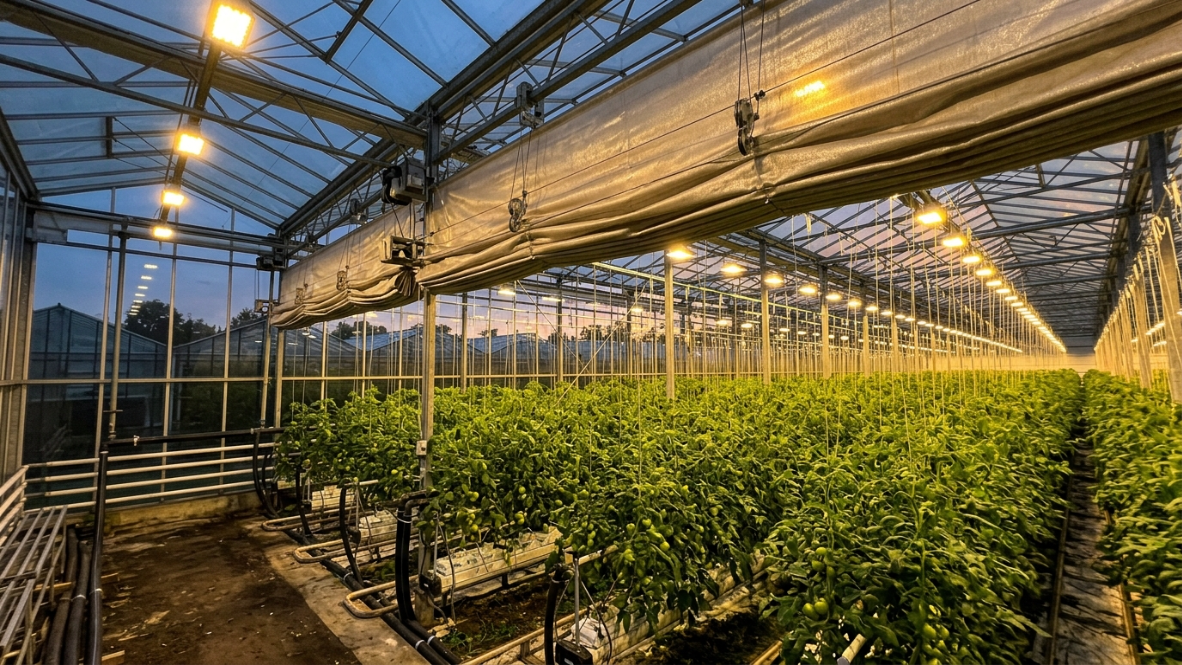
Lighting and HVAC upgrades get the headlines, but the building envelope determines how much of your heating and cooling energy actually stays inside the greenhouse.
Thermal Screens and Energy Curtains
UMass Extension documents 30–50% savings in heating costs from properly deployed thermal screens. A separate review by Ahamed et al. found that energy curtains reduce nighttime heat loss by 40–70%. For operations in heating-dominated climates, this is one of the highest-ROI investments available, sometimes surpassing lighting upgrades in payback speed.
Glazing, Insulation, and Air Sealing
Double-layer glazing and polycarbonate panels with infrared-inhibiting coatings can save up to 15% on heating costs. Even simpler: sealing air leaks around vents, doors, and panel joints can cut up to 10% off the heating bill. These aren’t glamorous improvements, but they reduce the baseline energy demand that every other system has to work against.
North wall insulation and greenhouse orientation optimization also contribute, though the magnitude depends on latitude and prevailing wind patterns.
Common Mistakes That Reduce Greenhouse Energy Savings
Many greenhouse upgrades fail to deliver expected savings because operators overlook one or more of these issues.
Installing LEDs without adjusting HVAC
Cooling systems are often oversized after LED retrofits.
Ignoring DLI
Running lights on timers instead of actual light requirements wastes electricity.
Skipping Thermal Screens
Heat loss through glazing continues regardless of lighting efficiency.
Missing Utility Pre-Approval
Installing fixtures before rebate approval can eliminate available incentives.
Buying Fixtures Based Only on Wattage
Fixture efficacy (µmol/J), optical design, and light distribution have a greater impact on operating costs than wattage alone.
Financial Incentives: Rebates, Tax Deductions, and ROI
The economics of greenhouse energy savings improved substantially in recent years, largely because of expanding rebate programs and federal tax incentives.
Utility Rebates in 2026
Approximately 75–77% of the U.S. commercial market is covered by active incentive programs for LED lighting upgrades. In 2026, rebate amounts rose an average of 17% across all product types year-over-year. Transitioning from legacy HPS to LED can offset 30–70% of total fixture cost through rebates, with some prescriptive programs covering up to 100% of lighting costs.
Canadian programs offer up to $1,000 CAD per fixture in certain provinces.
Critical Pre-Approval Rules
Here’s a detail that catches operators off guard: retroactive rebates are almost nonexistent in 2026. If you install fixtures before receiving pre-approval from your utility program, you forfeit the incentive. The average pre-approval timeline runs about 22 days in North America, so this needs to be factored into project scheduling from day one.
Most 2026 programs also require a minimum photosynthetic photon efficacy (PPE) of 2.3 µmol/J to qualify. Many “Custom” rebate tiers now incentivize 2.8+ µmol/J, rewarding the most efficient fixtures with larger payouts. DLC listing is typically a prerequisite. Understanding greenhouse lighting rebates and eligibility can help operators avoid costly missteps.
The 179D Federal Tax Deduction
The 179D commercial building energy efficiency tax deduction applies to qualifying lighting projects started by June 30, 2026. This stacks on top of utility rebates, further reducing the effective cost of an upgrade.
Typical Payback
With rebates and energy savings combined, most greenhouse LED retrofits achieve payback in 2–3 years. The CABA Tech case study documented first-year energy savings of $230,994, which alone covered a substantial portion of the project cost.
Explore available rebates to see what programs cover your region before committing to a project timeline.
Example Greenhouse Energy Savings Calculation
Consider a greenhouse operating:
500 HPS fixtures
1,000W each
16 hours/day
£0.15 per kWh (or substitute the local electricity rate relevant to your audience)
After converting to 650W LEDs:
Lighting electricity decreases by roughly 30%
Cooling demand also falls
Maintenance costs decline because lamp replacement is eliminated
Utility rebates reduce upfront investment
Although actual results depend on climate and operating hours, this example illustrates why many commercial LED projects achieve payback within two to three years.
How to Calculate Greenhouse Energy Savings
Calculating potential savings requires a structured approach. Here’s how to build a reliable estimate.
1. Audit your current energy baseline. Document total kWh consumption, cost per kWh, fixture count, wattage per fixture, daily hours of operation, and seasonal variation. Pull 12 months of utility bills to capture seasonal swings.
2. Identify upgrade opportunities across all systems. Lighting is usually first, but don’t ignore thermal screens, air sealing, and controls. Each lever compounds the others.
3. Model direct and indirect savings separately. Direct savings come from reduced kWh on lighting. Indirect savings include lower HVAC loads, reduced maintenance and lamp replacement, and yield improvements that increase revenue per kWh consumed. The indirect savings are often underestimated.
4. Factor in the heating penalty. If you’re in a cold climate, model the increased heating cost that results from less fixture heat. Use the Wageningen research benchmark of 10–25% net total savings as a reality check.
5. Apply rebates and incentives. Get pre-approval before installation. Stack utility rebates with the 179D deduction where eligible.
6. Calculate payback period and ROI. Total project cost minus rebates, divided by annual net savings, gives you payback in years. Most operations land between 18 months and 3 years.
For a detailed walkthrough of the financial modeling, the greenhouse lighting ROI calculation guide covers each step with worked examples.
Adoption Is Still Early
Despite the clear math, adoption remains low. Greenhouse Grower, citing GLASE consortium data, reports that only around 2% of greenhouse ornamental growers use LED systems. The barrier isn’t skepticism about the technology. It’s the upfront capital cost, even when payback timelines are short. As Schaberg noted, “Most growers are hesitant to change to LEDs due to their prohibitively high cost, even if they can get that money back within one to two years.”
This is exactly why rebates matter so much. They don’t just improve ROI, they remove the psychological barrier of a large initial outlay.
Schedule a free lighting consultation to get a project-specific savings estimate for your greenhouse operation.
Greenhouse Energy Savings Checklist
Before starting an energy upgrade, confirm that you have completed the following:
Reviewed the last 12 months of utility bills
Calculated current lighting energy use
Measured fixture operating hours
Checked HVAC capacity
Evaluated thermal screens
Inspected glazing and air leaks
Verified utility rebate eligibility
Obtained rebate pre-approval
Compared fixture PPE ratings
Estimated payback period
Frequently Asked Questions
How much energy can a greenhouse save by switching from HPS to LED?
Lighting electricity consumption drops by 24–30% based on DOE data. When you include reduced HVAC loads and maintenance savings, total operating cost reductions are larger. However, in cold climates, the net total energy savings (accounting for increased heating) typically falls in the 10–25% range according to Wageningen University research.
Does LED lighting increase heating costs in winter?
Yes, in cold-climate greenhouses. LEDs produce far less waste heat than HPS fixtures, so heating systems must compensate. The net energy balance is still positive (you save more on lighting and cooling than you spend on additional heating), but planners should model both sides of the equation.
What are thermal screens, and how much do they save?
Thermal screens (also called energy curtains) are retractable fabric panels deployed inside the greenhouse, typically at night, to reduce heat loss through the roof. UMass Extension documents 30–50% savings on heating costs, making them one of the most cost-effective non-lighting energy upgrades available.
How do greenhouse lighting rebates work in 2026?
Approximately 75% of the U.S. commercial market is covered by utility rebate programs. Rebates can offset 30–70% of fixture costs. Most programs require DLC-listed fixtures with a minimum PPE of 2.3 µmol/J. Pre-approval is essential: installing before approval means forfeiting the rebate. Average pre-approval processing takes about 22 days.
What is DLI-based dimming, and how does it save energy?
DLI-based dimming automatically adjusts supplemental lighting intensity based on how much natural sunlight the greenhouse receives. When solar DLI is high, lights dim or turn off. This strategy saves an additional 20–30% on lighting electricity beyond the base savings from an LED upgrade.
How long does it take to pay back a greenhouse LED lighting investment?
Most operations achieve payback in 2–3 years when factoring in energy savings, maintenance savings, and utility rebates. Operations with high electricity rates, long photoperiods, or generous rebate programs often see payback under two years.
What is the difference between energy savings per watt and energy savings per unit of yield?
Energy savings per watt measures raw electricity reduction. Energy savings per unit of yield (grams per watt, revenue per kWh) measures economic efficiency. Strategies like under-canopy lighting may not reduce total watts, but they increase yield per watt by 15–30%, which often has a bigger impact on profitability than watt reduction alone.
Can centralized power systems improve greenhouse energy savings?
Yes. Moving LED drivers out of the grow space removes a heat source from the canopy zone, reducing HVAC load and simplifying climate control. It also reduces in-room failure points and can lower electrical infrastructure costs. This structural approach to energy savings is distinct from, and additive to, fixture-level efficacy improvements.