Remote Driver LED Grow Lights: Cut Heat & HVAC Costs 2026
Discover how Remote Driver LED Grow Lights cut canopy heat, extend driver life, and slash HVAC and install costs. Learn what works in 2026.
TL;DR
Remote driver LED grow lights separate the power supply from the light fixture, relocating it outside the grow environment. This reduces heat at the canopy, extends driver lifespan, simplifies wiring, and can cut HVAC costs by up to 8%. The benefits compound dramatically at commercial scale, though even hobby growers can move a single driver outside a tent with the right wire gauge. For large facilities, centralized remote driver systems represent one of the most impactful infrastructure decisions in a build.
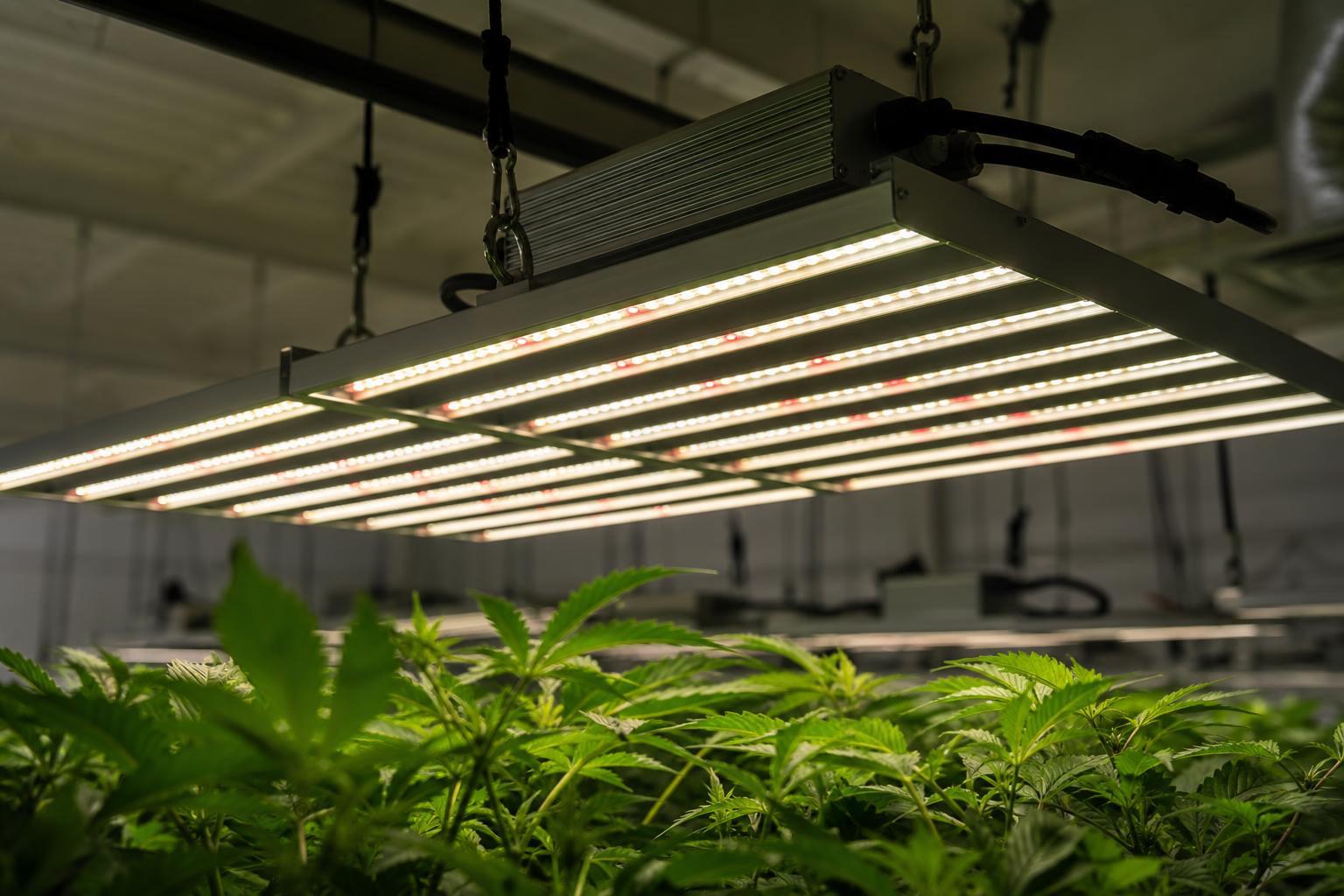
A remote driver LED grow light is any LED fixture whose power supply (the driver) is physically separated from the light and mounted outside the growing space. Instead of bolting the driver directly to the fixture above your canopy, you relocate it to a hallway, mechanical room, or centralized electrical rack and run cabling back to lightweight, driver-free fixtures.
This is not a niche concept. It is becoming the default architecture for serious commercial grows, and understanding it matters whether you are designing a 50,000 square foot cannabis facility or just trying to get a few extra degrees out of your grow tent.
Explore OptiDrive remote power to see how centralized driver architecture works in practice.
Direct Answer: What Are Remote Driver LED Grow Lights?
Remote driver LED grow lights separate the LED driver (power supply) from the light fixture and place it outside the grow environment. This reduces heat inside the grow room, improves driver lifespan, and can lower HVAC cooling demand by approximately 5–10% in real-world commercial setups. In large-scale cultivation facilities, this architecture also reduces electrical complexity and improves system reliability compared to traditional on-fixture drivers.
What an LED Driver Actually Does
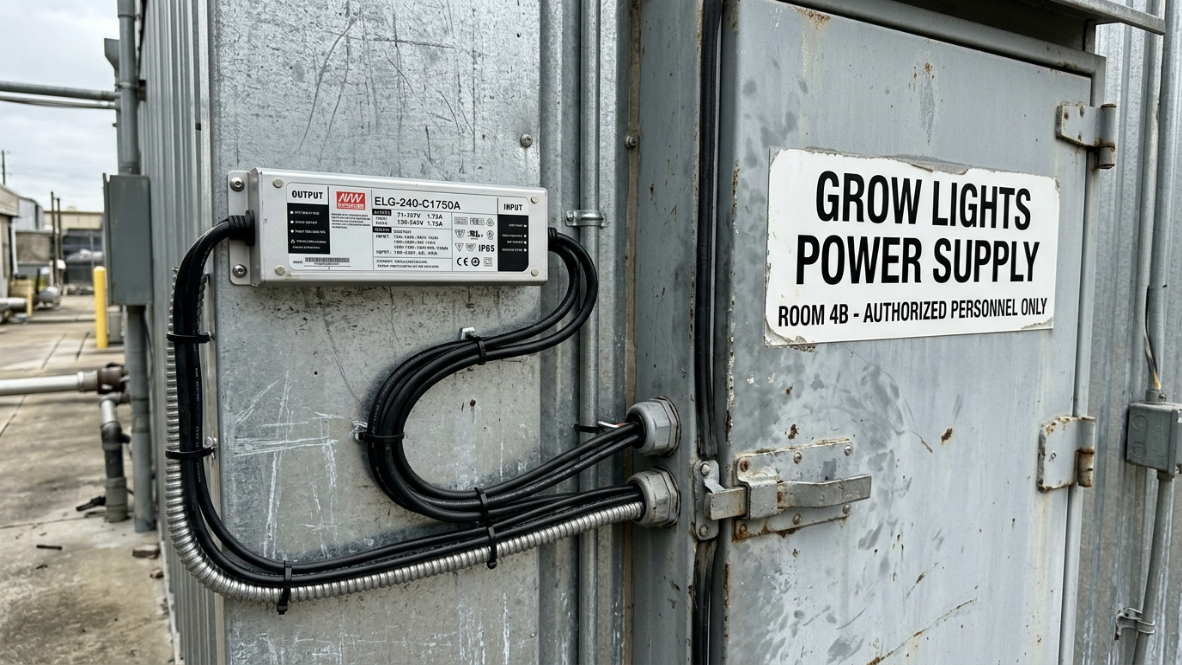
Before understanding why “remote” matters, you need to understand the driver itself.
An LED driver converts alternating current (AC) from your building’s electrical supply into regulated direct current (DC) that LEDs need to operate. But it does more than simple conversion. It manages current delivery to prevent a destructive cycle called thermal runaway: as LEDs heat up, their voltage drops, which causes them to draw more current, which generates more heat. Left unchecked, this cycle kills LEDs. The driver compensates for voltage changes and delivers stable current regardless of temperature fluctuations.
Drivers typically consume 5% to 15% of input power as conversion losses, and all of that lost energy becomes heat. In a traditional on-fixture design, that heat radiates directly into your grow space, right above the canopy.
Why Remote Driver Architecture Matters in Modern Grow Lighting
Remote driver systems are part of a broader shift toward centralized power architecture in controlled environment agriculture. Instead of distributing heat-generating components across hundreds of fixtures, power conversion is centralized in a controlled electrical space, improving thermal management, maintenance efficiency, and system uptime.
This design approach is especially relevant in:
Commercial cannabis cultivation facilities
Vertical farming systems with stacked canopy layers
Greenhouses using supplemental LED lighting
Research and pharmaceutical plant growth environments
As grow operations scale, driver placement becomes a structural engineering decision—not just a lighting choice.
How Remote Driver LED Grow Lights Work
The basic mechanics are straightforward. The driver sits outside the grow area. DC or low-voltage power travels through cabling to fixtures that contain only the LED arrays, optics, and heat sinks. The fixtures themselves become lighter, simpler, and cooler.
What varies is the scale and sophistication of the approach.
The Architecture Spectrum
Remote driver configurations range from dead simple to enterprise-grade:
Individual remote mount. A hobby grower moves a single Mean Well driver outside the tent using an extension cable. It works. Wire gauge matters, and voltage drop is real, but for a short run it is effective.
Remote-mountable per-fixture drivers. Small to mid-size commercial operations use detachable driver boxes mounted outside the room but still paired one-to-one with fixtures.
Centralized high-power drivers. One driver unit powers 6 to 24 or more fixtures. This is where the installation savings start compounding.
Centralized HVDC rack systems. High-voltage DC power distributed from an electrical room to an entire facility. This architecture can eliminate roughly 70% of electrical components compared to traditional designs.
Low-voltage distribution. Designed for retrofits where running high-voltage DC is impractical. Standard cabling carries low-voltage power, simplifying installation and improving safety.
The choice between high-voltage DC and low-voltage approaches comes down to your project. HVDC delivers higher efficiency and works best in new builds with dedicated electrical infrastructure. Low-voltage systems use standard cabling and avoid the need for DC-rated breakers, making them better suited to retrofits. Both achieve the core goal of getting drivers out of the grow room.
Remote Driver vs On-Fixture Driver LED Systems
Feature | On-Fixture Drivers | Remote Driver Systems |
|---|---|---|
Heat inside grow room | Higher | Lower |
HVAC load | Higher | Reduced (≈5–10%) |
Driver lifespan | Shorter (heat exposed) | Longer (cool environment) |
Maintenance access | Inside grow room | External access |
Wiring complexity | High | Moderate to centralized |
Biosecurity risk | Higher (non-washable components) | Lower |
Scalability | Limited | High (facility-wide systems) |
Why Growers Use Remote Driver LED Grow Lights
Heat Reduction and HVAC Savings
Lighting is the dominant heat source in a grow room, typically accounting for 70% to 80% of the total heat load. By relocating drivers outside the cultivation space, growers can remove up to 15% of the total sensible heat load from the room. In practice, the resulting HVAC reduction is typically closer to ~5–10% (site- and system-dependent), rather than ~30%.
For context, every watt of electrical power produces 3.41 BTU of heat. A 200-fixture commercial room with on-fixture drivers might dump thousands of watts of driver heat into the growing space that HVAC systems then have to remove. Relocating that heat to a mechanical room where it is already being managed changes the math significantly. For a deeper dive, see this guide on calculating HVAC for LEDs.
Understanding the distinction between sensible and latent heat also matters here, because driver heat is entirely sensible heat, the kind your AC system must directly combat.
Reliability: The Driver Is the Weak Link
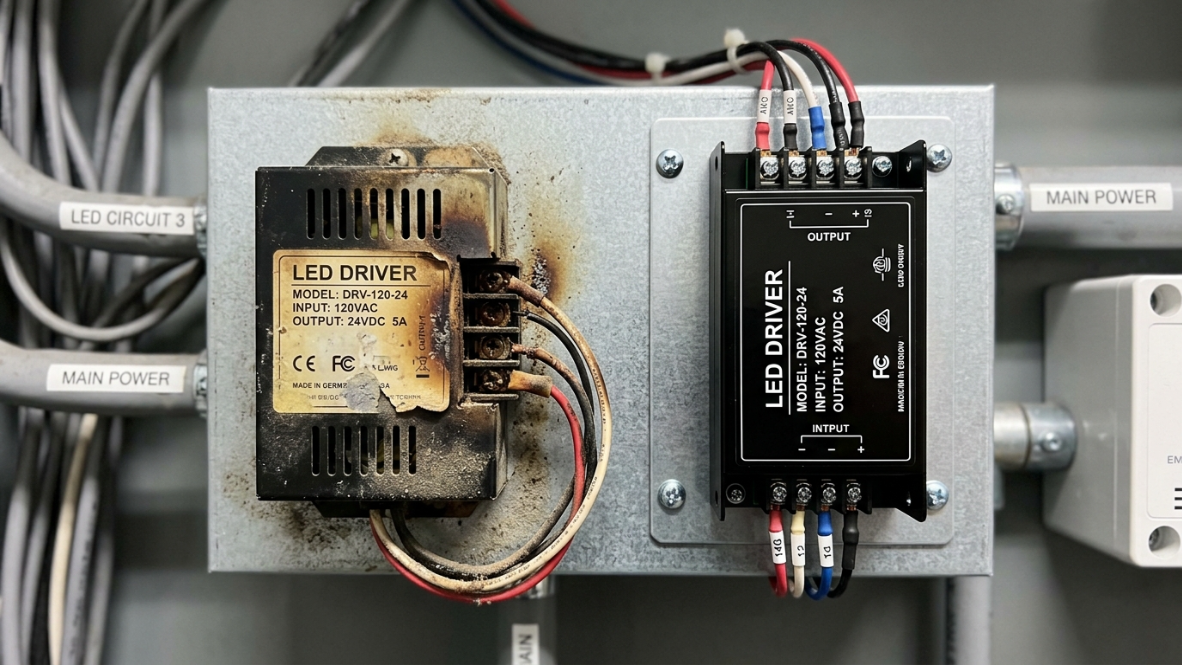
LED diodes are often rated for 40,000 to 50,000 hours or more. But the driver rarely lasts that long, and the culprit is almost always the electrolytic capacitors inside it.
Here is the critical data point most people miss: for every 10°C increase in ambient temperature, the life expectancy of electrolytic capacitors is halved. A driver rated for 50,000 hours at 70°F might last a fraction of that time inside a grow room running at 80°F to 85°F with high humidity. It is not the LEDs failing. It is the capacitors degrading in hot, humid conditions that they were never designed to endure.
Power surges make things worse. Greenhouses with generators and supplemental lighting systems can send voltage spikes through the line that destroy sensitive driver components. Moving drivers to a climate-controlled electrical room addresses both temperature and surge vulnerability at once. For more on this topic, read about LED reliability factors that affect fixture longevity.
Installation Cost Reduction
The savings here are substantial and well documented. Industry sources report up to 35% savings on initial costs when using centralized driver systems compared to individual on-fixture drivers, with approximately 20% annual savings on energy and maintenance.
The reason is structural. Traditional on-fixture drivers in a commercial setup require step-down controls to decrease voltage from 480V three-phase to 240/277V at each fixture. This doubles the lighting panels and electrical receptacles, and requires commercial relay contactors, which are among the most expensive components in any electrical buildout. Centralized remote driver systems eliminate most of this complexity.
One early adopter, GreenSeal Cannabis in Ontario, documented roughly 70% fewer electrical components than a traditional AC design. Practitioners on grower forums often confirm this pattern, noting that while the upfront driver hardware costs more per unit, the total installed cost drops because you are buying far less copper, conduit, and labor.
Explore available lighting rebates that can further offset the capital cost of remote driver systems.
Centralized Power Architecture in Commercial Horticulture
Large-scale cultivation facilities increasingly adopt centralized LED power systems similar to those used in industrial electrical engineering. Instead of distributing individual drivers across fixtures, systems consolidate power delivery into electrical rooms or rack-based driver arrays.
This approach is commonly implemented in:
High-density cannabis cultivation facilities
Large greenhouse production zones
Controlled environment agriculture (CEA) infrastructure projects
Companies such as Signify and other horticultural lighting manufacturers have explored centralized and modular driver architectures to improve scalability and reduce installation overhead in commercial environments.
Simplified Wiring and Zone Control
A remote driver system eliminates fixture-to-fixture dimming wiring while maintaining precise control. In a traditional setup, every fixture needs its own power connection plus a separate dimming signal wire. Multiply that across hundreds of fixtures and you get a wiring nightmare that is expensive to install and painful to troubleshoot.
Centralized systems can manage dimming and zone control from a single point, often with software-based interfaces. This allows growers to adjust light intensity by zone without entering the grow room or touching individual fixtures.
Maintenance and Biosecurity
This is an angle that almost no one talks about, but it matters enormously for cannabis cultivators pursuing GMP compliance.
Drivers are not washable. You cannot sanitize them during a room cleandown. Every on-fixture driver in a grow room is a surface that harbors dust, mold spores, and potential contaminants that you cannot adequately clean. Removing drivers from the grow space eliminates hundreds or thousands of non-washable components from your production environment.
Software-based monitoring in centralized systems can also diagnose problems and notify technicians without anyone entering the grow space. In a conventional AC design, someone has to physically spot a dead fixture before calling an electrician, which means entering production space, breaking the light cycle, and introducing biosecurity risk. For more on maintaining compliant facilities, see this guide on GMP compliance for cultivation.
Greenhouse Structural Benefits
For greenhouse operators, remote driver LED grow lights offer an additional advantage: reduced shadow and weight. With drivers removed, every fixture can be up to 10 pounds lighter, which reduces the structural steel requirements for mounting. Lighter, smaller fixtures also cast less shadow on the crop below, which matters when the whole point of a greenhouse is maximizing natural sunlight.
When Remote Drivers Make the Most Difference
The benefits of remote driver LED grow lights scale with facility size. Here is where the impact is greatest:
Large commercial cannabis and produce operations. Hundreds of fixtures mean hundreds of drivers generating heat, hundreds of potential failure points, and thousands of feet of wiring. Every benefit compounds.
Vertical farms. Tight, enclosed growing layers make heat management extremely difficult. Removing driver heat from multi-tier racks is one of the most effective climate control strategies available.
Greenhouses. Shadow reduction and structural savings on top of the standard thermal and reliability benefits. If you are considering supplemental lighting for an existing greenhouse, a remote driver approach can simplify the retrofit significantly. More on that in this guide to supplemental lighting.
New builds where electrical infrastructure is being designed from scratch. This is the ideal scenario for high-voltage DC centralized systems, where you can design the entire electrical backbone around the remote driver architecture from day one.
Technical Trade-offs to Consider
Voltage Drop
Growers using remote drivers that convert AC to low-voltage DC face a real constraint: you cannot distribute low-voltage power over long distances without significant voltage drop unless you use very thick, heavy, expensive conductors. Practitioners on forums like Rollitup and THCFarmer consistently emphasize this point, with the universal advice being to use the appropriate gauge wire for the distance you are running.
High-voltage DC distribution solves the distance problem but introduces safety complexity, including the need for DC-rated breakers and local disconnects.
Electrical Design Considerations (Critical for Scaling)
When designing remote driver systems, electrical planning becomes a key performance factor. Two main variables determine system efficiency:
Wire Gauge and Distance
Longer cable runs increase resistance, which can reduce voltage delivery to fixtures if undersized wiring is used.
System Voltage Type
Low-voltage DC systems → easier retrofit, shorter runs
High-voltage DC systems → better efficiency, long-distance distribution
Proper electrical design ensures that energy savings from remote drivers are not offset by transmission losses.
The Hobby Scale Question
Forum discussions reveal a genuine debate about whether remote drivers matter for small setups. One grower on a popular forum pointed out: “Why bother mounting the drivers outside the tent? Usually with LEDs the issue is that temperature in the tent is too low. That tiny bit of extra heat is even welcomed.”
This is a fair point. In a single-light tent, the driver’s heat may actually be useful, and the hassle of running properly gauged wire to an external location may not be worth the effort. The economic and thermal case for remote driver LED grow lights really kicks in when you have dozens or hundreds of fixtures, not one or two.
Retrofit Complexity
Existing structures, particularly traditional greenhouses, may face practical challenges integrating centralized driver systems. Routing new cabling through established infrastructure takes planning. However, low-voltage distribution approaches designed specifically for retrofits can mitigate much of this difficulty by using standard cabling rather than requiring new conduit runs.
Related Terms
LED driver: The AC-to-DC converter that regulates current to LEDs and prevents thermal runaway.
Thermal runaway: The destructive feedback loop where rising LED temperature causes increased current draw, generating more heat.
PPFD (Photosynthetic Photon Flux Density): The measurement of usable light reaching the canopy, measured in micromoles per square meter per second. Learn more about what a micromole is.
DLI (Daily Light Integral): The total amount of photosynthetically active light delivered to a crop over a 24-hour period.
Constant current vs. constant voltage: Two driver regulation methods. Most high-power LED grow lights use constant current drivers for better efficiency and diode protection.
Centralized power architecture: A system design where power conversion happens in one location and is distributed to multiple fixtures, as opposed to each fixture having its own power supply.
Evaluating remote driver systems for a new build or retrofit? Schedule a consultation to discuss how centralized power architecture fits your facility.
Related Concepts in LED Grow Lighting Systems
Understanding remote driver systems also requires familiarity with related horticultural lighting and electrical concepts:
LED driver efficiency and thermal derating
Thermal runaway in high-output LED arrays
PPFD and DLI optimization in plant lighting design
Constant current LED regulation systems
Centralized power distribution in controlled environment agriculture
These concepts are commonly referenced in commercial lighting design and greenhouse engineering documentation.
Frequently Asked Questions
Can I just move my Mean Well driver outside my grow tent?
Yes. For a single fixture on a short cable run, this is a practical and common approach. Use the wire gauge recommended by the driver manufacturer for the distance you are running. Voltage drop becomes a concern past about 10 to 15 feet with undersized wire, so do the math or consult a wiring chart before committing.
Is “driverless grow light” the same as “remote driver”?
They are related but distinct. A “driverless” fixture has no driver inside it at all and relies entirely on an external centralized power system. A “remote driver” setup could mean anything from a single detached driver outside a tent to a full rack-mounted centralized system. All driverless fixtures use remote drivers, but not all remote driver setups qualify as “driverless” in the centralized sense.
Does removing the driver affect light output or dimming control?
No. A properly designed remote driver system delivers the same current and voltage to the LEDs as an on-fixture driver would. Dimming control is maintained through the centralized system, often with more precision and flexibility than individual on-fixture dimming controls.
How far can I place a remote driver from the fixture?
It depends on the voltage and wire gauge. Low-voltage DC systems are limited to relatively short runs (typically under 50 feet without significant conductor upsizing). High-voltage DC systems can distribute power across much longer distances with minimal loss, which is why they are preferred for large commercial facilities.
What is the biggest advantage of remote driver LED grow lights at commercial scale?
It is hard to pick just one because the benefits stack. But if forced to choose: reliability. Removing drivers from hot, humid grow rooms can double or triple their operational lifespan by keeping electrolytic capacitors within their rated temperature range. When you multiply that across hundreds of fixtures, the avoided downtime and replacement costs are substantial.
Do remote driver systems qualify for utility rebates?
Many centralized LED grow light systems are eligible for utility rebates, particularly when they demonstrate energy savings over traditional lighting. Check with your utility provider or explore available rebates to see what applies to your project.
Are remote driver systems only for cannabis?
Not at all. The architecture is equally relevant for commercial greenhouse produce, vertical farming operations growing leafy greens and herbs, and research institutions. Any facility running dozens or more LED fixtures in a controlled environment can benefit from remote driver configurations.