How Much Supplemental Lighting Does A Greenhouse Need—2026
Learn how much supplemental lighting does a greenhouse need in 2026: calculate DLI deficits, convert to PPFD and hours, avoid costly mistakes.
TL;DR
The amount of supplemental lighting a greenhouse needs depends on the gap between your crop’s target Daily Light Integral (DLI) and the DLI your greenhouse actually receives from sunlight. Leafy greens typically need 12 to 17 mol/m²/d, fruiting crops need 20 to 35, and cannabis in flower needs 35 to 50+. To calculate your specific requirement, measure or estimate your indoor DLI from sunlight, subtract it from your crop’s target, then convert that deficit into the PPFD and hours your fixtures must deliver.
Why the Answer Isn’t One Number
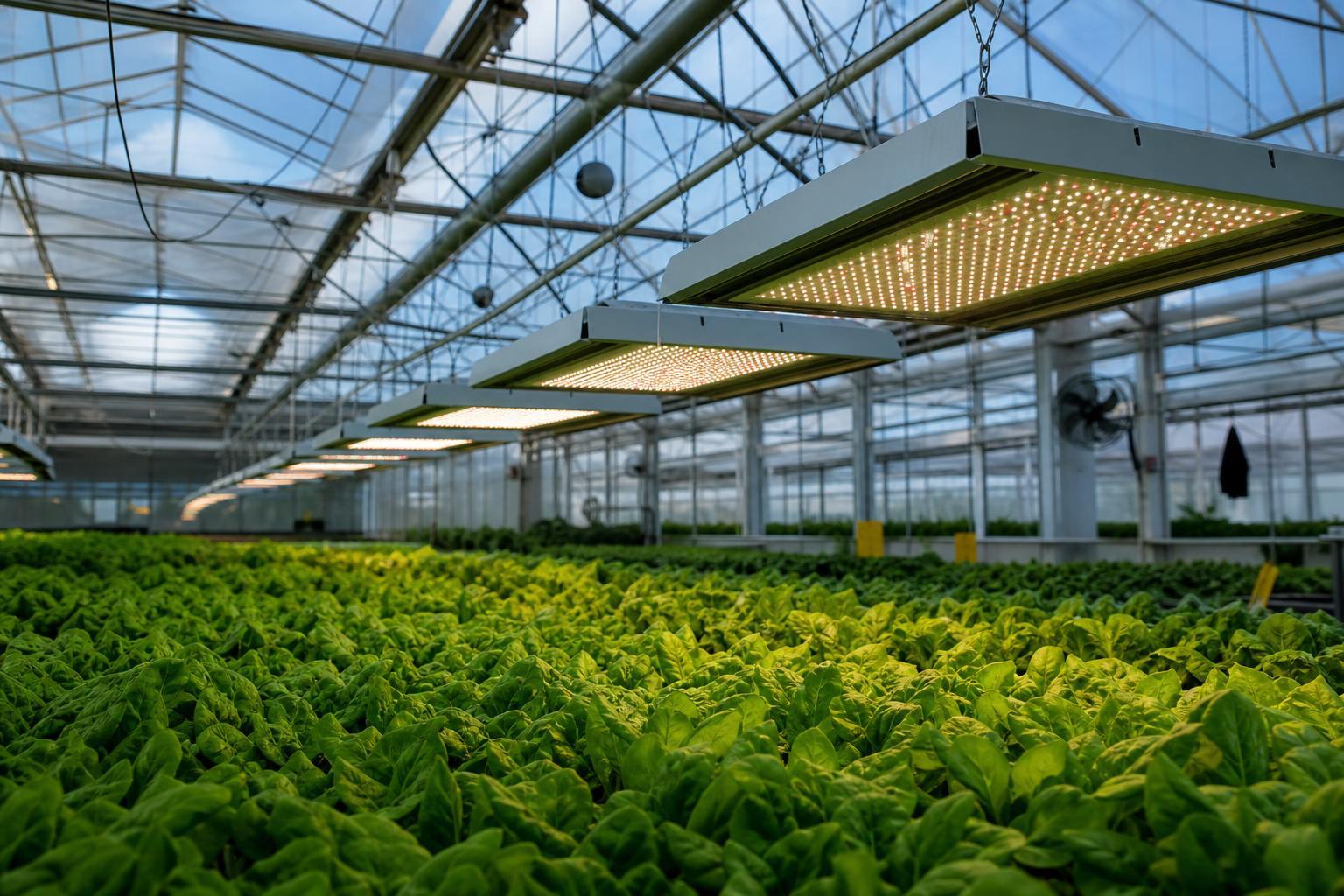
There is no single answer to how much supplemental lighting a greenhouse needs. A lettuce grower in Georgia and a tomato grower in Michigan can be growing in identical structures, yet their supplemental lighting requirements are completely different. The gap between available sunlight and crop demand is what matters, and that gap shifts with latitude, season, glazing type, and what you’re growing.
The good news: the math is straightforward once you understand a few key concepts. This guide walks through the calculation step by step, with real numbers you can plug in for your own operation.
Explore greenhouse supplemental lighting options before running your numbers, or keep reading to size your needs first.
Key Terms You Need to Know
Before running any calculations, four concepts need to be clear.
Daily Light Integral (DLI)
DLI is the total amount of photosynthetically active light a plant receives over a full 24-hour period, measured in mol/m²/d. Think of it like rainfall: PPFD is how hard it’s raining at any given moment, but DLI is the total amount that falls into the bucket by the end of the day. This is the single most important metric for sizing supplemental lighting because plants respond to accumulated light, not peak intensity. For a deeper explanation of DLI and how it’s measured, see our greenhouse DLI and PPFD guide.
PPFD (Photosynthetic Photon Flux Density)
PPFD tells you how many photosynthetically active photons are hitting one square meter per second, measured in µmol/m²/s. Fixture manufacturers advertise high PPFD numbers because they look impressive on a spec sheet. But plants respond to total photons received over the day, not simply the highest instantaneous intensity. A fixture blasting 1,000 µmol/m²/s for four hours delivers fewer total photons than one running at 400 µmol/m²/s for twelve hours.
PAR (Photosynthetically Active Radiation)
PAR is the wavelength range (400 to 700 nm) that drives photosynthesis. It defines which photons count. PPFD tells you how many of those photons arrive per second. When someone says “PAR light,” they mean light within this usable range.
Greenhouse Light Transmission
This is where many growers get surprised. The light inside a greenhouse is typically reduced 35 to 50% from what is available outside. Manufacturer specs for glazing materials are measured with light hitting perpendicular to the surface, which almost never happens in practice. Once you account for the angle of the sun, structural framing, condensation, and accumulated grime, measured PAR at the leaf canopy is often only 40 to 60 percent of outdoor levels. In one study, a glass-glazed greenhouse transmitted only 56% of outside light to the canopy, and a double polyethylene house transmitted just 45%.
Supplemental Lighting vs. Photoperiod Lighting
This distinction trips people up constantly. Photoperiod lighting delivers just 1 to 2 µmol/m²/s, barely enough for plants to perceive that lights are on. It’s used to trigger or inhibit flowering responses in day-length-sensitive crops, not to drive growth. Supplemental lighting, by contrast, delivers meaningful photon quantities (typically 100 to 400+ µmol/m²/s) specifically to increase the total DLI and boost photosynthesis. As Roberto Lopez of Michigan State explains, confusing these two categories is one of the most common errors in greenhouse lighting design.
Practitioners on cannabis growing forums reinforce this point. One greenhouse cannabis grower planning a winter grow was focused entirely on preventing early flowering rather than maximizing PPFD, revealing that for cannabis growers, the “how much supplemental lighting” question is often about photoperiod management first and DLI optimization second.
The Five-Step Supplemental Lighting Calculation
Here’s how to determine exactly how much supplemental lighting your greenhouse needs.
Step 1: Find Your Outdoor DLI
Outdoor DLI ranges from roughly 5 mol/m²/d on a dark, cloudy winter day in the northern U.S. to about 60 mol/m²/d on a cloudless summer day. The interactive DLI maps from Clemson and NOAA are the standard free tool for looking up monthly averages by location. Most operations design around their darkest month (usually December or January at mid and high latitudes) because that’s when the supplemental lighting deficit is largest and most limiting to production.
Step 2: Apply Your Greenhouse Transmission Factor
Multiply the outdoor DLI by your greenhouse’s actual light transmission percentage. If you don’t have a measured value, use these rough estimates:
| Glazing Type | Typical Transmission |
|---|---|
| Single-layer glass | 55-65% (at canopy) |
| Double-pane glass | 45-55% (at canopy) |
| Single poly | 50-60% (at canopy) |
| Double poly | 40-50% (at canopy) |
| Polycarbonate (twin-wall) | 45-55% (at canopy) |
These are real-world, at-canopy values, not the manufacturer’s perpendicular-incidence specs. To get your own number, Virginia Tech Extension recommends simply measuring light inside and outside at the same time: if you read 6,300 foot-candles outside and 4,100 inside, your transmission is about 65%.
Note that winter makes things worse. For a gutter-connected greenhouse with double-pane glass at 49° latitude, transmission of south-facing roof panels at noon on December 21st drops to about 48% because of the low solar angle.
Step 3: Determine Your Crop’s Target DLI
Different crops need very different amounts of light. These targets come from university extension research and represent the DLI range where each crop performs well:
| Crop | Target DLI (mol/m²/d) |
|---|---|
| Lettuce, leafy greens | 12-17 |
| Herbs (basil, cilantro) | 12-17 |
| Bedding plant seedlings/plugs | 10-12 |
| Tomatoes | 20-30 |
| Peppers | 20-30 |
| Cucumbers | 20-30 |
| Cannabis (vegetative) | 20-35 |
| Cannabis (flower) | 35-50+ |
For crop-specific detail, our guides on lettuce lighting requirements and cannabis DLI targets go much deeper.
Cannabis is worth a special note. Research published in PMC found that even 52 mol/m²/d of supplemental lighting did not saturate crop responses in cannabis, meaning yields kept climbing well beyond the levels where most food crops plateau.
Step 4: Calculate Your DLI Deficit
This is simple subtraction:
DLI deficit = Target DLI – Indoor DLI from sunlight
If your greenhouse receives 5 mol/m²/d from the sun in January and your lettuce needs 17 mol/m²/d, your deficit is 12 mol/m²/d. That’s what your lighting system needs to deliver.
Step 5: Convert the Deficit to PPFD and Hours
The formula:
PPFD (µmol/m²/s) = DLI deficit (mol/m²/d) × 1,000,000 ÷ (Photoperiod in hours × 3,600)
The intensity and duration are inversely related. Choosing a lower light intensity requires a longer photoperiod, and running higher intensity means you can run fewer hours.
Worked Examples at Two Latitudes
Example 1: Lettuce in Michigan (January)
- Outdoor DLI: ~10 mol/m²/d (from DLI maps for Kalamazoo, MI, January average)
- Greenhouse transmission: 50% (double poly) → Indoor DLI from sun: 5 mol/m²/d
- Target DLI for lettuce: 17 mol/m²/d
- DLI deficit: 12 mol/m²/d
- Running lights for 16 hours: PPFD needed = 12 × 1,000,000 ÷ (16 × 3,600) = 208 µmol/m²/s
That’s a substantial supplemental requirement. The fixtures need to deliver roughly 200 µmol/m²/s across the growing area for 16 hours every day in the dead of winter.
Example 2: Tomatoes in Georgia (January)
- Outdoor DLI: ~20 mol/m²/d (from DLI maps for Athens, GA, January average)
- Greenhouse transmission: 55% (single glass) → Indoor DLI from sun: 11 mol/m²/d
- Target DLI for tomatoes: 25 mol/m²/d
- DLI deficit: 14 mol/m²/d
- Running lights for 16 hours: PPFD needed = 14 × 1,000,000 ÷ (16 × 3,600) = 243 µmol/m²/s
Despite Georgia getting twice the winter sunlight, the higher DLI target for tomatoes creates a similar supplemental demand in absolute terms. This is why the question “how much supplemental lighting does a greenhouse need” never has a universal answer.
Need help sizing fixtures for your specific facility? Schedule a free consultation with a lighting specialist who can run these numbers for your exact crop, location, and greenhouse.
How Latitude and Season Change the Math
From October to March, the DLI is a limiting factor for greenhouse crop production in the northern half of the U.S. and in Canada. During these months, outdoor DLI can fall as low as 1 to 5 mol/m²/d in northern states, making supplemental lighting almost mandatory for commercial quality and throughput.
The cost gap is real. Lighting costs in Kalamazoo, Michigan, are nearly twice as high as in Athens, Georgia, because Michigan has both shorter days and lower sunlight intensity during winter. A greenhouse in Phoenix or Tucson may not need supplemental lighting at all for most crops outside of the cloudiest winter weeks.
This is why designing your supplemental lighting around the worst-case month matters. If you size for March, you’ll be undersized in January. If you size for January, you can simply run fewer hours the rest of the year. For a full breakdown of how greenhouse energy costs scale with location, including rebate opportunities that offset the capital expense, it’s worth reviewing the available incentives in your utility territory.
How Greenhouse Construction Affects Light Levels
Glazing type gets most of the attention, but structure matters just as much. Gutter-connected houses with wide gutters and heavy trusses can shade 10 to 15% of the growing area regardless of glazing material. Retractable shade systems left deployed too late into autumn are another common culprit.
Age matters too. Polyethylene films degrade under UV exposure, losing 5 to 10% of their original transmission within two to three years. Glass stays more stable but accumulates mineral deposits and algae on interior surfaces, especially in humid climates. A greenhouse that transmitted 60% of outside light when new may be down to 45% five years later if the glazing hasn’t been cleaned or replaced.
All of these factors mean that the actual light reaching your canopy can be significantly lower than what you’d calculate from manufacturer specs alone. Measuring with a quantum sensor at canopy height is always more reliable than estimating.
Common Mistakes When Sizing Supplemental Lighting
Under-sizing to Save Money Upfront
This is the most expensive mistake in greenhouse lighting. Budget fixtures that deliver insufficient PPFD for a crop’s DLI target don’t just underperform, they waste every dollar spent on electricity to run them. If your lettuce needs 200 µmol/m²/s of supplementation and you install fixtures that deliver 80, you haven’t saved 60% of the cost. You’ve spent 40% of the money for almost none of the benefit. When comparing LED and HPS options, focus on delivered PPFD at canopy height, not just wattage.
Over-supplementing on Cloudy Days
One practitioner on the Permies gardening forum made a sharp observation: if light intensity is 10,000 foot-candles when sunlit and 1,000 when overcast, the photosynthesis rate when cloudy is not 10% of the sunny rate. It’s closer to 50%. That’s because the photosynthesis light-response curve is non-linear. Plants approach saturation at moderate intensities, meaning the difference between a bright cloudy day and full sun matters less to photosynthesis than most growers assume. Running supplemental lights at full power every time a cloud passes overhead wastes significant energy.
Using Fixed Timers Instead of PAR-responsive Controls
Fixed timers run your lights the same duration regardless of how much sunlight came through the roof that day. Smart controllers that measure incoming PAR and adjust supplemental lighting in real time can reduce energy costs substantially. University of Georgia researchers developed controls that provide light in the most efficient way possible, estimating up to 40% reduction in supplemental lighting costs.
Ignoring Glazing Degradation
If you calculated your supplemental needs when the greenhouse was new and haven’t revisited those numbers in three to five years, you’re likely under-lit. Remeasure your transmission factor annually.
Confusing Photoperiod Needs with DLI Supplementation
As discussed earlier, photoperiodic lighting and supplemental lighting serve completely different purposes. Installing high-output fixtures to extend day length for short-day plant control is overkill. And installing low-output photoperiod bulbs expecting them to boost growth is futile.
Making Supplemental Lighting Cost-Effective
Supplemental lighting commonly accounts for 10 to 30% of a greenhouse’s operating expenses. Since typical greenhouse profit margins run 1 to 5%, the efficiency of your lighting system directly impacts whether you make money or lose it.
Fixture Efficacy: The Number That Matters Most
Fixture efficacy, measured in µmol/J (micromoles of photosynthetically active photons per joule of electricity), determines your operating cost per unit of light. An older HPS fixture at 1.6 µmol/J requires nearly twice the electricity to deliver the same photons as a modern LED at 3.0+ µmol/J. Over a 300-fixture greenhouse running 12 hours a day, that difference can exceed $100,000 per year in electricity alone. For operations still running legacy fixtures, the case for transitioning to LED grow lighting is strong.
Lower PPFD Over Longer Photoperiods
Research from Ceres Greenhouse Solutions and multiple university studies shows that plants like lettuce, basil, and mizuna photosynthesize more efficiently at lower PPFD spread over longer periods than at higher PPFD over shorter periods, when total DLI is held constant. In some studies, plants grown under the same DLI but with lower PPFD over extended photoperiods were approximately 30% larger. This means that for non-photoperiod-sensitive crops, running your lights at moderate intensity for 16 to 18 hours beats blasting them at high intensity for 10 hours, even though the delivered DLI is the same.
The DLI Carryover Concept
A 2024 peer-reviewed study by Jayalath et al. introduced a concept that almost no commercial lighting guides have incorporated yet. The researchers found that the DLI requirement can be reduced by approximately 5.25 mol/m²/d on the day following a sunny day, because plants carry over photosynthetic benefits. By analyzing historical weather data from five U.S. locations, they quantified annual energy savings of approximately 75 to 190 MWh per hectare from incorporating this carrying-over DLI concept in greenhouse lettuce production. That’s a meaningful reduction in operating cost, and it’s achievable through better controls rather than additional hardware.
Under-canopy Lighting for Dense Canopy Crops
For crops like cannabis that develop thick upper canopies, adding more top light hits diminishing returns because most of the additional photons are absorbed by the top few inches of foliage. Under-canopy lighting addresses this by delivering light directly to lower branches and bud sites that top lighting can’t reach. This approach can dramatically improve lower-canopy quality and yield without increasing total fixture wattage at the top of the room.
Explore the Boost XE under-canopy LED for operations where lower-canopy production is a priority.
Don’t Forget HVAC Interactions
Every watt of lighting generates heat. Fixtures mounted above the canopy add to the sensible heat load your HVAC system must manage. Choosing more efficient fixtures doesn’t just lower your electric bill, it reduces your cooling bill too. Our guide on HVAC sizing for LED lights covers this interaction in detail.
Rebates and Incentives
Many utility companies offer substantial rebates for greenhouse LED lighting upgrades, sometimes covering 30 to 50% of the hardware cost. Check available utility rebates before finalizing your budget, as they can dramatically shorten payback timelines.
Putting It All Together
Figuring out how much supplemental lighting a greenhouse needs comes down to five numbers: your outdoor DLI, your greenhouse’s transmission factor, your crop’s target DLI, the resulting deficit, and how many hours you want to run your lights. The math itself is simple. The hard part is getting accurate inputs and designing a system that delivers the right PPFD uniformly across the growing area at an operating cost that makes economic sense.
Most commercial supplemental lighting systems are designed to deliver around 200 µmol/m²/s of additional light, which, combined with available sunlight and appropriate photoperiods, fills the DLI gap for a wide range of crops in most North American greenhouses during winter. Many operations need an extra 4 to 8 mol/m²/d from LEDs to maintain production from October through March.
The calculation tells you what you need. The fixture selection, layout design, and controls strategy determine whether you achieve it efficiently or waste energy doing so.
Ready to size your system? Talk to a lighting specialist who can turn these calculations into a fixture layout and project quote for your greenhouse.
Frequently Asked Questions
How many hours per day should supplemental greenhouse lights run?
It depends on the PPFD your fixtures deliver and the DLI gap you need to fill. Most commercial operations run supplemental lights for 14 to 18 hours per day in winter. The formula is: hours = DLI deficit × 1,000,000 ÷ (fixture PPFD × 3,600). Photoperiod-sensitive crops like cannabis in flower and certain ornamentals require at least 4 to 6 hours of uninterrupted darkness, which caps your maximum runtime.
Can I use supplemental lighting year-round, or only in winter?
Supplemental lighting is most commonly used from October through March in northern latitudes, when outdoor DLI drops below crop targets. In summer, natural sunlight typically provides sufficient DLI for most crops. However, some high-value crops (particularly cannabis in flower, which targets 35 to 50+ mol/m²/d) may benefit from year-round supplementation even in sunny climates.
What’s the difference between 200 µmol/m²/s and 400 µmol/m²/s of supplemental light?
At 200 µmol/m²/s running for 16 hours, you deliver about 11.5 mol/m²/d of supplemental DLI. At 400 µmol/m²/s for the same 16 hours, you deliver about 23 mol/m²/d. The higher intensity makes sense for fruiting crops or cannabis that need large DLI top-ups, while 200 µmol/m²/s is sufficient for most leafy greens and herbs during winter. Higher intensity also means higher electricity cost and more heat to manage.
Is supplemental lighting worth the cost for small greenhouses?
The economics depend on crop value, not greenhouse size. High-value crops like cannabis, specialty herbs, and premium tomatoes can justify the investment even in small houses. For low-margin commodity crops, the math is tighter. Supplemental lighting typically accounts for 10 to 30% of operating expenses, so the crop revenue per square foot needs to exceed that cost by a comfortable margin.
How do I know if my current greenhouse lighting is adequate?
Measure DLI at canopy height using a quantum sensor over several days, including cloudy ones. Compare your measured DLI to your crop’s target. If your measured DLI falls short on more than a few days per month during your production season, your current lighting is likely inadequate. PAR-responsive controllers that log daily DLI make this assessment straightforward over time.
Does cloudy weather mean I need to double my supplemental lighting?
No. Photosynthesis has a non-linear response to light. An overcast day that reduces light intensity by 90% does not reduce photosynthesis by 90%, because many crops approach light saturation at moderate intensities. Smart controllers that respond to actual PAR levels are far more effective than blasting full supplemental power every time clouds roll in.
What’s the most efficient way to deliver supplemental DLI?
For crops that aren’t photoperiod-sensitive, running lower PPFD over a longer photoperiod is more efficient than high PPFD over fewer hours. Research shows this approach can produce plants up to 30% larger at the same DLI. Combine this with PAR-responsive controls and the DLI carryover concept (reducing light the day after a sunny day) to minimize energy waste.
How does greenhouse glazing type affect supplemental lighting needs?
Dramatically. A single-glass greenhouse may transmit 55 to 65% of outside light to the canopy, while a double-poly house may only transmit 40 to 50%. That 15-point difference in transmission translates directly to a larger DLI deficit and more supplemental light needed. Older or dirty glazing further reduces transmission, sometimes by another 10 to 15%.