Greenhouse Light Levels: How to Hit DLI Targets in 2026
Learn how to measure greenhouse light levels, convert PPFD to DLI, and size supplemental lighting for crops in 2026. Get formulas, ranges, and pro tips.
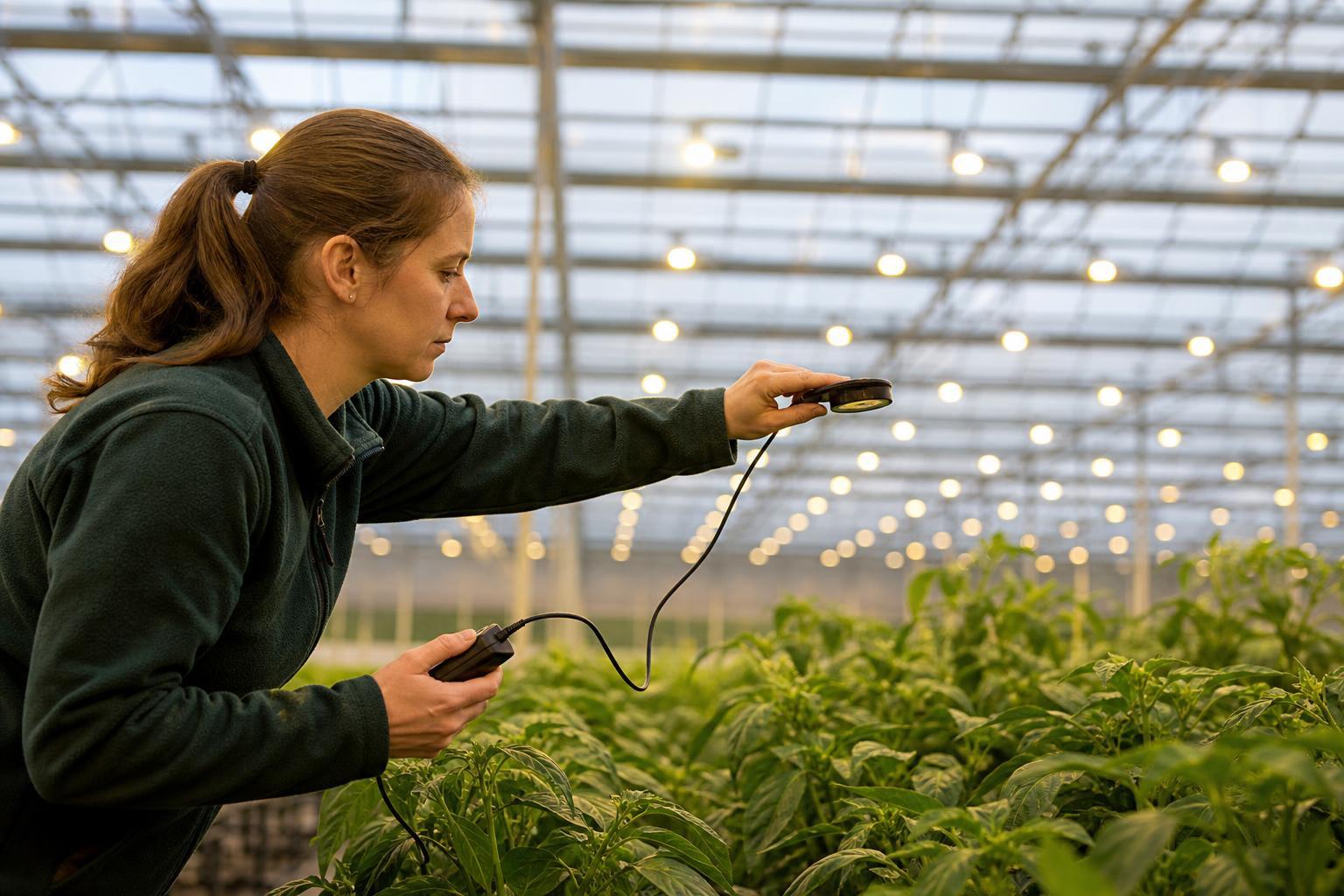
TL;DR
Greenhouse light levels measure how much photosynthetically useful light reaches crops inside a greenhouse, expressed as PPFD (instant intensity) and DLI (daily total). The right level depends on crop, growth stage, season, and how much light the greenhouse structure blocks. Supplemental lighting fills the gap between actual crop-level DLI and the crop’s target DLI, so the first step is always measuring, not buying fixtures.
Greenhouse light levels should be managed using Daily Light Integral (DLI) rather than lux or watts. Most commercial crops require between 5 and 30 mol·m⁻²·day⁻¹ depending on species and growth stage. Measure crop-level DLI using a quantum sensor, compare it with your crop target, then use supplemental LED lighting only to close the deficit during low-light periods. For most commercial growers, DLI is the primary metric for lighting decisions.
Greenhouse Light Levels at a Glance
Metric | What It Measures | Unit | Used For |
|---|---|---|---|
PAR | Plant-useful light | nm | Defines usable spectrum |
PPF | Fixture output | µmol/s | Compare fixtures |
PPFD | Instant light intensity | µmol·m⁻²·s⁻¹ | Measure canopy light |
DLI | Daily accumulated light | mol·m⁻²·day⁻¹ | Crop lighting target |
Photoperiod | Hours of light | Hours | Flowering & DLI |
What Greenhouse Light Levels Actually Measure
Greenhouse light levels are the amount of photosynthetically usable light reaching a crop canopy inside a greenhouse. Two numbers matter most: PPFD for the instantaneous light intensity at the canopy, and DLI for the total light accumulated over the full day.
What does not work: lumens, lux, foot-candles, or watts. Virginia Tech explicitly advises against using these human-lighting and energy units for plant production because they do not reflect the light plants use for photosynthesis.
Think of PPFD as the flow rate from a faucet and DLI as the total water collected in a bucket by the end of the day. A high PPFD for a short time and a lower PPFD for a longer time can produce similar DLI, but plants may not respond identically if intensity is pushed to extremes.
Talk to a lighting expert to translate your greenhouse light data into a fixture plan.
Key Terms
Term | Plain-English Meaning | Why It Matters |
|---|---|---|
PAR | The 400–700 nm waveband plants use for photosynthesis | Defines the useful light range |
PPF | Total photosynthetic photons a fixture emits per second | Compares fixture output |
PPFD | Photosynthetic photons hitting one square meter per second (µmol·m⁻²·s⁻¹) | Main canopy intensity measurement |
DLI | Total photosynthetic photons per square meter per day (mol·m⁻²·d⁻¹) | Main target for crop light sufficiency |
Photoperiod | Number of light hours in a day | Changes how much DLI accumulates |
Greenhouse transmission | Share of outdoor light reaching the crop | Determines usable sunlight inside |
Missouri Extension defines PAR and PPFD as the standard plant-relevant measurement framework. For a deeper breakdown of these units, see this guide on what a micromole is.
Why DLI Is the Most Important Greenhouse Light Level
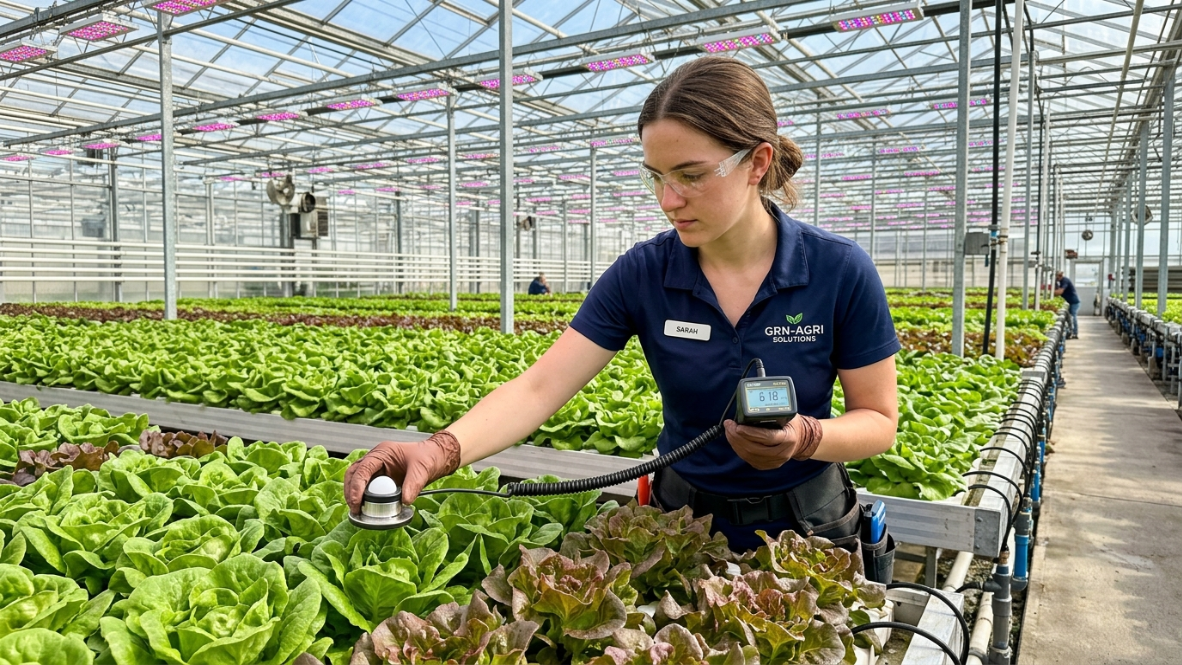
PPFD tells you what is happening right now. DLI tells you whether the crop got enough light today. For commercial greenhouse growers, DLI is almost always the better number to manage because it captures sunlight, supplemental lighting, cloud cover, and photoperiod across the full day.
The formula:
DLI (mol·m⁻²·d⁻¹) = PPFD (µmol·m⁻²·s⁻¹) × light hours × 0.0036
And the planning equation:
Supplemental DLI needed = target crop DLI − actual crop-level greenhouse DLI
The profitable question is not “How bright should my greenhouse be?” It is “How much DLI is my crop missing during the production period that matters?” For a full walkthrough, see the DLI calculations guide.
Typical Greenhouse Light Levels by Crop
There is no universal ideal greenhouse light level. The correct number depends on what you grow and when. These DLI ranges from Virginia Tech are useful starting points, not rigid prescriptions.
Crop or Stage | Target DLI (mol·m⁻²·d⁻¹) | Notes |
|---|---|---|
Seedlings | 5–10 | Low target during establishment |
Cuttings | 5–10 | Avoid stress while rooting |
Microgreens | 9–12 | Varies with species and color goals |
Lettuce | 12–17 | Common PPFD range: 250–350 µmol·m⁻²·s⁻¹ |
Spinach | 14–20 | Higher demand than lettuce |
Basil | 15–25 | High-light herb |
Tomato | 20–30 | Fruiting crop, higher energy demand |
Cucumber | 20–30 | Fruiting crop, higher energy demand |
Zucchini | 20–30 | Fruiting crop, higher energy demand |
A common error is saying “lettuce needs 300 PPFD” without context. A PPFD of 300 µmol·m⁻²·s⁻¹ delivers vastly different DLI depending on how many hours the light runs. Missouri Extension also warns that lettuce above 350 µmol·m⁻²·s⁻¹ may waste energy without meaningful yield gains and can cause photoinhibition. For detailed crop guidance, see the lettuce lighting requirements page.
Recommended Greenhouse PPFD by Crop
Many growers search for PPFD instead of DLI. While DLI is the better planning metric, PPFD is still useful for setting fixture output and checking canopy uniformity.
Crop | Typical PPFD |
|---|---|
Seedlings | 100–200 |
Lettuce | 250–350 |
Herbs | 250–400 |
Tomatoes | 400–700 |
Cucumbers | 400–700 |
Peppers | 400–700 |
Cannabis (where legal) | 600–1000 |
These values assume appropriate photoperiods. The same PPFD can produce very different DLI depending on how many hours the lights operate.
How Greenhouse Structure Changes Light Levels
A greenhouse is not a transparent box. Glazing, trusses, dust, curtains, gutters, hanging baskets, heat pipes, and seasonal sun angle all reduce the light reaching crops.
Purdue reports that outdoor monthly DLI across the U.S. can range from 5 to 60 mol·m⁻²·d⁻¹ depending on latitude, season, and cloud cover. But greenhouse DLI seldom exceeds 25 mol·m⁻²·d⁻¹ because of structural losses, and values can drop 40% to 70% below outdoor levels. Under heavily obstructed conditions, crop-level DLI may fall to just 1–5 mol·m⁻²·d⁻¹.
Vegetable Growers News puts the typical transmission loss at 35% to 50%, with average DLI inside U.S. greenhouses ranging from 5 to 30 mol·m⁻²·d⁻¹. Northern greenhouses can see DLI fall below 12 mol·m⁻²·d⁻¹ for roughly three months of the year.
This is why measuring greenhouse light levels at the crop canopy, not outside or at the ridge, is essential.
How Greenhouse Light Levels Change by Season
Outdoor sunlight changes dramatically throughout the year, causing greenhouse DLI to fluctuate even when the structure stays the same.
Season | Typical DLI Trend | Lighting Need |
|---|---|---|
Winter | Lowest | Usually highest |
Spring | Increasing | Moderate |
Summer | Highest | Often unnecessary |
Autumn | Declining | Increasing |
How to Measure Greenhouse Light Levels
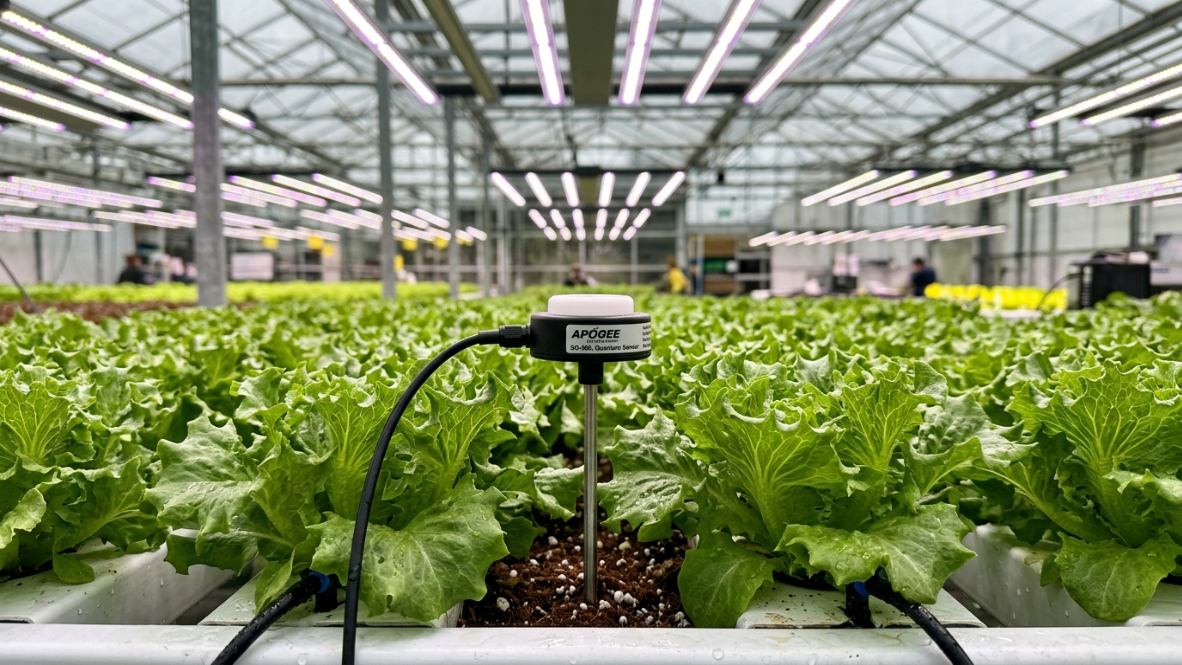
Good measurement is the foundation of every smart lighting decision.
Measure at crop height. The sensor goes where the canopy sits, not the floor or aisle.
Use a quantum sensor. These read PPFD in the plant-relevant 400–700 nm range.
Map multiple points. Measure corners, edges, and center of each growing zone, then average.
Track DLI over time. A single noon reading is misleading. Log data continuously, ideally every 15 to 60 seconds.
Focus on the worst period. Size lighting for the darkest month you need to produce through, not the sunniest day.
Keep sensors level and clean. Dirty or tilted sensors produce unreliable data.
Re-check after changes. Glazing replacement, new shade cloth, crop height shifts, different bench layouts, and fixture changes all alter crop-level greenhouse light levels.
Do not size a lighting project from one sunny afternoon. Size from the crop target DLI, measured crop-level DLI, and the darkest period you need to produce through.
Light Meter Comparison
Device | Measures | Best Use |
|---|---|---|
Lux meter | Human brightness | Not recommended |
Quantum sensor | PPFD | Best choice |
Spectrometer | Full spectrum | Research |
DLI logger | Daily light | Long-term monitoring |
How to Calculate Supplemental Lighting Needs
Once you know the gap between actual and target greenhouse light levels, the math is straightforward.
Example: Winter lettuce
Target DLI: 14 mol·m⁻²·d⁻¹
Outdoor winter DLI: 10 mol·m⁻²·d⁻¹
Greenhouse transmission: 60%
Crop-level DLI: 10 × 0.60 = 6 mol·m⁻²·d⁻¹
Deficit: 14 − 6 = 8 mol·m⁻²·d⁻¹
At a supplemental PPFD of 200 µmol·m⁻²·s⁻¹:
Hours needed = 8,000,000 ÷ (200 × 3,600) = 11.1 hours
The same framework applies to any crop. Swap in the crop’s target DLI, measure the actual greenhouse DLI, and calculate the deficit. For a complete guide on turning this math into a fixture layout, see the supplemental lighting guide.
Choosing the Right LED Efficiency
When comparing fixtures, growers should look beyond wattage.
Instead compare:
PPE (µmol/J)
Fixture efficacy
Uniformity
Beam angle
Dimming capability
Specification | Why It Matters |
|---|---|
PPE | Lower electricity cost |
Uniformity | More consistent crops |
Dfficacy | Better ROI |
Dimming | Dynamic DLI control |
Supplemental Lighting vs. Photoperiodic Lighting
These are two different tools solving two different problems, and growers confuse them regularly. Practitioners on Reddit propagation forums frequently conflate photoperiod extension with DLI supplementation.
Supplemental lighting delivers meaningful photosynthetic photons to close a DLI gap. It operates at tens to hundreds of µmol·m⁻²·s⁻¹.
Photoperiodic lighting manipulates how plants perceive day length to control flowering or vegetative responses. Ohio State notes that recommended intensities for photoperiodic control can be as low as 1–2 µmol·m⁻²·s⁻¹.
A low-intensity lamp can trigger a flowering response or keep a crop vegetative, but it will not meaningfully close a DLI deficit.
Daily Workflow for Managing Greenhouse Light Levels
Morning
Check weather
Midday
Monitor DLI accumulation
Afternoon
Adjust supplemental lighting
End of day
Compare achieved DLI against target
Common Mistakes With Greenhouse Light Levels
Using lux or watts as plant-light metrics. These human-brightness and energy units do not map cleanly to what plants use. See why comparing LEDs to HPS by wattage alone is particularly misleading.
Buying fixtures before measuring DLI. Practitioners on Reddit report this as a common and expensive mistake. In one r/macrogrowery thread, a grower asked for LED recommendations without having measured light intensity. The most useful reply ignored product suggestions entirely and asked about cloudy-day DLI and greenhouse transmission losses. Measure the deficit first.
Assuming more light always pays. A crop may grow better with more light, but every extra mole does not necessarily pay back. Supplemental lighting can account for 10% to 30% of greenhouse operating expenses. Over-lighting is a profit problem, not just a biological one.
Ignoring environmental follow-through. Higher greenhouse light levels increase demand on water, nutrition, CO₂, and humidity control. Doubling DLI without adjusting the environment can shock plants. For related guidance, see how to plan HVAC for LED lighting.
Running static timers instead of DLI-aware controls. Timers can work, but they are blunt. In a greenhouse, the sun is part of the lighting system, and controls should account for it. Practitioners on LinkedIn describe closed-loop systems using 0–10V dimming curves that increase output on cloudy days and reduce it when sunlight is sufficient. DLI-based controls consistently outperform fixed schedules.
Putting It Together: A Framework for Commercial Growers
Managing greenhouse light levels in a commercial operation comes down to five steps:
Choose the crop and stage. Target DLI differs. Seedlings need 5–10 mol·m⁻²·d⁻¹. Tomatoes need 20–30.
Measure actual crop-level DLI. Use quantum sensors at canopy height, logged over time, during the darkest production period.
Calculate the deficit. Target minus actual equals the supplemental requirement.
Convert the deficit into PPFD and runtime. Use the formulas above.
Use smart controls. DLI-integrating controls that dim or cycle fixtures based on real-time sunlight avoid wasting electricity and ensure consistent daily targets.
A professional lighting design translates these DLI requirements into fixture layout, PPFD uniformity maps, electrical requirements, and operating cost projections. For greenhouse top lighting projects, the Altus 1K is built for this kind of project-level planning.
Check available lighting rebates to understand how incentives affect project ROI.
Frequently Asked Questions
What is a good light level for a greenhouse?
There is no single number. Target DLI depends on crop, growth stage, and production goal. Seedlings thrive at 5–10 mol·m⁻²·d⁻¹, lettuce at 12–17, and fruiting crops like tomatoes at 20–30. The “good” level is whatever meets the crop target during your darkest production period.
How do you measure greenhouse light levels?
Use a quantum sensor (PAR meter) placed at crop canopy height. Measure at multiple points across the growing area and log readings over time. A single noon reading is not representative. Track DLI across full days, especially during cloudiest months.
Is greenhouse light the same as outdoor light?
No. Greenhouse structure, glazing, dust, curtains, and hanging baskets commonly reduce light by 35% to 50%. Greenhouse DLI seldom exceeds 25 mol·m⁻²·d⁻¹, even when outdoor DLI is much higher.
What is the difference between PPFD and DLI?
PPFD is the instantaneous light intensity at the canopy, measured in µmol·m⁻²·s⁻¹. DLI is the total light accumulated over the day, measured in mol·m⁻²·d⁻¹. PPFD is the flow rate. DLI is the daily total.
Can you give plants too much light?
Yes. Lettuce above 350 µmol·m⁻²·s⁻¹ PPFD may waste energy and risk photoinhibition. Excessive light also increases water, nutrient, and HVAC demands. More light is only better up to the point where the crop can use it and the economics support it.
Do I need supplemental lighting in my greenhouse?
Only if your crop-level DLI falls below the crop’s target during the production periods that matter. Measure first, then decide. Many greenhouses need supplemental lighting in winter but not in summer.
What is the difference between supplemental and photoperiodic lighting?
Supplemental lighting delivers high-intensity photosynthetic photons (often 100–400+ µmol·m⁻²·s⁻¹) to close a DLI gap. Photoperiodic lighting uses very low intensity (as little as 1–2 µmol·m⁻²·s⁻¹) to control flowering or vegetative responses. They solve different problems.
Should I use a timer or DLI-based controls?
DLI-based controls are better for most commercial operations because they respond to real-time sunlight. Timers ignore the sun and often deliver too much light on bright days and not enough on cloudy ones.
Need help translating greenhouse light levels into a fixture layout and operating plan? Schedule a free consultation with a lighting expert.