PPFD for Cannabis Veg Stage: 2026 Guide & DLI Chart
PPFD for cannabis veg stage: 400–600 default, 600–900 for advanced. Get DLI conversions, charts, and setup tips to dial in your veg room.
TL;DR
For cannabis in the vegetative stage, a practical PPFD target is 400 to 600 µmol/m²/s at the canopy. Established plants in well-controlled environments can handle 600 to 900 µmol/m²/s for faster, more compact growth. At an 18-hour photoperiod, 400 to 600 PPFD translates to roughly 26 to 39 mol/m²/day DLI. The right number depends on plant maturity, cultivar response, environmental control, photoperiod length, and production goals.
What Is the Best PPFD for Cannabis in the Vegetative Stage?
The recommended PPFD for cannabis in the vegetative stage is 400–600 µmol/m²/s at canopy level for general vegetative growth. Established plants in controlled indoor environments may benefit from 600–900 µmol/m²/s when the cultivar, temperature, humidity, irrigation, and other growing conditions support higher light intensity. Under an 18-hour light schedule, 400–600 PPFD delivers a daily light integral (DLI) of approximately 25.9–38.9 mol/m²/day. Newly rooted clones and recovering transplants generally need a more conservative starting intensity. The ideal target depends on plant maturity, photoperiod, and the desired canopy structure.
Quick Reference: Cannabis Veg PPFD and DLI
Vegetative growth situation | Suggested PPFD | DLI at 18 hours |
|---|---|---|
Rooted clones or transplant recovery | 200–350 µmol/m²/s | 13.0–22.7 mol/m²/day |
Early vegetative growth | 300–450 µmol/m²/s | 19.4–29.2 mol/m²/day |
General vegetative growth | 400–600 µmol/m²/s | 25.9–38.9 mol/m²/day |
Established plants needing compact growth | 600–900 µmol/m²/s | 38.9–58.3 mol/m²/day |
How to use this chart: Treat these ranges as practical starting points rather than universal biological limits. Measure PPFD at canopy level, account for the daily light schedule, and consider plant response and environmental conditions before increasing intensity.
DLI is calculated from PPFD and the number of light hours per day. Values are rounded to one decimal place.
What PPFD Means and Why It Matters in Veg
PPFD stands for photosynthetic photon flux density. It measures how many photosynthetically useful photons (in the 400 to 700 nm range) land on a square meter of canopy every second, expressed in µmol/m²/s. Virginia Tech’s lighting guide lists PPFD as the preferred unit for plant lighting because it directly reflects light a plant can use for photosynthesis, unlike lux or lumens, which are calibrated to human vision.
PPFD for cannabis veg stage specifically describes the light intensity your plants receive while producing leaves, stems, branches, and roots before flowering begins. Getting this number right shapes everything from internode length and stem thickness to how quickly a canopy fills out. For a broader look at targets across all growth phases, see our full cannabis PPFD guide.
Recommended Cannabis Veg PPFD Chart
The best vegetative stage PPFD is not one number. It shifts with plant maturity and what you are growing toward.
Veg Phase | Canopy PPFD (µmol/m²/s) | DLI at 18/6 (mol/m²/day) | Notes |
|---|---|---|---|
Rooted clones / transplant recovery | 200–350 | 13–23 | Keep light low while roots and transpiration capacity catch up. |
Early veg | 300–450 | 19–29 | Plants recovering from transplant or just starting canopy development. |
Standard veg | 400–600 | 26–39 | Best default for most growers. Strong, reliable growth. |
Late veg / established plants | 600–750 | 39–49 | Healthy, fast-growing plants in a well-managed room. |
Aggressive commercial veg | 750–900 | 49–58 | Drives compact morphology. Requires full environmental control. |
Above 900 | 58+ | High-input strategy only. Cultivar, CO₂, VPD, irrigation, and nutrition must all support it. |
Most community discussions settle on 400 to 600 PPFD for veg as the standard recommendation. Practitioners on Reddit report this range repeatedly, though experienced growers often redirect the conversation to DLI and photoperiod, noting that a PPFD number without light hours is incomplete.
If you are planning a commercial veg room and want a project-specific target, talk to our lighting team for a free consultation.
PPFD vs. DLI: Why Cannabis Veg Needs Both Numbers
PPFD is a snapshot of intensity at any given moment. DLI (daily light integral) is the total daily dose. Think of PPFD as the speed and DLI as the mileage. A plant under 600 PPFD for 18 hours receives far more total light than the same 600 PPFD under 12 hours.
The formula is straightforward:
DLI = (PPFD x light hours x 3600) / 1,000,000
For a full breakdown of when to use each metric, see our PPFD vs. DLI guide.
DLI Conversion Table for Cannabis Veg
PPFD (µmol/m²/s) | 16-hr DLI | 18-hr DLI | 20-hr DLI | 24-hr DLI |
|---|---|---|---|---|
300 | 17.3 | 19.4 | 21.6 | 25.9 |
400 | 23.0 | 25.9 | 28.8 | 34.6 |
500 | 28.8 | 32.4 | 36.0 | 43.2 |
600 | 34.6 | 38.9 | 43.2 | 51.8 |
700 | 40.3 | 45.4 | 50.4 | 60.5 |
800 | 46.1 | 51.8 | 57.6 | 69.1 |
900 | 51.8 | 58.3 | 64.8 | 77.8 |
This table matters more than most growers realize. Under 18/6, 600 PPFD equals about 38.9 DLI. Under 20/4, it jumps to 43.2. Under 24/0, it hits 51.8. Autoflower growers running longer photoperiods can often use lower PPFD and still reach the same daily light target. Practitioners in autoflower forums regularly flag this point, noting that the same PPFD delivers very different daily doses depending on schedule length.
For detailed DLI calculations by growth stage, see our cannabis DLI guide.
How to Calculate DLI From PPFD
To calculate daily light integral (DLI), multiply PPFD by the number of hours the lights are on, then convert seconds and micromoles into moles.
Formula:
DLI = PPFD × light hours per day × 3,600 ÷ 1,000,000
Example: 500 PPFD under an 18-hour light schedule
Multiply PPFD by daily light hours: 500 × 18 = 9,000.
Convert hours to seconds: 18 × 3,600 = 64,800 seconds.
Apply the complete formula: (500 × 18 × 3,600) ÷ 1,000,000.
The resulting DLI is 32.4 mol/m²/day.
The same PPFD produces different DLI values under different photoperiods:
PPFD | 16 hours | 18 hours | 20 hours | 24 hours |
|---|---|---|---|---|
400 | 23.0 | 25.9 | 28.8 | 34.6 |
500 | 28.8 | 32.4 | 36.0 | 43.2 |
600 | 34.6 | 38.9 | 43.2 | 51.8 |
All DLI values are expressed in mol/m²/day and rounded to one decimal place.
Key takeaway: PPFD describes instantaneous light intensity, while DLI describes the total daily light dose. Evaluate both metrics when comparing lighting setups with different photoperiods.
What Research Says About Veg-Stage Cannabis PPFD
The most directly relevant study tested indoor cannabis (‘Gelato’ clones) under PPFD levels from 135 to 1,430 µmol/m²/s on a 16-hour photoperiod for 21 days of vegetative growth. Light intensity changed plant architecture significantly: stem thickness, node count, chlorophyll content, and aboveground dry weight all increased as PPFD rose, while internode length and leaf size decreased. The researchers concluded that 600 to 900 µmol/m²/s balanced morphology and energy use under those conditions.
This finding is worth sitting with. At roughly 600 PPFD, plants developed a more open architecture with longer internodes. At roughly 900 PPFD, plants were more compact with thicker stems and shorter internodes. Both outcomes are valid. They serve different production goals.
A separate greenhouse study found that increasing DLI from about 18 to 52 mol/m²/day produced linear increases in fresh mass, dry mass, node number, stem diameter, and branching, with no saturation in vegetative growth even at the highest light levels tested. Cannabis is a high-light crop. But “can use more light” is not the same as “should always run at maximum.”
What Peer-Reviewed Research Says About Cannabis Veg PPFD
Research on cannabis lighting supports adjusting PPFD to the plant's growth stage, production goals, and growing environment rather than using one universal target.
A study published in Industrial Crops and Products investigated the effects of light intensity on vegetative cannabis plants. Researchers grew ‘Gelato’ clones under canopy-level PPFD ranging from 135 to 1,430 µmol/m²/s for 21 days using a 16-hour photoperiod.
The results showed that light intensity influenced several growth characteristics, including stem thickness, internode length, leaf size, node development, and aboveground dry weight. Plants grown at approximately 600 PPFD developed a more open architecture, while plants grown at approximately 900 PPFD tended to be more compact and robust.
These findings support using different PPFD targets for different production goals. A more open canopy may be desirable when airflow and plant structure are priorities, while compact growth may be preferred in production systems that require uniform plant architecture.
However, this experiment does not establish a universal optimum for every cannabis cultivar or growing environment. The results reflect a particular genotype, experimental duration, photoperiod, and set of growing conditions.
Practical takeaway: Use 400–600 µmol/m²/s as a general starting range for vegetative growth, and consider higher intensities for established plants when environmental conditions and production objectives justify them. Treat research findings as evidence for informed adjustments, not as a guarantee of a particular growth rate or yield.
Why High-PPFD Claims Need Context
When growers online argue about 1,000+ PPFD in veg, those numbers usually originate from flowering yield studies or leaf-level photosynthesis research. One well-known study found that dry flower yield increased linearly up to 1,800 PPFD during the bloom cycle, but it also warned that leaf-level photosynthesis does not reliably predict whole-plant crop yield. A classic photosynthesis study showed cannabis leaves responding to light up to 1,500 PPFD at 30°C with elevated CO₂, but leaf-level optima and recommended veg-room settings are two different things.
The bottom line: 400 to 600 PPFD is a reliable starting range for cannabis veg PPFD. Pushing to 600 to 900 is research-backed for established plants when the environment keeps up.
Why Flowering-Stage PPFD Research Does Not Establish a Veg Target
Cannabis lighting studies must be interpreted in the context of the growth stage being investigated. Research on flowering plants can provide useful information about photosynthesis, flower yield, and light response, but it does not automatically establish the ideal PPFD for vegetative growth.
For example, a 2021 study investigated cannabis plants during a 12-hour flowering photoperiod at PPFD levels ranging from 120 to 1,800 µmol/m²/s. The researchers found that leaf-level photosynthetic responses did not reliably predict whole-plant responses to light intensity.
This distinction matters because leaf photosynthesis, vegetative architecture, biomass accumulation, and final flower yield are different outcomes. A light level associated with a positive result for one outcome should not be treated as a universal recommendation for another.
When evaluating a PPFD recommendation, check the growth stage, cultivar, photoperiod, measured outcome, and environmental conditions before applying the finding to a different production system.
Sources and Methodology
The PPFD ranges in this guide are presented as practical reference points, informed by published cannabis lighting research and the relationship between PPFD, photoperiod, and daily light integral (DLI). They are not universal biological limits or guarantees of plant performance.
Research findings should be interpreted according to the cultivar, growth stage, photoperiod, experimental duration, environmental conditions, and outcomes measured in each study. Where research findings differ from practical recommendations, the conditions of the original experiment should be considered before applying them to another growing environment.
DLI values in this article are calculated from PPFD and daily light hours using the standard conversion formula. Rounded values may differ slightly from calculations performed with unrounded figures.
When to Use 400 to 600 vs. 600 to 900 PPFD
Choosing the right cannabis veg stage PPFD depends on what you are trying to achieve.
Production Goal | Better Range (µmol/m²/s) | Why |
|---|---|---|
Gentle transition from propagation | 200–350 | Reduces stress while roots establish. |
General vegetative growth | 400–600 | Reliable default. Easier to manage. |
Faster, stockier growth | 600–900 | Drives compact morphology if environment supports it. |
Open canopy for airflow | 400–600 | May produce longer internodes and better air circulation. |
High-density commercial veg | 600–900 | Best when uniformity, fertigation, VPD, and CO₂ are all controlled. |
Higher PPFD only helps when other growth factors are not limiting. One practitioner article on cannabis lighting framed it clearly: plants perform according to their most limiting factor, whether that is CO₂, temperature, humidity, or root-zone conditions. Increasing light without addressing those bottlenecks can hurt more than it helps. If you are pushing past 600 PPFD, you should already have VPD dialed in and a plan for CO₂ supplementation.
How to Adjust PPFD During the Cannabis Veg Stage
PPFD should be adjusted according to plant maturity, measured light intensity, and the conditions in the growing environment. A target that works for established plants may be unsuitable for newly rooted clones or plants recovering from stress.
1. Establish a baseline
Measure PPFD at canopy level and record the average across the growing area. Note the photoperiod, temperature, humidity, irrigation conditions, and the plants' current growth stage. This gives you a baseline for evaluating future changes.
2. Evaluate plant response
Look at growth patterns over time rather than relying on a single leaf symptom. Stem development, internode length, new leaf growth, and canopy uniformity can help you assess whether the current lighting setup is meeting your production goals.
3. Check other environmental factors
Before increasing or decreasing PPFD, assess temperature, humidity, airflow, root-zone conditions, irrigation, and nutrition. Changes in these factors can affect plant response and may produce symptoms that resemble light stress.
4. Make measured adjustments
Change light intensity gradually rather than making a large jump based on a chart alone. Recheck canopy PPFD after adjusting fixture height or output, then observe how the plants respond before making further changes.
5. Recalculate DLI when the photoperiod changes
Changing the number of light hours changes DLI even if PPFD stays constant. Recalculate daily light exposure whenever the lighting schedule changes so that the intensity and duration are evaluated together.
Important: There is no universal adjustment interval or percentage increase that suits every cultivar and growing environment. Use measured readings, documented observations, and the response of the plants to guide decisions.
How to Measure PPFD Correctly
A cannabis veg PPFD number is only as good as the measurement behind it.
Use a quantum sensor or PAR meter for accuracy. Calibrated quantum sensors are the industry standard for plant-relevant light measurement. Phone apps can serve as cost-effective tools for rough comparisons, but community threads on Reddit repeatedly warn that apps without the correct diffuser setup can be off by 20 to 30%. Useful for directional checks, unreliable for dialing in exact targets.
Measure at canopy height. Take readings at the growing tips, not at the floor or tray surface.
Map the whole canopy, not the brightest point. Record three numbers:
Average PPFD across the canopy
Minimum PPFD (typically corners and edges)
Maximum PPFD (typically directly under the fixture center)
One grower in a forum discussion captured this problem well: 600 PPFD in the middle but only 350 at the corners. That is not a “600 PPFD veg room.” It is a room with a roughly 475 average and serious uniformity issues. Plants respond to the full canopy environment, not the best number on the map.
For propagation and multi-tier veg rooms where uniform coverage matters most, the Infinity XE is designed specifically for cannabis veg and propagation applications.
Quantum Sensors vs. Phone Apps for PPFD Measurement
The best measurement method depends on whether you need a rough comparison or a repeatable, calibrated reading.
Measurement method | Best use | Main limitation |
|---|---|---|
Calibrated quantum sensor | Accurate canopy measurements and repeatable lighting assessments | Requires suitable equipment and correct measurement technique |
Dedicated PAR meter | Checking PPFD across a growing area | Accuracy depends on sensor quality and calibration |
Smartphone lighting app | Preliminary comparisons and rough estimates | Results depend on the phone, sensor, app, and calibration method |
For reliable results, follow the sensor manufacturer's measurement instructions and measure at the actual canopy height. Use the same measurement method and grid positions when comparing readings over time.
When evaluating a commercial lighting system, record the average PPFD, minimum PPFD, maximum PPFD, and the variation across the canopy. These measurements reveal whether a target intensity is distributed consistently rather than concentrated directly beneath the fixture.
Signs Your Veg PPFD Is Too Low or Too High
Symptoms of too little light:
Excessive stretching and long internodes
Weak, thin stems
Slow canopy fill
Leaves reaching aggressively toward the light source
Symptoms of too much light:
Pale or chlorotic new growth near the canopy top
Leaf edges curling upward (tacoing or cupping)
Slowed growth despite abundant light
Symptoms worse in hotspots, milder at canopy edges
Increased irrigation demand or VPD stress
These signs overlap with many other problems. A thread on Rollitup captured the common confusion: growers running 380 to 550 PPFD in veg were asking whether their plants looked light-stressed, but the symptoms often pointed to heat, low humidity, or nutrient issues. Before blaming PPFD, check temperature, humidity, root health, and nutrient balance.
Common Mistakes When Setting Cannabis Veg PPFD
Even when the target PPFD is reasonable, measurement and interpretation errors can lead to inconsistent results.
Using PPFD without considering DLI. A reading of 600 µmol/m²/s does not describe the full daily light dose. Calculate DLI using the actual photoperiod.
Measuring only the center of the canopy. The brightest point may not represent the average intensity across the growing area. Map multiple positions, including corners and edges.
Copying a target from another growth stage. Flowering-stage research does not automatically establish a suitable vegetative-stage target. Check the conditions and outcomes studied.
Increasing light before checking environmental conditions. Higher light input can increase water demand and place greater demands on environmental management. Check the overall growing conditions before raising PPFD.
Diagnosing light stress from leaf appearance alone. Leaf curling, discoloration, and slowed growth can have several causes. Check environmental conditions, irrigation, root health, and nutrition before attributing symptoms to PPFD.
Treating wattage as a substitute for PPFD. Electrical power consumption does not directly tell you how much photosynthetically active light reaches the canopy. Fixture efficacy, optics, mounting height, and layout all affect the result.
The most reliable approach combines canopy measurements, DLI calculations, environmental monitoring, and observations of plant development.
Commercial Cannabis Veg Lighting Considerations
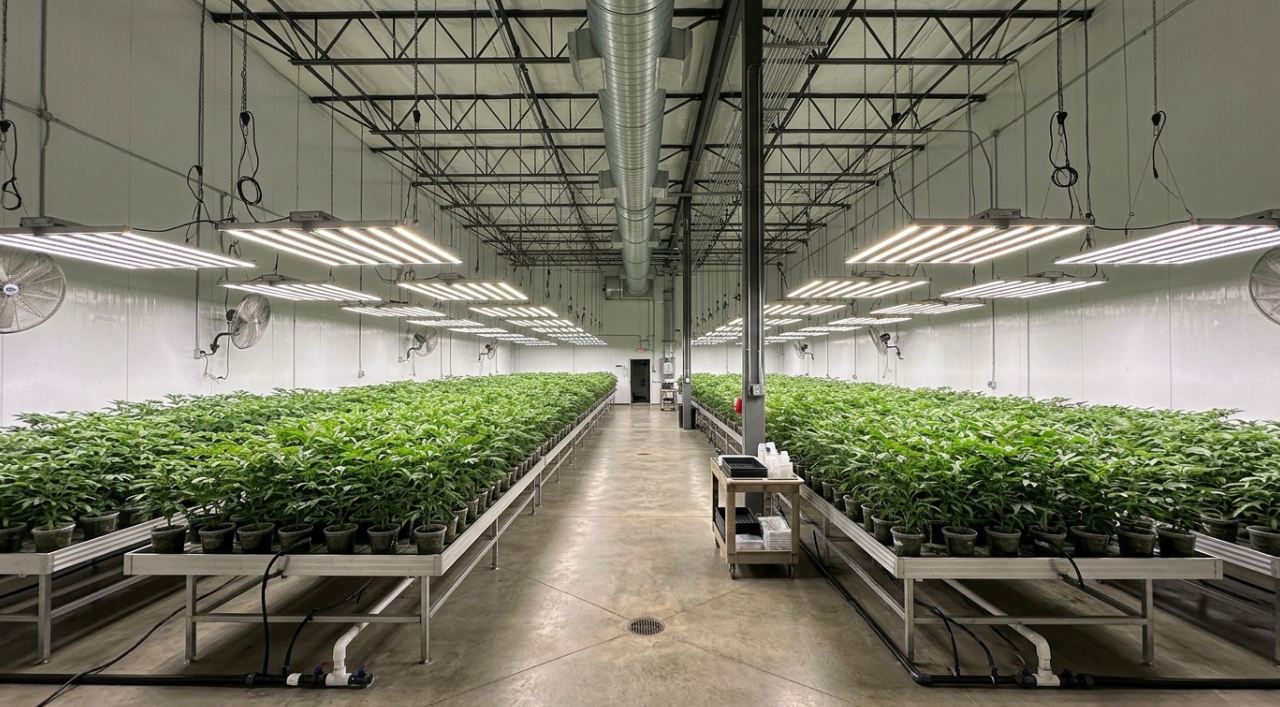
For professional cultivators, PPFD for cannabis veg stage is part of a system. Designing a commercial veg room around a single PPFD target misses the point. What matters:
Average canopy PPFD, min/max, and uniformity ratios. Two rooms can both claim “600 PPFD veg lighting.” One may have a smooth canopy average. The other may have 900 PPFD hotspots and 300 PPFD corners. Environmental best practices guides emphasize that lighting designs should include PPFD maps showing the full range across the growing area.
DLI targets tied to production schedules. A practical commercial veg target is roughly 25 to 40 mol/m²/day for standard programs, scaling up to 40 to 55+ for aggressive crop steering.
Energy cost and heat load. Higher PPFD means more power draw and more heat. Moving drivers outside the grow space with centralized power systems can reduce canopy-zone heat and simplify HVAC planning. The OptiDrive platform is built for large-scale deployments where electrical infrastructure, driver heat, and fixture serviceability directly affect operating cost.
Veg lighting shapes the flower crop. The PPFD you run in veg determines internode length, branching density, stem strength, and canopy architecture. These characteristics carry directly into the flower room, affecting yield potential, training labor, and canopy uniformity under bloom lighting.
FAQ
What PPFD should cannabis be at during veg?
For most growers, 400 to 600 µmol/m²/s is a strong default for the vegetative stage. Established plants in well-controlled environments can benefit from 600 to 900 µmol/m²/s, which peer-reviewed research supports as a range that balances compact morphology and energy use.
Is 600 PPFD too much for veg?
Not for established, healthy plants under an 18-hour photoperiod. At 18/6, 600 PPFD equals about 38.9 mol/m²/day DLI, which is aggressive but reasonable. For newly rooted clones or stressed plants, 600 PPFD may be too much too soon. Start lower and increase as the plant catches up.
Is 700 PPFD good for veg?
Yes, for strong, established plants with a dialed environment. At 18/6, 700 PPFD equals about 45.4 DLI. Temperature, humidity, CO₂, irrigation, and nutrition all need to support that level of light input.
Can I run 900 PPFD during the vegetative stage?
You can, but it should be intentional. At 18/6, 900 PPFD delivers about 58.3 DLI, which is a high daily light dose. Research supports 900 PPFD for compact, sturdy vegetative morphology under controlled conditions, but this is not a beginner default and not appropriate for every cultivar.
What DLI does 500 PPFD produce at 18 hours?
32.4 mol/m²/day. Use the formula: DLI = (500 x 18 x 3600) / 1,000,000.
Do autoflowers need different PPFD in veg?
Autoflowers often run under 20/4 or 24/0 light schedules. Because they receive more total hours of light each day, the same PPFD produces a higher DLI than it would under 18/6. You may need to reduce PPFD to keep the daily light total within a productive range rather than an excessive one.
Is PPFD more important than watts for cannabis?
For crop response, yes. Watts measure electrical power draw, not canopy light. The same wattage from two different fixtures can produce very different PPFD levels depending on efficacy, optics, mounting height, and room geometry. Plant scientists recommend using PPFD and DLI rather than watts or lux for lighting decisions.
Should I measure PPFD with a phone app?
Phone apps give useful directional comparisons (is the center brighter than the corner?) but should not be treated as precision instruments. For commercial cultivation where repeatable results matter, calibrated quantum sensors are the standard.