Cannabis Veg Room Lighting 2026: Buyer's Guide to PPFD & DLI
Compare PPFD, DLI, spectrum, and layout for Cannabis Veg Room Lighting in 2026. Get targets, uniformity tips, and a checklist for compact plants.
TLDR
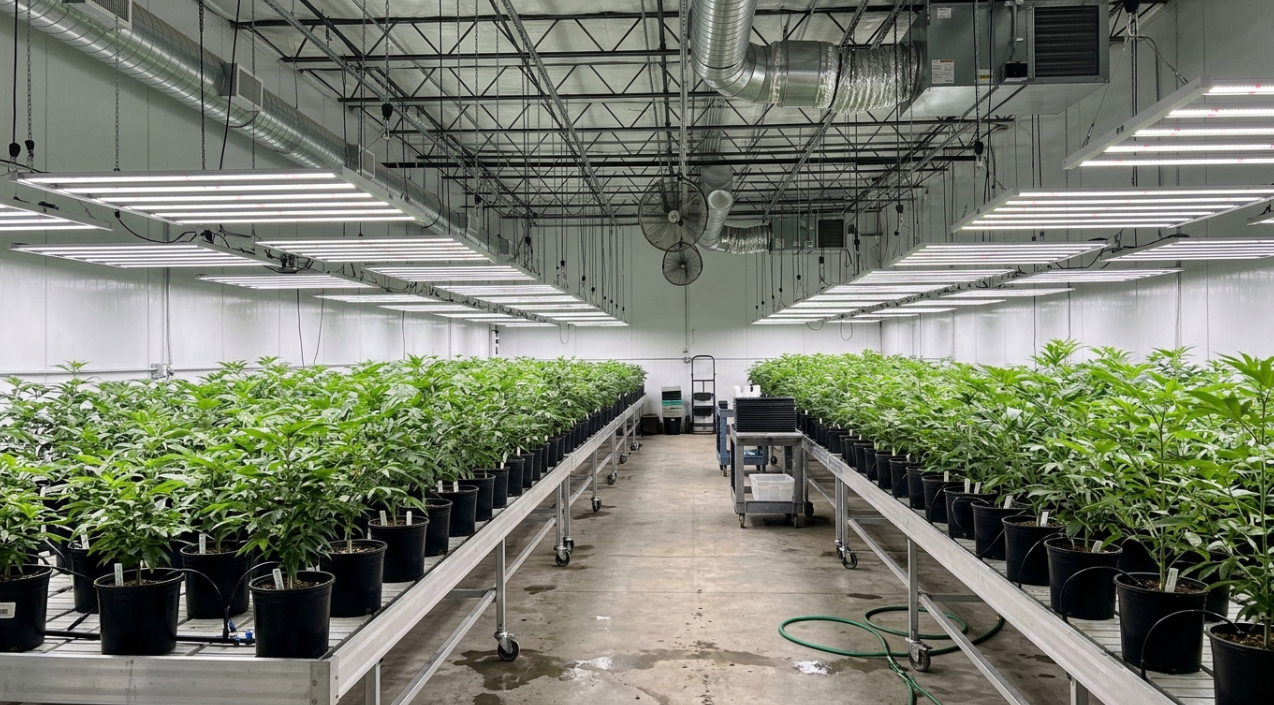
Cannabis veg room lighting is the combination of photoperiod, PPFD, DLI, spectrum, and uniformity used to keep photoperiod cannabis in vegetative growth and build strong plant architecture before flower. Most commercial veg rooms run 18 hours of light per day at 300 to 600 µmol/m²/s for general vegetative growth, with 600 to 900 µmol/m²/s producing more compact plants when the rest of the environment supports it. The goal is not just preventing flowering. It is shaping the plant the flower room will receive.
Cannabis Veg Room Lighting: Quick Answer
Cannabis veg room lighting is the combination of light intensity, daily light exposure, photoperiod, spectrum, and fixture coverage used to support vegetative growth before flowering. For photoperiod cannabis, an 18-hours-on, 6-hours-off schedule is a common starting point. A general vegetative lighting range is approximately 300–600 µmol/m²/s PPFD, while young or recently rooted plants may require less and higher-intensity strategies require suitable environmental controls.
The right setup depends on plant stage, cultivar, canopy size, temperature, humidity, irrigation, and production goals. Growers should evaluate both average canopy PPFD and daily light integral (DLI), then confirm that light is distributed evenly across the entire growing area.
Cannabis Veg Room Lighting at a Glance
Lighting Variable | Practical Starting Point | What to Check |
|---|---|---|
Photoperiod | 18 hours of light and 6 hours of darkness for photoperiod cannabis | Confirm the schedule suits the cultivar and production plan |
PPFD | Approximately 300–600 µmol/m²/s for general veg | Adjust for plant stage, cultivar, and environmental capacity |
DLI | Calculate from PPFD and daily light hours | Compare total daily light exposure rather than intensity alone |
Spectrum | Broad-spectrum white LED is a practical commercial option | Evaluate plant response, fixture efficacy, and visibility |
Uniformity | Measure light across a canopy grid | Check average, minimum, maximum, and edge readings |
Fixture efficiency | Compare PPE in µmol/J | Evaluate alongside PPFD maps, cost, and fixture performance |
Controls | Dimming and programmable scheduling | Confirm compatibility with facility controls |
Installation | Match fixtures to room dimensions and mounting height | Check electrical capacity, heat load, and safety listings |
These values are starting points rather than universal prescriptions. Confirm lighting targets against reliable crop research, cultivar response, and the environmental conditions the facility can maintain.
What Cannabis Veg Room Lighting Means
Cannabis veg room lighting is the lighting strategy used during the vegetative stage of cannabis production. This stage sits between propagation (where clones root or seeds germinate) and flowering (where plants produce buds under short days).
For photoperiod cannabis, long-day light schedules prevent the plant from initiating flower. The standard commercial approach is 18 hours light, 6 dark, commonly written as 18/6. Plants stay vegetative as long as the dark period remains short enough.
But veg room lighting involves more than just keeping lights on for 18 hours. In a commercial facility, it includes target light intensity at the canopy (PPFD), total daily light delivered (DLI), the spectral composition of the light, how fixtures are arranged across the growing area, how evenly they cover the canopy, and how the room’s lighting connects to HVAC, controls, and the broader production schedule.
The five variables that define cannabis veg room lighting are photoperiod, PPFD, DLI, spectrum, and uniformity. Every decision in a veg room traces back to one or more of these.
Explore indoor cannabis lighting systems designed around these principles.
Why Veg Room Lighting Matters
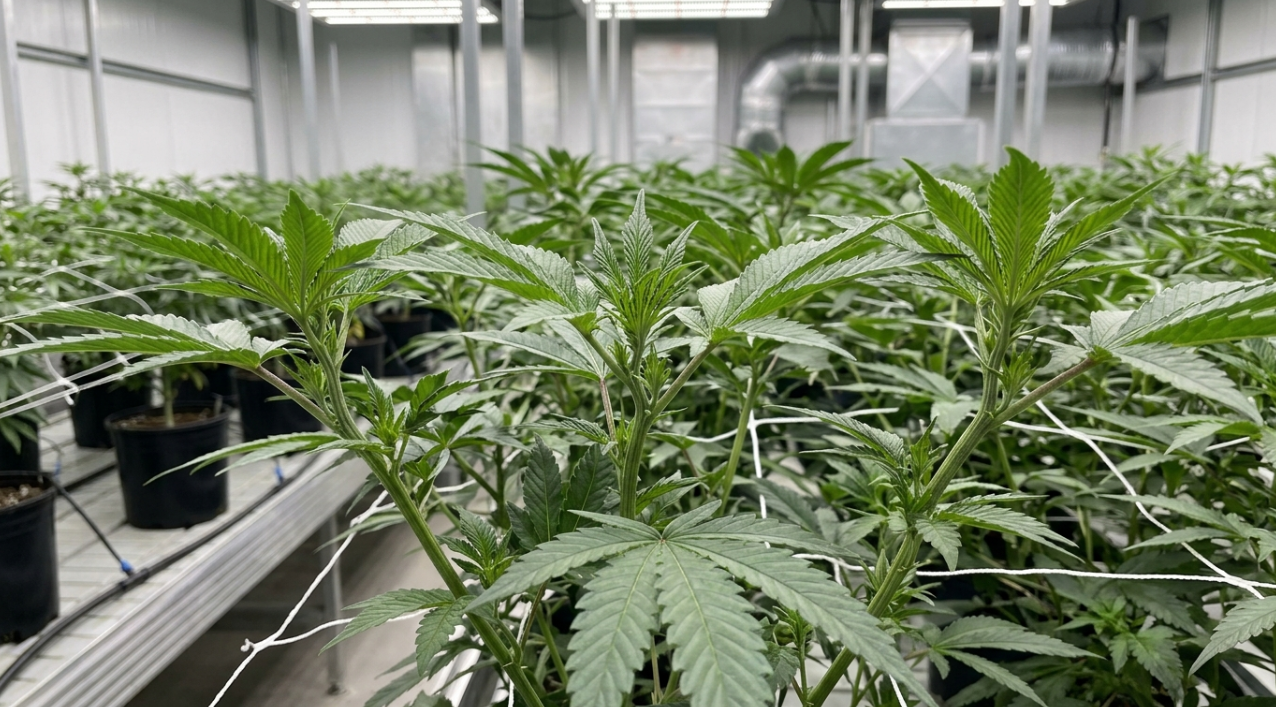
Veg lighting is not weaker flower lighting. It is an architecture tool.
The light a cannabis plant receives during veg determines its height, internode spacing, number of branches, stem thickness, node count, and overall canopy shape. A controlled study on vegetative-stage cannabis found that light intensity directly changed plant architecture: higher PPFD produced compact plants with thicker stems and more nodes, while moderate PPFD around 600 µmol/m²/s created a more open plant structure with longer internodes that may improve airflow in dense canopies.
This matters because the flower room inherits whatever the veg room produces. Uneven veg lighting creates uneven canopies at flip. Overly stretched plants crowd each other and block airflow. Under-lit veg plants may lack the branching or root mass to handle flower-room intensity.
The veg room is where growers decide what kind of plant their flower room will receive. Getting veg lighting right is getting production right.
For a detailed look at intensity targets during veg, see this cannabis veg PPFD guide.
Core Lighting Metrics for Veg Rooms
Before choosing fixtures or setting schedules, growers need to understand a handful of metrics. These terms come up constantly in cannabis lighting conversations, and confusing them leads to poor purchasing decisions and inconsistent crops.
Photoperiod
The number of hours per day that plants receive light. In photoperiod cannabis veg, long days (typically 18 hours) prevent flowering. Photoperiod also determines how much total light plants receive each day when combined with intensity.
PPFD
Photosynthetic Photon Flux Density, measured in µmol/m²/s. This is the amount of usable light arriving at the canopy every second. PPFD is the grower’s real-time intensity metric. It tells you how much light plants are actually getting right now, at canopy level.
DLI
Daily Light Integral, measured in mol/m²/day. This is the total amount of usable light delivered to each square meter of canopy over a full day. DLI combines intensity and duration. The formula is straightforward: DLI equals PPFD times hours times 0.0036. For example, 400 µmol/m²/s for 18 hours equals about 25.9 mol/m²/day.
For a complete breakdown of how DLI connects PPFD to photoperiod across cannabis growth stages, see this DLI by stage guide.
PPF
Photosynthetic Photon Flux, measured in µmol/s. This is the total number of plant-usable photons a fixture produces per second. PPF describes the fixture’s total output, not what lands on the canopy.
PPE
Photosynthetic Photon Efficacy, measured in µmol/J. This is the number of photons produced per joule of electricity. Higher PPE means more light per watt of electricity consumed, which drives operating cost comparisons.
Spectrum
Spectrum describes the distribution of light wavelengths emitted by a fixture. Different wavelengths can influence plant morphology and photosynthetic responses, but the effects depend on the complete spectrum, light intensity, cultivar, and growing conditions. Evaluate spectrum alongside fixture efficacy, canopy coverage, and worker visibility.
Uniformity
Light uniformity describes how consistently PPFD is distributed across the growing area. A room can have a suitable average PPFD while still containing areas that receive substantially more or less light. Measure multiple canopy points and compare average, minimum, and maximum readings to identify uneven coverage.
Quick Reference Table
Term | What It Measures | Why It Matters in a Veg Room |
|---|---|---|
Photoperiod | Hours of light per day | Keeps photoperiod cannabis vegetative |
PPFD | Instantaneous canopy intensity | Shows how much light plants receive right now |
DLI | Total daily light dose | Allows comparison across different schedules |
PPF | Total fixture photon output | Helps compare fixture capacity before layout |
PPE | Photon output per watt | Drives energy cost and efficiency decisions |
Spectrum | Wavelength composition | Influences morphology, growth habit, visibility |
Uniformity | Evenness of canopy light | Prevents inconsistent plant size and readiness |
Practical PPFD and DLI Ranges for Cannabis Veg
There is no single universal PPFD for every veg room. The right intensity depends on plant age, cultivar, CO₂ supplementation, VPD, irrigation capacity, and the grower’s architectural goals. That said, research and practitioner experience converge on useful ranges.
How to Choose a PPFD Target for Cannabis Veg
Choose a PPFD target based on the plant's current stage, its response to light, and the conditions your facility can maintain. Avoid selecting a target based on plant age alone.
Recently rooted clones: Begin with a conservative light level and increase it gradually as plants establish roots and new growth.
Established vegetative plants: Use a measured canopy PPFD target that supports steady growth without excessive stretching or unnecessary energy use.
Late-vegetative plants: Consider whether more intensity will support the desired plant structure and prepare the canopy for the next production stage.
Mother plants: Prioritize consistent coverage and manageable growth rather than automatically maximizing intensity.
High-intensity environments: Increase light only when temperature, humidity, irrigation, nutrition, and other environmental factors can support the additional demand.
Monitor new growth, leaf posture, internode spacing, and canopy consistency after adjusting intensity. These observations help determine whether the current setup is appropriate, but visible symptoms alone cannot diagnose the cause of plant stress.
Remember that PPFD measures instantaneous light intensity, while DLI measures the accumulated daily light dose. Evaluate both metrics before changing a lighting schedule.
Rooted clones and early veg: Lower intensity, often 150 to 300 µmol/m²/s. The priority is acclimation and root establishment, not pushing growth.
General veg and teens: Commonly 300 to 600 µmol/m²/s. This range supports healthy vegetative growth without demanding aggressive environmental controls.
Late veg and aggressive production: 600 to 900 µmol/m²/s. Research on vegetative cannabis found that this range balanced morphology goals with energy use. Approximately 900 µmol/m²/s produced the most compact plants, while 600 µmol/m²/s promoted a more open structure better suited to cultivars that need intra-canopy airflow.
Above 900 µmol/m²/s: Possible, but not a default. It requires CO₂ supplementation, tight VPD control, and strong irrigation. A greenhouse cannabis study found that growth metrics continued increasing linearly up to about 52 mol/m²/day DLI, but the authors stressed that results depended on precise environmental control across all inputs.
Practitioners on Reddit consistently report using 400 to 600 µmol/m²/s for mid-veg. A frequently cited comment in a cannabis cultivation thread gave the DLI formula, shared stage-based cheat-sheet ranges, but warned that growers should still watch plant response because “the plants have the final say.” That is good advice.
DLI Reference Table for Cannabis Veg
Average Canopy PPFD | DLI at 16h | DLI at 18h | Practical Use |
|---|---|---|---|
200 µmol/m²/s | 11.5 mol/m²/day | 13.0 mol/m²/day | Early veg, acclimation |
300 µmol/m²/s | 17.3 mol/m²/day | 19.4 mol/m²/day | Conservative veg |
400 µmol/m²/s | 23.0 mol/m²/day | 25.9 mol/m²/day | Common mid-veg target |
500 µmol/m²/s | 28.8 mol/m²/day | 32.4 mol/m²/day | Strong general veg |
600 µmol/m²/s | 34.6 mol/m²/day | 38.9 mol/m²/day | High-end general / late veg |
900 µmol/m²/s | 51.8 mol/m²/day | 58.3 mol/m²/day | Aggressive compact strategy |
These are planning ranges, not prescriptions. The right veg light level depends on cultivar, CO₂, VPD, irrigation, nutrition, canopy density, and whether the goal is compact or more open plants.
Light Schedule for Cannabis Veg
Photoperiod cannabis stays vegetative under long days and begins flowering when the dark period extends. The Resource Innovation Institute confirms that cannabis in vegetative stages typically requires 18-hour photoperiods, while flowering stages need 12 hours or less.
Some growers run 16/8, 20/4, or even 24/0 schedules. Each has tradeoffs. A 20/4 schedule delivers more DLI at the same PPFD, which can accelerate growth. A 16/8 schedule uses less electricity but delivers less total daily light. Running 24/0 eliminates the dark period entirely, which some cultivators prefer for stock plants, though most production veg rooms use 18/6 as a baseline.
For more detail on how schedules interact with DLI, see this cannabis light schedule guide.
One common question is whether growers can shorten the photoperiod by increasing PPFD to maintain the same DLI. Mathematically, yes. Practically, it is more complicated. Practitioners on Reddit’s macro-growing community have noted that equal DLI delivered through very high instantaneous PPFD over a compressed period does not always produce the same plant response as moderate PPFD over a longer day. Plants have physiological limits on how fast they can process light, and pushing beyond those limits wastes energy or causes photoinhibition.
Autoflowering (day-neutral) cannabis is a separate case. These varieties flower based on age, not photoperiod, and are typically grown under 18 to 20 hours of light from start to finish. The veg lighting strategy for autoflowers differs fundamentally from photoperiod cannabis rooms.
Spectrum in Cannabis Veg Rooms
The old rule of thumb was simple: blue light for veg, red light for flower. This came from the HID era, when metal halide fixtures (blue-heavy) were used for vegetative growth and high-pressure sodium fixtures (red-heavy) were used for flowering. The shortcut contains a kernel of truth, but it oversimplifies modern LED decisions.
Research on cannabis light quality has found that high-blue-fraction treatments produced shorter plants with reduced stretch, consistent with blue-light-induced dwarfing observed in other greenhouse crops. Blue light can genuinely help keep veg plants compact.
But spectrum is not the only lever for compactness, and blue-heavy fixtures can sacrifice efficacy. Red photons are cheaper to produce (in terms of µmol/J) than blue photons, so a fixture skewed heavily toward blue may deliver fewer total photons per watt.
Full-spectrum white LED light has become the practical choice in many commercial cannabis veg rooms. White-spectrum fixtures support plant growth across the PAR range, provide better visibility for crop inspection and IPM scouting, create a more comfortable work environment, and often achieve strong PPE numbers. For a deeper look at wavelength effects, this light spectra impact summary covers the research in detail.
The bottom line: spectrum affects morphology, but it should be evaluated alongside intensity, DLI, uniformity, fixture efficacy, and working conditions. Buying a fixture purely for its spectrum while ignoring everything else is a recipe for disappointment.
LEDs in Commercial Cannabis Veg Rooms
LEDs have become the dominant fixture type in commercial cannabis cultivation. A 2021 industry lighting study found that LEDs surpassed all other types across propagation, vegetation, and flowering rooms. In the same survey, HPS use fell from 62% of growers in 2016 to just over one-third in 2021.
The shift is especially visible in veg rooms. Vertical rack use in vegetative stages grew from 25% of surveyed growers in 2017 to 37% in 2021, a trend directly tied to LED adoption. LEDs run cooler at the fixture than HPS, making them practical for multi-tier configurations where headroom is limited and heat accumulates quickly.
When evaluating LED fixtures for cannabis veg room lighting, the relevant comparison points are:
PPF: Total photon output in µmol/s, not wattage.
PPE: Efficiency in µmol/J. The DesignLights Consortium’s Hort V4.0 standard sets a minimum of 2.5 µmol/J for listed LED horticultural fixtures.
PPFD map: How light distributes across the canopy at the intended mounting height.
Controls: Dimming, scheduling, and integration with environmental controls.
Safety listing: UL or equivalent certification.
Form factor: Bar-style fixtures work well in multi-tier racks. Larger bar arrays suit single-tier rooms with more headroom.
For multi-tier cannabis veg, compact bar fixtures like the Infinity XE are built for tight vertical clearances where heat and form factor matter most. Facilities that need flexibility across both veg and flower stages may benefit from the Strata HP, a universal-power fixture designed for multi-tier applications.
Practitioners on Reddit’s macro-growing forums report that many facilities are moving away from legacy fluorescent and older LED veg fixtures toward more efficient, controllable options. Dimming capability, listing requirements, and lower heat output come up repeatedly as the key decision factors.
How to Choose Cannabis Veg Room Lights
Choosing cannabis veg room lights requires more than comparing wattage or selecting a fixture with a high photon efficacy rating. The best option must deliver the required canopy PPFD, distribute light evenly, fit the room's dimensions, and operate within the facility's electrical and cooling capacity.
Commercial Veg Lighting Comparison Checklist
Buying Factor | What to Compare | Why It Matters |
|---|---|---|
Photon output | PPF in µmol/s | Indicates total fixture photon output |
Canopy intensity | Average and distribution of PPFD | Shows whether plants receive the intended intensity |
Photon efficacy | PPE in µmol/J | Helps estimate electricity efficiency |
Coverage | PPFD maps at the proposed mounting height | Identifies weak areas and hotspots |
Form factor | Fixture dimensions and profile | Determines suitability for single-tier or multi-tier rooms |
Controls | Dimming, scheduling, and integration | Supports changing crop requirements |
Electrical requirements | Voltage, current, and circuit capacity | Helps establish installation feasibility |
Thermal considerations | Fixture heat release and room cooling requirements | Supports HVAC planning |
Durability and service | Warranty, repairability, and replacement parts | Affects maintenance and ownership costs |
Total cost | Purchase, installation, electricity, and maintenance | Helps compare long-term value fairly |
Before requesting a quote or choosing a fixture, evaluate the following factors.
1. Match Fixture Output to the Growing Area
Review the fixture's photosynthetic photon flux (PPF), measured in µmol/s, and request a PPFD map for the proposed mounting height and growing-area dimensions. A fixture with high total output may still produce uneven coverage if its distribution does not match the room.
2. Compare Photon Efficacy and Electricity Costs
Photosynthetic photon efficacy (PPE), measured in µmol/J, indicates how efficiently a fixture converts electrical energy into photosynthetic photons. Higher PPE can reduce the electricity needed to deliver a comparable photon output, but it does not guarantee better canopy coverage or lower total ownership costs.
Compare efficacy alongside the actual fixture price, installation costs, controls, maintenance requirements, and expected operating hours.
3. Check Mounting Height and Fixture Dimensions
Low-profile LED bars may suit multi-tier racks with limited vertical clearance. Larger fixtures may be suitable for single-tier rooms with more headroom. Evaluate canopy spacing, worker access, airflow, and the distance between fixtures and plants before finalizing the layout.
4. Evaluate Controls and Dimming
Dimming and programmable scheduling can help operators adjust light output as plants grow. Confirm the available control protocols, compatibility with facility automation, and whether dimming preserves the required uniformity at the selected output.
5. Confirm Electrical and Safety Requirements
Review input voltage, current draw, circuit capacity, installation requirements, and applicable electrical safety listings. Confirm the requirements for the facility's jurisdiction with a qualified electrical professional.
6. Review Warranty, Service, and Total Cost
Compare warranty coverage, expected service life, replacement-part availability, manufacturer support, and maintenance access. A lower purchase price may not provide the best long-term value if operating costs or maintenance requirements are higher.
The goal is to choose a lighting system that meets the room's crop requirements and operational constraints—not simply the fixture with the highest advertised output or lowest price.
Layout and Uniformity: The Most Under-Explained Part of Veg Lighting
Most cannabis lighting articles focus on what PPFD to target. Fewer explain how to actually deliver that PPFD evenly across a room. This is where many veg rooms fail.
A single PPFD reading taken directly under a fixture is not representative of the room. The Resource Innovation Institute states clearly that average PPFD should be measured across evenly spaced canopy points, not based on one center reading. Virginia Tech adds that moving lights closer increases peak PPFD but can reduce uniformity because fewer plants receive adequate coverage.
What Good Layout Thinking Looks Like
Start with target average PPFD and canopy dimensions, not with a fixture model.
Request or create a PPFD map showing intensity across the full growing area.
Check edge and corner readings, not just center points.
Use dimming to adjust intensity as plants grow toward fixtures. In multi-tier veg, even a few inches of canopy growth can significantly change PPFD.
Consider reflective wall and ceiling surfaces. White walls capture stray photons and improve room-level efficiency.
Re-measure after plants grow and after any dimming or height changes.
Commercial growers on LinkedIn have shared that PPFD simulations and photometric mapping are becoming standard practice in facility design, not just for flower rooms but for veg and mother rooms as well. This makes sense: uniformity in veg produces uniform plants, which makes the flower room more predictable.
Lighting also interacts with HVAC and airflow. As the vegetative canopy develops, it changes air movement patterns and transpiration demand. Veg room lighting should be considered as part of the total room environment, not as an isolated fixture decision. For a closer look at how fixture choice affects cooling loads, see HVAC sizing for LED lights.
How to Calculate Cannabis Veg Room Lighting Requirements
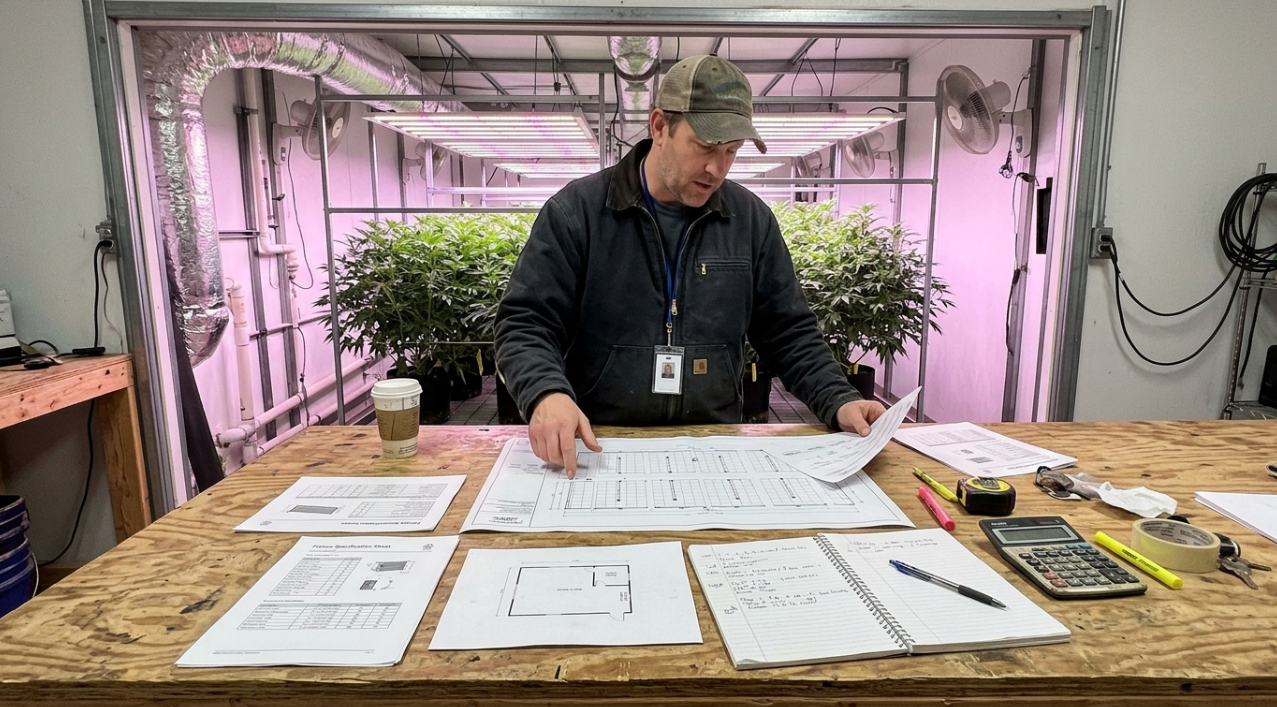
Planning a veg room starts with the growing area, the target canopy PPFD, and the fixture's measured performance. These calculations help establish a preliminary lighting plan, but a PPFD map and on-site measurements are still needed to confirm the final installation.
Step 1: Calculate Daily Light Integral
Use this formula:
DLI = PPFD × light hours per day × 0.0036
For example, a canopy receiving an average PPFD of 400 µmol/m²/s for 18 hours receives approximately 25.9 mol/m²/day.
Step 2: Calculate the Required Photon Delivery Across the Canopy
Multiply the target average PPFD by the canopy area.
Approximate canopy photon delivery = target PPFD × canopy area
For a 20 m² growing area with a target average PPFD of 400 µmol/m²/s, the corresponding canopy photon delivery is approximately 8,000 µmol/s.
This is a canopy-level planning calculation, not the required fixture PPF. Fixtures emit photons that do not all reach the growing area, so the actual fixture requirement depends on optical distribution, mounting height, room geometry, and lighting-system efficiency.
Step 3: Estimate Electrical Demand
Once you have a proposed fixture configuration, estimate the connected electrical load by adding the input wattage of all fixtures.
For example, 10 fixtures rated at 400 W each have a combined nominal fixture load of 4,000 W, or 4 kW.
Actual power consumption depends on the operating settings and fixture specifications. Confirm the circuit design and electrical requirements with a qualified professional.
Step 4: Validate the Layout With a PPFD Map
Request a manufacturer-supplied simulation or create a lighting plan based on the room dimensions, fixture arrangement, and intended mounting height. After installation, measure PPFD at evenly spaced canopy points and compare the readings with the design targets.
Check the average, minimum, maximum, and spatial distribution before considering the room commissioned.
A calculation helps narrow down fixture options. Measurement confirms whether the lighting system delivers the intended result.
Veg-to-Flower Transition: Avoid the DLI Cliff
One of the most practical pain points in cannabis production is the transition from veg to flower. When plants move from an 18-hour veg schedule to a 12-hour flower schedule, the photoperiod drops by a third. If PPFD stays the same, DLI drops by a third too.
Here is a quick example:
Late veg: 500 µmol/m²/s × 18 hours = 32.4 mol/m²/day
Early flower (same PPFD): 500 µmol/m²/s × 12 hours = 21.6 mol/m²/day
Early flower (adjusted PPFD): 750 µmol/m²/s × 12 hours = 32.4 mol/m²/day
To maintain the same DLI after a photoperiod change, canopy PPFD must be adjusted to account for the shorter lighting period. However, maintaining identical DLI is not always necessary or desirable. The appropriate target depends on the production plan, cultivar response, and the environmental conditions in the flower room.
For example, changing from 18 hours of light to 12 hours while maintaining 500 µmol/m²/s reduces DLI from 32.4 to 21.6 mol/m²/day. Increasing PPFD to 750 µmol/m²/s would mathematically restore the original DLI, but it would not guarantee an identical plant response.
Plan the transition using measured canopy intensity, the target DLI for each stage, and the flower room's ability to support the intended light level. Avoid assuming that a higher PPFD is always the best way to compensate for shorter days.
Common Mistakes in Cannabis Veg Room Lighting
Using watts as the primary metric. Watts measure electrical input, not light output. Two 600W fixtures can deliver very different amounts of photons depending on their efficacy. Use PPF, PPFD, and PPE.
Using lumens or lux. These metrics are weighted for human vision, not plant photosynthesis. Serious horticultural lighting decisions should use PAR, PPFD, and DLI. The common shorthand is “lumens are for humans.”
Reading PPFD only under the fixture. One center reading can look impressive while the edges of the canopy sit at half the intensity. Always measure across a grid at canopy height.
Ignoring DLI when changing photoperiod. Switching from 18/6 to 16/8 without adjusting PPFD reduces total daily light by about 11%. DLI, not just PPFD, determines how much light plants actually receive.
Moving fixtures too close to chase intensity. Closing the gap between fixture and canopy raises peak PPFD but often creates hot spots and kills uniformity. Dimming is usually a cleaner solution. For more on why fixture comparisons go wrong, read about comparing LEDs to HPS.
Treating spectrum as a magic fix. Switching to a “veg spectrum” will not compensate for insufficient intensity, poor uniformity, or an environment that cannot support the light the plants are receiving.
Copying flower-room intensity into veg. Veg plants may tolerate high light, but the goal is not maximum yield yet. It is the right plant structure for the production plan. Blasting young clones with 900 µmol/m²/s wastes electricity and can stress plants that have not built the root mass or leaf area to use it.
Commercial Cannabis Veg Room Lighting Checklist
For growers designing a new veg room or retrofitting an existing one, this checklist covers the decisions that matter most. Do not buy a veg light. Buy a veg room lighting plan.
Before buying or installing veg room lights:
Define the crop stage the room will serve: rooted clones, teens, mothers, or late veg.
Define the production goal: compact plants, open architecture, faster turns, or mother maintenance.
Set a target photoperiod (18/6 is the common starting point).
Set target average PPFD and DLI based on crop stage and cultivar.
Confirm canopy dimensions, bench layout, and plant spacing.
Decide whether the room is single-tier or multi-tier.
Request or build a PPFD map for the proposed fixture layout.
Check expected uniformity, including edges, corners, and aisle transitions.
Confirm fixture PPE, spectrum, controls, safety listing, and warranty.
Plan heat load and confirm HVAC capacity.
Commission the room with a calibrated quantum meter after installation.
Re-measure after plants grow, after dimming adjustments, and after any fixture height changes.
Choosing Veg Lighting by Desired Plant Outcome
Desired Outcome | Lighting Strategy |
|---|---|
Compact, sturdy plants | Higher PPFD, sufficient blue, controlled internodes |
More open plants for airflow | Moderate PPFD, avoid excessive compactness |
Faster veg turn | Higher DLI if environment supports it |
Mother plant maintenance | Stable DLI, consistent uniformity, lower stress |
Multi-tier veg | Low-profile LED bars, careful PPFD mapping, dimming |
Smooth flip to flower | Late-veg intensity ramp, DLI planning for transition |
Planning or retrofitting a commercial cannabis veg room? Talk with a lighting expert before committing to fixture counts, mounting heights, or electrical infrastructure.
Final Thoughts on Cannabis Veg Room Lighting
Effective cannabis veg room lighting starts with matching light intensity, daily exposure, spectrum, and coverage to the plants and the production environment. An 18/6 schedule and a general PPFD range of 300–600 µmol/m²/s provide a starting framework for photoperiod cannabis, but the right settings depend on cultivar, growth stage, environmental controls, and production goals.
For commercial facilities, the quality of the lighting layout matters as much as the fixture itself. Evaluate canopy PPFD distribution, photon efficacy, dimming, electrical requirements, and cooling capacity before committing to a system. After installation, measure the canopy and adjust the setup as plants grow.
Planning a commercial cannabis veg room or upgrading an existing facility? Request a lighting consultation to evaluate fixture selection, room layout, PPFD targets, and the requirements of your production system before finalizing your equipment investment.
Frequently Asked Questions
What does cannabis veg room lighting mean?
Cannabis veg room lighting is the lighting strategy used in a vegetative cannabis room to keep photoperiod plants in vegetative growth and build strong, uniform plant architecture before flowering. It includes the photoperiod, PPFD, DLI, spectrum, fixture layout, and canopy uniformity used over rooted clones, teen plants, mothers, or mid-stage vegetative cannabis.
What PPFD should cannabis have in veg?
General vegetative cannabis commonly runs between 300 and 600 µmol/m²/s. For more aggressive production goals, 600 to 900 µmol/m²/s can produce compact, sturdy plants, but it requires the environment (CO₂, VPD, irrigation, nutrition) to support higher light. Research on vegetative cannabis found that 600 to 900 µmol/m²/s balanced morphology and energy use effectively.
What DLI should cannabis have in veg?
Veg DLI depends on both PPFD and photoperiod. At 18 hours of light, 400 µmol/m²/s delivers about 25.9 mol/m²/day, while 600 µmol/m²/s delivers about 38.9 mol/m²/day. Use the formula DLI = PPFD × hours × 0.0036 to calculate for your specific setup.
Is 18/6 the best light schedule for cannabis veg?
18/6 is the most common commercial baseline for photoperiod cannabis. Some growers use 16/8 or 20/4, each with different energy and DLI tradeoffs. The key is maintaining long enough days to prevent flowering while delivering the right total daily light dose for the production plan.
Is blue light better for cannabis veg?
Blue light can help reduce elongation and create more compact plants. But full-spectrum white LEDs are often the practical choice in commercial rooms because they combine good efficacy, broad-spectrum plant performance, and worker visibility. Spectrum is one factor among many, not a standalone solution.
Can cannabis get too much light in veg?
Yes. Excessive PPFD wastes energy and can create stress if CO₂, temperature, humidity, and irrigation are not aligned. Young plants with limited root mass and leaf area cannot use very high light productively. More is not automatically better.
Should veg lights be different from flower lights?
Not always. Some facilities use different fixtures in veg and flower because the rooms have different form factors, mounting heights, or intensity requirements. Others use the same fixture platform and adjust output with dimming. The decision should come from target PPFD, DLI, canopy geometry, and production workflow, not from an assumption that veg needs a fundamentally different kind of light.
How many LED lights do I need for a cannabis veg room?
The number of fixtures depends on the growing area, target average PPFD, fixture photon output, light distribution, mounting height, and room layout. Start with the canopy dimensions and target light level, then compare fixture specifications and PPFD maps. Validate the proposed layout with measurements after installation rather than relying on wattage or fixture count alone.
What is the difference between PPFD and DLI for cannabis?
PPFD measures the instantaneous intensity of photosynthetically active photons reaching a surface, in µmol/m²/s. DLI measures the total amount of those photons received over a day, in mol/m²/day. PPFD describes the light level at a given moment, while DLI accounts for both intensity and lighting duration.
What should I compare when buying commercial cannabis veg lights?
Compare fixture PPF, PPE, canopy PPFD distribution, dimming capabilities, mounting dimensions, electrical requirements, safety listings, warranty, and total operating cost. Request a PPFD map for the proposed room layout and evaluate the complete system rather than choosing a fixture based on wattage or advertised efficiency alone.
How do you measure cannabis veg room lighting properly?
Use a calibrated PAR or quantum meter at canopy height. Take readings across a grid covering the full growing area, not just directly under fixtures. Calculate average, minimum, and maximum PPFD, then convert to DLI using the photoperiod. Re-measure as plants grow closer to fixtures and after any dimming adjustments.