Cannabis DLI by Stage: 2026 Targets, PPFD & Formula
Learn Cannabis DLI by Stage with 2026 targets, PPFD × hours × 0.0036 formula, CO₂ tips, and autoflower notes. See the table and examples.
TL;DR
Cannabis DLI by stage determines how many photons your plants receive each day, and the targets shift as the plant matures. Seedlings need 6 to 20 mol/m²/day, vegetative plants 20 to 40, and flowering plants 35 to 50 (or up to 65 with supplemental CO₂). DLI matters more than PPFD alone because it accounts for both light intensity and photoperiod length, giving you the full picture of daily light dose.
What Is the Ideal DLI for Cannabis?
The ideal daily light integral (DLI) for cannabis depends on the plant's growth stage, photoperiod, cultivar, CO₂ availability, and growing environment. As a general starting point, seedlings and clones receive lower daily light levels than established vegetative and flowering plants. DLI is measured in mol/m²/day and accounts for both light intensity (PPFD) and the number of hours of light received.
To calculate DLI, multiply PPFD by the daily light hours and by 0.0036. For example, 800 µmol/m²/s of PPFD over a 12-hour light period equals 34.56 mol/m²/day. Target ranges should be treated as starting points rather than universal requirements, particularly when comparing plants grown under different environmental conditions.
Cannabis DLI by Growth Stage: Quick Reference Chart
The following table summarizes the approximate DLI ranges discussed in this guide. Use them as starting points rather than universal requirements: cultivar, temperature, CO₂ availability, irrigation, and other growing conditions influence how plants respond to light.
Growth stage | Illustrative DLI range (mol/m²/day) | Common photoperiod for planning | What to consider |
|---|---|---|---|
Seedlings and clones | 6–20 | Often 18/6 | Begin conservatively and assess plant response |
Vegetative growth | 20–40 | Often 18/6 | Increase light as plants establish and expand |
Early flowering | 30–45 | Often 12/12 for photoperiod plants | Account for the shorter light period |
Peak flowering | 40–50 | Often 12/12 for photoperiod plants | Monitor temperature, canopy uniformity, and stress |
Late flowering | 30–50 as a planning range | Often 12/12 for photoperiod plants | Do not assume a light reduction is necessary for every cultivar |
Autoflowering plants | Determine the target by growth stage and conditions | Often 18/6 or 20/4 | Use actual daily light hours when calculating DLI |
Important: These ranges are approximate horticultural guidance, not validated requirements for every cannabis cultivar. Higher DLI does not automatically mean better yield or quality. Elevated CO₂ can change the response to light, but the benefit depends on the full growing environment.
Talk to a lighting expert about hitting these DLI targets in your facility.
What Is DLI?
DLI stands for Daily Light Integral. It measures the total number of photosynthetically active photons (PAR, 400–700 nm) that land on a square meter of canopy over the course of an entire day. The unit is mol/m²/day.
Think of it like a rain gauge. PPFD tells you how hard it’s raining right now. DLI tells you how much total rain collected in the bucket by the end of the day. Two very different rainstorms can fill the bucket to the same level, one heavy and short, the other light and long. The same logic applies to light.
This distinction matters for cannabis growers because PPFD alone can mislead you. A fixture pumping 900 µmol/m²/s sounds impressive, but if your plants only receive 12 hours of it, the daily dose may be lower than a gentler 500 µmol/m²/s running for 18 hours. For a deeper comparison of these two metrics, see our guide on PPFD vs. DLI.
The DLI Formula
The calculation is straightforward:
DLI = PPFD × photoperiod (hours) × 0.0036
The 0.0036 conversion factor accounts for the unit math: 3,600 seconds per hour divided by 1,000,000 micromoles per mole. An equivalent form is PPFD × hours / 277.8.
PPFD to DLI Conversion Chart
Use this chart to estimate daily light integral at common PPFD readings. The figures assume a constant PPFD throughout the light period and do not account for changes in light intensity during the day.
PPFD (µmol/m²/s) | DLI at 12 hours | DLI at 18 hours | DLI at 20 hours |
|---|---|---|---|
200 | 8.6 | 13.0 | 14.4 |
300 | 13.0 | 19.4 | 21.6 |
400 | 17.3 | 25.9 | 28.8 |
500 | 21.6 | 32.4 | 36.0 |
600 | 25.9 | 38.9 | 43.2 |
700 | 30.2 | 45.4 | 50.4 |
800 | 34.6 | 51.8 | 57.6 |
900 | 38.9 | 58.3 | 64.8 |
1,000 | 43.2 | 64.8 | 72.0 |
Formula: DLI = PPFD × light hours × 0.0036.
For example, a PPFD of 600 µmol/m²/s over 18 hours delivers approximately 38.9 mol/m²/day. At the same PPFD over 12 hours, DLI falls to approximately 25.9 mol/m²/day.
Worked Examples
Here’s the insight that makes DLI click: two completely different setups can deliver the exact same daily light dose.
Veg room: 600 PPFD × 18 hours × 0.0036 = 38.9 mol/m²/day
Flower room: 900 PPFD × 12 hours × 0.0036 = 38.9 mol/m²/day
Same DLI. Totally different intensity and duration. This is why cannabis DLI by stage is a better planning metric than raw PPFD. The veg room hits its target with moderate intensity over a long photoperiod. The flower room compensates for its shorter 12/12 schedule by cranking intensity higher.
One more example to show the flip side: running 500 PPFD for 18 hours gives you 32.4 mol/m²/day. Drop that same 500 PPFD to a 12-hour photoperiod and you only get 21.6 mol/m²/day, a 33% reduction in daily light. For step-by-step calculation walkthroughs, check out how to calculate DLI from PPFD.
Cannabis DLI Targets by Stage, Explained
The quick reference table above gives you the numbers. Here’s the reasoning behind each stage.
Seedlings and Clones: 6–20 mol/m²/day
Young plants have small root systems, undeveloped leaf area, and limited ability to process light energy. Pushing intensity too early causes bleaching or stunted growth. Most growers start clones and fresh seedlings at the low end (6–12 mol/m²/day) and ramp toward 20 as the first true leaves develop. PPFD in this range sits between 80 and 300 µmol/m²/s depending on photoperiod.
CO₂ supplementation is not used during this stage because the plants simply can’t utilize the extra carbon at this size.
Vegetative: 20–40 mol/m²/day
The vegetative stage is where the plant builds its scaffold: stems, branches, nodes, and leaf mass. DLI drives this structural growth. More total daily light means tighter internodes, thicker stems, and more bud sites for later. The 20–40 mol/m²/day range accommodates everything from early veg (lower end) to aggressive late-veg pushing (upper end).
At 18/6, hitting 40 DLI requires about 617 PPFD. That’s well within the capability of most commercial LED fixtures. On community forums like r/microgrowery, growers frequently report good results in the 25–35 DLI range during veg, reserving the 35–40 push for the final week before flip.
Early Flowering: 30–45 mol/m²/day
After the photoperiod switch to 12/12, plants enter the stretch phase. They’re still growing vegetatively while also initiating flower sites. Light demand increases, but the shorter photoperiod means you need higher PPFD to maintain or increase DLI. Hitting 40 DLI on a 12-hour day requires roughly 926 µmol/m²/s.
This is the stage where growers who were comfortable at 500 PPFD during veg realize they need to ramp up significantly. It’s also where fixture selection becomes critical, because the light needs to deliver high PPFD uniformly across the canopy.
Peak Flowering: 40–50 mol/m²/day
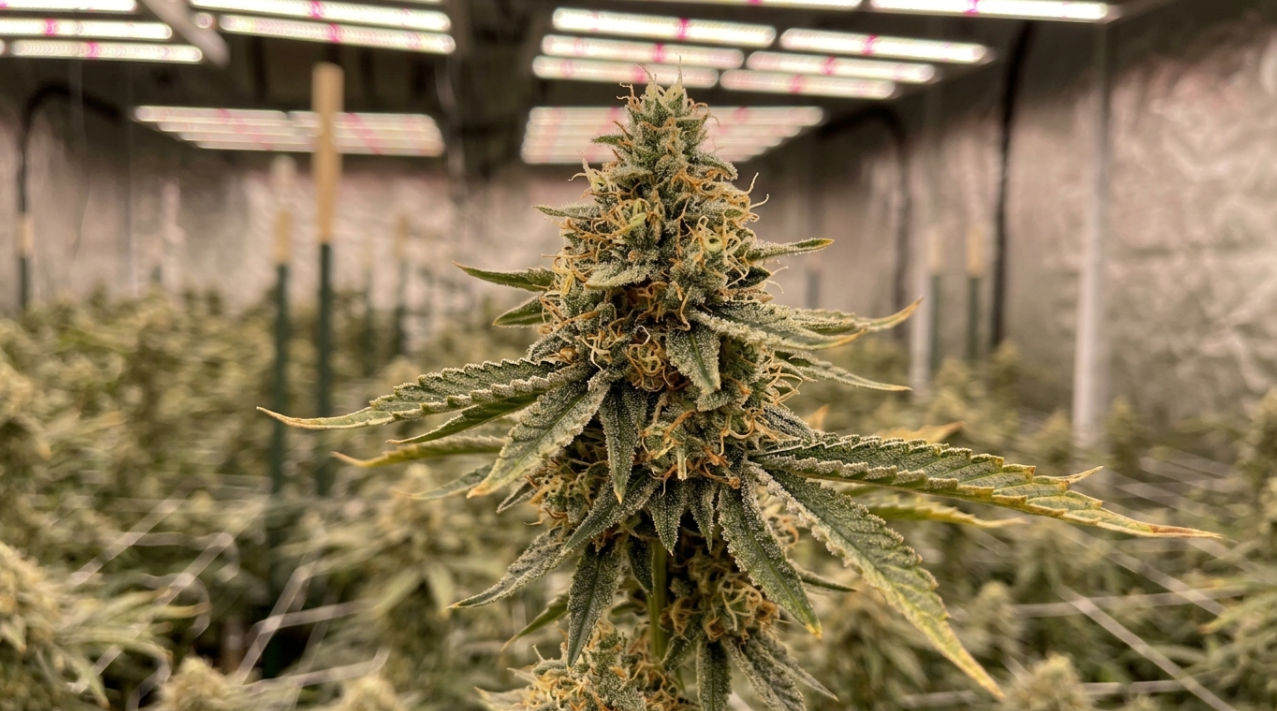
Peak flower is when cannabis has the highest light demand. Bud development, resin production, and cannabinoid synthesis all benefit from maximum photosynthetic output. Research from Utah State University’s Bugbee lab found that as light intensity increased, biomass, flower yield, and cannabinoid content per square meter all increased. One study achieved 285 g/m² at 52 mol/m²/day DLI with no signs of light saturation.
Without CO₂, the practical ceiling sits around 50 mol/m²/day for most cultivars. Push beyond that without environmental support and you’ll see diminishing returns or outright stress.
Late Flower and Flush: 30–40 mol/m²/day
Many experienced growers taper light intensity during the final 1–2 weeks. The biological rationale: the plant is finishing ripening, not building new tissue. Reducing DLI to 30–40 mol/m²/day can reduce heat stress and energy costs during a period when the plant’s metabolic demands are declining.
This isn’t universal. Some cultivators maintain peak DLI right through harvest. But the taper approach is widely practiced in commercial operations, and practitioners on Reddit frequently report that a gradual 10–15% reduction during the last two weeks produces no measurable yield loss while saving on electricity.
How to Choose the Right DLI for Cannabis
The best DLI target depends on more than the plant's growth stage. Before increasing light intensity, consider the following factors.
Factor | Why it matters |
|---|---|
Growth stage | Young plants and established flowering plants respond differently to light intensity |
Photoperiod | Longer light periods can deliver the same DLI at lower PPFD |
Cultivar | Different genetics can respond differently to the same lighting conditions |
CO₂ availability | Elevated CO₂ may change how efficiently plants use additional light |
Temperature and humidity | Environmental conditions affect photosynthesis and plant stress |
Irrigation and root health | Plants must have sufficient water and healthy roots to support growth |
Canopy uniformity | Uneven lighting can leave some areas underlit while others receive excessive intensity |
A Practical Approach
Start with a conservative target appropriate to the growth stage and measure PPFD at canopy level. Calculate the resulting DLI using the actual light period, then observe plant development and environmental conditions before making adjustments.
Avoid increasing light intensity simply to reach the upper end of a published range. If plants show signs of stress, investigate temperature, irrigation, nutrient availability, and other possible causes before assuming DLI is the only problem.
The objective is to find a light level that supports healthy growth under your specific conditions, not to maximize DLI regardless of the consequences.
CO₂ and DLI: Raising the Ceiling
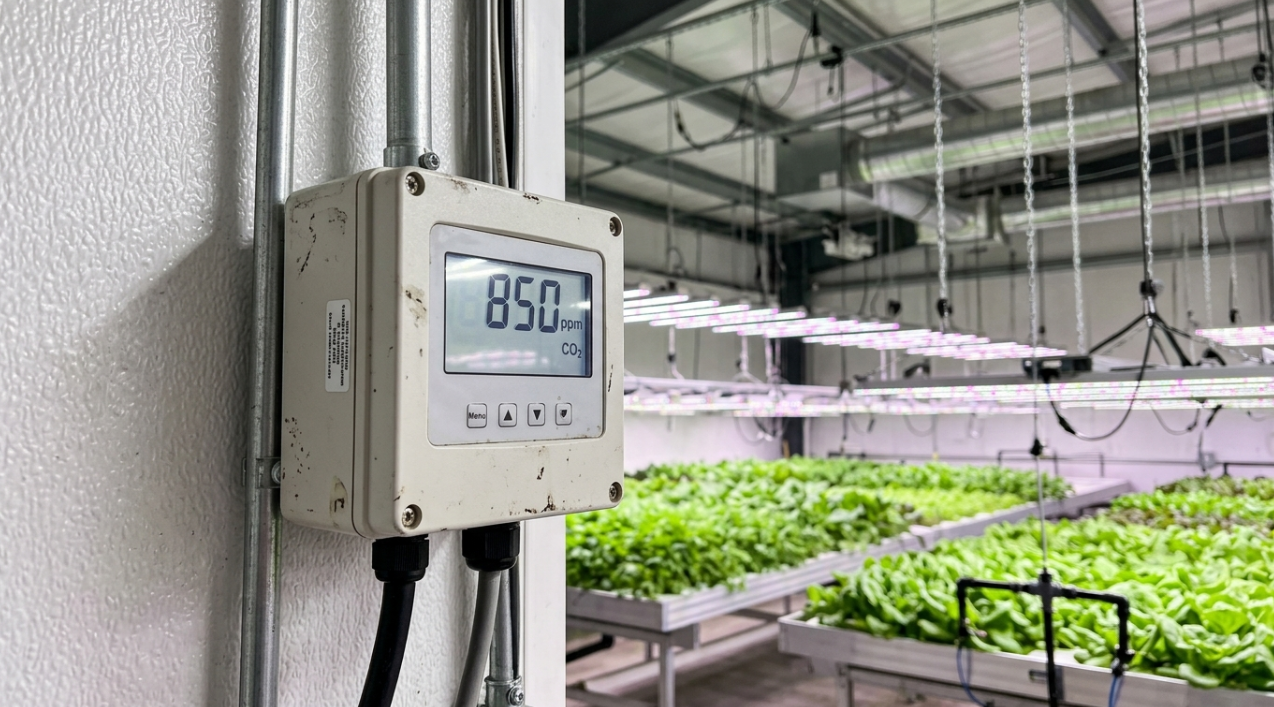
This is the single most important variable that changes cannabis DLI targets by stage.
Under ambient CO₂ (roughly 400 ppm), cannabis plants reach a photosynthetic saturation point somewhere around 800–1,000 µmol/m²/s PPFD. Beyond that, additional light doesn’t translate to additional growth. It just generates heat and stress.
Enriching to 800–1,500 ppm CO₂ raises that saturation point. Research published in Cannabis Business Times indicates that supplementation to 800–1,000 ppm can increase yields by 10% to 25%. More striking, Utah State University research showed that CO₂ enrichment increased biomass and yield by approximately 40%, regardless of DLI level or cultivar.
What this means practically: with CO₂, DLI values of 50 to 65 mol/m²/day become productive rather than stressful during peak flower. Without CO₂, those same numbers would cause light stress and wasted electricity. For a deeper dive into how CO₂ interacts with lighting strategy, read about the role of CO₂ in controlled environment agriculture.
There’s a critical caveat. Pushing DLI above 50 requires more than just CO₂. You also need proper VPD management, sufficient irrigation, adequate root zone volume, and HVAC capacity to handle the heat load. High DLI without matched environmental controls produces worse results, not better.
Autoflower DLI: Different Math
Autoflowering cannabis varieties flower based on age rather than photoperiod. That changes the DLI equation fundamentally.
Because autoflowers don’t need a 12/12 flip, growers can run them on 18/6 or 20/4 through the entire lifecycle, including flower. This means you can hit flowering DLI targets at much lower PPFD.
The comparison is striking: an autoflower on a 20/4 schedule hits 40 DLI at just 555 PPFD. A photoperiod strain on 12/12 needs 926 PPFD for the same daily dose. The autoflower gets there with roughly 40% less intensity, which translates to less heat, lower electricity bills, and less stress on the canopy.
Most commercial autoflower rooms settle on 18/6 or 20/4 schedules because they balance DLI, heat load, and power cost effectively. Some growers on cannabis forums push to 50+ DLI on autos by running 20/4 at 700 PPFD, and report excellent results when CO₂ and environmental conditions support it.
Signs of DLI Imbalance
Too High
When DLI exceeds what the plant can process, the signs are visible and specific:
Bleached leaves. The most common sign. Leaves directly exposed to excessive light turn pale yellow or white, starting at the top of the canopy. The plant reduces pigment production as a defense mechanism.
Leaf curling (“tacoing”). Leaves fold upward along the midrib to reduce their surface area and light exposure. This is a heat and light stress response.
Foxtailing and white buds. During flower, excess light can cause buds to grow abnormal, spire-like structures (foxtails) and lose color. Fragrance and potency drop significantly.
Above roughly 65 mol/m²/day without CO₂, light bleaching becomes common. On the THCFarmer forums, experienced growers recommend what they call “muscle training,” bumping intensity by about 5% per week and watching for leaf stress and foxtailing as signals that you’ve gone too far. This graduated approach is far safer than jumping straight to target PPFD.
Too Low
Insufficient DLI produces a different set of problems: tall, leggy plants with stretched internodes, thin stems, slow development, fewer bud sites, and ultimately lower yields. A higher DLI increases total photosynthesis and drives cannabis to produce larger, denser buds, so falling short means leaving yield on the table.
There’s also the under-canopy problem. Even if your top-canopy DLI is perfect, the lower canopy often receives far less light due to shading from upper fan leaves. This is where under-canopy LED supplementation becomes relevant, adding DLI to the lower canopy without increasing top-light intensity and the heat that comes with it.
Want to address low DLI in your lower canopy? Explore the Boost XE under-canopy bar.
How to Measure DLI
There are three practical approaches:
Quantum meters. The Apogee MQ-500 is considered the gold standard for measuring grow lights, with a refined spectral response across the 400–700 nm PAR range. It gives you instantaneous PPFD readings that you plug into the formula above. Professional-grade instruments run $400–500. For guidance on selecting and using these tools, see our PAR meter guide.
Smartphone apps. Apps like Photone calculate DLI from your phone’s light sensor. They’re not as accurate as dedicated quantum sensors, but for hobby growers and quick spot-checks, they’re a useful budget option.
Calculation method. Most indoor growers don’t need an integrating meter that logs readings all day because they control the photoperiod. If your PPFD is consistent (and it should be with properly mounted LEDs), the formula DLI = PPFD × hours × 0.0036 gives you an accurate result from a single measurement.
Greenhouse Considerations
For greenhouse cannabis operations, DLI planning gets more complex because natural light varies by season, latitude, and weather. You can’t establish an effective supplemental lighting strategy without knowing the DLI the sun provides to your greenhouse on its own.
During winter at northern latitudes, natural DLI can drop below 10 mol/m²/day. Since cannabis needs a minimum of roughly 35 DLI during flowering, supplemental lighting must make up the difference. The calculation is simple: measure or estimate your natural DLI, subtract it from your target, and size your supplemental fixtures to fill the gap.
DLI Ramping: A Practical Week-by-Week Approach
Rather than jumping straight to target DLI at each stage transition, experienced growers ramp gradually. A common approach:
Seedling week 1–2: Start at 6–10 DLI. Let the roots establish.
Seedling week 3: Ramp to 15–20 DLI as the first true leaf sets expand.
Early veg: Step up to 25 DLI. Increase by 3–5 DLI per week.
Late veg: Reach 35–40 DLI in the final week before flip.
Flower week 1–2: Ramp from 30 to 40 DLI as stretch begins.
Flower week 3–6: Reach and hold peak DLI (40–50, or 50–65 with CO₂).
Flower week 7+: Optionally taper to 30–40 DLI during ripening.
This progressive approach reduces stress, gives you time to observe how each cultivar responds, and avoids the waste of pushing intensity beyond what the plant can use at any given moment.
Ready to design a lighting plan that hits these targets across your grow? Schedule a free consultation with a lighting expert.
Frequently Asked Questions
What is a good DLI for cannabis?
A good DLI depends on the growth stage. Seedlings thrive at 6–20 mol/m²/day, vegetative plants at 20–40, and flowering plants at 35–50. With supplemental CO₂ and proper environmental controls, flowering plants can benefit from DLI values up to 65.
What DLI do cannabis seedlings need?
Cannabis seedlings perform best at 6–20 mol/m²/day. Start at the low end (6–10) for fresh sprouts and clones, then ramp toward 15–20 as the first true leaves develop. CO₂ supplementation is not needed at this stage.
What DLI should I target for flowering cannabis?
Without CO₂, aim for 40–50 mol/m²/day during peak flower. With CO₂ enrichment at 800–1,500 ppm, you can push to 50–65 mol/m²/day productively. The key is ensuring your environment (VPD, temperature, irrigation) keeps up with the increased light.
How do I calculate DLI from PPFD?
Use the formula: DLI = PPFD × hours of light × 0.0036. For example, 800 PPFD for 12 hours equals 800 × 12 × 0.0036 = 34.6 mol/m²/day.
Is DLI different for autoflowers?
Yes. Because autoflowers can run on 18/6 or 20/4 photoperiods through flower, they hit the same DLI at significantly lower PPFD. An autoflower on 20/4 reaches 40 DLI at just 555 PPFD, while a photoperiod strain on 12/12 needs 926 PPFD for the same dose.
What happens if DLI is too high?
Excess DLI causes bleached or yellowing leaves at the canopy top, upward leaf curling (“tacoing”), and foxtailing in buds. During flower, light-burned buds turn white and lose potency. Without CO₂, symptoms typically appear above 50–65 mol/m²/day.
Does CO₂ change DLI targets?
It raises the ceiling. CO₂ enrichment to 800–1,500 ppm allows cannabis to productively use DLI values that would cause stress under ambient conditions. Research shows CO₂ at these levels can increase yields by 10–40%, but only when paired with sufficient light intensity and proper VPD management.
Do I need a PAR meter to measure DLI?
Not necessarily. If you control your photoperiod (as most indoor growers do), a single PPFD reading plugged into the DLI formula gives you an accurate result. Dedicated quantum meters like the Apogee MQ-500 provide the most precise readings, but smartphone apps work for rough estimates on a budget.