Cannabis LED Light Distance: How Far Should Lights Be (2026)
Get science-backed cannabis LED light distance for seedlings, veg, and flower—PPFD, DLI, and dimming vs height. See exact starting ranges.
TL;DR
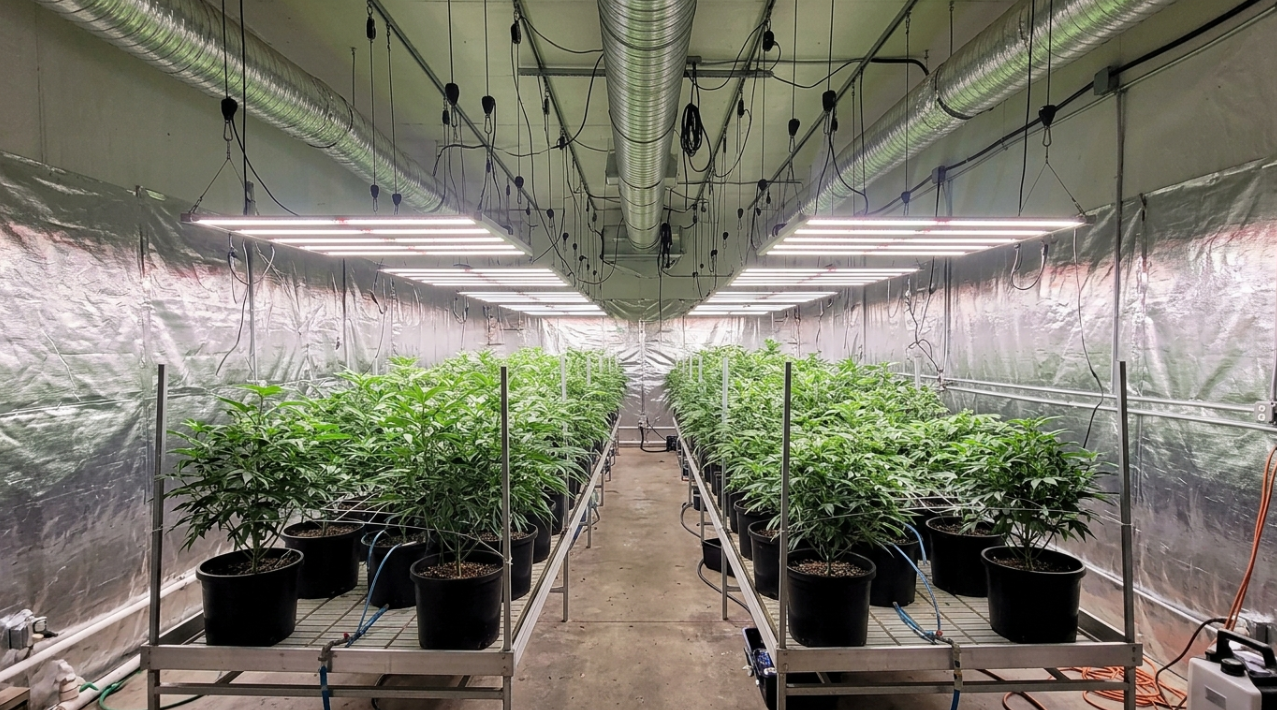
Cannabis LED light distance affects how much usable light reaches the plant canopy, influencing photosynthesis, growth, and light-stress risk. However, the ideal hanging height depends on the LED fixture's output, beam pattern, dimmer setting, growth stage, and environmental conditions.
A light positioned too close can create intense hotspots and damage upper leaves or flowers, while a fixture positioned too far away may deliver insufficient light or uneven coverage. The best approach is to start with the manufacturer's recommended hanging height and verify the actual light intensity at canopy level.
This guide explains how far LED grow lights should be from cannabis plants, how to use PPFD and Daily Light Integral (DLI) to fine-tune hanging height, and how commercial growers can improve canopy coverage and lighting consistency.
Explore Thrive’s indoor cannabis lighting solutions
What Cannabis LED Light Distance Means
Cannabis LED light distance is the measurement from the bottom of an LED grow light fixture to the top of the plant canopy. It’s typically expressed in inches or centimeters.
This number matters because it controls the photosynthetic photon flux density (PPFD) reaching your plants. PPFD is the amount of photosynthetically active light hitting a given area per second, measured in µmol/m²/s. More distance means less PPFD. Less distance means more PPFD, but also more risk of light stress.
The mistake most growers make is treating distance as the metric itself. Distance is a proxy. PPFD is the real metric. Two different LED fixtures at the same height can deliver wildly different PPFD values depending on their wattage, optics, and beam angle. That’s why a PAR meter or manufacturer PPFD map should always back up your hang height decisions.
For a deeper explanation of how cannabis LED grow lights work and the terminology involved, start with the glossary.
Quick Reference: Cannabis LED Light Distance by Growth Stage
The appropriate LED hanging height depends on fixture design, light output, canopy size, and the plant's growth stage. The ranges below are illustrative starting points for suitable fixtures, not universal specifications.
Growth stage | Illustrative hanging distance | Example PPFD range | Photoperiod example |
|---|---|---|---|
Seedlings and clones | 24–36 inches (60–90 cm) | 100–300 µmol/m²/s | 18/6 |
Vegetative growth | 18–24 inches (45–60 cm) | 400–600 µmol/m²/s | 18/6 |
Early flowering | 12–18 inches (30–45 cm) | 600–800 µmol/m²/s | 12/12 |
Peak flowering | 12–18 inches (30–45 cm) | 800–1,000 µmol/m²/s | 12/12 |
Important: These example ranges are not validated for every LED fixture or cannabis cultivar. Follow the manufacturer's hanging-height and intensity recommendations first, then measure PPFD at canopy level. Some fixtures may need to be positioned considerably higher or lower.
Why LED Wattage Does Not Determine Hanging Height
Two LED grow lights with the same electrical wattage can produce different PPFD levels because of differences in efficiency, optics, fixture dimensions, and light distribution. A high-output fixture can also create intense hotspots even when its average canopy PPFD appears appropriate.
Instead of choosing hanging height based on wattage alone:
Check the manufacturer's PPFD map at the intended mounting height.
Measure light intensity across the canopy when possible.
Adjust dimmer output to manage intensity without unnecessarily changing coverage.
Recheck light distribution as the canopy grows.
For a more detailed explanation of stage-specific light intensity, see the cannabis PPFD guide.
The Science: Why LED Light Distance Changes Intensity
Light intensity generally decreases as the distance from a light source increases, but the exact relationship depends on the size and design of the fixture.
For an ideal point source, the inverse square law states that irradiance decreases in proportion to the square of the distance. Doubling the distance reduces irradiance to approximately one-quarter under those ideal conditions.
However, commercial LED grow lights often use multiple diodes arranged across long bars or large panels. These fixtures are extended light sources, so their PPFD distribution does not necessarily follow the inverse square law at typical hanging heights.
This distinction matters when adjusting cannabis LED light distance. Moving a fixture closer can increase the light reaching parts of the canopy, but it can also create hotspots and reduce uniformity. Raising the fixture can spread light over a wider area, although the average intensity may decrease.
Practical takeaway: Do not assume that halving the distance will quadruple canopy PPFD. Use the fixture's PPFD map or measure the canopy directly to determine how much intensity changes at different hanging heights.
Why Distance Alone Isn’t Enough: PPFD and DLI
Knowing your cannabis LED light distance is step one. Knowing the PPFD at canopy level is step two. But the metric that actually predicts yield is step three: Daily Light Integral, or DLI.
PPFD: The Instantaneous Measure
PPFD tells you how much photosynthetically active radiation hits a square meter of canopy per second. It’s the speedometer of your lighting setup. Useful in the moment, but it doesn’t tell you how far you’ve driven.
DLI: The Daily Total
DLI measures the total photosynthetically active photons your plants receive over a full day, expressed in mol/m²/day. It’s calculated with a simple formula:
DLI = PPFD × hours of light × 0.0036
For example, a plant receiving 600 µmol/m²/s for 18 hours gets a DLI of 38.9 mol/m²/day.
Cannabis DLI targets by stage:
Growth Stage | DLI Target (mol/m²/day) |
|---|---|
Seedlings | 6–16 |
Vegetative | 20–40 |
Flowering | 35–50 |
Cannabis is a high-light crop and can absorb up to 65 mol/m²/day under optimal conditions, though most commercial operations target the 40 to 50 range during flower for the best balance of yield and efficiency.
The connection to LED light distance is direct. If your light is too far away, PPFD drops, and you can’t hit your DLI target even with a long photoperiod. If your light is too close and you’re running 18-hour days in veg, you might overshoot DLI and stress the plants.
The cannabis DLI guide covers the formula and stage-specific targets in full.
LED Hanging Height vs. Dimmer Setting vs. PPFD vs. DLI
These four factors are related, but they serve different purposes. Understanding the difference helps growers adjust light intensity without creating unnecessary coverage problems.
Factor | What it tells you | How to use it |
|---|---|---|
Hanging height | The physical distance between the fixture and canopy | Adjust when the coverage footprint or mounting position needs to change |
Dimmer setting | The fixture's relative output, when dimming is supported | Fine-tune output while generally maintaining the same fixture position |
PPFD | The instantaneous photosynthetic photon flux reaching the canopy | Measure light intensity and identify hotspots or underlit areas |
DLI | The accumulated daily quantity of photosynthetic photons | Evaluate light exposure over the complete lighting schedule |
Changing the dimmer can reduce or increase PPFD, but it does not necessarily correct an uneven light distribution. Raising a fixture may improve coverage across a larger area, but it can also reduce the light reaching the canopy.
DLI depends on both PPFD and the duration of the lighting period. For example, two setups can deliver the same DLI while using different combinations of light intensity and photoperiod.
The best approach is to use the manufacturer's guidance to establish a suitable mounting position, measure PPFD across the canopy, and calculate DLI using the actual lighting schedule.
Dimming vs. Distance: How to Actually Adjust
This is the most debated topic in cannabis growing forums, and almost no ranking article gives a clear answer.
The Forum Debate
Practitioners on RollItUp have strong opinions on this. One experienced grower put it bluntly: “Playing with distance is a waste of electricity. You are wasting the light on your walls to reduce the light on the plants. Bad idea. Personally I leave the lights at the correct height for optimal uniformity and dim them if needed.”
On the other side, growers on Autoflower.org report leaving lights at the same height from start to finish, sometimes dimming but often running at 100%, with the fixture 24 to 28 inches above seedlings and letting plants grow into the light over time.
The Practical Framework
Both approaches have merit, but the most effective method combines them:
Set your height based on the growth stage. Distance controls how much floor area your fixture covers. Higher hang heights spread light across a wider footprint. Lower heights concentrate it.
Use the dimmer for fine intensity adjustments. Once your light is at the right height for uniform coverage, dial intensity up or down to hit your PPFD target. This is especially useful for small adjustments in the ±10% to 20% range.
Think of it this way: height sets your coverage pattern, and the dimmer sets your intensity within that pattern. Adjusting height when you just need a small PPFD change wastes uniformity. Adjusting the dimmer when your coverage footprint is wrong wastes canopy area.
Signs Your Cannabis LED Lights May Be Too Close or Too Far Away
Plant appearance can help identify potential lighting problems, but no single symptom confirms that hanging height is the cause. Check light measurements alongside temperature, watering, nutrient management, and other environmental conditions.
Signs the LED Grow Light May Be Too Close
Excessive light intensity can cause stress in the parts of the canopy receiving the most light. Potential warning signs include:
Pale or bleached upper leaves: The areas closest to the fixture may lose their normal green color.
Upward-curling or cupped leaves: Leaf shape can change under high light stress, although heat and environmental conditions can produce similar symptoms.
Uneven growth across the canopy: Plants directly beneath hotspots may show more stress than those near the edges.
Pale upper flowers: Bleaching may occur when developing flowers receive excessive light, but other causes should also be considered.
What to check: Measure PPFD at the affected locations, compare the readings with the manufacturer's guidance, and check canopy temperature. If light intensity is excessive, reduce the dimmer setting or adjust the mounting height while preserving reasonable coverage.
Signs the LED Grow Light May Be Too Far Away
Insufficient light can contribute to weak or elongated growth, especially when plants are reaching toward a stronger light source. Possible signs include:
Excessive stem elongation: Plants may develop longer internodes as they respond to limited light.
Weak or spindly growth: Insufficient light can limit the development of sturdy stems and branches.
Uneven canopy development: Plants or canopy areas receiving less light may grow differently from better-lit areas.
Slow growth: Low light availability can limit photosynthesis, although nutrient, root, temperature, and watering problems can cause similar symptoms.
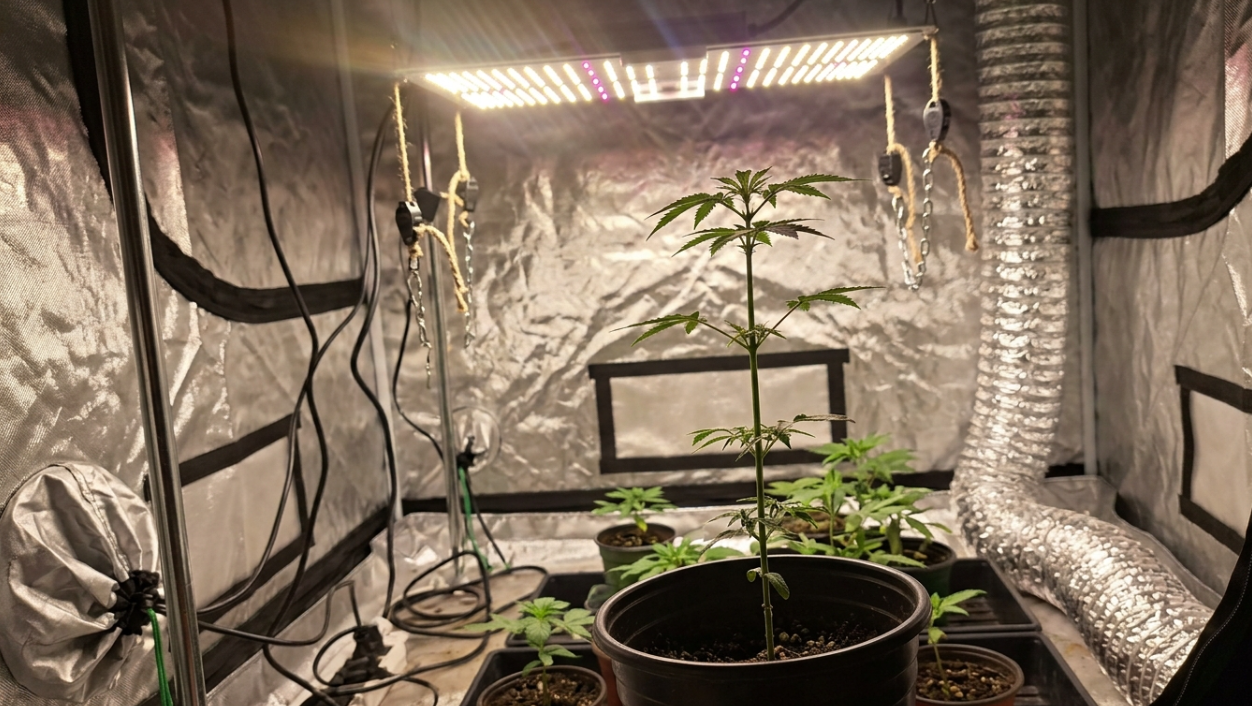
What to check: Measure PPFD at the canopy, inspect the fixture's coverage pattern, and compare the readings with the appropriate stage-specific guidance.
How to Distinguish Lighting Problems From Other Issues
Observation | Possible explanation | What to check |
|---|---|---|
Pale upper leaves | Excessive light, heat stress, or a nutrient-related issue | PPFD, canopy temperature, and nutrient conditions |
Elongated stems | Insufficient light or other growth-related factors | PPFD, light coverage, and plant development |
Uneven growth across the room | Uneven light distribution or environmental variation | PPFD map, airflow, temperature, and irrigation |
Pale upper flowers | Excessive light or another environmental stressor | Light intensity, canopy temperature, and flower development |
Avoid making major lighting changes based on leaf appearance alone. Confirm the likely cause with measurements and monitor new growth after making an adjustment.
Commercial Considerations: Where Generic Advice Falls Short
Most content on LED light distance for cannabis is written for home growers running a single tent. Commercial operations face a different set of problems.
Uniformity Matters More Than Peak PPFD
A canopy averaging 900 µmol/m²/s sounds great until you realize the center is getting 1,400 and the corners are getting 400. The center plants show light stress while the edge plants stretch. You get two different crops in one room.
Industry-standard targets call for canopy PPFD uniformity within ±10% to 15% of the mean, with a coefficient of variation (CV) below 15%. The target uniformity ratio (minimum PPFD divided by average PPFD) should be 0.75 or higher. Below 0.70, edge plants underperform significantly.
One grower shared on a cannabis forum that raising fixtures by just 8 inches, which dropped peak output by 5%, improved yield uniformity from 72% to 89%. The small reduction in maximum intensity was more than compensated by consistent performance across the entire canopy.
This is where professional lighting design pays for itself. Thrive’s fixtures are engineered to deliver ±5% design-to-install PPFD variance, which means the light map you’re shown during consultation matches what actually hits your canopy after installation.
PPFD Mapping: Measure, Don’t Guess
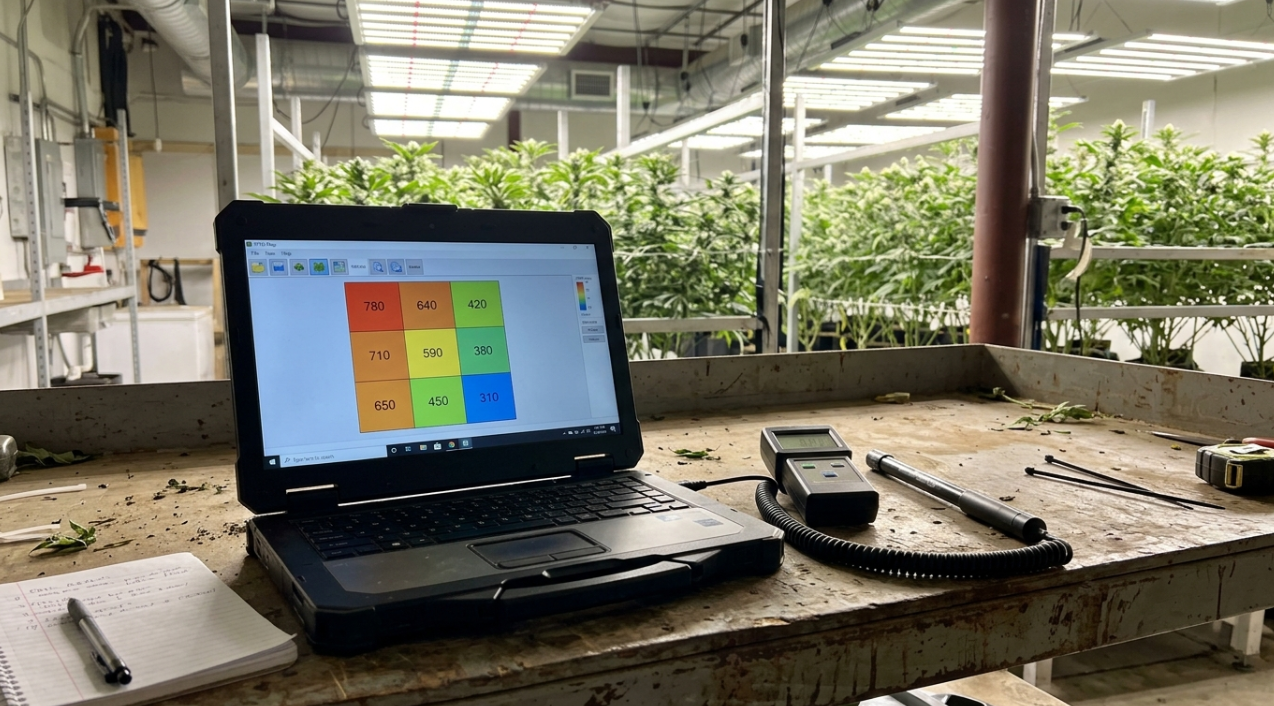
Commercial growers should map PPFD at a minimum of 9 points per fixture zone (a 3×3 grid at canopy height). This reveals hot spots, dead zones, and whether your hang height is optimized for coverage or just intensity.
Manufacturer PPFD maps are a starting point, but they’re measured in controlled conditions. Reflective walls, neighboring fixtures, and canopy shape all change real-world numbers. Measure after install. Measure again after adjusting height.
Under-Canopy Lighting as a Distance Strategy
Here’s something almost no article about LED light distance mentions: the distance from your top lights to the canopy isn’t the only distance that matters. The distance from your lower canopy to any light source determines whether those lower buds develop into sellable product or stay as larfy popcorn.
Peer-reviewed research confirms what commercial growers have been reporting. Both subcanopy and inter-canopy lighting resulted in more uniform light distribution and increased yields. The inter-canopy treatment showed a 29.95% increase in dry inflorescence yield, 24.4% higher THC accumulation, and 12.5% more total terpene concentration.
Adding under-canopy lighting means your top-light distance becomes less of a sole determinant of lower-canopy performance. Instead of pushing top lights dangerously close to reach the bottom of the plant, you address lower-canopy light levels directly.
See the Boost XE under-canopy fixture
How CO₂ Affects Cannabis LED Light Intensity
Carbon dioxide concentration is one factor that influences how cannabis responds to high light intensity. Photosynthesis depends on several interacting conditions, including available light, CO₂, temperature, water, and plant health.
Supplemental CO₂ can support higher photosynthetic rates under suitable growing conditions, but it does not establish a universal PPFD ceiling or guarantee higher yields. The response depends on the cultivar, environmental conditions, lighting schedule, and overall production system.
Research from the University of Guelph examined indoor-grown cannabis under canopy PPFD levels ranging from approximately 120 to 1,800 µmol/m²/s during flowering. In that experiment, dry inflorescence yield increased with increasing canopy light intensity across the tested range. The researchers also emphasized the need to balance potential production benefits against lighting and operating costs. <Cite refs={["turn461494search3","turn461494search6"]}/>
What This Means for LED Hanging Height
Rather than assuming that plants need supplemental CO₂ above a fixed PPFD value, use a measurement-based approach:
Start with the recommended mounting height for the fixture.
Measure canopy PPFD and calculate DLI for the actual lighting schedule.
Consider temperature, humidity, CO₂ availability, and plant response together.
Evaluate the cost of additional lighting against the production benefit it may provide.
Avoid increasing light intensity solely because supplemental CO₂ is available.
For commercial facilities, the objective is not simply to maximize PPFD. It is to establish a lighting strategy that balances canopy uniformity, crop performance, energy consumption, and operating costs.
Learn more about environmental management in controlled-environment agriculture.
How to Find Your Ideal Cannabis LED Light Distance
Rather than memorizing a single number, follow this process:
Start with the manufacturer’s recommended hang height for your growth stage. This gives you the right coverage footprint.
Set your dimmer to match the target PPFD for that stage. Use the table above as a starting point.
Measure PPFD at canopy level. A PAR meter is ideal. At minimum, check center, edges, and corners.
Watch the plants for 3 to 5 days. New leaves growing flat and green with tight internodal spacing means you’re in the zone. Cupping, yellowing, or bleaching on top leaves means too close. Stretching means too far.
Adjust the dimmer first. If PPFD is off by 10% to 20%, the dimmer is faster and preserves your coverage pattern.
Adjust height only for larger changes. If you need to change PPFD by 30% or more, or if your coverage footprint doesn’t match your canopy area, move the fixture.
Reassess as plants grow. Cannabis can gain several inches per week during the vegetative stretch. A distance that was perfect on Monday might be too close by Friday.
Frequently Asked Questions
What is the best distance for a 1000W LED grow light from cannabis?
During flowering, 18 to 24 inches is a common starting range for 1000W LED fixtures. During veg, 24 to 30 inches. During seedling stage, 30 to 36 inches. These numbers vary by manufacturer, so always check the fixture’s PPFD map at different heights and verify with a PAR meter at the canopy.
Can I just measure distance instead of buying a PAR meter?
Distance is a rough proxy. Two fixtures at 18 inches can deliver completely different PPFD values depending on their wattage, optics, and age. A PAR meter removes the guesswork. If budget is tight, at minimum use the manufacturer’s published PPFD maps for your specific hang height.
Does cannabis LED light distance change for autoflowers?
Autoflowers have the same PPFD targets as photoperiod strains. The difference is the photoperiod. Many growers run autoflowers on 20/4 or even 24/0 light schedules, which means DLI accumulates faster. You may need to hang lights slightly higher or dim them down to avoid exceeding DLI targets, especially during flower when running more than 18 hours of light.
Should I adjust distance or dimmer when my plants are stretching?
Lower the light first to reduce the coverage area and increase canopy PPFD, then increase dimmer output if needed. Stretching means the plant isn’t getting enough light, so you need more intensity at the canopy. Lowering the fixture gets you there faster than cranking the dimmer alone, especially if the light was hung too high for your grow space.
How often should I adjust my LED height during a grow?
Check the gap between your fixture and the canopy top at least twice per week during vegetative growth, when plants grow fastest. During flower, once a week is usually sufficient after the initial stretch period. Many growers use adjustable hangers or ratchet pulleys to make quick changes easier.
Why are my top buds bleaching white even though temperature is fine?
This is light bleaching, not heat stress. When LEDs are too close, the photon intensity degrades cannabinoids and terpenes in the uppermost flowers, turning them white or pale yellow. The fix is straightforward: increase your cannabis LED light distance by 2 to 4 inches, or reduce dimmer output by 10% to 15%, and give the plant a week to recover.
Does raising my LED improve coverage uniformity?
Yes. Higher hang heights spread light across a wider area, reducing the intensity difference between the center and edges of your canopy. The tradeoff is lower peak PPFD. For commercial operations, the uniformity gain from raising fixtures even a few inches often outweighs the slight drop in center intensity.
Getting cannabis LED light distance right is foundational, but it’s just one piece of a complete lighting strategy. For commercial facilities where uniformity, energy efficiency, and consistent yields matter, professional lighting design makes the difference between a good room and a great one.