Cannabis LED Grow Lights 2026: The Complete Glossary
Your complete glossary for cannabis LED grow lights—PPFD, DLI, spectrum, efficacy, rebates, and more. Optimize yield, quality, and ROI today.
TL;DR
Cannabis LED grow lights have become the dominant lighting technology in indoor and greenhouse cultivation, with nearly 80% of growers now using LEDs as their primary solution. This glossary covers every term you need to evaluate, purchase, and operate cannabis LED fixtures, from light measurement metrics like PPFD and DLI to fixture form factors, electrical infrastructure concepts, and certification standards. Each definition connects directly to real cannabis growing outcomes so you can make confident decisions about your facility’s lighting.
Buying cannabis LED grow lights without understanding the terminology is like reading a map in a language you don’t speak. You’ll end up somewhere, but probably not where you intended.
The problem is real. Growers routinely compare fixtures using the wrong metrics, overspend on features that don’t move the needle, or underspend on specs that actually determine yield and quality. A 2023 Cannabis Business Times survey found that 62% of respondents listed crop quality as the most important factor driving their LED decisions, with yield coming in second at just 16%. The vocabulary growers need is shifting from “how much can I harvest” to “how consistent and high-grade is my output.”
This glossary translates every lighting term you’ll encounter into plain language, explains why each one matters for cannabis specifically, and gives you the practical benchmarks to make smart purchasing and operational decisions.
Talk to a lighting specialist about how these metrics apply to your specific facility layout and goals.
Quick Answer: Which Cannabis LED Grow Light Specifications Matter Most?
If you're comparing cannabis LED grow lights, focus on these five specifications first:
Specification | Target Benchmark |
|---|---|
PPFD | 800 to 1,000 µmol/m²/s during flowering |
DLI | 40 to 50 mol/m²/day |
Efficacy (PPE) | 2.5 to 3.0+ µmol/J |
Uniformity | 0.85 or higher |
Spectrum | Full-spectrum white LEDs |
Avoid comparing fixtures by wattage alone.
Instead, evaluate:
PPFD maps
Fixture efficacy
Canopy uniformity
DLC certification
Dimming capability
For most commercial cannabis cultivation facilities, PPFD and efficacy have a greater impact on yield and operating costs than additional spectrum features such as UV or far-red supplementation.
Key takeaway: PPFD determines how much light reaches the canopy. Efficacy determines how much electricity is required to produce that light.
Cannabis LED Grow Light Glossary: Key Terms at a Glance
Term | What It Measures | Why It Matters |
|---|---|---|
PAR | Useful light wavelengths | Defines the photosynthesis range |
PPF | Total photons emitted | Measures fixture output |
PPFD | Photons reaching the canopy | Determines plant growth |
DLI | Daily light exposure | Predicts yield |
PPE | Light produced per watt | Determines efficiency |
CRI | Color accuracy | Improves plant inspection |
DLC | Efficiency certification | Enables rebates |
Uniformity | Light distribution | Reduces canopy hotspots |
Light Measurement Terms
These are the numbers that actually matter when evaluating cannabis LED grow lights. Master these six metrics and you’ll cut through 90% of marketing noise.
PAR (Photosynthetically Active Radiation)
PAR defines the range of light wavelengths that drive photosynthesis: 400 to 700 nanometers. It is not a unit of measurement. This is one of the most common misunderstandings in grow lighting. When someone says a light has “high PAR,” what they usually mean is high PPFD (defined below). PAR simply describes the bandwidth of useful light. Think of it as the playing field, not the score.
PPF (Photosynthetic Photon Flux)
PPF measures the total number of photosynthetically active photons a fixture emits per second, expressed in micromoles per second (µmol/s). It tells you about the light itself, not what reaches your canopy. For a plant to receive the full PPF rating, it would need to be at zero distance from the fixture, which is obviously impossible. PPF is useful for comparing the raw output of two fixtures side by side but tells you nothing about light distribution across a real canopy. For more on what a micromole actually represents, that context helps ground these numbers.
PPFD (Photosynthetic Photon Flux Density)
PPFD is the metric that matters most at the plant level. It measures how many photosynthetically active photons land on a specific area of canopy per second, expressed in µmol/m²/s. Unlike PPF, PPFD accounts for fixture height, beam angle, and reflector design.
Cannabis PPFD targets by growth stage:
Vegetative phase: 400 to 800 µmol/m²/s
Flowering phase: 800 to 1,000 µmol/m²/s
With CO₂ supplementation (1,200 to 1,500 ppm): up to 1,500 µmol/m²/s
Without CO₂ enrichment, pushing PPFD above roughly 900 µmol/m²/s is wasted energy and can cause light stress. The plant simply can’t photosynthesize fast enough to use the extra photons. For stage-by-stage targets, the cannabis PPFD guide breaks this down in detail.
Common confusion: PPF vs. PPFD. PPF is a fixture spec. PPFD is a canopy reading. A light with a high PPF but poor optics can deliver mediocre PPFD where it counts. Always evaluate fixtures on mapped PPFD data, not just headline PPF.
DLI (Daily Light Integral)
DLI measures the total photosynthetically active light a plant receives over a full 24-hour period, expressed in mol/m²/day. If PPFD is the rate of rainfall, DLI is the total inches of rain that fell all day. It accounts for both light intensity and duration, making it the primary predictor of yield potential.
Most flowering cannabis performs best at 40 to 50 mol/m²/day. Calculating your DLI is straightforward: multiply your average PPFD by the number of seconds in your light period, then convert. A dedicated cannabis DLI guide walks through the formula and targets for each growth stage.
Efficacy (PPE / µmol/J)
Efficacy tells you how much usable light a fixture produces per watt of electricity consumed, measured in µmol/J (micromoles per joule). The higher the number, the less you pay to produce the same amount of plant-usable light.
This metric deserves more attention than it gets. Peer-reviewed research shows that fixture efficacy has a greater impact on ROI than spectral fine-tuning. Until 2014, the best horticultural LED fixtures matched double-ended HPS at roughly 1.7 µmol/J, according to Michigan State University research. Today, top-tier commercial cannabis LED grow lights exceed 3.0 µmol/J, nearly doubling the efficiency of HPS.
Uniformity Ratio
A well-designed lighting layout aims for a uniformity ratio of 0.85 or higher. That means the lowest PPFD reading across the canopy is at least 85% of the highest reading. Low uniformity creates hotspots and dead zones, which produce uneven flower development, inconsistent potency, and a mix of A-grade and unmarketable buds from the same room.
Uniformity is a major differentiator between professional lighting systems and low-cost fixtures. Almost no consumer-facing content explains this metric, but commercial growers and facility engineers rely on it constantly. When evaluating cannabis LED grow lights for a commercial flower room, ask for the full PPFD map, not just the center-point peak reading.
For a deeper look at flower room lighting layout, the cannabis flower room lighting guide covers uniformity planning in context.
Spectrum and Light Quality Terms
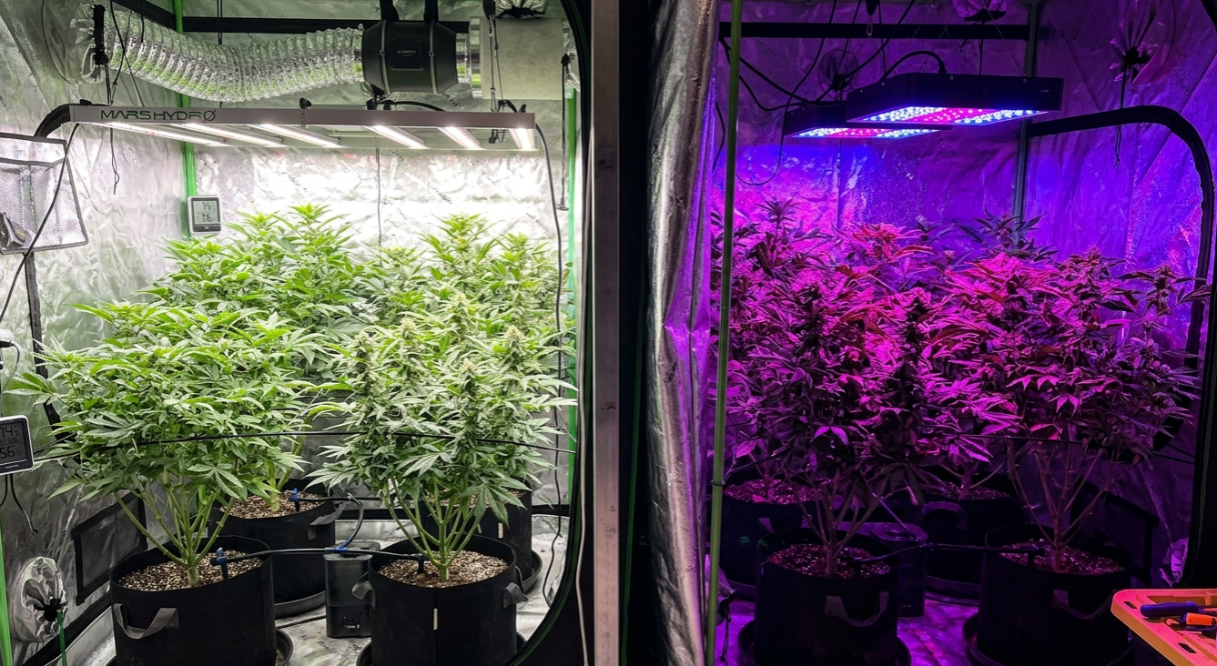
Spectrum determines not just how much your plants grow, but how they grow. Different wavelengths influence architecture, potency, terpene production, and flowering speed. Here’s what each part of the spectrum does for cannabis.
Full Spectrum (White Light)
Full-spectrum LEDs use phosphor-coated diodes to produce broad white light that closely mimics natural sunlight. Modern cannabis LED grow lights have largely converged on warm-white spectra. Beyond matching or exceeding the growth rates of older technologies, full-spectrum white light makes it far easier for growers to visually inspect plants for pests, nutrient deficiencies, and disease.
For a research-backed overview of how light spectra affect plant growth, that summary covers the science behind spectrum selection.
Blurple (Legacy Red-Blue LED)
Early LED grow lights used only red and blue diode chips, producing a distinctive blue-purple hue that the growing community nicknamed “blurple.” These fixtures were designed around the idea that plants only need red and blue wavelengths, which turned out to be an oversimplification.
Blurple lights are outdated. Practitioners on THCFarmer forums are blunt about this: all of the major LED brands for cannabis have swapped to cool and warm white. There’s a reason blurple panels are so cheap compared to full-spectrum fixtures. They don’t grow cannabis as well as modern LEDs that deliver a wider, more complete spectrum. If you have the choice, avoid them.
Red Light (600 to 700 nm)
Red photons are the primary driver of flower development in cannabis. They fuel the most efficient photosynthetic reactions and promote bud density, size, and overall yield. Most commercial cannabis LED grow lights are weighted toward red wavelengths for exactly this reason.
Blue Light (400 to 500 nm)
Blue photons play a supporting but important role. They promote shorter internodes and bushier plant architecture, which matters in grow rooms where vertical space is limited. Research has also shown that blue light can increase cannabinoid concentrations, particularly THC. However, a fixture that’s too blue-heavy will sacrifice flower weight.
Far-Red (730 nm)
Far-red sits just outside the traditional PAR range and plays two distinct roles. During the light period, it triggers the Emerson Enhancement Effect, which increases overall photosynthetic efficiency by allowing the plant to use far-red photons alongside red photons. When applied as an end-of-day pulse, far-red accelerates the plant’s transition to its dark-period state, potentially shortening flowering timelines by a few days.
UV Light (Ultraviolet)
UV wavelengths sit just below the visible spectrum and can trigger a cannabis plant’s defense mechanisms. In small, controlled doses, UV exposure may increase the production of oils, resins, and trichomes. Excessive UV, however, damages both plants and people. This is a supplemental tool, not a primary lighting strategy.
Experienced growers on forums are clear about priorities here: don’t buy a weak main light because it has a few extra spectrum diodes. White-light coverage, fixture quality, and canopy uniformity come first. Extra red, far-red, UVA, or UVB can be useful in specific situations, but they are not magic yield buttons.
CRI (Color Rendering Index)
CRI measures how accurately a light source reveals the true colors of objects compared to natural sunlight, on a scale of 0 to 100. While CRI doesn’t directly affect plant growth, a higher CRI makes it much easier to spot pests, discoloration, nutrient deficiencies, and mold during visual inspections. In a commercial operation where catching problems early saves thousands, this matters.
Fixture Form Factor Terms
The shape and design of a cannabis LED grow light determines how evenly it distributes light, how much heat it generates at the canopy, and which grow environments it suits best.
Bar-Style LED Fixtures
Bar-style fixtures spread diodes across multiple parallel bars, reducing hotspots and improving uniformity across the canopy. This is the dominant form factor in commercial cannabis cultivation for good reason: the distributed layout delivers more even PPFD maps, runs cooler because the diodes aren’t concentrated in one spot, and fits cleanly into standard ceiling grid configurations.
For most cannabis flower rooms 4x4 feet and larger, bar-style LEDs are the standard recommendation from both manufacturers and experienced growers. The Pinnacle series is one example of a commercial bar-style fixture designed for cannabis flower rooms, available across multiple wattage classes to match different room sizes and PPFD targets.
Quantum Board LED Fixtures
Quantum boards mount many LEDs onto a single flat board. Forum growers on GrowWeedEasy note that while quantum boards work well, especially in smaller spaces (2x2, 2x4, or 3x3 tents), bar-style fixtures generally outperform them in flower given the more even light spread and larger sweet spot. Quantum boards remain excellent entry points for home growers where cost, simplicity, and passive cooling matter most.
COB (Chip on Board) LED
COB technology bonds multiple LED chips to a single substrate, creating a dense, powerful point source. COBs produce an intense, concentrated beam with good canopy penetration. They are no longer the default recommendation for most new growers, but they still make sense for DIY builders, tall-plant setups, and situations where deep-canopy supplemental light from a compact source is needed.
Top Light vs. Under-Canopy Light
Top lights are the primary overhead fixtures that deliver the bulk of your PPFD. Under-canopy lights (also called interlighting or intracanopy lighting) supplement from below, targeting the lower and middle bud sites that overhead light can’t reach.
This distinction has become increasingly important. A 2025 study published in PMC found that interlighting achieved a 29.95% increase in dry flower yield, 24.4% higher THC accumulation, and 12.5% more total terpenes compared to top lighting alone. Under-canopy lighting converts lower bud sites into denser, A-grade flower, increasing the percentage of A-grade buds from roughly 37% to 50% while reducing trim waste from 35% to 26%.
For commercial cultivators, under-canopy lighting is increasingly a competitive necessity rather than an experimental add-on. The Boost XE is a 120W under-canopy bar designed specifically for this application. And for growers who want to go deeper on the economics, the under-canopy lighting ROI guide breaks down the payback math.
Electrical and Infrastructure Terms
Lighting infrastructure is less exciting than spectrum science, but it has an outsized impact on operating costs, reliability, and facility design. These terms show up on every commercial project.
LED Driver
The driver is the power supply that converts AC mains electricity to the regulated DC current an LED fixture needs. Drivers are arguably the most critical component of a cannabis LED grow light, and they’re also the most common point of failure. When an LED fixture fails, the driver is usually the culprit, and the cause is almost always heat damage. Driver quality, thermal management, and placement all affect long-term reliability.
For more on the relationship between LEDs and HVAC load, that context explains why heat management around drivers matters for facility-wide climate control.
Remote / Centralized Power Architecture
This is a concept every commercial operation should understand. In a standard setup, each fixture has its own driver mounted at or near the fixture. In a remote power architecture, the drivers (or power supply modules) are relocated outside the grow space to a centralized rack or equipment room.
The benefits are substantial. Moving drivers out of the canopy reduces in-room heat load, which cuts HVAC costs. It eliminates hundreds or thousands of in-room failure points. Individual fixtures become lighter and easier to install and maintain. And centralized power distribution can lower wiring and conduit costs on large projects.
Light fixture drivers are not the most discussed technology in cannabis cultivation, but they should be. The OptiDrive system is one example of remote power architecture designed for commercial horticulture, available in both DC and low-voltage DE configurations.
Wattage (and Why It Misleads)
Wattage measures the electrical power a grow light consumes. It does not measure light output. This distinction trips up more growers than any other spec.
Practitioners on Reddit and growing forums consistently flag this problem. As one widely cited guide puts it: LED wattage can be a particularly misleading way of assessing the power of a potential LED light. Watch out for it in the marketing of some less desirable LED imports. Wattage is merely a measure of the amount of power used, not a measure of the amount of useful light produced.
A 600W fixture with 3.0 µmol/J efficacy produces far more usable light than a 1,000W fixture with 1.5 µmol/J efficacy, while consuming 40% less electricity. Always compare fixtures on efficacy and mapped PPFD, not wattage. The article on common mistakes when comparing LEDs to HPS covers this wattage trap in detail.
Dimming and 0-10V Control
Modern cannabis LED grow lights support dimming, typically via a 0-10V control signal. This lets you dial light intensity up or down to match growth stages, DLI targets, and climate conditions without swapping fixtures. A modern lighting program combines mapped PPFD, dialed DLI, dimmable control, and a climate that matches light intensity. Whether you’re lighting a compact single-tier room or a high-ceiling bay, choose fixtures that deliver uniform PAR and integrate cleanly with 0-10V controls.
Daisy-Chaining
Daisy-chaining connects multiple fixtures in series so they share a single control signal and power connection. This simplifies wiring in larger grow spaces and allows growers to dim or control entire rows of lights from one point.
Heat Sink and Thermal Management
A heat sink is a component (usually finned aluminum) designed to pull heat away from LED chips and electronic components. The greater the surface area, the better the heat dissipation. Proper thermal management extends fixture lifespan and prevents the light output degradation that occurs when LEDs overheat. Copper is the most thermally efficient material, but aluminum is standard in most commercial fixtures due to cost and weight considerations.
Certification and Economics Terms
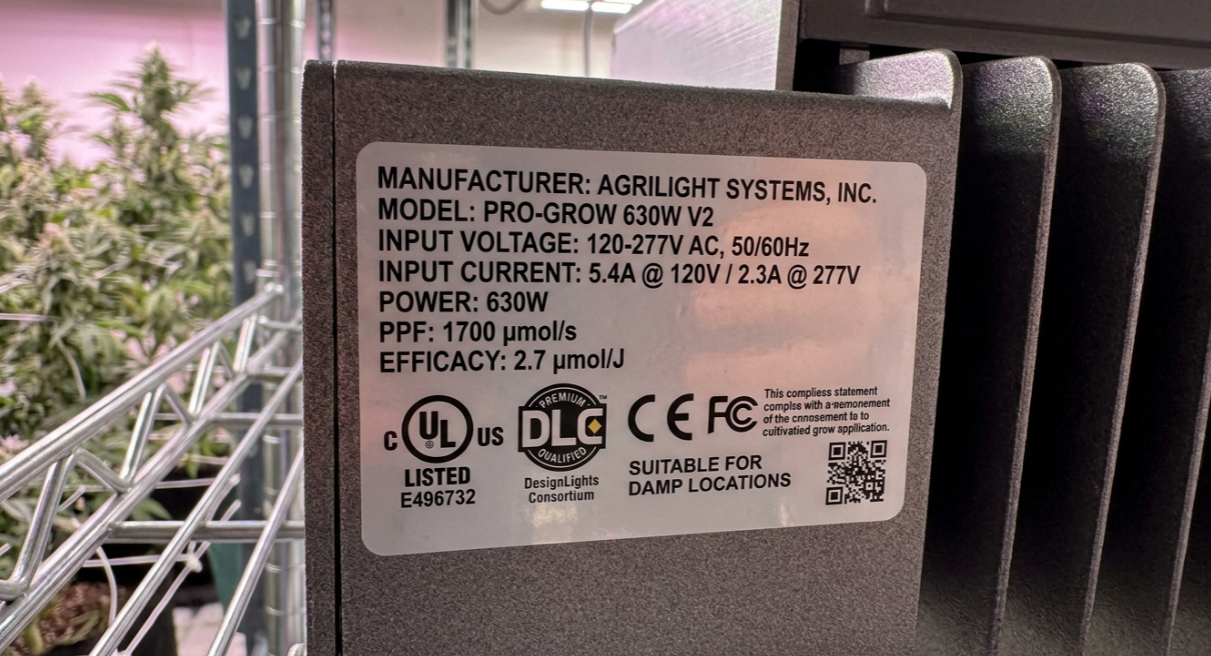
For commercial cannabis operations, these terms translate directly into dollars. DLC certification, rebates, and safety listings aren’t bureaucratic checkboxes; they’re financial tools.
DLC (DesignLights Consortium) Certification
In 2018, the DesignLights Consortium published testing and reporting requirements specifically for horticultural LED fixtures. DLC certification is the qualifying standard most utility providers use to approve LED grow light rebates. The current DLC Horticultural Technical Requirements V4.0 set a minimum photosynthetic photon efficacy (PPE) threshold of 2.5 µmol/J.
If your cannabis LED grow lights aren’t DLC-listed, you’re almost certainly leaving rebate money on the table. For a full explanation of DLC-listed LED grow lights and why the listing matters, that article covers the certification process and rebate connections.
UL Listing
UL (Underwriters Laboratories) listing is the North American standard for electrical safety compliance. A UL-listed fixture has been tested and certified to meet safety standards for electrical construction, thermal performance, and fire risk. In many jurisdictions, UL listing is required for permitting and insurance. It’s a baseline requirement for any commercial cannabis facility, not an optional feature.
Utility Rebates
In North America, utility companies are aggressively incentivizing the transition to energy-efficient horticultural lighting. Facilities that install DLC-qualified cannabis LED grow lights can receive cash rebates, often ranging from $100 to $400 or more per fixture. In large commercial operations with hundreds of fixtures, these rebates can erase the upfront cost difference between LED and legacy HPS systems almost entirely.
Eligibility depends on DLC certification, local utility programs, and sometimes fixture efficacy tiers. The rebate information page can help determine which programs apply to a specific facility.
Cultivation Strategy Terms
Lighting terminology only matters if it connects to growing decisions. These terms bridge the gap between fixture specs and canopy outcomes.
Photoperiod
Photoperiod is the number of hours of light and dark a cannabis plant receives in each 24-hour cycle. Cannabis is a photoperiod-sensitive crop: flowering is triggered by switching to a 12-hour light, 12-hour dark schedule (12/12). Vegetative growth typically uses 18/6 or 20/4 schedules.
Photoperiod directly affects DLI. A plant receiving 800 µmol/m²/s PPFD for 12 hours of flower gets a very different DLI than a veg plant receiving the same PPFD for 18 hours. Every lighting plan must account for this. The photoperiod management guide explains how to optimize light schedules across growth stages.
Crop Steering (Light-Related)
Crop steering uses environmental controls, including light intensity and duration, to push plants toward specific growth responses. In cannabis cultivation, this means aligning PPFD, DLI, CO₂ levels, airflow, irrigation, and nutrition into a coordinated program rather than adjusting any single variable in isolation.
Optimal results occur when all these inputs are balanced. Commercial cultivation requires carefully managing light as one piece of a larger system, not as a standalone factor.
Under-Canopy Lighting (Interlighting / Intracanopy)
Under-canopy lighting supplements the lower and middle canopy with light delivered from below or within the plant structure. In cannabis, this approach targets bud sites that would otherwise produce loose, low-grade flower (sometimes called “larf” or “popcorn buds”) due to shading from the upper canopy.
Practitioners report yield increases of 20% to 30% with properly implemented under-canopy lighting. The biggest upside is not just total weight, but grade distribution: converting lower bud sites into denser, sellable A-grade flower. Commercial growers who skip under-canopy lighting are likely leaving both yield and revenue on the table.
Light Distance and Hanging Height
The distance between your fixture and the top of your canopy directly affects PPFD, uniformity, and heat exposure. Hanging too close creates hotspots and light stress; hanging too far reduces intensity and wastes photons. Most manufacturers provide recommended hanging heights based on target PPFD at various dimming levels. Always refer to the fixture’s PPFD map at your intended mounting height rather than relying on general rules of thumb.
Common Cannabis LED Grow Light Mistakes
Choosing Lights Based on Wattage
Electrical consumption does not equal plant performance.
Ignoring Uniformity
Hotspots create inconsistent flower development.
Installing Fixtures Too Close to the Canopy
Excessive PPFD causes light stress and bleaching.
Overusing Supplemental UV
UV should supplement a primary lighting strategy rather than replace it.
Increasing PPFD Without Adding CO₂
Cannabis cannot efficiently use extreme light levels without matching environmental conditions.
LED vs. HPS: Key Terms Compared
The transition from HPS (high-pressure sodium) to LED has been the defining technology shift in cannabis cultivation over the past decade. When Cannabis Business Times first published its lighting report in 2016, only 15% of operators used LED as their primary lighting. By 2025, that number had climbed to nearly 80%.
Here’s how the two technologies compare across the metrics that matter:
Metric | HPS | LED |
|---|---|---|
Efficacy | ~1.7 µmol/J | 2.5 to 3.0+ µmol/J |
Energy consumption | Baseline | 40% to 60% less |
Yield benchmark | 1.0 to 1.2 g/W | 2.0 to 2.5+ g/W |
Expected lifespan | 10,000 to 24,000 hours | 40,000 to 50,000+ hours |
Heat profile | Radiant heat directed downward toward canopy | Convective heat rising upward, away from canopy |
HVAC impact | High cooling demand | Roughly $0.40 to $0.60 HVAC savings per $1 saved on lighting |
Spectrum control | Fixed; warm yellow-orange | Adjustable; full-spectrum white, with red/blue/far-red tuning options |
Bulb replacement | Every 6 to 12 months | None required within rated lifespan |
Historically, pulling 1.0 to 1.2 grams per watt under HPS was considered the mark of a master grower. Modern LEDs have shifted the benchmark to 2.0 to 2.5+ grams per watt, driven by superior light distribution, canopy penetration, and balanced spectrum.
One often-overlooked advantage: LED grow lights produce convective heat that rises away from plants, allowing cultivators to downsize HVAC equipment. The cooling savings compound on top of the direct energy savings.
How to Compare Cannabis LED Grow Lights in 5 Steps
Step 1: Ignore Wattage
Do not compare 600W versus 1,000W fixtures.
Compare efficacy (µmol/J) instead.
Step 2: Verify PPFD Maps
Always request:
Average PPFD
Minimum PPFD
Maximum PPFD
Uniformity ratio
Never rely on center-point measurements.
Step 3: Match PPFD to Growth Stage
Growth Stage | Recommended PPFD |
|---|---|
Seedlings | 100 to 300 µmol/m²/s |
Vegetative growth | 400 to 800 µmol/m²/s |
Flowering | 800 to 1,000 µmol/m²/s |
Flowering with CO₂ | 1,200 to 1,500 µmol/m²/s |
Step 4: Verify DLC Certification
DLC-listed fixtures may qualify for utility rebates.
Step 5: Calculate the Total Cost of Ownership
Include:
Electricity
HVAC
Fixture replacement
Rebates
Maintenance
LED Adoption Trends in Cannabis
The adoption curve for cannabis LED grow lights has been steep. Moving from 15% adoption in 2016 to roughly 80% in 2025 represents a fundamental infrastructure shift across the industry. Several factors drove this:
Economics won the argument. Fixture efficacy doubled from 1.7 µmol/J to above 3.0 µmol/J over roughly a decade. Utility rebates of $100 to $400+ per fixture shortened payback periods to months rather than years.
Quality became the priority. When 62% of growers say crop quality is their top reason for choosing LEDs (ahead of yield at 16%), the conversation has permanently shifted from “can LEDs match HPS?” to “how do I optimize my LED setup?”
Infrastructure caught up. Remote power systems, 0-10V dimming integration, and DLC certification standards matured to the point where LED installations are now simpler and more predictable than HPS buildouts, especially at scale.
Cannabis LED Grow Light Buying Checklist
Before purchasing a fixture, verify:
Question | Yes/No |
|---|---|
Is the fixture DLC-certified? | |
Is efficacy above 2.5 µmol/J? | |
Are PPFD maps available? | |
Is the uniformity ratio above 0.85? | |
Does the fixture support 0-10V dimming? | |
Does the manufacturer publish a lifespan rating? | |
Does the fixture qualify for utility rebates? |
Frequently Asked Questions
What is the most important spec when comparing cannabis LED grow lights?
Efficacy (µmol/J) and mapped PPFD are the two specs that matter most. Efficacy tells you how efficiently a fixture converts electricity into plant-usable light. PPFD maps show you how that light is actually distributed across your canopy. Wattage alone tells you almost nothing about growing performance.
What PPFD should I target for flowering cannabis?
Most commercial growers target 800 to 1,000 µmol/m²/s during flower. With supplemental CO₂ at 1,200 to 1,500 ppm, cannabis can photosynthesize at PPFD levels up to 1,500 µmol/m²/s. Without CO₂ enrichment, anything above roughly 900 µmol/m²/s risks light stress without a proportional yield increase.
Are blurple LED grow lights still worth buying?
No. Blurple (red-blue only) LEDs are old technology. Modern full-spectrum white LEDs deliver equal or better growth rates while making plant inspection far easier. Every major LED manufacturer has moved to full-spectrum designs, and experienced growers across forums are unanimous: blurple panels should be avoided if full-spectrum alternatives are available.
How much energy do LEDs save compared to HPS?
LED grow lights use 40% to 60% less energy than HPS fixtures while producing equal or higher usable light output. Additionally, the convective heat profile of LEDs reduces HVAC cooling requirements, saving roughly $0.40 to $0.60 on cooling for every dollar saved on lighting energy.
What is DLC certification and why does it matter?
DLC (DesignLights Consortium) certification means a fixture has been independently tested and meets minimum efficacy thresholds (currently 2.5 µmol/J under V4.0 requirements). It matters because DLC certification is the standard most utility companies require before approving energy-efficiency rebates, which can range from $100 to over $400 per fixture.
Does under-canopy lighting really increase yields?
Published research and practitioner reports consistently show yield increases of 20% to 30% when under-canopy lighting is properly implemented. A 2025 PMC study documented nearly 30% more dry flower, 24.4% higher THC, and 12.5% more terpenes. The practical benefit goes beyond total weight: under-canopy lighting shifts the grade distribution toward more A-grade sellable flower and less trim waste.
What is remote power architecture and who needs it?
Remote power architecture moves LED drivers out of the grow space and into a centralized equipment area. This reduces in-room heat, eliminates hundreds of potential failure points above the canopy, and simplifies installation. It’s most relevant for commercial operations with large fixture counts where driver heat load, maintenance access, and install costs are significant factors.
How long do cannabis LED grow lights last?
Most commercial LED fixtures are rated for 40,000 to 50,000 hours or more. At a typical 12-hour flowering photoperiod, that’s roughly 9 to 11 years of use before output degrades meaningfully. This eliminates the 6-to-12-month bulb replacement cycles that HPS requires.
Ready to apply these terms to a real facility plan? Schedule a free consultation with a lighting specialist to get PPFD maps, DLI calculations, and rebate guidance tailored to your operation.