Under-Canopy LED Lighting: 2026 Guide to Boost Yield
Learn how Under-Canopy LED Lighting boosts yields 20–35%, improves bud quality, and reduces lollipopping. Get specs, setup timing, and ROI tips.
TL;DR
Under-canopy LED lighting places low-wattage LED bars beneath the plant canopy, pointing upward to illuminate lower leaves and bud sites that overhead lights can’t reach. Commercial growers consistently report 20 to 35% yield increases, better bud quality, and improved cannabinoid profiles. The technique has moved from experimental to mainstream, with industry surveys showing grower interest in subcanopy lighting jumped 12 percentage points in a single year. Success depends on proper spectrum choice, correct placement timing, and environmental adjustments.
If you’re exploring under-canopy lighting for your facility, talk to a lighting specialist to understand what it could mean for your operation.
Quick Answer: Is Under-Canopy LED Lighting Worth It?
Under-canopy LED lighting increases light penetration into the lower portion of the plant by placing supplemental LED bars beneath the canopy.
Most commercial growers report:
Metric | Typical Improvement |
|---|---|
Yield | 20-35% |
Bud size | Up to 27% |
THC concentration | Up to 5% |
Payback period | 1-2 harvests |
Recommended installation | Days 14-21 of flowering |
Recommended fixture wattage | 60-160W |
Recommended mounting height | 8-12 inches above the substrate |
Under-canopy lighting works best in dense cannabis canopies where lower flowers receive inadequate light from overhead fixtures.
Commercial operations with high plant density usually see the greatest return on investment.
What Is Under-Canopy LED Lighting?
Under-canopy LED lighting is a supplemental lighting technique that places slim, low-wattage LED bars beneath the plant canopy to deliver photosynthetically active radiation (PAR) upward into shaded lower foliage and bud sites. The goal is simple: give the bottom of the plant the light it needs to produce quality flowers, not just the top.
In practice, this means LED bars (typically 60 to 160 watts each) mounted on floor-level stands or racking, angled upward so photons hit the undersides of leaves and lower flower sites that overhead fixtures cannot effectively reach.
Related Terms: A Quick Clarification
The industry uses several terms that overlap but aren’t perfectly interchangeable:
Under-canopy lighting (UCL): Fixtures positioned below the canopy, pointing up. The most common usage in commercial cannabis.
Subcanopy lighting (SCL): Functionally identical to under-canopy. Used interchangeably in most trade literature.
Intercanopy lighting: Fixtures placed between layers of canopy, sometimes vertically within the plant structure rather than strictly below it. More common in greenhouse produce crops like tomatoes and cucumbers.
Intracanopy lighting: A broader academic term covering any supplemental light delivered inside or within the canopy zone, including both inter- and subcanopy positions.
No ranking page in the current search results clearly distinguishes these terms, which creates real confusion for growers researching the topic. For this article, “under-canopy” and “subcanopy” refer to the same thing: lights below the canopy, pointing up.
Why Under-Canopy Lighting Exists: The Light Distribution Problem
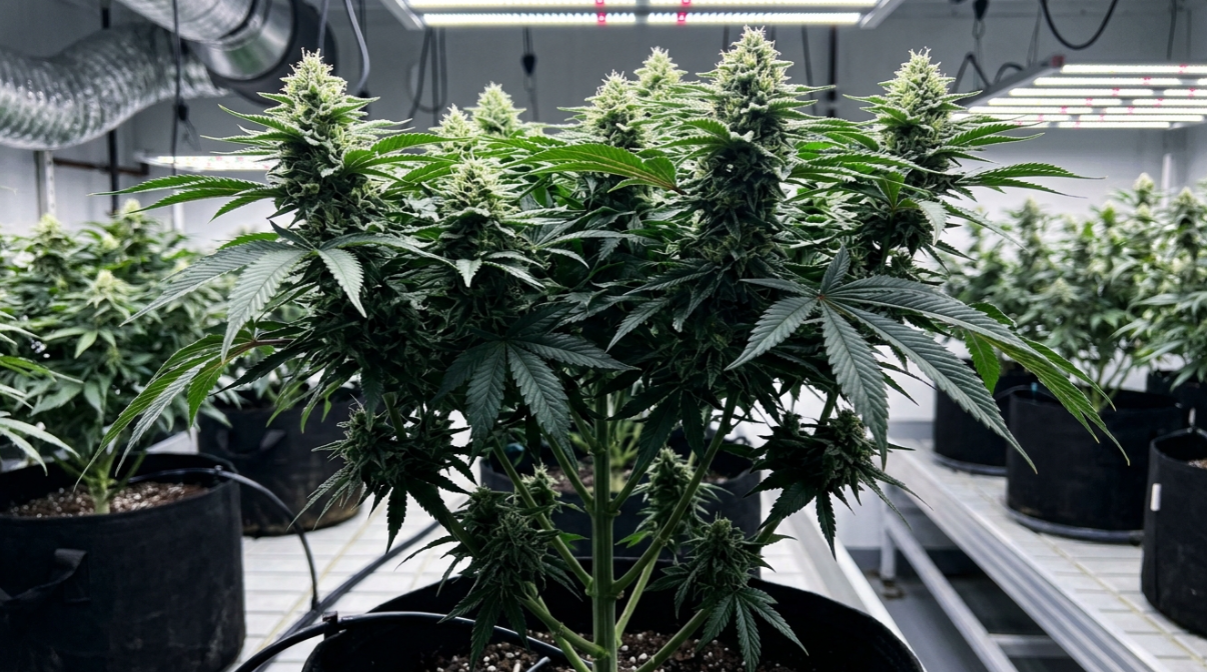
Every indoor and greenhouse grow room has the same fundamental physics problem. Overhead lights, no matter how powerful or well designed, create an uneven distribution of PAR through the plant. The uppermost leaves and branches intercept the majority of available photons, acting as a natural barrier. By the time light filters down through a dense canopy, the lower third of the plant receives a fraction of what the top gets.
The result is predictable and expensive. Lower bud sites produce small, loose, underdeveloped flowers, what growers call “popcorn” or “larf.” These lower buds lack the density, trichome coverage, and cannabinoid concentration of top-cola flowers. In many operations, they’re trimmed away entirely (a practice called lollipopping) because they aren’t worth processing. That represents wasted plant energy, wasted nutrients, and wasted canopy space.
Under-canopy LED lighting addresses this directly. By introducing PAR from below, it restores photosynthetic activity to leaves and bud sites that were previously operating in near-darkness. Horticultural studies have measured a 15% increase in photosynthesis in lower leaves when illuminated from below, along with a 10% boost in chlorophyll production.
The approach doesn’t replace overhead lighting. It complements it, turning the entire vertical profile of the plant into productive canopy rather than just the top layer. For a deeper look at how top and bottom lighting work together, the cannabis flower room lighting guide covers the full strategy.
Documented Benefits
The evidence base for under-canopy LED lighting has grown substantially over the past several years, spanning peer-reviewed research, commercial case studies, and thousands of real-world harvests.
Yield Increases
The well-supported range for yield gains is 20 to 35%, depending on cultivar, facility conditions, and how well the grower integrates the lighting into their overall environment.
Industry case studies have demonstrated a 20% increase in yield and a 27% enhancement in bud size with under-canopy supplementation.
One cultivation data platform reports that growers who optimize plant count and environmental conditions alongside under-canopy lighting commonly see 25 to 35% increases in their first run.
A 2018 study found that integrating LED interlighting improved light-use efficiency from 0.27 g/mol under standard HPS to 0.37 g/mol with supplemental LEDs, a 37% improvement in grams per mole of photons delivered.
Peer-reviewed research published in 2025 (Garrido et al.) confirmed that subcanopy and intercanopy supplemental lighting improved plant growth, flowering, yields, and quality across multiple horticultural crops including tomato, cucumber, sweet pepper, and blackberry, not just cannabis.
For growers focused on the financial math, the under-canopy lighting ROI guide breaks down payback calculations in detail.
Quality Improvements
Yield is only half the story. Research and grower reports consistently show:
A substantial increase in A-grade flowers as a proportion of total harvest
Improved bud density throughout the lower canopy
Enhanced cannabinoid profiles, including a reported 5% increase in THC levels across the crop
Better terpene expression, which affects both aroma and market value
Labor and Uniformity
When lower bud sites actually produce quality flowers, growers can reduce or eliminate aggressive lollipopping and defoliation of the bottom canopy. This saves labor hours. It also creates better crop uniformity from top to bottom, which simplifies processing, grading, and packaging.
Under-Canopy LED Lighting by the Numbers
Statistic | Research Finding |
|---|---|
Lower-leaf photosynthesis | +15% |
Chlorophyll production | +10% |
Yield increase | 20-35% |
Bud size increase | +27% |
Light-use efficiency | +37% |
THC increase | +5% |
Tomato yield increase | 11-21% |
Growers interested in supplemental lighting | 78% |
The Spectrum Question: White vs. Red-Heavy
This is where most guides fall short. Spectrum choice matters more for under-canopy lighting than for overhead fixtures, and the reason is rooted in plant biology.
What Happens to Light Inside a Dense Canopy
Upper leaves absorb most of the blue and red wavelengths from overhead fixtures. By the time light filters to the lower canopy, the spectral environment is already heavily shifted toward red and far-red. Green light penetrates deeper than red or blue because leaves reflect and transmit green wavelengths more readily.
This means the lower canopy already lives in a red-dominated light environment. Adding more red-heavy light from below amplifies an existing imbalance rather than correcting it.
The Case for Full-Spectrum White
Full-spectrum white light, rich in green wavelengths alongside red and blue, provides the balanced photon signal that lower leaves are starved for. Green photons drive photosynthesis in deeper leaf layers that red photons cannot effectively reach. For a more thorough treatment of this topic, the summary of light spectra and plant growth explains the mechanisms in detail.
There’s also a practical benefit for workers. Full-spectrum white light renders plant colors accurately, making it easier to spot pests, nutrient deficiencies, and disease. Red-heavy “pink” or “blurple” light makes visual crop inspection unreliable.
Far-Red and the Emerson Enhancement Effect
Far-red wavelengths (700 to 750 nm) play a real role in under-canopy photosynthesis. When far-red photons arrive alongside red photons, they trigger the Emerson Enhancement Effect, a synergy where the combined photosynthetic output exceeds what either wavelength produces alone. Quality under-canopy fixtures include some far-red output for this reason. The key is balance, not dominance of any single wavelength band.
What PPFD Should Under-Canopy Lights Deliver?
Photosynthetic Photon Flux Density (PPFD) measures how much usable light reaches plant tissue.
Unlike overhead fixtures, under-canopy lights don't need to deliver extremely high PPFD values.
Growth Stage | Recommended PPFD |
|---|---|
Early flowering | 100-150 μmol/m²/s |
Mid flowering | 150-250 μmol/m²/s |
Late flowering | 200-300 μmol/m²/s |
Higher PPFD isn't always better.
Excessive intensity can bleach lower leaves and increase heat accumulation beneath the canopy.
The goal is to supplement overhead lighting rather than replace it.
Key Specifications for Evaluating Fixtures
When comparing under-canopy LED bars, these are the specifications that matter most:
Efficacy (μmol/J): This is the “miles per gallon” of grow lights, measuring how many photons the fixture produces per watt of electricity consumed. High-end under-canopy bars operate between 2.5 and 3.3 μmol/J. Higher is better, but only if the light distribution and spectrum also meet your needs.
Wattage: Most commercial under-canopy bars run between 60 and 160 watts per bar. A 120W bar is the sweet spot for cannabis flower rooms, providing enough intensity to drive meaningful photosynthesis without overwhelming the lower canopy or adding excessive heat.
IP Rating: Under-canopy fixtures sit in the most humid zone of the grow room, near the substrate and irrigation. IP65 or IP66+ ratings are essential for long-term reliability in these conditions.
DLC Listing: The DesignLights Consortium Horticultural Qualified Products List (DLC Hort QPL) provides third-party verification of photometric performance. DLC-listed fixtures also qualify for utility rebates, which can dramatically change project economics.
Safety Certifications: UL, ETL, or CSA listing confirms the fixture meets electrical safety standards. This is non-negotiable for commercial facilities and often required by building codes and insurance.
Warranty: Five years is the commercial-grade benchmark. Anything less signals either lower component quality or less confidence from the manufacturer.
A purpose-built under-canopy LED bar should check all of these boxes while maintaining a slim enough form factor to fit beneath dense canopy without obstructing airflow.
Don’t shop on marketing claims alone. Use the DLC Hort QPL to compare reported versus independently tested photometric performance before committing to any fixture.
How Many Under-Canopy LED Bars Do You Need?
The number of fixtures depends on:
Plant density
Row spacing
Canopy width
Trellis configuration
Fixture wattage
A typical commercial flowering room uses:
Canopy Area | Typical Configuration |
|---|---|
4×8 feet | 2-4 bars |
4×16 feet | 4-8 bars |
4×24 feet | 6-12 bars |
Manufacturers may recommend different layouts, but uniform light distribution is more important than fixture quantity.
Growers should measure PPFD beneath the canopy rather than relying exclusively on square-foot recommendations.
How to Implement Under-Canopy Lighting
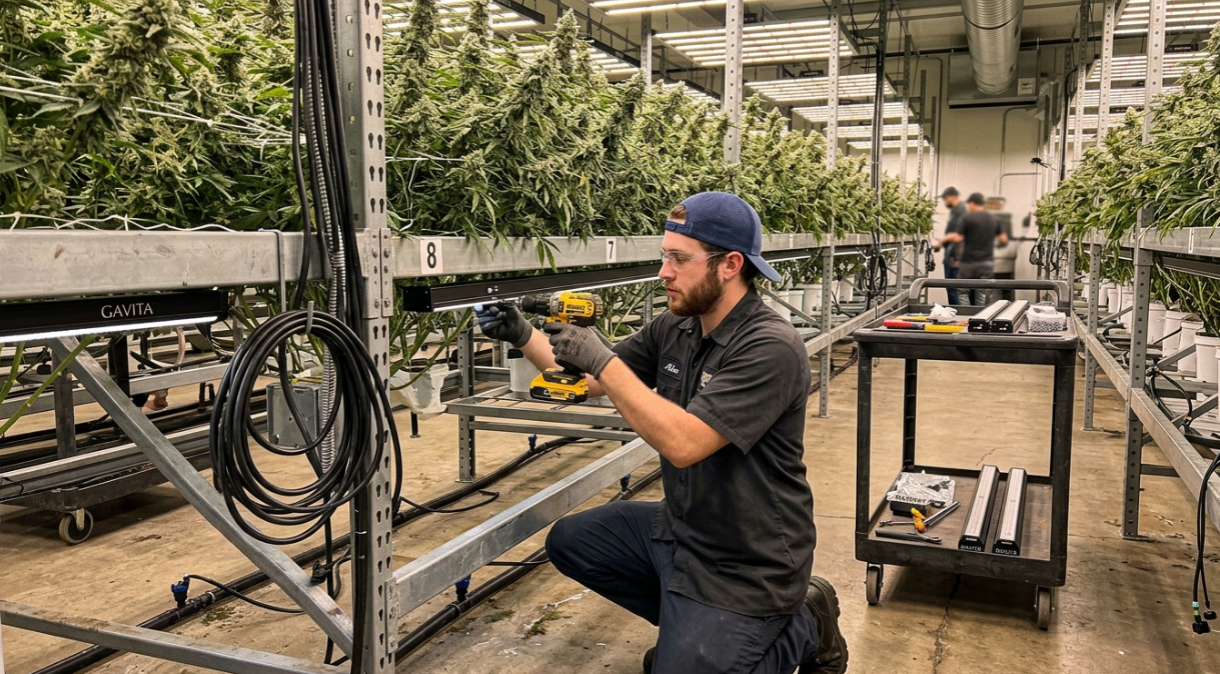
Getting the hardware right is only the first step. Proper implementation makes the difference between a 20% yield bump and wasted electricity.
Placement
Position under-canopy lights approximately 8 to 12 inches above the substrate or pot base, pointing upward. This height prevents direct heat stress on roots and the growing medium while delivering enough PPFD to lower leaves and bud sites. The bars should sit below the lowest significant foliage, not buried within the canopy.
Timing
The ideal introduction point is 14 to 21 days into the flowering cycle, after the initial stretch phase. By this point the canopy has filled in enough that lower sites are genuinely light-deprived, and the plant’s energy is redirecting toward flower production.
Intensity Ramping
Start with under-canopy lights at 40 to 50% output. Gradually increase intensity over two to three weeks to allow plants to adapt without stress. Jumping straight to full power can cause light bleaching on leaves that have acclimated to low-light conditions.
Environmental Adjustments
This is where many growers stumble. Adding light beneath the canopy changes the root-zone microclimate. Temperatures at the base of the plant may rise slightly. Humidity under dense foliage can shift. Both affect vapor pressure deficit (VPD), which drives transpiration and nutrient uptake.
Monitor these changes and adjust fans, HVAC, and dehumidification accordingly. The guide on managing VPD in cannabis covers the principles. For the HVAC load side of the equation, calculating cooling needs for LEDs provides the math.
Rethinking Defoliation
Traditional lollipopping assumes the lower canopy won’t produce anything worthwhile. Under-canopy lighting changes that assumption. But growers need to be careful: illuminating the lower canopy encourages more biomass growth, and if that growth isn’t managed, overcrowding can create airflow problems and increase disease risk. The common under-canopy lighting mistakes guide addresses this directly.
The balance is strategic defoliation rather than aggressive stripping, removing enough leaf material to maintain airflow while keeping enough to capture the supplemental light.
ROI and Rebates
The economics of under-canopy LED lighting are straightforward. You’re adding 20 to 35% more harvestable flower without adding square footage, without adding more plants (in many cases), and without dramatically increasing your total power draw. The fixtures are low wattage relative to overhead lights.
Commercial growers report that the added yield covers equipment cost within one to two harvests at typical market prices. That’s a payback period most capital investments in agriculture can’t match.
Who Should Use Under-Canopy LED Lighting?
Under-canopy lighting works best for:
Ideal candidates
Commercial cannabis facilities
High-density cultivation
Multi-tier grows
Greenhouse cannabis operations
Less suitable candidates
Small hobby grows
Low-density cultivation
Autoflower grows with open canopies
Facilities already achieving uniform lower-canopy development
Utility Rebates
DLC-listed under-canopy fixtures qualify for utility rebate programs in many states and provinces. In some regions and programs, rebates have covered 100% of the fixture cost. California programs, for example, have offered $69 to $89 per fixture depending on facility configuration.
Always verify current rebate eligibility through your utility provider before purchasing. The rebate and incentive programs page tracks active programs and eligibility requirements.
Industry Adoption: No Longer Experimental
The 2025 Cannabis Business Times State of the Cannabis Lighting Market report makes the trend unmistakable. Of commercial indoor and greenhouse growers surveyed, 78% expressed interest in exploring lighting types to supplement top lighting, a 27-percentage-point increase since 2022.
Within that group, interest in intercanopy lighting reached 43% (up 11 points from the prior year), and interest in subcanopy lighting specifically hit 36%, up 12 percentage points in a single year, the greatest growth of any supplemental lighting category surveyed.
This isn’t a niche experiment anymore. It’s becoming standard practice for competitive commercial operations.
Under-Canopy LED vs. Traditional Overhead Lighting
Feature | Under-Canopy LED | Overhead Lighting |
|---|---|---|
Fixture position | Beneath the canopy | Above the canopy |
Primary purpose | Improve lower growth | Drive overall growth |
PPFD target | 100-300 μmol/m²/s | 800-1,200 μmol/m²/s |
Energy consumption | Low | High |
Installation complexity | Moderate | Moderate |
Best application | Dense canopies | Entire crop |
How Under-Canopy Fits Into a Total Lighting Strategy
Under-canopy lighting is a supplement, not a replacement. It works alongside overhead fixtures to create a complete light distribution strategy that covers the full vertical profile of the plant. The top lights do the heavy lifting. The under-canopy bars fill the gap.
Electrical Scaling
Where this gets complicated is at scale. Adding dozens or hundreds of under-canopy bars to a large facility means more wiring, more circuits, and more drivers generating heat in the grow space. Each fixture with an onboard driver is another potential failure point and another source of heat that HVAC must manage.
Centralized power architecture addresses this by relocating LED drivers outside the grow room entirely. This reduces in-room heat, simplifies wiring, and removes hundreds of failure points from the canopy zone. For large-scale deployments, centralized power distribution changes the installation economics and long-term reliability math significantly.
Cross-Crop Applications
While cannabis gets the most attention, under-canopy and intercanopy lighting has proven effective across multiple greenhouse crops. Tomato studies show 11 to 21% increases in fruit yield. The Garrido et al. 2025 review confirmed benefits in cucumber, sweet pepper, blackberry, and bush bean production as well. Greenhouse produce growers evaluating supplemental lighting strategies should consider under-canopy as part of their overall greenhouse lighting design.
Designing for Total Canopy Distribution
The most forward-thinking facility designers are now planning for under-canopy lighting from the start rather than retrofitting it later. This means accounting for the additional circuits, mounting infrastructure, and HVAC capacity during the design phase. It means choosing fixtures and power systems that integrate cleanly rather than bolting on aftermarket solutions.
The growers seeing the best results treat under-canopy LED lighting not as an add-on but as an integral part of their lighting architecture from day one.
Ready to evaluate under-canopy lighting for your facility? Schedule a free consultation to discuss your layout, goals, and expected ROI.
Common Under-Canopy Lighting Mistakes
Installing lights too early
Introducing supplemental lighting before canopy formation reduces efficiency.
Using red-only fixtures
Lower canopies already receive red-shifted light.
Ignoring airflow
Additional foliage increases humidity and disease pressure.
Running lights at full intensity immediately
Plants acclimated to shade should be transitioned gradually.
Failing to adjust HVAC
Additional heat sources alter VPD and root-zone conditions.
Frequently Asked Questions
How much yield increase can I expect from under-canopy LED lighting?
The well-documented range is 20 to 35%, depending on cultivar, environmental conditions, and how well you integrate the lighting into your cultivation practices. Some growers report higher numbers, but 20 to 35% is the range supported by both peer-reviewed research and consistent commercial results.
When should I turn on under-canopy lights during the grow cycle?
The standard recommendation is 14 to 21 days into the flowering phase, after the initial stretch. Start at 40 to 50% intensity and ramp up over two to three weeks to avoid stressing leaves that have adapted to low light levels.
Does spectrum matter for under-canopy lighting?
Yes, and it matters more than most growers realize. The lower canopy already receives a red-shifted light environment because upper leaves filter out blue and green wavelengths. Full-spectrum white light corrects this imbalance by delivering the green-rich, balanced photons that lower leaves need. Red-heavy fixtures amplify the existing spectral skew rather than fixing it.
Do I need to adjust my HVAC or environment when adding under-canopy lights?
Almost always. Adding light sources beneath the canopy raises root-zone temperatures slightly and can alter humidity patterns under dense foliage. Both affect VPD. Monitor your microclimate closely and adjust airflow, dehumidification, and cooling as needed.
Should I still lollipop or defoliate my plants with under-canopy lighting?
You’ll likely defoliate less aggressively, but you won’t stop entirely. The goal shifts from removing unproductive lower growth to managing canopy density for airflow. Without some strategic leaf removal, the extra biomass growth can create overcrowding and increase disease risk.
Do under-canopy LED fixtures qualify for utility rebates?
DLC-listed under-canopy fixtures qualify for rebate programs offered by many utility providers. Some programs have covered the full cost of the fixtures. Check with your local utility and verify that any fixture you’re considering is on the DLC Horticultural Qualified Products List.
How is under-canopy lighting different from intercanopy lighting?
Under-canopy (or subcanopy) lighting places fixtures below the canopy pointing up. Intercanopy lighting places fixtures within or between canopy layers, sometimes vertically among the plant structure. Both target shaded plant tissue, but the positioning and ideal applications differ. In cannabis, under-canopy is the dominant approach. In greenhouse produce crops like tomatoes, intercanopy placement between vine rows is more common.
What wattage do I need for under-canopy LED bars?
Commercial under-canopy bars typically range from 60 to 160 watts. For cannabis flower rooms, 120W per bar is the most common specification, providing enough intensity for meaningful photosynthesis without excessive heat or energy draw. The right wattage depends on plant density, canopy thickness, and the intensity of your overhead lighting.