Under-Canopy Lighting Mistakes: 8 Errors to Avoid (2026)
Learn the 8 under-canopy lighting mistakes that kill yield—timing, spectrum, VPD, PPFD, and wiring. Get 2026 best practices to boost ROI—read now.
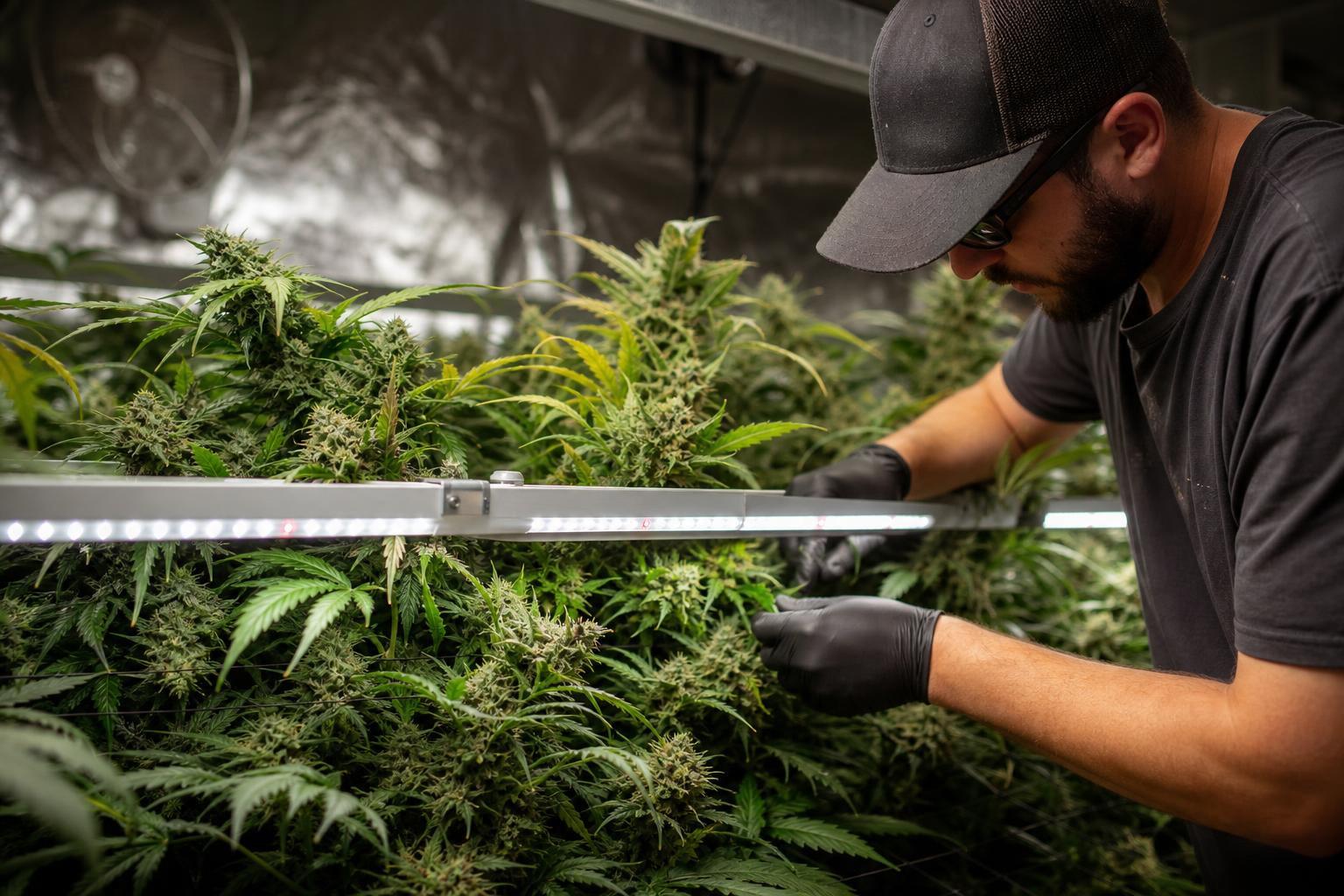
TL;DR
Under-canopy lighting (UCL) can deliver 20% to 30% yield increases, but only when the rest of your cultivation system adapts to support it. The most common under-canopy lighting mistakes include continuing aggressive pruning that removes the very bud sites UCL is meant to feed, ignoring VPD and microclimate shifts below the canopy, choosing the wrong spectrum, over-lighting from below, and failing to plan for electrical infrastructure upgrades. Treating UCL as a plug-and-play accessory rather than a system-level change is where most growers go wrong.
Under-canopy lighting has moved past the experimental phase. A 2025 study published in PMC found that interlighting achieved a 29.95% increase in dry flower yield, 24.4% higher THC accumulation, and 12.5% more total terpenes. Industry surveys report that 65% of commercial growers considering new lighting want to explore sub-canopy and intercanopy fixtures. The technology works.
But installation is not the finish line. It is the starting line.
The growers who see those headline yield numbers share one thing in common: they adjusted their entire cultivation approach, not just their light plan. The growers who are disappointed almost always made one or more of the under-canopy lighting mistakes described below. Each mistake has a clear root cause, and each one has a practical fix.
Considering under-canopy lighting for your facility? Explore the Boost XE, a 120W full-spectrum white under-canopy LED bar built for commercial grows.
Mistake 1: Keeping the Same Pruning Strategy
This is the single most ironic and most common under-canopy lighting mistake. A grower installs UCL to make lower bud sites productive, then strips those bud sites away through aggressive lollipopping and defoliation, exactly as they did before.
The habit makes sense in a top-lit-only room. Without light reaching the lower canopy, those sites produce airy, underdeveloped “popcorn” buds that aren’t worth the plant’s energy. Removing them redirects resources to the top colas. Growers have done this for years, and the muscle memory is strong.
But UCL changes the equation. The whole point is to deliver photons to the lower third of the plant so those bud sites can develop dense, marketable flower. If you remove them out of habit, you’ve paid for fixtures that have nothing to illuminate.
The fix
Reassess your defoliation approach after installing under-canopy lights. Retain more lower bud sites than you would in a top-lit-only room. This doesn’t mean abandoning all pruning; you still want adequate airflow and some canopy management. But the balance shifts. Leave enough lower growth for the UCL to do its job. Monitor the results over a full cycle or two, and adjust from there.
Mistake 2: Ignoring VPD and Microclimate Shifts
Adding light below the canopy is not just adding light. It is adding heat, increasing transpiration, and changing the humidity profile in a zone that was previously cooler and more stagnant than the top of the room.
In a standard top-lit grow room, temperature is highest at canopy level and drops toward the floor. This “temperature stratification” affects everything from VPD calculations to root zone health. Under-canopy lighting disrupts this gradient. The lower canopy gets warmer, transpiration increases across more leaf area, and humidity can spike in the dense foliage where airflow is already limited.
Growers who treat UCL as an additive accessory, something you bolt on without touching anything else, often see humidity-related problems like powdery mildew or bud rot in the exact zone they were trying to improve.
The fix
Monitor VPD at the lower canopy, not just at the top. Adjust fans and dehumidification to account for the added heat load and increased transpiration. For a deeper understanding of why this matters, read about VPD in cannabis cultivation. You may also need to revisit your HVAC sizing to account for the additional fixtures.
The adjustment doesn’t have to be dramatic. But it does have to be intentional.
Mistake 3: Wrong Activation Timing
When should you turn on under-canopy lights? The answer is narrower than most growers expect, and getting the timing wrong is one of the more wasteful under-canopy lighting mistakes.
Some growers activate UCL during vegetative growth, reasoning that more light at any stage equals more growth. Others wait until deep into flower, hoping for a late-cycle boost. Both approaches miss the optimal window.
During veg, plants are building structure, not developing bud sites. The lower canopy has little to gain from upward-directed light at this stage, and the added energy cost is hard to justify. On the other end, waiting until week five or six of flower means the lower bud sites have already been starved of light during their critical development phase.
The fix
Most published cultivation guidance points to a window of roughly 14 to 21 days into the flowering cycle. This is after the initial stretch (when plants are rapidly elongating) but before lower bud sites have been permanently limited by light deprivation. Some experienced growers prefer activating slightly earlier in flower, treating UCL as part of the overall lighting system from the start. The key principle: not during veg, and not as a last-minute rescue in late flower.
Mistake 4: Choosing the Wrong Spectrum
This is where under-canopy lighting mistakes get technical, and where a lot of money gets wasted.
Many under-canopy fixtures on the market use heavy-red spectra. Red LEDs are cheap to manufacture and produce impressive-looking PPFD numbers. They market well to growers who equate “more red” with “more flower.” But the science doesn’t support this approach for under-canopy applications.
Here’s why. Green wavelengths penetrate deeper into leaf tissue than red wavelengths do. Below the canopy, where light must pass through multiple leaf layers before reaching lower bud sites, full-spectrum white light (which contains significant green) outperforms narrow-band red. Research on how light spectra affect plant growth consistently shows that balanced, full-spectrum light provides more complete hormonal signaling than narrow-band alternatives.
University of Guelph research found that full-spectrum colors under the canopy increased yields by 24.5% compared to red-heavy alternatives. Matching your under-canopy spectrum to your top lights also avoids confusing plant photoreceptors, which can produce uneven growth responses between the upper and lower canopy.
The fix
Choose full-spectrum white under-canopy fixtures rather than heavy-red or “pink” bars. Match the spectral profile to your top lights as closely as practical. This produces more uniform plant signaling from top to bottom and takes advantage of green wavelengths’ superior tissue penetration.
Mistake 5: Over-Lighting the Lower Canopy
The assumption that more light always equals more yield is wrong everywhere in cultivation, but it is especially wrong when lighting from below.
Here’s a piece of plant physiology that most growers never learn. The top surface of a cannabis leaf absorbs roughly 90% of light and converts about 75% of that energy into glucose, with 25% becoming heat. The underside of the leaf absorbs about 75% of light but converts only about 25% to glucose, with the remaining 75% becoming heat. This means excess light hitting the bottom of leaves generates three times more heat per unit of photosynthesis than light hitting the top.
This is why over-lighting from below is not just wasteful. It is actively counterproductive. You get diminishing photosynthetic returns and disproportionate heat stress, exactly where you can least afford it.
Understanding heat dynamics in controlled environments helps explain why this excess heat below the canopy creates cascading problems for VPD and plant health.
The fix
Start at 50% intensity and ramp up gradually over one to two weeks. Measure PPFD at the lower canopy (not at the fixture output). While the top canopy might receive 800 to 1,200 µmol/m²/s, the lower third often receives only 100 to 200 µmol/m²/s from the top lights alone. A moderate supplement of 200 to 300 µmol/m²/s from below is often sufficient. Dim based on plant response, not on fixture capability. If you see leaf curling, bleaching, or signs of heat stress at the lower nodes, you’ve gone too far.
For growers dialing in their overall light levels, the cannabis flower room lighting guide covers PPFD and DLI targets in more detail.
Mistake 6: Overlooking Electrical Infrastructure
This is the under-canopy lighting mistake that doesn’t get discussed in most cultivation-focused articles, because it sits on the facilities side of the operation rather than the grow side. But it is one of the most expensive surprises growers encounter.
Many commercial cultivation facilities were not designed with dedicated lighting circuits at bench level. Adding dozens or hundreds of under-canopy fixtures means additional wiring runs, conduit, circuit breakers, and potentially panel upgrades. One published resource on UCL retrofits noted that electrical infrastructure is one of the most common challenges, because cultivation teams focus on grow-side decisions while electrical requirements become an afterthought.
The cost of electrical work can rival the cost of the fixtures themselves, especially in older facilities. Growers who discover this mid-project face delays, budget overruns, and sometimes a decision to scale back their UCL deployment.
The fix
Assess your panel capacity, circuit availability, and conduit routing before ordering fixtures. Budget for electrical work as a line item alongside the fixtures themselves. For larger deployments, centralized power architectures can simplify wiring significantly by moving drivers out of the grow space and reducing the number of circuits needed at bench level.
Planning a large UCL deployment? OptiDrive is a remote power system designed to reduce installation complexity and move heat-generating drivers outside the canopy.
For more context on this infrastructure challenge, the guide on horticulture lighting power distribution covers centralized versus distributed approaches in detail.
Mistake 7: Not Adjusting Nutrients and Irrigation
A more active canopy is a hungrier canopy. This is straightforward plant physiology, yet it is one of the most overlooked under-canopy lighting mistakes in practice.
When under-canopy lighting makes more leaf area and more bud sites photosynthetically active, the plant’s total transpiration rate increases. More water moves through the plant. More nutrients are pulled from the root zone. If the fertigation program stays exactly the same, the plant will show signs of underfeeding or drought stress, often first in the very lower growth you’re trying to improve.
Industry analysis from cultivation platforms confirms that facilities implementing UCL often need to adjust irrigation strategies, not because plants are arbitrarily “drinking more,” but because a more uniformly active canopy demands more consistent water and nutrient delivery.
The fix
Increase water volume and nutrient concentration proportionally. Monitor runoff EC more frequently during the first few cycles with UCL to calibrate the adjustment. Expect higher transpiration rates and plan for the additional dehumidification load they create. The nutrient strategies with LED lighting guide provides a practical framework for making these adjustments.
Mistake 8: Poor Fixture Placement and Physical Access
The physical setup seems simple, but poor placement is one of the most common under-canopy lighting mistakes in commercial facilities where space is tight, benches are packed, and trellising limits access.
Typical placement errors include aiming lights sideways rather than upward (wasting photons on stems and bench legs instead of leaf undersides), mounting too close to the canopy (creating hot spots), mounting too far below (letting photons dissipate before reaching foliage), and blocking irrigation access so that routine watering becomes a time-consuming obstacle course.
Water safety is also a practical concern. UCL fixtures sit in the splash zone during irrigation, and fixtures without adequate IP ratings can become electrical hazards.
The fix
Mount under-canopy bars 8 to 12 inches below the canopy, angled upward toward the foliage. Use adjustable stands or mounting hardware that allows repositioning as the canopy develops. Choose slim-profile bars that don’t obstruct worker access or irrigation lines. Verify that fixtures carry appropriate environmental protection ratings for wet environments. The Boost XE under-canopy lighting page discusses form factor and design considerations for commercial spaces.
The Common Thread: UCL Is a System-Level Decision
Every mistake on this list shares the same root cause. Growers treat under-canopy lighting as a standalone accessory, something you add to an existing system without changing anything else. It isn’t.
Adding light to the lower canopy changes pruning requirements, environmental conditions, nutrient demand, electrical load, and crop management workflows. The growers who see 20% to 30% yield gains are the ones who adjust all of these simultaneously. The growers who are disappointed typically changed one variable (the light) and held everything else constant.
The under-canopy lighting ROI guide walks through how to calculate the full return on investment when these system-level adjustments are factored in.
Think of it this way: under-canopy lighting doesn’t just give your plants more photons. It gives your entire facility a new set of demands. Meeting those demands is what separates a successful UCL deployment from an expensive one.
Ready to plan your under-canopy lighting correctly from the start? Schedule a free consultation with a lighting expert to design a system that accounts for every variable.
Frequently Asked Questions
What is the most common under-canopy lighting mistake?
Continuing to aggressively prune and lollipop lower growth after installing UCL. The whole purpose of under-canopy lighting is to make lower bud sites productive, so removing them defeats the investment. Growers should retain more lower growth and allow the additional light to develop those sites into dense, marketable flower.
When should I turn on under-canopy lights during the grow cycle?
The optimal window is approximately 14 to 21 days into the flowering cycle, after the initial stretch is complete but before lower bud sites have been permanently limited by light deprivation. Using UCL during vegetative growth provides little benefit, and activating it only in late flower misses the critical development window.
Does under-canopy lighting increase humidity in my grow room?
Yes. By making more leaf area photosynthetically active, UCL increases transpiration rates across the plant. This raises humidity, particularly in the dense lower canopy where airflow is already restricted. Growers should monitor VPD below the canopy and adjust dehumidification accordingly.
Should under-canopy lights match the spectrum of my top lights?
Matching spectra is recommended. Full-spectrum white light performs better below the canopy than heavy-red fixtures because green wavelengths penetrate deeper into leaf tissue. A mismatched spectrum between top and bottom lights can also confuse plant photoreceptors and create uneven growth responses.
How much PPFD should under-canopy lights deliver?
There is no single number, but a moderate supplement of 200 to 300 µmol/m²/s at the lower canopy is a common starting point. Start at 50% intensity and ramp up over one to two weeks while watching for signs of light stress. The undersides of leaves are significantly less efficient at converting light to glucose compared to the top surfaces, so more intensity doesn’t linearly translate to more yield.
Do I need to upgrade my electrical panel for under-canopy lighting?
Possibly, especially in retrofit facilities. Many commercial grows were not designed with lighting circuits at bench level. Adding dozens of fixtures can exceed existing panel capacity and require new conduit runs, breakers, and wiring. Assessing electrical infrastructure before purchasing fixtures prevents costly mid-project surprises.
Can under-canopy lighting cause heat stress?
Yes, particularly if fixtures are mounted too close to the canopy or run at excessive intensity. The undersides of cannabis leaves convert roughly 75% of absorbed light energy into heat (versus 25% on the top surface), making over-lighting from below especially problematic. Proper placement, moderate intensity, and adequate airflow mitigate this risk.
Is under-canopy lighting worth the investment for commercial growers?
Published data supports yield gains of 20% to 30% when UCL is implemented correctly. A 2025 study found nearly 30% increases in dry flower yield alongside meaningful gains in cannabinoid and terpene content. However, these results require corresponding adjustments to pruning, environment, nutrients, and infrastructure. UCL delivers strong ROI when treated as a system-level upgrade, not a bolt-on accessory.