Seedling Lighting Greenhouse Guide 2026: DLI, PPFD, Tips
Seedling Lighting Greenhouse made simple: DLI targets, PPFD, photoperiod, spectrum, and fixture height for compact plugs. Learn more.
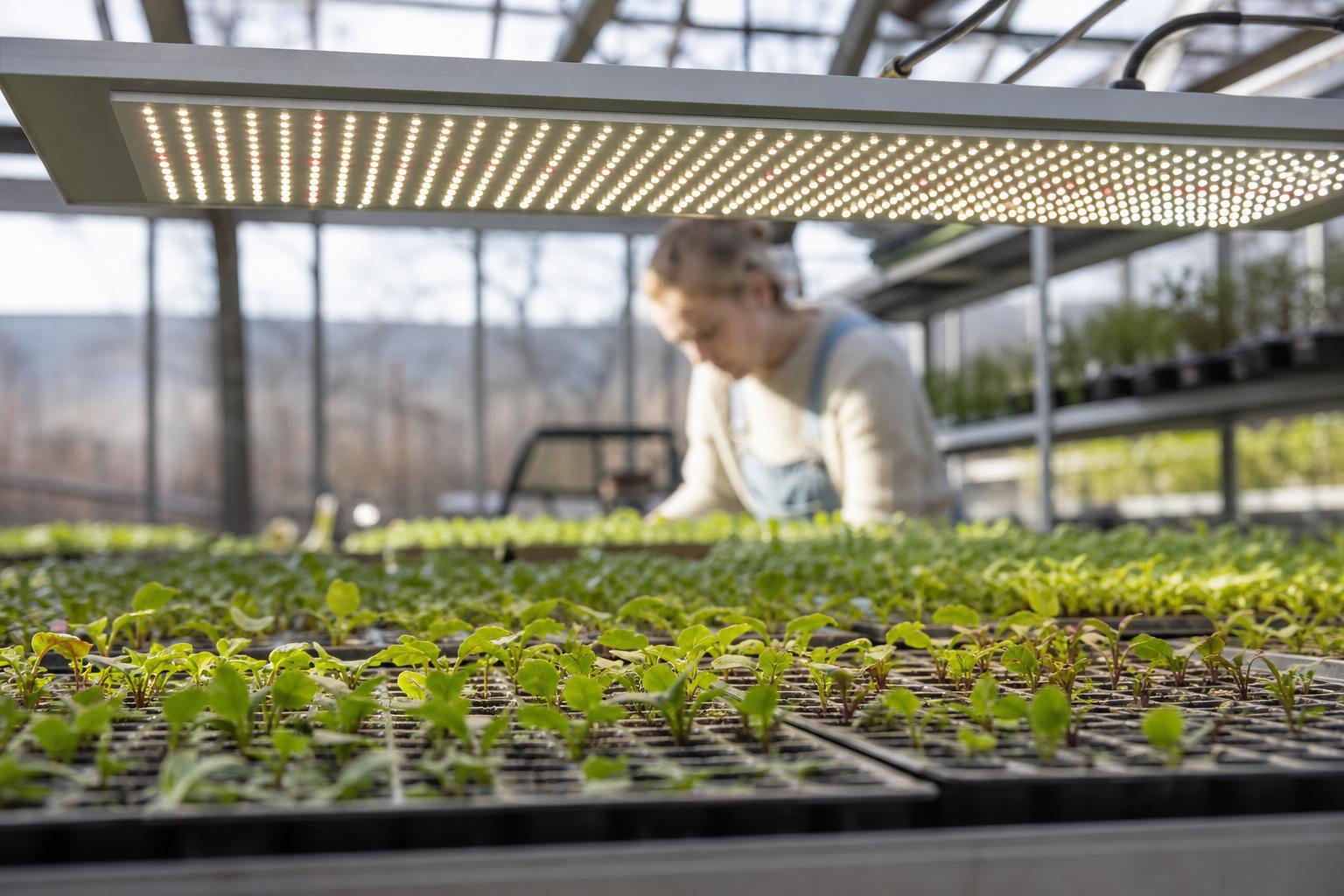
TL;DR
Seedling lighting in a greenhouse compensates for the dramatic drop in natural light that occurs during winter and early spring propagation. Greenhouse structures, glazing, and thermal curtains can reduce outdoor light levels by 40 to 70%, leaving seedlings with as little as 1 to 5 mol/m²/day, far below the 8 to 12 mol/m²/day they need. The fix involves understanding DLI targets, choosing the right PPFD intensity, setting a proper photoperiod, and selecting reliable LED fixtures mounted at the correct height.
Greenhouses exist to capture sunlight. That’s the whole point. But from December through March, the sun doesn’t cooperate, and greenhouse structures themselves steal a surprising amount of whatever light does arrive. The result is seedlings that stretch, weaken, and take far longer to reach transplant size than they should. This is the problem that seedling lighting in a greenhouse is designed to solve.
Whether you’re a hobbyist starting tomato plugs in February or a commercial propagator running thousands of flats through a winter production cycle, the principles are the same. The difference is scale.
Explore propagation LED fixtures designed for seedling and multi-tier applications.
What “Seedling Lighting Greenhouse” Means
Seedling lighting greenhouse refers to the practice of providing supplemental or sole-source artificial light to seedlings growing inside a greenhouse environment. The goal is to compensate for insufficient natural sunlight, particularly during winter and early spring when propagation demand is highest but light levels are lowest.
This isn’t about replacing the sun. As one experienced grower noted on a gardening forum, “natural light in a greenhouse is so much brighter than anything you can affordably get from artificial lighting.” Supplemental lighting fills the gap between what the sun delivers through your glazing and what your seedlings actually need to grow compact and healthy.
Why Seedlings Need Supplemental Light in Greenhouses
The vast majority of seed and cutting propagation happens between December and March. Outdoor DLI (Daily Light Integral) across the U.S. during these months ranges from roughly 5 to 30 mol/m²/day depending on latitude and cloud cover. That sounds manageable until you account for what happens inside the greenhouse.
Greenhouse structures, glazing materials, thermal curtains, hanging baskets, and overhead infrastructure reduce incoming light by 40 to 70%. A location receiving 15 mol/m²/day outdoors might deliver only 4.5 to 9 mol/m²/day at bench level. In heavily obstructed facilities, that number drops to 1 to 5 mol/m²/day.
For seedlings, this creates serious problems:
- Leggy, weak growth. Insufficient light is the single most common cause of leggy seedlings. Without adequate photons, stems elongate as the plant searches for a stronger light source. The result is thin, floppy transplants that perform poorly after planting.
- Longer crop cycles. Propagation time increases substantially when seedlings don’t receive enough daily light. For commercial operations, this means lower throughput and higher bench costs per plant.
- Poor root development. Light drives photosynthesis, which drives carbohydrate production, which supports root growth. Cut the light and the whole chain slows down.
The core issue is straightforward: greenhouse light levels during peak propagation season are often half or less of what seedlings require.
Key Metrics: DLI and PPFD
Two numbers govern every seedling lighting decision in a greenhouse. Understanding both, and how they relate to each other, is essential.
DLI (Daily Light Integral)
DLI measures the total number of photosynthetically active photons delivered to a plant over a full day, expressed in mol/m²/day. Think of it as the plant’s daily calorie intake of light.
For seedlings, research from multiple university programs points to consistent targets:
- Minimum for quality plug production: 8 to 12 mol/m²/day
- Below 6 mol/m²/day: Expect etiolated, stretchy growth as seedlings search for more light
- Experiments with celosia, impatiens, salvia, marigold, and viola showed that quality parameters at transplant improved as DLI increased up to 12 mol/m²/day
DLI is the metric that matters most because it captures total light delivery, not just a snapshot of intensity.
PPFD (Photosynthetic Photon Flux Density)
PPFD measures instantaneous light intensity in µmol/m²/s. It tells you how many photons are hitting the canopy right now.
For seedlings, the working range is:
- 100 to 200 µmol/m²/s for early establishment and delicate seedlings
- Up to 300 µmol/m²/s for more developed plugs approaching transplant
- Above 500 µmol/m²/s risks bleaching young cotyledons and curling true leaves
The critical mistake many growers make is tracking PPFD without DLI context. A fixture delivering 200 µmol/m²/s sounds adequate, but if it only runs for 8 hours, total DLI from that fixture is just 5.76 mol/m²/day, well below target.
The DLI-to-PPFD Conversion
The formula connecting these two metrics:
PPFD (µmol/m²/s) = (DLI × 1,000,000) ÷ (photoperiod hours × 3,600)
Worked example: You need a DLI of 12 mol/m²/day and plan to run lights for 16 hours.
PPFD = (12 × 1,000,000) ÷ (16 × 3,600) = 208 µmol/m²/s
That’s the average supplemental PPFD required, assuming zero contribution from sunlight. On sunny days, you’d need less. On overcast January days in the Pacific Northwest, you’d need all of it.
For a deeper walkthrough of this conversion, see the DLI formula and PPFD examples guide.
Progressive DLI Staging
Rather than treating seedling lighting as a single static number, the best approach stages DLI upward as plants develop:
| Growth Stage | Target DLI (mol/m²/day) |
|---|---|
| Germination | 5 to 10 |
| Cotyledon stage | 10 to 14 |
| True leaf development | 14 to 18 |
| Transplant readiness | 18 to 22 |
This progression matches the plant’s increasing photosynthetic capacity. Flooding germinating seeds with high light wastes energy and can damage emerging tissue. Starving established seedlings with germination-level light produces weak transplants.
Photoperiod: How Long to Light Seedlings
Photoperiod is the number of hours seedlings receive light each day. For greenhouse seedling lighting, the standard recommendation is 14 to 16 hours of total light (sun plus supplemental), followed by a dark period of 6 to 8 hours.
The dark period is not optional. During darkness, seedlings undergo respiration processes that convert stored sugars into structural compounds. Research has shown that under 24-hour lighting, tomatoes developed intumescence (abnormal cell growth) and lettuce produced significantly less wet and dry mass compared to plants given a dark rest period.
That said, there’s a useful strategy for managing energy costs: extending the supplemental photoperiod at reduced intensity can deliver the same DLI at lower peak wattage. Running fixtures at 150 µmol/m²/s for 18 hours delivers the same total photons as 225 µmol/m²/s for 12 hours, but with lower electrical demand during peak pricing windows.
The practical schedule for most greenhouse seedling operations:
- Lights on: Supplement from pre-dawn through the natural photoperiod, extending into early evening to reach 16 total hours
- Lights off: 6 to 8 hours overnight
- Avoid: Running lights continuously unless specific crop research supports it for your species
Light Spectrum for Greenhouse Seedlings
Spectrum, the color composition of light, matters for seedling morphology, but the degree to which it matters depends on whether your fixtures are the sole light source or supplementing sunlight.
Blue Light (400 to 500 nm)
Blue wavelengths promote compact, sturdy seedling growth. Michigan State University research found that plants grown under at least some blue light were more compact and generally of greater horticultural quality. When blue light drops below 5% of the total spectrum, plants grow tall and leggy with weak stems. An ideal blue fraction near 15% promotes short stature without wasting energy on wavelengths plants use less efficiently.
For more on how different light spectra affect plant growth, university research provides detailed crop-by-crop breakdowns.
Red Light (600 to 700 nm)
Red wavelengths drive photosynthesis efficiently and promote leaf expansion and biomass accumulation. However, excessive red light without sufficient blue causes the same elongation problems as insufficient total light.
The Greenhouse Nuance: Spectrum Dilution
Here’s something most seedling lighting guides miss. In greenhouse environments where plants receive ambient sunlight alongside supplemental lighting, the spectrum of the fixtures has significantly less impact on plant morphology. Sunlight already provides a complete, broad spectrum. The supplemental fixture is adding photons on top of that background.
This means the debate between “pink” red-blue fixtures and full-spectrum white fixtures matters far less in a greenhouse than in a sole-source growth chamber or indoor vertical farm. Full-spectrum white LED fixtures have become the practical standard for greenhouse seedling lighting because they deliver good plant results while creating a much more pleasant work environment. Practitioners on community forums consistently recommend full-spectrum white over pink or purple fixtures, citing both plant performance and the ability to actually see their plants in natural color.
Light Source Types for Greenhouse Seedling Production
LED Fixtures
LED grow lights now hold roughly 59.5% of the greenhouse lighting market, and that share continues to climb. The reasons are straightforward: lower energy consumption, dramatically less radiant heat at the canopy, longer fixture life, and the ability to tune spectrum.
Michigan State research found that seedling growth is generally similar under supplemental greenhouse lighting from LEDs compared to legacy high-pressure sodium lamps. The advantage of LED is not that plants grow differently. It’s that you spend less on electricity and HVAC while getting the same or better results.
For many greenhouse applications, a 1000W HPS fixture can be replaced with approximately 700W of LED lighting while delivering similar PPFD levels at the canopy, reducing lighting energy consumption by roughly 25%. For growers considering the switch, understanding the common mistakes when comparing LEDs to HPS can prevent costly errors.
Supplemental lighting typically accounts for 10 to 30% of a greenhouse’s total operating expenses. That makes fixture efficiency and reliability direct profit levers.
Check available rebates for greenhouse LED lighting upgrades.
High-Pressure Sodium (HPS)
HPS lamps remain in some older greenhouses and still produce adequate light for seedlings. Their drawbacks are higher energy use per photon delivered, significant radiant heat output that can stress young seedlings if mounted too close, and shorter lamp life requiring periodic bulb replacement. For operations considering transitioning to LED grow lighting, the payback period has shortened considerably as LED prices have dropped and energy costs have risen.
Fluorescent (T5 and T8)
Fluorescent tubes served hobbyist and small-scale propagators well for decades. They’re affordable upfront and produce low heat. But their efficiency per watt is poor compared to modern LEDs, they dim with age, and replacement tube costs add up. For new installations, fluorescent is increasingly hard to justify.
Fixture Placement and Uniformity
Getting seedling lighting right in a greenhouse isn’t just about choosing the right fixture. It’s about where you put it.
Mounting Height
For seedlings and delicate young plants, fixtures should be mounted 60 to 90 cm (roughly 24 to 36 inches) above the canopy, delivering 100 to 200 µmol/m²/s PPFD. This height provides even coverage without hotspots that can burn cotyledons or cause uneven growth.
As seedlings mature and tolerate higher intensity, fixtures can be brought closer (30 to 60 cm) to deliver 200 to 300+ µmol/m²/s. The greenhouse grow light height guide covers mounting calculations in more detail.
Uniformity Across Propagation Benches
Uniformity is the silent killer of plug quality. If the center of a bench receives 250 µmol/m²/s while edges get 120, you’ll produce two populations of seedlings from the same tray, some compact and strong, others stretched and weak.
On multi-tier benches where fixtures sit close to the canopy, mounting distance and uniformity need to be verified at the design stage rather than assumed. PPFD mapping with a quantum sensor before committing to a layout prevents expensive corrections later.
Common Mistakes in Greenhouse Seedling Lighting
1. Not Providing Enough Light
This is the number one problem, full stop. If your winter DLI is below 6 mol/m²/day at bench level, your seedlings will stretch no matter what else you do right. Measure before you guess.
2. The Heat Mat Plus Low Light Trap
Practitioners across multiple gardening forums describe the same pattern: germination heat mats left running after seedlings emerge, combined with inadequate lighting. Temperature directly accelerates cell division and expansion. Warm conditions drive rapid growth, but without enough light to support that growth, it becomes weak and elongated. Remove heat mats once seedlings emerge, or at least ensure your supplemental lighting matches the growth rate your temperature is driving.
3. Buying Cheap Fixtures That Fail in Humidity
Greenhouse environments are humid. One grower on the Permies forum reported that inexpensive LED strip lights from Amazon “begin to dim after a while,” with transformer failures within a year. Commercial greenhouse fixtures need appropriate environmental protection ratings and quality drivers to survive the moisture, temperature swings, and chemical exposure typical of propagation environments. Understanding LED reliability in greenhouse settings matters more than the upfront price tag.
4. Running Lights 24 Hours
Some growers assume that more light hours always means better growth. Research shows otherwise. Without a dark period, specific crops develop physiological disorders, reduced biomass, and weaker structure. Stick to 14 to 18 hours and give seedlings their rest.
5. Measuring PPFD Without Calculating DLI
A handheld PAR meter reads 150 µmol/m²/s and you assume everything is fine. But 150 µmol/m²/s for 10 hours is only 5.4 mol/m²/day, barely enough for the least demanding seedlings. Always calculate DLI from your PPFD readings and photoperiod.
6. Ignoring Fixture Height After Initial Setup
Seedlings grow. A fixture mounted 60 cm above newly sown trays might be 45 cm above seedlings three weeks later, delivering substantially more intensity than intended. Check and adjust as canopy height changes, particularly for sensitive species.
Putting It All Together: A Seedling Lighting Checklist
- Measure your baseline DLI at bench level during your propagation season. A quantum sensor and data logger running for a week of typical weather gives you real numbers.
- Calculate the deficit between your measured DLI and your target (8 to 12 mol/m²/day for most seedlings).
- Choose your photoperiod (16 hours is a good starting point).
- Use the conversion formula to determine what supplemental PPFD your fixtures need to deliver.
- Select fixtures rated for greenhouse conditions with appropriate efficiency, spectrum, and environmental protection.
- Map PPFD uniformity across your bench layout before finalizing fixture spacing and height.
- Stage DLI upward as seedlings develop from germination through transplant readiness.
For commercial operations evaluating a seedling lighting greenhouse project, a free consultation with a lighting expert can help size the system to your specific facility, crop mix, and climate.
Frequently Asked Questions
How much light do seedlings need in a greenhouse?
Most seedlings need a minimum DLI of 8 to 12 mol/m²/day for quality plug production. This translates to a PPFD of roughly 100 to 300 µmol/m²/s depending on photoperiod length. In winter, greenhouses often deliver only 1 to 5 mol/m²/day at bench level after structural light losses, making supplemental lighting necessary.
What is the best light spectrum for greenhouse seedlings?
Full-spectrum white LED light with approximately 15% blue content produces compact, sturdy seedlings without the visual drawbacks of red-blue “pink” fixtures. In greenhouses, the ambient sunlight already provides a broad background spectrum, so the supplemental fixture’s specific spectrum has less impact on plant morphology than it would in a sole-source indoor environment.
How many hours of light do seedlings need per day?
Most seedlings perform best with 14 to 16 hours of total light per day, followed by 6 to 8 hours of darkness. The dark period supports respiration and stem development. Avoid 24-hour lighting unless crop-specific research supports it for your species.
Should I use LED or HPS for greenhouse seedling lighting?
LED fixtures now dominate the greenhouse market for good reason: they deliver similar seedling growth results to HPS at roughly 25% lower energy consumption, with less radiant heat and longer fixture life. The initial cost is higher, but operating savings and available utility rebates typically bring payback within two to three years.
Why are my greenhouse seedlings leggy even with grow lights?
The most likely cause is insufficient total DLI, not just low PPFD. Check your actual daily light delivery using the DLI formula. Also look for the heat mat trap: if germination heat mats are still running, warm temperatures accelerate elongation faster than your lights can support. Finally, verify fixture uniformity, because edge seedlings receiving half the light of center seedlings will stretch regardless of average readings.
How high should grow lights be above seedlings in a greenhouse?
Mount fixtures 60 to 90 cm (24 to 36 inches) above the seedling canopy for early-stage propagation, delivering 100 to 200 µmol/m²/s. As plants develop and can tolerate more intensity, fixtures can be lowered to 30 to 60 cm. Always verify PPFD at canopy level after adjusting height.
How do I calculate DLI from PPFD?
Use the formula: DLI = (PPFD × photoperiod hours × 3,600) ÷ 1,000,000. For example, 200 µmol/m²/s for 16 hours equals (200 × 16 × 3,600) ÷ 1,000,000 = 11.52 mol/m²/day. This confirms you’re hitting the 8 to 12 mol/m²/day target range for seedlings.
Does greenhouse seedling lighting really pay for itself?
For commercial propagators, yes. Supplemental lighting shortens crop cycles, improves plug quality, reduces shrinkage, and enables earlier market timing. Lighting typically represents 10 to 30% of greenhouse operating expenses, but the return in faster turns and better transplant quality usually exceeds the cost within the first few production seasons.