Greenhouse Basil Lighting: 2026 DLI, PPFD & Spectrum Guide
Greenhouse Basil Lighting guide: hit 15–20 DLI and 200–300 PPFD with 16–18 h days. Optimize spectrum for flavor and costs. Get pro sizing tips.
TL;DR
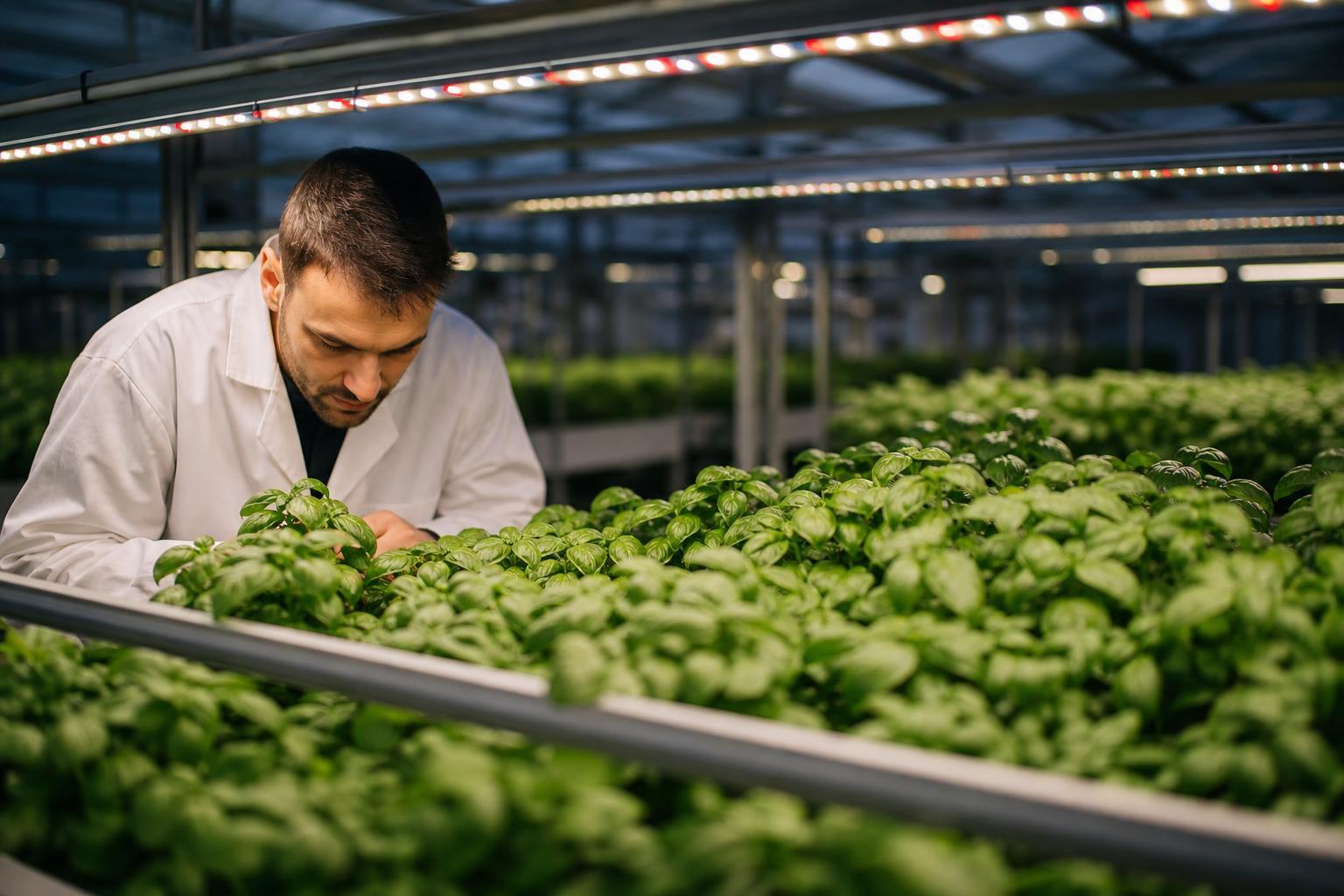
Greenhouse basil lighting refers to supplemental artificial light used to maintain basil yield, quality, and year-round production in greenhouse environments. Basil performs best at 200–300 µmol/m²/s PPFD, 15–20 mol/m²/d DLI, and a 16–18 hour photoperiod. Spectrum matters more than most growers realize: it affects not just biomass but also aroma and essential oil profiles. Overlighting above 600 µmol/m²/s causes stress and flavor degradation.
Parameter | Minimum | Optimal | Maximum |
|---|---|---|---|
DLI (mol/m²/d) | 12 | 15–20 | ~26–29 |
PPFD (µmol/m²/s) | 100 | 200–300 | 600 |
Photoperiod (hours) | 12 | 16–18 | 20–24* |
Spectrum | Red + Blue | Full-spectrum white with R+B emphasis | Add far-red for yield boost |
24 hours is possible but may accelerate flowering. Most commercial operations stay at 16–18 hours.
If you’re sizing a supplemental lighting system for basil, a free consultation with a lighting specialist can help translate these numbers into a practical fixture layout.
How Much Light Does Basil Need in a Greenhouse?
Greenhouse basil generally performs well at about 15–20 mol/m²/d DLI, with roughly 200–300 µmol/m²/s PPFD at the canopy and a total photoperiod of about 16–18 hours per day. These are practical production targets rather than universal limits. The amount of supplemental lighting you need depends on how much sunlight already reaches the crop. During bright summer periods, natural sunlight may provide most or all of the required DLI; during low-light winter periods, supplemental LED lighting can fill the deficit.
For most commercial greenhouse basil production, prioritize total daily DLI first, canopy-level PPFD second, and spectrum third. Use a quantum sensor to measure PPFD at crop height and control supplemental fixtures based on the natural light entering the greenhouse.
What Greenhouse Basil Lighting Actually Means
Greenhouse basil lighting is the practice of providing supplemental artificial light to basil (Ocimum basilicum) grown under glass or poly to maintain or increase yield, quality, and production consistency, particularly during low-light winter months. It is not about replacing sunlight entirely. It is about filling the gap between what the sun delivers through your glazing and what basil actually needs to grow well.
Basil is a high-light crop. Its optimal daily light integral sits above 20 mol/m²/d, which puts it in the same general category as tomatoes and peppers rather than shade-tolerant herbs. In northern latitudes during winter, natural DLI inside a greenhouse can drop to 5 mol/m²/d or lower. Without supplemental lighting, growers see slower growth, leggy stems, thin leaves, and poor flavor. Research from a tropical greenhouse study found that basil grown under LED supplementation for just three hours before sunrise and three hours after sunset produced shoot fresh weight 2.68 times higher than plants receiving only natural sunlight. That is a dramatic return from six hours of fill light.
For a broader look at how supplemental lighting works across crops, see our guide to supplemental greenhouse lighting.
Key Metrics: DLI, PPFD, and Photoperiod
Three numbers govern every greenhouse basil lighting decision. Understanding what each one means (and how they interact) is the difference between a productive system and an expensive electricity bill.
DLI (Daily Light Integral)
DLI measures the total number of photosynthetically active photons delivered to a crop over a 24-hour period, expressed in mol/m²/d. Think of it as a rain gauge for light: PPFD tells you how hard it is raining at any given moment, while DLI tells you how much rain fell in the whole day.
Research has recommended DLIs for basil growth ranging from 12.9 to 28.8 mol/m²/d. For commercial greenhouse production, the practical sweet spot is 15–20 mol/m²/d. One study found that reducing DLI from 24.9 to 13.5 mol/m²/d did not cause significant changes in fresh and dry mass, which suggests that pushing above 20 mol/m²/d yields diminishing returns. Below 12 mol/m²/d, quality drops noticeably: thinner leaves, less aroma, slower turnover.
For growers focused on indoor vertical farming where energy cost is the primary constraint, a DLI of 12.9 mol/m²/d has been suggested as the minimum to maintain high yield and nutritional quality while minimizing electricity spend. Greenhouse growers, who get free photons from the sun, should aim higher.
To calculate DLI from your supplemental PPFD and hours of operation:
DLI = PPFD × photoperiod (seconds) ÷ 1,000,000
For example, 250 µmol/m²/s for 16 hours: 250 × 57,600 ÷ 1,000,000 = 14.4 mol/m²/d from supplemental light alone. Add your natural DLI contribution and you have the total. Our DLI formula and conversion guide walks through more detailed examples.
PPFD (Photosynthetic Photon Flux Density)
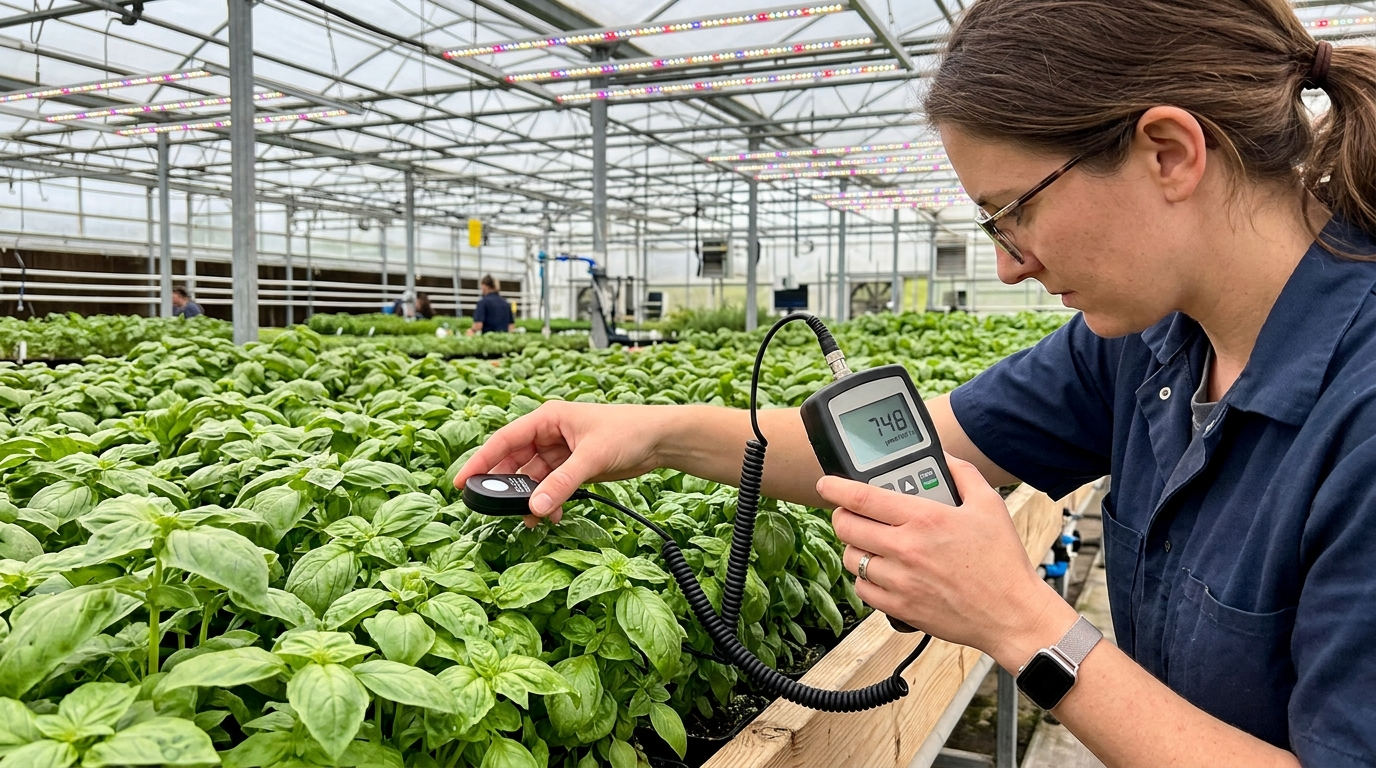
PPFD measures instantaneous light intensity at the canopy surface, in µmol/m²/s. This is the number you measure with a quantum sensor at crop height, not the number on a fixture spec sheet.
Research found a progressive increase in basil biomass up to a PPFD of 250 µmol/m²/s, with no further yield increase at 300 µmol/m²/s. Water use efficiency was also maximized at 250 µmol/m²/s and above. Additional studies confirmed that basil growth and quality improved up to an optimal range of 250–290 µmol/m²/s.
The upper limit matters just as much as the target. PPFD above 600 µmol/m²/s can be detrimental to basil, causing leaf damage, reduced growth, and negative effects on taste. More is not better.
For commercial greenhouse supplemental lighting, the fixtures do not need to deliver the entire PPFD target. You are adding to whatever the sun provides. In summer, that supplement might be zero. In winter, it might be 100–200 µmol/m²/s to bring total canopy-level PPFD into the productive range. Our PPFD measurement guide explains how to map light levels at crop height and identify deficit zones.
Photoperiod
Photoperiod is the total hours of light per day, combining natural daylight and supplemental hours. For basil, 12–16 hours is the general range, but commercial growers targeting maximum production should plan for 16–18 hours.
Here is where basil lighting gets interesting from an economic standpoint. Research has shown that, at a constant DLI target, basil photosynthesizes better at a lower PPFD spread over a longer photoperiod. This means you can run lower-wattage fixtures for more hours and hit the same DLI at lower peak electrical demand. The energy savings are real: lower peak draw reduces demand charges, which are often the most expensive component of a commercial electric bill.
One study found that flower initiation and harvesting occur earliest under an 18-hour photoperiod, while the highest total yield was reported under 24-hour illumination. Most commercial operations avoid continuous lighting because it accelerates flowering (which ends the vegetative harvest window), but 16–18 hours is standard practice. For more on setting photoperiod schedules, see our greenhouse photoperiod lighting guide.
Total Light vs. Supplemental Light: The Number That Matters
When basil is grown in a greenhouse, the crop receives light from two sources:
Natural sunlight entering through the greenhouse covering
Supplemental artificial light from LEDs or other fixtures
The basil plant responds to the total light reaching the canopy, not to the output of the LED fixture by itself.
For example, if the crop receives 150 µmol/m²/s of natural PPFD and your target is 250 µmol/m²/s, the supplemental system only needs to provide approximately another 100 µmol/m²/s under those conditions.
Natural Canopy PPFD | Supplemental PPFD | Approx. Total PPFD |
|---|---|---|
50 | 200 | 250 |
100 | 150 | 250 |
150 | 100 | 250 |
200 | 50 | 250 |
250 | 0 | 250 |
This is why greenhouse lighting should be controlled from measured canopy conditions, rather than running fixtures at a fixed output all year.
The same principle applies to DLI. Calculate the natural-light contribution first, then use supplemental lighting to close the remaining DLI gap.
Spectrum: What Kind of Light Matters for Basil
Not all photons are equal. The spectral composition of your greenhouse basil lighting affects photosynthesis rates, plant morphology, and, critically for basil, aroma and flavor. This last point is underappreciated in most lighting guides, and it is one of the biggest levers basil growers have.
White Broad-Spectrum
A 2026 study published in Horticulturae found that white LED supplementation produced the highest net photosynthesis throughout the photoperiod, increasing carbon assimilation by up to 90% during active supplementation compared with non-supplemented controls. White light also improved stomatal and photosynthetic coordination, meaning the plant was better at managing gas exchange under supplemental conditions.
Full-spectrum white light has a practical advantage too: it creates a comfortable working environment. Greenhouses staffed with harvest crews for hours at a time benefit from light that does not cast everything in an unnatural pink or purple hue.
Blue Light
Chlorophyll fluorescence data indicate that conversion of light into chemical energy is roughly the same under green, red, and white light, but 35% higher under blue light. Blue wavelengths also promote compact, bushy growth, reducing the legginess that plagues under-lit basil. For greenhouse operations, this means a spectrum with meaningful blue content helps produce a denser, more marketable plant.
Red and Far-Red
Red light drives photosynthesis efficiently and promotes biomass accumulation. Far-red light, when combined with red, triggers shade-avoidance responses that increase internode length and canopy spread. One study found that a combination of blue, red, and far-red LED illumination led to a one-fold increase in basil yield compared with white LED illumination alone.
The Aroma Connection
This is where greenhouse basil lighting gets commercially interesting beyond simple weight-per-square-foot calculations. Research suggests that spectral quality directly influences aroma volatiles and secondary metabolic resource allocation in basil. Green light, which penetrates deeper into the plant canopy, may promote the synthesis of volatile compounds in lower leaves. Far-red light, when combined with red, has been associated with enhanced production of volatile oils like methyl chavicol and linalool. Narrowband red and blue wavelengths are known to improve sensory quality in certain crops, and manipulating spectral quality has been shown to enhance production of secondary metabolites for culinary, medicinal, and commercial purposes.
Put simply: light spectrum does not just affect how big your basil gets. It affects how it smells and tastes. For operations selling fresh-cut basil to restaurants or retail where aroma is a quality differentiator, this is not a minor detail.
For a deeper dive into how different wavelengths affect plant physiology, our summary of light spectra impacts on plant growth covers the underlying science across multiple crop types.
Seasonal Supplemental Lighting Strategy
The amount of supplemental light basil needs changes dramatically across the year. A January day in Michigan delivers a fraction of the photons that a July day does, and your greenhouse glazing cuts that further (typical transmittance is 50–70% depending on material, age, and cleanliness).
Sizing Your Supplement
The calculation is straightforward:
Determine your target DLI (15–20 mol/m²/d for basil).
Estimate natural DLI inside the greenhouse for each month (historical weather data × glazing transmittance).
The gap is your supplemental DLI target.
Convert that to PPFD and hours using the DLI formula.
In winter, commercial growers commonly supplement at 100–200 µmol/m²/s for 12–24 hours per day. A winter basil trial found that plants grown under higher supplemental LED intensity (200 µmol/m²/s) grew faster than those under 130 µmol/m²/s, though both supported healthy production during the darkest months.
The Photoperiod Cost Trick
Because basil responds well to lower intensity spread over longer hours, you can size fixtures for 150 µmol/m²/s instead of 250 µmol/m²/s and run them for 18 hours instead of 12. The DLI ends up in the same range, but your peak electrical demand is significantly lower. This is especially valuable in utility markets with high demand charges.
Lighting already accounts for 10–30% of total greenhouse operating costs, and up to 30% of production costs in leafy crops. Every strategy that reduces peak draw without cutting DLI directly improves margins.
DLI Carry-Over
An emerging finding with real economic potential: researchers have shown that excess light from a sunny day can “carry over” to reduce supplemental needs the following day. The DLI requirement can be reduced by approximately 5.25 mol/m²/d on the day after a bright day. Across five US locations, this approach yielded estimated annual energy savings of 75–190 MWh per hectare in greenhouse lettuce production. The principle applies to basil as well, though growers need automated light control systems to capture these savings in practice.
Growers evaluating the total cost picture should also explore available lighting rebates and incentives, which can significantly offset the upfront capital investment.
Common Greenhouse Basil Lighting Mistakes
Overlighting
More light is not always better. At The Chef’s Garden, basil and microgreens crops germinated well under supplemental lights, but then growth stalled. It was not until the lights were shut off that the plants recovered and took off. This real-world case, reported by CEA World, illustrates a blind spot many growers share: overlighting can be just as harmful as underlighting.
At PPFD levels above 600 µmol/m²/s, basil experiences leaf damage, growth reduction, and flavor degradation. If your summer natural light plus supplemental light exceeds this threshold, you need to either dim or shut off fixtures during peak solar hours.
Underlighting Seedlings
Basil seedlings should receive strong light during their first eight weeks. Research on basil ‘Nufar’ grown under sole-source intensities of 100, 200, 400, or 600 µmol/m²/s for two weeks showed that higher light inputs during the seedling stage increased growth and potentially increased yields at harvest. This early-stage investment pays outsized dividends. Skimping on light during propagation permanently limits adult plant vigor.
Our seedling lighting guide covers propagation-stage light targets in more detail.
Ignoring Spectrum for Quality
Many growers optimize purely for grams per square foot and never consider what their light spectrum does to basil’s aromatic profile. If you are growing commodity basil by weight, this might be acceptable. If you are selling to chefs, farmers’ markets, or retail customers who judge basil by smell and taste, spectrum is a production variable you cannot afford to ignore.
Using Wattage Instead of PPFD
Practitioners on Houzz forums describe a common scenario: a grower lights a 15×20-foot greenhouse section with T5 fluorescents, considers upgrading to metal halide, but frames the entire decision around fixture wattage and electricity cost. Wattage tells you how much power a fixture consumes. It tells you nothing about how many photons reach the canopy. Always measure PPFD at crop height with a quantum sensor. Two fixtures with identical wattage can deliver wildly different PPFD depending on their efficacy, optics, and mounting height. For guidance on comparing LEDs to HPS without falling into the wattage trap, that linked article is worth reading.
Greenhouse Basil Lighting Troubleshooting
Basil Is Leggy and Stretching
Possible causes include insufficient PPFD, insufficient DLI, excessive plant density, or an inappropriate spectrum. Measure PPFD at canopy height before increasing fixture wattage.
Basil Leaves Are Bleaching or Showing Damage
Check whether canopy PPFD is excessively high, especially during periods when natural sunlight and supplemental LEDs overlap. Also check leaf temperature, irrigation, humidity, and other environmental factors before blaming light alone.
Basil Is Growing Slowly in Winter
Measure the greenhouse's actual DLI. Low winter DLI is a common reason for slow growth. If the DLI is below your production target, calculate the supplemental-light deficit rather than simply increasing fixture wattage.
Basil Has Good Biomass but Poor Aroma
Evaluate spectrum, cultivar, harvest timing, temperature, nutrition, and other environmental factors. Light spectrum can influence volatile compounds, but aroma is not controlled by lighting alone.
Some Benches Grow Better Than Others
Map PPFD across the entire canopy. Uneven fixture spacing, greenhouse structure, shadows, and changing solar angles can create significant light differences within the same greenhouse.
LED vs. HPS for Greenhouse Basil
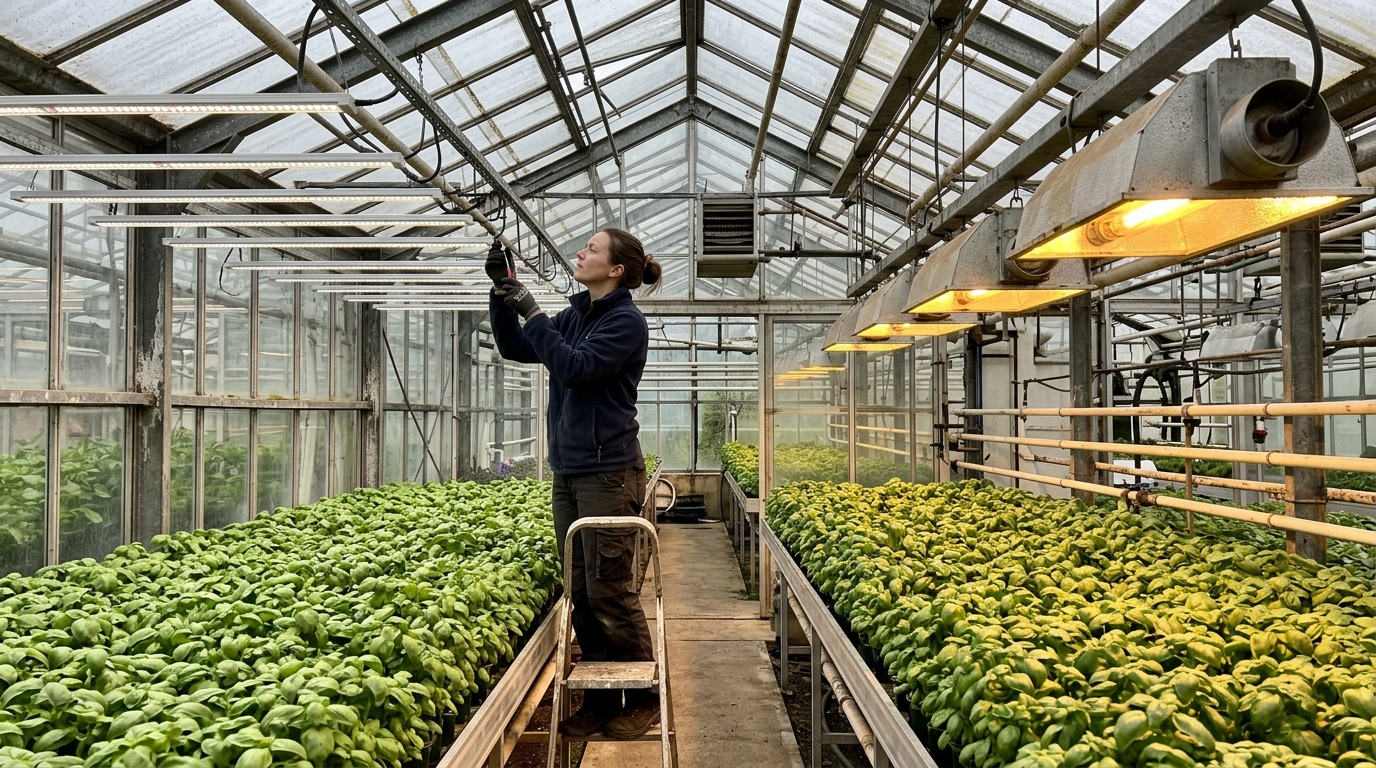
The transition from HPS to LED in greenhouse basil production is well underway, and the economics increasingly favor LEDs. The core advantages:
LEDs offer spectral control (tunable blue, red, far-red ratios), lower heat load at the canopy, higher electrical efficacy (commonly 40–60% energy savings over HPS), longer operational life, and eligibility for utility rebates and incentives. Research comparing LEDs with optimized blue/red ratios to HPS found that LEDs promoted both yield and nutritional value in basil. The lower radiant heat also means less HVAC load, which compounds the energy savings.
HPS fixtures are still in use, particularly in older facilities. They deliver a broad spectrum and significant radiant heat, which can be useful in cold climates where the heat load displaces some heating costs. But the efficiency gap has widened to the point where new HPS installs are rare in commercial herb production.
Practitioners on the Permies forum report growing basil for winter markets under “very strong grow lights,” noting that passive winter window light is insufficient. For growers still running legacy HPS or fluorescent systems, the path to LED is well documented. Our guide on transitioning to LED grow lighting covers the practical steps.
Fixture Selection for Greenhouse Basil
Choosing the right fixture depends on your production system. Bench-grown basil in a single-tier greenhouse needs top-light fixtures mounted above the crop. Multi-tier production (common in vertical or hybrid greenhouse setups) calls for compact bar fixtures that fit between shelves.
Key selection criteria:
Efficacy: Prioritize fixtures rated at 2.5 µmol/J or higher. This measures how many photons you get per watt of electricity consumed.
Spectrum: Full-spectrum white with meaningful red and blue content is practical for basil. It supports both photosynthesis and a comfortable working environment.
Certifications: UL and DLC listing matter for safety, code compliance, and rebate eligibility. Many utility rebate programs require DLC-listed fixtures.
System compatibility: For larger deployments, consider whether the fixture works with centralized power architecture, which can reduce installation costs and simplify maintenance.
For greenhouse-scale basil operations using top lighting, the Altus 1K is designed for supplemental greenhouse applications. For multi-tier herb production, the Strata 30W bar was built for leafy greens, herbs, and vegetables at close mounting distances.
Frequently Asked Questions
How much light does basil need in a greenhouse?
Basil needs 15–20 mol/m²/d DLI for optimal commercial production. In terms of instantaneous intensity, aim for 200–300 µmol/m²/s PPFD at canopy height. During winter months when natural light is insufficient, supplemental lighting fills the gap between what the sun provides and what basil requires.
What is the best light spectrum for greenhouse basil?
Full-spectrum white LED light with emphasis on red and blue wavelengths delivers the best combination of photosynthesis efficiency, plant morphology, and aroma quality. Adding far-red can boost yield further. Research shows that spectrum affects not just basil size but its essential oil profile, including compounds like linalool that define basil’s characteristic scent.
How many hours of light does basil need per day?
Commercial greenhouse basil production typically targets 16–18 hours of total light (natural plus supplemental). Basil can tolerate up to 24 hours of continuous light, but this accelerates flowering and shortens the vegetative harvest window. Running a longer photoperiod at lower PPFD is an effective cost-saving strategy because it achieves the same DLI with lower peak electrical demand.
Can you give basil too much light?
Yes. PPFD above 600 µmol/m²/s causes leaf damage, growth stalling, and flavor degradation. Real-world cases have documented basil growth halting under excessive supplemental light, recovering only after the lights were shut off. Always measure total PPFD (natural plus supplemental) at canopy height during peak hours.
Is supplemental lighting worth the cost for greenhouse basil?
For year-round commercial production, almost certainly. One study showed a 2.68× increase in fresh weight from just six hours of daily LED supplementation. Winter production without supplemental light produces leggy, low-quality plants with slow turnover. The economics improve further with utility rebates, the photoperiod cost optimization strategy (lower PPFD, longer hours), and the DLI carry-over approach.
Should basil seedlings get extra light?
Yes, and this is one of the most under-appreciated aspects of greenhouse basil lighting. Research shows that high light inputs during the first two to eight weeks have an outsized positive effect on adult plant vigor and harvest yields. Skimping on seedling-stage light is a false economy.
What is the difference between DLI and PPFD?
PPFD measures instantaneous light intensity (how many photons hit the canopy right now), while DLI measures the total light delivered over a full day. PPFD is like the flow rate from a faucet; DLI is the total water collected in a bucket over 24 hours. Both matter for greenhouse basil lighting, but DLI is the more useful target for production planning because it accounts for both intensity and duration.
How do I calculate how much supplemental light my basil needs?
Start with your target DLI (15–20 mol/m²/d). Subtract the natural DLI your greenhouse receives for each month (based on historical solar data and your glazing transmittance). The remaining DLI gap is what your fixtures need to deliver. Use the formula DLI = PPFD × hours × 3600 ÷ 1,000,000 to convert between intensity, duration, and total daily light. Our greenhouse lighting calculator guide can help you run these numbers for your specific location.
Ready to size a supplemental lighting system for your basil operation? Schedule a free consultation with a lighting specialist to get a layout matched to your greenhouse, climate zone, and production goals.