Under-Canopy Lighting Safety: 2026 Guide for Growers
Under-canopy lighting safety guide covering IP ratings, UL 8800, GFCI, fire prevention, and worker protection. Use this checklist.
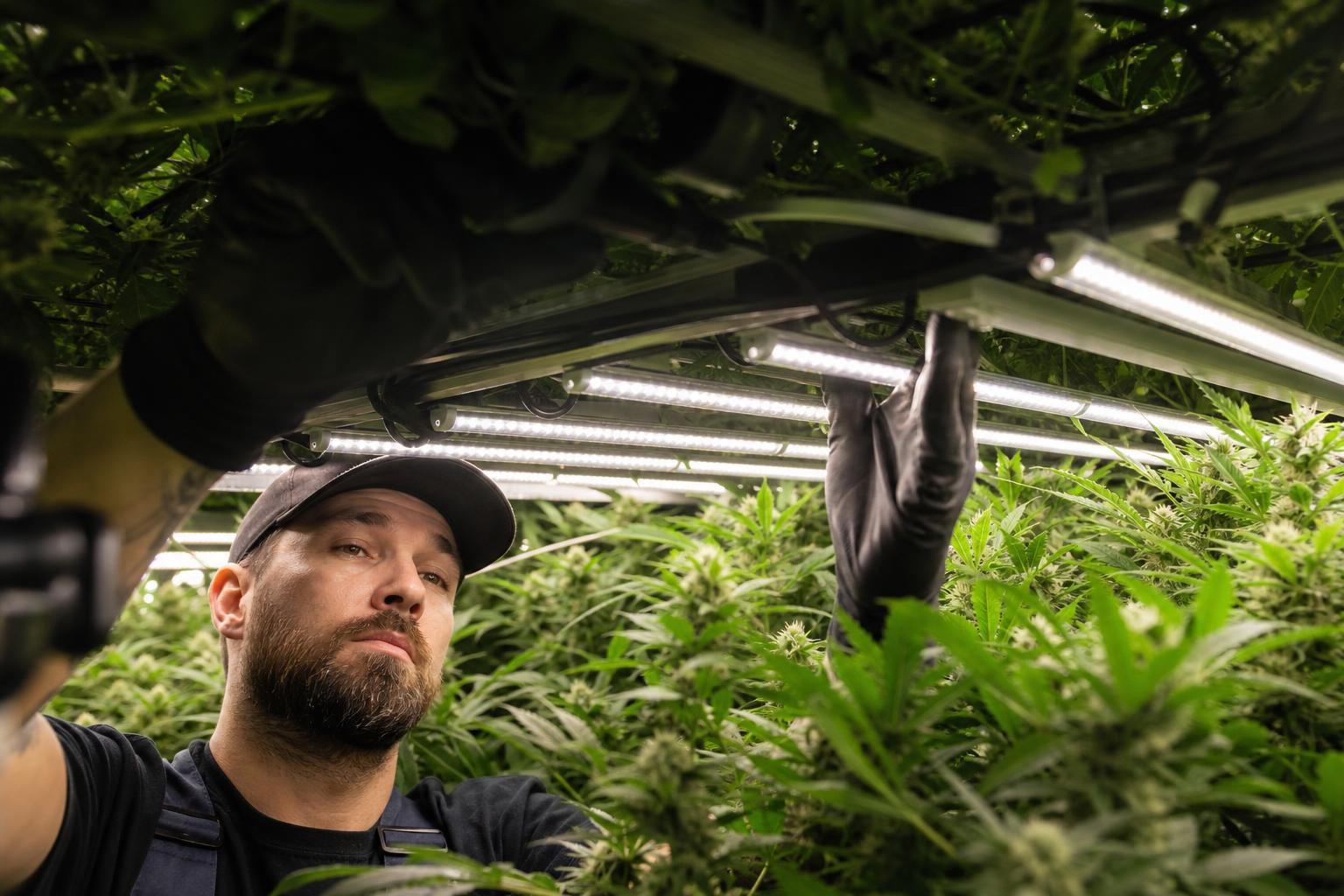
TL;DR: Under-canopy lighting safety covers the full set of precautions needed when operating LED bars in the humid, confined zone beneath a plant canopy. It spans IP ratings (IP65 or IP66 minimum), electrical certifications (UL 8800), NEC code compliance (especially the GFCI requirement in Section 410.184), fire prevention, and worker protection from photobiological hazards. No single standard covers it all, which is why growers need to understand each safety dimension before installing fixtures below the canopy.
What Under-Canopy Lighting Safety Actually Means
Under-canopy lighting safety is not a single regulation or certification. It is the combined set of precautions, from fixture design to installation practice to worker protection, that commercial growers must address when placing LED bars in the space beneath the plant canopy. This zone presents conditions that are fundamentally different from where top lights operate: higher humidity, direct exposure to irrigation spray, constant physical contact with workers, and proximity to plant tissue.
The concept spans six categories: ingress protection (IP ratings), electrical safety certifications (UL 8800, ETL, CSA), performance certifications (DLC Hort QPL), code compliance (NEC, OSHA, local fire codes), worker safety (photobiological risk and eye protection), and fire prevention (wiring, circuit loading, heat management).
For a broader look at why growers add light below the canopy in the first place, see the under-canopy lighting overview.
Why Under-Canopy Is a Distinct Safety Category
Not all lighting positions carry the same risk profile. Top lights hang well above the work zone, away from irrigation, and in relatively stable air. Under-canopy fixtures face a harsher reality.
The Historical Problem
Before LEDs, placing lights beneath the canopy was genuinely dangerous. Traditional fluorescent and HID bulbs reach ignition-point temperatures, making any contact with plant material a serious fire risk. The radiant heat alone would damage tissue at close range. LED technology, with its dramatically lower thermal output, is what made safe under-canopy placement viable in the first place. That history matters because it explains why under-canopy lighting safety standards focus so heavily on the conditions LEDs do face (moisture, physical contact) rather than the one they largely solved (extreme heat).
For more on how this shift played out in practice, read the evidence behind under-canopy lighting.
The Harsher Operating Environment
Three factors make the under-canopy zone uniquely demanding:
-
Proximity to water. Fixtures sit near substrate level, directly in the spray zone where irrigation, foliar treatments, and hose-downs are routine. A fixture that works fine overhead may fail within weeks at plant level.
-
Worker contact. Under-canopy bars are at arm height or below. Workers brush against them constantly during pruning, defoliation, trellising, and harvest. This means both physical durability and photobiological safety matter more than they do for overhead fixtures.
-
Microclimate effects. The space beneath a dense canopy tends to trap humidity and restrict airflow. Without proper ventilation, this microclimate accelerates moisture damage to improperly rated fixtures and creates conditions that favor mold.
These factors are why under-canopy lighting safety requires its own analysis, separate from general grow-room lighting safety.
IP Ratings: Moisture and Dust Protection
The IP (Ingress Protection) rating is arguably the single most critical safety specification for any under-canopy fixture. It tells you how well the enclosure protects electrical components from dust and water intrusion.
How the Two-Digit System Works
The first digit (0 through 6) rates protection against solid objects, including dust. The second digit (0 through 9) rates protection against water. A rating of IP65 means the fixture is completely dust-tight (6) and protected against water jets from any direction (5). IP66 means dust-tight and protected against powerful water jets. IP67 allows temporary immersion under test conditions.
IP65 vs. IP66 for Under-Canopy Use
Industry guidance consistently recommends IP65 as the absolute minimum for under-canopy applications, with IP66 as the more conservative choice. The difference matters. IP65 handles water jets; IP66 handles powerful water jets. In a grow room where foliar sprays and pressure washing occur, IP66 provides a meaningful extra margin of protection.
Practitioners on retailer and cultivation forums report that connector failures, not fixture body failures, are the most common point of moisture intrusion. Waterproof connectors are critical components that many growers overlook when evaluating under-canopy lighting safety. The fixture body can be IP66, but if the power connection is unrated, water finds a way in.
IP Rating vs. UL Wet-Location Listing
Here is a nuance that trips people up: an IP66 fixture is built to resist powerful water jets, so it will generally exceed basic wet-location expectations. But a UL wet-location listing does not guarantee IP66 performance because the tests differ. One simulates falling water; the other simulates high-pressure jets. Smart growers look for both a UL wet-location listing and a high IP rating. They test different things and together provide stronger assurance.
If you are evaluating under-canopy bars for a commercial operation, the Boost XE product page shows how these specs come together in a purpose-built 120W under-canopy fixture.
Electrical Safety Certifications
UL 8800: The Horticultural Lighting Standard
UL 8800, first published in August 2019 and most recently revised in March 2025, is the safety standard built specifically for horticultural lighting equipment. Unlike general luminaire standards, UL 8800 addresses the unique conditions of grow environments: wet and humid air, chemical exposure, specialized wiring methods that support flexible positioning, and photobiological effects on workers.
Key provisions relevant to under-canopy lighting safety:
- Photobiological limits. Risk Group 3 (hazardous even for momentary exposure) is not permitted for any horticultural luminaire under UL 8800.
- Ingress protection requirements appropriate for the grow environment.
- Wiring and connection methods that accommodate the flexible placement under-canopy bars require.
Fixtures may also carry ETL or CSA listings, which are recognized equivalents tested by different certification bodies. The important thing is that an OSHA-recognized Nationally Recognized Testing Laboratory (NRTL) or an SCC-recognized body has verified the product.
DLC Hort QPL: Performance Verification with a Safety Prerequisite
The DesignLights Consortium’s Horticultural Qualified Products List certifies that a fixture meets minimum efficacy thresholds (currently 2.5 µmol/J under V4.0 requirements). But DLC listing is not just about performance. A product must first be certified to ANSI/UL 8800 before it can even appear on the DLC Hort QPL. In other words, UL 8800 is the gatekeeper for DLC eligibility, which in turn gates utility rebates that can range from $100 to over $400 per fixture.
For a deeper explanation of what DLC listing means and why it matters financially, see this guide to DLC-listed grow lights.
Why Uncertified Fixtures Are a Liability
Using fixtures without UL, ETL, or CSA listings in a commercial facility creates problems on multiple fronts. Insurance providers may deny claims involving uncertified electrical equipment. Code inspectors can flag and reject the installation. And in the event of a fire or injury, the liability exposure increases dramatically. In commercial cannabis cultivation, where facilities are classified as F-1 occupancy under the International Building Code, the regulatory scrutiny is especially tight.
NEC Compliance: The GFCI Requirement That Changed Everything
This is one of the most underappreciated under-canopy lighting safety topics, and it has real operational consequences.
NEC Section 410.184
In 2020, the National Electrical Code introduced Section 410.184, requiring horticultural luminaires connected via flexible cord with an attachment plug or separable connector to be on GFCI-protected circuits. The 2023 NEC reinforced this requirement. The intent is straightforward: improve personnel safety and reduce fire risk in wet environments.
Because under-canopy fixtures are almost always cord-connected (growers need to reposition them between cycles and adjust height as plants grow), they land squarely within this requirement.
The Article 547 Misconception
A common misconception among growers is that NEC Article 547, which covers agricultural buildings, exempts them from the GFCI requirement. It does not. As practitioners on electrical forums have pointed out, the NEC would not create a specific GFCI requirement for horticultural lighting only to negate it in another section.
The Nuisance-Tripping Problem
GFCI protection sounds simple on paper. In practice, it has been a major operational headache. Practitioners on forums like Mike Holt’s report a consistent pattern: after about an hour, each GFCI breaker trips. The issue is cumulative leakage current. When multiple fixtures share a GFCI-protected circuit in a humid grow room, small amounts of normal leakage from each fixture add up until the breaker trips. This is not a fault condition; it is the GFCI doing its job in an environment that pushes its sensitivity threshold.
How to Avoid the GFCI Requirement Legally
The NEC requirement applies specifically to flexible cord-connected fixtures. Hardwired fixtures do not require GFCI protection. Centralized power architectures that distribute low voltage to fixtures can also avoid this requirement, because the fixtures themselves are not cord-connected to line voltage.
This is one of the practical reasons centralized power systems have gained traction in large commercial grows. The OptiDrive platform, for example, moves drivers out of the grow room entirely, which addresses GFCI complexity while also reducing in-room heat and potential failure points. For more on the electrical design considerations, see the greenhouse electrical design glossary.
Fire Prevention
Grow-room fires are not hypothetical. Overloaded electrical wiring has caused fires in cannabis cultivation facilities, and the risk increases when operators add under-canopy lighting to a facility that was not designed for the additional electrical load.
Circuit Loading
If a facility is already near maximum electrical capacity, adding new fixtures can cause breakers to trip or, worse, lead to unsafe wiring modifications. Every under-canopy installation should start with a load calculation that accounts for the new fixtures alongside existing top lights, HVAC, dehumidification, and irrigation systems.
Wiring Best Practices
Running extension cords haphazardly through the canopy is a fire hazard and an operational risk. Electrical wiring in humid grow rooms must be adequately sealed to prevent moisture infiltration that could lead to shorts or failures. Use rated, sealed connections. Follow NEC wiring methods. Treat the wiring infrastructure as seriously as the fixtures themselves.
Cultivation practitioners consistently emphasize that under-canopy lighting should be treated as an infrastructure decision, not just a fixture purchase. The electrical capacity, ventilation, and environmental controls must all support the added load before installation begins.
LEDs and Thermal Safety
The passive cooling advantage of LEDs is significant for fire prevention. Unlike HID bulbs that reach temperatures capable of igniting plant material, LED bars generate far less heat at the fixture surface. This does not eliminate thermal considerations entirely (heat still needs to go somewhere, and proper heat management remains important), but it removes the most extreme fire risk associated with legacy technologies.
Worker and Photobiological Safety
Under-canopy fixtures present a unique worker-safety concern that top lights do not: they operate at or near eye level.
IEC 62471 Risk Groups
Under IEC 62471 and UL 8800, horticultural luminaires are sorted into photobiological risk groups (RG0 through RG3) based on standardized testing. Two hazard types drive nearly every assessment: blue light, which carries retinal risk, and near-infrared, which carries thermal risk to the eye.
- RG0 (Exempt): No hazard at normal behavioral limits.
- RG1 (Low Risk): No hazard due to normal behavioral aversion (looking away from bright light).
- RG2 (Moderate Risk): Aversion response may protect the eye, but extended exposure can cause harm.
- RG3 (High Risk): Hazardous even for momentary exposure. Not permitted under UL 8800.
For under-canopy bars, the risk is amplified by proximity. Workers performing canopy management tasks (pruning, defoliating, trellising) spend extended periods directly next to these fixtures. Research data shows that light sources in indoor grow facilities can emit levels of UV and blue light that become dangerous over long exposure periods or at close range.
Practical Worker-Safety Measures
- Grow-room eyewear. Workers should use ANSI Z87+ rated glasses with spectral filtering designed for horticultural lighting environments.
- UV protocols. If any fixtures include UV supplementation, post no-entry rules during UV windows. Practitioners recommend running UV mid-day only, with clear signage.
- Mounting clearance. Keep fixtures 8 to 20 inches below the canopy and at least 6 inches from any leaf surface. This creates safe working clearance while keeping the light close enough to be effective. Fixtures placed too low become obstructions for routine cultivation tasks.
- Turn off before spraying. Powering down under-canopy lights during irrigation or foliar application is both an electrical safety measure and a practical way to reduce moisture intrusion, even with IP-rated fixtures.
Practical Safety Checklist for Under-Canopy Installations
Use this as a quick reference when specifying or auditing under-canopy lighting in a commercial facility:
- [ ] IP65 or higher on both the fixture body and all connectors
- [ ] UL 8800, ETL, or CSA listing from a recognized certification body
- [ ] DLC Hort QPL listed (required for most utility rebates)
- [ ] NEC-compliant wiring: GFCI-protected if cord-connected, or hardwired/centralized power to avoid nuisance tripping
- [ ] Circuit load verified: facility electrical capacity can handle additional fixtures
- [ ] Sealed, rated connections: no improvised extension cords or splices
- [ ] Passive cooling confirmed: no hot surfaces in contact range of plants or workers
- [ ] ANSI Z87+ eyewear available for all grow-room personnel
- [ ] UV protocol posted if UV-spectrum fixtures are present
- [ ] Adequate clearance between fixtures, plant tissue, and worker access paths
- [ ] Irrigation and airflow verified to confirm they do not directly contact fixture lenses
For a complete walkthrough of the physical installation process, the under-canopy installation checklist guide covers positioning, wiring, and common mistakes.
If you want help assessing whether your facility is ready for under-canopy lighting, schedule a free consultation with a lighting specialist.
Frequently Asked Questions
What IP rating do under-canopy lights need?
IP65 is the widely accepted minimum, providing dust-tight protection and resistance to water jets from any direction. IP66 is the more conservative choice for facilities where foliar sprays or pressure washing are common. Make sure the connectors, not just the fixture body, carry the same rating.
Is UL 8800 required for commercial grow lights?
UL 8800 is the safety standard specific to horticultural lighting, and it is required as a prerequisite for DLC Hort QPL listing. While no single federal law mandates UL 8800 for every installation, most commercial operations need it for insurance compliance, building inspections, and access to utility rebates.
Do under-canopy lights require GFCI protection?
Under NEC Section 410.184, cord-connected horticultural luminaires with a separable connector or attachment plug must be on GFCI-protected circuits. Hardwired fixtures and fixtures powered through centralized low-voltage architectures can legally avoid this requirement, which is one reason centralized power systems have become popular in large grows.
Why do GFCI breakers trip with grow lights?
In humid grow rooms, small amounts of normal leakage current from multiple fixtures accumulate on a shared GFCI circuit. When the total exceeds the breaker’s trip threshold (typically 5 milliamps), it trips. This is not a fixture defect. It is a known limitation of GFCI protection in high-humidity, multi-fixture environments.
What photobiological risk group should under-canopy lights be?
Most commercial under-canopy LEDs fall into RG1 or RG2 under IEC 62471. UL 8800 prohibits RG3 (hazardous even for momentary exposure) for any horticultural luminaire. Because under-canopy fixtures operate at eye level, even RG1 or RG2 lights warrant ANSI Z87+ rated eyewear for workers spending extended time nearby.
Can I use HPS or fluorescent lights under the canopy?
No. Legacy HID and fluorescent technologies generate surface temperatures high enough to ignite plant material on contact. The extreme radiant heat also damages plants at close range. LED technology, with its dramatically lower thermal output, is the only lighting type considered safe for under-canopy placement.
Does NEC Article 547 exempt grow rooms from GFCI requirements?
No. This is a common misconception. Article 547 covers agricultural buildings broadly, but it does not override Section 410.184’s specific GFCI requirement for cord-connected horticultural luminaires. The NEC created a targeted rule for this exact application, and no other section exempts it.
How far should under-canopy lights be from the plants?
The general recommendation is 8 to 20 inches below the canopy, with at least 6 inches of clearance from any leaf surface. This range balances light delivery with safe working clearance and reduces the risk of heat stress on lower plant tissue. For detailed placement guidance, see the under-canopy light placement guide.