Strawberry Greenhouse Lighting: 2026 DLI & PPFD Guide
Learn how strawberry greenhouse lighting optimizes DLI, PPFD, photoperiod, spectrum and uniformity for yield and quality. Get 2026 best practices.
TLDR
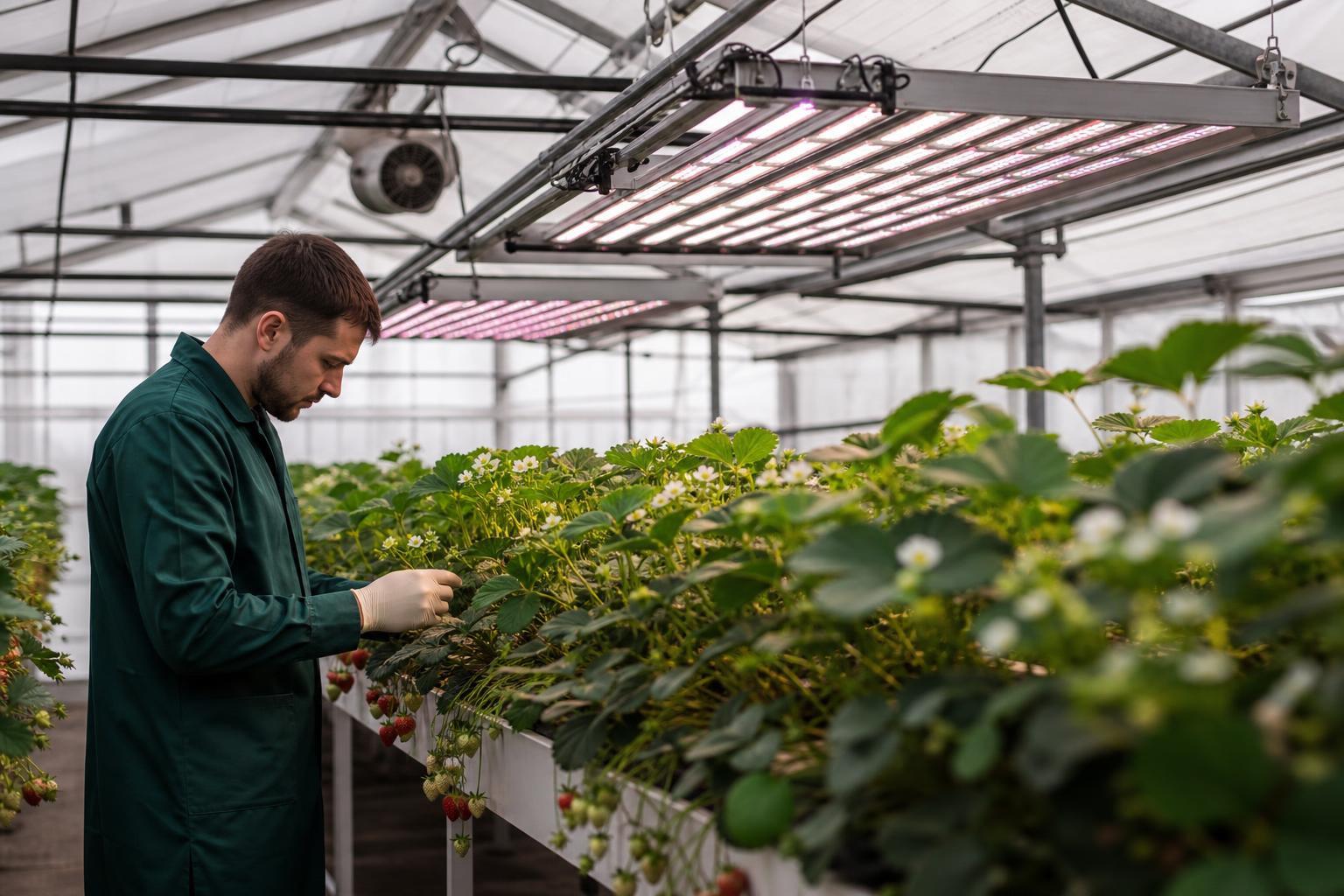
Strawberry greenhouse lighting is the use of supplemental LED fixtures to close the gap between what the sun delivers through a greenhouse structure and what strawberry plants need for photosynthesis, flowering, and fruit quality. The key metrics are DLI (daily light integral), PPFD (photosynthetic photon flux density), photoperiod, spectrum, and uniformity. There is no universal light recipe for strawberries because cultivar, season, greenhouse design, crop stage, and economics all change the answer. The right starting question is not “what light do strawberries need?” but “what is this greenhouse’s DLI deficit, and what is the most efficient way to close it?”
What Is Strawberry Greenhouse Lighting?
Strawberry greenhouse lighting is the use of supplemental grow lights, usually LED fixtures, to give greenhouse-grown strawberries enough usable light for photosynthesis, flowering, fruit development, and consistent production. In commercial greenhouses, the goal is not simply to install lights. It is to manage DLI, PPFD, photoperiod, spectrum, and uniformity around the crop’s needs and the greenhouse’s natural light conditions.
In most greenhouse systems, supplemental lighting does not replace the sun. It fills the gap when natural light falls short, especially during winter months, on cloudy days, under older or dirty glazing, inside dense canopies, or in multilayer strawberry production systems. Virginia Tech’s supplemental lighting guide identifies four inputs growers need: average monthly DLI, fixture PPFD at crop height, greenhouse covering and structure light loss, and the desired crop DLI. Without all four, sizing a lighting system becomes guesswork.
Talk to a lighting specialist about your greenhouse structure, crop targets, and DLI goals before selecting fixtures.
Why Lighting Matters for Greenhouse Strawberries
Strawberries are a high-value, fresh-market crop. USDA reported U.S. strawberry utilized production reached a record 3.22 billion pounds in 2024, with more than 80% going to the fresh market. California accounts for roughly 90% of domestic production, which means most of the country depends on shipped berries for much of the year.
Greenhouse production changes that equation. Purdue’s greenhouse strawberry guide distinguishes high tunnels (which protect from rain and wind) from climate-controlled greenhouses that enable year-round production. But year-round production in northern greenhouses runs into a hard physical limit: winter sunlight is not enough to support strong yields and good fruit quality.
That is where supplemental lighting enters. Trade coverage of CEA strawberries makes the economics clear, though. Greenhouse strawberries are financially difficult even under good conditions. They usually need off-season production timing, local supply advantages, freshness claims, or higher sugar content to justify the investment.
The practical takeaway: lighting for greenhouse strawberries is about winter economics and market positioning. If supplemental light can move production into a higher-value window, improve Brix, or stabilize supply when field berries are unavailable locally, it has a strong business case. If it only adds energy cost without a price or yield advantage, it is just expensive photons.
Key Metrics Behind Strawberry Greenhouse Lighting
Six metrics define how growers plan and evaluate lighting for strawberry greenhouses. Understanding each one matters because fixture manufacturers, extension resources, and research papers all use these terms, and confusing them leads to bad purchasing decisions.
PPFD
Photosynthetic photon flux density measures how much plant-usable light reaches a square meter of canopy per second, expressed as µmol·m⁻²·s⁻¹. Think of it as the instantaneous light intensity at the crop. PPFD is the number growers measure with a quantum sensor at canopy height, and it is the foundation for checking whether a fixture delivers what it promises.
DLI
Daily light integral is the total plant-usable light delivered to the canopy over a full day, expressed as mol·m⁻²·d⁻¹. If PPFD is the speedometer, DLI is the odometer. For fruiting crops like strawberries, total daily light matters more than peak intensity because the plant accumulates photosynthetic energy over hours.
The formula is simple. Iowa State gives it as: DLI = PPFD × hours × 0.0036. A deeper walkthrough of DLI calculations from PPFD can help growers who want to practice running the numbers for their own greenhouse.
Photoperiod
Photoperiod is the length of the light/dark cycle. For strawberries, this is not just about how long the lights run. NC State’s strawberry lighting resource explains that seasonal flowering cultivars (short-day types) and day-neutral types respond differently to daylength and temperature, with distinct flowering behaviors. Getting the photoperiod wrong for a given cultivar can suppress flowering or trigger unwanted runnering.
A dedicated guide to greenhouse photoperiod lighting covers these cultivar responses in more detail.
Spectrum
Spectrum describes the mix of wavelengths the light delivers: blue, red, far-red, white, UV. Each wavelength can influence growth habit, flowering, fruit color, sugar content, or disease response. But spectrum is a tuning knob, not a magic switch. It should be addressed only after DLI and photoperiod goals are clear.
Uniformity
Uniformity measures how evenly light is distributed across the canopy. In strawberry production, this matters because the plant is low-growing, the canopy changes shape as trusses develop, and multilayer systems create severe shading on lower tiers. Poor uniformity means some plants are over-lit while others are starved, which shows up as inconsistent fruit size and ripening. For commercial growers, understanding uniformity metrics and targets is essential to getting consistent results.
Efficacy
Fixture efficacy, measured as µmol/J (photons per watt of input power), determines how efficiently a fixture converts electricity into plant-usable light. Higher efficacy means lower energy cost per mol of light delivered. The DLC’s V3.0 horticultural lighting standard sets a minimum LED efficacy threshold of 2.30 µmol/J, which is 35% above the most efficacious non-LED HPS luminaire.
Photosynthetic Lighting vs. Photoperiodic Lighting
This is the distinction most competing pages miss, and it is arguably the most important concept in strawberry greenhouse lighting.
Photosynthetic lighting
Photosynthetic lighting is higher-intensity supplemental light used to increase DLI and drive crop productivity when sunlight falls short. Ohio State’s berry lighting resource describes it as supplemental lighting that promotes photosynthesis and productivity, noting that 100 to 200 µmol·m⁻²·s⁻¹ PPFD appears to be a typical supplemental intensity applied to strawberry in the limited information available. This is the kind of lighting most people picture when they think about grow lights: bright, energy-consuming, and directly tied to yield.
Photoperiodic lighting
Photoperiodic lighting is low-intensity lighting used to manipulate the plant’s perception of daylength. Ohio State notes that long-day responses in sensitive strawberry cultivars can be induced at as little as 1 to 3 µmol·m⁻²·s⁻¹ PPFD, and that night-interruption lighting is typically applied for about four hours around midnight. At those intensities, the contribution to DLI is negligible. The light is a developmental signal, not an energy source.
NC State explains that night interruption and daylength extension can enhance flowering in long-day cultivars and inhibit flowering in short-day cultivars, with responses shaped by the ratio of red to far-red light. This means the same photoperiodic strategy can help or hurt, depending on the cultivar.
A common mistake is treating all strawberry lighting as the same job. Photosynthetic lighting is an energy and yield tool. Photoperiodic lighting is a developmental signal. They can overlap in a single greenhouse, but they should not be confused. A grower running high-intensity lights 18 hours a day to “trigger flowering” in a day-neutral cultivar is wasting electricity on a response that does not exist.
Common Strawberry Lighting Targets
Strawberry greenhouse lighting targets vary by cultivar, production stage, greenhouse location, season, crop density, CO₂ strategy, temperature, and whether the goal is photosynthesis or photoperiod control. There is no universal recipe. But there are working ranges growers and researchers converge around.
A Cornell-linked greenhouse trial reported that 15 mol·m⁻²·d⁻¹ DLI was on the low end for strawberries and that, for most cultivars, a recommended DLI is 20 to 25 mol·m⁻²·d⁻¹. In that same trial, ambient winter light was as low as 1 to 2 mol·m⁻²·d⁻¹, meaning supplemental lighting had to do most of the work.
Practitioners on LinkedIn, drawing from university strawberry lighting coursework, have described winter greenhouse DLI as sometimes falling below 5 mol·m⁻²·d⁻¹ and framed 10 to 12 as a practical minimum, with 20 to 25 as ideal and excessive DLI potentially causing stress.
| Metric | Typical range for supplemental strawberry lighting | Context |
|---|---|---|
| PPFD (supplemental) | 100 to 200 µmol·m⁻²·s⁻¹ | Ohio State’s limited strawberry data |
| DLI (total target) | 15 to 25 mol·m⁻²·d⁻¹ | 15 is low-end; 20 to 25 recommended for most cultivars |
| Photoperiod | Cultivar-dependent | Short-day types differ from day-neutral types |
| Spectrum | Full-spectrum white common; red/blue/far-red for specific goals | No single “best” spectrum |
| Efficacy | 2.30+ µmol/J (DLC V3.0 minimum) | Higher efficacy reduces operating cost |
These numbers are starting points, not prescriptions. A grower in Michigan with a 30-year-old glass house and a grower in North Carolina with a new polycarbonate structure face completely different DLI deficits, even growing the same cultivar.
How to Calculate Supplemental Light for Strawberries
This is where strawberry greenhouse lighting moves from concept to design. The math is straightforward.
Step 1: Calculate supplemental DLI from a given PPFD and duration
Using the Iowa State equation:
DLI = PPFD × hours × 0.0036
Example: If strawberry lights deliver 200 µmol·m⁻²·s⁻¹ at canopy height for 10 hours, the supplemental DLI is:
200 × 10 × 0.0036 = 7.2 mol·m⁻²·d⁻¹
That does not mean the crop only receives 7.2 DLI. In a greenhouse, total DLI equals sunlight transmitted through the structure plus supplemental light.
Step 2: Frame the DLI deficit
Supplemental DLI needed = target crop DLI - usable greenhouse sunlight DLI
Where:
Usable greenhouse sunlight DLI = outside DLI × greenhouse transmission factor
If the target is 20 mol·m⁻²·d⁻¹, the outside DLI in January is 12, and the greenhouse transmits 60% of that light, the usable natural DLI is 7.2. The deficit is 12.8 mol·m⁻²·d⁻¹, which the supplemental system needs to close.
Step 3: Convert the deficit into fixture requirements
From the deficit, work backward to PPFD and hours. If the supplemental system runs for 14 hours:
PPFD needed = 12.8 ÷ (14 × 0.0036) = approximately 254 µmol·m⁻²·s⁻¹
Virginia Tech notes that lighting systems are often run in the morning and evening when ambient PPFD is low rather than during peak sun, which can affect how many supplemental hours are practical.
A clean glossary page should not pretend a grower can fully size a greenhouse lighting project from a web article. The math above teaches the framework. For commercial projects, a professional lighting design accounts for fixture spacing, mounting height, canopy architecture, dimming controls, and seasonal variability.
How Spectrum Affects Strawberry Growth and Fruit Quality
Spectrum is the topic most likely to be oversimplified. Red and blue wavelengths are photosynthetically important, but strawberry response depends on the spectrum mix, intensity, timing, cultivar, and growing environment.
A 2025 study summarized by University of Nevada Extension found that dark interruption with blue LEDs improved accumulated berry yield, increased antioxidant activity, and reduced powdery mildew incidence compared with the control and red LED treatment. That sounds like blue wins. But Mississippi State/USDA-linked research found that high-intensity red LED treatments caused the greatest plant injury ratings in a separate trial, and leaves from those red treatments had the highest anthracnose severity after inoculation. Red was harmful in one context, not simply “good for strawberries.”
A 2026 trade report on greenhouse strawberry trials found that dynamic spectra produced yield advantages in some treatments, but responses differed by cultivar and growing conditions. The researchers explicitly warned against using one lighting recipe for every crop.
For a broader overview of how different wavelengths affect plant growth, Thrive’s summary of light spectra and plant growth covers the basics without crop-specific overreach.
The position worth taking: spectrum matters, but spectrum is not magic. In strawberry lighting, spectrum should be tuned only after the grower knows the crop goal, cultivar, DLI target, greenhouse climate, and production stage.
What Research Says About Yield and Fruit Quality
The evidence for supplemental lighting in strawberry greenhouses is strong where natural light is genuinely limiting. Here are the most useful data points.
A 2024 commercial greenhouse study tested an hourly light integral strategy, targeting a DLI of 12.6 mol·m⁻²·d⁻¹ and achieving about 10. It raised canopy temperature by 1 to 2°C and reported a 32% increase in yield per plant, 21% higher soluble solids, and a 33% improvement in sugar-acid ratio compared with the unlit control.
In a Cornell-linked greenhouse trial, ambient light DLI was as low as 1 to 2 mol·m⁻²·d⁻¹. With supplemental LED light set to a DLI of 15, Albion yielded 3.68 kg/m² versus 1.77 kg/m² under ambient light. Cabrillo yielded 5.67 kg/m² versus 3.03 kg/m² under ambient conditions. The cultivar difference is striking: same lighting, same greenhouse, different outcomes.
A Japanese subtropical greenhouse study found that integrated environmental control plus daytime LED lighting improved yield and fruit quality, but the effect was limited when solar radiation was already high. When the sun is strong enough, more artificial light adds cost without proportional return.
The synthesis: supplemental lighting can meaningfully improve strawberry yield and quality, especially where winter or cloudy conditions create a real DLI deficit. But more light is not automatically better. The value depends on cultivar, stage, climate, existing sunlight, crop load, and the rest of the greenhouse environment.
Lighting Design Factors in a Commercial Strawberry Greenhouse
Fixture output is only one piece of the puzzle. A strawberry greenhouse lighting plan is simultaneously a DLI plan, an electrical plan, and a climate plan.
Key design factors include:
- Location and seasonal sunlight. A greenhouse in upstate New York faces a vastly different winter DLI than one in central Florida.
- Greenhouse covering and structural shading. Glass, polycarbonate, polyethylene, and dirty glazing all transmit different amounts of light. Structural members cast shadows.
- Target DLI and crop stage. Vegetative growth, flowering, and fruiting may have different light needs.
- Photoperiod and cultivar type. Short-day and day-neutral cultivars require different photoperiod strategies.
- Fixture PPFD at canopy height. Not rated PPFD, but measured PPFD at the actual mounting height and spacing.
- Light distribution and fixture spacing. Poor spacing creates hot spots and dark zones.
- Crop density and canopy architecture. Strawberry canopies change as trusses develop and leaves expand.
- Multilayer or tabletop configuration. A practitioner on LinkedIn described a four-layer glasshouse system where upper layers shaded lower layers, requiring dimmable LED modules and 291 µmol·m⁻²·s⁻¹ at the bottom level to meet the DLI target.
- Energy rate and utility incentives. LED retrofits often qualify for rebates that reduce capital cost.
- HVAC and heat implications. Every watt of lighting that does not become plant-usable light becomes heat. In an enclosed greenhouse, this affects temperature management. Thrive’s guide on HVAC load from LED lights covers how to account for this.
- Controls, dimming, and sensors. Smart controls can dim lights when solar PPFD rises and ramp up when clouds roll in, saving energy without sacrificing DLI.
- Electrical infrastructure and serviceability. At commercial scale, hundreds of fixtures mean hundreds of drivers, connection points, and potential failure locations.
For larger greenhouse lighting projects, fixture output is only part of the equation. Thrive’s OptiDrive platform moves LED drivers out of the grow area to simplify power architecture, reduce in-room failure points, and support large-scale deployments.
Common Strawberry Greenhouse Lighting Mistakes
Buying lights based on wattage alone
Watts measure power draw, not plant light delivered. Practitioners on Reddit repeatedly warn others to use PPFD and DLI rather than lux or vague wattage claims. One hydroponics thread called lux-based LED specs a red flag and advised measuring PPFD and DLI at the actual mounting distance. If a strawberry lighting spec sheet only emphasizes watts, lumens, or lux, ask for horticultural metrics: PPF, PPFD maps, efficacy, spectrum, and uniformity data.
Ignoring DLI and only looking at PPFD
PPFD is a moment. DLI is the day. A Reddit user advising on fruiting crop lighting framed 15+ DLI as a practical starting point, while emphasizing PPFD maps and hanging height as critical context. For strawberries, total daily light drives fruit development more than peak intensity.
Copying someone else’s light recipe
A 2026 greenhouse strawberry trial summary explicitly concluded that growers should use research as a baseline and monitor crop registration data, fruit load, and plant response rather than adopting a recipe from another greenhouse. Cultivar, geography, greenhouse structure, crop load, and environment all change the result.
Confusing photoperiodic lighting with photosynthetic lighting
A few µmol can affect a light-sensitive cultivar’s daylength response, but that intensity does not meaningfully raise DLI. These are different tools for different goals. Treating them as interchangeable wastes energy or creates the wrong developmental signals.
Treating spectrum as more important than environment
Spectrum can shift plant response, but temperature, humidity, irrigation, nutrition, CO₂, crop load, and cultivar can override simplistic spectrum assumptions. The same 2026 trial summary explicitly says lighting cannot be considered in isolation and should be coordinated with every other environmental input.
Ignoring crop load
Lighting increases the plant’s energy budget, but crop load decides how that energy gets spent. The 2026 trial report noted that a fixed four-flower pruning approach outperformed a more labor-intensive crop-load adjustment strategy by 11 to 14% in one trial. An overloaded plant will not respond to more light the way a properly pruned one does.
Underestimating electrical infrastructure and lifecycle cost
In a Reddit discussion about lighting a larger greenhouse, commenters pushed the buyer to think about lifecycle, warranty, failure risk, and energy cost rather than chasing the cheapest fixtures. One commenter estimated that small differences in fixture efficacy can offset upfront savings over the life of the system. A forum user growing hydroponic strawberries also pointed out that lighting is not the only limiting factor: root-zone health, EC management, oxygen, humidity, and temperature all affect whether plants can use the light they receive.
When to Talk to a Lighting Expert
Not every grower needs a full lighting design consultation. But certain situations call for professional input:
- New greenhouse construction where lighting is part of the original design
- Retrofit from legacy HPS or fluorescent to LED
- Winter production targets that require significant supplemental DLI
- Multilayer strawberry systems where uniformity is three-dimensional
- Facilities where utility rebates could offset capital cost
- Electrical constraints that affect fixture count, driver placement, or circuit capacity
- Projects where ROI modeling is needed before committing capital
For commercial greenhouse strawberry lighting, Thrive designs and manufactures LED fixtures purpose-built for CEA environments, including the Altus 1K for greenhouse top lighting and the Pinnacle Series across multiple power classes. Thrive reports under 1% fixture failure rate over its 5-year warranty period and ±5% design-to-install PPFD variance, which reduces the risk that what gets installed does not match what was planned.
If you are sizing a new greenhouse strawberry lighting system or evaluating an LED retrofit, talk with Thrive about your crop goals, greenhouse structure, DLI targets, electrical constraints, and ROI assumptions.
Frequently Asked Questions
What is the best light for greenhouse strawberries?
There is no single best light. The best system delivers the target DLI and photoperiod uniformly, fits the greenhouse structure, supports the cultivar and crop stage, and makes economic sense. LEDs are the dominant technology because they deliver efficient plant-usable light with controllable spectrum and dimming. But “best” depends on the project.
How much DLI do greenhouse strawberries need?
Reported targets vary. Cornell-linked greenhouse trial reporting describes 15 mol·m⁻²·d⁻¹ as low-end and 20 to 25 mol·m⁻²·d⁻¹ as recommended for most cultivars. A 2024 commercial study achieved roughly 10 mol·m⁻²·d⁻¹ and still reported significant yield and quality gains over the unlit control. The right number depends on cultivar, crop stage, season, CO₂, temperature, and economics.
What PPFD is used for supplemental strawberry lighting?
Ohio State’s berry lighting resource says that, among limited strawberry information, 100 to 200 µmol·m⁻²·s⁻¹ appears to be a typical supplemental PPFD range. Actual designs should be based on DLI deficit, mounting height, uniformity requirements, and greenhouse transmission.
Is red and blue light enough for strawberries?
Red and blue wavelengths are photosynthetically important, but strawberry response depends on spectrum mix, intensity, timing, cultivar, and environment. Research has shown both useful and negative effects depending on the treatment. High-intensity red LED treatments caused injury in one greenhouse study, while blue LEDs reduced powdery mildew in another. Full-spectrum white light is a common practical choice because it balances plant needs with worker visibility.
Do greenhouse strawberries need light at night?
Sometimes, but the goal matters. Low-intensity night interruption can manipulate photoperiod response in some cultivars, while higher-intensity lighting at night or early morning can contribute to DLI. These are different strategies. A night interruption at 2 to 3 µmol·m⁻²·s⁻¹ for four hours is a developmental signal. Running full-intensity lights overnight is an energy decision that must be justified by the DLI math.
Can supplemental lighting improve strawberry yield?
Yes, especially where natural light is low. A 2024 commercial greenhouse study reported a 32% increase in fruit yield per plant under an hourly light integral LED strategy. A separate trial reported that LED-supplemented Cabrillo strawberries yielded 5.67 kg/m² versus 3.03 kg/m² under ambient winter light. The magnitude of improvement depends on how large the DLI deficit was before supplemental lighting was added.
How do I know if my greenhouse needs supplemental lighting?
Estimate monthly greenhouse DLI, account for covering and structure losses, choose a crop target, and calculate the deficit. If the deficit is large during your production window, supplemental lighting is worth evaluating. Virginia Tech identifies average monthly DLI, fixture PPFD at crop height, structure loss, and target DLI as the key inputs for making this determination.