Side Lighting vs Under-Canopy Lighting (2026): Yields, ROI
Compare side lighting vs under-canopy lighting in cannabis. See 2026 research on 20–30% yield gains, pros/cons, ROI, and setup tips. Learn more.
TL;DR
Side lighting and under-canopy lighting both supplement overhead grow lights, but they differ in fixture placement, light direction, and the areas of the plant they illuminate.
Side lighting places LED fixtures vertically beside plants, directing light horizontally toward the canopy. Under-canopy lighting places LED bars horizontally beneath the main canopy, directing light upward toward shaded lower foliage and flower sites.
For dense commercial canopies, under-canopy lighting is generally the more targeted approach because it delivers supplemental photons directly to lower plant structures. Side lighting can be useful in smaller enclosed spaces or specific plant configurations, but its effectiveness depends on canopy geometry, fixture distribution, and light intensity.
Research has demonstrated yield and quality improvements from intercanopy and subcanopy lighting in cannabis production. However, results depend on the experimental setup, cultivar, spectrum, supplemental photon input, and environmental conditions. These results should not be treated as guaranteed commercial yield increases.
Explore under-canopy lighting solutions built for commercial cultivation.
What Is Side Lighting?
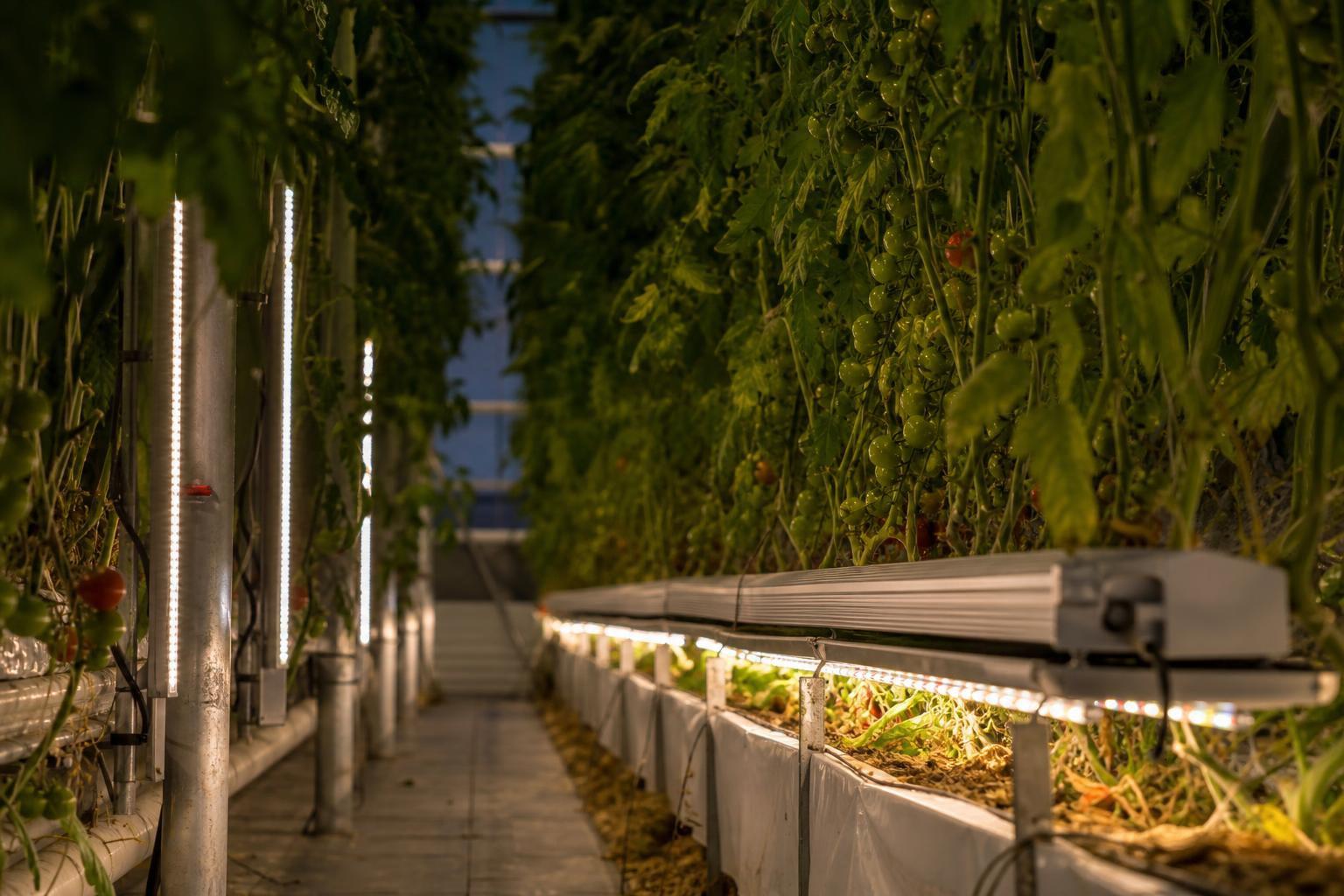
Side lighting means mounting fixtures vertically alongside plants so the light shines inward, hitting the plant from the side rather than from above. Most setups use LED bars, LED strips, or CFL tubes hung at canopy height around the perimeter of the grow space or between rows.
The idea is straightforward: if overhead light can’t reach the middle and lower portions of a plant, maybe horizontal light can. Side lighting has been a popular DIY approach in small grow tents for years, partly because it’s cheap and easy to set up with hardware store materials.
What Is Under-Canopy Lighting?
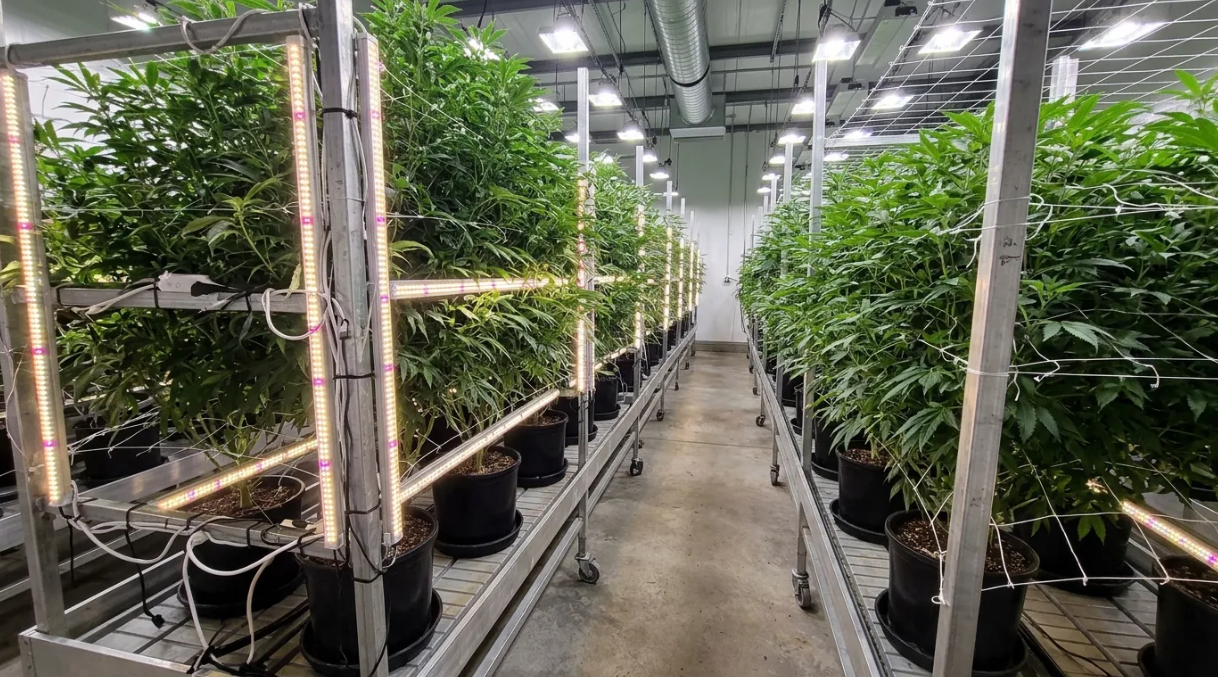
Under-canopy lighting (sometimes called subcanopy lighting or SCL) positions LED bar fixtures horizontally below the main plant canopy, facing upward. The goal is to illuminate the shaded lower leaves and bud sites that overhead fixtures simply can’t reach, no matter how powerful they are.
This approach directly targets the zones where light levels drop off sharply. In a dense cannabis canopy, light intensity at the bottom can fall to 10-15% of what the top cola receives. Under-canopy bars push localized PPFD in those lower zones from near-darkness up to 350-450 μmol/m²/s, enough to shift lower leaves from passive maintenance into active photosynthesis.
Clearing Up the Terminology: Intercanopy, Interlighting, and Subcanopy
This is where most articles fall short. These terms get tossed around as synonyms, but they describe slightly different fixture placements:
Under-canopy (subcanopy): Fixtures sit below the canopy floor, pointing up. Light reaches the lowest bud sites first.
Intercanopy (interlighting): Fixtures are positioned within the canopy structure itself, at the middle and basal levels of the plant. Light reaches mid-canopy foliage directly.
Side lighting: Fixtures are mounted at the sides of the canopy, pointing inward horizontally.
The distinction matters because intercanopy placement (within the canopy) has produced the strongest research results of any supplemental approach. A 2025 peer-reviewed study found that intercanopy lighting delivered even better outcomes than strict under-canopy placement, though both outperformed overhead-only setups. For a deeper look at how light placement shapes lower-bud development, see this lower canopy lighting guide.
In practical commercial use, the terms “under-canopy” and “intercanopy” often describe the same bar-style fixtures at slightly different mounting heights. Side lighting is a fundamentally different orientation.
Side Lighting vs. Intercanopy vs. Under-Canopy Lighting
Although these supplemental lighting configurations share the goal of improving light distribution, their fixture positions and photon delivery patterns are different.
Lighting configuration | Fixture position | Light direction | Primary target |
|---|---|---|---|
Side lighting | Beside the plants | Horizontal, inward | Outer and middle canopy |
Intercanopy lighting | Within the plant canopy | Usually horizontal or angled | Middle and lower foliage |
Under-canopy lighting | Below the main canopy | Upward | Lower foliage and shaded plant structures |
Overhead lighting | Above the canopy | Downward | Upper canopy |
Why the distinction matters: Intercanopy and under-canopy lighting should not automatically be treated as identical systems. A fixture positioned inside the canopy may distribute photons differently from one mounted beneath it. This affects light penetration, leaf exposure, fixture spacing, and overall supplemental photon delivery.
When evaluating research or comparing commercial LED products, check the actual fixture position and orientation rather than relying exclusively on the terminology used by manufacturers.
The Core Difference and Why It Matters
The physical placement comparison is simple:
Overhead light travels downward. Dense canopy absorbs most photons before they reach lower branches.
Side light travels horizontally inward. It hits the outer edges of mid-canopy but struggles to penetrate deep into a dense plant.
Under-canopy light travels upward. It delivers photons directly to the bud sites that overhead fixtures starve.
This isn’t just about total light in the room. It’s about where the photons land. Cannabis exhibits strong apical dominance, meaning the plant naturally prioritizes the highest growth point (the main cola) for resources. When overhead lighting is the only source, that hormonal bias gets amplified by a physical light gradient. The top buds get maximal light, the bottom buds get almost none, and the result is a harvest split between premium colas and low-value popcorn.
Under-canopy lighting breaks that pattern by feeding light energy to precisely the zones the plant would otherwise abandon.
PPFD Distribution: How to Measure Side and Under-Canopy Lighting Performance
Fixture placement alone does not determine how effective supplemental lighting will be. Growers also need to measure how many photosynthetically active photons reach different sections of the plant canopy.
Photosynthetic photon flux density (PPFD), measured in μmol/m²/s, describes the amount of photosynthetically active radiation reaching a specific surface each second.
In an overhead-only lighting system, the upper canopy generally receives the highest PPFD, while lower foliage may receive substantially less light because of shading and leaf overlap.
Side lighting attempts to improve horizontal light distribution by directing photons inward. Under-canopy lighting adds photons from below, targeting shaded foliage and lower plant structures.
How to Compare PPFD Across Different Lighting Configurations
A quantum PAR sensor can help growers evaluate the effectiveness of supplemental lighting.
Measurements should be taken at multiple canopy heights and positions rather than at a single point.
Measurement location | What it reveals |
|---|---|
Upper canopy | Light exposure from overhead fixtures |
Middle canopy | Light penetration through the plant structure |
Lower canopy | Whether supplemental lighting reaches shaded foliage |
Outer canopy | Effectiveness of side-mounted fixtures |
Inner canopy | Light distribution in dense plant structures |
Take measurements under the same operating conditions, including fixture output, sensor orientation, and overhead lighting settings.
For a meaningful comparison, measure PPFD with the supplemental fixtures switched off and then switched on. This reveals how much additional light each configuration contributes to the target areas.
Why Light Uniformity Matters
A high PPFD reading at one location does not necessarily mean the entire canopy receives adequate light.
Growers should evaluate both average PPFD and the variation between measurement points. More uniform photon distribution can help reduce differences between upper, middle, and lower plant structures.
Daily light integral (DLI), measured in mol/m²/day, provides another useful measurement by describing the total photosynthetic light received over a complete photoperiod.
Together, PPFD and DLI help growers assess whether supplemental fixtures are improving light distribution rather than simply increasing electrical consumption.
What the Research Says
Under-Canopy and Intercanopy: Strong, Consistent Evidence
The research base for under-canopy and intercanopy lighting has grown substantially in recent years.
Under-Canopy and Intercanopy Lighting: Research Results Compared
Scientific research provides evidence that supplemental lighting within the plant canopy can improve light distribution, inflorescence production, and product consistency. However, results vary depending on fixture placement, supplemental power, and growing conditions.
Research | Lighting approach | Reported finding | Evidence type |
|---|---|---|---|
Garrido et al. (2025) | Subcanopy lighting | 24.58% increase in dry inflorescence yield compared with overhead-only lighting | Peer-reviewed controlled experiment |
Garrido et al. (2025) | Intercanopy lighting | 29.95% increase in dry inflorescence yield compared with overhead-only lighting | Peer-reviewed controlled experiment |
Garrido et al. (2025) | Intercanopy lighting | 24.42% increase in total THC yield | Peer-reviewed controlled experiment |
Garrido et al. (2025) | Intercanopy lighting | 12.5% increase in total terpene concentration, as reported by the study | Peer-reviewed controlled experiment |
Hawley et al. (2018) | Supplemental LED spectrum | Reported 18–24% higher dry bud yield under the tested lighting treatment | University research |
Important research distinction: The Garrido et al. experiment compared overhead-only lighting with supplemental subcanopy and intercanopy systems. Its results demonstrate the potential of illuminating shaded plant structures, but they do not establish that every under-canopy fixture or commercial installation will achieve the same increases.
The Hawley et al. findings should also be distinguished from direct comparisons of side-mounted and under-canopy fixtures. Different lighting experiments should not be presented as interchangeable evidence.
A 2025 peer-reviewed study by Garrido et al. published in MDPI Plants tested both subcanopy and intercanopy LED treatments against overhead-only controls. Both supplemental approaches created more uniform light distribution and increased yields. The intercanopy treatment showed a 29.95% increase in dry inflorescence yield, 24.4% higher THC accumulation, and a 12.5% increase in total terpene concentration.
Earlier work from the University of Guelph (Hawley et al., 2018) found that under-canopy lighting increased total dry bud mass by 20-24%. Perhaps more importantly, lower buds developed THC and terpene profiles that often matched the top colas, dramatically improving harvest uniformity.
Commercial trials have confirmed these numbers outside the lab. A multi-facility study by StateHouse showed a 20% increase in flower yield and a 27% improvement in the premium-to-small bud ratio. The critical finding: these gains came from repositioning light energy under the canopy, not from increasing total power consumption.
The evidence extends beyond cannabis. A blackberry study found that plants with moderate to higher LED intercanopy light produced 79% to 122% more fruit than control plants. Tomato, cucumber, sweet pepper, and bush bean crops have all shown measurable improvements from subcanopy or intercanopy supplemental lighting.
For a comprehensive look at the yield data, this piece on under-canopy lighting research summarizes why the debate about whether it works is essentially settled.
Side Lighting: Limited and Conditional Evidence
Side lighting has far less peer-reviewed support, especially for cannabis. A 2023 study on lettuce found that side lighting increased fresh weight by 19-34% depending on spectrum. But lettuce is a low, open plant with completely different architecture than a dense cannabis canopy, making direct comparison difficult.
For cannabis specifically, the evidence is mostly anecdotal. Practitioners on grower forums are genuinely split. On ILGM’s forum, one experienced grower shared: “I’ve tried side lighting with T5 3500k 54-watt lights and I didn’t see enough difference to make it worth that extra wattage.” The broader consensus across 420Magazine and Rollitup threads echoes this sentiment: most growers who have tried side lighting found the results underwhelming relative to the added electricity cost.
Side Lighting: When It Actually Makes Sense
Side lighting isn’t useless. It fills a specific niche.
Small enclosed spaces. In a 4x4 or 5x5 grow tent, side-mounted LED strips or bars can meaningfully increase total light hitting the plants because reflective tent walls bounce that light back. The enclosed geometry amplifies what would otherwise dissipate in a larger room.
Tall, columnar plant architectures. If you’re growing tall plants without topping or training (certain sativa phenotypes, for example), side lighting can reach the long stretches of stem and branch that overhead light misses. This is a narrow use case but a real one.
Supplemental UV or far-red. Some growers mount side-facing UV-A or far-red bars to influence resin production or flowering response. This is less about general photosynthesis and more about targeted photomorphogenic effects.
Where side lighting falls short:
Difficult to scale in commercial rooms where light disperses without reflective walls nearby
Less targeted than under-canopy placement because horizontal light still hits mostly upper and mid-canopy foliage
Diminishing returns as room size increases
No strong peer-reviewed evidence for cannabis yield gains
Under-Canopy Lighting: When It Makes Sense
Under-canopy lighting addresses the most common scenario in commercial cannabis: a dense, trained canopy (SOG, SCROG, or topped and spread plants) where overhead fixtures, no matter how powerful, cannot push enough photons to the lower third of the plant.
Dense canopies. This is the primary use case. The denser your canopy, the steeper the light gradient from top to bottom, and the more value under-canopy bars deliver.
Commercial facilities focused on grams per square foot. When you’re measuring revenue per square foot, converting popcorn buds into dense, trimable flower changes the economics of every harvest cycle. To understand the financial mechanics, the under-canopy lighting ROI guide breaks down payback timelines.
Facilities already at maximum overhead PPFD. If your top canopy is already receiving 800-1000+ μmol/m²/s, adding more overhead light hits a point of diminishing returns (and risks light burn at the top). Under-canopy bars redirect supplemental energy where the plant can actually use it.
Greenhouse operations. In greenhouses where natural sunlight dominates overhead lighting, under-canopy bars can supplement the lower canopy zones that even sunlight, combined with supplemental top lights, can’t reach. Learn more about greenhouse supplemental lighting strategies.
Why Marketable Flower Quality Matters More Than Total Yield
One of the most important financial considerations when evaluating supplemental lighting is the difference between total harvested biomass and marketable production.
A lighting system can increase total flower weight without producing an equivalent increase in premium-grade flower. For commercial facilities, the distribution of flower quality across the canopy can be just as important as the final harvest weight.
Lower canopy structures often receive less light than upper flowering sites. This can contribute to differences in flower development, density, and chemical profiles.
Research by Garrido et al. (2025) found that both subcanopy and intercanopy lighting improved yield uniformity in their experimental setup. The treatments also reduced variability in dry inflorescence production and chemical profiles.
For commercial growers, this suggests an additional benefit beyond increasing total production: more consistent output across different canopy positions.
However, higher total yield does not automatically translate into a higher premium-grade fraction. Facilities should track marketable flower weight, grade distribution, processing losses, and product quality separately.
The most useful performance metric is not simply how much additional biomass a lighting system produces, but how much additional saleable product it generates.
Side Lighting vs. Under-Canopy Lighting: Which Offers Better ROI?
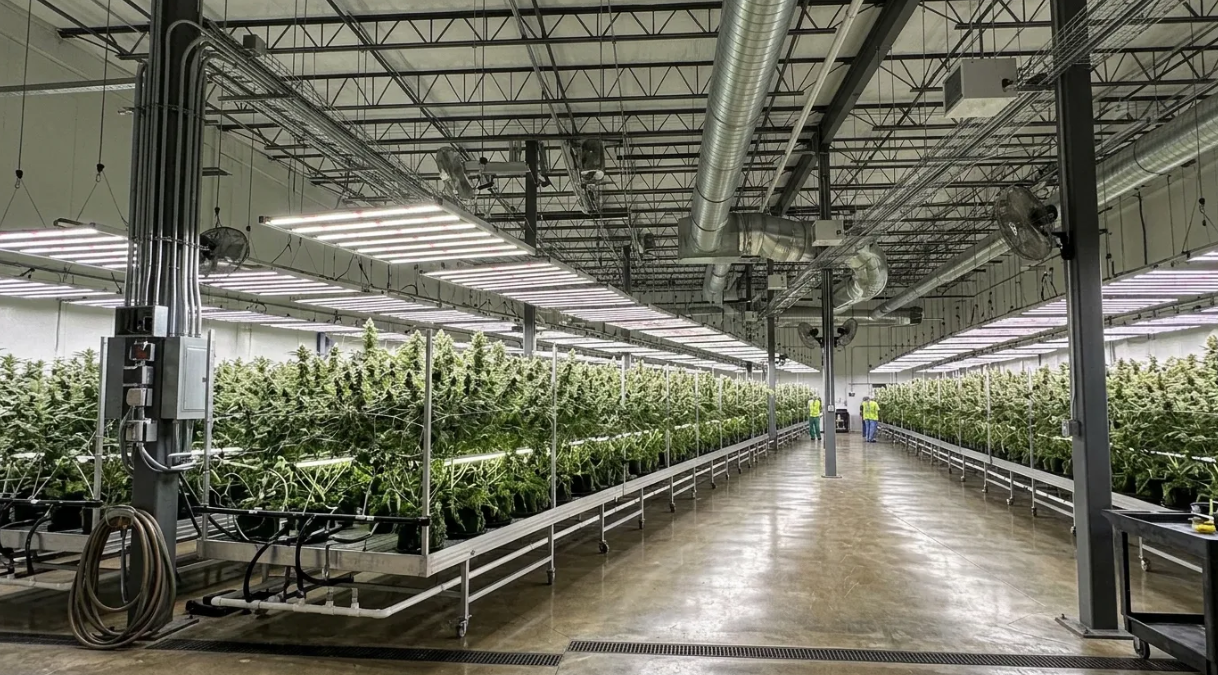
The return on investment (ROI) of supplemental grow lighting depends on three primary factors: additional marketable yield, electricity consumption, and installation costs.
Under-canopy lighting can offer an attractive financial opportunity in facilities where the lower canopy produces a significant amount of underdeveloped or unmarketable flower. However, the financial benefit depends on whether the additional production generates enough revenue to offset the extra operating expenses.
Side lighting may have a lower initial equipment cost in small grow spaces, but its financial value depends on how much additional usable light reaches the target foliage.
How to Calculate Supplemental Lighting ROI
Use the following formula to estimate the financial return of an additional lighting installation:
Incremental profit = Additional marketable yield revenue − Additional electricity cost − Additional operating costs
To calculate the percentage ROI:
ROI (%) = (Net additional profit ÷ Initial installation investment) × 100
For a more complete payback calculation:
Payback period (months) = Initial installation investment ÷ Monthly net additional profit
Example ROI Calculation
The following example uses hypothetical figures to demonstrate how a commercial grower can evaluate supplemental lighting.
Financial variable | Example assumption |
|---|---|
Initial fixture and installation cost | $10,000 |
Additional monthly electricity expense | $500 |
Additional monthly maintenance expense | $100 |
Additional monthly marketable yield revenue | $2,000 |
Monthly net additional profit | $1,400 |
Estimated payback period | 7.14 months |
These figures are illustrative, not measured results from a lighting trial or a guaranteed commercial return.
The example assumes that the additional flower production can be sold at the expected market price and that the facility has sufficient capacity to process it.
Which Lighting Configuration Has Better ROI?
For dense commercial canopies, under-canopy lighting may provide better financial value because its fixtures target foliage that receives relatively little overhead light.
Side lighting may be more economical for smaller installations where reflective walls and limited growing areas help retain supplemental light.
The best option should be determined using measured PPFD distribution, incremental electricity consumption, marketable yield, and actual installation costs.
The key consideration: Don't evaluate supplemental lighting by total yield alone. Calculate the additional revenue generated per kilowatt-hour and per dollar invested.
The Labor Cost Angle
This benefit rarely gets mentioned. As one industry observer noted in Cannabis Business Times, “A lot of the labor that goes into cannabis, which is a substantial part of its cost, is managing canopy to get light to those lower buds.” Under-canopy lighting can reduce the time crews spend on aggressive defoliation, lollipopping, and lower-branch training, because those lower sites are actually producing worthwhile flower. In operations where trimming labor is a top-three expense, this matters.
Side Lighting vs. Under-Canopy Lighting: Complete Comparison
Comparison factor | Side lighting | Under-canopy lighting |
|---|---|---|
Fixture position | Beside plants | Below the main canopy |
Light direction | Horizontal, inward | Upward |
Primary target | Outer and middle canopy | Lower and shaded canopy |
Light penetration | Depends on canopy density and fixture positioning | Directly supplements shaded lower areas |
Typical application | Small enclosed spaces and selected plant architectures | Dense canopies and commercial growing facilities |
Research support in cannabis | Limited direct evidence | Peer-reviewed evidence for subcanopy supplementation |
Yield potential | Depends on plant architecture and photon delivery | Demonstrated improvements in controlled experiments |
Installation | Can be simple in small spaces | Requires suitable mounting and clearance |
Energy consumption | Depends on fixture output and operating schedule | Adds electrical load to the existing system |
Energy efficiency | Must be measured under actual operating conditions | Must be measured against incremental yield |
HVAC requirements | Additional heat must be considered | Additional heat must be considered |
Commercial scalability | Depends on facility layout | Can integrate with suitable growing systems |
ROI considerations | Initial cost and measurable additional production | Equipment cost, energy consumption, and additional marketable yield |
Comparison takeaway: Under-canopy lighting has stronger direct research support for improving lower-canopy light distribution in cannabis production. Side lighting can still serve specific layouts, but growers should evaluate both approaches using measured PPFD, energy consumption, and marketable yield rather than assuming one configuration is always more efficient.
Common Mistakes and Misconceptions
“Photoreceptors Are Only on Top of Leaves”
This objection appears constantly on Rollitup, 420Magazine, and other grower forums. The logic goes: since stomata and chloroplasts are concentrated on the upper leaf surface, shining light upward from below is wasteful.
It’s an oversimplification. Research from the University of Guelph demonstrated that the leaf-level light response does not reliably predict whole-plant responses to light intensity. Lower leaves do photosynthesize when given adequate light, and the whole-plant yield response to under-canopy lighting is well documented at 20-30% gains. The individual leaf is not the right unit of analysis. The crop is.
Adding Fixtures Without Adjusting HVAC
LED bars placed within or below the canopy add heat directly to the grow zone. Even efficient LEDs convert some electricity to thermal energy, and that heat load is now inside the canopy rather than above it. Facilities that add under-canopy lighting without recalculating their HVAC capacity risk temperature and humidity problems. Plan for the thermal impact before installation. For guidance on sizing cooling for LED setups, see this HVAC guide for LED grow lights.
Starting Too Early in the Growth Cycle
Most experienced growers and lighting manufacturers recommend activating under-canopy bars 14-21 days into the flowering cycle, not from day one. The canopy needs to develop enough density for the supplemental light to serve its purpose. Running under-canopy lighting during early veg or early flower before the canopy has filled in wastes energy and adds unnecessary heat.
For detailed placement and timing guidance, the under-canopy light placement guide covers optimal bar heights and activation windows.
Ignoring Spectrum
Not all under-canopy bars are equal. Red-heavy bars may squeeze out marginally more flower weight, but full-spectrum white bars produce more balanced growth and a better work environment for the people in the room. The tradeoff between maximum red-spectrum flower push and full-spectrum quality is worth considering, especially in facilities where staff work under the lights for hours. This summary of how light spectra affect plant growth explains the spectrum considerations in detail.
Choosing Based on Wattage Alone
A 120W under-canopy bar and a 120W side-mounted panel are not interchangeable just because they draw the same power. Beam distribution, fixture orientation, and how that energy translates to PPFD at the target zone matter far more than the number on the spec sheet.
What to Look for When Choosing Under-Canopy LED Fixtures
Choosing an under-canopy lighting system requires more than comparing wattage and fixture prices. Commercial growers should evaluate photon output, electrical efficiency, fixture dimensions, environmental protection, and compatibility with their existing growing infrastructure.
1. Photosynthetic Photon Output
Check the fixture's PPFD distribution and photosynthetic photon flux (PPF) specifications. These measurements help determine how effectively the fixture delivers usable light to the intended canopy area.
2. Fixture Efficiency
Compare photosynthetic photon efficacy, expressed in μmol/J. This indicates how many photosynthetic photons a fixture produces per joule of electrical energy.
Higher efficacy can reduce the electricity required to deliver a given amount of supplemental light, although actual crop-level efficiency also depends on fixture placement and photon distribution.
3. Fixture Dimensions and Mounting
Check whether the LED bars fit beneath the canopy without interfering with trellis systems, irrigation lines, plant maintenance, or harvesting operations.
The mounting arrangement should allow adequate clearance and consistent light distribution.
4. Environmental Protection
Commercial grow environments can expose fixtures to humidity, irrigation spray, and cleaning chemicals.
Review the fixture's IP rating, operating temperature range, electrical protection, and manufacturer installation requirements before purchasing.
5. Dimming and Control Compatibility
Dimming capabilities allow facilities to adjust supplemental light output based on environmental conditions, crop development, and the existing overhead lighting system.
Check whether the fixtures integrate with the facility's lighting controls.
6. Total Cost of Ownership
Evaluate the complete cost rather than the purchase price alone.
Consider:
Initial fixture and installation costs
Electricity consumption
Maintenance and replacement costs
Expected operating hours
Additional HVAC requirements
Expected increase in marketable production
A fixture with a higher purchase price may provide better long-term value if its efficiency, durability, and performance justify the investment.
Final buying consideration: Request photometric or PPFD distribution data and independently evaluate fixture performance under your facility's actual growing conditions before committing to a large installation.
Limitations of Under-Canopy and Side Lighting
Supplemental lighting can improve photon distribution, but it does not guarantee higher yields or better crop quality in every facility.
Several factors can limit its effectiveness.
Additional electricity consumption: Supplemental LED fixtures increase the facility's electrical load. The additional revenue must justify the operating expense.
Increased cooling requirements: Additional lighting power contributes to the room's thermal load. HVAC systems must be evaluated before installing supplemental fixtures.
Canopy architecture: Plants with open structures may already receive sufficient light throughout their foliage. Additional fixtures may provide limited incremental benefits.
Fixture placement: Poor positioning can create uneven illumination, excessive exposure in localized areas, or inefficient photon distribution.
Crop response: Yield and quality responses vary by cultivar, growing conditions, light spectrum, and total daily light exposure.
Installation and maintenance: Commercial installations require suitable mounting, electrical infrastructure, access for maintenance, and compatibility with existing equipment.
The most reliable way to evaluate supplemental lighting is to conduct a controlled comparison using consistent crop conditions, measured electricity consumption, and marketable yield data.
Rather than assuming that more light always produces more revenue, growers should establish whether the additional photons are improving production efficiently.
Choosing the Right Approach for Your Facility
The decision between side lighting vs under-canopy lighting comes down to a few practical questions:
How large is your grow space? In a small tent (4x4 or smaller) with reflective walls, side lighting can work. In anything larger, under-canopy bars deliver more targeted results.
How dense is your canopy? If you’re growing single-cola SOG plants or heavily trained SCROG canopies, the light gradient from top to bottom is steep, and under-canopy lighting directly solves it. If your plants are open and airy, supplemental lighting of any kind may not be necessary.
What’s your existing overhead PPFD? If your top canopy is already well-lit (800+ μmol/m²/s), adding more overhead intensity won’t help much. Repositioning light energy below the canopy is a better use of additional watts.
What crop are you growing? Cannabis, with its dense vertical canopy and valuable lower flower sites, benefits enormously from under-canopy lighting. Low-profile crops like lettuce may see benefits from side lighting in certain configurations, though the evidence is more limited.
What’s your budget and scale? Side lighting is cheap for a single tent. Under-canopy lighting, designed as bar fixtures that integrate with commercial racking and trellis systems, scales efficiently across a large facility.
According to a 2022 Cannabis Business Times survey, 51% of growers were interested in exploring side, intercanopy, subcanopy, or other supplemental lighting beyond overhead fixtures. The industry is clearly moving in this direction.
Talk to a lighting specialist about which approach fits your facility and growing style.
Frequently Asked Questions
Is side lighting or under-canopy lighting better for cannabis?
Under-canopy lighting has stronger direct research support for improving light distribution and lower-canopy production in cannabis. Side lighting can be useful in smaller enclosed spaces or specific plant architectures, but there is less direct evidence establishing its yield performance in cannabis.
Does side lighting increase cannabis yield?
Side lighting can increase the amount of light reaching outer and middle canopy areas, but its effect on total cannabis yield depends on plant architecture, fixture placement, and supplemental photon delivery. There is currently less direct peer-reviewed cannabis evidence for side-mounted lighting than for subcanopy and intercanopy approaches.
Can side lighting and under-canopy lighting be used together?
Yes. Both configurations can be incorporated into the same facility. However, growers should evaluate their combined photon contribution, electrical consumption, and heat load to determine whether using both systems provides an additional economic benefit.
Do plants absorb light from below?
Yes. Plant leaves can photosynthesize when exposed to suitable light from below or other directions. The effectiveness depends on leaf orientation, shading, light intensity, and the amount of radiation absorbed by the foliage.
How much additional electricity does under-canopy lighting consume?
There is no universal percentage because energy consumption depends on fixture wattage, operating hours, and the existing overhead lighting system. In the Garrido et al. (2025) experiment, subcanopy lighting increased lighting energy consumption by 13.13%, while intercanopy lighting increased it by 23.21% compared with overhead-only lighting.
These figures apply to that specific experimental setup and should not be treated as standard commercial installation estimates.
What PPFD should under-canopy LED fixtures deliver?
There is no universal under-canopy PPFD target for every crop or facility. The appropriate level depends on the existing overhead PPFD, canopy density, photoperiod, cultivar, and total daily light exposure.
Growers should measure PPFD at multiple canopy positions and evaluate the additional light delivered by supplemental fixtures rather than relying on a single target value.
Is under-canopy lighting worth it for small grow spaces?
It depends on the canopy structure and existing light distribution. Small growing spaces with open canopies may not benefit enough to justify additional fixtures. Dense canopies with substantial lower foliage may have more potential to benefit from supplemental lighting.
Should growers choose full-spectrum white or red-heavy under-canopy LEDs?
The choice depends on the intended application, fixture performance, and operating environment. Full-spectrum white light can make visual plant inspection easier, while different spectral combinations can influence plant responses. Compare measured fixture efficacy and crop-specific research instead of assuming one spectrum always produces better results.
How do you calculate under-canopy lighting ROI?
Calculate additional marketable production revenue and subtract the incremental electricity, maintenance, and other operating costs. Divide the resulting net additional profit by the initial installation investment to calculate percentage ROI.
The payback period can be estimated by dividing the initial investment by monthly net additional profit.
What is the difference between intercanopy and under-canopy lighting?
Under-canopy lighting places fixtures below the main canopy and directs light upward. Intercanopy lighting positions fixtures within the canopy, typically around the middle and basal plant levels. Both supplement overhead lighting, but their fixture positions and photon distribution differ.