Cannabis Lower Bud Lighting: 2026 Guide to Yield & ROI
Learn how cannabis lower bud lighting boosts yields 20–35%, upgrades popcorn buds to A-grade, and pays back in 1–2 harvests. Get setup tips.
TL;DR
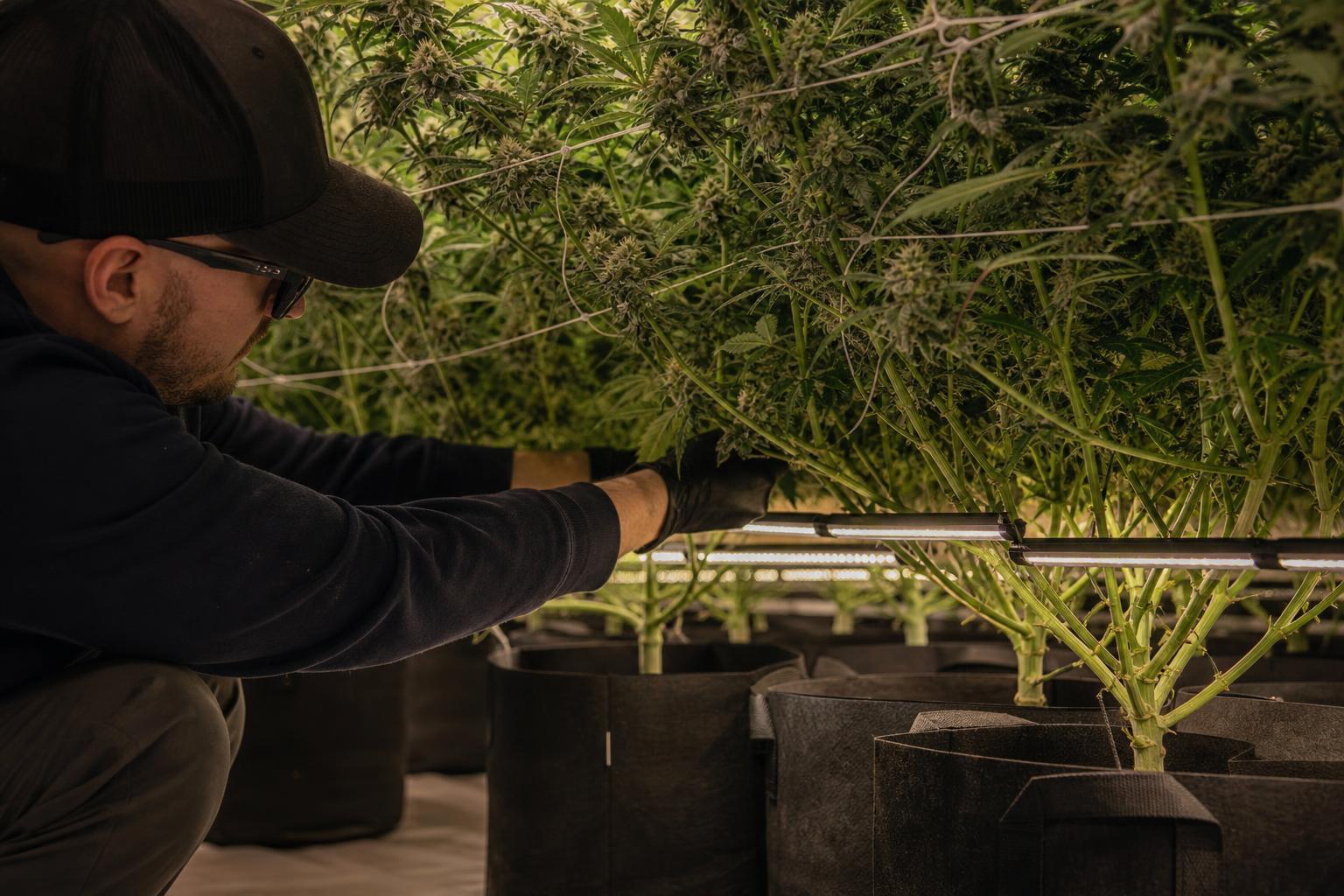
Cannabis lower bud lighting uses supplemental LED fixtures beneath or within the plant canopy to deliver light to shaded flowering sites. Also known as under-canopy lighting (UCL), this approach helps growers address uneven light distribution, improve lower-canopy flower development, and evaluate whether additional lighting can increase the value of each harvest.
Overhead fixtures provide most of the light in a conventional indoor cannabis facility, but upper leaves and flowers intercept some of that light before it reaches lower branches. Under-canopy lighting introduces a second light source closer to shaded plant material. The results depend on fixture placement, light intensity, spectrum, canopy structure, environmental conditions, and electricity costs.
This guide explains how under-canopy lighting works, what published research says about yield and flower quality, how to evaluate supplemental PPFD, and how to calculate whether an installation could deliver a worthwhile return on investment.
What Is Cannabis Lower Bud Lighting?
Cannabis lower bud lighting is the use of supplemental LED fixtures beneath or within the plant canopy to deliver light to shaded flowering sites. Also called under-canopy lighting (UCL), it can improve light distribution, increase harvestable flower yield, and make production more uniform. A 2025 study published in Plants reported a 24.58% increase in dry inflorescence yield with subcanopy lighting and a 29.95% increase with inter-canopy lighting under its experimental conditions. Actual results depend on cultivar, canopy structure, lighting design, environmental conditions, and electricity consumption.
Under-Canopy Lighting vs. Overhead Lighting vs. Lollipopping
Under-canopy lighting, overhead lighting, and lollipopping address lower-canopy production in different ways. Overhead lighting supplies the primary light source, under-canopy lighting adds photons to shaded plant sections, and lollipopping removes selected lower growth rather than attempting to develop it into harvestable flower.
Method | How it works | Main advantage | Main limitation |
|---|---|---|---|
Overhead lighting | Delivers light from above the canopy | Provides the primary light source for the crop | Light distribution may be uneven in dense canopies |
Under-canopy lighting | Adds supplemental light below the canopy | Targets shaded lower flowering sites | Adds equipment cost, electricity consumption, and installation complexity |
Inter-canopy lighting | Places supplemental fixtures within the canopy | Can deliver light to middle and lower plant sections | Requires careful fixture placement and canopy management |
Lollipopping | Removes selected lower growth | Reduces unproductive growth and can improve access and airflow | Removes growth that might otherwise contribute to harvestable yield |
Combined approach | Uses overhead lighting, supplemental lighting where appropriate, and selective pruning | Allows lighting and canopy management to work together | Requires careful evaluation of cost, crop response, and labor |
The best approach depends on the existing light distribution, canopy structure, production goals, and operating costs. Supplemental lighting is not automatically more profitable than pruning, and the two methods are not necessarily mutually exclusive.
Why Lower Buds Need Dedicated Light
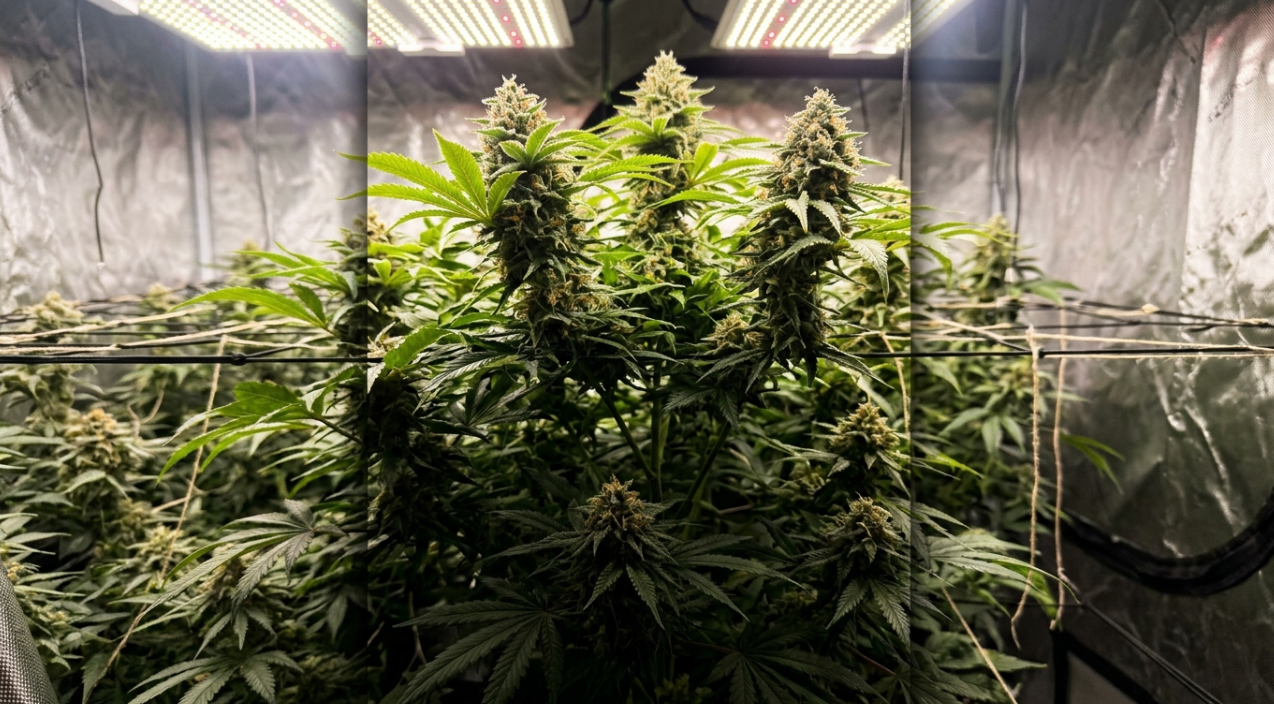
The physics here are simple but punishing. A well-positioned overhead LED or HPS fixture might deliver 600 to 1,000 µmol/m²/s of PPFD at the canopy surface. By the time those photons pass through several layers of fan leaves and cola tops, intensity drops to just 100 to 200 µmol/m²/s at the lower branches. That is below the threshold cannabis needs to produce dense, resinous flower.
The result is what growers call “popcorn buds,” small, airy, low-potency flowers that lack the density and trichome coverage of top-canopy colas. Popcorn buds typically end up as trim or extraction material, selling for a fraction of what premium flower commands.
For decades, the standard workaround has been lollipopping, the aggressive removal of lower growth to redirect the plant’s energy toward top colas. It works, but it solves the problem by discarding potential yield rather than recovering it. Cannabis lower bud lighting takes the opposite approach: instead of removing the growth, you give it the light it needs to develop fully.
How Under-Canopy Lighting Works
Under-canopy lighting uses low-wattage LED bars, typically ranging from 60 to 160 watts, positioned at or near substrate level and angled upward into the canopy. This creates a second photosynthetically active plane below the plant, delivering 200 to 300 µmol/m²/s of supplemental PPFD directly to shaded bud sites. Combined with whatever residual light filters down from above, lower bud zones reach the 350 to 450 µmol/m²/s range, enough for meaningful flower development.
Key setup parameters include:
Mounting height: 8 to 12 inches above the substrate
Installation timing: Typically activated days 14 to 21 into the flowering cycle
Fixture wattage: 60 to 160W per bar, depending on canopy density and spacing
Purpose-built fixtures like the Boost XE are designed specifically for this application, running cool enough for close placement within the canopy without creating heat pockets that stress plants.
It is worth noting the terminology distinctions here. Sub-canopy lighting (SCL) refers specifically to bars placed below the canopy and pointing upward. Inter-canopy lighting (ICL) describes fixtures positioned within the canopy itself, often between plant rows. “Intra-canopy lighting” is a catch-all that covers both approaches. Research suggests SCL tends to be most efficient for raw yield and THC production, while ICL can deliver strong return on investment for yield improvements. Most commercial growers default to the sub-canopy configuration.
How to Measure Light at Lower Bud Sites
Measuring photosynthetic photon flux density (PPFD) at different canopy heights helps growers determine whether lower flowering sites receive substantially less light than upper plant sections. It also provides a way to evaluate whether supplemental lighting improves light distribution.
PPFD measures the number of photosynthetically active photons reaching a surface each second. It is expressed in micromoles per square meter per second (µmol/m²/s).
Where to Measure PPFD
A useful assessment compares light levels at several positions throughout the canopy rather than relying on a single measurement at the top.
Measurement position | What it helps reveal |
|---|---|
Upper canopy | The intensity delivered by the primary lighting system |
Middle canopy | How much light reaches intermediate plant sections |
Lower flowering zone | Whether lower bud sites receive substantially less light |
Interior canopy | How light distribution changes in heavily shaded areas |
Lower canopy with supplemental lighting | How the additional fixtures change light availability |
Take measurements using a suitable quantum sensor and follow a consistent measurement procedure. Keep the sensor orientation, position, fixture operating conditions, and measurement locations consistent when comparing results.
PPFD and DLI Are Different Measurements
PPFD describes instantaneous light intensity. Daily light integral (DLI) measures the total quantity of photosynthetically active photons received over an entire day.
DLI is expressed in mol/m²/day. When PPFD remains constant throughout a lighting period, it can be estimated using this formula:
DLI = PPFD × lighting hours × 3,600 ÷ 1,000,000
For example, a constant PPFD of 300 µmol/m²/s maintained for 12 hours corresponds to a DLI of 12.96 mol/m²/day at the measurement location.
This is a mathematical example, not a recommended lower-canopy target. Actual DLI depends on the measured light level over time, and fluctuating light requires an appropriate time-integrated measurement or calculation.
How to Interpret the Measurements
A large difference between upper and lower canopy PPFD indicates uneven light distribution, but it does not automatically mean supplemental lighting will be profitable. The crop's response depends on factors such as leaf area, canopy architecture, environmental conditions, and the amount of additional light supplied.
After installing supplemental fixtures, repeat the measurements at the same locations. Compare the change in lower-canopy light availability with harvested flower yield, quality measurements, and additional electricity consumption.
This process helps determine whether the supplemental lighting system addresses a real production limitation rather than simply increasing the total amount of light delivered to the room.
Measured Results: What the Data Shows
The evidence base for cannabis lower bud lighting has grown beyond anecdotes. Multiple academic studies and large-scale commercial trials now quantify the benefits.
Yield Gains: What Published Research Shows
Supplemental lighting within the cannabis canopy can increase harvestable flower production when lower plant sections receive additional usable light. However, the magnitude of the response depends on the lighting treatment, cultivar, canopy structure, and growing environment.
A 2025 study published in Plants compared conventional overhead lighting with subcanopy lighting (SCL) and inter-canopy lighting (ICL). Researchers reported the following increases in dry inflorescence yield relative to the overhead-lighting treatment:
Lighting treatment | Increase in dry inflorescence yield |
|---|---|
Subcanopy lighting | 24.58% |
Inter-canopy lighting | 29.95% |
The same study reported an increase in total THC production of 18.67% with subcanopy lighting and 24.42% with inter-canopy lighting. Total terpene concentration and terpene production should be interpreted separately because concentration and total compound yield do not measure the same outcome.
These results demonstrate the potential of supplemental lighting to increase production under controlled experimental conditions. They do not establish a guaranteed yield increase for every commercial facility.
For commercial growers, the next step is to determine whether the additional harvestable flower generated by supplemental lighting is sufficient to offset equipment, electricity, maintenance, and other operating costs. A facility's own replicated harvest data provides a stronger basis for investment decisions than a yield estimate taken from another growing environment.
Quality Improvements: Flower Uniformity and Cannabinoid Production
The value of under-canopy lighting is not limited to total dry flower weight. Supplemental light can also change how harvestable biomass and chemical compounds are distributed throughout the plant.
In a 2025 controlled study, subcanopy and inter-canopy lighting increased total dry inflorescence yield and total cannabinoid production compared with overhead lighting alone. Inter-canopy lighting produced the largest reported increase in dry inflorescence yield, at 29.95%, and total THC production, at 24.42%.
The study also found reduced variability in several production and chemical-profile measurements. These findings suggest that supplemental lighting may help facilities produce more consistent crops, although the magnitude of the benefit will depend on the growing system and cultivar.
Growers should distinguish three measurements when evaluating results:
Dry flower yield: The total weight of harvested and dried flower.
Cannabinoid concentration: The proportion of a particular cannabinoid in a measured flower sample.
Total cannabinoid yield: The total amount of a cannabinoid produced across the harvested crop.
These measurements answer different questions. More total THC can result from producing more flower even if the THC concentration does not increase. For commercial operations, evaluating both laboratory results and the amount of saleable flower provides a more complete picture of whether supplemental lighting improves product value.
Under-Canopy Lighting ROI and Payback
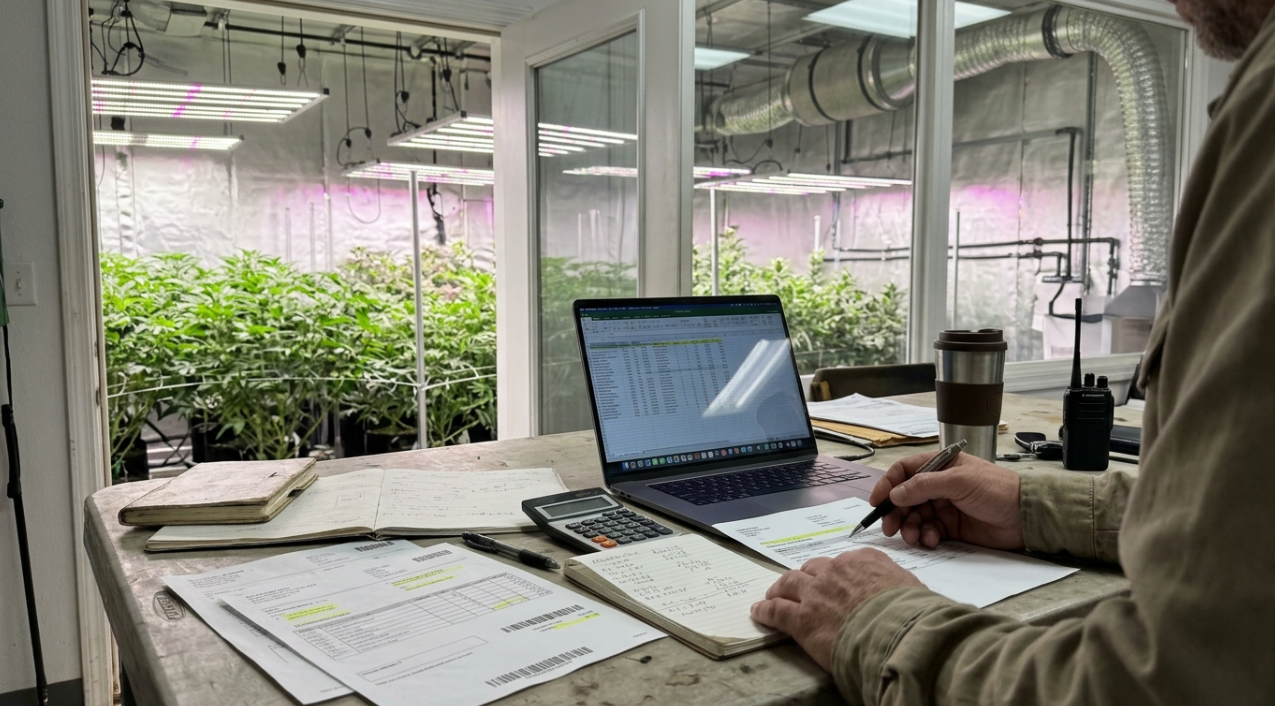
Under-canopy lighting ROI depends on how much additional saleable flower the system produces, the value of that flower, and the additional costs required to operate the equipment.
A higher harvest weight does not automatically produce a higher profit. The additional flower must have market value, and the value generated must exceed the incremental operating costs and investment.
What to Include in the Calculation
Variable | What to measure |
|---|---|
Initial equipment cost | Supplemental fixtures, drivers, wiring, controls, and installation |
Additional saleable yield | Incremental dry flower that can actually be sold |
Net selling price | Realized price after relevant discounts and selling costs |
Additional electricity | Energy consumed by supplemental fixtures during the evaluation period |
Additional labor | Any changes in pruning, harvesting, trimming, and maintenance costs |
Other operating costs | Repairs, replacement parts, and other incremental expenses |
Evaluation period | One harvest, several harvests, or the expected equipment life |
Formula for Incremental Profit
Incremental operating profit per harvest can be estimated as:
Incremental operating profit = additional saleable flower revenue − additional operating costs
Additional operating costs should include incremental electricity, labor, maintenance, and other recurring expenses attributable to the lighting system.
To estimate simple payback:
Payback period in harvests = initial installed cost ÷ incremental operating profit per harvest
This calculation assumes incremental operating profit remains reasonably consistent across harvests. It is not a discounted cash-flow analysis and does not account for financing costs, taxes, or changes in future selling prices.
Illustrative ROI Example
Suppose a facility evaluates a supplemental lighting system with an installed cost of $12,000. The following numbers are hypothetical and are intended to demonstrate the calculation, not to represent typical commercial results.
Variable | Illustrative assumption |
|---|---|
Initial installed cost | $12,000 |
Additional saleable flower per harvest | 10 lb |
Net selling price per additional pound | $800 |
Additional revenue per harvest | $8,000 |
Additional electricity and other operating costs | $2,000 |
Incremental operating profit per harvest | $6,000 |
Simple payback period | 2 harvests |
In this example, the system generates $8,000 in additional revenue and incurs $2,000 in incremental operating costs per harvest. That leaves $6,000 in incremental operating profit per harvest.
Dividing the $12,000 installed cost by $6,000 in incremental operating profit gives a simple payback period of two harvests.
The result would change if the facility produced less additional saleable flower, received a lower selling price, or incurred higher electricity costs.
How to Evaluate Your Own Lighting System
Use measured harvest data and actual operating costs wherever possible. Compare similar production cycles, account for differences in cultivar and environmental conditions, and distinguish additional saleable flower from material that receives no additional commercial value.
For a more detailed breakdown, see our under-canopy lighting ROI guide. Facilities evaluating an installation may also wish to investigate available utility rebates, subject to eligibility and current program requirements.
For a deeper breakdown of the economics, the under-canopy lighting ROI guide walks through the full payback calculation. Many facilities also qualify for utility rebates that further reduce upfront cost.
What Affects Under-Canopy Lighting Performance?
Under-canopy lighting performance depends on more than fixture wattage. The amount of usable light reaching lower flowering sites, the crop's response to that light, and the cost of delivering it all influence the final result.
Canopy Density and Light Distribution
Dense canopies can create substantial differences in light availability between upper and lower plant sections. However, the benefit of supplemental lighting depends on the actual light deficit and whether the shaded plant material can use additional photons productively.
Measure light distribution throughout the canopy before choosing a fixture configuration.
Cultivar and Plant Architecture
Cannabis cultivars differ in plant height, branching patterns, leaf arrangement, and flowering characteristics. These differences affect how light travels through the canopy and where supplemental fixtures may be useful.
A lighting arrangement that performs well in one production system may not deliver the same results in another. Evaluate the system against the facility's own cultivars and production conditions.
Environmental Conditions
Additional light can increase photosynthetic demand, but the crop must have suitable environmental conditions to use that light effectively. Carbon dioxide availability, temperature, humidity, irrigation, and nutrient management all influence plant performance.
Lighting should therefore be evaluated alongside the existing environmental management system rather than as an isolated upgrade.
Fixture Efficiency and Installation
Fixture wattage alone does not establish how effectively a system delivers usable light to lower flowering sites. Fixture efficacy, optical distribution, mounting position, coverage, and operating hours all affect performance.
When comparing equipment, consider the amount of light delivered to the intended plant area relative to electricity consumption, as well as installation requirements and maintenance.
Electricity Costs and Product Value
The commercial value of supplemental lighting depends on the additional saleable product generated relative to the system's total cost.
A facility with high electricity rates or limited improvement in saleable yield may experience a longer payback period than a facility with lower energy costs and a larger improvement in product value.
For this reason, evaluate both crop performance and operating economics before committing to a full installation.
Practical Considerations for Cannabis Lower Bud Lighting
Environment Comes First
Under-canopy lighting does not guarantee higher yields. Additional photons can support photosynthesis only when the crop has suitable growing conditions, including adequate carbon dioxide availability, appropriate temperature and humidity, effective irrigation, and balanced nutrition.
Growers should evaluate these factors before increasing light delivery. If the crop is already limited by another environmental variable, supplemental fixtures may add electricity costs without producing a proportional increase in harvestable flower.
Track environmental conditions and harvest outcomes together so that changes in yield can be evaluated against the lighting treatment and other production variables.
Spectrum Matters
The spectral distribution of a supplemental fixture can influence how plants respond to additional light. Red, blue, green, and far-red wavelengths differ in their effects on photosynthesis, plant development, and light penetration through foliage.
However, spectrum should not be evaluated in isolation. Total photon delivery, fixture efficacy, mounting position, canopy structure, and the crop's response all influence performance.
When comparing under-canopy fixtures, examine the manufacturer's spectral data and photon output rather than choosing a product based on color temperature or marketing terminology alone. Where possible, compare crop yield and quality results under the actual operating conditions in which the fixture will be used. Understanding how light spectrum affects plant growth helps growers make informed fixture choices rather than defaulting to red-heavy bars.
Pruning Strategy Changes
Here is a nuance that catches new adopters off guard: cannabis lower bud lighting changes your pruning approach. Growers accustomed to aggressively stripping lower growth need to recalibrate. When under-canopy lighting is present, some of that lower canopy material that would have been removed can now become productive. The shift is not about abandoning defoliation, it is about being more selective and leaving bud sites that now have enough light to develop fully.
Heat and Power at Scale
Modern LED under-canopy bars run cool enough for close placement, but they still add heat inside the canopy zone. Low-wattage fixtures with passive cooling are the standard choice for this reason. At facility scale, adding dozens or hundreds of supplemental bars also creates wiring and power distribution complexity. Centralized power platforms like OptiDrive can simplify deployment by moving drivers out of the grow space, reducing both the electrical footprint and in-room heat load.
Common Under-Canopy Lighting Problems and What to Check
Observed problem | Possible explanation | What to investigate |
|---|---|---|
Lower flowers remain underdeveloped | Lower-canopy light availability may still be inadequate | Measure PPFD at representative lower flowering sites and review fixture coverage |
Electricity costs increase without a meaningful yield improvement | Additional light may not be addressing the crop's main production limitation | Compare energy use, harvestable yield, and other environmental conditions |
Results differ significantly between cultivars | Differences in plant architecture and crop response may affect light distribution | Evaluate the lighting configuration separately for each cultivar |
Flower production improves but product value does not | Additional yield may not meet the required quality or market specifications | Compare saleable yield, laboratory results, and realized selling prices |
Some areas receive much more supplemental light than others | Fixture spacing, positioning, or canopy structure may create uneven coverage | Map light distribution at multiple canopy positions |
Maintenance or installation costs exceed expectations | Wiring, mounting, access, or fixture servicing may have been underestimated | Review the installation plan and full operating-cost assumptions |
These observations are diagnostic starting points, not proof that lighting is the cause of a production problem. Compare measurements and crop records before changing the system.
Related Terms
Popcorn buds: Small, fluffy buds caused by insufficient light at lower nodes. The primary symptom that cannabis lower bud lighting addresses.
Lollipopping: The practice of removing lower growth to redirect energy upward. Under-canopy lighting offers a yield-additive alternative.
PPFD (Photosynthetic Photon Flux Density): The measure of usable light reaching plant tissue, expressed in µmol/m²/s. The core metric for evaluating lower bud lighting effectiveness. For targets by growth stage, see the cannabis light intensity guide.
DLI (Daily Light Integral): Total photon delivery over a full day. Under-canopy lighting increases DLI for lower plant zones that would otherwise fall short.
Canopy light attenuation: The progressive drop in light intensity as photons pass through leaf layers, the root cause of poor lower bud development.
For deeper technical reading on these concepts, explore the whitepapers library.
Evaluate Under-Canopy Lighting for Your Facility
Under-canopy lighting can improve light distribution and increase harvestable flower production, but the financial outcome depends on your existing lighting system, canopy structure, electricity costs, and the value of the additional saleable yield.
If you are evaluating supplemental lighting for a commercial cultivation facility, schedule a consultation with Thrive Agritech to discuss your lighting requirements, installation considerations, and potential return on investment.
A useful evaluation should consider light distribution, fixture performance, additional energy consumption, and expected crop outcomes rather than relying on yield projections alone.
FAQ: Cannabis Lower Bud Lighting
What is cannabis lower bud lighting?
Cannabis lower bud lighting uses supplemental fixtures beneath or within the plant canopy to improve light delivery to shaded flowering sites. Also known as under-canopy lighting, it complements overhead fixtures and can improve lower-canopy flower production when insufficient light is limiting growth.
How much can under-canopy lighting increase cannabis yield?
The increase depends on the cultivar, lighting configuration, canopy structure, and growing environment. A 2025 controlled study reported a 24.58% increase in dry inflorescence yield with subcanopy lighting and a 29.95% increase with inter-canopy lighting compared with overhead lighting alone. These experimental results should not be treated as guaranteed commercial outcomes.
Does under-canopy lighting increase THC potency?
Under-canopy lighting can increase total cannabinoid production by increasing the amount of harvested flower. However, total cannabinoid yield and cannabinoid concentration are different measurements. Growers should evaluate both laboratory-measured cannabinoid concentrations and total harvested production when assessing the effect on product quality.
What PPFD should lower cannabis buds receive?
There is no single PPFD target that applies to every lower-canopy growing environment. The appropriate light level depends on the cultivar, existing overhead illumination, supplemental fixture output, canopy structure, and environmental conditions. Measure PPFD at representative lower flowering sites and evaluate the crop's response rather than relying on fixture wattage alone.
How do you measure light at lower bud sites?
Use a suitable quantum sensor to measure PPFD at multiple positions throughout the canopy, including upper, middle, lower, and interior sections. Keep measurement positions and conditions consistent when comparing lighting configurations. Repeating the measurements after adding supplemental fixtures helps establish how much additional light reaches the intended flowering sites.
Does under-canopy lighting replace lollipopping?
Not necessarily. Under-canopy lighting can make some shaded flowering sites more productive, but selective pruning may still be useful for managing plant structure, airflow, and unproductive growth. The appropriate combination depends on canopy architecture and the production system.
Is under-canopy lighting worth the electricity cost?
It can be worthwhile when the additional saleable flower and other measurable benefits exceed the incremental operating costs and investment. Evaluate additional revenue, electricity consumption, labor, maintenance, equipment cost, and the realized value of the harvested product. A facility-specific ROI calculation is more reliable than assuming a standard payback period.
What is the difference between subcanopy and inter-canopy lighting?
Subcanopy lighting places supplemental fixtures below the canopy, directing light upward toward shaded plant sections. Inter-canopy lighting places fixtures within the canopy to illuminate middle and lower plant areas. The effectiveness of each approach depends on fixture placement, canopy structure, light distribution, and the growing environment.
When should under-canopy lighting be evaluated?
Evaluate supplemental lighting when measurements indicate that lower-canopy light availability may be limiting harvestable flower production. Establish a baseline for light distribution, electricity use, and harvest results before comparing the performance of a supplemental system.
The appropriate timing and operating schedule depend on the lighting design and crop response rather than a universal flowering-day recommendation.
Ready to evaluate how cannabis lower bud lighting fits your facility? Schedule a free consultation with a lighting expert to discuss your specific setup and goals.