Greenhouse Lighting for Cucumbers: 2026 DLI & PPFD Guide
Greenhouse Lighting for Cucumbers: DLI 20–30, PPFD 300–600, 16–20h photoperiod, 9:1 red–blue, interlighting gains. Get the full glossary now.
TL;DR
Greenhouse cucumbers need 20 to 30 mol/m²/d of daily light for production-stage fruiting, with PPFD targets ranging from 150 µmol/m²/s for seedlings up to 600 µmol/m²/s during fruit set. Optimal photoperiod falls between 16 and 20 hours. A red-to-blue spectrum ratio of roughly 9:1 supports strong seedling growth, while interlighting can boost yields by 10 to 24%. This glossary covers every key lighting term cucumber growers need, backed by research-grade numbers.
Cucumbers are among the most light-hungry greenhouse crops. They grow fast, produce dense canopies, and respond dramatically to both the quantity and quality of photons they receive. Getting the lighting wrong doesn’t just reduce yield. It can trigger source-sink imbalances that produce excessive foliage at the expense of fruit, a problem that practitioners frequently flag as devastating to ROI.
This glossary covers every term a commercial grower needs to understand greenhouse lighting for cucumbers, from foundational measurements through spectrum science to system economics. Each entry includes the specific numbers and thresholds that matter for cucumber production.
Explore the Altus 1K for greenhouse supplemental toplighting applications.
Greenhouse Cucumber Lighting: Quick Answer
Greenhouse cucumbers generally perform well with a production-stage DLI of about 20–30+ mol/m²/d, while supplemental-lighting PPFD commonly falls in the 300–600 µmol/m²/s range during flowering and fruiting. Seedlings need substantially less light, typically around 6–10 mol/m²/d DLI. A total photoperiod of roughly 16–18 hours per day is commonly used in commercial production, although the optimal schedule depends on natural sunlight, cultivar, climate, electricity costs, and the target DLI.
For high-wire cucumbers, interlighting can supplement toplighting by delivering photons directly into the lower canopy, where dense foliage can otherwise limit light penetration. Spectrum also matters: cucumbers need sufficient blue light for normal development, while red and far-red wavelengths influence photosynthesis and plant morphology.
The most important principle is to manage DLI, PPFD, photoperiod, spectrum, and light distribution together rather than treating any one measurement as the complete lighting target.
Cucumber Lighting Requirements by Growth Stage
Cucumber lighting requirements increase as plants move from propagation into active vegetative growth, flowering, and fruit production. The following ranges provide practical starting points rather than universal setpoints.
Growth Stage | DLI Target | PPFD Starting Range | Typical Photoperiod |
|---|---|---|---|
Early seedlings | 6–10 mol/m²/d | 150–250 µmol/m²/s | 14–16 hours |
Late seedlings / transplants | 10–15 mol/m²/d | 200–300 µmol/m²/s | 14–18 hours |
Vegetative growth | 15–20+ mol/m²/d | 200–400 µmol/m²/s | 16–18 hours |
Flowering | 18–25+ mol/m²/d | 300–500 µmol/m²/s | 16–18 hours |
Fruiting / production | 20–30+ mol/m²/d | 300–600 µmol/m²/s | 16–18 hours |
These are starting ranges, not fixed prescriptions. Natural solar radiation, cultivar, canopy density, CO₂ concentration, temperature, greenhouse glazing, fixture efficacy, and electricity cost should all be considered when setting a commercial lighting program.
DLI vs. PPFD: Which Number Should Cucumber Growers Use?
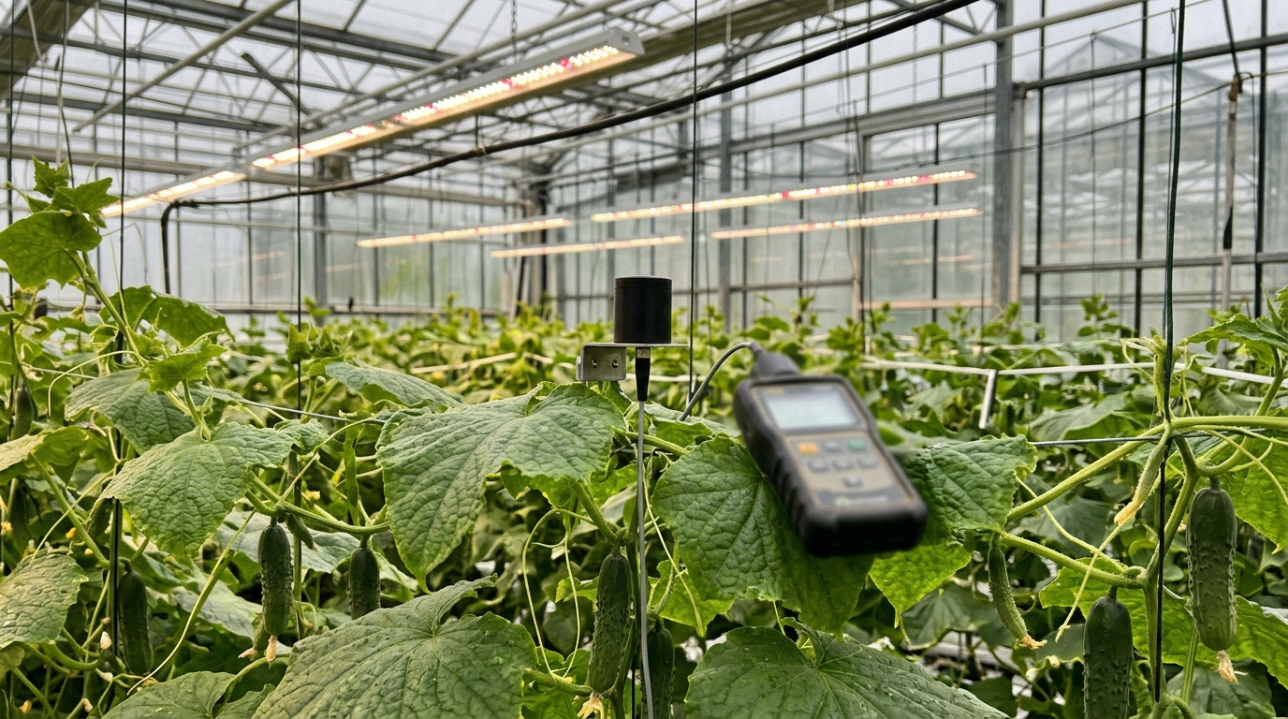
PPFD and DLI measure different aspects of the same lighting environment.
PPFD measures instantaneous light intensity. It tells you how many photosynthetically active photons reach the canopy each second.
DLI measures accumulated light. It tells you the total number of photosynthetically active photons delivered to one square meter over an entire day.
For cucumber production, DLI is usually the better metric for determining whether the crop is receiving enough total daily light, while PPFD is useful for setting fixture intensity and checking whether light is distributed appropriately across the canopy.
A greenhouse can therefore have a suitable PPFD but still miss its DLI target if the lights operate for too few hours. Conversely, a lower PPFD running for a longer photoperiod can produce the same daily photon total.
DLI Formula
DLI = PPFD × hours of light × 0.0036
For example, a cucumber canopy receiving 400 µmol/m²/s for 18 hours would receive:
400 × 18 × 0.0036 = 25.92 mol/m²/d
That puts the crop within the commonly targeted production range of approximately 20–30+ mol/m²/d.
How Much Supplemental Light Do Cucumbers Need?
The amount of supplemental lighting required depends on the difference between the crop's target DLI and the DLI supplied naturally by sunlight.
A simple approach is:
Supplemental DLI required = Target DLI − Natural greenhouse DLI
If the crop target is 25 mol/m²/d and the greenhouse receives 10 mol/m²/d from sunlight, the lighting system needs to provide approximately:
25 − 10 = 15 mol/m²/d of supplemental light
The required PPFD and operating hours can then be calculated from the available lighting period.
For example, providing 15 mol/m²/d over 16 hours requires approximately:
15 ÷ (16 × 0.0036) = 260 µmol/m²/s
This calculation should be treated as a starting point. Natural sunlight changes throughout the day and season, so commercial systems are generally better controlled using radiation sensors or DLI-based automation rather than a fixed output every day.
Light Measurement Fundamentals
PAR (Photosynthetically Active Radiation)
PAR refers to the wavelengths of light between 400 and 700 nanometers that plants use for photosynthesis. It’s not a unit of measurement itself but rather a defined range. Think of PAR as the “menu” of light wavelengths a cucumber plant can actually eat.
Why it matters for cucumbers specifically: cucumber leaves are broad and arranged to maximize light capture, but their rapid canopy growth means lower leaves quickly fall into PAR deficit. Understanding PAR is the foundation for every other lighting metric in this glossary. For a deeper dive into measuring this range, see our PAR vs. PPFD guide.
PPFD (Photosynthetic Photon Flux Density)
PPFD measures the number of photosynthetically active photons hitting one square meter of canopy per second, expressed in µmol/m²/s. It’s the “speedometer” of your lighting system, telling you how much light is arriving at any given moment.
Cucumber-specific PPFD targets vary by growth stage:
Seedlings: 150 to 250 µmol/m²/s
Vegetative growth: 200 to 400 µmol/m²/s
Flowering and fruiting: 300 to 600 µmol/m²/s
A commonly cited baseline PPFD for greenhouse cucumber production is 230 µmol/m²/s, though this is a minimum average rather than an upper target. Growers pushing for maximum winter production will aim for the higher end of each range.
DLI (Daily Light Integral)
DLI is the total number of photosynthetically active photons delivered to one square meter over a full day, measured in mol/m²/d. If PPFD is the speedometer, DLI is the odometer. It tells you how much total light your cucumbers received in 24 hours, which is what actually drives growth and yield.
The DLI calculation formula:
DLI = PPFD × photoperiod (in seconds) ÷ 1,000,000
Or more practically: DLI = PPFD × hours of light × 0.0036
Cucumber DLI targets by growth stage:
Growth Stage | DLI Target (mol/m²/d) |
|---|---|
Early seedlings | 6 to 10 |
Late seedlings / transplants | 10 to 15 |
Production (fruiting) | 20 to 30+ |
Research from the University of Guelph recommended a DLI of 6.35 mol/m²/d for cucumber plug seedlings, achievable with a PPFD of 110 to 125 µmol/m²/s over a 14 to 16 hour photoperiod. Production-stage plants need three to five times that amount.
This staged DLI progression is critical. Jumping straight to production-level light on young transplants wastes energy and can cause stress. For a full walkthrough of DLI calculations and targets across crops, see our DLI formula and conversion guide.
Light Uniformity
Light uniformity describes how evenly PPFD is distributed across the growing area, typically expressed as a percentage variance (for example, ±10%). Poor uniformity means some plants get significantly more light than others.
For cucumbers, uneven light produces uneven fruit size and maturity, which creates harvesting headaches and inconsistent pack-outs. In high-wire cucumber systems where rows can be 10 to 12 feet tall, maintaining uniformity is especially challenging because the canopy architecture itself creates deep shade zones. A target of ±5% to ±10% PPFD variance across the growing area is considered good practice.
Our uniformity metrics guide covers measurement methods and acceptable thresholds in detail.
Signs Greenhouse Cucumbers Are Not Getting Enough Light
Insufficient light affects cucumber growth before growers necessarily see an obvious yield decline. Common signs include:
Excessive stem elongation and stretched growth
Larger gaps between leaves
Thin or weak foliage
Reduced lower-canopy photosynthesis
Poor flower and fruit development
Slower fruit production
Uneven fruit size
A lower-than-target daily light integral
The most reliable way to diagnose low-light conditions is to measure PPFD at canopy level and calculate DLI over the complete day.
Visual symptoms alone are not enough to determine whether the problem is light intensity, spectrum, temperature, nutrition, CO₂, or another environmental factor.
Photoperiod and Timing
Photoperiod
Photoperiod is the total number of hours a plant receives light in a 24-hour cycle. For greenhouse cucumbers, there’s a meaningful gap between what research shows is optimal and what commercial operations typically run.
Research-optimal range: 16 to 20 hours
Commercial practice: 14 to 18 hours
The difference comes down to economics. Research from Lanoue et al. (2021) found that photoperiods of 18 to 20 hours produced excellent results in controlled settings, but running supplemental lights for 20 hours a day in a commercial greenhouse gets expensive fast. Agriculture Canada researchers have pointed out that higher DLIs may further increase yield but not necessarily profits, because the additional yield gain may not justify the input costs.
The right photoperiod for your operation depends on your electricity rate, natural daylight contribution, heating strategy, and cultivar. Most growers in northern latitudes running supplemental greenhouse lighting for cucumbers land on 16 to 18 hours total during winter months, including natural daylight.
Continuous Light (CL)
Continuous light means running 24 hours of illumination with no dark period. Most greenhouse crops, particularly tomatoes, suffer leaf injury (chlorosis and necrosis) under continuous light. Cucumbers are different.
Research has shown that greenhouse cucumbers tolerate continuous light better than most fruiting vegetables. In trials by Lanoue et al. (2021), mini-cucumber cultivar “Bonwell” grown under continuous light treatments produced similar yields compared to control plants on standard photoperiods. The key caveat: continuous light can still cause leaf chlorosis unless growers use a thermoperiod (temperature cycling) or alternate the light spectrum during the extended hours.
The researchers used dynamic spectral strategies, alternating between red-dominant and blue-dominant light during the continuous period, to avoid injury. This is emerging science, not standard commercial practice. But it signals that cucumber growers may eventually have more flexibility with photoperiod than they currently assume.
DLI-Based Lighting Control
Rather than running supplemental lights on a fixed timer, DLI-based control adjusts light output in response to real-time solar radiation. On cloudy days, LEDs run longer or brighter. On sunny days, the system dims or shuts off to avoid wasting electricity.
The results are significant. Research by van Iersel and Gianino found that automated DLI-based LED control achieved 20 to 92% electricity cost reductions compared to fixed schedules, depending on the target DLI and natural light conditions. For cucumber growers chasing a production DLI of 20 to 30 mol/m²/d, this approach keeps daily light consistent while cutting the energy bill substantially during shoulder seasons when natural light is variable.
For more on managing supplemental hours, see our greenhouse lighting schedule guide.
Spectrum
Light spectrum describes the wavelength composition of the photons reaching your crop. Cucumbers respond to specific wavelength ranges in distinct ways, and getting the spectrum right matters as much as getting the intensity right.
Full-Spectrum White Light
Full-spectrum white LEDs emit a broad wavelength distribution that approximates sunlight, covering blue, green, red, and everything between. The practical advantage is twofold: plants receive balanced spectral input without manual tuning of individual color channels, and the working environment for greenhouse staff is dramatically better than under pink or purple lights.
Research confirms that plants grown under white light develop photosynthetic and physiological characteristics comparable to or better than those under narrow-band red-only light. For a broader look at how spectrum affects plant development, our light spectra impact summary covers the research across crop types.
Red Light (600 to 700 nm)
Red photons are the primary driver of photosynthesis and biomass accumulation in cucumbers. They’re absorbed efficiently by chlorophyll and converted to chemical energy at high rates. Most photosynthetic activity in a cucumber leaf is powered by red light.
However, monochromatic red light alone causes problems. Studies have documented “red light syndrome,” where plants grown under only red wavelengths develop low photosynthetic capacity and unresponsive stomata. The fix is straightforward: add blue.
Blue Light (400 to 500 nm)
Blue light controls several processes that red light cannot. It drives chloroplast development, chlorophyll synthesis, and stomatal opening. Research published in Frontiers in Plant Science found that photosynthetic capacity was highest in cucumber leaves treated with blue light, positively correlated with leaf thickness, nitrogen concentration, and chlorophyll content.
For greenhouse cucumber lighting, blue light is the morphological regulator. It keeps plants compact, prevents excessive stretching, and ensures stomata function properly for gas exchange. Most growers underestimate how much blue light matters.
Far-Red Light (700 to 750 nm)
Far-red wavelengths sit just outside the traditional PAR range but have pronounced effects on cucumber morphology. Far-red increases hypocotyl elongation, plant height, and overall leaf area while decreasing leaf width.
Here’s the complication: some cucumber cultivars are sensitive to far-red exclusion and fail to develop normal morphology when far-red is absent from the spectrum. This means the light spectrum a grower chooses can interact with cultivar genetics in unexpected ways. If you’re growing a cultivar that responds poorly under a spectrum that excludes far-red, adding it back (even in small amounts) can restore normal growth patterns.
Red:Blue Ratio
The ratio of red to blue photons in a supplemental lighting spectrum has a measurable impact on cucumber seedling quality. Research has found that a 9R:1B ratio (90% red, 10% blue) produced the best growth in cucumber seedlings compared to other combinations.
This is a useful starting benchmark, but production-stage plants under glass receive substantial natural blue light from sunlight, so the supplemental ratio matters most during propagation and in deep-winter conditions where natural light is minimal.
Lighting System Types
Supplemental Lighting
Supplemental lighting fills the gap between the natural sunlight available in a greenhouse and the DLI target a crop requires. For cucumbers, the need is greatest in winter and during extended cloudy periods, when natural DLI can drop below 5 mol/m²/d in northern latitudes.
Alabama Extension researchers have confirmed that cucumber yield suffers significantly in winter with low light levels, making supplemental lighting the primary tool for year-round production consistency. The question is never whether cucumbers benefit from supplemental light. It’s how much supplemental light is economically justified.
Toplighting
Toplighting places fixtures above the canopy, directing light downward. This is the standard approach for greenhouse cucumber supplemental lighting and works well for crops in early growth stages or lower-wire training systems.
For high-wire cucumbers that can reach 10 to 15 feet, toplighting alone has limitations. Light intensity drops with distance and the dense upper canopy blocks photons from reaching productive lower leaves. Typical toplighting installations for cucumbers use 600W to 1050W LED fixtures. The Altus 1K is one example of a commercial greenhouse toplighting fixture designed for this application.
Interlighting (Under-Canopy Lighting)
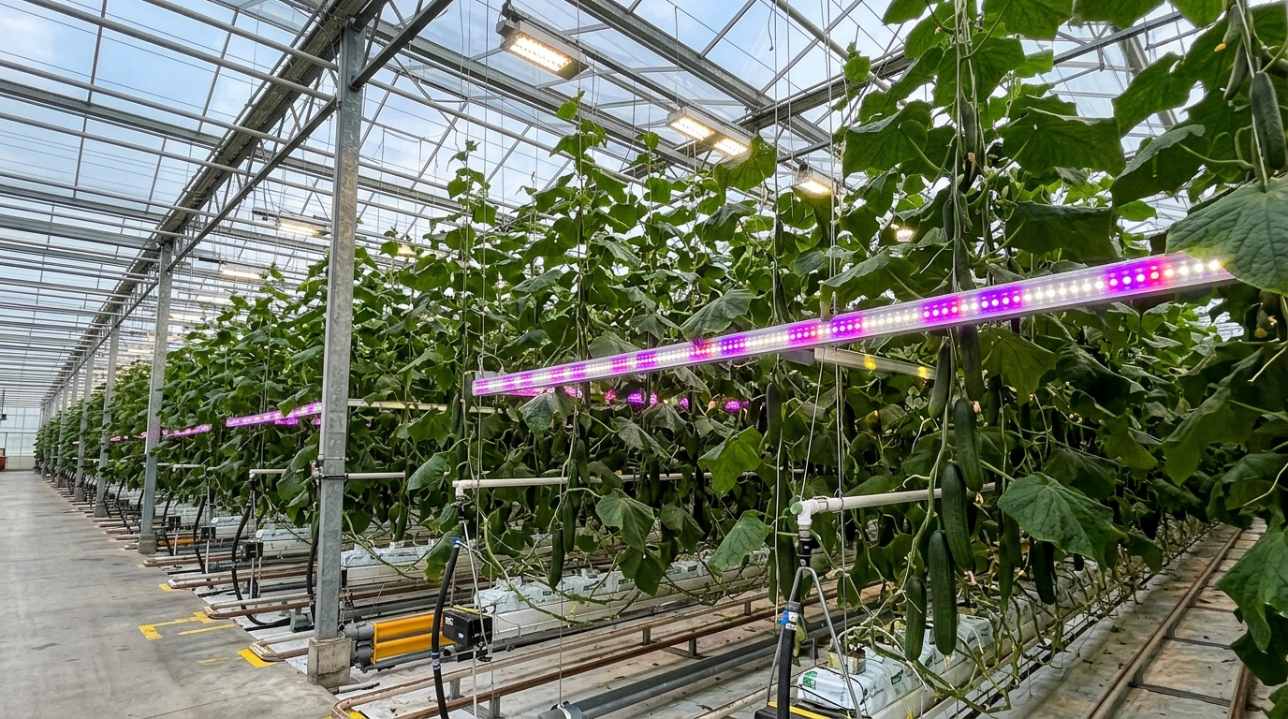
Interlighting places supplemental fixtures within the crop canopy rather than above it. For high-wire cucumber systems, this is where the biggest efficiency gains are possible.
Dense cucumber canopies shade their own lower leaves, reducing photosynthesis in tissue that could otherwise contribute to fruit production. Interlighting addresses this directly. Greenhouse trials have found that LED intercanopy lighting improved cucumber yields by up to 24% under high light conditions. Separate research showed that LED interlighting increased plant CO₂ net assimilation by 40% compared to plants under natural greenhouse light alone.
The early yield data is particularly compelling: one trial documented an 11.6% early yield increase from LED interlighting, with all LED interlighting treatments improving fruit visual quality. For a synthesis of the research supporting this approach, see our article on under-canopy lighting results.
See the Boost XE, an under-canopy lighting bar designed for high-wire greenhouse and indoor growing systems.
LED vs. HPS
High-pressure sodium (HPS) fixtures were the greenhouse standard for decades. LEDs have largely overtaken them on efficiency, spectrum control, and longevity, but the comparison isn’t as simple as “LED always wins.”
Where LEDs are clearly better: A study by Kowalczyk et al. (2020) found that LED-LED combinations (toplighting plus interlighting) produced 32.55% higher production value relative to HPS, despite higher absolute variable costs. Separate research showed LEDs increased electricity use efficiency by approximately 20% in both summer and winter, with electricity consumption of 9.0 kWh/kg for LED-LED versus 10.9 kWh/kg for HPS-HPS.
The honest caveat: HPS fixtures produce significant radiant heat, which in cold climates partially offsets greenhouse heating costs during winter. Pure LED lighting reduces that waste heat, meaning the greenhouse heating system has to work harder. Research has confirmed that heating per unit yield rose significantly under LED-LED combinations in winter. This doesn’t negate the LED advantage, but it’s a real factor in cold-climate ROI calculations.
For growers considering the switch, our HPS to LED transition guide walks through the key considerations.
How to Design a Greenhouse Lighting System for Cucumbers
A practical cucumber lighting design can be built in seven steps:
1. Set the production DLI target
Start with the desired crop stage and production objective rather than choosing a fixture first.
2. Measure natural greenhouse DLI
Use a calibrated quantum sensor, PAR sensor, or suitable greenhouse radiation-monitoring system to determine how much light the crop already receives.
3. Calculate the supplemental DLI requirement
Subtract measured natural DLI from the target DLI.
4. Select the PPFD and photoperiod
Determine how much supplemental PPFD is needed during the available lighting window.
5. Design for canopy uniformity
Measure PPFD at multiple canopy positions rather than relying on the fixture's center reading.
6. Determine whether interlighting is necessary
Tall, dense cucumber canopies may benefit from fixtures positioned within the canopy to improve light penetration.
7. Model energy and climate impacts
Compare fixture efficacy, electricity cost, heating requirements, cooling load, expected yield response, maintenance, and available rebates before finalizing the system.
System Design and Economics
Fixture Efficacy (µmol/J)
Fixture efficacy measures how many photosynthetically active photons a fixture produces per joule of electrical energy consumed. Higher numbers mean more light per dollar of electricity. A fixture rated at 2.5 µmol/J or above is competitive by current commercial standards.
When comparing fixtures, check that the efficacy rating is for the complete fixture (including driver losses), not just the LED chip. The difference can be 10 to 15%.
HVAC Load
Switching from HPS to LED changes the thermal equation in a greenhouse. LEDs produce less radiant heat directed at the canopy, which reduces cooling demand during warm months. But it also means less “free” heat during winter.
Growers need to model both sides of this equation. In warm climates or summer production, the HVAC savings from LEDs can be substantial. In northern winter production, the heating cost increase may partially offset the lighting energy savings. Our HVAC sizing guide for LED lights explains how to calculate the thermal impact.
Centralized / Remote Power
Traditional LED fixtures contain their drivers (power converters) inside the fixture housing. Centralized or remote power systems relocate those drivers outside the growing space into a rack or panel.
The benefits for greenhouse cucumber operations are practical. Removing drivers from the fixture reduces weight above the canopy, cuts in-room heat, eliminates hundreds of potential failure points from the growing environment, and can simplify electrical installation. The OptiDrive system is one example of this architecture, designed to work across multiple fixture types.
ROI and Payback Period
For most commercial greenhouse operations, the payback period for a comprehensive LED retrofit typically ranges from 18 to 36 months. This is driven by reduced energy bills, zero bulb replacement costs, faster crop turnover, and the yield improvements that come from better light quality and distribution.
The ROI math for greenhouse cucumber lighting specifically benefits from two factors: cucumbers’ high DLI requirement means the energy savings from efficient LEDs compound quickly, and the documented yield gains from interlighting (10 to 24%) directly add revenue. For a detailed breakdown, see our greenhouse lighting payback guide.
Utility Rebates and Incentives
LED fixtures that meet DesignLights Consortium (DLC) efficacy thresholds often qualify for utility rebate programs that can offset 30 to 70% of fixture cost. These programs vary by utility and region but are widely available across North America. Check our rebate eligibility page to see what programs apply to your operation.
Source-Sink Balance
This isn’t a lighting term per se, but it’s the biological reality that governs whether more light actually means more profit. Cucumbers grow fast and can easily produce excessive vegetative growth (the “source”) at the expense of fruit (the “sink”). Too much light with the wrong spectrum balance pushes plants toward leafy growth, shading out fruit-bearing nodes and reducing marketable yield.
This is why spectrum matters as much as intensity. High red-to-blue ratios drive elongation and canopy density. Balanced spectra with adequate blue content promote compact, productive growth that directs energy toward fruit set rather than leaf expansion. The point of diminishing returns on supplemental light is real, and it’s defined by economics as much as biology.
Cucumber Seedling Quality Under Supplemental Light
Supplemental LED lighting during propagation pays dividends long before production begins. Research has shown that LED-supplemented cucumber seedlings developed shorter hypocotyls, larger leaf area, and thicker leaves compared to seedlings grown under solar light alone. Shoot fresh weight, root fresh weight, and seedling quality index increased by 30.8%, 3.2-fold, and 1.8-fold respectively when blue and UVA wavelengths were added to supplemental white light.
Stronger seedlings establish faster after transplant, which accelerates the transition to the high-DLI production phase. This early investment in propagation lighting often has the best return per dollar of any lighting spend in a cucumber operation.
Putting It All Together
Greenhouse lighting for cucumbers is not a single decision. It’s a system of interdependent choices: spectrum, intensity, duration, fixture placement, and control strategy all interact. The glossary above gives you the vocabulary and benchmarks to make those choices with confidence.
The core numbers worth memorizing: 20 to 30 mol/m²/d DLI for production, 300 to 600 µmol/m²/s PPFD during fruiting, 16 to 18 hours of photoperiod, and at least 10% blue in the spectrum. Everything else builds on those foundations.
Ready to design a cucumber lighting system? Schedule a free consultation with a Thrive lighting specialist to discuss your facility, targets, and budget.
Greenhouse Cucumber Lighting: Key Numbers at a Glance
Metric | Practical Reference |
|---|---|
Seedling DLI | 6–10 mol/m²/d |
Production DLI | 20–30+ mol/m²/d |
Seedling PPFD | 150–250 µmol/m²/s |
Fruiting PPFD | 300–600 µmol/m²/s |
Common total photoperiod | 16–18 hours/day |
DLI conversion factor | PPFD × hours × 0.0036 |
Example: 400 PPFD × 18 hours | 25.92 mol/m²/d |
Seedling red:blue benchmark | 9:1 |
Interlighting yield response reported in cited research | Approximately 10–24% |
These values should be treated as research and production benchmarks rather than universal setpoints. Actual requirements depend on cultivar, climate, natural sunlight, greenhouse environment, and production system.
Frequently Asked Questions
How much light do greenhouse cucumbers need?
Production-stage greenhouse cucumbers need a DLI of 20 to 30 mol/m²/d and a PPFD of 300 to 600 µmol/m²/s during fruiting. Seedlings require much less, starting around 6 to 10 mol/m²/d at 150 to 250 µmol/m²/s. These targets should increase progressively as the plant matures through vegetative and flowering stages.
What is the best photoperiod for greenhouse cucumbers?
Research supports 16 to 20 hours as the optimal photoperiod range. Most commercial operations run 14 to 18 hours total (natural daylight plus supplemental) depending on energy costs and climate. Cucumbers are more tolerant of extended photoperiods than tomatoes, giving growers some flexibility.
Can cucumbers grow under continuous light?
Emerging research shows that certain cucumber cultivars tolerate 24-hour continuous light without yield loss, provided the grower uses temperature cycling or alternating spectral strategies to prevent leaf chlorosis. This is not yet standard commercial practice, but it demonstrates cucumbers’ unusual photoperiod flexibility compared to other greenhouse fruiting crops.
What spectrum is best for greenhouse cucumber lighting?
A full-spectrum white light with a strong red component and at least 10% blue content covers the needs of most cucumber operations. Research points to a 9:1 red-to-blue ratio as optimal for seedling growth. Some cultivars also require far-red wavelengths for normal morphological development.
Does interlighting actually increase cucumber yields?
Yes. Multiple greenhouse trials have documented yield increases of 10 to 24% from LED interlighting in cucumber production. The benefit comes from delivering photons to lower canopy leaves that toplighting alone cannot reach, particularly in high-wire systems where the canopy is dense and tall.
How long does it take to pay back an LED lighting investment for cucumbers?
Most commercial greenhouse LED retrofits achieve payback in 18 to 36 months, driven by energy savings, reduced maintenance, and yield improvements. Utility rebates can offset 30 to 70% of the upfront fixture cost, accelerating the timeline significantly.
Is HPS or LED better for greenhouse cucumbers?
LED fixtures outperform HPS on energy efficiency (roughly 20% better electricity use efficiency), spectrum tunability, and longevity. The one area where HPS still has an advantage is waste heat contribution in cold-climate winter production, which can offset heating costs. For most operations, the total economics favor LED.
What is the biggest mistake growers make with cucumber supplemental lighting?
Treating light as a single variable. Pushing intensity without balancing spectrum can drive excessive vegetative growth at the expense of fruit, creating a source-sink imbalance that actually hurts yield and ROI. The right approach matches intensity, spectrum, and photoperiod to each growth stage.