Tomato PPFD Greenhouse Guide 2026: DLI Targets by Stage
Tomato PPFD Greenhouse targets by stage: seedlings 150–300, veg 300–500, fruiting 400–600 µmol/m²/s with DLI 20–30 mol/m²/d. Get pro tips now.
TL;DR
PPFD (photosynthetic photon flux density) measures the instantaneous light intensity hitting your tomato canopy, expressed in µmol/m²/s. Greenhouse tomatoes need 150–300 PPFD as seedlings, 300–500 during vegetative growth, and 400–600+ during fruiting. But PPFD alone isn’t enough for planning. You need to convert it to DLI (daily light integral), targeting 20–30 mol/m²/d for optimal tomato production. In northern greenhouses during winter, supplemental lighting at 125–250 µmol/m²/s is typically required to close the gap between natural light and what tomatoes actually need.
What PPFD Means (And Why It’s Not the Same as Lux)
Photosynthetic photon flux density, or PPFD, is the number of photosynthetically active photons (wavelengths between 400 and 700 nm) landing on a square meter of surface every second. The unit is µmol/m²/s, sometimes written as µmol m⁻² s⁻¹.
This distinction matters: lighting for humans is measured in lumens and lux, which weight wavelengths according to human eye sensitivity. A green photon registers as very bright to our eyes but is less photosynthetically efficient than a red one. PPFD counts every photon in the PAR range equally, because photosynthesis operates on quantum mechanical excitations where the number of photons matters more than their total energy. For a deeper breakdown of this distinction, see our guide on PAR vs. PPFD explained.
When someone searches for “tomato PPFD greenhouse,” they’re really asking: how much photosynthetically useful light should my tomato plants be receiving at any given moment? The answer depends on the growth stage, the time of year, and a few interacting variables that most guides skip over.
If you’re evaluating supplemental lighting for your greenhouse operation, schedule a free consultation with a lighting specialist to review your specific situation.
Why PPFD Matters for Greenhouse Tomatoes
The 1% Rule
The most powerful argument for paying attention to tomato PPFD in greenhouse production is the “1% rule of thumb”: a 1% reduction in daily light integral results in roughly a 1% reduction in yield. This relationship, documented by researchers including Marcelis and others, holds particularly well for greenhouse tomatoes during winter and spring, though the effect is slightly smaller in summer.
Over the past 40 years, fruit yield in Dutch greenhouses has increased by more than 200%, largely because of higher light transmissivity of greenhouse covers, with a 1% light increment resulting in a 0.7–1% increase in yield. That’s not a theoretical relationship. It’s backed by decades of commercial data.
The Winter Light Deficit
Here’s the problem most greenhouse tomato growers face. In locations like Harrow, Ontario, the outdoor daily light integral during winter drops to 5–15 mol/m²/d. Traditional glass or double-poly greenhouse covers transmit only about 50–65% of that outdoor light after accounting for structural shading. That means the DLI inside the greenhouse can be as low as 2.5–7.5 mol/m²/d during the darkest months.
Optimal DLI for tomato production is 20–30 mol/m²/d. The gap between what nature provides in winter and what tomatoes need can be 12–27 mol/m²/d. That’s a massive deficit, and it explains why supplemental lighting is not optional for winter greenhouse tomato production in northern latitudes.
For details on how greenhouse structures affect light delivery, read our greenhouse shading and supplemental lighting guide.
PPFD Targets by Tomato Growth Stage
The right PPFD for greenhouse tomatoes changes as the plant develops. Here are research-backed targets for each stage:
Seedling Stage
| Parameter | Target Range |
|---|---|
| PPFD | 150–300 µmol/m²/s |
| DLI | 8–13 mol/m²/d |
| Photoperiod | 14–16 hours |
Research has determined that the ideal light for tomato seedlings is between 250 and 300 PPFD with a DLI of 10–13. That’s actually lower than many online sources suggest. Going below 100 µmol/m²/s, though, leads to weak, leggy seedlings that struggle to recover even when light levels increase later.
Vegetative Stage
| Parameter | Target Range |
|---|---|
| PPFD | 300–500 µmol/m²/s |
| DLI | 15–25 mol/m²/d |
| Photoperiod | 14–17 hours |
During vegetative growth, the priority is leaf expansion and building the photosynthetic factory that will eventually support fruit production. Sun-loving plants like tomatoes typically need 400–600 µmol/m²/s during this stage, with 300 as a minimum for acceptable growth.
Fruiting Stage
| Parameter | Target Range |
|---|---|
| PPFD | 400–600 µmol/m²/s (canopy level) |
| DLI | 20–30 mol/m²/d |
| Photoperiod | 14–17 hours |
This is where light directly converts to dollars. Higher PPFD during fruiting drives fruit set, sugar accumulation, and overall yield. Research shows high-light plants like tomatoes can use PPFD levels of 600–1,000 µmol/m²/s during this stage, but there’s a catch: diminishing returns kick in much sooner than the leaf-level saturation point would suggest.
Understanding Diminishing Returns
Individual tomato leaves don’t reach full light saturation until roughly 2,200 µmol/m²/s. But the whole canopy is not a single leaf. Practitioners on Reddit and in grower forums consistently report that doubling light intensity past 400–500 PPFD does not double growth. The photosynthetic response follows a logarithmic curve: each additional unit of light produces less additional photosynthesis than the one before it, until a saturation point where more light does nothing at all.
From an economic standpoint, this matters enormously. Pushing PPFD above 300 µmol/m²/s in a controlled environment becomes progressively less efficient per dollar spent on electricity. The sweet spot for most commercial greenhouse tomato operations, balancing yield gains against energy costs, lands in the 400–600 µmol/m²/s range at canopy level during peak production.
For a complete look at tomato-specific lighting, our tomato DLI and PPFD calculation guide walks through seasonal planning in detail.
PPFD vs. DLI: The Relationship Every Tomato Grower Needs
PPFD is an instantaneous snapshot. DLI is the full-day total. Think of PPFD as the speed on your speedometer and DLI as the total miles driven by the end of the day.
The formula connecting them is:
DLI = PPFD × photoperiod (hours) × 3600 ÷ 1,000,000
Or more simply: DLI = PPFD × hours × 0.0036
Worked Example: Closing the Winter Gap
A tomato grower in Michigan measures a winter DLI inside the greenhouse of 5 mol/m²/d. The target is 30 mol/m²/d (the high end, aiming for maximum winter yield). The supplemental gap is 25 mol/m²/d.
Using a 16-hour photoperiod:
Required supplemental PPFD = 25 ÷ (16 × 0.0036) = 25 ÷ 0.0576 ≈ 434 µmol/m²/s
That’s a large supplemental load. Most commercial operations would compromise, targeting perhaps 20–25 mol/m²/d total DLI during the darkest weeks rather than trying to fully replicate summer conditions. A more typical supplemental PPFD of 200–250 µmol/m²/s running for 16 hours adds about 11.5–14.4 mol/m²/d, bringing the total to roughly 16.5–19.4 mol/m²/d. Not perfect, but a massive improvement over 5.
This kind of calculation is exactly why DLI should be your planning target, with PPFD as the tool you use to get there. You set the DLI goal based on the crop, then work backward to determine how much supplemental PPFD you need and for how many hours.
Factors That Shift the Optimal Tomato PPFD in Greenhouse Production
CO₂ Enrichment Changes Everything
This is the biggest gap in most guides about tomato PPFD for greenhouse growing: CO₂ concentration directly shifts the light saturation curve. Increasing CO₂ from 400 to 1,000 ppm within a PPFD range of 303–653 µmol/m²/s increased net photosynthesis by 51% in research trials. One study found the highest tomato yield (6.86 kg/plant) at 800 ppm CO₂ combined with 600 µmol/m²/s light intensity.
The practical takeaway is straightforward. Higher PPFD only fully pays off when CO₂ is also elevated. Running expensive supplemental lighting at 400+ µmol/m²/s while leaving CO₂ at ambient 400 ppm is leaving money on the table. For a comprehensive look at this interaction, see the role of CO₂ in controlled environment agriculture.
Photoperiod Limits
Tomatoes are not indifferent to how long the lights stay on. Extending the photoperiod beyond approximately 17 hours can cause leaf chlorosis, reduced leaf growth, and lower plant vigor. Research has shown that plants under 23-hour lighting developed chlorosis regardless of spectral composition, and yield under 23-hour treatments was lower than under 17-hour treatments.
This has direct implications for DLI math. You cannot simply reduce PPFD and extend hours indefinitely to hit your DLI target cheaply. The safe operating range for greenhouse tomato photoperiod is 14–18 hours. Our greenhouse photoperiod lighting guide covers how to balance these constraints.
Canopy Depth and Light Distribution
A single PPFD reading at the top of the canopy tells you almost nothing about what the lower and middle leaves are receiving. In a dense tomato canopy, light can drop by 80–90% from the top leaf to the bottom.
Research on inter-canopy LED placement shows meaningful results. Placing lights within the canopy improved photosynthetic capacity of lower leaves and increased tomato yield by up to 17% compared to overhead lighting alone. Daytime inter-lighting increased yield by 27% in winter, while nighttime inter-lighting added 24% in winter and 12% in summer. A meta-analysis of supplemental LED lighting trials found statistically significant average yield increases of 40%, along with improvements in soluble solids (+6%), ascorbic acid (+11%), and leaf chlorophyll content (+31%).
Under-canopy and inter-canopy lighting represents one of the most cost-effective ways to improve total canopy PPFD without simply adding more overhead wattage. The Boost XE under-canopy LED bar is specifically designed for this application.
Greenhouse Transmission Loss
Your greenhouse structure absorbs 35–50% of outdoor light before it ever reaches the crop. Glass, polycarbonate panels, structural members, condensation, and dirt all reduce transmission. When calculating supplemental PPFD needs for greenhouse tomatoes, start with what actually arrives at canopy level, not what the weather station reports outside.
How Supplemental Lighting Closes the PPFD Gap
Typical Supplemental Levels
Supplemental lighting in commercial greenhouse tomato production is typically installed as overhead fixtures providing 125–250 µmol/m²/s at canopy level. Michigan State University Extension recommends 125–175 µmol/m²/s for high-light vegetable crops, noting that 200 µmol/m²/s is common in northern European tomato greenhouses where natural DLI is very low.
The economics are significant. Research has shown that supplemental lighting can boost fruit production by as much as 62% and increase the proportion of fruit graded medium or larger from 62% to 71%. One study found that winter greenhouse tomato production normally returned $43,661 annually, while supplemental lighting increased returns by approximately 49%.
But electricity costs are real. LED lighting, even with high efficacy fixtures, can account for up to 30% of a grower’s operating costs in some regions. Check whether lighting rebates and incentives are available in your area, as utility programs can significantly reduce the upfront investment.
LED vs. Legacy HPS
LEDs have largely replaced high-pressure sodium (HPS) fixtures in new greenhouse installations for several reasons: higher electrical efficiency (more photons per watt), lower radiant heat at the canopy, longer fixture life, and the ability to tune spectrum. The reduced heat load also means less HVAC demand, which compounds the energy savings. For a fair comparison of the two technologies, see this common mistake when comparing LEDs to HPS.
Spectrum Considerations
Not all photons are created equal for tomato growth, even within the PAR range. Research indicates that adding 6–12% blue light to supplemental red light is advantageous for growth and yield, while both 0% and 24% blue light are suboptimal. Full-spectrum white LED fixtures naturally provide a balanced mix of red, blue, and green wavelengths without requiring manual spectral tuning, which simplifies decision-making for growers.
For greenhouse top-lighting applications, the Altus 1K provides full-spectrum supplemental light designed for high-ceiling greenhouse environments.
How to Measure PPFD in a Greenhouse
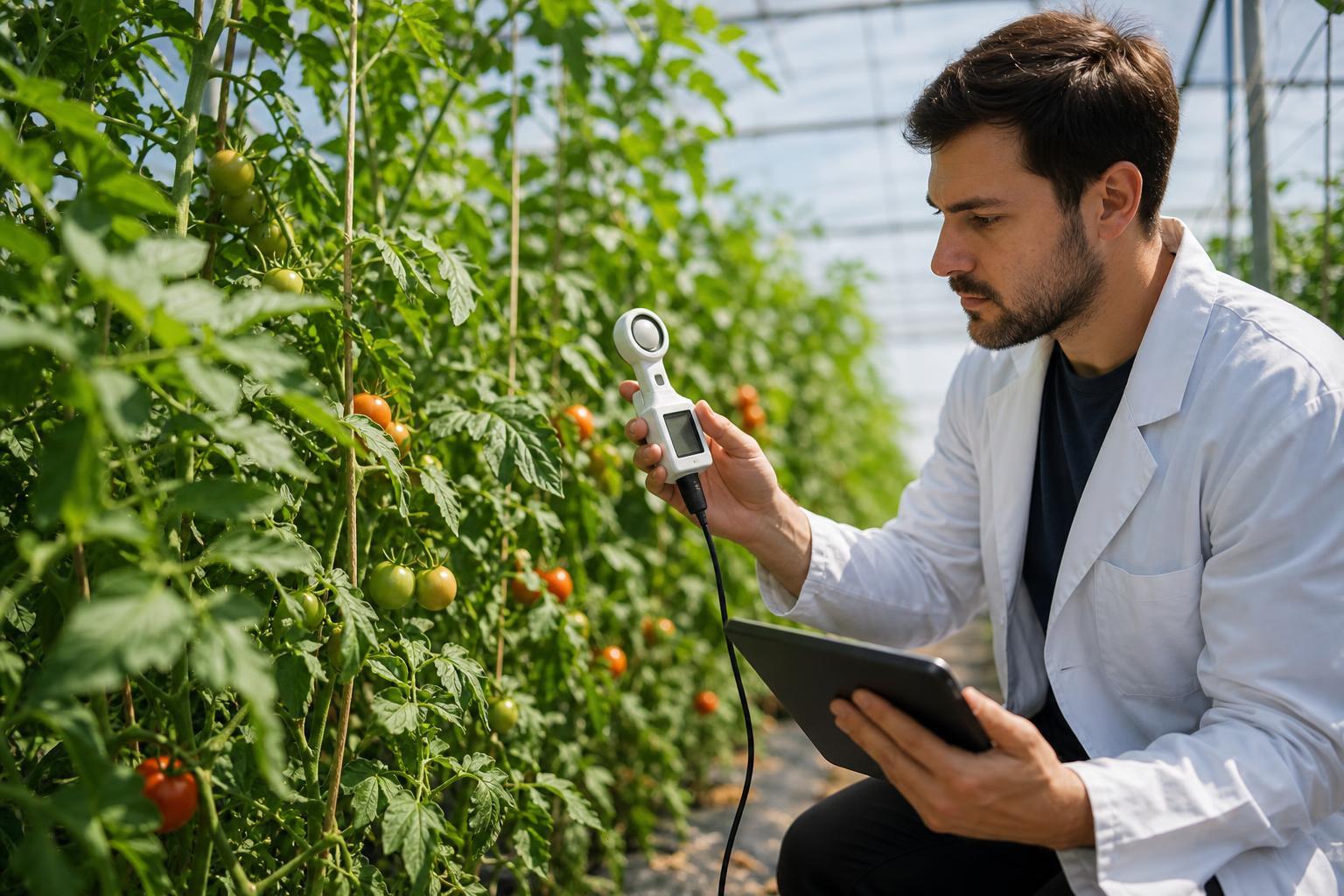
Accurate PPFD measurement requires a quantum sensor (also called a PAR meter) rather than a standard lux meter. Here are the essentials:
Measure at canopy level. Hold the sensor at the height of the growing tip or the top of the fruit-bearing zone, not above the canopy or at bench height.
Take multiple readings. PPFD varies across the greenhouse due to structural shading, distance from fixtures, and fixture spacing. A single point measurement can be misleading. Map a grid of at least 9–12 points across your growing area and calculate the average, minimum, and maximum.
Measure at different times. Natural light changes throughout the day and across seasons. Supplemental PPFD should be measured separately (at night or with blackout) and then combined with typical daytime readings to estimate total DLI.
Watch for uniformity. Large differences between your highest and lowest PPFD readings indicate poor light distribution, which leads to uneven growth. Our greenhouse lighting uniformity guide explains the metrics and targets to aim for.
Quick Reference: Tomato PPFD Greenhouse Targets
| Growth Stage | PPFD (µmol/m²/s) | DLI (mol/m²/d) | Photoperiod | Notes |
|---|---|---|---|---|
| Seedling | 150–300 | 8–13 | 14–16 h | Below 100 risks leggy growth |
| Vegetative | 300–500 | 15–25 | 14–17 h | 400+ preferred for vigorous growth |
| Fruiting | 400–600 | 20–30 | 14–17 h | Diminishing returns above 500 without CO₂ enrichment |
| Supplemental (overhead) | 125–250 | Varies | Up to 16–17 h | 200 µmol/m²/s common in northern operations |
| CO₂ enriched (800+ ppm) | Up to 600–800 | 25–35 | 14–17 h | Higher PPFD becomes economically justified |
Frequently Asked Questions
What is the ideal PPFD for tomatoes in a greenhouse?
The ideal PPFD depends on growth stage. Seedlings do best at 150–300 µmol/m²/s, vegetative plants at 300–500, and fruiting plants at 400–600. These ranges assume ambient CO₂ levels. With CO₂ enrichment to 800–1,000 ppm, the upper end of each range becomes more productive.
How do I convert PPFD to DLI for greenhouse tomatoes?
Use the formula: DLI = PPFD × photoperiod (hours) × 0.0036. For example, 400 µmol/m²/s over a 16-hour photoperiod gives a DLI of 400 × 16 × 0.0036 = 23.04 mol/m²/d. This falls right in the optimal 20–30 mol/m²/d range for greenhouse tomatoes.
Can you give tomatoes too much PPFD?
Yes. While individual tomato leaves don’t fully saturate until around 2,200 µmol/m²/s, the whole-canopy economic returns plateau much earlier. Most growers see diminishing returns above 400–500 µmol/m²/s at ambient CO₂. Additionally, exceeding 17 hours of photoperiod to compensate for lower PPFD can cause leaf chlorosis and yield loss.
How much supplemental PPFD do greenhouse tomatoes need in winter?
That depends on your location and greenhouse transmission. A northern greenhouse receiving only 5 mol/m²/d of natural DLI during winter would need supplemental PPFD of roughly 200–434 µmol/m²/s (depending on photoperiod length) to approach the 20–30 mol/m²/d target. Most commercial operations install 125–250 µmol/m²/s of supplemental overhead lighting.
Does CO₂ enrichment change the PPFD target for tomatoes?
Absolutely. Increasing CO₂ from 400 to 1,000 ppm can boost net photosynthesis by over 50% within typical greenhouse PPFD ranges. The highest tomato yields in research trials occurred at 800 ppm CO₂ combined with 600 µmol/m²/s. Without CO₂ enrichment, pushing PPFD much above 500 is hard to justify economically.
What’s the maximum photoperiod for greenhouse tomatoes?
Keep it under 17–18 hours. Research consistently shows that extending beyond 17 hours leads to leaf chlorosis, reduced vigor, and lower yields. The safe, productive range is 14–17 hours of combined natural and supplemental light.
Should I use inter-canopy lighting instead of adding more overhead PPFD?
Both have a role, but inter-canopy lighting is remarkably efficient. Studies show yield increases of 17–27% from adding light within the canopy rather than simply increasing overhead intensity. The lower and middle leaves receive more photons without the diminishing returns that come from pushing top-canopy PPFD higher and higher.
How do I measure PPFD accurately in my greenhouse?
Use a quantum sensor (PAR meter), not a lux meter. Measure at canopy height, take readings at multiple points across your growing area, and measure both with and without supplemental lights to understand each contribution separately. Poor uniformity (big variation between readings) is just as problematic as low average PPFD.
Ready to close the light gap in your greenhouse? Talk to a lighting specialist about the right supplemental PPFD strategy for your tomato operation.