Greenhouse PPFD Calculator: 2026 Guide to DLI & Targets
Use our Greenhouse PPFD Calculator to turn DLI and photoperiod into exact PPFD. See the formula, step-by-step workflow, and crop targets. Start now.
TL;DR
A greenhouse PPFD calculator converts the gap between your crop’s daily light requirement and what your greenhouse actually delivers into a specific supplemental light intensity target, measured in µmol/m²/s. The core formula is: PPFD = DLI × 1,000,000 ÷ (photoperiod hours × 3,600). This article walks through each step, from finding your outdoor DLI to accounting for greenhouse transmission losses to landing on the exact supplemental PPFD your crop needs, with worked examples and crop-specific targets.
Quick Answer: How Do You Calculate Greenhouse PPFD?
To calculate supplemental greenhouse PPFD, first determine your crop’s target DLI, subtract the DLI already provided by sunlight inside the greenhouse, then convert the remaining DLI into PPFD based on your supplemental photoperiod.
Formula:
Required supplemental PPFD = (Target DLI − Indoor DLI) × 1,000,000 ÷ (Supplemental hours × 3,600)
Where:
- Target DLI = your crop’s desired daily light integral in mol/m²/day
- Indoor DLI = the sunlight your greenhouse already provides
- Supplemental hours = how long your grow lights will operate each day
- PPFD = supplemental light intensity required at canopy level in µmol/m²/s
For example, if a crop needs 17 mol/m²/day, the greenhouse provides 7.2 mol/m²/day, and supplemental lights run for 16 hours, the required supplemental PPFD is approximately 170 µmol/m²/s.
The key is to calculate the DLI deficit first. PPFD without a photoperiod does not tell you the total amount of light your crop receives.
Greenhouse PPFD Calculator: Enter Your Numbers
Use the following four inputs to estimate the supplemental PPFD your greenhouse needs.
Input | What to enter |
|---|---|
Crop target DLI | Your crop's target in mol/m²/day |
Outdoor DLI | Average outdoor DLI for your location and growing month |
Greenhouse transmission | Percentage of outdoor light reaching the crop canopy |
Supplemental photoperiod | Number of hours per day the lights will operate |
Step 1: Calculate Indoor DLI
Indoor DLI = Outdoor DLI × Greenhouse transmission
Example:
12 mol/m²/day × 0.60 = 7.2 mol/m²/day
Step 2: Calculate the DLI Deficit
DLI deficit = Target DLI − Indoor DLI
Example:
17 − 7.2 = 9.8 mol/m²/day
Step 3: Convert the Deficit to Supplemental PPFD
Supplemental PPFD = DLI deficit × 1,000,000 ÷ (photoperiod × 3,600)
Example:
9.8 × 1,000,000 ÷ (16 × 3,600) = 170 µmol/m²/s
Result
For these example conditions, the greenhouse requires approximately 170 µmol/m²/s of supplemental PPFD at the canopy for 16 hours per day.
This is an estimate. Actual fixture requirements should account for canopy area, fixture efficiency, mounting height, optical distribution, PPFD uniformity, and measured greenhouse light levels.
PPFD to DLI Conversion Table
Use this table to see how much DLI a constant PPFD delivers at different photoperiods.
PPFD | 12 hours | 16 hours | 18 hours | 20 hours |
|---|---|---|---|---|
100 µmol/m²/s | 4.32 DLI | 5.76 DLI | 6.48 DLI | 7.20 DLI |
200 µmol/m²/s | 8.64 DLI | 11.52 DLI | 12.96 DLI | 14.40 DLI |
300 µmol/m²/s | 12.96 DLI | 17.28 DLI | 19.44 DLI | 21.60 DLI |
400 µmol/m²/s | 17.28 DLI | 23.04 DLI | 25.92 DLI | 28.80 DLI |
500 µmol/m²/s | 21.60 DLI | 28.80 DLI | 32.40 DLI | 36.00 DLI |
600 µmol/m²/s | 25.92 DLI | 34.56 DLI | 38.88 DLI | 43.20 DLI |
800 µmol/m²/s | 34.56 DLI | 46.08 DLI | 51.84 DLI | 57.60 DLI |
1,000 µmol/m²/s | 43.20 DLI | 57.60 DLI | 64.80 DLI | 72.00 DLI |
Formula: DLI = PPFD × photoperiod × 3,600 ÷ 1,000,000
These values assume the stated PPFD remains constant throughout the supplemental photoperiod.
DLI to PPFD Conversion Table
If you already know the amount of supplemental DLI you need, use this table to estimate the required PPFD.
Supplemental DLI | 12 hours | 16 hours | 18 hours | 20 hours |
|---|---|---|---|---|
5 mol/m²/day | 116 µmol/m²/s | 87 µmol/m²/s | 77 µmol/m²/s | 69 µmol/m²/s |
8 mol/m²/day | 185 µmol/m²/s | 139 µmol/m²/s | 123 µmol/m²/s | 111 µmol/m²/s |
10 mol/m²/day | 231 µmol/m²/s | 174 µmol/m²/s | 154 µmol/m²/s | 139 µmol/m²/s |
12 mol/m²/day | 278 µmol/m²/s | 208 µmol/m²/s | 185 µmol/m²/s | 167 µmol/m²/s |
15 mol/m²/day | 347 µmol/m²/s | 260 µmol/m²/s | 231 µmol/m²/s | 208 µmol/m²/s |
20 mol/m²/day | 463 µmol/m²/s | 347 µmol/m²/s | 309 µmol/m²/s | 278 µmol/m²/s |
25 mol/m²/day | 579 µmol/m²/s | 434 µmol/m²/s | 386 µmol/m²/s | 347 µmol/m²/s |
Formula: PPFD = DLI × 1,000,000 ÷ (photoperiod × 3,600)
The table represents supplemental DLI, not total daily DLI. If sunlight already supplies part of the crop's target, subtract the greenhouse's existing DLI before using the conversion.
What PPFD Means in a Greenhouse Context
PPFD stands for Photosynthetic Photon Flux Density. It measures the number of photosynthetically useful photons landing on a given surface area per second, expressed in micromoles per square meter per second (µmol/m²/s). If you’re unfamiliar with the unit, our explanation of what a micromole is covers the basics.
Unlike lux or lumens, which are weighted toward human vision, PPFD counts only photons within the 400 to 700 nm wavelength range, the band plants actually use for photosynthesis. Two lights can produce identical lux readings and deliver very different PPFD values depending on their spectrum. This is why lux meters are unreliable for greenhouse light assessment, and why a proper PAR (quantum) sensor matters.
A greenhouse PPFD calculator takes this concept and makes it actionable. It answers a specific question: given your location, your greenhouse structure, and your crop, how much supplemental light intensity do you need at canopy level?
If you’re planning a supplemental lighting project, talk to a lighting specialist who can model your specific greenhouse geometry before committing to a fixture layout.
The Core Formula: PPFD and DLI
The relationship between PPFD and DLI (Daily Light Integral) is the foundation of every greenhouse PPFD calculator. DLI measures the total photon dose a plant receives over an entire day, expressed in mol/m²/d. PPFD is the instantaneous intensity. The two connect through time.
From PPFD to DLI:
DLI (mol/m²/d) = PPFD (µmol/m²/s) × photoperiod (hours) × 3,600 ÷ 1,000,000
From DLI to PPFD (the formula growers actually need):
PPFD (µmol/m²/s) = DLI (mol/m²/d) × 1,000,000 ÷ (photoperiod (hours) × 3,600)
The 3,600 converts hours to seconds. The 1,000,000 converts micromoles to moles (or back). A useful shorthand: 1 µmol/m²/s sustained for one hour equals 0.0036 mol/m².
DLI is arguably the single most important number for greenhouse supplemental lighting decisions. Two growers can provide identical PPFD but get dramatically different results if one runs lights for 8 hours and the other for 16. The DLI greenhouse calculations guide covers target values and planning in more depth.
How to Calculate Greenhouse PPFD: Step by Step
This is the actual workflow behind any greenhouse PPFD calculator. Five steps, each building on the last.
Step 1: How to Find Outdoor DLI for Your Greenhouse
Your outdoor DLI depends on location, season, weather, latitude, and time of year. Use the DLI for the specific month you are designing your supplemental lighting system around rather than relying on an annual average.
For winter production, use the months when natural light is lowest. For year-round operations, calculate the lighting requirement for each critical production period and size the system around the most demanding period.
What to Look For
When finding outdoor DLI data, identify:
Your greenhouse location or nearest representative weather station
The month or production period being analyzed
Average daily DLI in mol/m²/day
Whether the value represents outdoor conditions
Whether the data is an average or a design-condition estimate
Clemson University horticultural research and extension resources are among the established sources for greenhouse light-management research, including work by James Faust on greenhouse lighting and light transmission.
For the most accurate lighting design, measured outdoor and indoor PAR data from your actual greenhouse is preferable to relying exclusively on a regional average.
Step 2: Greenhouse Light Transmission: Why the Glazing Specification Isn't Enough
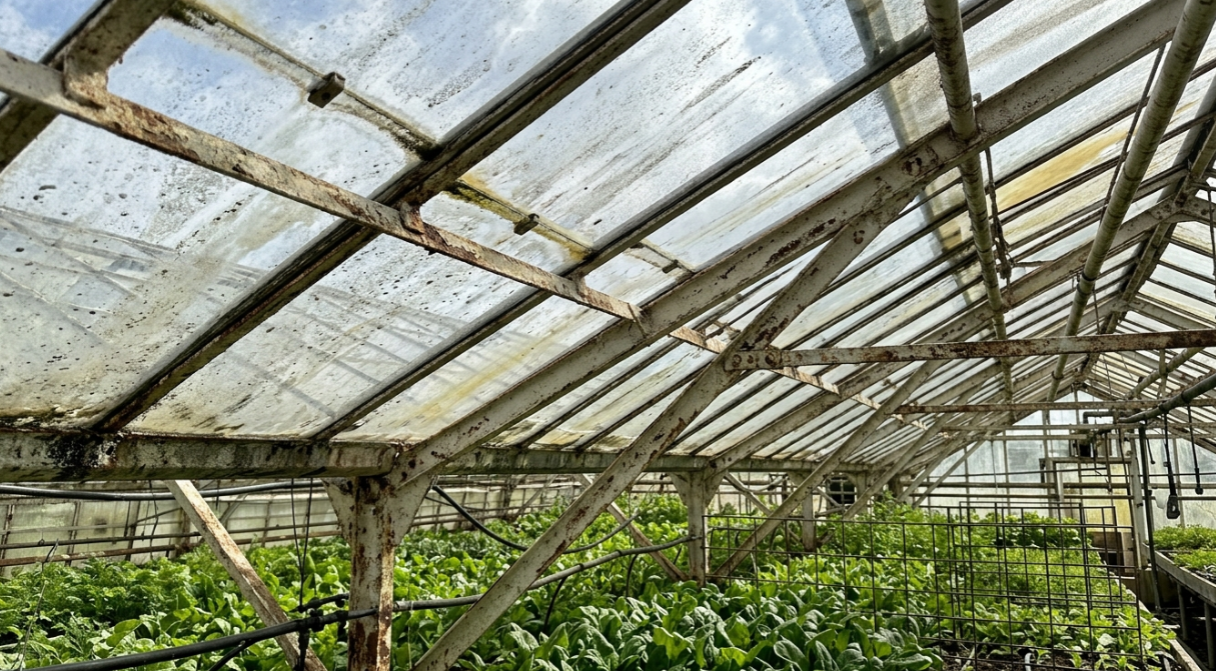
Greenhouse light transmission is the percentage of available sunlight that reaches the growing area. Do not assume that the light-transmission specification printed on a glazing product represents the final PPFD reaching the crop canopy.
Actual light delivery can be affected by:
Glazing material and thickness
Diffuse versus direct transmission
Structural framing
Roof and gutter design
Dirt and dust
Condensation
Aging or yellowing of the covering
Shade curtains and screens
Hanging equipment
Seasonal solar angle
The position of the crop canopy
For this reason, use the manufacturer's transmission specification as a starting point, then validate the result with PAR measurements when possible.
The Most Accurate Method
Measure PPFD outside and inside the greenhouse under comparable conditions.
Effective transmission = Indoor PPFD ÷ Outdoor PPFD × 100
For example, if outdoor PPFD is 1,000 µmol/m²/s and canopy-level PPFD inside the greenhouse is 600 µmol/m²/s:
600 ÷ 1,000 × 100 = 60% effective transmission
This measured value is more useful for lighting calculations than assuming a generic transmission percentage.
Step 3: Calculate Indoor DLI
Multiply outdoor DLI by your transmission factor.
Indoor DLI = Outdoor DLI × transmission %
Example: 12 mol/m²/d × 0.60 = 7.2 mol/m²/d
Step 4: Find the Deficit
Subtract your indoor DLI from your crop’s target DLI.
Deficit = Target DLI − Indoor DLI
If your lettuce needs 17 mol/m²/d and you’re getting 7.2, the deficit is 9.8 mol/m²/d.
Step 5: Convert the Deficit to Supplemental PPFD
Now apply the inverse formula, plugging in your planned supplemental photoperiod:
Required PPFD = 9.8 × 1,000,000 ÷ (16 × 3,600) = 170 µmol/m²/s
That’s it. Your greenhouse PPFD calculator output tells you that you need fixtures capable of delivering 170 µmol/m²/s of supplemental light, averaged across the canopy, for 16 hours per day.
For a detailed look at how supplemental hours interact with light targets, see the greenhouse supplemental lighting hours guide.
Worked Example: Lettuce Grower in Ohio, January
Variable | Value |
|---|---|
Outdoor DLI (January, Ohio) | 12 mol/m²/d |
Greenhouse transmission | 60% |
Indoor DLI | 7.2 mol/m²/d |
Lettuce target DLI | 17 mol/m²/d |
DLI deficit | 9.8 mol/m²/d |
Supplemental photoperiod | 16 hours |
Required supplemental PPFD | 170 µmol/m²/s |
This example matches the approach used by university extension worksheets and the most authoritative supplemental lighting guides ranking for this topic. The numbers change with your crop, location, and greenhouse, but the method stays the same. Our lettuce lighting requirements page covers crop-specific targets in more detail.
Greenhouse DLI Targets by Crop
DLI is generally the better starting point for greenhouse lighting decisions because it accounts for both light intensity and photoperiod. The appropriate target varies by cultivar, growth stage, production objective, temperature, CO₂ concentration, and other environmental conditions.
Crop category | Typical planning DLI range | Why it matters |
|---|---|---|
Propagation / seedlings | 6–12 mol/m²/day | Lower light levels are commonly used during establishment |
Lettuce / leafy greens | 12–17 mol/m²/day | Light affects growth rate, biomass, and crop timing |
Herbs | 12–20 mol/m²/day | Requirements vary considerably by species |
Tomatoes | 20–30+ mol/m²/day | Higher DLI generally supports greater productivity within appropriate environmental limits |
Fruiting vegetables | 18–30+ mol/m²/day | Crop and production stage strongly influence the target |
These are planning ranges rather than universal prescriptions. Use crop-specific research and cultivar information when establishing a commercial lighting target.
For example, Cornell greenhouse-lighting research describes tomato production targets in the general range of 22–30 mol/m²/day while also showing that production responses depend on the lighting and environmental conditions used.
Can Longer Photoperiods Reduce the PPFD You Need?
Yes. If the crop can tolerate the longer photoperiod, increasing lighting hours allows you to deliver the same supplemental DLI at a lower PPFD.
For example, a supplemental DLI of 17.3 mol/m²/day can be delivered approximately as:
Photoperiod | Required PPFD |
|---|---|
12 hours | 401 µmol/m²/s |
14 hours | 344 µmol/m²/s |
16 hours | 300 µmol/m²/s |
18 hours | 267 µmol/m²/s |
20 hours | 241 µmol/m²/s |
The lower-intensity strategy can affect fixture count, electrical demand, operating hours, electricity rates, plant morphology, and crop development.
However, longer photoperiods are not automatically better. Crop-specific photoperiod requirements, flowering responses, electricity pricing, temperature management, and daily dark-period requirements should be considered before changing the lighting schedule.
The best schedule is therefore the one that meets the crop's DLI target while balancing plant response, equipment cost, energy cost, and operating constraints.
Common Greenhouse PPFD Calculation Mistakes
Using Peak PPFD Instead of Canopy Average
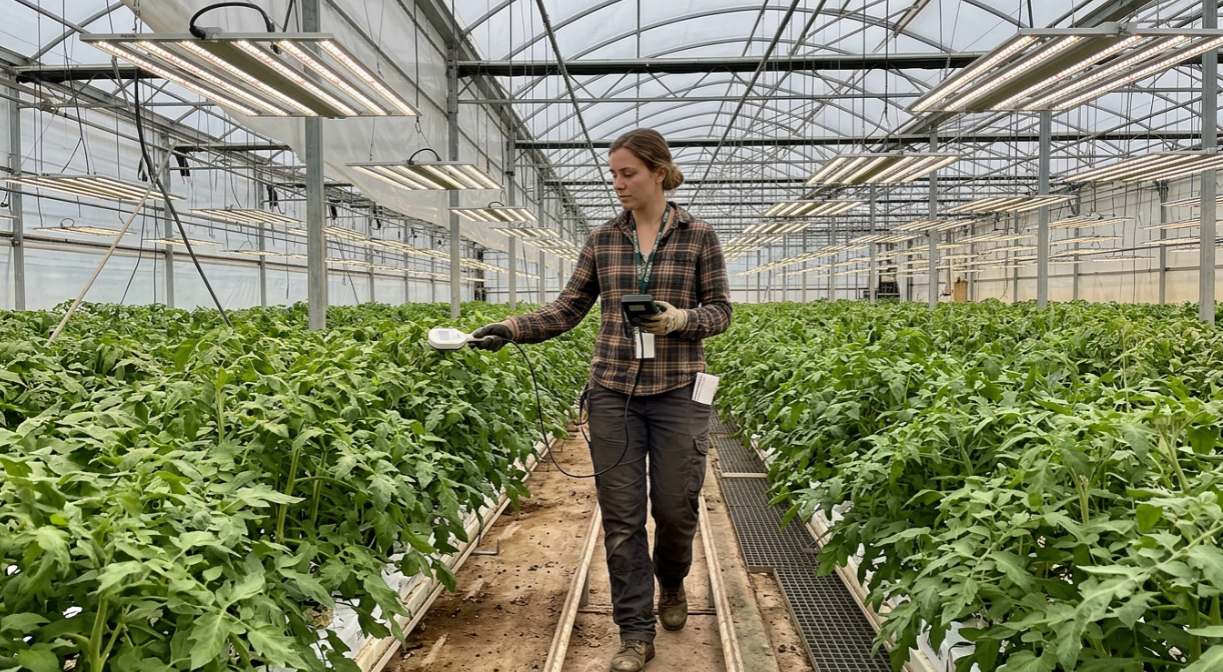
Two rooms can have the same average PPFD and produce drastically different results. A fixture might spec 800 µmol/m²/s directly underneath it, but drop to 300 µmol/m²/s at the canopy edges. What matters is the average across the entire growing area, not the number at the hot spot.
Uniformity standards from Runkle (2017) suggest 10 to 20 percent variation is generally acceptable, while others argue that ±5 percent is a more appropriate target for professional greenhouse operations. The coefficient of variation (CV), calculated as standard deviation of PPFD readings divided by mean PPFD times 100, should ideally stay below 15% for commercial production.
Sizing to Room Dimensions, Not Canopy Dimensions
One of the most common mistakes in greenhouse lighting is using fixture spacing based on room dimensions instead of active canopy dimensions. If your growing area doesn’t extend to the walls, your fixtures shouldn’t either. Calculate coverage based on where plants actually are.
Ignoring Transmission Losses and Glazing Age
As noted above, effective greenhouse transmission is often 40 to 60 percent of outdoor PAR, not the 80 to 90 percent that glazing spec sheets suggest. Running a greenhouse PPFD calculator with optimistic transmission values will under-size your lighting system from day one, and the problem only worsens as glazing ages.
Sizing to Wattage Instead of PPFD at Canopy
Wattage tells you how much electricity a fixture consumes, not how much useful light reaches your plants. A fixture delivering 100 µmol/m²/s when your tomatoes need 200 µmol/m²/s of supplemental light is burning money while producing mediocre fruit. Always size to the PPFD target your greenhouse PPFD calculation produces, then find fixtures that deliver it efficiently. Learn more about why comparing fixtures by wattage alone is misleading.
Using a Lux Meter Instead of a PAR Meter
Lux measures perceived brightness to the human eye. PPFD measures photons plants use for photosynthesis. The conversion factor between lux and PPFD varies dramatically depending on the light source’s spectrum, making lux-to-PPFD conversions unreliable. Invest in a quantum sensor (PAR meter) that reads µmol/m²/s directly. It’s the only way to validate that your greenhouse PPFD calculator output matches reality at canopy level.
Related Terms: PAR, PPF, PPFD, and DLI
These four terms get tangled constantly. Here’s how they fit together.
Term | What It Measures | Unit | Analogy |
|---|---|---|---|
PAR | The wavelength range plants use (400–700 nm) | Not a unit, it’s a range | The playing field |
PPF | Total photon output from a fixture | µmol/s | Total water leaving a hose |
PPFD | Photon intensity at a specific point on the canopy | µmol/m²/s | Rain falling on one square meter per second |
DLI | Total daily photon dose | mol/m²/d | Total rainfall in the gauge at end of day |
PPF is a fixture-level spec. PPFD is what arrives at canopy level after accounting for mounting height, room geometry, and fixture spacing. A fixture with high PPF but poor layout can deliver wildly inconsistent PPFD. For a deeper look at how spectrum influences plant growth beyond raw PPFD numbers, see the summary of light spectra impacts.
From Calculator Output to Fixture Selection
Once you’ve run through the greenhouse PPFD calculator workflow and know your target, the next step is matching that target to actual fixtures and layouts. A few practical considerations:
Uniformity matters as much as intensity. Proper fixture spacing, optical design, and mounting height all determine whether your PPFD target is met consistently or only in the center of the canopy.
Account for HVAC load. Every watt of light in a greenhouse adds heat. LED fixtures produce significantly less heat than HPS, but the thermal impact still needs to be part of the plan, especially at higher PPFD targets. Our post on HVAC requirements for LED lights covers the math.
Consider the full canopy, not just the top. For crops like cannabis, PPFD planning that includes under-canopy supplementation can improve lower-canopy quality and total yield beyond what top-light-only approaches achieve.
For greenhouse top-lighting applications, the Altus 1K is designed for supplemental and sole-source greenhouse lighting at commercial scale. For operations that need a range of power options, the Pinnacle series covers 300W to 840W configurations.
Frequently Asked Questions
What is a greenhouse PPFD calculator?
A greenhouse PPFD calculator is a formula-based tool that determines how much supplemental light intensity (measured in µmol/m²/s) your greenhouse needs. It accounts for outdoor solar radiation, greenhouse transmission losses, crop DLI targets, and supplemental photoperiod to produce a specific PPFD target for your fixtures.
What PPFD do I need for my greenhouse?
It depends entirely on your crop, location, and season. Leafy greens need supplemental PPFD of roughly 100 to 250 µmol/m²/s in winter at northern latitudes. Tomatoes may need 200 to 400 µmol/m²/s. The only way to get a precise number is to run through the five-step calculation using your actual greenhouse transmission and local DLI data.
Can I use a lux meter to measure greenhouse PPFD?
Not reliably. Lux meters are weighted toward human visual perception, and the conversion factor between lux and PPFD changes depending on the light source’s spectrum. A quantum sensor that reads directly in µmol/m²/s is the correct tool for greenhouse PPFD measurement.
How does photoperiod affect the PPFD I need?
Longer supplemental photoperiods reduce the PPFD required to hit a given DLI target. If your crop tolerates 18 hours of light instead of 12, you can deliver the same total daily dose at two-thirds the intensity. This can reduce fixture count and upfront cost significantly.
What is a good PPFD uniformity target?
For commercial greenhouse production, a coefficient of variation (CV) below 15% is the accepted threshold. Some researchers and practitioners push for ±5% variation as a tighter standard. Uniformity depends on fixture spacing, mounting height, and optical design, not just total output.
Does CO₂ supplementation change my PPFD targets?
Yes. Below about 600 µmol/m²/s, ambient CO₂ levels are usually sufficient. Above that threshold, plants increasingly need supplemental CO₂ (1,000 to 1,500 ppm) to use the additional light productively. Running high PPFD without supplemental CO₂ wastes electricity.
How often should I recheck my greenhouse transmission?
At least annually, and ideally before winter when supplemental lighting matters most. Glazing degradation, dirt accumulation, and condensation can reduce effective transmission by 10 to 15 percentage points within a few years, silently undermining your lighting plan.
Where can I get help sizing supplemental lighting for my greenhouse?
If you’ve run the greenhouse PPFD calculator numbers and want professional validation or a full lighting design, schedule a consultation with a lighting specialist who can model your specific greenhouse geometry, crop mix, and energy goals.