Greenhouse Lighting for Peppers: 2026 DLI & PPFD Guide
Greenhouse Lighting for Peppers: hit 20–30 DLI with 2026 PPFD targets, formulas, and 16–20h photoperiod tips. Size by the DLI gap—not watts.
TLDR
Greenhouse lighting for peppers closes the gap between what the sun delivers inside a greenhouse and what peppers actually need to grow, flower, and fruit consistently. The most useful metric is DLI (daily light integral), not watts or fixture count. Commercial pepper crops typically target 20 to 30 mol/m²/day during fruiting, and supplemental lights should only supply the deficit after accounting for greenhouse transmission losses of 30% to 50%.
What Greenhouse Lighting for Peppers Means
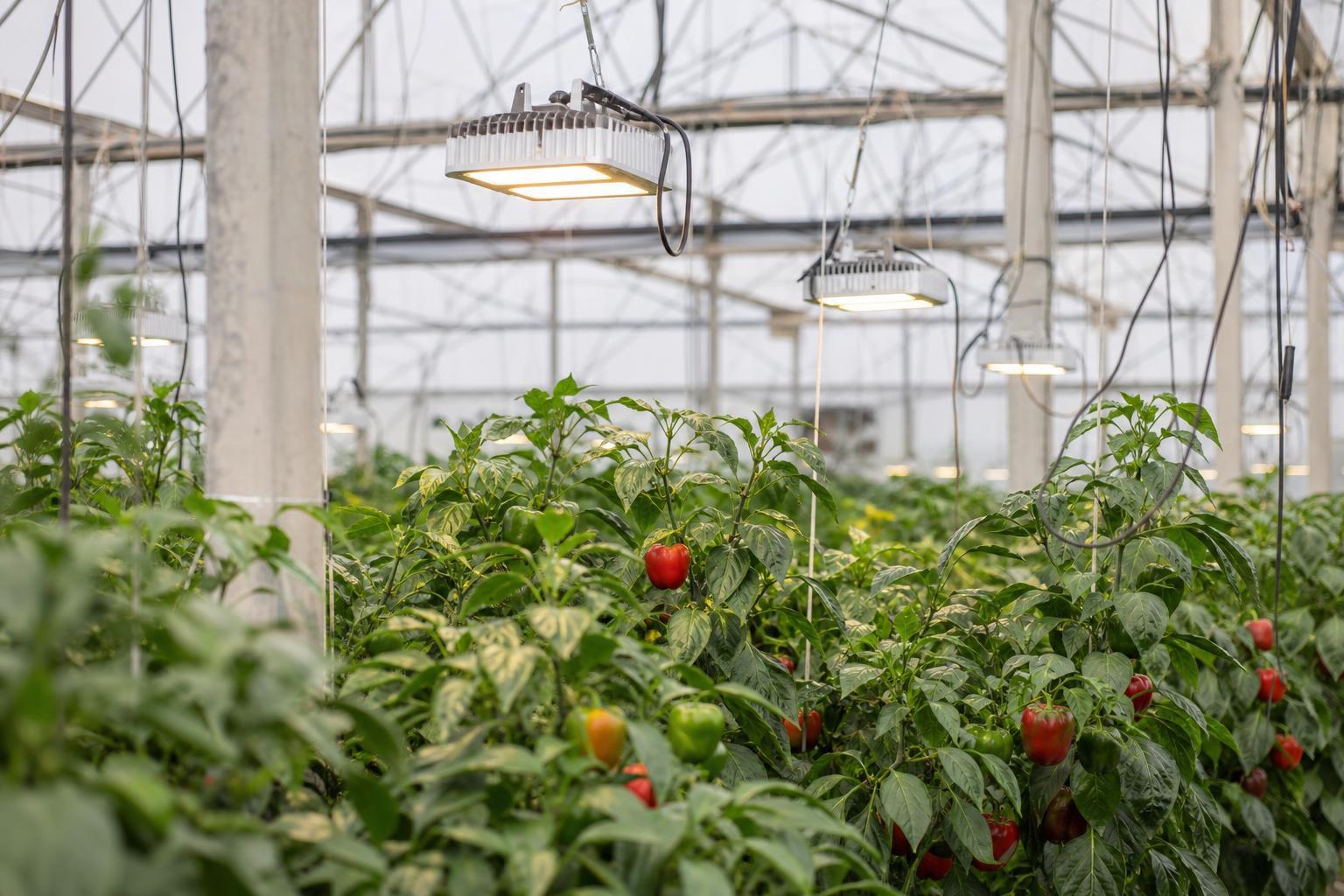
Greenhouse lighting for peppers is the use of supplemental grow lights, lighting controls, spectrum selection, and fixture layout to help pepper crops reach their target DLI and canopy PPFD when natural sunlight falls short. The goal is not to replace the sun. It is to fill the gap between the light a greenhouse actually delivers and the light peppers need for vegetative growth, flowering, fruit set, fruit fill, and consistent year-round production.
Think of it as a way to make the crop’s light supply predictable. The sun provides part of the daily light dose. Supplemental fixtures provide the missing portion when clouds, winter, or greenhouse structure reduce what reaches the canopy.
Request a lighting consultation to translate your pepper DLI targets into a fixture layout and ROI plan.
Why Peppers Need Supplemental Light in a Greenhouse
Peppers are high-light fruiting crops. Unlike leafy greens that produce acceptable yields under moderate light, peppers demand substantially more photosynthetic energy to develop flowers, set fruit, fill fruit, and maintain production cycles through the year.
The greenhouse itself blocks light. Virginia Tech Extension notes that greenhouses commonly receive 30% to 50% less light than open fields because of glazing, structural members, curtains, and other obstructions. A winter day with 12 mol/m²/day outdoors might deliver only 7 or 8 mol/m²/day at the crop canopy, well below what fruiting peppers need.
Michigan State University identifies DLI as the biggest limitation for vine crops during low-light conditions, recommending at least 15 mol/m²/day and preferably more than 20 for vine crop production. Mature pepper canopies also self-shade, meaning lower leaves and fruiting zones can be light-starved even when top leaves look well-lit. If you have not measured light levels inside your structure, our guide on measuring DLI in greenhouses covers practical methods.
Here is a useful framework for sizing greenhouse pepper lighting:
Outdoor DLI × greenhouse transmission + supplemental DLI = crop DLI
If outdoor winter DLI is 12, greenhouse transmission is 60%, and the production target is 22 mol/m²/day, the inside natural DLI is about 7.2 and the supplemental gap is roughly 14.8 mol/m²/day.
Key Terms: DLI, PPFD, PAR, and Related Metrics
Terminology is one of the biggest sources of confusion in greenhouse pepper lighting. Iowa State Extension provides clear definitions for plant-light metrics and warns against confusing them with human-light metrics like lumens and lux.
| Term | Plain definition | Why it matters for peppers |
|---|---|---|
| PAR | Photosynthetically active radiation, roughly 400 to 700 nm | The waveband used in standard plant-light measurements |
| PPF | Total PAR photons a fixture emits per second (µmol/s) | Compares fixture output, not what reaches the crop |
| PPFD | PAR photons reaching one square meter of canopy per second (µmol/m²/s) | Shows whether the canopy receives enough intensity at a given moment |
| DLI | Total PAR photons per square meter per day (mol/m²/day) | The best single metric for combining sunlight and supplemental light |
| PPE | Fixture efficacy: µmol of light per joule of energy | Higher efficacy lowers operating cost for a target DLI |
| Photoperiod | Hours of light and darkness in 24 hours | Peppers benefit from long days but should not run under simple 24-hour schedules |
| Supplemental PPFD | PPFD from fixtures only | The gap lights must fill |
| Total canopy PPFD | Sunlight plus supplemental light at the crop | What the plant actually experiences |
| Interlighting | LED bars placed within the crop canopy | Useful where dense pepper foliage shades lower leaves and fruiting zones |
When a guide says peppers need “400 to 700 µmol/m²/s during fruiting,” that is typically total canopy PPFD (sunlight plus fixtures), not what the lights alone must deliver. For a clear breakdown, see our PPFD vs DLI guide.
Practitioners on Reddit regularly stumble over this distinction. One grower found conflicting DLI recommendations ranging from 14 to 30 mol/m²/day and struggled to determine whether 500 PPFD for 12 to 16 hours would be enough. The confusion almost always traced back to mixing up supplemental and total numbers.
Pepper DLI and PPFD Targets by Growth Stage
Pepper light requirements shift as the plant develops. These targets are practical ranges, not absolute prescriptions. Actual needs depend on cultivar, CO₂ levels, temperature, crop load, and market timing.
| Growth stage | Practical DLI range (mol/m²/day) | Notes |
|---|---|---|
| Seedling and propagation | 6 to 12 | Enough for compact, sturdy transplants without stretch |
| Vegetative and establishment | 12 to 20 | Building canopy; targets vary by transplant age, cultivar, and season |
| Flowering and fruiting | 20 to 30 | Typical commercial production target |
| Low-light minimum | 12 to 15+ | Production becomes light-limited below about 12 DLI |
The flowering and fruiting PPFD figures often cited in commercial guides (several hundred µmol/m²/s) refer to total canopy PPFD. The fixtures only need to supply the gap between sunlight reaching the crop and the target. Ontario greenhouse vegetable guidance describes winter supplemental approaches using roughly 100 to 200 µmol/m²/s for 13 to 16 hours, not the 500+ numbers sometimes listed without context.
For a deeper stage-by-stage breakdown, our pepper lighting requirements guide covers DLI, PPFD, spectrum, and interlighting in detail.
How to Calculate Supplemental Lighting for Peppers
The core formulas are straightforward:
DLI = PPFD × hours × 0.0036
PPFD needed = target DLI ÷ hours ÷ 0.0036
A worked greenhouse example:
- Target pepper DLI: 22 mol/m²/day
- Measured winter greenhouse DLI (sunlight only): 8 mol/m²/day
- DLI gap: 14 mol/m²/day
- Supplemental photoperiod: 16 hours
- Required supplemental PPFD: about 243 µmol/m²/s
Two greenhouses can need very different lighting systems. A facility receiving 14 mol/m²/day of natural winter DLI needs far less supplemental light than one receiving 6. For more step-by-step examples, see DLI formula and conversions.
Growers on Reddit echo the importance of measuring before buying. In one discussion, a grower looking to outfit greenhouses with LEDs said the companies they contacted were “obviously trying to upsell.” Other commenters pushed the grower to measure cloudy-day DLI and estimate greenhouse light loss before deciding whether supplemental lighting for peppers was even justified.
Do not size pepper lighting from watts per square foot. Start with the DLI gap.
Photoperiod: How Many Hours of Light?
Peppers can use long days, but they cannot safely run under continuous light. Research summaries on sweet pepper photoperiod report that yields increased under 16- and 20-hour photoperiods, but 24-hour continuous light decreased yield compared with 20 hours. A separate study found that constant 24-hour white light significantly reduced fruit production compared with a 16-hour control.
The practical range for greenhouse pepper lighting is 16 to 20 hours. Preserve a real dark period unless you are using a validated dynamic-lighting protocol. Specialized nighttime spectrum strategies exist in research settings, but they are not a default commercial recommendation. For more on managing light hours seasonally, our greenhouse photoperiod guide covers scheduling strategies.
Spectrum Considerations
Spectrum is not a simple red-versus-blue question for peppers. Dense pepper canopies make light penetration a genuine concern. A 2022 study found that adding green light to red/blue LED recipes increased light intensity deep in sweet pepper canopies by 43% to 158% and improved fruit weight by 2% to 15%, depending on cultivar and green-light percentage.
Full-spectrum white light has practical advantages beyond top-leaf photosynthesis. It supports crop scouting, creates a more comfortable work environment, and delivers wavelengths that penetrate deeper into canopy layers. LEDs also shape plant anatomy: one study found LED-grown pepper transplants had thicker leaves with more chloroplasts than HPS-grown transplants, though the response was cultivar-dependent. The takeaway is that LEDs give growers more control over spectrum, heat, and dimming, but pepper response still varies by cultivar and environment.
For a broader look at how spectrum shapes plant development, see our light spectra impact summary.
Top Lighting vs Interlighting
Most greenhouse lighting for peppers starts with overhead fixtures delivering supplemental PPFD across the crop canopy. For many operations, top lighting alone is enough to close the DLI gap. Thrive’s commercial greenhouse top-lighting fixtures, including the Altus 1K and Pinnacle Series, are designed for this application.
But peppers grow tall and dense. In high-wire production, lower leaves and fruiting zones sit in deep shade. Interlighting (LED bars placed within the canopy) addresses this directly. A 2019 bell pepper study found that intra-canopy LED lighting increased inner-canopy photosynthetic rates 3.5- to 5.7-fold and boosted spring fruit yield by about 30%. The gain came from more fruits per plant, not larger individual fruits.
Practitioners are already testing this concept. A 2026 vertical farming thread described inter-canopy lighting in hydroponic pepper production, reporting better lower-leaf activity, more uniform development, and possible fruit-set benefits in lower zones. Greenhouse lighting for peppers is not only about what reaches the top of the canopy. It is also about how light distributes through a tall, self-shading crop.
Common Mistakes in Greenhouse Pepper Lighting
Sizing from watts instead of DLI
Watts measure power draw, not plant-usable light. A 600W fixture and a 1000W fixture might deliver very different amounts of PAR depending on efficacy, optics, and mounting height. Start with your DLI gap, then choose fixtures that deliver the supplemental PPFD the crop needs.
Confusing supplemental PPFD with total PPFD
If a guide says peppers need 500 µmol/m²/s during fruiting, that is typically the total canopy target (sun plus fixtures). On a winter day delivering 150 µmol/m²/s from sunlight, the fixtures only need to add 350. Oversizing from a total number wastes capital and energy.
Using outdoor DLI instead of inside-greenhouse DLI
Outdoor weather station data does not reflect what reaches the crop. Greenhouse transmission losses of 30% to 50% are normal. Measure or model the inside-greenhouse DLI before committing to a lighting design.
Placing sensors in misleading locations
A DLI-based controller is only as good as its sensor location. GLASE/Cornell research found that a sensor in a shady spot caused the system to overshoot DLI, while a sunny-spot sensor caused undershoot. In a pepper greenhouse with gutters, trusses, and uneven crop heights, representative sensor placement is critical.
Running 24-hour light
More hours does not always mean more production. Sweet pepper research consistently shows 24-hour continuous white light decreases yield. Keep a real dark period.
Ignoring heat and electrical architecture
In larger installations, hundreds of drivers mounted above the canopy add heat and create maintenance complexity. Centralized power architecture can move drivers out of the growing environment, reducing above-canopy heat load and simplifying long-term serviceability.
When to Work with a Lighting Designer
A good lighting plan for greenhouse peppers may recommend fewer fixtures than you expected, or no retrofit at all if natural DLI, crop schedule, and market timing do not justify the investment. The first step is always measurement, not a quote.
Professional lighting design is worth considering when you are:
- Planning winter pepper production or year-round scheduling
- Retrofitting from HPS to LED
- Building a new greenhouse and specifying electrical infrastructure
- Growing high-wire peppers with dense canopy shading
- Targeting consistent DLI with automated dimming and sensor-based controls
- Evaluating fixture layout and light uniformity across the crop area
Thrive works with commercial growers to translate pepper DLI targets into fixture layouts, control strategies, and ROI-based plans backed by a 5-year warranty and ±5% design-to-install PPFD accuracy.
Schedule a free consultation to start with your DLI gap, not a product pitch.
Frequently Asked Questions
How much light do greenhouse peppers need?
Commercial greenhouse peppers are high-light fruiting crops. A practical production DLI target is often 20 to 30 mol/m²/day during fruiting, with lower values acceptable during vegetative growth. MSU recommends at least 15 and preferably more than 20 mol/m²/day for vine crops. Older sweet pepper greenhouse literature says production becomes light-limited below about 12 mol/m²/day.
What PPFD should greenhouse pepper lights provide?
That depends on the DLI gap. Fruiting peppers may need several hundred µmol/m²/s of total canopy PPFD, but fixtures only supply the difference between the crop target and the sunlight reaching the canopy. A common supplemental range for greenhouse fruiting crops is roughly 100 to 250 µmol/m²/s, depending on photoperiod and natural DLI.
Can greenhouse peppers have light 24 hours a day?
Not with standard full-spectrum or white lighting. Sweet pepper research found 24-hour light reduced yield compared with a 20-hour photoperiod. Specialized dynamic nighttime spectra may maintain yield in research settings, but commercial plans should preserve a dark period.
Is interlighting useful for greenhouse peppers?
Yes, especially in tall or dense crops. A bell pepper study found intra-canopy LED lighting increased inner-canopy photosynthesis by 3.5- to 5.7-fold and boosted spring fruit yield by about 30%. The benefit is strongest where self-shading limits light to lower fruiting zones.
Is full-spectrum light better than red and blue for peppers?
Full-spectrum light has practical advantages because dense pepper canopies benefit from wavelengths that penetrate beyond the top leaves. Research showed that adding green light to red/blue recipes increased deep-canopy intensity by 43% to 158% and improved fruit weight by 2% to 15%. Full-spectrum white light also makes crop scouting easier and creates a more comfortable work environment.
How do I know if my greenhouse needs supplemental lighting for peppers?
Measure or estimate the inside-greenhouse DLI by season, account for transmission loss (typically 30% to 50%), choose a crop DLI target, and calculate the gap. If your winter DLI inside the greenhouse falls well below 15 to 20 mol/m²/day, supplemental lighting is likely worth investigating. Start with data, not assumptions.