Cannabis Lighting Stages 2026: PPFD, DLI & Spectrum Guide
Master cannabis lighting stages with research-backed PPFD, DLI, and spectrum targets from seed to harvest. Avoid common errors and boost yield.
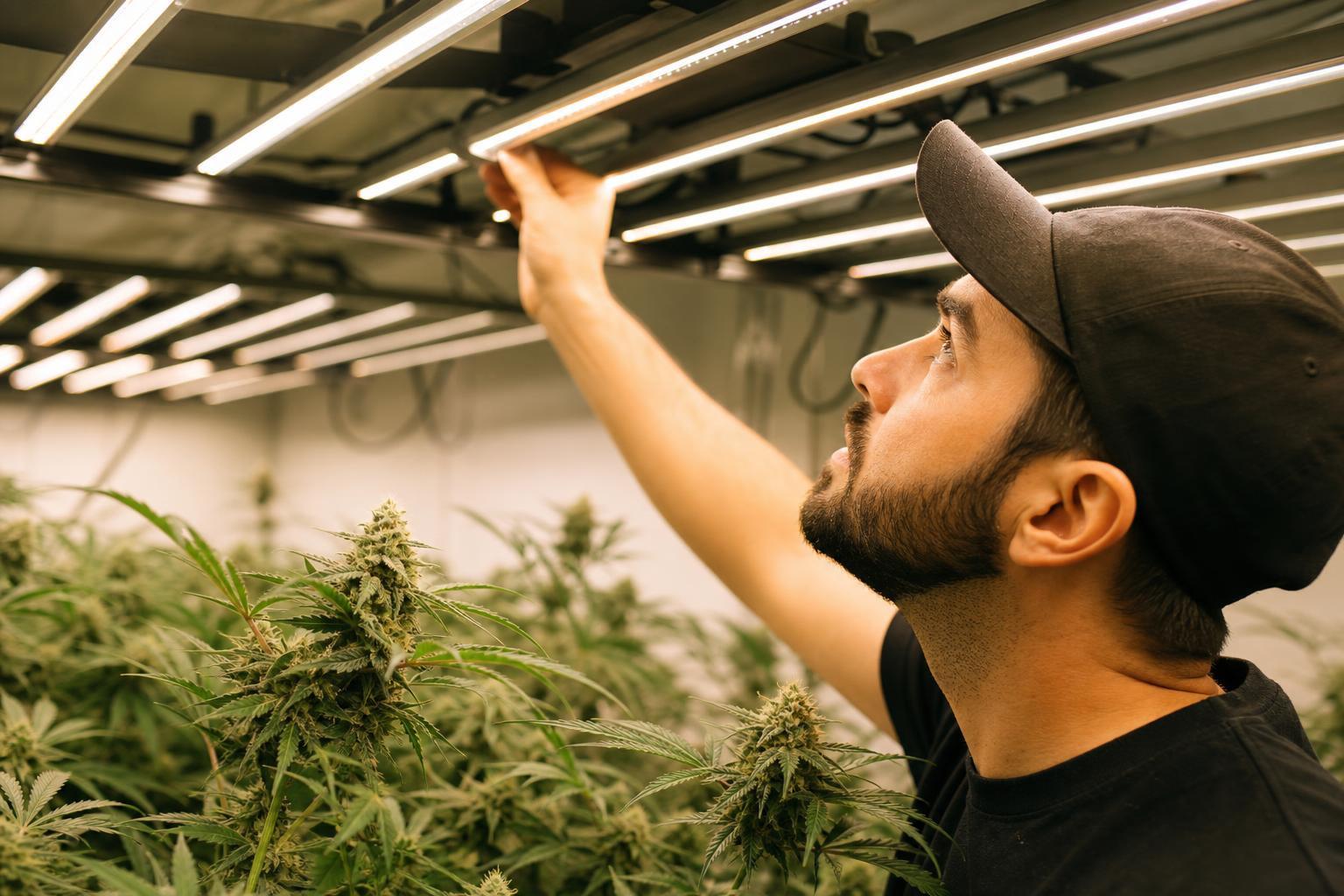
TL;DR
Cannabis lighting stages refer to the distinct light requirements at each phase of the plant’s lifecycle, from germination through harvest. Each stage demands specific adjustments to three variables: photoperiod (hours of light per day), intensity (measured in PPFD), and spectrum (the color balance of the light). Getting these right is the single most controllable factor in determining yield, potency, and plant health. This guide breaks down every stage with research-backed targets and practical advice.
Cannabis is one of the most light-responsive crops grown in controlled environments. Unlike temperature or humidity, which fluctuate and resist precision, lighting can be dialed in exactly. That makes it both the biggest opportunity and the most common source of controllable mistakes in an indoor or greenhouse grow.
The concept of cannabis lighting stages is straightforward: as the plant moves from a fragile seedling to a vegetative powerhouse to a flowering machine, its relationship with light changes dramatically. The photoperiod shifts, the intensity demands climb, and the ideal spectrum evolves. Treating lighting as a single static setting across the entire lifecycle leaves significant yield and quality on the table.
This guide covers every stage in detail, with the specific numbers, the reasoning behind them, and the mistakes that trip up growers at each phase.
Talk to a lighting specialist about designing a multi-stage cannabis lighting plan for your facility.
Quick Reference Table: Cannabis Lighting Stages at a Glance
Stage | Duration | Photoperiod | PPFD (µmol/m²/s) | DLI (mol/m²/day) |
|---|---|---|---|---|
Germination / Clone | 1–2 weeks | 18–24h light | 75–200 | 6–12 |
Seedling | 2–3 weeks | 18/6 | 200–400 | 12–20 |
Vegetative | 3–16 weeks | 18/6 or 20/4 | 400–600 | 20–45 |
Transition / Stretch | 1–3 weeks | 12/12 | Ramp from 400 to 700+ | 20–30 |
Peak Flowering | 4–6 weeks | 12/12 | 700–1,000 (up to 1,500 with CO₂) | 35–50 |
Late Flower / Ripen | 1–2 weeks | 12/12 (or 10/14) | 400–800 (optional taper) | 25–35 |
Autoflower (all stages) | 8–12 weeks | 18/6 or 20/4 | 300–700 | 30–45 |
All ranges assume ambient CO₂ levels (400–600 ppm). With CO₂ supplementation at 1,000–1,500 ppm, upper PPFD thresholds can increase 30–50%.
Why Cannabis Lighting Changes by Stage
Cannabis is a photoperiod-sensitive plant. In nature, shortening days in late summer trigger it to stop building structure and start producing flowers. Indoor growing exploits this biology by manually controlling the light schedule.
But photoperiod is only one variable. The plant’s energy needs change too. A seedling with two tiny leaves cannot process the same light intensity as a mature plant with dozens of fan leaves and an established root system. Blasting a seedling with flower-level light is like force-feeding a newborn a steak dinner. It does not end well.
Three variables change across cannabis lighting stages:
Photoperiod (hours of light per day) controls whether the plant stays in vegetative mode or transitions to flowering. Long days (18+ hours) keep it vegetating. Short days (12 hours) trigger bloom.
PPFD (Photosynthetic Photon Flux Density) measures the intensity of usable light hitting the canopy at any given moment, expressed in µmol/m²/s. Think of it as the flow rate of a garden hose.
DLI (Daily Light Integral) measures the total photons delivered over a full day, expressed in mol/m²/day. This is the bucket that fills up over time. The DLI formula is simple: DLI = PPFD × photoperiod hours × 0.0036.
DLI is the master metric because it accounts for both intensity and duration. This matters enormously during the veg-to-flower transition, as we will see.
Stage 1: Germination and Cloning
Seeds themselves germinate in darkness or very dim light. Once they crack and a taproot emerges, the tiny sprout needs gentle illumination.
Photoperiod: 18 to 24 hours of light. Many growers run 18/6 to give the plant a rest period, though 24/0 works for clones that need consistent humidity and warmth.
PPFD: 75 to 200 µmol/m²/s. This is deliberately low. Dutch Passion notes that one of the most common mistakes from less experienced growers is damaging seedlings with too much light, particularly when they are trying to break in a new high-power LED fixture.
DLI: 6 to 12 mol/m²/day.
Spectrum: A balanced full-spectrum fixture is the default choice for this stage. Keep intensity low and use dimming/height to avoid stress, rather than switching to a different spectral mix.
What to watch for: Curling leaves, bleaching, or a seedling that seems to stall after its first set of true leaves. These are signs the light is too intense. Raise the fixture or dim it. Low-wattage propagation bars designed for multi-tier environments, like the Infinity XE, are purpose-built for this stage because they deliver even, gentle light without the risk of cooking young plants.
Stage 2: Vegetative Growth
The vegetative stage is where the plant builds its frame: stems, branches, and the fan leaves that will power flower production later. This phase can last anywhere from three to sixteen weeks depending on the cultivar, training methods, and the grower’s goals.
Photoperiod: 18 to 24 hours of light per day. The 18/6 schedule is standard. Some growers prefer 20/4 for faster growth, though the marginal gains beyond 18 hours diminish. Research published in Frontiers in Plant Science confirms that high light intensity during veg is necessary to maximize growth, and proper photoperiod control is critical for initiating budding when the time comes.
PPFD: 400 to 600 µmol/m²/s for established vegetative plants. Early veg (the first week or two after seedling stage) benefits from a gentler 200–400 µmol/m²/s ramp-up.
DLI: 20 to 45 mol/m²/day, peaking around weeks five and six at 40–45 DLI. With CO₂ supplementation, some commercial growers push to 50–55 DLI during peak veg.
Spectrum: Use a balanced full-spectrum fixture during vegetation. Focus on dialing in PPFD/DLI, uniformity, and canopy management; you generally do not need to change spectral mix between veg and flower when using modern LEDs.
Why this stage matters for yield: A common mistake is rushing through veg to get to flower faster. But the canopy structure built during vegetation directly determines how many bud sites will be available and how efficiently the plant can intercept light. Skimping on veg is borrowing from your harvest.
Stage 3: The Transition (Pre-Flower Stretch)
This is the most under-discussed of all cannabis lighting stages, and it is where many growers make a costly mistake.
When you flip from 18/6 to 12/12, the plant does not immediately start flowering. It enters a stretch phase lasting one to three weeks where it can double in height. During this period, the hormonal machinery is shifting gears, and the plant is simultaneously finishing its structural growth while beginning to set flower sites.
Photoperiod: 12 hours light, 12 hours uninterrupted darkness. The dark period must be absolute (more on light leaks below).
PPFD: This is where the ramp matters. A practitioner article in Herbage magazine captures the insight well: through trial and error, experienced growers have found that plants respond best when you do not immediately blast them with full flowering intensity the day you flip the schedule. Instead, increasing intensity in a linear fashion over the first two to three weeks reduces shock and stress on plants going from one extreme to another.
Start the transition at 400–500 µmol/m²/s and ramp toward 700+ over two to three weeks.
DLI: 20 to 30 mol/m²/day during the ramp, climbing toward full-flower targets by the end of the stretch.
Spectrum: Keep a balanced full-spectrum fixture through the transition/stretch. Prioritize a gradual PPFD ramp after the flip; intensity and DLI management matter more than stage-specific spectral changes.
Why the ramp matters: The DLI math reveals the problem. A plant receiving 600 PPFD under 18/6 gets a DLI of about 39 mol/m²/day. Switch to 12/12 at the same PPFD, and DLI drops to roughly 26. That is a one-third reduction in the plant’s daily photon budget at the exact moment it needs energy to fuel the stretch. Growers who understand this compensate by boosting PPFD, but doing so gradually avoids the stress that comes from a sudden intensity cliff.
Stage 4: Peak Flowering
This is where light intensity demands are highest and where lighting decisions have the most direct impact on yield and cannabinoid content.
Photoperiod: 12 hours light, 12 hours dark. No exceptions, no interruptions.
PPFD: Commercial cannabis flower rooms typically target 700–900 µmol/m²/s under ambient CO₂. With CO₂ enrichment at 1,000–1,500 ppm, growers push to 900–1,500 µmol/m²/s. Research published in PubMed found that dry inflorescence yield increased linearly with canopy-level PPFD up to 1,800 µmol/m²/s, even though leaf-level photosynthesis saturated well below that point. This means the plant as a whole can use far more light than a single leaf measurement would suggest.
DLI: 35 to 50 mol/m²/day. Because flowering plants only get 12 hours of light instead of 18, the flower room must deliver roughly 50% higher PPFD to accumulate a comparable daily photon budget. For a deep dive into flower room design, see the cannabis flower room lighting guide.
Spectrum: A balanced full-spectrum fixture is the default choice in peak flower as well. Rather than switching to a different spectrum, hit flower targets by managing PPFD, DLI, and (if used) CO₂.
The CO₂ Ceiling: Why More Light Without CO₂ Wastes Money
Increasing PPFD without addressing CO₂ is like widening a highway but keeping the on-ramp to one lane. Cannabis photosynthesis hits a ceiling at ambient CO₂ levels, and that ceiling kicks in around 800 PPFD. Pushing past that point without supplementation wastes electricity and generates heat without proportional yield gains. For a complete breakdown, read about CO₂ in controlled environment agriculture.
Under-Canopy Lighting: The Biggest Gap in Most Flower Rooms
Top-only lighting leaves 30 to 40% of bud sites in the shadow of the canopy. This is the single largest untapped yield opportunity in most cannabis facilities, and peer-reviewed research backs it up. A study published in MDPI found that intra-canopy lighting (ICL) produced a 29.95% increase in dry inflorescence yield, a 24.4% higher accumulation of THC, and a 12.5% increase in total terpene concentration.
Timing matters. Most growers introduce under-canopy lights around day 14 to 21 of flower, when the canopy has thickened enough to block light from reaching lower bud sites. Earlier wastes energy, later limits effectiveness.
Fixtures like the Boost XE are designed specifically for this role, adding light below the canopy without adding significant total power draw. To understand the economics, see under-canopy lighting ROI.
Flowering Sub-Stages
Most guides treat flowering as a single block. In reality, it has distinct phases with different priorities:
Flowering initiation (weeks 1–3): Pistils emerge as white hairs. Bud sites establish in clusters. Light intensity is still ramping up from the transition phase.
Mid-flowering (weeks 4–5): Buds fatten significantly. Pistils begin to darken. Aromatic terpene production accelerates. This is when peak PPFD should be fully online.
Late flowering / ripening (week 6+): Trichomes develop and mature, producing the resin containing cannabinoids, flavonoids, and terpenes. Some growers begin tapering intensity here (covered in the next section).
Stage 5: Late Flower and Ripening
The final one to two weeks before harvest present a strategic choice. Some experienced growers reduce light intensity during this period, intentionally stressing plants in a controlled way that may encourage increased trichome production and improved final quality.
PPFD: 400 to 800 µmol/m²/s (a deliberate taper from peak levels).
DLI: 25 to 35 mol/m²/day.
What practitioners report: The taper strategy is debated. Some growers swear by dropping intensity or even shortening the light period to 10/14 in the final week. Others maintain peak intensity until chop day. The logic behind the taper is that mild stress can trigger the plant to produce more resin as a protective response. This has anecdotal support, though controlled studies are limited.
What is not debated is that the plant’s metabolic activity slows during ripening. It is converting existing resources into cannabinoids and terpenes rather than building new tissue. A modest reduction in light intensity during this phase makes physiological sense and saves energy.
Autoflower Lighting: A Different Approach
Autoflowering cannabis varieties operate on an internal clock rather than responding to photoperiod changes. They transition from vegetative growth to flowering based on age, not the ratio of light to dark hours. This simplifies the cannabis lighting stages conversation but introduces different considerations.
Photoperiod: Most autoflower growers run 18/6 or 20/4 from seed to harvest. There is no need to flip to 12/12. Some run 24/0, though the returns on those extra hours are marginal.
PPFD: 300 to 700 µmol/m²/s. Because autoflowers receive 18 to 20 hours of light daily, they accumulate more DLI at any given PPFD than photoperiod strains on a 12/12 schedule. For example, 700 PPFD under 20/4 delivers about 50.4 mol/m²/day, which is quite aggressive. Practitioners on Reddit and growing forums frequently note that autos do great at 500–600 PPFD because the longer photoperiod compensates for the lower intensity.
DLI: 30 to 45 mol/m²/day throughout the lifecycle. This is consistent from veg through flower because the photoperiod does not change.
Spectrum: Use a balanced full-spectrum fixture throughout the autoflower lifecycle. Because the photoperiod stays consistent, focus on keeping PPFD/DLI in range and avoid chasing stage-specific spectral tweaks.
Key Terms Quick Glossary
PAR (Photosynthetically Active Radiation): The 400–700nm wavelength range that plants use for photosynthesis. All meaningful cannabis lighting metrics are measured within this range.
PPFD (Photosynthetic Photon Flux Density): The amount of PAR light hitting a given area per second, measured in µmol/m²/s. This is your instantaneous intensity reading. For practical guidance, see the cannabis PPFD guide.
DLI (Daily Light Integral): The total photosynthetically active photons delivered over a full day. Calculated as PPFD × hours × 0.0036. This is the cumulative metric that actually predicts plant performance.
Photoperiod: The number of hours of light per day. In cannabis cultivation, the photoperiod is the primary trigger controlling the transition between vegetative and flowering stages.
Full Spectrum: Modern full-spectrum LED lights combine wavelengths across the PAR range (and sometimes beyond), providing plants with a complete light diet that mimics natural sunlight while allowing growers to emphasize specific wavelengths through dimming or spectral tuning.
Balanced full spectrum: A balanced full-spectrum fixture works across all stages. In most grows, it’s more effective to control intensity (PPFD), daily dose (DLI), uniformity, and photoperiod than to chase specific wavelength mixes.
Light Stress: Damage caused by excessive PPFD. Symptoms include bleached or curling leaves, yellowing leaf tips, slowed growth, and scorching. More common in seedling and early veg stages.
Common Lighting Mistakes by Stage
Burning seedlings. New growers with powerful LEDs frequently hang them too close or run them at full power over young plants. At the germination and seedling stage, 200 µmol/m²/s is plenty.
Not ramping intensity at the flip. Switching from 18/6 at moderate PPFD to 12/12 at maximum PPFD in a single day shocks plants. Ramp up over two to three weeks.
Running above 800 PPFD without CO₂. Without supplemental CO₂, the plant cannot use the extra photons. You are paying for electricity and heat without getting yield in return.
Ignoring the lower canopy. Top lighting alone cannot penetrate a dense canopy. Supplemental under-canopy lighting has been shown to increase yields by 20–30% in peer-reviewed studies.
Light leaks during flower. Even brief light exposure during the dark cycle can confuse the plant’s hormonal signals, potentially causing stress, re-vegetation, or hermaphroditism. A simple test: stand in the grow space during the dark cycle. If you can see light, the plant can too.
Using wattage as a proxy for output. Wattage measures electricity consumption, not light delivery. PPFD and efficacy (µmol/J) are the metrics that matter. Top-tier LED fixtures now exceed 3.5 µmol/J, while legacy HPS hovers around 1.7 to 1.9 µmol/J.
Full-Spectrum LED vs. Stage-Specific Lighting
The old approach to cannabis lighting involved swapping bulbs or fixtures between veg and flower. This worked, but it was inefficient, labor-intensive, and expensive. Modern balanced full-spectrum LED fixtures can cover all stages by adjusting intensity rather than changing lamp types.
That paradigm is over. In 2024, 78% of cannabis growers reported using LEDs for the vegetative phase (up from just 17% in 2016), and HPS usage in flower dropped to 22%, down from 62% in 2016 according to Cannabis Business Times. LEDs use up to 60% less energy than HPS fixtures, generate less heat (reducing HVAC costs), and deliver a fuller, more tunable spectrum.
Modern dimmable full-spectrum LED fixtures handle all cannabis lighting stages with a single unit. Dim them for seedlings, run them at moderate output for veg, and push them to full power for flower. The spectrum remains balanced across the PAR range, and the grower adjusts intensity rather than physically changing equipment.
For facilities evaluating a transition from HPS to LED, the math is compelling. The energy savings alone typically pay back the fixture cost within one to three years, and the crop quality improvements (cited as the number one priority by 42% of growers in the same Cannabis Business Times survey) begin immediately.
Designing a Multi-Stage Facility
Commercial operations running separate rooms for veg and flower need lighting designed for each environment. The veg room needs even, moderate-intensity coverage. The flower room needs maximum output, excellent uniformity, and increasingly, under-canopy supplementation.
The cannabis lighting market is valued at $2.45 billion in 2025 and is projected to reach $3.37 billion by 2030, reflecting how seriously the industry takes this investment. Getting the lighting design right from the start, with stage-appropriate fixtures, proper spacing, and infrastructure for supplemental CO₂ and under-canopy bars, is the foundation of a profitable grow.
Schedule a free consultation to discuss lighting design for your cannabis facility’s specific stages and layout.
Frequently Asked Questions
What PPFD should I use for cannabis seedlings?
Keep PPFD between 75 and 200 µmol/m²/s for seedlings. This is enough to drive early growth without causing light stress. Higher intensities can bleach leaves, curl tips, and stunt development during this fragile stage.
Why does cannabis need 12 hours of darkness to flower?
Cannabis is a short-day plant. Uninterrupted darkness lasting 12 hours triggers the production of florigen, the hormone that initiates flowering. Any light interruption during the dark period can delay or disrupt this process, which is why light leaks are so damaging during flower.
How do I calculate DLI for my grow room?
Use the formula: DLI = PPFD × photoperiod hours × 0.0036. For example, 600 PPFD over 18 hours equals 600 × 18 × 0.0036 = 38.9 mol/m²/day. This tells you the total photon delivery your plants receive daily, which is more meaningful than a snapshot PPFD reading alone.
Can I use the same LED light for all cannabis lighting stages?
Yes. Modern dimmable full-spectrum LEDs can cover every stage by adjusting the output level. Dim to 15–30% for seedlings, run at 50–70% for veg, and push to full power for flower. This has replaced the old approach of swapping between metal halide and HPS bulbs.
Do autoflowers need different light schedules than photoperiod strains?
Autoflowers do not require a 12/12 flip to initiate flowering. Most growers run them on 18/6 or 20/4 from seed to harvest. Because they receive more hours of light per day, they accumulate higher DLI at moderate PPFD levels, so intensity can be lower than what photoperiod strains need during their 12/12 flower phase.
Is it worth pushing PPFD above 1,000 µmol/m²/s without CO₂?
Generally no. At ambient CO₂ levels (around 400 ppm), cannabis photosynthesis reaches diminishing returns around 800 PPFD. Pushing higher without supplemental CO₂ wastes energy and increases heat load without proportional yield gains. CO₂ enrichment to 1,000–1,500 ppm unlocks the plant’s ability to use higher light intensities productively.
What does under-canopy lighting do during the flowering stage?
Under-canopy lighting delivers photons to the lower bud sites that top lighting cannot reach through a dense canopy. Peer-reviewed research has documented yield increases of roughly 30%, along with higher cannabinoid and terpene concentrations, when intra-canopy supplemental lighting is added during flower.
How long should the vegetative stage last for maximum yield?
There is no single answer because it depends on the cultivar, training approach, and canopy management strategy. Most indoor grows run four to eight weeks of veg. The key principle is that the canopy structure built during vegetation determines how many bud sites are available during flower. Cutting veg short to save time often costs more in reduced harvest than it saves in shortened cycle time.