Vertical Farm Grow Lights: 2026 Guide to Metrics & Fixtures
Learn how vertical farm grow lights impact yield and costs—metrics, spectra, bars vs. boards, remote drivers, IP ratings. Get pro tips now.
TL;DR
Vertical farm grow lights are specialized LED fixtures engineered for multi-tier, close-canopy indoor farming where artificial light is the sole energy source for photosynthesis. Lighting accounts for 65% to 85% of a vertical farm’s total energy consumption, making fixture efficiency (measured in µmol/J, not watts) the single biggest factor in operational profitability. The bar/strip form factor dominates because it fits tight rack spaces, allows airflow, and delivers uniform light. Remote driver architecture, where power supplies sit outside the growing racks, removes heat and failure points from the cultivation zone and is quickly becoming the standard for commercial-scale facilities.
What Are Vertical Farm Grow Lights?
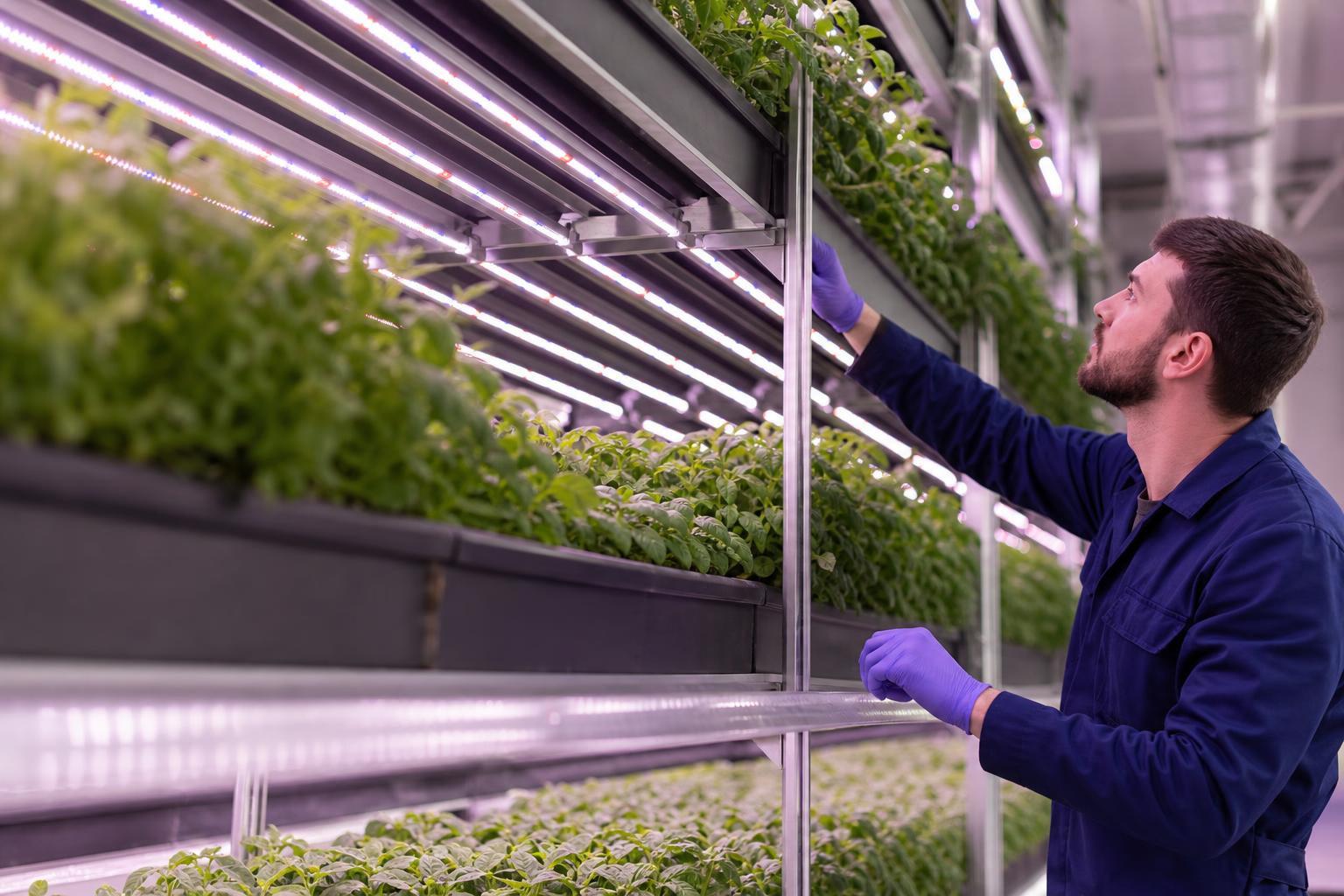
Vertical farm grow lights are LED fixtures designed specifically for controlled environment agriculture (CEA) facilities where plants grow on stacked racks, typically from floor to ceiling. Unlike greenhouse supplemental lights that boost natural sunlight, these fixtures are the sole source of photosynthetic energy. Every photon a plant receives comes from the light mounted 6 to 12 inches above its canopy.
That distinction matters. A greenhouse top light can afford to be big, heavy, and hot because it hangs several feet above the crop with open air circulating around it. A vertical farm fixture cannot. It has to be thin enough to fit between rack tiers, cool enough to sit inches from leaf tissue, and optically designed to spread light evenly across a narrow shelf rather than flood a wide open floor.
This is why vertical farm grow lights are not simply “grow lights that happen to fit on a shelf.” The form factor, thermal management, driver architecture, IP rating, and optics are all engineered around constraints that do not exist in greenhouse top-lighting or single-tier indoor setups.
Considering a multi-tier lighting project? Talk to a lighting expert to get fixture recommendations matched to your facility layout and crop plan.
Why LEDs, Not HPS or Fluorescent
Until about a decade ago, high-pressure sodium (HPS) was the default in indoor horticulture. Two factors killed HPS for vertical farming. First, HPS lamps produce far too much radiant heat to mount inches from plant tissue inside an enclosed rack tier. Second, LEDs now deliver a 24% to 30% reduction in electricity consumption compared to HPS at equivalent light output.
Linear fluorescent tubes (T5, T8) have the right form factor, slim and cool, but they cannot produce enough photons in the wavelengths plants need most. They also degrade faster and lack the spectral tunability that LEDs offer.
LEDs won vertical farming not on any single advantage but on the combination of high efficacy, controllable spectrum, compact form factor, low radiant heat, and instant dimming capability. No other technology checks all five boxes.
Why Lighting Is the #1 Cost in Vertical Farming
Lighting consumes 65% to 85% of total energy in a vertical farm. HVAC takes another 15% to 20%. And electricity itself can account for up to 40% of total operating expenses, according to research by Avgoustaki and Xydis published in ScienceDirect.
Current benchmarks for lettuce production sit at 10 to 18 kWh per kilogram, with an energy use intensity of 850 to 1,150 kWh per square meter per year. Those numbers make one thing obvious: fixture efficiency is not a nice-to-have specification. It is the primary lever for facility profitability.
The Heat Loop
Here is the part many first-time operators miss. Every watt of electricity that enters a grow light produces two outputs: photons and heat. Even the best LEDs convert roughly 40% to 50% of input power into waste heat. That heat has to be removed by the HVAC system, which consumes more electricity to do so.
So a less efficient fixture costs you twice: once on the electric bill for lighting, and again on the electric bill for cooling. Improving fixture efficacy by even 0.5 µmol/J across a facility with thousands of fixtures produces compounding savings. For a deeper look at how lighting and cooling interact, the guide on climate control in vertical farming breaks this relationship down in practical terms.
Key Metrics: The Numbers That Matter
The lighting industry uses a handful of metrics that every vertical farm operator needs to understand. These are not academic abstractions. They directly determine how many fixtures you need, how much energy you will consume, and whether your crops will grow properly.
PAR (Photosynthetically Active Radiation)
PAR is the range of light wavelengths that plants use for photosynthesis: 400 to 700 nanometers. It is not a unit of measurement. It is a definition of the useful light spectrum. When someone says a fixture produces “PAR light,” they mean it emits photons within this range. Any light outside 400 to 700 nm (with the emerging exception of far-red, 700 to 750 nm) does not contribute meaningfully to photosynthesis in most crops.
PPF (Photosynthetic Photon Flux)
PPF measures the total number of PAR photons a fixture emits per second, expressed in micromoles per second (µmol/s). Think of it as the fixture’s raw output. A fixture with a PPF of 80 µmol/s produces 80 micromoles of usable photons every second, regardless of where those photons land. For more context on what a micromole actually represents, that guide is helpful.
PPFD (Photosynthetic Photon Flux Density)
PPFD measures how many PAR photons actually reach one square meter of canopy per second, expressed as µmol/m²/s. This is the number that matters most at the plant level. Two fixtures with identical PPF can deliver very different PPFD depending on optics, mounting height, and spacing. Always ask for PPFD maps, not just PPF numbers, when evaluating fixtures.
DLI (Daily Light Integral)
DLI is PPFD integrated over the entire photoperiod. It tells you the total daily dose of photons a plant received, expressed in mol/m²/day. If PPFD is the flow rate, DLI is the bucket that fills over the course of a day.
DLI is the practical unit growers actually manage to. You can hit the same DLI with high PPFD over a short photoperiod or lower PPFD over a longer one. Most leafy green operations in vertical farms target 12 to 17 mol/m²/day.
PPE (Photosynthetic Photon Efficacy)
PPE is the efficiency metric that separates profitable operations from energy-bankrupt ones. It measures how many usable photons a fixture produces per joule of electricity, expressed as µmol/J.
Top-tier commercial LED grow lights now exceed 3.5 µmol/J. First-generation vertical farm fixtures installed around 2018 to 2020 typically delivered 2.0 to 2.5 µmol/J. Practitioners on forums and industry platforms put the current commercial-grade sweet spot at 3.0 to 3.4 µmol/J, a range that balances performance with realistic pricing. When comparing vertical farm grow lights, PPE should be the first number you examine, not wattage.
PPFD and DLI Targets by Crop
Getting the light recipe right is critical. Underlight a crop and you get slow, leggy growth with poor yield. Overlight it and you waste electricity while risking physiological damage like tip burn, which is especially common in butterhead lettuce when DLI exceeds 17 mol/m²/day. Hort Americas specifically recommends keeping DLI below 17 for indoor vertical farming systems to mitigate calcium uptake issues that cause tip burn.
Crop | PPFD Range (µmol/m²/s) | DLI Range (mol/m²/day) | Notes |
|---|---|---|---|
Lettuce (head) | 150–250 | 12–17 | DLI above 17 risks tip burn in sensitive varieties |
Lettuce (baby leaf) | 200–300 | 14–20 | Higher light shortens cycle time |
Basil and herbs | 200–350 | 15–20 | Basil tolerates higher intensity well |
Microgreens | 100–250 | 8–14 | Short cycle, lower total light demand |
Strawberries | 250–400 | 17–25 | Fruiting crops need substantially more light |
Tomatoes and peppers | 350–500+ | 20–30 | Rarely grown in vertical farms due to energy cost |
These ranges assume typical temperatures, CO₂ levels, and airflow. Adjusting CO₂ upward allows plants to use more light productively, which is why some facilities push PPFD higher when supplementing with CO₂.
For a detailed breakdown of lettuce lighting requirements including cultivar-specific guidance, that resource goes deeper than this overview.
Fixture Form Factors for Vertical Farms
Light Bars and Strips: The Dominant Form Factor
The bar or strip is the standard fixture shape in vertical farming for good reason. It is slim (often under 1 inch thick), mounts flush against the underside of a rack shelf, and allows conditioned air to pass through the gaps between bars. That airflow matters. In a tightly stacked rack system, anything that blocks air movement destabilizes the microclimate around the canopy, creating hot spots, humidity pockets, and uneven VPD.
Practitioners on Upstart University, a practitioner-focused indoor farming education platform, specifically recommend the light bar form factor for vertical farming due to its length, coverage, and compatibility with multi-tier rack systems.
Bars typically use wide beam angles of 120 degrees or more because the light has to spread evenly across the shelf from just 6 to 12 inches away. A narrow beam at that distance would create intense hot spots in the center and dark zones at the edges.
For leafy greens, microgreens, and herbs, a lower-wattage bar like the Strata at 30W delivers the right PPFD levels without overcooking the canopy. When operations need more output for propagation or denser canopies, fixtures like the Infinity XE at 60W step up in intensity while maintaining the slim bar profile.
Quantum Boards: Why They Fall Short in Multi-Tier
Quantum board style fixtures, flat rectangular panels covered in LEDs, work fine in single-tier or open-room grows. In a multi-tier vertical farm, they create problems. Their solid surface acts as a physical baffle, blocking vertical airflow through the rack. They also concentrate heat across a wide flat area with no gaps for convective cooling. For any operation stacking more than two tiers, bars are the better choice.
T5/T8 Fluorescent Tubes
Still found in budget microgreen operations and germination racks, fluorescent tubes have the right shape but the wrong performance. They lack the spectral control, efficacy, dimming capability, and longevity of LEDs. For anything beyond the smallest hobby setup, they are a false economy.
Spectrum: Full White vs. Pink (Red/Blue)
Early LED grow lights used narrow-band red and blue diodes, producing the purple-pink glow that became synonymous with indoor farming. The logic was simple: chlorophyll absorbs most strongly in the red (~660 nm) and blue (~450 nm) ranges, so why waste energy producing green and yellow photons?
The answer turned out to be more nuanced than the early engineering suggested.
What Each Wavelength Does
Blue (400–500 nm) promotes compact vegetative growth, strong root development, and leaf expansion. It acts as a growth regulator, keeping plants from stretching.
Red (600–700 nm) drives photosynthesis most efficiently and promotes flowering and fruiting. It is the workhorse wavelength for biomass accumulation.
Far-red (700–750 nm) influences plant morphology, particularly stem elongation and leaf expansion. It also plays a role in phytochrome signaling that affects flowering timing.
Green (500–600 nm) penetrates deeper into the canopy than red or blue, reaching lower leaves that would otherwise be shaded. It contributes more to photosynthesis than early research suggested.
The Case for Full-Spectrum White
Full-spectrum white LEDs produce a broad, balanced output across the visible range. Samsung’s own vertical farming research positions full-spectrum white as the superior approach because it enables easier detection of diseases and creates a pleasant work environment compared to narrow-spectrum pink light.
That disease detection point is not trivial. Under pink lights, fungal infections, nutrient deficiencies, and pest damage are extremely difficult to spot visually because everything looks the same shade of purple. Workers performing quality checks or IPM scouting need white light to see what they are looking at. Many facilities running pink fixtures end up adding supplemental white light strips just for worker visibility, which adds cost and complexity.
The worker environment argument matters too. Staff retention in vertical farms is already challenging. Working 8-hour shifts under oppressive pink lighting contributes to fatigue and discomfort. Full-spectrum white light makes the work environment feel more natural.
For a research-backed deep dive into how different spectra affect plant growth, that summary covers the published literature in detail.
Remote Drivers vs. Integrated Drivers
This is one of the most consequential design decisions in a vertical farm, yet it gets surprisingly little attention in most buying guides.
What a Driver Does
Every LED fixture needs a driver: the component that converts AC line voltage to the DC voltage LEDs require. That conversion generates significant heat, typically accounting for 15% to 20% of the fixture’s total thermal output. In an integrated fixture, the driver sits inside or attached to the light bar itself, adding bulk and dumping that heat directly into the rack tier.
Why Remote Drivers Matter More in Vertical Farms
Remote driver architecture separates the power supply from the LED bars. The ultra-thin light bars mount above the plants, while the drivers consolidate outside the grow racks, on walls, at the ends of aisles, or in a separate utility room.
This does three things at once:
Removes heat from the cultivation zone. Moving drivers out of the rack can eliminate up to 30% of the thermal load from the growing area, reducing the strain on HVAC and dehumidification systems. The guide on HVAC sizing for LED lights quantifies this relationship.
Frees physical space. Integrated drivers add thickness to fixtures, eating into the already tight clearance between the light and the plant canopy. Every millimeter matters when you are working with 6 to 12 inches of vertical space per tier.
Reduces in-rack failure points. Drivers are the most failure-prone component in an LED fixture. In a facility with thousands of fixtures, having drivers distributed throughout the racks means maintenance crews must climb into growing areas to diagnose and replace failed units, risking crop contamination and downtime. Consolidating drivers in accessible utility locations simplifies serviceability.
Centralized Power as the Next Evolution
The concept extends beyond individual remote drivers to centralized power distribution, where a single high-capacity platform supplies DC power to dozens or hundreds of fixtures across entire rack systems. The OptiDrive platform represents this approach, consolidating power conversion into rack-mounted modules that feed multiple fixtures simultaneously.
Centralized systems change the economics of large vertical farm installs by reducing total wiring runs, simplifying electrical permitting, and creating a single point of monitoring and control for the entire lighting infrastructure.
Green Simplicity’s managing director captured the broader principle well: “The biggest mistake a lot of vertical farms make is trying to reinvent the wheel. They start with ambitious plans, but then they run into problems because they’re trying to build everything themselves.” Standardized, purpose-built power architecture is one way to avoid that trap.
Heat Management and HVAC Impact
The relationship between lighting and cooling is the defining economic tension of vertical farming.
Although LEDs are often called “cool” light sources, more than 80% of the heat they produce is still emitted into the surrounding environment, according to research published in the journal Horticulturae. In the dense, enclosed microenvironment of a vertical rack tier, that heat accumulates fast. It raises leaf temperature, destabilizes vapor pressure deficit (VPD), and in severe cases causes the tip burn disease that ruins entire harvests of sensitive lettuce varieties.
The math works like this: if a rack tier draws 500 watts of lighting power and the fixtures operate at 50% wall-plug efficiency, roughly 250 watts becomes heat inside that tier. Multiply that across a facility with 500 rack tiers and you have 125 kilowatts of heat that the HVAC system must remove, continuously, for 16 to 20 hours per day.
This is why efficiency improvements in vertical farm grow lights deliver a dual economic benefit. A fixture that converts more electricity into photons (higher PPE) wastes less as heat, reducing both the lighting bill and the cooling bill simultaneously. It is the single biggest lever for vertical farm profitability.
Uniformity: Why It’s a Commissioning Problem
Hitting 90% or better PPFD uniformity across a vertical rack tier is less about chasing peak intensity and more about reducing the gap between the brightest and dimmest zones. A tier where the center reads 300 µmol/m²/s but the edges read 150 µmol/m²/s will produce two different crops on the same shelf: oversized, potentially stressed plants in the middle and undersized, photon-starved plants at the margins.
When that happens across hundreds of rack tiers, the entire financial model of a commercial indoor farm collapses. You cannot sell inconsistent product at premium prices. You cannot accurately forecast yield. And you waste significant growing area on underperforming edge zones.
Design Variables That Determine Uniformity
Bar spacing and overlap. Multiple narrow bars spaced evenly across a shelf tier with overlapping beam patterns produce more uniform light than a single wide fixture.
Mounting height. Even a change of 2 inches in mounting height shifts the PPFD distribution significantly when the fixture is already only 8 inches from the canopy.
Beam angle. Wide beam angles (120° or more) spread light to the edges. Narrower angles concentrate it in the center.
Reflective surfaces. White-painted shelf surfaces and side walls recapture photons that would otherwise be lost at the edges.
The right approach is to request IES photometric files from fixture manufacturers and run simulation software before installation, not after. Discovering dead spots after transplant is far more expensive than modeling them during the design phase. For more on avoiding common indoor ag pitfalls, that guide covers several design-stage mistakes that become expensive post-build.
Waterproofing and IP Ratings
Vertical farms are wet environments. Nutrient solution sprays, high humidity, condensation dripping from rack shelves, and regular washdowns all expose fixtures to moisture. Ingress protection ratings are not a spec-sheet afterthought. They directly affect uptime, safety, and total cost of ownership.
IP65 is the minimum standard for commercial vertical farm grow lights. It means the fixture is fully dust-tight and protected against low-pressure water jets from any direction.
IP66 adds protection against stronger water jets, relevant for facilities that use pressure washers during cleaning cycles.
IP67 means the fixture can survive temporary submersion, useful insurance against the inevitable moment when a drip tray overflows or an irrigation line fails above a light fixture.
Choosing fixtures below IP65 in a commercial vertical farm leads to corroded connectors, shorted drivers, nuisance electrical trips, and premature fixture replacement. The upfront cost difference between IP65 and IP67 is small compared to the cost of replacing fixtures mid-crop.
Controls, Dimming, and Automation
0-10V Dimming
The standard dimming protocol for commercial vertical farm grow lights is 0-10V, where a low-voltage control signal adjusts fixture output from 0% to 100%. This allows growers to dial intensity up or down without physically moving fixtures, which is especially valuable in a multi-tier rack where height adjustments are impractical.
MODBUS and Facility-Level Integration
Larger operations integrate lighting controls into building management systems via MODBUS, enabling automated scheduling, zone-by-zone dimming, and real-time energy monitoring across the entire facility. This level of integration is essential for operations managing thousands of fixtures across multiple rooms or buildings.
Staged Lighting by Growth Phase
One of the most effective energy-saving strategies in vertical farming is staged lighting, using lower intensity during germination and early seedling development, then ramping up to full output as plants mature. According to AGEYE, this approach can reduce energy consumption during the first 20% to 30% of a crop cycle by 40% to 50% with no measurable impact on final yield.
The logic is straightforward: a seedling with two tiny leaves cannot use the same quantity of photons as a mature plant with a full canopy. Delivering full power from day one wastes electricity and generates unnecessary heat.
Reliability and Total Cost of Ownership
The average LED grow light has a service life exceeding 50,000 hours, which translates to roughly six or more years of continuous operation. But service life alone does not capture the true cost picture.
Failure Rate Over Warranty Period
In a facility running 10,000 fixtures, even a 2% annual failure rate means 200 failed units per year, each requiring diagnosis, removal, replacement, and potential crop loss during the downtime. Fixture reliability data, specifically failure rates over the warranty period rather than just rated lifetime, should be a primary selection criterion. Practitioners on Upstart University discourage commercial farmers from using unvetted light bars with unknown quality and warranty histories, especially at commercial scale where a single bad batch can affect thousands of plants simultaneously.
Understanding LED reliability at a deeper level is worth the read before committing to any large purchase.
Certifications and Rebates
UL listing confirms a fixture has been tested and certified for electrical safety by a nationally recognized testing laboratory. DLC (DesignLights Consortium) listing indicates that a fixture meets specific efficiency thresholds and qualifies for utility rebate programs. In many jurisdictions, DLC-listed vertical farm grow lights qualify for rebates that can offset 20% to 40% of the purchase price. Check available rebate programs before finalizing your purchasing decision, as the savings can significantly shorten payback timelines.
Sticker Price vs. True Cost
The cheapest fixture per unit is almost never the cheapest fixture over five years. True cost of ownership includes energy consumption (driven by PPE), cooling costs (driven by thermal efficiency), maintenance and replacement frequency (driven by failure rate and warranty terms), and installation labor (driven by driver architecture and wiring complexity). A fixture that costs 15% more upfront but delivers 0.5 µmol/J better efficacy and half the failure rate will be dramatically cheaper over a five-year operating period.
Frequently Asked Questions
What type of grow light is best for vertical farming?
LED light bars with wide beam angles (120° or more) are the standard for vertical farming. Their slim profile fits between rack tiers, allows airflow, and enables uniform PPFD distribution from close mounting distances of 6 to 12 inches. Look for fixtures with a PPE of 3.0 µmol/J or higher and an IP rating of at least IP65.
How many hours a day do vertical farm grow lights run?
Most vertical farm LED lights run 16 to 20 hours per day for leafy greens and herbs, with some operations running up to 24 hours for certain crops. The photoperiod is set to deliver the target DLI for the crop being grown. Lettuce typically needs 12 to 17 mol/m²/day, which can be achieved with moderate PPFD over a longer photoperiod or higher PPFD over a shorter one.
Why are remote drivers important for vertical farm grow lights?
Remote drivers move the heat-generating power conversion component outside the growing rack, removing up to 30% of the thermal load from the cultivation area. This reduces HVAC costs, frees vertical space between rack tiers, and consolidates the most failure-prone component in an accessible location for easier maintenance.
What PPFD do lettuce and leafy greens need in a vertical farm?
Most leafy greens perform well at 150 to 300 µmol/m²/s, targeting a DLI of 12 to 17 mol/m²/day. Pushing DLI above 17 can cause tip burn in sensitive varieties like butterhead lettuce due to calcium uptake issues. Baby leaf lettuce can tolerate slightly higher levels (up to 20 mol/m²/day) because of its shorter production cycle.
What does PPE mean for grow lights, and why does it matter?
PPE (photosynthetic photon efficacy) measures how many usable photons a fixture produces per joule of electricity consumed, expressed as µmol/J. It is the most important efficiency metric for vertical farming because it directly determines your energy cost per photon. Current commercial-grade fixtures range from 3.0 to 3.5 µmol/J, with research-grade systems exceeding 4.0 µmol/J.
Is full-spectrum white light better than red/blue pink light for vertical farming?
Full-spectrum white light offers practical advantages for commercial operations. It enables visual disease detection and quality inspection without supplemental lighting, creates a more comfortable work environment for staff, and produces a balanced spectrum that supports all growth stages. Pink (red/blue) light can be slightly more photosynthetically efficient in theory, but the operational trade-offs rarely justify it at commercial scale.
How long do vertical farm LED grow lights last?
Quality LED grow lights are rated for 40,000 to 50,000+ hours, roughly five to six years of continuous operation. However, rated lifetime only tells part of the story. Failure rate during the warranty period, warranty terms, and ease of replacement in a densely packed rack environment are equally important factors in total cost of ownership.
Do vertical farm grow lights qualify for utility rebates?
Many do, provided they carry DLC (DesignLights Consortium) listing. DLC-listed fixtures meet specific efficacy thresholds recognized by utility companies across North America. Rebates can offset a significant portion of the upfront purchase cost, sometimes 20% to 40%, making them an important factor in project economics.
Planning a vertical farm lighting project? Whether you are designing a new facility or upgrading an existing one, the right lighting design starts with a conversation about your crops, rack configuration, and energy goals. Schedule a free consultation with a lighting specialist to get a recommendation tailored to your operation.