PPFD for Seedlings Cannabis: 2026 Guide + Exact Targets
Get PPFD for Seedlings Cannabis right: start 100–200, ramp to 200–300 µmol/m²/s, pair with 18/6 and ~13 DLI. See signs and a simple ramp plan.
TL;DR
Cannabis seedlings need a PPFD of 100 to 300 µmol/m²/s, with the safest starting point around 100 to 200 for the first week and a gradual ramp to 200 to 300 by week two. Running a full-power LED without dimming is the most common way growers burn seedlings. Pair your PPFD target with an 18/6 light schedule, aim for a daily light integral (DLI) of roughly 13 mol/m²/day, and read the plant before you trust the meter.
Cannabis seedlings are simultaneously the most fragile and most important stage of a grow. Get the light wrong in the first two weeks and you’re fighting uphill for the rest of the cycle. The core question growers face is simple: what PPFD should cannabis seedlings actually receive?
The answer requires more than a single number. It requires understanding what PPFD measures, how to ramp it through the seedling stage, and what the plant looks like when you’ve nailed it (or missed).
If you’re building out a propagation environment and need fixture-specific guidance, talk to a lighting expert before locking in your layout.
What PPFD Actually Measures
PPFD stands for Photosynthetic Photon Flux Density. It tells you how many photons in the 400 to 700 nm wavelength range (the range plants use for photosynthesis) land on one square meter of surface every second. The unit is µmol/m²/s, sometimes written as µmol·m⁻²·s⁻².
Think of it as the speed of usable light hitting your canopy at a specific point, at a specific moment. It does not tell you total fixture output (that is PPF), the cumulative daily light dose (that is DLI), or how much electricity you’re using (that is watts). For a deeper breakdown of these distinctions, see this guide on PPF vs. PPFD.
PPFD answers one narrow question: how intense is the plant-usable light right here, right now? That makes it the most practical metric for dialing in seedling light levels because seedlings occupy a small, defined area and their tolerance for intensity changes week to week.
The Target: PPFD for Cannabis Seedlings
The consensus across grower guides, commercial lighting manufacturers, and cultivation forums is clear: cannabis seedlings perform best at 100 to 300 µmol/m²/s. But that range is too broad to be useful on its own. The key is breaking it into sub-stages.
Seedling PPFD Ramp Schedule
Stage | Timeframe | PPFD Target (µmol/m²/s) |
|---|---|---|
Germination / Cotyledons emerging | Days 1–3 | 100–150 |
Early seedling (first true leaves) | Days 4–10 | 150–250 |
Late seedling / pre-veg transition | Days 11–14+ | 250–300+ |
Practitioners on growing forums report starting even lower. One popular approach suggests holding PPFD at 80 to 150 µmol/m²/s for the entire first week, then slowly climbing to the 200 to 300 range. A week-by-week ramp guide from a seed bank recommends 100 to 200 in week one and 200 to 300 in week two, adjusting based on plant response.
Some outlier sources recommend 200 to 400 or even 400 to 600 µmol/m²/s for seedlings. These numbers are too aggressive for most scenarios, especially under modern high-efficiency LEDs. Cultivar matters too: compact, fast-finishing, indica-leaning lines and many autoflowers often prefer the lower end, while more vigorous sativa-leaning or haze-type cultivars can sometimes tolerate (and eventually use) higher intensity once established—provided temperature, CO₂, and watering are well-managed. Err on the conservative side and let the plant tell you when it’s ready for more.
Photoperiod
Run seedlings on an 18-hours-on, 6-hours-off light schedule. This provides ample photosynthetic time while giving a rest period that mimics natural light cycles. Some growers run 20/4 or even 24/0, but 18/6 is the most widely recommended starting point and pairs well with the PPFD ranges above.
The DLI Sanity Check
PPFD tells you the intensity at any given moment. DLI (Daily Light Integral) tells you the total light dose your seedlings receive over the entire day. Both matter.
Here’s the formula:
DLI = PPFD × hours of light × 0.0036
At 200 PPFD on an 18-hour schedule: 200 × 18 × 0.0036 = 12.96 mol/m²/day, which rounds to about 13 DLI. That sits comfortably inside the 6 to 16 mol/m²/day range recommended for cannabis seedlings.
If you want to go deeper on this calculation, our DLI formula guide walks through additional examples.
There’s real disagreement in the community about ideal seedling DLI. Forum discussions on 420 Magazine reflect this: growers report targets anywhere from 12 to 30 DLI. One experienced cultivator shared that they progressed from a conservative DLI of 12 to starting seedlings at 25 DLI, then ramping aggressively to 58 mols through flower. The takeaway is that the 13 DLI calculated above is a safe, moderate starting point, not a ceiling.
Why Seedlings Need Less PPFD Than Mature Plants
Mature cannabis plants in flower can handle 600 to 1,000+ µmol/m²/s, and peer-reviewed research published in Frontiers in Plant Science shows that yield increases linearly with canopy-level PPFD up to 1,800 µmol/m²/s. So why can’t seedlings handle the same intensity?
Three reasons:
Underdeveloped root systems. Seedlings have tiny root networks that can’t yet uptake water and nutrients fast enough to support high rates of photosynthesis. Blasting them with light creates a demand the roots can’t meet.
Small leaf area. With only cotyledons or a first set of true leaves, there simply isn’t enough photosynthetic machinery to process intense light. The excess energy converts to heat stress at the leaf surface.
Limited photosynthetic capacity. The chloroplasts in young tissue are still developing. Exceeding their capacity damages these structures, causing bleaching, curling, or necrosis. This is why light spectrum also matters during propagation, as full-spectrum white light distributes energy more evenly across wavelengths than narrow red/blue “blurple” fixtures.
The gradual ramp from 100 to 300 µmol/m²/s over the seedling stage mirrors the plant’s own development. As roots grow, leaves expand, and photosynthetic capacity increases, the plant can absorb and use progressively more light.
Signs You’re Too High or Too Low
Meters give you a number. The plant gives you the truth. As one contributor on THCFarmer put it: “What you should be asking is how do I tell if I need more light or less light from what the plant is doing. The PPFD meters should only be used as a tool to give you a rough idea on what the light intensity is, not as a guide.”
Too Much PPFD
Leaf tips curling upward (“taco-ing”)
Yellowing on upper leaves, especially those closest to the light
Veins staying green while leaf tissue between them turns pale or yellow
Bleached, almost white leaf tips in severe cases
Stunted growth despite otherwise good conditions
The first sign often isn’t yellowing. It’s a subtle upward curl at the leaf margins. If you catch it early, simply dim the fixture or raise it a few inches and the plant usually recovers within days.
Too Little PPFD
Elongated, spindly stems (“stretching” or “leggy growth”)
Pale, thin leaves
Seedling toppling under its own weight
Slow development of true leaves
Stretching is the classic sign. If your seedlings are reaching upward like they’re desperate for light, PPFD is too low. Bump it up by 50 µmol/m²/s and reassess after a day or two.
The Sweet Spot
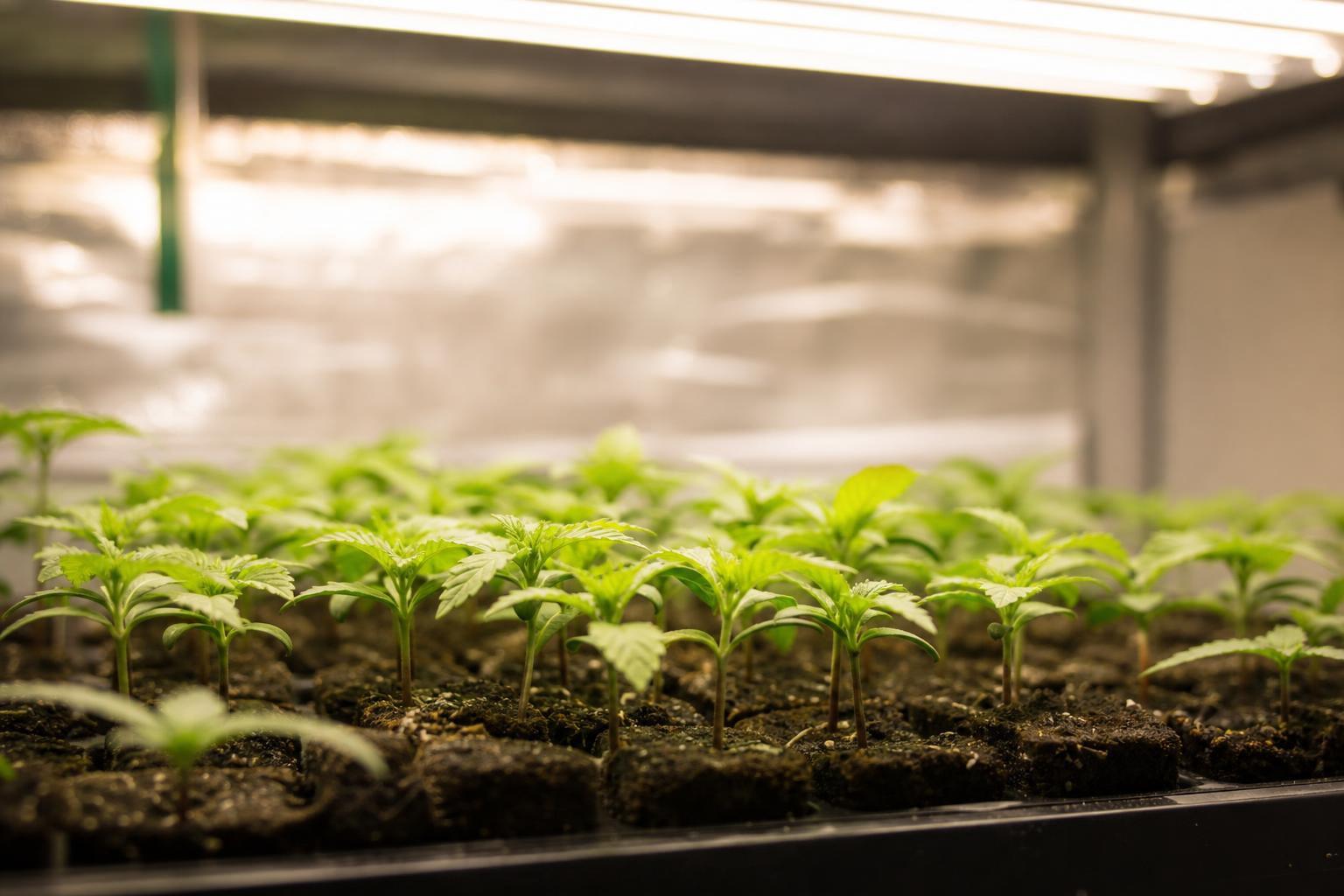
Healthy cannabis seedlings under correct PPFD show:
Short, stocky stems with tight internode spacing
Vibrant, bright green leaves
Steady development of new leaf sets
No curling, no discoloration, no dramatic stretching
How to Hit the Right PPFD for Cannabis Seedlings
Dim Your Fixture
This is the most important practical step. A 720W LED fixture at 18 inches delivers far more than 300 µmol/m²/s. Most full-power LEDs produce 600+ µmol/m²/s at 12 inches, which is roughly double what seedlings can handle.
Dim to 30 to 50% of full output for the first two weeks, then ramp toward 80 to 100% as plants transition into vegetative growth. Most modern commercial LED fixtures, including dedicated propagation bars like the Infinity XE, include dimming controls for exactly this purpose.
One equipment reviewer’s complaint captures the common mistake perfectly: “The light output is so strong, giving my seedlings light burn. Without an accurate PAR meter, which I don’t have, a grower will burn up plants.”
Raise the Light
If your fixture doesn’t dim (or doesn’t dim low enough), increase the distance between the light and the canopy. Every additional inch reduces PPFD meaningfully at seedling level. Growers who recently transitioned from HPS often underestimate how much more efficient LEDs are at delivering photons per watt, leading to the same burn problem.
Measure at Canopy Level, Multiple Points
A PAR meter (or quantum sensor) measures PPFD directly. When using one:
Take readings at the canopy surface, not at the light fixture
Check multiple points across the tray, not just the center
Look for uniformity, since edge plants getting 100 µmol/m²/s while center plants get 300 will produce inconsistent seedlings
A single center-point reading that looks perfect doesn’t mean the whole tray matches. PPFD uniformity across the growing area matters just as much as the average number. For more on measurement technique, read our guide on how to measure PPFD.
Read the Plant First, Meter Second
Meters are tools, not oracles. Environmental conditions shift, genetics vary, and a reading of 200 µmol/m²/s might be too much for a stressed clone but perfect for a vigorous seedling from seed. Train yourself to read the visual indicators described above and use the meter to calibrate your eye, not replace it.
PPFD Across the Full Cannabis Lifecycle
Seedling PPFD is just the starting point. Here’s how intensity targets progress through the full growth cycle:
Growth Stage | PPFD Range (µmol/m²/s) | Typical DLI (mol/m²/day) |
|---|---|---|
Seedling | 100–300 | 6–16 |
Vegetative | 300–600 | 20–40 |
Flowering | 600–1,000+ | 35–50+ |
Research from Frontiers in Plant Science found that aboveground biomass was 1.3 to 1.5 times higher in high-PPFD treatments versus low-PPFD treatments, with the most economically relevant metric, inflorescence dry weight, showing a 1.6x increase. Cannabis is exceptionally tolerant of high light intensity at maturity. The challenge is getting there gradually.
Higher PPFD in later stages also requires the environment to keep up. Temperature, VPD, and CO₂ availability set the ceiling for what PPFD can deliver. Pushing 1,000 µmol/m²/s in a hot, poorly ventilated room does not produce high yield. It produces stressed plants.
For a complete stage-by-stage breakdown, see our cannabis PPFD guide.
Spectrum Matters Too
Not all light at the same PPFD is equal. Full-spectrum white LEDs distribute energy across the entire 400 to 700 nm range, providing a balanced photon diet that mimics sunlight. Older red/blue “blurple” fixtures concentrate energy in narrow bands, which can overdrive certain photoreceptors while starving others.
For seedlings, full-spectrum white is the current industry standard. It supports balanced morphology (compact growth, strong stems) and provides a better working environment for cultivators who need to inspect young plants for health issues. Seedlings grown under narrow-band lighting sometimes show abnormal leaf coloration that makes it harder to diagnose stress.
Environmental Co-Factors That Interact with PPFD
Chasing a PPFD number without managing the surrounding environment is a common trap. Seedling PPFD targets of 100 to 300 µmol/m²/s assume reasonable conditions:
Temperature: 72 to 78°F (22 to 26°C) at canopy level
Humidity: 65 to 70% relative humidity for seedlings (high VPD stress amplifies light stress)
Airflow: Gentle circulation to strengthen stems without drying out soil
Nutrition: Light feeding only; seedlings in the first week often need nothing beyond what’s in the starter medium
As one cultivation resource puts it: high PPFD in a hot, humid room does not produce high yield. PPFD is just one factor. Consider temperature, humidity, and nutrition alongside it for a complete approach.
Frequently Asked Questions
What PPFD should I use for cannabis seedlings in the first week?
Start at 100 to 150 µmol/m²/s for the first three days after germination. Once cotyledons are fully open and the first true leaves begin to appear, you can increase to 150 to 200 µmol/m²/s. Some experienced growers start as low as 80 µmol/m²/s and ramp from there.
Can LED grow lights burn cannabis seedlings?
Yes. Modern LEDs are extremely efficient at converting watts to photons. A full-power LED fixture at 12 to 18 inches can easily deliver 600+ µmol/m²/s, roughly double what seedlings tolerate. Always dim to 30 to 50% or raise the fixture height during the seedling stage.
How do I calculate DLI from my PPFD reading?
Use this formula: DLI = PPFD × hours of light × 0.0036. For example, 200 PPFD under an 18-hour light schedule gives you 200 × 18 × 0.0036 = approximately 13 mol/m²/day, which is right in the sweet spot for cannabis seedlings.
What’s the difference between PPFD and DLI?
PPFD is the intensity of light at a given moment, measured in µmol/m²/s. DLI is the total accumulated light dose over an entire day, measured in mol/m²/day. PPFD is a snapshot; DLI is the whole picture. Both are useful, and you need both to set up a seedling environment correctly.
Should I use 18/6 or 24/0 light schedule for cannabis seedlings?
The standard recommendation is 18 hours on, 6 hours off. This provides plenty of light for growth while allowing a dark period. Running 24/0 increases DLI without increasing PPFD, which means you can overshoot your daily light target even at moderate intensity. The 18/6 schedule is simpler to manage and widely supported.
How do I know if my seedling PPFD is too low?
The most obvious sign is stretching: tall, thin stems with wide gaps between nodes. Seedlings may also show pale, underdeveloped leaves and struggle to support their own weight. If you see these signs, increase PPFD by 50 µmol/m²/s at a time until growth tightens up.
Do I need a PAR meter to grow cannabis seedlings?
You don’t strictly need one, but it makes life easier. A PAR meter removes guesswork from dimming and height adjustments. Without one, rely on the visual signs described above: compact growth and bright green leaves mean you’re in the range. If buying a meter isn’t feasible, manufacturer spec sheets and hanging-height charts provide rough starting points.
When should I increase PPFD beyond 300 µmol/m²/s?
Once seedlings have three to four sets of true leaves, a well-established root system, and are ready for transplant into their vegetative container, you can begin pushing into the 300 to 600 µmol/m²/s vegetative range. This transition typically happens around days 14 to 21, depending on genetics and growing conditions.
Building a propagation space or scaling up your seedling program? Schedule a free consultation with a Thrive lighting specialist to match fixture selection, dimming protocols, and layout to your specific grow.