Grow Light HVAC Load: How to Calculate and Reduce It
Learn how to calculate grow light HVAC load, size cooling correctly, and reduce heat and energy costs with efficient LED fixtures. Read the guide.
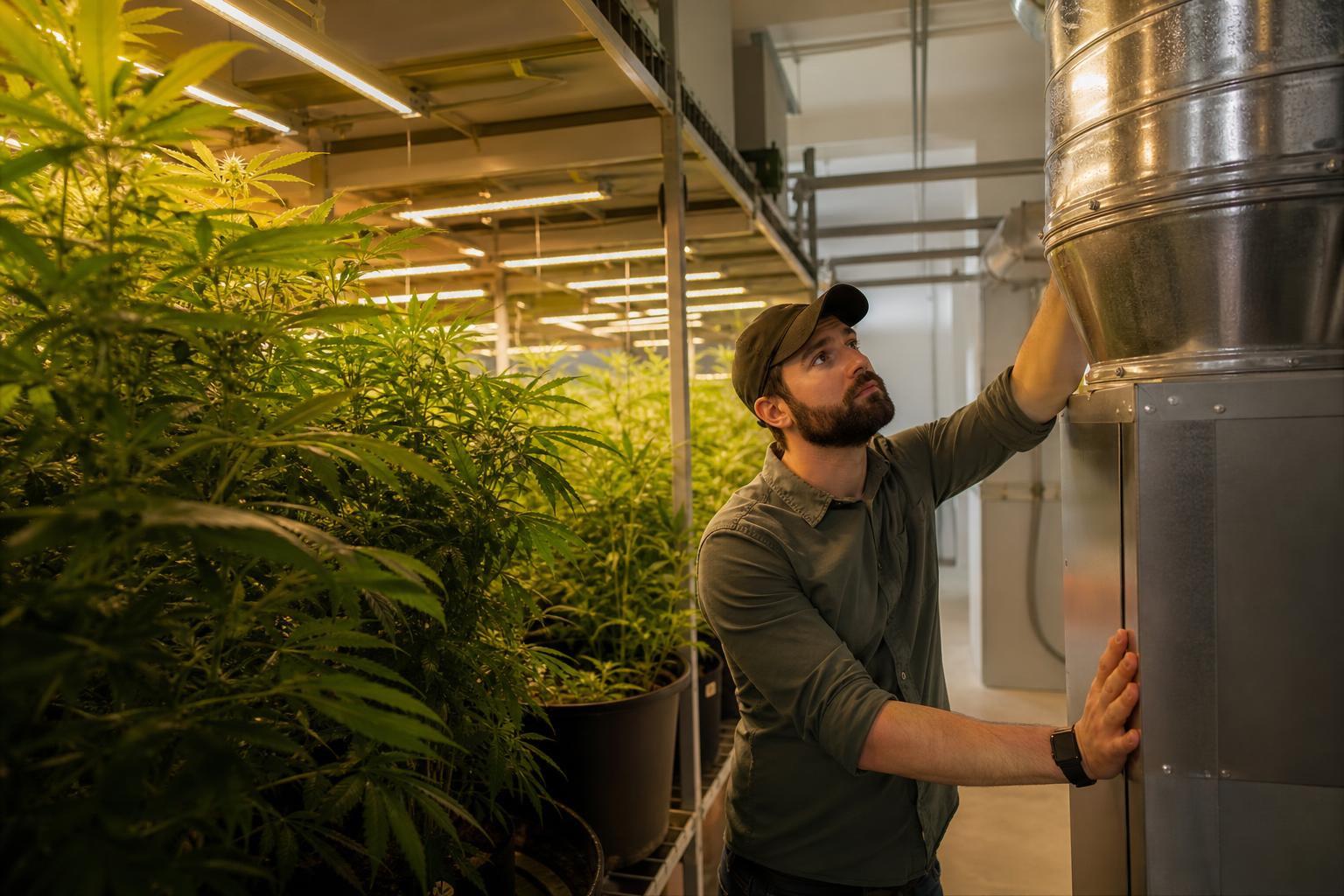
TL;DR: Grow light HVAC load is the thermal energy your horticultural lighting adds to a grow space that your cooling system must remove. Every watt at the wall generates 3.412 BTU/hr of heat, and lighting accounts for 70 to 85% of a grow room’s total cooling load. Understanding this number, and the split between sensible heat and latent moisture load, is the foundation for sizing HVAC correctly and controlling operating costs.
What Is Grow Light HVAC Load?
Grow light HVAC load is the amount of heat energy that horticultural lighting introduces into a controlled-environment grow space, measured in BTU/hr or tons of cooling. It represents the thermal burden your HVAC system must overcome to maintain target temperature and humidity setpoints.
The physics here are simple and non-negotiable. Every watt of electrical power consumed by a light fixture produces 3.412 BTU/hr of heat. This is not an approximation or a rule of thumb. It is a thermodynamic constant. Whether the fixture is LED, HPS, or fluorescent, a watt at the wall creates the same amount of thermal energy.
What makes grow light HVAC load different from, say, the lighting load in an office building is its sheer scale relative to the space. In an office, lights are a minor contributor to the cooling equation. In a grow room, they dominate it.
Explore commercial LED grow lights designed to minimize thermal load while maximizing photon output.
Why Grow Light HVAC Load Matters
The financial stakes are significant. Lighting and HVAC together account for close to 90% of energy use in a typical indoor grow, with HVAC alone responsible for roughly half of a facility’s total electricity consumption. Energy costs can represent as much as 50% of overall production costs for indoor operations.
On the capital expenditure side, a purpose-built cannabis grow HVAC system typically costs between $215 and $350 per square foot installed. For a 5,000 square foot canopy, that means $300,000 or more just for climate control equipment. Every watt of unnecessary heat from your lighting forces you to buy more HVAC capacity upfront and pay more to run it every month.
Lighting is the single largest contributor to cooling load in any indoor grow. Multiple engineering analyses confirm that horticultural lighting accounts for 70 to 85% of the total cooling requirement in a grow room. It is not uncommon for these spaces to require 80 watts per square foot, with roughly half of that load attributed to the HVAC and dehumidification equipment serving the space.
For facility designers and operators evaluating greenhouse energy savings, the grow light HVAC load is where the biggest efficiency gains hide.
Sensible vs. Latent Load: The Distinction That Changes Everything
Most content about grow light heat stops at temperature. That misses half the problem.
Sensible Load
Sensible heat is the heat you can measure with a thermometer. It is the straightforward temperature increase caused by your fixtures running. Grow lights account for the bulk of the sensible cooling load in a cultivation space, and it is the easier half of the equation to understand and manage.
Latent Load
Latent load is moisture. Plants transpire water vapor into the air, and because transpiration is an evaporative process, it actually converts some of the sensible heat from your lights into latent heat. The air temperature drops slightly, but the moisture content of the air rises. This is what makes grow room HVAC fundamentally different from comfort cooling.
Standard commercial buildings operate at a sensible heat ratio (SHR) between 0.75 and 0.85, meaning most of the cooling work is simple temperature reduction. Indoor cultivation spaces operate at an SHR of 0.50 to 0.60 because of massive plant transpiration. In plain terms, nearly half of the cooling work in a grow room is moisture removal, not temperature control. Standard comfort AC units are not built for this ratio and will fail to maintain proper conditions.
This matters directly for VPD management, which depends on the relationship between temperature and humidity staying within a tight range.
The Lights-Off Transition Problem
One of the most dangerous moments in a grow room’s daily cycle happens when the lights turn off. The sensible load from lighting drops to zero instantly. The thermostat responds by shutting down the cooling system because there is no temperature call. But the plants do not stop transpiring immediately. Moisture continues pouring into the air while the system that would normally remove it sits idle.
This mismatch between the disappearing sensible load and the lingering latent load is a primary cause of humidity spikes during dark periods. Humidity spikes cause mold, powdery mildew, and botrytis. Practitioners on forums consistently identify this lights-off transition as one of the hardest operational problems to solve, particularly for facilities using standard residential or light commercial AC equipment that cannot decouple dehumidification from cooling.
For a deeper look at this challenge, see this guide on humidity control in cannabis facilities.
How to Calculate Grow Light HVAC Load
The Core Formula
The basic calculation is straightforward:
BTU/hr from lighting = Total fixture input watts × 3.412
Use the actual draw measured at the wall (check your driver label or product specifications), not the advertised marketing wattage. This is a common source of error.
To convert to tons of cooling: 1 ton = 12,000 BTU/hr
Worked Example
Consider a flower room running 26,000 watts of LED lighting:
- Lighting sensible load: 26,000 W × 3.412 = 88,712 BTU/hr
- Add a 20% miscellaneous allowance for drivers, fans, and envelope heat: 88,712 × 1.20 = 106,454 BTU/hr
- In tons: 106,454 ÷ 12,000 = approximately 8.9 tons of cooling from lighting alone
This does not include the latent load from plant transpiration, occupant heat (roughly 400 BTU/hr per person), or ventilation infiltration. A complete load calculation requires all of those inputs.
Quick Reference Numbers
For smaller operations: a 10×10 room running 2,000 to 3,000 watts of LED lighting requires approximately 8,000 to 12,000 BTU/hr of cooling from lighting alone.
At commercial scale: a 1,000-light cannabis facility typically requires between 220 and 350 tons of total HVAC cooling capacity, depending on lighting technology and building envelope.
The Safety Buffer
Multiply your total equipment wattage by 3.412 to get BTU/hr, then add a 20 to 30% safety buffer. For a sealed room with no passive ventilation, use 30%. This buffer accounts for dehumidifier heat rejection, ballast and driver losses, envelope gains, and the inevitable gap between design conditions and real-world operation.
For more detail on right-sizing your cooling, read about how much HVAC you need to cool LED lights.
LED vs. HPS: What Actually Changes the Grow Light HVAC Load
The Thermodynamic Truth
A 1,000W LED fixture and a 1,000W HPS fixture both produce exactly 3,412 BTU/hr of heat. Watt for watt, they are identical from a thermal standpoint. Every watt of electricity eventually becomes heat regardless of the source.
The advantage of LED is not that it produces less heat per watt. It produces more photons per watt. That means you need fewer total watts to achieve the same PPFD at the canopy, which means less total heat dumped into the room at equivalent light levels.
Quantified Differences
Data from Seattle City Light shows that flower room HPS fixtures at 1,100 watts were replaced by LEDs at 580 watts, a 47% reduction in input power for the same useful light output. That 47% reduction in wattage translates directly to a 47% reduction in grow light HVAC load.
The heat distribution pattern also differs. LEDs emit heat convectively (upward, away from the canopy), while HPS fixtures radiate heat downward toward the plants. This matters for plant stress and leaf surface temperature, but it does not change the total BTU the HVAC system must remove.
Growers considering the switch should read this comparison of LED vs. HPS lighting economics to understand the full payback picture.
Common Mistakes in Grow Light HVAC Load Calculations
These errors show up repeatedly in facility designs and practitioner discussions. They are worth calling out because each one leads to undersized HVAC, temperature control failures, or unexpected operating costs.
1. Omitting Dehumidifier Heat
The single most common error in grow room HVAC sizing is forgetting that dehumidifiers are also electrical equipment that rejects heat into the room. For a space already running hot from LED fixtures, that omission reliably produces an undersized AC unit that loses control of temperature during peak afternoon hours.
2. Using Marketing Watts Instead of Wall Watts
Fixture manufacturers sometimes advertise an LED by its “equivalent” wattage or theoretical maximum rather than its actual draw. Always use the measured wall watts from the driver label or published product specifications. The difference between a marketed “1000W equivalent” and the actual 650W draw is a 35% error in your HVAC calculation.
3. Treating LED Rooms as “No Heat” Rooms
LEDs produce less total heat than HPS at the same PPFD, but they do not eliminate heat. Every watt consumed still becomes 3.412 BTU/hr. Practitioners on Reddit report that first-time LED growers frequently undersize their HVAC because they expect LEDs to run “cool,” then struggle with temperature control once the canopy fills in and transpiration ramps up.
4. Ignoring the Lights-Off Transition
As discussed above, when lights shut off, the cooling demand falls but moisture stays high. A grower on THCFarmer forums running 12 HPS lights on a 4-ton unit reported having to shut off two lights just to get temperatures under control, eventually deciding to add a mini-split. The root cause in many cases like this is not total HVAC capacity but the inability to handle the transition between photoperiods.
5. Sizing Based on Old HPS Experience
If you are replacing HPS with LED, you cannot simply carry over your old HVAC sizing assumptions. The lower wattage means less sensible heat, which sounds good, but it also means less natural drying of the air. The latent load from plant transpiration stays roughly the same, and without the excess heat from HPS to help drive moisture out, humidity problems can actually get worse after an LED retrofit.
How to Reduce Grow Light HVAC Load
Choose Higher-Efficacy Fixtures
More photons per watt means fewer watts needed to hit your PPFD target, which directly shrinks the thermal load. ASHRAE 90.1-2022 now regulates horticultural lighting by efficacy, requiring 1.9 µmol/J for large indoor grow buildings and 1.7 µmol/J below the 40 kW threshold. Meeting or exceeding these efficacy standards is the most direct way to reduce your grow light HVAC load.
Use Remote or Centralized Driver Architecture
LED drivers are typically between 89% and 95% efficient, so they account for 5 to 11% of the total heat a fixture produces. That sounds small, but it adds up fast at scale. A standard 1,000W LED produces about 3,400 BTU/hr of heat, with the driver contributing roughly 272 BTU/hr.
Moving drivers out of the grow environment and into a separate electrical room eliminates that driver heat from the cultivation space entirely. A Thrive Agritech white paper on driver strategies for vertical farming found that relocating drivers could reduce the canopy’s heat load by 15,000W, or more than 50,000 BTU/hr, in a typical multi-tier installation.
There is an additional efficiency benefit: HVAC systems operate more efficiently conditioning a dry space like an electrical room than a humid grow space. Centralizing drivers can reduce total energy consumption by an additional 3 to 4%.
See how OptiDrive remote power architecture moves driver heat out of the grow space while simplifying electrical infrastructure.
Right-Size HVAC to the Actual Load
Oversized HVAC wastes capital. Undersized HVAC loses control of the environment. The only way to get it right is to calculate the grow light HVAC load accurately (using wall watts, not marketing specs), account for both sensible and latent components, add the appropriate safety buffer, and select equipment rated for the low sensible heat ratios that grow rooms demand.
Efficient fixtures reduce the load you have to remove, which is why fixture selection and HVAC sizing are linked decisions that should happen together, not sequentially. Facilities looking to reduce operating expenses should treat lighting and climate control as a single, integrated design problem.
Grow Light HVAC Load Quick Reference Table
| Scenario | Input Watts | BTU/hr (Lights Only) | Tons of Cooling (Lights Only) |
|---|---|---|---|
| Small room, 2,000W LED | 2,000 | 6,824 | 0.57 |
| Small room, 3,000W LED | 3,000 | 10,236 | 0.85 |
| Mid-size room, 10,000W LED | 10,000 | 34,120 | 2.84 |
| Commercial flower room, 26,000W LED | 26,000 | 88,712 | 7.39 |
| Large facility, 100,000W LED | 100,000 | 341,200 | 28.4 |
Note: These figures represent the lighting sensible load only. Add 20 to 30% for miscellaneous heat sources and calculate latent load separately based on plant count, growth stage, and irrigation volume.
Frequently Asked Questions
How do you calculate the HVAC load from grow lights?
Multiply the total input wattage of all fixtures (measured at the wall, not marketing specs) by 3.412 to get BTU/hr. Add a 20 to 30% buffer for driver losses, dehumidifier heat rejection, and envelope gains. Divide by 12,000 to convert to tons. For a detailed walkthrough, see how much HVAC you need to cool LED lights.
Do LED grow lights produce less HVAC load than HPS?
Per watt at the wall, no. Both produce 3.412 BTU/hr per watt. But LEDs produce more photons per watt, so you need fewer total watts to achieve the same light level. That means less total heat in the room, often 40 to 50% less, at equivalent PPFD.
Why does my grow room get humid when the lights turn off?
When lights shut off, the sensible heat load disappears and the thermostat stops calling for cooling. But plants continue transpiring moisture for a period afterward. Without active dehumidification running independently of the cooling call, humidity spikes rapidly. This is the primary cause of dark-period mold and mildew issues.
What percentage of a grow room’s cooling load comes from lighting?
Lighting accounts for 70 to 85% of the total cooling load in most indoor grow rooms. It is by far the single largest contributor and the most impactful variable you can change through fixture selection and efficiency improvements.
What is sensible heat ratio (SHR) and why does it matter for growers?
SHR is the proportion of total cooling load that is temperature-related (sensible) versus moisture-related (latent). Standard buildings have an SHR of 0.75 to 0.85. Grow rooms run at 0.50 to 0.60, meaning nearly half the cooling work is dehumidification. Standard comfort AC cannot handle this ratio effectively.
Does moving LED drivers out of the grow room reduce HVAC load?
Yes. LED drivers produce 5 to 11% of a fixture’s total heat. At commercial scale, relocating them to a separate electrical room can remove tens of thousands of BTU/hr from the grow space. HVAC systems also run more efficiently conditioning a dry electrical room than a humid cultivation environment.
How much HVAC does a 1,000-light cannabis facility need?
Total HVAC cooling capacity for a 1,000-light facility typically falls between 220 and 350 tons, depending on lighting technology, building envelope, geographic location, and whether drivers are co-located with fixtures or housed remotely.
What is the ASHRAE efficacy requirement for grow lights?
ASHRAE 90.1-2022 requires a minimum photosynthetic photon efficacy of 1.9 µmol/J for indoor grow buildings above the 40 kW lighting threshold, and 1.7 µmol/J below it. Higher-efficacy fixtures directly reduce the grow light HVAC load by delivering the same photon output at lower wattage.
Ready to right-size your lighting and reduce your facility’s thermal load? Talk to a lighting expert for a free consultation on fixture selection, HVAC load impact, and project design.