Cucumber DLI Greenhouse: 2026 Targets & How to Calculate
Learn the Cucumber DLI Greenhouse range (20–30 mol·m⁻²·d⁻¹), the DLI formula, and how to size supplemental PPFD by deficit. Calculate your gap today.
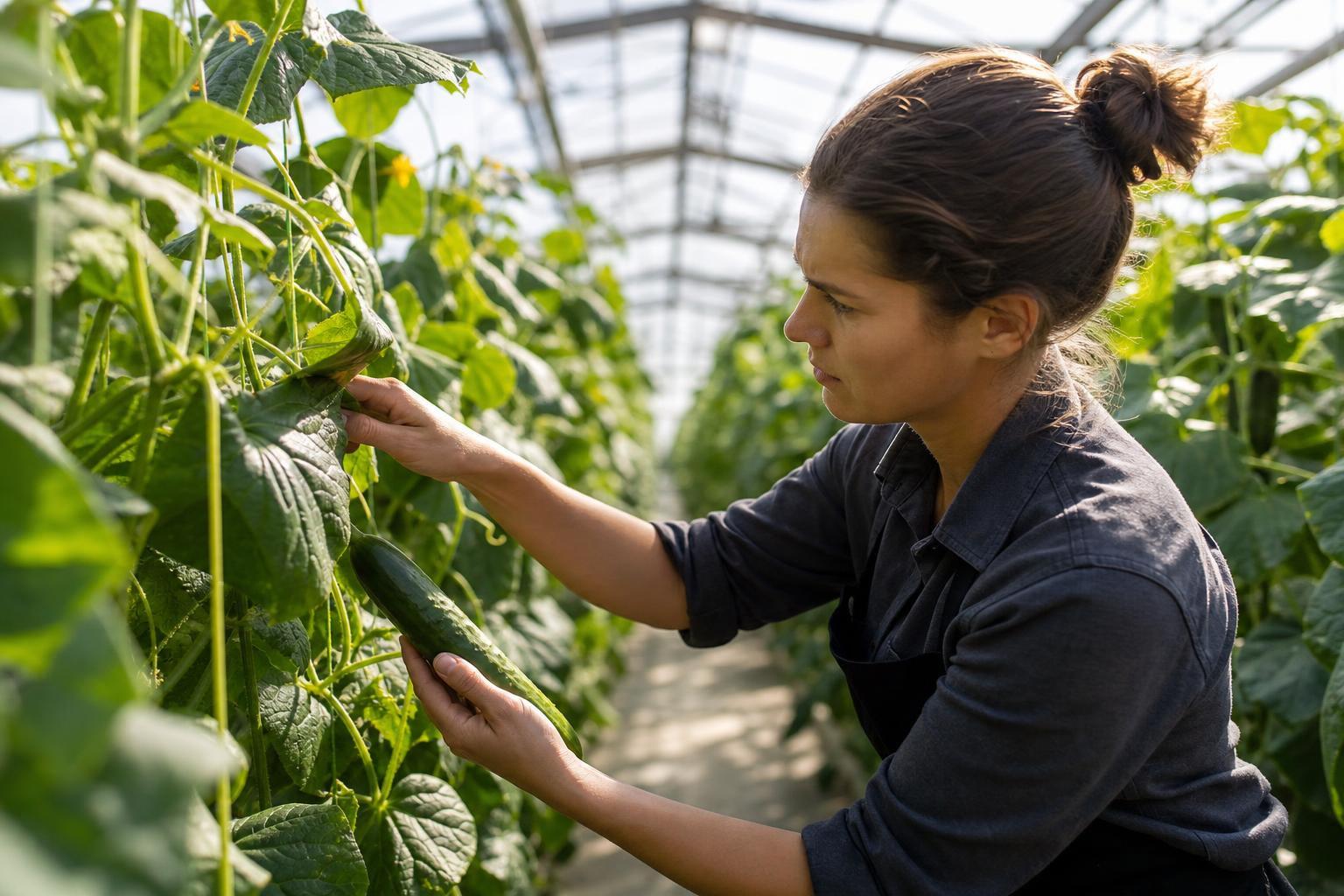
Cucumber DLI in a Greenhouse: Definition, Target Range, and How to Calculate It
TL;DR
Greenhouse cucumbers need a daily light integral (DLI) of 20 to 30 mol·m⁻²·d⁻¹ at the crop canopy for productive fruiting. Calculate DLI using the formula: PPFD × hours × 0.0036. Greenhouse glazing cuts outdoor sunlight by 35% to 65%, so light at the cucumber canopy is far less than outdoor measurements suggest. The practical question for any cucumber greenhouse is not total light demand but the DLI deficit that supplemental lighting must fill.
What Does Cucumber DLI Mean in a Greenhouse?
DLI stands for daily light integral. It measures the total photosynthetically active light (PAR, 400 to 700 nm) that reaches a square meter of cucumber canopy over 24 hours. The unit is mol·m⁻²·d⁻¹.
PPFD (photosynthetic photon flux density) tells you light intensity at any given moment, measured in µmol·m⁻²·s⁻¹. DLI is the full day’s accumulation of that intensity. Practitioners on Reddit describe it as the difference between how hard it is raining right now versus how much total rain fell by the end of the day. That analogy holds up technically: PPFD is the rate, DLI is the daily total.
For greenhouse cucumber production, DLI is the crop’s daily light budget. It answers whether the crop received enough usable photons over the day, not just whether the greenhouse looked bright at noon. This distinction matters because cucumbers are high-light fruiting crops that need substantially more daily light than leafy greens, herbs, or microgreens.
Need a professional assessment of your greenhouse light levels? Talk to a lighting expert.
What DLI Do Greenhouse Cucumbers Need?
For commercial fruiting cucumber production, the working target is 20 to 30 mol·m⁻²·d⁻¹. Around 15 mol·m⁻²·d⁻¹ is commonly treated as a lower production boundary. About 30 mol·m⁻²·d⁻¹ is often cited as a high-performance optimum.
These numbers are not universal for all growth stages.
| Crop Stage | DLI Target | Notes |
|---|---|---|
| Seedlings and propagation | 5 to 10 mol·m⁻²·d⁻¹ | Much lower than fruiting targets. One controlled-environment study found optimal seedling DLI near 6.35 mol·m⁻²·d⁻¹. |
| Production (fruiting) | 20 to 30 mol·m⁻²·d⁻¹ | Standard working range for commercial greenhouse cucumbers. |
| Lower boundary | ~15 mol·m⁻²·d⁻¹ | Below this, expect yield drops, weaker growth, and fruit quality problems. |
| High-performance target | ~30 mol·m⁻²·d⁻¹ | Often cited as optimum, but economics, CO₂, temperature, and cultivar affect the real breakeven. |
One important detail that many generic DLI guides miss: these targets refer to total DLI at the crop canopy, not the amount a fixture must provide. In a greenhouse, sunlight contributes part of this budget. Supplemental lighting only needs to cover the gap.
Practitioners on Reddit and in grower forums frequently mix up total DLI and supplemental DLI, which leads to oversized lighting systems and unnecessary electricity costs. A cucumber greenhouse needing 25 mol total does not mean the fixtures must deliver 25 mol. For a deeper breakdown, see our DLI formula and conversion guide.
How to Calculate Cucumber DLI from PPFD
The formula is straightforward:
DLI = PPFD × photoperiod hours × 0.0036
Where:
- DLI is in mol·m⁻²·d⁻¹
- PPFD is in µmol·m⁻²·s⁻¹
- Photoperiod is hours of light per day
- 0.0036 converts micromoles per second into moles per day
This conversion logic follows the same approach published in university supplemental lighting worksheets.
Worked example:
A cucumber crop receives an average of 400 µmol·m⁻²·s⁻¹ for 16 hours:
400 × 16 × 0.0036 = 23.0 mol·m⁻²·d⁻¹
That puts the crop within the 20 to 30 target range. If the average intensity drops to 250 µmol·m⁻²·s⁻¹ for the same 16 hours:
250 × 16 × 0.0036 = 14.4 mol·m⁻²·d⁻¹
Now the crop is below the 15 mol minimum, and production problems will appear.
Why Greenhouse Transmission Changes Everything
Outdoor DLI is not crop-canopy DLI. This is one of the most overlooked points in greenhouse cucumber lighting.
Greenhouse glazing, structural framing, equipment, condensation, and dirt all reduce the light that reaches the crop. Published transmission values range from 35% to 80% depending on covering material, age, orientation, and cleanliness. Michigan State University Extension places typical greenhouse transmission at 40% to 65%.
That means a location with 15 mol·m⁻²·d⁻¹ outdoor DLI might deliver only 6 to 10 mol inside the greenhouse. In cloudy northern winters, MSU Extension reports that indoor greenhouse DLI can drop to 2 to 4 mol·m⁻²·d⁻¹, drastically below cucumber requirements.
A cucumber greenhouse in a northern winter is almost never meeting the 20 to 30 mol target from sunlight alone. The real question is how much of that target sunlight supplies at the canopy and how much must come from supplemental LEDs. As one grower in a Reddit greenhouse discussion put it: “What’s your DLI inside the greenhouse on cloudy days?” That is the right diagnostic starting point. Before discussing fixture count, measure the deficit. For a broader look at seasonal planning, our guide on supplemental lighting needs walks through the full evaluation process.
How to Calculate Supplemental DLI for Greenhouse Cucumbers
This is the calculation that turns a glossary definition into a practical sizing tool.
Step 1: Choose your cucumber target DLI.
For fruiting production, start with 20 to 30 mol·m⁻²·d⁻¹.
Step 2: Estimate outdoor DLI.
Use local DLI maps, weather station data, or your greenhouse control system.
Step 3: Estimate greenhouse transmission.
Measure it with inside and outside PPFD readings on a sunny day, or use a conservative estimate (50% to 60% is a reasonable starting assumption).
Step 4: Calculate inside natural DLI.
Inside natural DLI = outdoor DLI × transmission factor.
Step 5: Calculate supplemental DLI needed.
Supplemental DLI = target cucumber DLI, minus inside natural DLI.
Step 6: Convert supplemental DLI to PPFD.
Supplemental PPFD = supplemental DLI ÷ light hours ÷ 0.0036.
Worked Example
- Target cucumber DLI: 25 mol·m⁻²·d⁻¹
- Outdoor winter DLI: 12 mol·m⁻²·d⁻¹
- Greenhouse transmission: 60%
- Inside natural DLI: 12 × 0.60 = 7.2 mol·m⁻²·d⁻¹
- Supplemental DLI needed: 25 - 7.2 = 17.8 mol·m⁻²·d⁻¹
- Supplemental light hours: 16
- Required supplemental PPFD: 17.8 ÷ 16 ÷ 0.0036 = 309 µmol·m⁻²·s⁻¹
The fixture does not need to deliver 25 mol of DLI. It needs to deliver about 18 mol, and the sun handles the rest. The question is never “How much light do cucumbers need?” in isolation. The real greenhouse question is “How much of that light does the sun already supply at the canopy, and what deficit remains?”
Explore greenhouse supplemental top lights built for commercial DLI targets.
PPFD Needed for Common Cucumber DLI Targets
This table shows the average PPFD required to reach a given cucumber DLI target across different photoperiods. Values assume uniform delivery over the entire light period.
| Target DLI (mol·m⁻²·d⁻¹) | 12 h | 14 h | 16 h | 18 h | 20 h |
|---|---|---|---|---|---|
| 20 | 463 µmol | 397 µmol | 347 µmol | 309 µmol | 278 µmol |
| 25 | 579 µmol | 496 µmol | 434 µmol | 386 µmol | 347 µmol |
| 30 | 694 µmol | 595 µmol | 521 µmol | 463 µmol | 417 µmol |
These are total PPFD values. In a greenhouse, the supplemental fixture only needs to provide the deficit portion. If sunlight already delivers 8 mol and the target is 25, the lighting system covers 17 mol.
A 2025 commercial-scale cucumber study targeted 27.5 ± 2.5 mol·m⁻²·d⁻¹ using supplemental light averaging 250 µmol·m⁻²·s⁻¹ at the canopy over an 18-hour photoperiod. The LED treatment in that study consumed 40% less energy than HPS while maintaining photosynthetic performance. Results like these validate the DLI deficit approach at real commercial scale.
When comparing fixture output, look at PPFD delivery at the canopy, not wattage. Our walkthrough on comparing LEDs to HPS covers this common mistake in detail.
What Happens When Cucumber DLI Is Too Low?
Low DLI does not just reduce yield. It changes the shape and balance of the entire cucumber crop. When greenhouse cucumbers fall below about 15 mol·m⁻²·d⁻¹ consistently, a recognizable pattern of symptoms appears:
- Larger, thinner leaves with less structural integrity
- Elongated internodes that make plants leggy and weak
- Fewer flowers and delayed flower initiation
- Shorter, paler fruit with reduced skin chlorophyll
- Lower fruit quality and shorter shelf life
- Reduced root and shoot growth
- Possible root decline when the plant cannot support both vegetative growth and fruit load
These are documented in cucumber agronomy research and they are not subtle. A cucumber crop running at 8 to 10 mol looks fundamentally different from one running at 25. The shift toward weak, vegetative growth affects current yield, harvest timing, labor efficiency, and marketable quality.
Community discussions on Reddit reflect this reality. Growers who try to grow cucumbers alongside lettuce or herbs quickly discover the mismatch. One commenter in a hydroponics thread warned that fruiting crops like cucumbers and tomatoes need far more DLI than leafy greens and should never be designed around a generic “vegetable” lighting level. The same light plan that works for lettuce will starve a cucumber crop.
Can Cucumbers Get Too Much DLI?
More light is not automatically better. At some point, additional photons stop converting into profitable yield. Electricity costs go up. Cooling load rises. Water and nutrient demand increases. And at very high intensities, photo-oxidative stress becomes a risk.
The practical ceiling for most commercial greenhouse cucumber operations falls somewhere around 30 mol·m⁻²·d⁻¹. Beyond that, the economics shift, and diminishing returns set in. The best cucumber DLI target is not the highest number you can afford. It is the DLI that produces profitable yield under your electricity rate, crop price, greenhouse transmission, CO₂ strategy, and climate-control capacity.
Where and How to Measure Cucumber DLI in a Greenhouse
If the greenhouse “looks bright,” that does not mean cucumbers are receiving enough DLI. The human eye is a poor judge of plant-useful light. Lux, lumens, and foot-candles measure human visual brightness, not photosynthetic photon delivery. These metrics are unreliable for crop decisions.
Use a PAR or PPFD sensor and measure at the crop canopy. Not at fixture height, not at the greenhouse peak, but where the cucumber leaves actually are. For a full overview of sensor types and placement strategies, see our guide on measuring DLI in greenhouses.
Key measurement practices:
- Take readings at multiple locations across the greenhouse, not just one central spot
- Measure on cloudy days, not only sunny ones (the deficit is what drives lighting design)
- Recheck as canopy height changes through the season
- For commercial systems, use integrated sensors tied to a controller so supplemental lights run only when natural PPFD falls below a threshold
Growers on Reddit frequently ask whether small LED bars add meaningful photons to a greenhouse. The answer depends entirely on measurement. A grower on the Oregon Coast discussed planning LED bars for winter DLI support and asked about automatic intensity controls, IP65-rated fixtures, and PAR sensors. The questions reflect the real user concern: how to control lights economically in a humid greenhouse environment. Without canopy-level PPFD data, any fixture choice is a guess.
Why Top-Canopy DLI Is Not the Whole Story
Cucumber DLI in a greenhouse is usually discussed as a single number at the top of the canopy. But cucumbers are tall, layered vine crops, especially in high-wire training systems. The upper canopy shades lower leaves, and those lower leaves lose photosynthetic capacity as light drops off.
Research from Wageningen University found that substituting 33% of top light with intracanopy light increased fresh fruit yield by an average of 17% across cucumber and tomato crops. The yield response was larger at higher supplemental intensities. That finding makes a critical point: a good DLI number at the top of the crop does not guarantee useful light deeper in the canopy.
For high-wire cucumbers, canopy management (pruning, leaf removal, plant spacing) and light distribution matter as much as the headline DLI target. Training system, row orientation, and fixture placement all influence how much light reaches the lower fruiting zone. A greenhouse can hit the right average DLI at the top of the crop and still underlight the lower canopy.
DLI Works with Temperature, CO₂, Humidity, Irrigation, and Nutrition
Cucumber DLI is not a standalone metric. Higher DLI raises photosynthetic potential, but the crop must have adequate CO₂, water, nutrients, and climate control to convert those extra photons into growth.
The interaction with CO₂ is especially significant. Crop agronomy research reports that increasing CO₂ from ambient (about 365 ppm) to 800 ppm can maintain a similar growth rate with 30% less light under low-light conditions. CO₂ enrichment can partially compensate for a DLI deficit, and adding light without adding CO₂ leaves performance on the table. For background on this relationship, see our article on CO₂ in controlled environments.
Higher DLI also increases transpiration, which raises irrigation and humidity management demands. If a grower raises cucumber DLI with supplemental lighting but does not adjust irrigation, EC, pruning, temperature, or humidity, the crop may not convert added light into profitable yield. Adjusting nutrient strategies with LEDs is part of this same conversation.
What Cucumber DLI Means for Supplemental Greenhouse Lighting
For commercial greenhouse operations, cucumber DLI is a planning unit, not just a definition. It tells you whether supplemental lighting is needed, how much, and when.
The decision framework is simple:
- Set a cucumber DLI target based on crop stage and production goals.
- Measure or estimate inside natural DLI across the growing season.
- Calculate the deficit.
- Convert the deficit into required PPFD and run hours.
- Select fixtures based on canopy-level PPFD delivery, not wattage alone.
- Validate with sensors and crop response after installation.
When the DLI deficit is large (common in northern winters), supplemental lighting becomes an economic question, not just an agronomic one. Operating cost, energy rates, greenhouse lighting rebates, HVAC implications, and crop revenue all factor into whether the investment pays back.
Horticulture practitioners in high-latitude regions frame this clearly. One LinkedIn post from a Nordic grower noted that winter DLI can be as low as 0 to 5 mol·m⁻²·d⁻¹, while cucumber needs 20 to 30 mol. That deficit is too large to ignore if year-round production is the goal.
The best cucumber DLI target is not always 30. It is the DLI that produces profitable yield given your electricity rate, crop price, greenhouse structure, and climate-control capacity. Chasing the highest possible DLI without accounting for costs is a fast way to destroy project ROI.
Calculate your cucumber greenhouse DLI gap with a lighting expert.
Frequently Asked Questions
What is the best DLI for greenhouse cucumbers?
For commercial fruiting production, use 20 to 30 mol·m⁻²·d⁻¹ as the practical target range. Around 15 mol·m⁻²·d⁻¹ is a commonly cited minimum. About 30 mol·m⁻²·d⁻¹ is often considered optimal under productive greenhouse conditions. The ideal number depends on cultivar, crop stage, CO₂ level, and economics.
How do you calculate cucumber DLI?
Use the formula: DLI = PPFD × photoperiod hours × 0.0036. For example, 400 µmol·m⁻²·s⁻¹ for 16 hours gives 400 × 16 × 0.0036 = 23.0 mol·m⁻²·d⁻¹.
What PPFD do cucumbers need in a greenhouse?
It depends on the target DLI and photoperiod. To reach 25 mol·m⁻²·d⁻¹, average PPFD would be about 579 µmol for 12 hours, 434 µmol for 16 hours, or 386 µmol for 18 hours. In a greenhouse, sunlight supplies part of this, so supplemental fixtures only need to cover the deficit.
Is 15 DLI enough for cucumbers?
Around 15 mol·m⁻²·d⁻¹ is a lower boundary, not a target. Expect slower growth, fewer flowers, weaker fruit quality, and longer internodes at this level. Commercial operations should aim for 20 to 30 mol·m⁻²·d⁻¹.
Should I measure cucumber DLI outside or inside the greenhouse?
Both are useful, but crop decisions should be based on inside DLI at the cucumber canopy. Greenhouse glazing and structure can reduce outdoor light by 35% to 65%. Outdoor DLI maps are a starting point, not a crop plan.
Can I use lux or lumens to measure cucumber DLI?
Not for serious crop decisions. Lux and lumens describe human visual brightness, not plant-useful photons. Use a PAR/PPFD meter or greenhouse sensors that report µmol·m⁻²·s⁻¹ and calculate DLI from those readings.
Do greenhouse cucumbers always need supplemental lighting?
Not always, but often. Winter production, northern latitudes, cloudy climates, and year-round high-yield operations typically require supplemental light. The right way to decide is to calculate the gap between the cucumber DLI target and the natural DLI reaching the crop inside the greenhouse.
Are cucumbers sensitive to photoperiod?
Cucumbers are generally day-length neutral for flowering, meaning they do not need a specific short-day or long-day signal. However, photoperiod can affect growth habit, flower sex expression in some varieties, and stem quality. DLI is the primary crop energy metric, while photoperiod is the time window used to deliver that energy.